 Goals & Progress


A life plan template that fits on one page
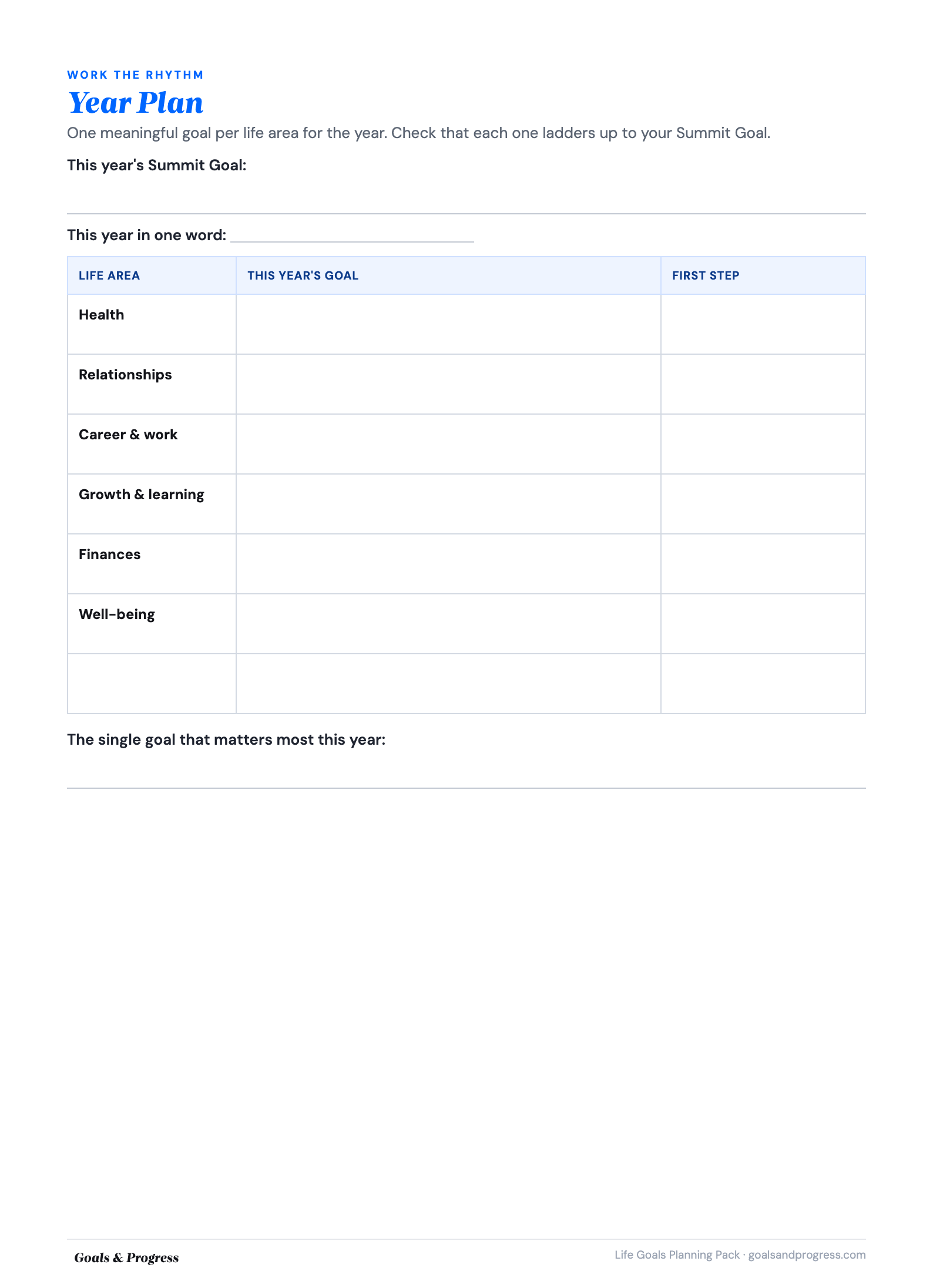
A life plan template is a single structure that holds your long-term direction and the goals you are giving the next twelve months across every part of your life. This one is the Year Plan sheet from the free Life Goals Planning Pack, pulled out as its own page so you can print it right now. It puts your Summit Goal at the top, then asks for one goal and one first step per life area underneath it.
It is built for one person planning their own life, not a team or a department. The horizon is deliberately split: the line at the top carries the five to ten year ambition, and the table below it only asks what happens this year. That split is what keeps a life plan from turning into a wish list you never open again.
Download the printable life plan template.
One page, blank and ready to print. No email address needed.
- A line for your Summit Goal and the year in a word
- Six named life areas plus a blank row for one of your own
- A goal and a first step per area, then the goal that matters most
- A4 and US Letter, plain black and blue on white
Free to use and print as often as you like. Run it again next year.
What is on the sheet
One page, printed in black and blue on white, with every field blank. It reads from the top down, and each part narrows the one above it.
- A line for this year’s Summit Goal, so the long-term ambition sits above everything else on the page.
- A short field for the year in one word, which is easier to remember than a paragraph and works as a filter when a new commitment turns up.
- A three-column table: life area, this year’s goal, and the first step. The named rows are health, relationships, career and work, growth and learning, finances, and well-being, with a blank row for an area of your own.
- A closing line at the foot for the goal that matters most this year, which is the tie-breaker when two areas want the same evening.
How to fill in the life plan template
Work from the top down and keep every entry short enough to remember without looking. Half an hour is usually enough if you already know your Summit Goal.
- Write your Summit Goal first, in a sentence a stranger could picture. If you do not have one yet, stop and do that part properly; the rest of the sheet is only as good as this line.
- Rate each life area from one to ten for how satisfied you feel with it today, in the margin next to the row. The widest gaps between what you care about and where you stand are the areas worth your attention this year.
- Write a goal in two or three areas, not all seven. Focusing on more than three areas at a time is how a year plan becomes a list of things you feel guilty about in March.
- Give every goal you write a first step in the right-hand column, small enough to do in the next week. A year plan with no next action is a description, not a plan.
- Finish with the closing line: the goal that matters most this year. Pick it now, while the year is calm, because that is the answer you will need when two goals collide in a busy week.
Leaving rows blank is a choice. An area with no goal this year is an area you have decided to hold steady, which is a legitimate answer and usually a wiser one than spreading yourself across all seven.
A filled example you can copy
Here is the sheet worked through, so you can see how specific each entry needs to be. Three areas carry a goal, three are left alone on purpose, and the ratings in the second column are the satisfaction scores that decided which three.
Summit Goal (five to ten years)Build a healthier rhythm so I have the energy for work, for my family, and for myself.
| Life area | Today | This year’s goal | First step |
|---|---|---|---|
| Health | 3 | Exercise three times a week by the end of the year, without it depending on motivation | Book two fixed slots in next week’s calendar |
| Relationships | 5 | One protected family block every weekend, kept even in busy months | Agree the slot with the family on Sunday |
| Career and work | 4 | Stop taking meetings after 18:00 so the evenings stay usable | Change the calendar working hours today |
| Growth and learning | 7 | Holding steady this year | |
| Finances | 7 | Holding steady this year | |
| Well-being | 4 | Holding steady, because the health goal already carries it | |
| Your own area | Left blank |
The goal that matters most this yearExercise three times a week, because the other two get easier once it holds.
Three things in that sheet are worth copying. Every goal answers to the same Summit Goal, every goal names something you could check from the outside, and every first step is small enough to do in the next seven days. A goal like “be healthier” would have failed all three tests.
The blank rows are doing work too. Well-being scores as low as career here, and it still gets no goal, because the health row already moves it and a fourth focus area would take attention from the three that matter. Deciding to hold an area steady is a plan, not a gap.
What if it does not go to plan
A year plan meets reality somewhere around week six. These are the situations that stop most of them, with the answer the method gives for each.
What if I do not have a Summit Goal yet?
Fill in nothing else until that line is written. Every row below it inherits its reason from the top of the page, so a table filled in without a Summit Goal produces seven unrelated resolutions. Work through the life goals worksheet first, then come back with one sentence for the top line.
What if every area feels like it needs work?
Rate them and let the numbers narrow it. Score each area for how satisfied you are today and how much it matters to you, then take the two widest gaps plus a third if it is close behind. Three focus areas is the cap in the method, and it exists because the fourth one is what makes the first three stall.
What if I am already behind by March?
Being behind on a year plan usually means you tried to act on the year directly. A year is not a unit you can work in, so take the goal down to the quarter, then let the quarter distil into no more than two priorities a month. Nine months of two priorities a month is a serious amount of ground, and the plan does not need rewriting to get it.
What if two goals want the same evening?
The closing line on the sheet already answered this, which is the reason it is on the sheet. You pick the goal that matters most in a calm week so the collision in a busy one is not a fresh decision. If the line no longer feels true, change it at your quarterly check-in rather than in the middle of the week that forced the question.
What if my circumstances change completely?
A new job, a move, or a new baby resets the year, not the direction. The plan is built to flex at the bottom and hold steady at the top, so rewrite the year goals and the first steps, and leave the Summit Goal alone unless the change altered what you want in five years. Print a fresh sheet rather than editing the old one.
What if I fill it in and never look at it again?
Then the plan was never wired into a rhythm. The sheet is the top of a cadence, and the parts that keep it alive are further down: the monthly check-in decides what the next four weeks carry, and the weekly reflection catches drift while it is still small. Pin the page somewhere you pass daily and put the monthly check-in in your calendar on the day you print it.
Where the year plan fits in the bigger system
A year is too long to act on directly. In the Goals and Progress method, the year sits in the middle of the Goal Cascade: your Summit Goal narrows to an annual goal, the year narrows to a quarter, the quarter to a month, the month to a week, and the week to today. Every level inherits its focus from the one above, which is why this sheet asks for the Summit Goal before it asks for anything else.
The sheet is the top of that chain on paper. Once it is filled in, the quarter plan takes one of these goals and cuts it into a ninety-day slice, and the month plan cuts that again into at most two priorities. You can see the full chain in the guide to goal cascading from vision to daily tasks.
The rhythm around it is what keeps the plan honest. The quarterly check-in is where you adjust a goal that is not moving, the monthly check-in is where you decide what the next four weeks carry, and the annual wrap-up is where you look back and fill in a fresh sheet. If you are not sure which goal belongs at the top of the page, work through the life goals worksheet first.
Frequently Asked Questions
What is the difference between a life plan template and a life goals template?
A life plan template spreads one year across the different areas of your life; a life goals template takes a single goal and runs it down through every level, from your values to today. This page is the first of those. The life goals template is the second, and the two work well together: fill in the year across your areas here, then take the goal that matters most and cascade it there.
Do I have to fill in every life area?
No, and filling in all of them is the most common way this sheet goes wrong. Two or three areas is the working limit for a year, because each goal needs quarters, months, and weeks behind it to move. The other rows are there so you can see what you are deliberately leaving alone.
When should I fill it in?
Any month works; January has no special power. The natural moment is your annual wrap-up, when you have just looked back at the year that ended and the answers are still fresh. If you are starting mid-year, plan the months you have left rather than waiting for a clean date.
What if a goal stops making sense in April?
Cross it out and write the truer version next to it. The plan is built to flex at the bottom and hold steady at the top, so changing a year goal is normal while changing a Summit Goal should be rare. The quarterly check-in is the natural moment to make that edit.
What size does it print at?
Both sizes are here: A4 portrait and US Letter portrait, one page each, so you can take the one that matches your printer without scaling anything. Black and white printing is fine, since the blue carries no information.
Is this for personal life planning or for work?
It is built for personal life planning. Career and work is one row among six, which is the point: a plan that only covers your job is what leaves the other five areas to chance. If you need OKRs for a team, this is the wrong sheet.
Related pages
- Life goals: the hub page for the whole method, from values to daily action.
- Life goals worksheet: guided exercises for choosing the Summit Goal that belongs at the top of this sheet.
- Life goals template: the same method applied to one goal, cascaded down through every level.
- Weekly review template: the five-minute reflection that keeps a year plan from going stale.
- Printable habit tracker: a month of the repeatable actions behind these goals, on one page.
- Annual planning guide: the longer walkthrough for planning a year properly.


