 Goals & Progress


A printable habit tracker: define the habits, then track the month
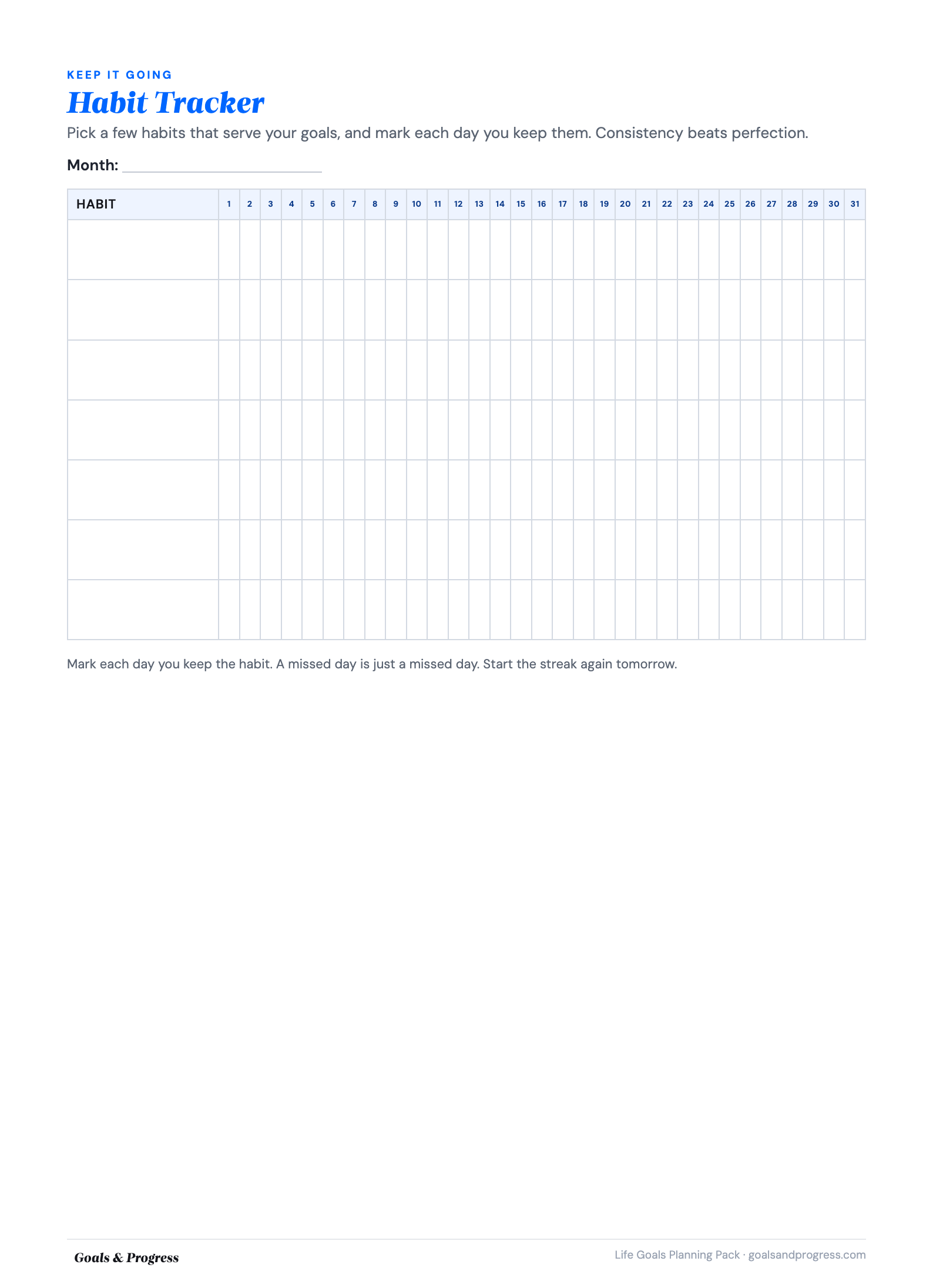
A printable habit tracker is a sheet where you define the habits you are building and then mark every day you keep them. This one is the habit tracker from the free Life Goals Planning Pack, pulled out as its own download so you can print it without signing up for anything. It prints as two sides: the front is where each habit gets defined properly, the back is the month grid where you mark the days.
The definition half is the part most trackers leave out, and it is the part that decides whether the grid still has marks in it by the third week. A row of empty boxes records what you did. It gives you nothing to do at 21:00 on a Tuesday when you are tired and the box is still blank.
It is built for one person tracking their own habits on paper, at the kitchen table or inside a notebook. There is no streak counter, no reminder, and no app to open. If you want your phone to nudge you, this is the wrong tool. It suits you if you would rather see the habits behind your goals in the room where you live.
Download the printable habit tracker.
Two sides, blank and ready to print. No email address needed.
- Room to define six habits: identity, trigger, reason, reward, and the lazy day version
- A month grid underneath, with three marks instead of one
- A4 and US Letter, plain black and blue on white
Free to use and print as often as you like. Print a fresh copy each month.
What is on the sheet
Two landscape sides, printed in black and blue on white, with every field blank. The order between them is the whole idea: you define the habits on the front, then track them on the back. Print it double-sided and the definitions sit behind the grid all month.
- A line at the top for the month, so a stack of printed sheets stays in order.
- Six habit definition blocks on the front. Each one asks for the habit itself, the identity behind it, the trigger that starts it, the reason it is worth keeping, the reward that follows, and the lazy day version. The blocks are numbered, and the numbers match the grid rows on the back.
- A month grid underneath, with one row per habit and a column for every day.
- Three marks instead of a tick: kept, lazy day version, and missed. The legend sits beside the grid.
- A closing line under the grid: the miss is not what breaks a habit, the day after the miss is.
Why the sheet asks for five things before it asks for a tick
A habit you have only named is a habit you will negotiate with. “Exercise more” is not something you can start at a specific moment, so it loses every argument with a tired evening. Each field on the definition block closes off one of the ways that argument gets won.
| Field | What it asks for | What it prevents |
|---|---|---|
| The habit | The action itself, small enough that you can say yes or no about it at the end of the day | A goal wearing a habit’s clothes |
| I am someone who | The person you become each time you do it | A habit with no reason to survive a bad week |
| Trigger | The routine you already have that this one comes after | Depending on remembering |
| Reason why | The plain benefit, in your own words, not a borrowed one | Habits inherited from someone else’s list |
| Reward | Something you get within minutes of finishing | A loop with nothing to close it |
| Lazy day version | The smallest version that still counts, decided in advance | A bad day turning into a lost habit |
Fill the lazy day version last and make it smaller than feels serious. If you would not do it on your worst evening of the month, it is not the lazy day version yet.
Three marks, and the Comeback rule
The grid has three marks because a day has three honest outcomes. You kept the habit, you did the lazy day version, or you missed it. A tracker with only a tick forces two of those into the same empty box, which is how one ordinary bad day starts reading like failure.
The Comeback rule is the one that governs the grid: the miss is not what breaks a habit, the day after the miss is. A miss opens a one-day window. The lazy day version is the move you already decided on, so the next mark on the sheet is a small one rather than a second blank.
That is why the sheet asks you to write the lazy day version while you are calm, weeks before you need it. Deciding what counts on a five-minute evening is a different job from doing it, and doing both at 22:00 rarely ends with a mark on the page. The rule builds on the never-miss-twice idea, credited to James Clear and the Seinfeld calendar.
How to use the habit tracker
The sheet is simple. The choices you make before you write on it are what decide whether it survives past week two. Five steps, in order.
- Print one copy and write the month at the top. A tracker you share with last month gets confusing by the second week, so start a clean sheet each month.
- Fill the definition blocks before you mark anything. The sheet holds six habits, but three is a sane start and two is better if you are coming from nothing. Empty rows cost you nothing.
- Shrink each habit until you could keep it on an average day, and shrink the lazy day version until you could keep it on your worst one. “Twenty minutes of reading” is a plan for a good week; “one page” is what keeps the row alive on a tired Tuesday.
- Mark the grid the same day, and keep the sheet where the habit happens. A tracker in a drawer stops being a tracker by about day four.
- Read the rows across at your weekly reflection. You are not counting the marks, you are looking for where the gaps cluster, because a gap that lands on the same weekday every week is a scheduling problem.
Each habit on the sheet should serve something above it. If you cannot say which goal a row is feeding, that row is a candidate to cut at the end of the month.
A filled example you can copy
Here is the sheet worked through for one month, at the level of detail that holds up. The habits come from the Habit Library in the Life Goals App, so they are written the way the method asks for. Copy the shape rather than the habits.
1. Walk for 20 minutes after lunch
2. Lights out by 23:00 on weeknights
3. Read for 20 minutes a day
Kept Lazy day version Missed
The miss is not what breaks a habit. The day after the miss is.
Read in words, the walking row keeps the habit for most of the month, drops two days entirely, and follows each of those with a lazy day and then a normal one. Nothing in that row went dark for two days running, which is the Comeback rule doing its job on paper.
The sleep row is the one worth stopping on. It has four misses in the month and all four land on a Thursday. That is not a willpower problem, it is a calendar problem, and the fix is to move the wind-down alarm earlier on the day the late meeting sits. A month on one page shows you that; a phone notification does not.
The reading row is almost unbroken, and the reason is written two lines above it. When the lazy day version is a single page, there is no evening on which the honest answer is no.
What if it does not go to plan
These are the situations that end most paper trackers. Each one has an answer inside the method, and most of them are decided before the month starts rather than during it.
What if I miss a day?
Leave the box empty and treat tomorrow as the real decision. Under the Comeback rule a single miss costs you nothing, so the only question is what the next mark says. Do the lazy day version at minimum, mark it, and the row stays alive. Two blanks in a row is the pattern to protect against, not one.
What if I miss a whole week?
Do not backfill and do not restart the sheet. Pick up on the day you are on with the lazy day version of one habit, not all three. A week of blanks is usually a sign that something changed in the week itself, so use your weekly reflection to name what it was before you decide the habits were the problem.
What if I cannot think of a lazy day version?
Cut the habit down until the answer appears. If the habit is a 30-minute run, the lazy day version is ten easy minutes where walking counts. If it is a strength session, it is one light set at home. The test is simple: could you do it on the worst evening you had last month, without negotiating?
What if the same weekday keeps coming up blank?
Change the trigger, not the habit. A gap that clusters on one weekday means the habit is scheduled against something the week protects more strongly, and no amount of resolve moves a standing meeting. Rewrite the trigger line on the definition block so the habit sits somewhere the week leaves alone, then print a fresh sheet next month.
What if I want to track more than a handful of habits?
Print a second sheet if you truly need it, but the limit is doing something useful. The method caps focus deliberately at every level, from three life areas down to two priorities per month, because attention is the thing in short supply rather than ambition. Three defined habits carried through a month beats seven named in the first week and abandoned by the third.
What if I keep the habits and nothing changes?
Then the habits are probably not attached to anything. Check the reason why line on each block: if it names a benefit you cannot connect to a goal you chose deliberately, you are being consistent at the wrong thing. Take the row back up the cascade and either tie it to a goal or cut it at the end of the month.
Where a habit tracker fits in the bigger system
A habit tracker on its own tells you that you did a thing eleven times. It becomes useful when the habits on it are the repeatable part of a goal you chose deliberately. In the Goals and Progress method that chain is called the Goal Cascade: your Summit Goal sits at the top, and it narrows through annual, quarterly, monthly, weekly, and daily levels until it reaches something you can do today.
The habit layer sits under the daily level. Your daily plan holds the main task for the day, and the tracker holds the actions that repeat regardless of what today looks like. Both answer to the level above them, which is why the first question about any habit is which goal it feeds. You can see the whole chain in the guide to goal cascading from vision to daily tasks.
The review rhythm around the sheet is light. The weekly reflection is where you read the rows and notice a pattern, the monthly check-in is where you decide which habits carry into the next sheet, and the annual wrap-up is where you look back at what stuck. If you have not chosen the goal these habits serve yet, the life goals worksheet is the place to start.
Frequently Asked Questions
How many habits should I track at once?
The sheet holds six, but the useful number is two or three. The definition blocks take a whole side precisely so the number stays small: a habit worth five fields is a habit worth carrying for a month. Start with two, add a third once both feel automatic, and leave the remaining rows empty without guilt.
What do I do when I miss a day?
Leave the box empty and do the lazy day version tomorrow. That is the Comeback rule, and it is the reason the grid has a third mark: a small mark keeps the row alive where a second blank starts a new pattern. The habit you defined in advance already tells you what the small version is, so there is nothing to decide on the night.
Can I use it for a month with fewer than 31 days?
Yes. Cross out the columns you do not need before you start, so the end of the grid matches the end of your month. The sheet is the same for every month, which is what makes it reprintable.
What size does it print at?
Both sizes are here: A4 and US Letter, two landscape sides each, so you can take the one that matches your printer without scaling anything. Print double-sided, flipping on the short edge, and the definitions land behind the grid. Black and white printing is fine, since the blue and amber carry no information the legend does not repeat in words.
What is the lazy day version for?
It is the smallest version of the habit that still counts, written down before you need it. One page instead of twenty minutes, one lap instead of a walk, one light set instead of a session. It gets its own mark on the grid so a bad day produces a small mark rather than a blank, which is what keeps a month from unravelling after a hard week.
How is this different from the full Life Goals Planning Pack?
This page gives you the habit tracker on its own, straight away. The pack is the same tracker plus ten more sheets, from your values and Summit Goal down through the year, quarter, month, week, and day, so the habits you track connect to something. Take the single sheet if you only want the grid, and the pack if you want the system around it.
Related pages
- Life goals: the hub page for the whole method, and the place to start if this sheet is your first contact with it.
- Life goals worksheet: guided exercises for choosing the goal your habits are meant to serve.
- Life goals template: the full cascade on one reusable page, for when you already know your goal.
- Life plan template: one printable page for the year across your life areas.
- Weekly review template: the five-minute reflection sheet where you read your tracker rows.
- Habit formation guide: the research behind why small habits stick and large ones stall.


