Goals & Progress


Why goals feel arbitrary by March
You set ambitious goals in January, and by March they feel arbitrary. You are still busy, but the work has drifted from the future you actually wanted. The usual fix is to write better goals. The real fix is to put an architecture above them.
A Goal Cascade is a six-level goal hierarchy that connects your values at the top to a specific action you can take today at the bottom. Each level constrains the level below it, so a single Summit Goal flows down through an Annual Goal, a Focus Quarter, and a weekly plan until it becomes one line in today's check-in. This article is a definitional walkthrough: what the Goal Cascade is, why the architecture works, the six levels in detail, what fails when a level is missing, how it compares to a Goal Pyramid and an OKR tree, and one worked trace of a Summit Goal travelling all the way down to a Wednesday morning task.
The architecture is what most goal advice leaves out. Without something the annual goal serves, and something it cascades down into, the goal sits floating in the calendar with nothing to anchor it on a hard week. Goal-setting research has long noted that long-horizon goals set in isolation tend to feel disconnected from daily effort, which is the gap a nested structure is built to close.
The Goal Cascade is the six-level architecture we use at Goals and Progress to solve that problem. It starts with your values and ends with the line you wrote in today's check-in. This is the sibling walkthrough to our hub on how to set effective life goals. The hub gives you the framework end to end; this article goes deeper on the architectural layer. If you want the longer time-horizon context, see our guide to short and long-term planning.
What the Goal Cascade is
The Goal Cascade is a six-level architecture connecting your highest-order intentions (values) down to a specific action you can take today. It is a goal hierarchy, but a working one: every level has a defined cadence and a constraint on the level below. The six levels are:

- Values (revisited once a year)
- Vision (the 5 to 10 year picture)
- Summit Goal (one per focus area)
- Annual Goal (set as a Goal Plan: Outcome Map + Friction Map)
- Focus Quarter (12 weeks, one to three quarter goals)
- Weekly Reflection / Daily Reflection (the tactical layer)
The word cascade is doing work. It is dynamic (it suggests downward flow from level to level) rather than static (the way a pyramid sits). It also suggests that each level overflows into the level below. The Summit Goal is not just at the top; it is what fills the Annual Goal layer, which fills the Focus Quarter, which fills the week. That is the difference between a goal hierarchy that is only drawn and one that is actually run.
The architecture is original to Goals and Progress, but the underlying research is well-established. Carver and Scheier's On the Self-Regulation of Behavior [1] built the case that goal-directed behavior is governed by nested feedback loops, where higher-order goals supply the criteria that lower-order goals are tested against. Vallacher and Wegner [2] showed that human action exists on an identification hierarchy: people describe the same physical movement at different levels of abstraction depending on which level they are operating from. Bandura and Schunk [5] showed that distal goals alone do not sustain effort; proximal sub-goals are what carry persistence. The Goal Cascade is the practical scaffold that puts those three findings into a single planning system you can use.
The Goal Cascade is what makes a Wednesday afternoon block of writing feel meaningful instead of arbitrary.
Why this architecture works
Three lines of behavioral research explain why a nested cascade outperforms a flat list of goals, and they also explain why the question is really how to cascade goals rather than how to write a better one. A 2025 systematic review of goal setting in higher education makes the same point from the other direction: merely prompting people to set goals is unlikely to produce positive effects on its own, and additional guidance plus structured self-monitoring during the process is what carries goal outcomes [9]. A goal planning system is that structure.
Why does the brain need a hierarchy of goals at all?
Carver and Scheier [1] modelled human self-regulation as a hierarchy of feedback loops. The lowest-level loops manage physical actions; the highest-level loops manage system concepts (who you want to be). Each level sets the reference value for the level below. Lower loops report progress upward; higher loops adjust reference values downward when something is off. The Goal Cascade is a planning-grade implementation of that architecture: the Summit Goal sets the reference value for the Annual Goal, which sets the reference value for the Focus Quarter, and so on. Consistent with that framework, the feedback runs the other way during Check-ins and Reflections.
Why does meaning sometimes evaporate during the work itself?
Vallacher and Wegner [2] showed that the same action can be described at different levels of identification: "moving my fingers," "typing words," "writing a paragraph," "writing a book." When people get stuck on the low-level identification ("typing"), they can lose motivation. When they get stuck on the high-level identification ("writing a book"), they can lose execution. The healthy state is to flip between levels: zoom out for meaning, zoom in for action. The Goal Cascade is structured for that flip. You can read a Wednesday Daily Check-in as "ship the product page" (low) or as "build the thing I want to be known for" (high), depending on what the moment calls for.
Why does a long-horizon Summit Goal need short-horizon sub-goals?
Bandura and Schunk [5] showed that distal goals (long-horizon) alone are not enough to sustain effort; people need proximal sub-goals (near-horizon) to maintain it. In their study, children given proximal sub-goals plus a distal goal showed higher self-efficacy and better arithmetic performance than children given only a distant end-goal. Locke and Latham's 35-year review [3] is consistent with the broader pattern: specific, challenging goals reliably outperform vague intentions, and breaking distal goals into proximal sub-goals supports persistence. The Goal Cascade gives you both, by construction. The Summit Goal supplies the distal anchor; the Focus Quarter and Weekly Check-in supply the proximal sub-goals.
Hierarchical goals outperform flat goals because they engage two different motivational systems at once: meaning at the top, proximity at the bottom.
The six levels in detail
Each level has a definition, a cadence, and a constraint relationship with the level below. Read top to bottom, this is how a goal hierarchy turns into nested goals you can actually act on.
Level 1: Values
Five to ten ranked words plus a one-page purpose statement. Revisited once a year, usually as part of the Annual Reflection. Values is the only level that judges goals rather than sets them: a goal that contradicts a top-ranked value should be rejected, not refined. It constrains the Vision, because a Vision that contradicts your top-ranked values is not yours. In practice, Values look stable across years; small shifts are normal as life circumstances change. The full walkthrough lives in From values to goals.
Level 2: Vision
A one to two page document describing your life at the 5 to 10 year mark, drafted through the Vision Interview and Three Futures exercises. Rewritten once a year. Unlike a tidy mission statement, the Vision is meant to be lived in rather than displayed: it describes a future in enough sensory detail that you can test goals against it. It constrains the Summit Goal, because a Summit Goal that does not move you toward the Vision is the wrong Summit Goal. Vision is the only level whose primary output is prose. Everything below it is structured.
Level 3: Summit Goal
One sentence per chosen life area, 5 to 10 year horizon, specific enough that you would recognize success. We recommend one Summit Goal for each focus area, so two or three in total. It constrains the Annual Goal, because every Annual Goal must point at a Summit Goal. The Summit Goal is the visual anchor of the Cascade and the brand: the mountain peak with a flag in our logo is the Summit Goal made literal.
Level 4: Annual goal
Set once a year, as a Goal Plan, which pairs outcome measures with obstacle planning and has two sub-templates: an Outcome Map and a Friction Map. The Outcome Map lists three to five Success Measures with dates. The Friction Map names three to six likely obstacles and pairs each with an if-then plan, in the spirit of implementation-intention research [6][8]: deciding in advance "if obstacle X happens, then I do Y" makes the planned response far more likely to actually fire when the obstacle arrives. A 2024 meta-analysis of implementation intentions across 642 tests found that how much the plan helps depends on its format and the motivation behind it, not on a single fixed number [8], which is why the Friction Map asks you to write the if-then plan in your own words rather than copy a template. It constrains the Focus Quarter, because a Focus Quarter goal that does not move the Annual Goal forward should be downgraded or dropped. Two to four Annual Goals is typical; more than five is usually a sign the Summit Goal is too vague.
Level 5: Focus Quarter
A twelve-week execution cycle with one to three quarter goals. Where an annual horizon hides slippage until December, the Focus Quarter is short enough that a stalled milestone is visible within weeks. It begins with a quarter-kickoff (45 minutes), runs through twelve Weekly Check-ins, and ends with a Quarterly Reflection (60 minutes). Between the Focus Quarter and the Annual layer sits the Monthly Reflection: a 20-minute monthly review that checks whether the quarter goals are still the right ones and surfaces drift before it compounds. The Focus Quarter constrains the week, because a week without a clear connection to the current quarter goal is a week the Cascade is leaking.
Level 6: Weekly reflection / daily reflection
The tactical layer. Weekly Reflection: 10 minutes, Sunday recommended, names the two to three things that move the quarter goal forward this week. Daily Reflection: 3 minutes, names today's specific actions. It constrains nothing below it (this is the operational floor) but it is where the recurring time goes. This level also carries the recovery rule: the Two-day Rule says never skip the same commitment two days in a row, so a single missed day stays a blip instead of becoming a collapse. In a normal week, only this level is touched. The upper levels are referenced by the lower levels but not rewritten.
The Goal Cascade is heavy to set up once and light to run weekly. Most weeks you touch only the bottom rung.
What happens when a level is missing
Each level carries its own load. Pull one out and the failure shape changes in a predictable way. Naming the failure mode is the fastest diagnostic.
| Missing level | What it looks like in practice | The fix |
|---|---|---|
| Values missing | Annual goals copied from a workshop or someone else's playbook; motivation evaporates by week six | Run the Values exercise. One afternoon. Rank five core words. |
| Vision missing | Annual goals are competent but feel disconnected from a future you actually want to inhabit | Run the Vision Interview and Three Futures pair. One Sunday. |
| Summit Goal missing | Three to four annual goals pointing in three to four directions; you cannot choose what to drop on a hard week | Pick one Summit Goal. The criterion: a sentence you would still read out loud at 65 without flinching. |
| Annual Goal missing | Summit Goal looks majestic on paper; nothing happens this year | Write a Goal Plan (Outcome Map + Friction Map). One Saturday morning. |
| Focus Quarter missing | Annual Goal exists; milestone planning is vague; the year ends with most of the work crammed into the last six weeks | Adopt the Focus Quarter cadence. Kickoff, 12 weekly check-ins, reflection. |
| Weekly / Daily Check-in missing | Focus Quarter goals exist; weeks drift, work happens in fits | The 15-minute Sunday Weekly Check-in is the smallest unit where course-correction is possible. Without it, the quarter ends in surprise. |
The pattern in the table is consistent: each missing level pushes the failure mode one cadence further out. Without the Weekly Check-in, the quarter surprises you. Without the Focus Quarter, the year surprises you. Without the Summit Goal, the decade surprises you.
A missing level in the Goal Cascade does not just slow the system. It guarantees a specific kind of failure.
Goal Cascade vs Goal Pyramid and OKR tree
The Goal Cascade is not the only cascading goals framework in circulation. Two alternatives deserve a direct comparison, and the most common state of all (no architecture) deserves a mention too. SMART (Doran 1981) and WOOP (Oettingen 2014) are not in these tables because they sit inside the Annual Goal level, not above or alongside it; they answer "how do I write a single goal well," not "how do I structure a stack of goals across a decade."
Goal Cascade vs goal pyramid
| Dimension | Goal Cascade | Goal Pyramid (generic coaching) |
|---|---|---|
| Levels | 6, named, each with a template | 3 to 4, varies by author |
| Top-of-stack horizon | 5 to 10 years (Summit Goal); 10+ years (Values) | Variable, often unspecified |
| Values layer | Yes, explicit | No |
| Recovery rule | Yes (Two-day Rule: never skip the same commitment two days running; plus a planned Lazy Day) | No |
| What it leaves to chance | Very little; each level has a cadence and a template | Most of execution; the pyramid is a metaphor, not a system |
Goal Cascade vs OKR tree
| Dimension | Goal Cascade | OKR tree (Doerr / Grove) |
|---|---|---|
| Levels | 6, from Values to Daily Check-in | 2 to 3 (objective, key result, initiative) |
| Top-of-stack horizon | 5 to 10 years | 1 quarter to 1 year |
| Long-horizon meaning | Built in (Values, Vision, Summit Goal) | Left to chance above the annual line |
| Recovery and daily action | Two-day Rule plus a named Daily Check-in | Not specified |
What the tables are saying: the Goal Pyramid is a metaphor, not a system. It looks similar on a slide but has none of the constraint discipline, cadence naming, or recovery built in. The OKR tree is excellent for quarterly cadence (which we borrow into the Focus Quarter) but stops at the quarterly horizon. No architecture at all is the most common state, and it is also the state from which most planners get abandoned. The Goal Cascade is not better because it has more levels. It is better because each level is defined, has a cadence, and constrains the level below. For a deeper compare against external goal-tracking systems, see our sibling hub on goal tracking systems.

A worked trace: one Summit Goal travelling down all six levels
A single Summit Goal travels down all six levels by narrowing at each step: a decade-long ambition becomes a yearly goal, then a quarter goal, then a weekly plan, then one line in Wednesday's check-in. The trace below shows that narrowing for the kind of cascade a maker shipping a first product might build. The names and dates are an illustrative example, not a case study.
- Values (top-ranked): mastery of useful work.
- Vision (5 to 10 year picture): "I am the operator of a small system that ships well-researched products under my own name and supports the household income."
- Summit Goal: Be the operator who built and shipped one product end to end under my own name.
- Annual Goal: Ship V1 of the product by September, with several external users testing it before launch. (Outcome Map: a few success measures with dates. Friction Map: the likely obstacles, each paired with an if-then plan.)
- Focus Quarter (Q3): Finish the manuscript and the sales listing by Sept 30. Three quarter goals: manuscript draft, design pass, listing live.
- Weekly Check-in (first week of September): "Write the product-page copy this week and send the draft for review by Friday."
- Wednesday Daily Check-in: "90 minutes on product-page copy at 09:00, then send the draft by lunch."
Look at the relationship between the levels. The Wednesday Daily Check-in is one specific action: 90 minutes of writing product-page copy. But it is also the bottom rung of a six-level chain. If you walk back up the chain, the action gains meaning. The product page serves the sales listing. The listing serves the Q3 ship goal. The Q3 ship goal serves the Annual Goal. The Annual Goal serves the Summit Goal. The Summit Goal serves the Vision. The Vision serves the Values.
This is the action-identification flip Vallacher and Wegner described. On Wednesday morning, you can describe the work as "writing product-page copy" (low identification) or "shipping the product I want my name on" (high identification). The Goal Cascade is what makes both descriptions true at the same time.
Each Daily Check-in line is the visible tip of a six-level chain. The chain is what gives the action its weight.
Three common failure modes when using the Goal Cascade
The three most common failure modes are Cascade-without-values (skipping the top two levels), Cascade-as-rigid-contract (refusing to revise a goal after circumstances change), and over-cascading (running too many Summit Goals at once). The pattern underneath all three is the same: goals set without an upstream layer, or held too rigidly, tend to feel arbitrary once the early motivation fades, which is exactly what the Values and Vision levels exist to prevent.
Cascade-without-values. The most common failure. The reader adopts the structure but skips the Values and Vision levels because they feel soft. The result is a productivity scaffold with nothing to anchor it. By March, the Cascade looks like an org chart for a company you do not work for. The fix: do not skip the Values exercise. One afternoon, five ranked words. The cost is a Sunday; the benefit is everything below it.
Cascade-as-rigid-contract. The reader treats each level as binding. An Annual Goal set in January is treated as untouchable in June, even when life has moved. The result is that the Cascade fights the year instead of guiding it. This is consistent with goal-setting theory (Latham and Locke [4]), which holds that difficult goals raise performance only when the person has sufficient ability and commitment to them. Commitment is a moderating condition, so when circumstances change, the conditions that justified the original goal can change with them. The fix: every Quarterly Reflection is permitted to revise the Annual Goal, and every Annual Reflection is permitted to revise the Summit Goal. The Cascade is a living scaffold, not a contract.
Over-cascading. The reader maps every life area into the full six levels: ten Summit Goals, twenty annual goals, a Focus Quarter per area. The result is that the Cascade itself becomes the work. The fix: one Summit Goal for each focus area, so two or three, not ten. Pick the life areas where the gap between satisfaction and importance is largest (run the Life Areas Map once a year to find these). Cascade those. Let the other areas run on baseline maintenance.
A fourth and quieter failure: cascading goals that someone else set for you. The Cascade does not know if a goal is yours; it just propagates whatever is at the top. If the Summit Goal came from a partner's expectation or a generic "should," the whole Cascade inherits the misalignment. The Values exercise exists specifically to catch this before it propagates.
The Goal Cascade is only as good as the Summit Goal at the top, and the Summit Goal is only as good as the Values it sits on.
The research this builds on
This system builds on well-established research. The nested-feedback view of self-regulation comes from Carver and Scheier [1]; action identification from Vallacher and Wegner [2]; goal-setting theory from Locke and Latham [3][4]; proximal sub-goals from Bandura and Schunk [5]; and the if-then implementation intentions used inside the Friction Map from Gollwitzer [6], with later meta-analytic support both broadly [8] and in specific behavioral domains such as healthy eating [7]. The point that goals need structured support around them, not just better wording, is reinforced by a 2025 systematic review of goal setting [9]. Where we reference OKRs, WOOP, or SMART, it is to place them inside one level of the Cascade, not to teach them as our own.
How the Goal Cascade lives in the workbook and app
The Goal Cascade works the same on paper and on screen; the format is a preference, not a different system.
In the Life Goals Workbook, the Cascade is captured as a reusable planning template alongside the workbook's other templates. You fill it in once per year for each Summit Goal, then reference it during Weekly Check-ins and Quarterly Reflections. The workbook keeps the architecture in a paper form you can write in by hand. You can get it here: the Goal Cascade template in the Life Goals Workbook.
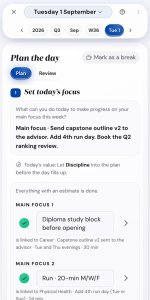
In the Life Goals App, the same Cascade is organized across a structural template and a set of cadence views, so the one cascade you defined can be read at different time horizons (year, quarter, month, week, day). Switching the time horizon is the explicit interface for the Vallacher and Wegner identification flip: the same goal, viewed close up for action or far out for meaning.
Key takeaways
- The Goal Cascade is a six-level goal hierarchy running from Values to today's Daily Check-in, where each level constrains the one below it.
- Every other level depends on the Summit Goal. Every Annual Goal must point at it, or it should be dropped.
- Hierarchical goals beat flat lists because they pair distal meaning at the top with proximal sub-goals at the bottom, the combination behavioral research links to sustained effort [3][5].
- A missing level produces a predictable failure: each gap pushes the surprise one cadence further out, from the week to the year to the decade.
- It is heavy to set up once and light to run. Most weeks you touch only the bottom rung; the upper levels are referenced, not rewritten.
- The minimum viable Cascade is a Summit Goal, the Two-day Rule, and a Weekly Check-in. A loose Cascade still beats no architecture.
Ramon's Take
A pyramid of goals looks tidy and still leaves the hardest question unanswered: what do I do today. The cascade earns its keep by connecting every level down to one concrete action, not by drawing the hierarchy.
Frequently asked questions
Is the Goal Cascade the same as a goal hierarchy or a Goal Pyramid?
It is a goal hierarchy, but a Goal Pyramid is usually just the picture of one (a triangle on a slide). The Goal Cascade adds what the picture leaves out: six named levels, each with a defined cadence, a template, and a constraint on the level below, plus a recovery rule. A pyramid drawing has none of those moving parts.
Where do OKRs fit inside the Goal Cascade?
OKR-style measurability lives inside the Annual Goal and Focus Quarter levels, not above them. OKR cadence is excellent for the quarterly horizon, which is exactly why we borrow it into the Focus Quarter. But OKRs alone stop at the annual line. The Goal Cascade adds three layers above (Summit Goal, Vision, Values) and an operational Daily Check-in below, so OKRs become the middle of the stack rather than the whole.
Do I have to use all six levels at once?
No, and most people should not start there. The system still works with only three parts: the Summit Goal, the Two-day Rule, and a Weekly Check-in. Vision, Annual Goal, and Focus Quarter are the recommended next layer to add as the year unfolds. Values is the upstream layer that prevents misalignment. Even a loose Cascade with only those three levels works better than no structure at all.
How often do I rewrite each level?
Values: once a year, during the Annual Reflection. Vision: once a year. Summit Goal: every 3 to 5 years, with optional refinement annually. Annual Goal: once a year. Focus Quarter: four times a year. Weekly Check-in: weekly. Daily Check-in: daily. The recurring time almost all lives in the bottom two cadences.
What if my Summit Goal changes mid-year?
Wait until the Annual Reflection in December unless something material happens, such as a job loss, an illness, a birth, or a divorce. Mid-year Summit changes are rare and usually a sign of impatience rather than new information. Annual Goal adjustments mid-year, by contrast, are common and welcome; that is what the Quarterly Reflection is for.
Does the Goal Cascade work for multiple Summit Goals at once?
Yes, but cap it at two. Running three or more Summit Goals in parallel typically means none of them gets the proximal attention that Bandura and Schunk [5] showed is required for sustained effort. If two Summit Goals start competing for the same Wednesday morning every week, that is the signal to drop one.
Where does the habit layer sit in the Goal Cascade?
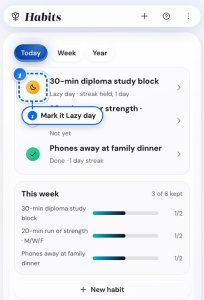
The Habit Tracker is a separate but adjacent structure that lives at the bottom of the Cascade, alongside the Daily Check-in. Each habit ideally serves one Summit Goal and runs on its own daily cadence, governed by the same Two-day Rule. See our Habit Tracker walkthrough for the full structure.
Glossary
- Goal Cascade | the six-level architecture connecting values down to today's action.
- Summit Goal | a long-term goal (5 to 10 years) that anchors annual goals.
- Goal Plan | the combined annual exercise (Outcome Map + Friction Map).
- Focus Quarter | a 12-week execution cycle with one to three focused goals.
- Two-day Rule | the recovery rule: never skip the same commitment two days in a row.
- Weekly Reflection / Daily Reflection | the tactical reviews, 10 minutes and 3 minutes.
- Monthly Check-in / Quarterly Check-in / Annual Wrap-up | the strategic reviews, 10, 20 and 30 minutes.
- Vision Interview | a written interview with your 5 to 10 year future self.
- Three Futures | an exploratory exercise imagining three 5-year lives.
A note before you start
The Goal Cascade looks heavy to read about because the page has to spell out six levels. In practice, only the bottom rung is touched most weeks. The upper levels are referenced (you re-read the Summit Goal during the Sunday Weekly Check-in to ask whether this week moved the chain), not rewritten.
You do not need to build all six levels this weekend. Take one Summit Goal sentence. Write one Annual Goal under it. Write one Focus Quarter goal under that. Then name one thing for this week. That is your first cascade, and it is enough to start. The rest of the architecture appears as the year unfolds. The Goal Cascade is not a planning project; it is a planning posture.
If you would rather run the architecture with a structure that already enforces the constraints, the Life Goals App does that, and its demo needs no sign-up.
The Goal Cascade does not ask you to become a different person. It asks you to be consistent at one level a week.
References
[1] Carver, C. S., & Scheier, M. F. (1998). On the Self-Regulation of Behavior. Cambridge University Press. https://doi.org/10.1017/cbo9781139174794
[2] Vallacher, R. R., & Wegner, D. M. (1987). What do people think they're doing? Action identification and human behavior. Psychological Review, 94(1), 3-15. https://doi.org/10.1037/0033-295x.94.1.3
[3] Locke, E. A., & Latham, G. P. (2002). Building a practically useful theory of goal setting and task motivation: A 35-year odyssey. American Psychologist, 57(9), 705-717. https://doi.org/10.1037/0003-066X.57.9.705
[4] Latham, G. P., & Locke, E. A. (2007). New developments in and directions for goal-setting research. European Psychologist, 12(4), 290-300. https://doi.org/10.1027/1016-9040.12.4.290
[5] Bandura, A., & Schunk, D. H. (1981). Cultivating competence, self-efficacy, and intrinsic interest through proximal self-motivation. Journal of Personality and Social Psychology, 41(3), 586-598. https://doi.org/10.1037/0022-3514.41.3.586
[6] Gollwitzer, P. M. (1999). Implementation intentions: Strong effects of simple plans. American Psychologist, 54(7), 493-503. https://doi.org/10.1037/0003-066X.54.7.493
[7] Adriaanse, M. A., Vinkers, C. D. W., De Ridder, D. T. D., Hox, J. J., & De Wit, J. B. F. (2011). Do implementation intentions help to eat a healthy diet? A systematic review and meta-analysis of the empirical evidence. Appetite, 56(1), 183-193. https://doi.org/10.1016/j.appet.2010.10.012
[8] Sheeran, P., Listrom, E., & Gollwitzer, P. M. (2024). The when and how of planning: Meta-analysis of the scope and components of implementation intentions in 642 tests. European Review of Social Psychology. https://doi.org/10.1080/10463283.2024.2334563
[9] Martins van Jaarsveld, G., Wong, J., Baars, M., Specht, M., & Paas, F. (2025). Goal setting in higher education: how, why, and when are students prompted to set goals? A systematic review. Frontiers in Education. https://doi.org/10.3389/feduc.2024.1511605
Guides for the Life Goals App