Goals & Progress


How to set effective life goals: complete framework + goal setting app (with templates)
"Week three: opened the app, saw the broken streak, closed the app, never opened it again." Typical reader, recovered from a productivity-tool graveyard
If that sentence describes the last six goal setting apps you tried, the problem is not you. The problem is the design. Every popular goal setting app is built around one or two of the five layers a goal actually needs to survive the year, and the missing layers are why the app gets deleted by Easter.
The single-framework approach has the same shape. SMART covers measurability. OKR covers quarterly cadence. WOOP covers obstacle planning. BHAG covers horizon. Each won the argument about its layer; none won the argument about the whole stack. So you adopt one, ride the novelty for two weeks, and quit by week five when the missing layers show up as friction you cannot name.
Norcross and colleagues tracked New Year's resolvers across two years and found only about 19% reported continuous success at the two-year mark, with most maintenance attempts dropping off inside the first six months [1]. That number is not a motivation problem. It is a synthesis problem.
This page lays out the complete framework we built at Goals and Progress to solve the synthesis problem, and the goal setting app that runs it for you. It has four phases, six cadence levels, and one rule that prevents the abandonment cycle. You can read it as a guide, walk through it with our workbook (a 29-page fillable PDF), or use the Goals & Progress Life Goals App on your phone or computer. The app links what matters to you with what you do today. When your days start to drift from your goals, you see it the same week.
The pieces are not new. Locke and Latham wrote their 35-year retrospective on goal-setting theory in 2002 [2]. Gollwitzer added implementation intentions in 1999 [4]. Fogg added the behavior model in 2009 [6]. What is new is the way the pieces fit together (the Goal Cascade), the vocabulary we built so each piece has a name your brain can hold (Summit Goal, Goal Plan, Trigger / Action / Reward, Two-day rule), and a goal setting app that runs the whole thing without forcing you into a single trick.
Effective life goals do not come from a better framework. They come from a complete one.
What "effective" life goals actually mean
A goal is effective when it survives the year. That is the only test that matters. By December most people cannot name the goals they set in January, and that is the failure mode we want to design out.
For a goal to survive the year, it needs five things. It needs a long horizon (so it does not change every quarter). It needs a values anchor (so motivation does not have to come from willpower). It needs an obstacle plan (so the first hard week does not end it). It needs a quarterly rhythm (so the year breaks into reviewable units before the year is over). And it needs a recovery rule (so the inevitable missed day does not turn into abandonment).
Most frameworks give you one or two of these. SMART gives you measurability but no horizon. OKR gives you a quarterly cadence but no values anchor. WOOP gives you obstacle planning but no long-term layer. BHAG gives you horizon but no recovery rule. Each is correct about its piece, and none is complete.
The synthesis we use at Goals and Progress combines all five into one nested system. The long horizon is the Summit Goal. The values anchor lives in Phase 1 (Discovery). The obstacle plan is the Friction Map (half of our Goal Plan). The quarterly rhythm is the Focus Quarter. The recovery rule is the Two-day rule.
A life goal that survives the year is not better-written. It is better-supported.
Why most life-goal plans fail in March
If you have ever set a January goal and watched it dissolve by Easter, you already know the pattern. The first two weeks are easy because novelty does the work. The third week is the test. By the fifth week, the goal is no longer in the spreadsheet you check.
The research lines up with that experience. Polivy and Herman called this the false-hope syndrome: people set goals they believe will be both easy and transformative, and the gap between belief and reality produces a quick collapse [8]. Gabriele Oettingen showed that pure positive thinking about a goal, without paired obstacle planning, actually reduced effort and lowered success rates compared to controls [3]. And Lally and colleagues, who measured habit formation in the real world, found the median time to automaticity was 66 days, with substantial individual variance [7]. So a goal that requires daily action needs roughly two and a half months of consistent practice before it runs without willpower.
What does this add up to? Three failure modes that account for the bulk of March abandonments.
| Failure mode | What it looks like | What the fix actually is |
|---|---|---|
| No values anchor | "I should run more" with no connection to a deeper why | Run the Values exercise (Phase 1) before any goal gets written |
| No obstacle plan | First hard week ends the streak | Run the Friction Map (Phase 2) alongside the Outcome Map |
| No recovery rule | Two missed days become four, become abandonment | Adopt the Two-day rule. One miss is data. Two misses in a row is a signal. |
You can solve any one of these and the system will still leak. Solve all three, and the system holds.
Most goals fail not because they were wrong, but because the support system around them was incomplete.
The Summit Goal + Goal Cascade architecture
This is the part of the framework that is original to Goals and Progress. The Summit Goal sits at the top of a six-level cascade, and every other piece of the system serves it.

The Summit Goal is a long-term goal (5 to 10 years out) that anchors annual goals and defines the direction of the next decade. It is far enough away that you cannot reach it this year, or even three years from now. It is specific enough that you would recognize it if you reached it. It is ambitious enough that you would be a different person when you reach it. The Goals and Progress logo is a mountain peak with a flag at the summit; the flag at the summit is the Summit Goal.
The Goal Cascade is the six-level architecture that connects the Summit Goal at the top to today's action at the bottom:
- Values (one-time exercise, revisited annually)
- Vision (the 5 to 10 year picture, drafted in the Vision Interview)
- Summit Goal (one to two per life area, no more)
- Annual Goal (set as a Goal Plan: Outcome Map + Friction Map)
- Focus Quarter (12 weeks, one to three quarter goals)
- Weekly Check-in / Daily Check-in (the tactical layer)
Each level constrains the level below it. You cannot set a useful weekly check-in if you have not set a Focus Quarter. You cannot set a useful Focus Quarter if you have not set an Annual Goal. And the Annual Goal only survives if it serves a Summit Goal that serves a Vision that comes from your Values.
This sounds heavy. It is not, because most of the layers stay stable. Values are revisited once a year. Vision is rewritten once a year (after the Annual Reflection). Summit Goals shift at most once every three to five years. Annual Goals are set once a year. The Focus Quarter is set four times a year. Only the Weekly Check-in and Daily Check-in are recurring.
"Specific challenging goals consistently outperform vague or easy goals across organizational, academic, and personal performance domains." Locke and Latham, American Psychologist, 2002 [2]
The cadence vocabulary matters because it tells you whether you are doing tactical work or strategic work. Check-in is tactical and present-focused (daily, weekly). Reflection is strategic and retrospective (monthly, quarterly, annual). Daily and weekly are check-ins because the time horizon is too short for real reflection. Monthly and longer are reflections because there is enough data to look back on.
The Summit Goal is the flag. The Goal Cascade is the path down the mountain.
The four-phase process (and which template handles each)
The full framework runs across four phases, each with named templates. The phases are how the workbook is organized. The Life Goals App follows the same four phases as guided steps, and adds Insights with your own numbers.
Phase 1: Discovery (one-time, revisited annually)
The upstream work. Before any goal gets written, three exercises run in sequence.
- Values exercise (T1A in the workbook). Rank five core values. Write a one-page purpose statement. This is the anchor everything else points to. Deep dive: From values to goals: turning what matters into what gets scheduled.
- Life Areas Map (T1B). Ten life areas (career, health, relationships, finances, personal growth, recreation, environment, contribution, family, creativity). Each gets a satisfaction score and an importance score. The gaps tell you where the next year of effort should go.
- Three Futures (T2A, optional but powerful). Imagine three different 5-year lives: your current best-case path, the alternative if the first becomes impossible, and a wild-card with no constraints. Three one-paragraph narratives. The exercise produces possibility before commitment.
- Vision Interview (T2A, paired with Three Futures). You write questions to your future self at 5-10 years out and answer them from that perspective. What does a typical day look like? What do they regret? What advice do they give the current you?
In the Life Goals App, you play a hand of 28 value cards, keep five and rank them. You rate ten life areas, and the map shows where the biggest gap is. Then you write three futures five years out and make one of them your active vision. That vision comes back at each quarter check-in and year wrap-up, so you can check whether it still fits.

The Life Goals App's welcome screen frames the four phases: Discovery, Planning, Execute, Habits. Each level inherits its focus from the one above, so a daily writing block points all the way back to the Summit Goal.
Phase 2: Planning (annual, set once a year)
This is where the Summit Goal gets named and the Annual Goal Plan gets written.
- Summit Goal (T2B). One sentence per chosen life area. Five to ten year horizon. Specific enough that you would recognize success. You write one or two of these in a typical year, not all ten.
- Annual Goal (T2C). Each annual goal is a Goal Plan, which has two sub-templates: the Outcome Map (what success looks like, measurably) and the Friction Map (what could stop you, with an if-then plan for each obstacle). The Outcome Map gets three to five Success Measures with dates. The Friction Map names three to six likely obstacles with if-then plans.
The Goal Plan is the structural backbone of the year. Both halves are required. The Outcome Map alone produces a wish; the Friction Map alone produces a problem list; together they produce a plan that has already survived its first thought-experiment.
In the Life Goals App, you give each focus area one Summit Goal. It has a date and a way to measure it. Each annual goal gets three to five targets. In the Friction Map, you turn each obstacle into an if-then plan.

Ramon's Summit Goal anchors the Career and Calling area: a 5-year horizon sentence written via the three-piece composer (verb, measure, target date), editable directly afterwards.
Phase 3: Execute (recurring cadences)
The execution layer. This is where most goal-setting systems stop and most plans dissolve.
- Focus Quarter (T3A). Twelve-week execution cycle with one to three focused goals. Replaces the year as the working unit. Begins with picking goals (downstream from the Annual Goal), runs through twelve Weekly Check-ins, and ends with a Quarterly Reflection.
- Monthly Reflection (T3B). Thirty minutes. What patterns emerged this month. Strategic, not tactical.
- Weekly Check-in (T3C and T3D). Fifteen minutes, Sunday recommended. What worked this week, what shifts next week. The smallest unit where you can actually course-correct.
- Daily Check-in (T3E). Two minutes. Did I do today's actions. Pure tactical.
Each level uses Success Measures (replaces the term KPI for personal-scale tracking) and Traffic Light status (replaces RAG: green / amber / red). Two ambers in a row is a signal to rethink, not a signal to push harder.
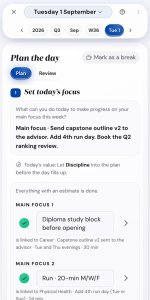
In the Life Goals App, you break your Summit Goal down to today with the Goal Cascade. Each level takes its focus from the level above. Each of today's tasks shows the goal it serves. Short reviews each day, week, month, quarter and year start from what you planned. You notice a slipping goal in the same week.

The 2024 year overview surfaces the Goal Cascade rungs alongside the Summit Goal anchor. The "522 days overdue" chip on the V1.1 backlog milestone is the app nudging an off-track item back into focus, not penalising the user.

Q1 2024 turns the annual goal into a focus quarter slice with the same plan-work-review loop one level down. Each quarterly review compares plan against outcome before the year is over.
Phase 4: Habits (optional, runs alongside execution)
The behavior layer. Not every Summit Goal needs a habit. The ones that do, need this.
- Habit Tracker (T4A). Up to four habits over a Focus Quarter. Each habit is structured as Trigger / Action / Reward: what cues it (time, place, preceding action), the action itself in five words or less, and the reward within minutes. Each habit also has a Lazy Day version: the minimum-viable form you can complete on your worst day. The underlying science is covered in Tiny Habits explained: BJ Fogg's behavior change method and Implementation intentions: Gollwitzer and Sheeran's d = 0.65 effect [5].
- The Two-day rule. One missed day is data. Two missed days in a row is a signal the design is wrong. Prevents the false-hope-and-collapse cycle that Polivy and Herman documented [8].
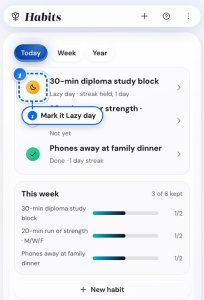
In the Life Goals App, each habit follows a routine you already have and gets a Lazy Day version. On a hard day you tick Lazy day, and your streak stays alive. Coming back the day after a miss earns a comeback badge. You can start from 250 ready-made habits.

The habit "Write 800 words on the active article" with trigger, identity statement, and Lazy Day fallback. Current streak is 127 days, anchoring the Two-day rule visually next to the field where you wrote it.
The four phases are not steps you complete once. They are layers you maintain at different cadences.
Goals and Progress vs four common frameworks
The synthesis becomes clearer when you compare the layers side by side. The frameworks below all have evidence behind them. None of them covers all five pieces.
| Framework | Summit horizon (5-10y) | Values anchor | Obstacle planning | Quarterly rhythm | Habit recovery rule |
|---|---|---|---|---|---|
| Goals and Progress (Summit Goal + Goal Cascade + Goal Plan + Two-day rule) | Yes | Yes | Yes (Friction Map) | Yes (Focus Quarter) | Yes (Two-day rule + Lazy Day) |
| SMART (Doran 1981) | No | No | No | No | No |
| OKR (Doerr, Grove) | No | No | No | Yes | No |
| WOOP (Oettingen, Gollwitzer) | No | No | Yes | No | No |
| BHAG (Collins and Porras 1994) | Yes | No | No | No | No |
The point is not that other frameworks are wrong. SMART is excellent for measurability. OKR is excellent for quarterly cadence. WOOP is excellent for obstacle planning. BHAG is excellent for horizon-setting. They each won an argument about their layer. They just never won the argument about the whole stack.
If you already use one of them and like it, keep it. Just make sure the other three layers are covered by something. The Goal Cascade approach is to name and combine all four into one system so nothing slips between layers.
A complete framework is not a maximalist framework. It is a system where no layer is missing.
Goal setting apps compared: where each one wins and where each one leaves you exposed
The frameworks comparison above explains the theory. The apps comparison below is the practical question most readers actually arrive with: which goal setting app should I install on Monday morning.
The answer almost no review article gives you: every popular goal setting app is built around one of the five layers. Pick the wrong one for your life situation and you will be back in the shortlist by April.
| Goal setting app | Summit horizon (5-10y) | Values anchor | Obstacle planning | Quarterly rhythm | Habit recovery rule | Where it wins |
|---|---|---|---|---|---|---|
| Life Goals App ($49.99 once) | Yes (Summit Goal 3, 5 or 10 years out) | Yes (values card game + Life Areas Map) | Yes (Friction Map with if-then plans) | Yes (Goal Cascade + quarter check-in) | Yes (Lazy Day version keeps the streak) | Links your values to today and shows drift the same week. All five layers, $49.99 once. |
| Strides | No | No | No | Limited (custom date ranges) | Partial (streak break warnings) | Habit + KPI tracking with flexible cadences. Best for the metric-obsessed. |
| Streaks | No | No | No | No | Yes (clean streak visualization) | Habit-only, beautiful UI, iOS-native. Best if you want one habit tracker and nothing else. |
| Productive | No | No | No | No | Yes (streak + mood) | Habit-focused with mood overlay. Best for habit + emotional pattern tracking. |
| Notion goals templates | Limited (depends on template) | Limited | Limited | Yes (quarterly database views) | No | Maximally customizable. Best if you enjoy building your own system and don't mind the maintenance cost. |
| Habitica | No | No | No | No | Partial (RPG-style streak penalties) | Gamified habit tracking. Best for users motivated by XP and visible damage from missed days. |
| TickTick | No | No | No | Limited | No | Task manager with habit add-on. Best if your goal load is task-shaped (deadlines, projects, lists). |
| Habi / similar AI-coaching apps | No | Partial (onboarding interview) | Limited | No | Partial | AI-coached daily prompts. Best for users who want a coach voice without the cost of a coach. |
What this table is saying: every named app on the shortlist wins one or two cells. None except the Life Goals App covers all five. That is not a marketing claim; it is a feature audit. If you build a spreadsheet of the same columns and rate any other app, you will reach the same conclusion.
The implication is not "use our app." The implication is: if you use a partial app, pair it with the other layers manually (a notebook for the Summit Goal, a quarterly review ritual for the Focus Quarter, a written Friction Map for the obstacle layer). The completeness is what matters; whether it lives in our app or across three other tools is your call.
For a deeper side-by-side on the most-asked comparisons, see Goals and Progress vs Notion goals templates, vs Strides / Streaks / Productive, and vs paper planner.
Pick the app that covers your gap, not the app with the prettiest UI. A goal setting app that leaves four of the five layers uncovered is not a system; it is a habit tracker with extra screens.
18 months of using the framework on my own life
The framework is easier to see in motion than in description. Here is a compressed version of my own use of it, January 2024 through November 2025.
In January 2024 I set one Summit Goal: be the technical operator who built and shipped one product end-to-end by age 40. That sentence covered the long horizon (5 years to 40 at the time), the value (mastery of useful work, ranked second in my values exercise), and the specificity test (I would know if I had reached it).
The 2024 Annual Goal Plan made the Summit Goal concrete. The Outcome Map: ship V1 of the workbook PDF by September, with at least three external users testing it before launch. The Friction Map named three likely obstacles. Family deadline conflict with launch week. A perfectionism trap that would make me rewrite forever. And the loneliness of a long indie build with no team to ship to.
Quarterly cadence: Q1 built workbook V1. Q2 wrote 47 supporting articles. Q3 launched on Gumroad. Q4 began the Life Goals App build (the same app you can try below).
Habits in the Habit Tracker: write 800 words on the active article, weekdays. Hit 18 of the first 21 days. Two misses came on a kid sick day and a server-down day. Two-day rule held. Came close on weekend three. The Lazy Day version became "200 words on anything, just open the doc." Without it, weekend three would have been the abandonment moment.
By November 2025 the system itself had become the product. The Annual Reflection that month surfaced something I had not noticed mid-year: the Summit Goal had shifted, without me noticing exactly when, from "ship one product" to "be the operator of a system that ships products." The sentence at the top of the cascade had updated, and the cascade had updated with it. That is the point. The cascade is not a contract; it is a living scaffold.
Lesson, expensive version: the Summit Goal does not need to be huge to be the Summit Goal. It needs to be 5 to 10 years out, AND a sentence you would still read out loud at age 65 without flinching.
The Goal Cascade is not the calendar. It is the connective tissue between the calendar and the values.
Five short examples by archetype
The framework adapts across life situations. Below are five compressed examples from real reader replies and consultations, anonymized.
Career pivot (engineer to PM, 3-year horizon)
Summit Goal: Be the technical-PM hybrid who runs a product team that ships measurable user outcomes by Jan 2027. Values anchor: mastery + impact. Annual Goal: shadow two existing PMs for 90 days; ship one external case study. Focus Quarter Q1: build an internal PM apprentice arrangement. Habits: weekly customer-interview Friday (Trigger: Friday 9 a.m. block), Lazy Day: send one async customer-pulse poll.
Parent in 30s (health + family Summit, 5-year)
Summit Goal: Be the parent who plays full-physical with my kids past age 50. Values anchor: presence + physical example. Annual Goal: run a sub-2-hour half-marathon by October. Friction Map: school pickup conflicts with afternoon runs (if-then: switch to 5 a.m. runs three weekdays), family events on race weekends. Habits: 20-minute easy run, Trigger: after morning coffee; Lazy Day: 10-minute walk around the block.
Mid-career writer (book + audience, 7-year)
Summit Goal: Publish a book in the field, with an audience that pre-orders without paid ads, by 2032. Values anchor: ideas that outlast me. Annual Goal: ship 10,000-word draft of book by December. Friction Map: paid-work spikes will eat writing time (if-then: pre-write Sunday mornings, two hours, weeks one and three of each month). Habits: 800 words daily on the active book chapter, Trigger: after dropping kids at school; Lazy Day: re-read yesterday's writing aloud.
Recovery person (sobriety + financial reset, 2-year compressed)
Summit Goal: Be the version of me my niece can call her anchor by her 18th birthday. Values anchor: trust earned, not promised. Annual Goal: maintain sobriety + clear $9k credit-card balance. Friction Map: stress weeks at work as relapse risk (if-then: AA meeting Tuesday + Thursday); social events with old crowd (if-then: bring a Plan B exit script). Habits: morning gratitude write (Trigger: bedside, 2 minutes); Lazy Day: one line in the gratitude notebook.
Pre-retiree (3-year transition to consulting + travel)
Summit Goal: Be the semi-retired consultant who works 60 days a year by January 2028. Values anchor: optionality + craft. Annual Goal: build two retainer clients at $X/month while still in current job. Friction Map: current employer non-compete clauses (if-then: legal review by month 3); spousal alignment on income reduction (if-then: monthly money-talk first Sunday). Habits: client-development conversation per week, Trigger: Wednesday 7-8 a.m.; Lazy Day: one warm reach-out email.
Across all five, the same scaffold holds. Summit Goal, then Annual Goal Plan with both halves, then Focus Quarter, then a habit or two with a Lazy Day. The content changes; the architecture does not.
The framework adapts because the layers are stable. The content fills them.
What if you hate frameworks: the case for staying loose
Not every reader benefits from the full scaffold. Locke and Latham themselves noted in their 2002 retrospective that learning goals (goals where the outcome is uncertain and the work is exploratory) sometimes benefit from the absence of a specific outcome target [2]. Research on positive psychology more broadly suggests that over-specification can crowd out the adaptive serendipity that produces unexpected wins.
If you find yourself building a Goal Plan and feeling like you are shrinking your own life to fit a template, that is a real signal. The synthesis still applies; the cadence intensity is what is adjustable. A loose version of the framework might be:
- One Summit Goal (mandatory, even if loose). Without it, the rest is unmoored.
- One annual Vision rewrite (mandatory). Without it, you drift.
- No Focus Quarter or Weekly Check-in (skipped). Replace with a monthly walking conversation with yourself or a trusted other.
- Two-day rule (mandatory). Without it, even loose intent dissolves on the first hard week.
The rest of the system depends on the Summit Goal and the Two-day rule. The middle layers are optional. Drop them if they cost you more than they give you. Pick them back up when life conditions change.
A framework that fits your week is a framework. A framework that fights your week is a project.
How to start in the next 90 minutes
The framework looks heavy on the page. In practice, the upfront work is one weekend. After that, the recurring cadence is 15 minutes a week.
Two paths to start.
Path 1: the workbook. A 29-page fillable PDF with all 11 templates (T1A through T4A). Print it, or fill it on screen. $39.99 on Gumroad. You walk through Phase 1 to Phase 4 once, then return to T3C every Sunday for the Weekly Check-in. Get the workbook here. For the deeper relationship between the workbook and the app, see From workbook to app: how the Life Goals Program ecosystem works.
Path 2: the Life Goals App. It runs the same four phases on your phone or computer. Each task shows the goal it serves. Short reviews show drift in the same week. Start in Essentials Mode with one Summit Goal, or use every option. It works in any modern browser and installs to the home screen of your phone. Connect your own Dropbox to use one plan on your phone and your computer. It costs $49.99, one payment, with a 14-day money back guarantee. You need no account. Try the demo first, with no sign-up, or see what the app does. The screenshots in this article show an earlier version of the app. To read why this site exists, see the About page.
Both paths land you in the same place by the end of your first weekend: a Summit Goal sentence, a Goal Plan for the year, a Focus Quarter for the next 12 weeks, and a Trigger / Action / Reward block for any habit you choose to track.
The first weekly check-in usually takes 30 minutes. By week four it is 15 minutes. By week eight it is automatic.
The framework is heavy to read about and light to live with.
Ramon's Take
I will be honest about who this is not for. If you want a heavy productivity dashboard, this is too plain. I built it for someone with a demanding job who needs the goal and the week to stay connected without much overhead.
Frequently asked questions
How long does it take to set up the whole framework the first time?
About one weekend (six to eight hours total) if you go through all four phases. You can split it across two weekends. The Vision Interview alone benefits from being done in a single sitting; the rest is interruptible.
Do I need the workbook AND the Life Goals App?
No. Either one runs the whole framework. The workbook is the printable version for people who think on paper. The app adds what paper cannot do. Each task shows the goal it serves, and your streaks and numbers update by themselves. You can use either, or both.
Can I use the framework if my Summit Goal is small or boring?
Yes. The Summit Goal does not need to be heroic. It needs to be true. "Be financially stable enough to take a sabbatical at 50" is as valid a Summit Goal as "win an Olympic medal." Specificity and 5-to-10-year horizon matter; ambition relative to other people does not.
What if my Summit Goal changes mid-year?
Wait until the Annual Reflection in December to formalize the change unless something material happens (job loss, illness, birth, divorce). Mid-year Summit changes are rare. Mid-year Annual Goal adjustments are common and welcomed.
What happens if I miss a Weekly Check-in for several weeks?
Same as the Two-day rule, scaled up. One missed week is data. Two missed weeks is a signal. Three missed weeks means the cadence design is wrong for your current life. Drop the Weekly and use a monthly check instead. The framework adapts; rigidity does not.
How does this differ from OKRs?
OKRs are quarterly objectives with measurable key results. The Goal Plan / Outcome Map uses the same measurable layer. The Goal Cascade adds the Summit Goal above and the Habit Tracker below. OKR alone is the middle, not the whole. If you already use OKRs at work, the cascade extends them upward and downward for personal use.
How does this differ from BHAGs?
BHAG (Big Hairy Audacious Goal) is the corporate-stretch-goal frame from Built to Last (Collins and Porras 1994) [9]. The Summit Goal applies the same long-horizon idea but is personal-scale and pairs with the brand mountain visual. BHAG alone has no obstacle plan, no quarterly rhythm, and no recovery rule.
Do I need to do all 10 life areas?
No. We recommend two or three focus areas per year, not all ten. The Life Areas Map exists to surface the gaps; the Summit Goal exists to choose which gap to close first.
What's the difference between a Check-in and a Reflection?
Check-in is tactical and present-focused (daily, weekly). Reflection is strategic and retrospective (monthly, quarterly, annual). Different cadences need different mental modes.
Can I share my goals with someone for accountability?
The app is built for one person, and the workbook is private by design. If you want accountability, share a weekly screenshot of your Weekly Check-in with one trusted person. Mutual accountability works; broadcasting goals does not (and arguably hurts, per old research on premature public commitment).
A note before you start
The year does not need to be heroic. It needs to be survivable.
The Reset Optimizer who rebuilds their system every January, the Restart Veteran who has watched four habit trackers die by Easter, the Direction Seeker who is not yet sure what to want, the Methodical Builder who wants the research before the commitment, the Family Anchor whose Sunday Check-in keeps getting interrupted by a sick kid: all of them get further with a system that bends than with a system that breaks.
The synthesis above is not a discipline machine. It is a scaffold. Some weeks it carries the whole weight. Some weeks one rung holds and the rest drift. The Two-day rule and the Lazy Day version exist precisely because rungs drift. You do not need to be a different person to use this. You need a system that assumes you are the person you already are, and gives you a way back when the week is hard.
That is what the framework is for. Start with one Summit Goal sentence this weekend. The rest follows.
Glossary
- Summit Goal | a long-term goal (5 to 10 years) that anchors annual goals.
- Goal Cascade | the six-level architecture connecting values down to today's action.
- Goal Plan | the combined annual exercise (Outcome Map + Friction Map).
- Outcome Map | sub-template defining what success looks like, measurably.
- Friction Map | sub-template anticipating obstacles with if-then plans.
- Focus Quarter | a 12-week execution cycle with one to three focused goals.
- Trigger / Action / Reward | the three-part structure of a habit row.
- Two-day rule | missing one day is data, missing two in a row is a signal.
- Lazy Day | the minimum-viable version of a habit you can complete on your worst day.
- Three Futures | exploratory exercise imagining three 5-year lives.
- Vision Interview | written interview with your 5 to 10 year future self.
- Life Areas Map | visual scan of ten life areas, rated for satisfaction and importance.
- Success Measure | measurable indicator of progress (replaces KPI for personal use).
- Traffic Light | three-color status: green (on track), amber (at risk), red (blocked).
- Weekly Check-in / Daily Check-in | tactical reviews. Check-in is tactical.
- Monthly / Quarterly / Annual Reflection | strategic reviews. Reflection is strategic.
References
- Norcross, J. C., Mrykalo, M. S., and Blagys, M. D. (2002). Auld lang syne: Success predictors, change processes, and self-reported outcomes of New Year's resolvers and nonresolvers. Journal of Clinical Psychology, 58(4), 397-405. https://doi.org/10.1002/jclp.1151
- Locke, E. A., and Latham, G. P. (2002). Building a practically useful theory of goal setting and task motivation. American Psychologist, 57(9), 705-717. https://doi.org/10.1037/0003-066X.57.9.705
- Oettingen, G. (2014). Rethinking Positive Thinking: Inside the New Science of Motivation. Penguin. ISBN 978-1591846871.
- Gollwitzer, P. M. (1999). Implementation intentions: Strong effects of simple plans. American Psychologist, 54(7), 493-503. https://doi.org/10.1037/0003-066X.54.7.493
- Gollwitzer, P. M., and Sheeran, P. (2006). Implementation intentions and goal achievement: A meta-analysis of effects and processes. Advances in Experimental Social Psychology, 38, 69-119. https://doi.org/10.1016/S0065-2601(06)38002-1
- Fogg, B. J. (2009). A behavior model for persuasive design. Proceedings of the 4th International Conference on Persuasive Technology, 1-7. https://doi.org/10.1145/1541948.1541999
- Lally, P., van Jaarsveld, C. H. M., Potts, H. W. W., and Wardle, J. (2010). How are habits formed: Modelling habit formation in the real world. European Journal of Social Psychology, 40(6), 998-1009. https://doi.org/10.1002/ejsp.674
- Polivy, J., and Herman, C. P. (2002). If at first you don't succeed: False hopes of self-change. American Psychologist, 57(9), 677-689. https://doi.org/10.1037/0003-066X.57.9.677
- Collins, J., and Porras, J. I. (1994). Built to Last: Successful Habits of Visionary Companies. HarperBusiness. ISBN 978-0060516406.