 Goals & Progress


A weekly review template you can finish in five minutes
A weekly review template is a short, fixed set of prompts you answer at the same time every week to see whether your plan is still moving. This one is the weekly sheet from the free Life Goals Planning Pack, pulled out as its own page so you can print it without signing up for anything. It asks four questions, has room to write two lines under each, and is meant to be finished in about five minutes.
It is built for one person reviewing their own week, not a team status meeting. There is no scoring, no tracker, and nothing to tally. In the Goals and Progress method this is the weekly reflection, the smallest planning rhythm in the system and the one that catches a drifting plan while there is still time to correct it.
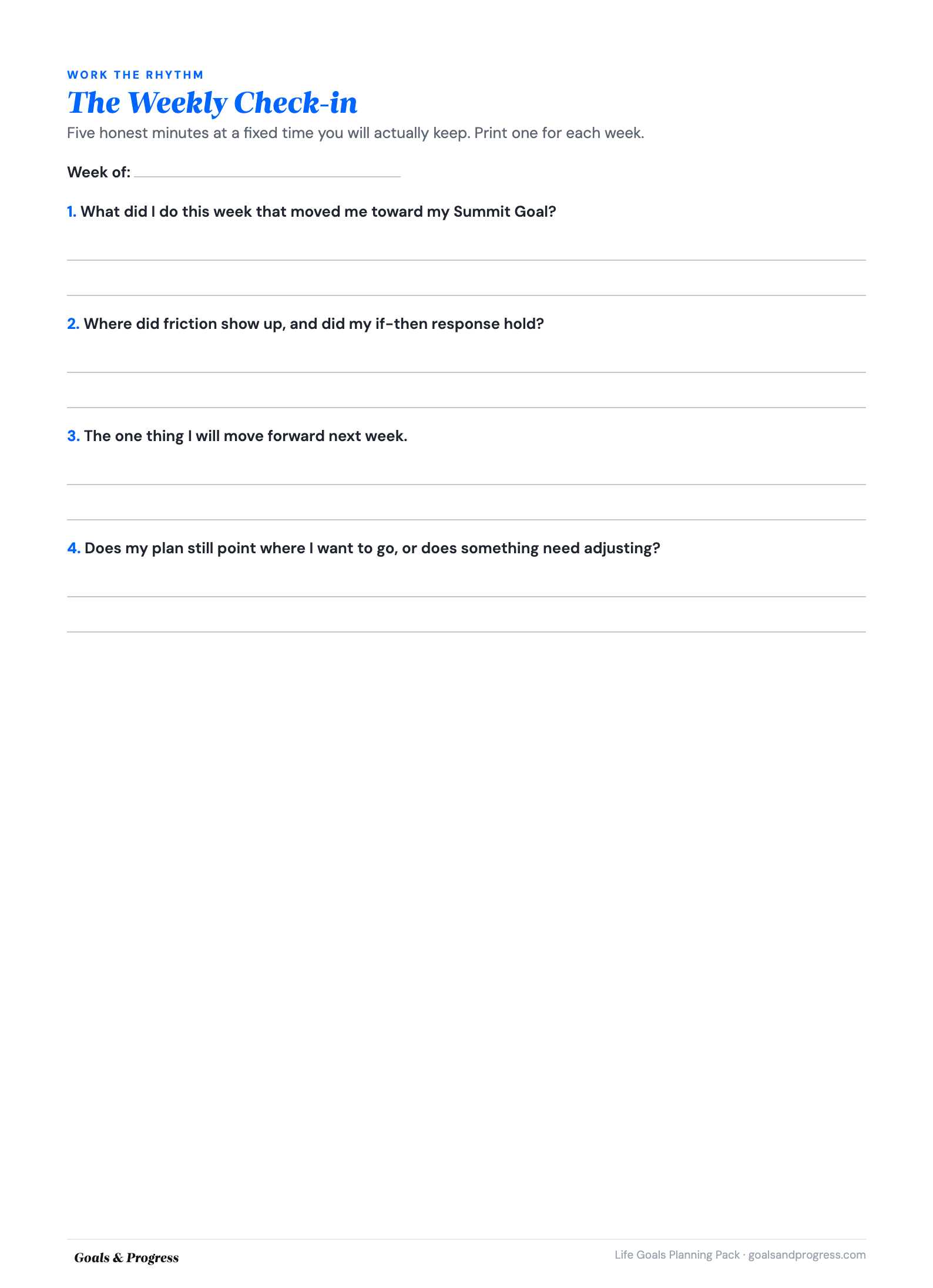
Download the printable weekly review template.
One page, blank and ready to print. No email address needed.
- Four prompts, two writing lines under each
- A line for the week, so a stack of sheets stays in order
- A4 and US Letter, plain black and blue on white
Free to use and print as often as you like. Print one for each week.
The four questions on the sheet
The sheet is one page with a line for the week at the top and four numbered prompts under it, each followed by two writing lines. The questions stay the same every week on purpose, because a review you have to redesign is a review you skip.
| The prompt | What it is doing |
|---|---|
| What did I do this week that moved me toward my Summit Goal? | Separates the week’s activity from the week’s progress, which are rarely the same thing |
| Where did friction show up, and did my if-then response hold? | Tests the obstacle plan you wrote earlier against what the week actually threw at you |
| The one thing I will move forward next week | Protects focus by refusing to let next week’s list grow |
| Does my plan still point where I want to go, or does something need adjusting? | Catches a plan that has drifted, before a whole quarter goes with it |
The two writing lines per answer are a deliberate limit. If a prompt needs a full page, the thing you are writing about belongs in the monthly check-in, where there is time for it.
How to run your weekly review
- Pick a fixed slot and keep it. Friday afternoon and Sunday evening both work; what matters is that it repeats, because a review at a different time each week turns into a decision you can lose.
- Print a small stack of sheets and write the week at the top of each one as you use it. Filed in order, they become a record of the year that takes no effort to keep.
- Answer the prompts in order and write plainly. Name something specific for the first question, even if it is small, and if you genuinely cannot name anything, write that down; a blank week is worth knowing about.
- When an if-then response fails, the response is the part that needs fixing. Rewrite it on the spot so the same obstacle meets a better plan next week.
- Finish with the fourth prompt and stop. Adjusting the plan is a monthly and quarterly job, so use the weekly reflection to notice the drift and the check-in to fix it.
Five minutes is the target and the ceiling. A review that grows into an hour of planning stops happening after about a month, and the version that survives is the short one you can do while the kettle boils.
A filled example you can copy
Here is the sheet filled in for a week that did not go to plan, which is the week worth showing. The Summit Goal behind it is about building a healthier rhythm, and every answer fits on the two lines the sheet gives you.
1. What did I do this week that moved me toward my Summit Goal?
Two of the three planned walks, both at lunch.
Kept the Sunday family block even though the week ran late.
2. Where did friction show up, and did my if-then response hold?
Thursday meeting ran to 19:00, so the evening walk went.
The if-then said walk at lunch instead, and I did not do it.
3. The one thing I will move forward next week
Put Thursday’s walk in the calendar as a lunch slot.
In the calendar, not in my head.
4. Does my plan still point where I want to go, or does something need adjusting?
Yes, the direction is right.
Three walks a week only works if two of them are at lunch. Raise it at the monthly check-in.
Five minutes. Same four questions next week.
Nothing in that sheet took longer to write than the vague version would have. Compare the two side by side and the difference is that every answer on the right names something you could check seven days later.
| Prompt | A weak answer | What the sheet above says |
|---|---|---|
| What moved me toward my Summit Goal? | “Was busy all week” | “Two of the three planned walks, both at lunch” |
| Where did friction show up? | “Things got in the way” | “Thursday meeting ran to 19:00, and the if-then said walk at lunch instead” |
| The one thing for next week | “Do better” | “Put Thursday’s walk in the calendar as a lunch slot” |
| Does the plan still point where I want to go? | “Yes, I think so” | “Yes, but three walks a week only works if two are at lunch” |
Notice what the fourth answer does not do. It spots the problem with the plan and hands it to the monthly check-in instead of rewriting the plan on a Friday afternoon, which is how a five-minute reflection stays five minutes.
What if it does not go to plan
Most weekly reviews die in one of six ways. Each has an answer in the method, and none of them requires a longer review.
What if nothing moved this week?
Write “nothing” on the line and keep going. A blank week is information, and the sheet is worth more for recording it than for hiding it. Then ask what sits behind it: did the week have a plan at all, or did it arrive without one? Two blank weeks in a row usually means the level above went unfilled rather than that the week went badly.
What if the same friction shows up every week?
Then it is not a willpower problem, it is a structural one. An obstacle that repeats has beaten your if-then response several times, so the response is what needs replacing rather than your resolve. Rewrite it as something the calendar can enforce, and if that fails twice more, move the goal’s action to a different part of the week.
What if the answer to the fourth prompt is no?
Note it and stop there. The weekly reflection is built to notice drift, not to fix it, because a plan rewritten on the strength of one week tends to be rewritten again the week after. Take the note into your monthly check-in, which is the level where changing the plan belongs.
What if I have not done one for a month?
Start at the next slot and do not backfill. Four sheets written from memory tell you very little, and the effort of catching up is what stops people restarting at all. If it helps, run a monthly check-in first to see where the plan stands, then pick the weekly rhythm back up from there.
What if it keeps turning into a planning session?
Hold the two-line limit and let the overflow go somewhere else. A review that expands into planning is a review that will be skipped when the week is busy, which is exactly the week you need it. Keep the reflection at five minutes and give planning its own slot at the monthly check-in.
What if I dread doing it?
Look at which prompt you are avoiding. Dread of the first question usually means the goal at the top is not yours, and that is a signal worth taking seriously rather than pushing through. Dread of the whole sheet is more often the slot: a review at the end of an exhausting Friday is a review you will learn to resent, so move it to Sunday and try again.
Where the weekly review fits in the bigger system
A weekly review only has something to review if a plan sits above it. In the Goals and Progress method that plan is the Goal Cascade: a Summit Goal narrows to an annual goal, the year to a quarter, the quarter to a month, the month to a week, and the week to today. The weekly reflection is the point where the bottom of that chain reports back up.
Each level runs the same short loop, at its own pace. Daily and weekly are reflections, monthly and quarterly are check-ins, and the year closes with a wrap-up. The weekly one carries the most weight because it happens often enough to catch a problem while it is still small. You can see how the levels connect in the guide to goal cascading from vision to daily tasks.
If the first prompt is hard to answer because you are not sure what your Summit Goal is, the sheet is not the problem. Work through the life goals worksheet first, then come back to the weekly rhythm with something to review.
Frequently Asked Questions
Weekly review or weekly reflection: is there a difference?
They describe the same five minutes; the Goals and Progress method calls the daily and weekly rhythms reflections, and reserves the word check-in for the monthly and quarterly ones. The two words mark different depths of review. A weekly reflection looks back at the week and picks the next thing, while a monthly or quarterly check-in is where you change the plan itself.
How long should a weekly review take?
About five minutes, which is why the sheet gives you two lines per answer instead of a blank page. Longer reviews are not better; they are just harder to repeat. If you find yourself needing thirty minutes, that is a sign the monthly check-in is overdue.
When is the best time to do it?
The best time is the one you will keep. Friday afternoon closes the working week while it is still fresh, and Sunday evening sets up the week ahead. Pick either, put it in the calendar, and use the same slot every week so it stops being a decision.
What if I skip a week?
Start again at the next slot and let the missed week go. Two skipped weeks in a row is worth a second look, because it usually means the slot sits in the wrong place. Move it and try again.
What size does it print at?
Both sizes are here: A4 portrait and US Letter portrait, one page each, so you can take the one that matches your printer without scaling anything. Black and white printing is fine, since the blue carries no information.
Can I use it without the rest of the pack?
Yes. The four prompts work against any goal you already have, and plenty of people will only ever want this page. The rest of the pack is there if you want the plan that the questions are reviewing, from your values and Summit Goal down to the year, quarter, month, and day.
Related pages
- Life goals: the hub page for the whole method, and the context this sheet sits inside.
- Life goals worksheet: guided exercises for the goal your weekly review is checking on.
- Life goals template: the full cascade on one reusable page.
- Life plan template: the year across your life areas, on one printable page.
- Printable habit tracker: the month grid you read alongside the second prompt.
- Weekly review and planning: the longer guide to running the review as a habit.


