Goals & Progress


Every sheet on this page, plus the rest of the set, is collected on the free printables page: seven goal setting worksheets in A4, A5 and US Letter, all without an email address.
A values list where each entry tells you what it absorbs
A values list is a set of words naming what matters to you, used to narrow down the handful you actually run your life by. There are hundreds of them online, most running to 200 or 400 words, and they share two problems. They are mostly synonyms, and they tell you nothing about what any of the words mean.
So you sit there deciding whether you are more Achievement or Excellence or Mastery or Competence, which is not a values exercise, it is a thesaurus exercise. And a 400-word list produces the pleasant feeling of agreeing with almost all of it, which is the opposite of choosing.
This list is 28 cards. Each one has a description, and each one names the values it absorbs: Achievement says outright that it covers Excellence, Mastery and Competence, so that is one decision instead of four. They are the same 28 cards the Life Goals App deals, with the app’s own wording, so nothing changes when you carry your five across. Interactive version below, printable if you would rather use paper.
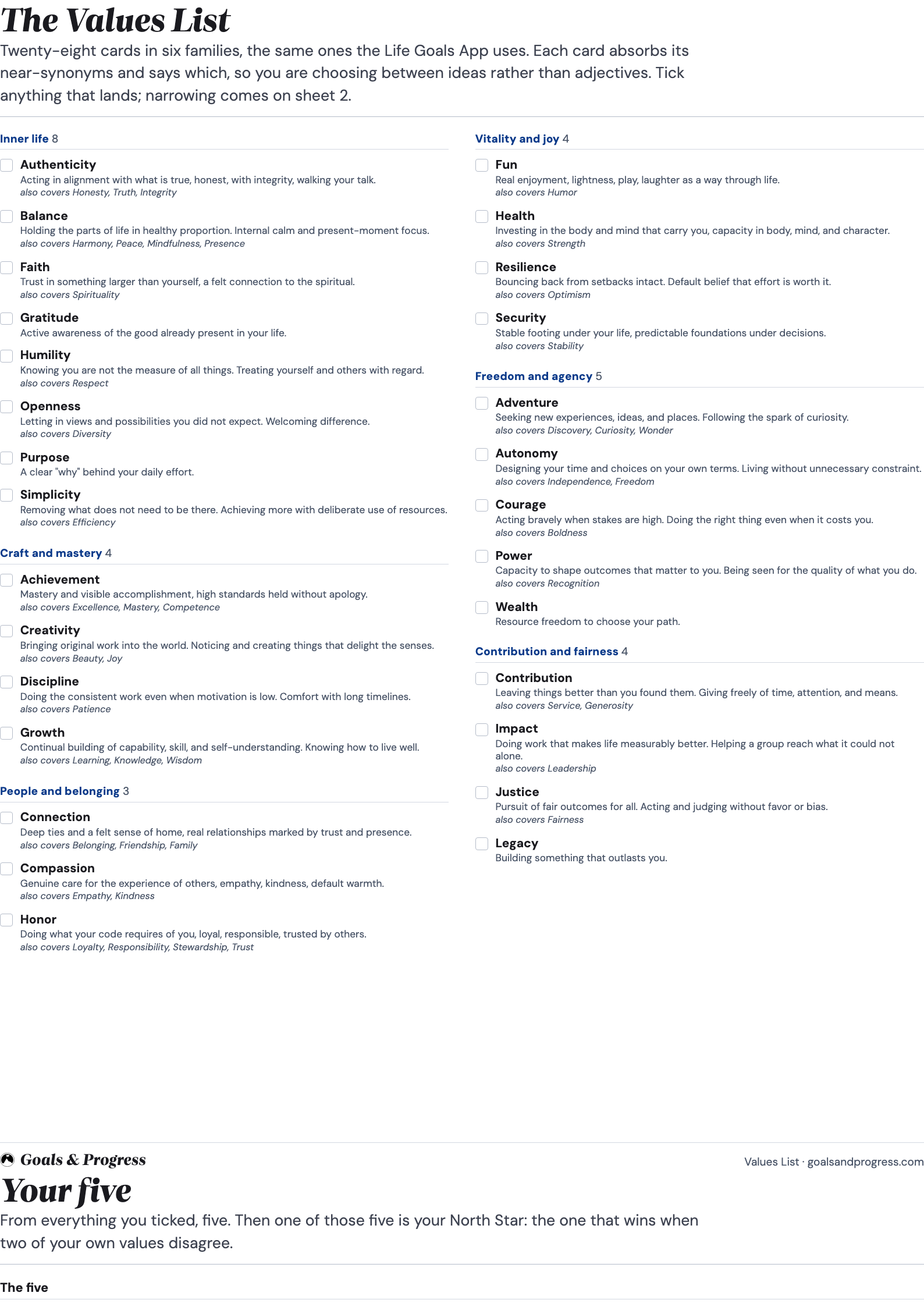
Download the values list.
Two sheets, ready to print. No email address needed.
- Sheet 1: all 28 cards with their descriptions and what each absorbs
- Sheet 2: your five, why each one, and your North Star
- A4, US Letter and A5 for a half-size notebook
Free to print as often as you like. Worth redoing once a year.
28 cards, because most of a 400-word list is synonyms
These are the 28 value cards the Life Goals App uses, with the app’s own descriptions. Each one absorbs its near-synonyms and says so, so Achievement, Excellence, Mastery and Competence are one decision rather than four. Tap to keep a card, tap again for the Maybe pile, and mark one as your North Star. Aim for five. Everything stays in this browser.
2. Your shortlist

The 28 cards, and why not 400 words
Longer is not better here, and it is worth being clear why. A values list has one job: to make you choose. Every word you add makes choosing harder while making the list feel more complete, which is a bad trade dressed as a generous one.
Honesty, Truthfulness, Candour, Sincerity and Integrity are one value with five labels. Offering all five is not more choice, it is a chance to spend twenty minutes picking a favourite adjective. Here they sit inside one card, Authenticity, which says so on its face.
The 28 sit in six families, the same six the app sorts by:
- Inner life (8): Authenticity, Balance, Faith, Gratitude, Humility, Openness, Purpose, Simplicity
- Craft and mastery (4): Achievement, Creativity, Discipline, Growth
- People and belonging (3): Connection, Compassion, Honor
- Vitality and joy (4): Fun, Health, Resilience, Security
- Freedom and agency (5): Adventure, Autonomy, Courage, Power, Wealth
- Contribution and fairness (4): Contribution, Impact, Justice, Legacy
The grouping matters because of what it exposes. When all five of your picks come out of one group, that is a finding: it usually means one part of your life has been doing all the talking. And when a whole group produces nothing at all, that is worth sitting with for a moment rather than moving past.
How to actually cut it down
- First pass, fast and generous. Go through all 28 and keep anything that lands. Do not weigh them against each other yet. Keeping 10 to 14 is the right shape for this stage.
- Second pass: the Maybe pile. Anything you kept because it sounded like the correct answer rather than a true one goes here. Respect, Responsibility and Discipline live here more often than people expect.
- Cut to five. This is meant to hurt slightly. If it does not, the earlier passes were too polite.
- Say why, in one line each. A value you cannot justify out loud is usually inherited rather than chosen. This step removes more values than the cut does.
- Name your North Star. One of the five. The tiebreaker for when two of your own values want opposite things.
The tiebreaker is the whole point
Five values sitting in a row are still just a list, because they never disagree on paper. They disagree in real life, and always in the same way: two of them want the same hour.
Freedom and Security often sit on the same shortlist, and they pull against each other: the job that pays reliably and the one you would rather be doing. Family and Achievement compete for the same evenings. Growth and Peace compete for the same weekend. A ranked set answers those. An unranked set lets you claim both and then feel vaguely bad either way.
That is why the last question on the printable is where your North Star is already being ignored. Not as an accusation, and not because you are doing it wrong. It is the part of this exercise that changes what happens next week.
Where this list comes from
Sorting values from a fixed deck of cards is a long-standing practice in counselling and coaching, and the version in common use descends from the values card sort used in motivational interviewing. The six-group structure here is loosely informed by Schwartz's work on how values cluster across cultures, without claiming to reproduce his model.
The six groups are the ones the Life Goals App uses. The app itself works from a shorter deck of 28 consolidated cards, where each card stands for a cluster of related values, because a card sort you do on a phone wants fewer cards than a list you scan on paper. So the vocabulary here is wider than the app's deck by design, and your five carry over into the same six families with the same North Star.
Inner life 8 cards
Authenticity
Also covers: Honesty, Truth, Integrity
You say the same thing in a meeting that you say in the car afterwards. Your calendar shows what you claim to care about. When you promise a friend something small, you do it, or you tell them plainly that you cannot. Authenticity also covers what you admit to yourself: naming a want you have kept hidden, or dropping a role you took on to please one person.
- Why those words became one card
- Honesty is truth in what you say. Integrity is truth in what you do. Truth is the standard both point at. One card holds all three, since splitting them lets a person claim two and skip the third.
- How it differs from its closest neighbour
- Honor measures you against a code and against what you owe other people: loyalty, responsibility, stewardship, trust. Authenticity measures you against your own inner position. You can keep every obligation and still hide what you think, and you can speak your truth and let people down.
- The question that points to it
- Have you dropped a role or a group you had joined only to please one person, and said why?
- A goal anchored to this value
- Tell my partner the thing about our weekly routine that I have avoided saying, within the next month, and agree on a changed plan that we both write down.
Balance
Also covers: Harmony, Peace, Mindfulness, Presence
You stop work at a set hour and the evening stays yours. You notice you are rushing and slow down. Sleep, food and movement hold steady in a busy week, not only in a calm one. Balance shows on an ordinary Wednesday. A holiday that repairs a hard quarter is repair work, and it is not the same as proportion held week by week.
- Why those words became one card
- Harmony and peace describe proportion between the parts of a life. Mindfulness and presence describe attention to the part you are in right now. Both are the same skill, held outward and inward, so one card covers them.
- How it differs from its closest neighbour
- Simplicity is about removing things. Balance is about keeping them and setting their size. A full life of work, family and sport can sit in good proportion while holding far more than a simple life allows. Cutting is one method for balance, and it is not the definition.
- The question that points to it
- Have you kept a hobby you love but cut its hours, so the other parts of your week still fit?
- A goal anchored to this value
- Keep two evenings a week with no screens and no work for three months, and mark each one on a paper calendar so the gaps are visible to me.
Faith
Also covers: Spirituality
You act as if your life sits inside something larger than your own plans. That can be a religion, a practice of prayer, meditation, or regular time in nature. It shows in habits with no output: a service you attend, a text you read every week, a silence you keep. Faith also shows in how you carry the outcomes you cannot control.
- Why those words became one card
- Spirituality names the same trust without naming a religion. A separate card would force a choice between the practising version of this value and the unaffiliated one, so a single card covers both, and the form stays open.
- How it differs from its closest neighbour
- Purpose is a why you can write down and check against your week. Faith is trust in something you cannot verify. A person can hold a clear purpose with no faith at all, and can hold deep faith while still unsure what to do on Monday morning.
- The question that points to it
- Do you keep a weekly practice that produces nothing, such as a service, a prayer, or a silent hour?
- A goal anchored to this value
- Attend a weekly service, or sit for twenty minutes of quiet practice every morning, for six months, and keep a short paper log of the days I did it.
Gratitude
Also covers: nothing. This card stands on its own.
You notice what is already working before you list what is missing. It shows in specific acts: telling a friend what they did well, writing to someone whose help you never acknowledged, or naming three concrete good things from a day that went badly. This is a practice of attention, so it is visible in what you say out loud and what you write down.
- Why those words became one card
- Gratitude stands alone since no neighbouring card contains it. Humility is about your size next to others. Faith is about trust in something larger. Neither requires you to notice what you already have, which is this card.
- How it differs from its closest neighbour
- Humility is about your place among other people and about the limits of what you know. Gratitude is about what you have received. A modest person can take every good thing for granted, and a very confident person can thank people every single day.
- The question that points to it
- Have you written to someone years later, naming help they gave you that you never mentioned at the time?
- A goal anchored to this value
- Write one short thank-you message every week for a year to a person who helped me, and keep the sent list so I can read the fifty names at the end.
Humility
Also covers: Respect
You treat the person serving you and the person hiring you the same way. You can say you were wrong without a long defence, and you can change your position when someone shows you better information. Humility also covers how you speak about yourself. You state what you did without inflating it, and you name the help you had along the way.
- Why those words became one card
- Respect is humility pointed at other people. Both rest on the same position: you are one person among many, with no special claim. Two cards would split a single attitude into an inward half and an outward half.
- How it differs from its closest neighbour
- Openness is about ideas and people you did not expect, and someone with a very high opinion of themselves can still hold it. Humility is about your own standing. You can welcome every strange idea and still think you are the smartest person in the room.
- The question that points to it
- Have you said plainly that you were wrong, in front of others, without explaining why you almost had it right?
- A goal anchored to this value
- Ask my partner, my closest friend and my brother what I get wrong, listen without answering back, and change one visible habit within a month of hearing them.
Openness
Also covers: Diversity
You read the argument on the other side before you decide. You spend time with people whose background does not match yours, and you let that change what you plan and do. Openness shows in small choices: taking the route you have not taken, saying yes to an invitation outside your usual circle, or changing a firm opinion after one good conversation.
- Why those words became one card
- Diversity is openness applied to people instead of ideas. Both describe letting in what is different from you. Naming them separately would suggest a person could welcome unfamiliar ideas while keeping a distance from unfamiliar people.
- How it differs from its closest neighbour
- Adventure is about going out to find new experience: discovery, curiosity, wonder. Openness is about what you do with the unfamiliar when it arrives on its own. A person can travel constantly and still reject every view that contradicts what they already hold.
- The question that points to it
- Have you changed a plan of your own after spending time with people whose background is nothing like yours?
- A goal anchored to this value
- Read six books this year by authors from countries I have never visited, and write one page on the point in each book that changed how I think.
Purpose
Also covers: nothing. This card stands on its own.
You can say what your daily effort is for, in one plain sentence, without checking a document. It shows when you turn down a good option since it does not serve that sentence, and when you keep going through a dull stretch of work while the direction still holds. Purpose is testable. Look at last month and see whether the hours match the sentence.
- Why those words became one card
- Purpose stands alone because no other card here covers the same ground. Faith is trust in something larger. Impact is the result you produce. Purpose is the reason behind your daily effort, and it can exist with or without either.
- How it differs from its closest neighbour
- Impact is measured outside you, in what changed for other people, and it takes in leadership. Purpose is measured inside you, in whether the reason still holds. A person can produce large results with no clear why, and can hold a firm why while the results stay small.
- The question that points to it
- Have you refused a good offer because it did not fit the plain reason you give for your daily effort?
- A goal anchored to this value
- Write my why in one sentence, then review my calendar every Sunday for six months and mark the hours that served it, until half of my free time matches.
Simplicity
Also covers: Efficiency
You own fewer things and you finish more of what you start. It shows in a short list of commitments, a wardrobe you can see in one look, and a week with space left in it. Simplicity also covers effort. You pick the method with fewer steps, and you stop a task once it is good enough for its real use instead of polishing it.
- Why those words became one card
- Efficiency is simplicity applied to effort and resources instead of possessions and commitments. Both describe removing what does not need to be there. A separate efficiency card would repeat the same instruction in slightly different words.
- How it differs from its closest neighbour
- Balance is about proportion between the parts you keep. Simplicity is about how many parts there are at all. A simple life can sit far out of proportion, with one activity filling every hour, and a balanced life can hold many parts at once.
- The question that points to it
- Have you given away things you still liked, or cancelled plans you enjoyed, to keep your list of commitments short?
- A goal anchored to this value
- Cut my recurring commitments from nine to four by the end of the year, and give away one bag of unused things every month until the store room is empty.
Craft and mastery 4 cards
Achievement
Also covers: Excellence, Mastery, Competence
You care about the standard of the thing you make, not only that it got done. You redo the paragraph, the recipe, the repair, because you can see the gap between what you produced and what you wanted. You want proof you can point at: a finished piece, a time on the clock, a skill you can show someone. Praise is welcome. You hold that standard whether or not anyone is watching.
- Why those words became one card
- Excellence, Mastery and Competence describe the same drive at different stages: the standard you hold, the skill that meets it, and the result other people can see. One card carries all three.
- How it differs from its closest neighbour
- Growth is measured against the person you were last year. Achievement is measured against a standard outside you: the finished result, the record, the level. You can grow a lot in a year and still miss the standard you set.
- The question that points to it
- Have you redone something you had already finished, at home, because you could see it missed the standard you set?
- A goal anchored to this value
- Play the whole Bach prelude from memory at my sister's birthday in June, at full tempo, with no stops. I will record it once a month to hear the gaps.
Creativity
Also covers: Beauty, Joy
You need to be making something, and you feel it when you are not. It can be a song, a garden bed, a meal, a piece of furniture, a photograph. You notice how things look and sound, and you change them until they feel right to you. Finishing matters less than the fact that the thing exists and came from you. Most of the pleasure is in the making itself.
- Why those words became one card
- Beauty and Joy sit here because both come from the same act. Making something and shaping how it looks, sounds or tastes is one motion, and the pleasure of it is part of the reason you do it.
- How it differs from its closest neighbour
- With Adventure you go looking for what already exists and is new to you: a place, an idea, an experience you have not met yet. With Creativity there is nothing to find. You make the thing, and it starts existing when you make it.
- The question that points to it
- Have you given up rest hours in a busy month to keep making something with your own hands?
- A goal anchored to this value
- Write and record six songs this year, and play three of them at the open mic on the first Tuesday in November, so other people hear them.
Discipline
Also covers: Patience
You decide once, then you stop arguing with yourself every morning. The run happens on the gray Tuesday as well as the bright Saturday, because the day of the week was never the reason. You are comfortable with slow. A skill that needs four years is still worth starting, and a bad week does not mean you have failed. You pick a smaller promise you can keep over a big one you cannot.
- Why those words became one card
- Patience belongs here because it is Discipline over a long span. Doing the work today when you do not feel like it, and waiting three years for the result, are the same act at two time scales.
- How it differs from its closest neighbour
- Resilience is what you use after something goes wrong: the illness, the rejection, the year you lost. You use Discipline when nothing has gone wrong. This is the ordinary Wednesday, where there is no setback to recover from, only a task you do not feel like doing.
- The question that points to it
- Have you kept a daily routine going through an ordinary month, on the days you did not want to?
- A goal anchored to this value
- Practice Spanish for fifteen minutes before breakfast every weekday until the end of the year, and hold a ten minute conversation with my neighbor in December without switching to English.
Growth
Also covers: Learning, Knowledge, Wisdom
You want to be better at something in December than you were in January, and you can name what. You read the book that is slightly too hard. You ask for the feedback you would rather not hear. Being a beginner does not embarrass you, so you start things badly on purpose. Some of what you build is skill you can show. Some of it is understanding yourself better, which nobody else will see.
- Why those words became one card
- Learning, Knowledge and Wisdom are three stages of the same process. You take something in, you can use it, and you know when to use it. Separate cards would make you choose between stages that only work together.
- How it differs from its closest neighbour
- You can reach a target without getting any better, by doing what you already know how to do. With Achievement you measure the result. With Growth you measure the change in you, so a failed attempt that taught you something still counts.
- The question that points to it
- Have you started something new in front of other people while you were still visibly bad at it?
- A goal anchored to this value
- Take the beginner pottery course in the fall and come out able to throw a bowl on the wheel by myself, with six finished pieces on the kitchen shelf.
People and belonging 3 cards
Connection
Also covers: Belonging, Friendship, Family
This value is visible in how you spend your week. You keep the Thursday call with your brother even when work is heavy. You remember which friend is having a hard month, and you ask about it again later. You pick the dinner where you can hear people talk. You stay in touch when there is no news to report, because the relationship matters to you more than the update.
- Why those words became one card
- Belonging, Friendship and Family describe one need in three settings: a group where you are known, people who chose you, people you grew up with. Splitting them turns a single choice into three near-identical ones.
- How it differs from its closest neighbour
- Connection is about the people you stay close to over years. Compassion applies to anyone, including a stranger you will never see again. You can care for someone in a difficult moment without wanting them in your life every week.
- The question that points to it
- Have you kept a regular call with a relative or friend through a very busy month, with no news to share?
- A goal anchored to this value
- Set one recurring evening each month for a meal with the same three friends, booked for the whole year, and count it as met only when the four of you are at the table.
Compassion
Also covers: Empathy, Kindness
Compassion is what you do in the twenty seconds after you notice someone is struggling. You ask a second question instead of moving on. You carry the bag without being asked. You keep your voice level with the tired person at the counter. You give the benefit of the doubt to the driver who cut in. The care is ordinary, and it happens whether or not anyone sees it.
- Why those words became one card
- Empathy is noticing what another person is going through. Kindness is acting on it. They are two halves of the same habit, and separating them would make you rank the feeling against the act.
- How it differs from its closest neighbour
- Compassion is how you treat the person in front of you right now. Contribution is what you give to people you may never meet, in time, money or effort. You can be warm to everyone you meet and still give nothing away.
- The question that points to it
- Have you stopped for a stranger who was struggling, and stayed long enough that it made you late?
- A goal anchored to this value
- Learn the names of the four neighbors on your floor and check on the oldest one every Sunday through the winter, keeping a short note of each visit.
Honor
Also covers: Loyalty, Responsibility, Stewardship, Trust
Honor is what happens after the enthusiasm has gone. You said you would help your friend move, so you show up on the cold Saturday. You pay back the money in the week you promised, not when it is convenient. When you have a problem with someone, you tell them yourself. You look after what was handed to you, whether that is a house, a savings account or a friendship.
- Why those words became one card
- Loyalty, Responsibility and Stewardship are the same promise pointed at different things: a person, a task, and something placed in your care. Trust is the result. You earn it from the people around you by keeping the first three.
- How it differs from its closest neighbour
- Authenticity is about matching your words to what is true inside you. Honor is about matching your actions to what you promised, even after you have changed your mind. Being honest about not wanting to help does not release you from the help you already agreed to give.
- The question that points to it
- Have you kept a promise to help someone on a day when you no longer wanted to keep it?
- A goal anchored to this value
- Write down every promise you make to your family for three months. Review the list each Sunday and finish anything still open before you agree to something new.
Vitality and joy 4 cards
Fun
Also covers: Humor
You keep time in the week that has no purpose beyond enjoying it. On a Tuesday evening you play a card game with the people you live with instead of clearing the inbox. You make a joke when the car trip has gone long and quiet. Fun as a value means protecting that time when the calendar fills up, and not treating it as the reward that comes after everything else is finished.
- Why those words became one card
- Humor is enjoyment in conversation, and play is enjoyment in time. Both come from the same preference for lightness, so the deck keeps them on one card instead of splitting a trait into two.
- How it differs from its closest neighbour
- Creativity is about making something that did not exist before, and the enjoyment comes from the work and from the result. Fun needs no product. An afternoon of cards leaves nothing behind, and for someone who holds Fun that is fine.
- The question that points to it
- Have you spent a free evening on play that produced nothing, while unfinished jobs were still waiting for you?
- A goal anchored to this value
- Hold twelve game nights this year, one each month, with all twelve dates in the calendar before the end of January and a short note after each one about who came.
Health
Also covers: Strength
You treat sleep, food and movement as decisions you make, not as things that happen to you when there is time left over. You notice when a week has left you with nothing in reserve, and you plan the next one differently. Health as a value covers the mind as well: reading, rest, and stopping work while there is still energy left for the evening. These choices happen on ordinary weekdays.
- Why those words became one card
- Strength is the visible result of the same daily choices. Training, sleep and food build it, and they are the same things that keep a body working over years. A separate Strength card would repeat the same question.
- How it differs from its closest neighbour
- Discipline is the ability to keep doing the work when motivation is low, whatever that work is. The method is the same for a thesis and for a marathon. Health names what you are protecting, so the two often pair, but they are separate choices.
- The question that points to it
- Have you left a party early, or turned down food you like, to protect your sleep or your training?
- A goal anchored to this value
- Walk or cycle to the station four mornings a week for the next three months, and keep an eleven o'clock lights-out on work nights, both marked on a paper calendar in the kitchen.
Resilience
Also covers: Optimism
A plan fails, and a day later you look at what is left and start again. You can see this value in how quickly you return to the work after a rejection, an injury, or a month where nothing moved. You can see it too in how much of the first goal survives the setback. Someone who holds Resilience keeps the same target and changes the route.
- Why those words became one card
- Optimism here means the working assumption that effort pays off. That assumption is what makes a person begin again after a setback, so it sits on the recovery card. Alone it would describe only a mood.
- How it differs from its closest neighbour
- Courage covers the moment before the outcome, when the risk is ahead and you act anyway. Resilience covers the moment after, when the result is already bad. A person can take a large risk and then stop at the first failure.
- The question that points to it
- After a plan of yours failed, did you begin again within days, still aiming at the same result?
- A goal anchored to this value
- Finish the half marathon in October after last year's injury, with a printed training plan on the fridge and a rule that one missed week does not end the plan.
Security
Also covers: Stability
You keep money in the bank and you know how many months it would cover. You sign a longer lease instead of moving every year. You make a decision once and then leave it alone, because a settled base is worth more to you than a slightly better option found by switching. Someone who holds Security also keeps the risks small in the parts of life that other people depend on.
- Why those words became one card
- Security is about the base holding, and Stability is about it holding for a long time. They describe the same preference at two points in time. A foundation that is safe today and gone next year provides no security.
- How it differs from its closest neighbour
- Wealth is about the range of choices money buys. Security is about the floor under you. Once the floor is solid, a person holding Security stops adding, while a person holding Wealth keeps building, because for them the point is the next option, not the buffer.
- The question that points to it
- Have you turned down a better place to live and stayed where you were, so that nothing had to change?
- A goal anchored to this value
- Build six months of expenses in a separate savings account by the end of next year, adding a fixed amount on the first of each month and checking the total every quarter.
Freedom and agency 5 cards
Adventure
Also covers: Discovery, Curiosity, Wonder
Someone who lives by Adventure keeps saying yes to the unfamiliar. They book the trip before the details are settled. They order the dish they cannot pronounce. They read outside their field and change routes on the way home for no reason beyond wanting to see the other street. When several weeks look the same, they change something. They put new experiences into the calendar first, ahead of the things that could happen any week.
- Why those words became one card
- Discovery, Curiosity and Wonder are three parts of the same experience of meeting something new. Curiosity is the interest itself, discovery is what you find, and wonder is what follows finding it.
- How it differs from its closest neighbour
- Openness is about what you let in when something unfamiliar arrives: another view, another way of living. Adventure is about what you go out and look for. You can travel widely and still reject every idea you meet, and you can stay home and change your mind often.
- The question that points to it
- Have you booked a trip before the details were settled, giving up a calmer plan you already had?
- A goal anchored to this value
- Spend two weeks travelling in a country where you do not speak the language, planned and booked by the end of March, with only the first three nights arranged in advance.
Autonomy
Also covers: Independence, Freedom
You can see this value in the structure of someone's day. They decide when work starts and when it stops. They can leave an arrangement that no longer suits them without asking permission. They keep the skills, savings and contacts that make more than one option real. They will often trade money or status for control of their calendar, and count that trade as a good one.
- Why those words became one card
- Independence and Freedom name the same thing from two sides. Independence is not depending on someone else for what you need. Freedom is the absence of rules you did not agree to. Autonomy covers both.
- How it differs from its closest neighbour
- Power is the capacity to change outcomes that involve other people. Autonomy is control over your own life only. A freelancer with no staff and no influence over their industry can have complete autonomy and almost no power, and be content with that.
- The question that points to it
- Have you accepted less money in exchange for deciding yourself when your day starts and when it stops?
- A goal anchored to this value
- Reach the point where you can cover twelve months of personal costs from savings by December, so leaving a job you dislike is a decision you can make in a week.
Courage
Also covers: Boldness
Courage is visible in the moments where staying quiet would be easier and cheaper. You say the unwelcome thing in the room where it is relevant, not afterwards to someone safe. You start the conversation you have been putting off for months. You accept a real cost: a lost contract, or a friendship that ends. The cost is known in advance and paid anyway.
- Why those words became one card
- Boldness is the everyday form of courage. It covers the smaller version, asking for the raise or sending the first message, where the risk is real but nobody's safety is involved. Both describe deciding to act despite the risk.
- How it differs from its closest neighbour
- Resilience is what happens after something goes wrong. You recover and carry on. Courage is what happens before, when you choose the risk while you can still avoid it. You can be very good at recovering from trouble you never chose.
- The question that points to it
- Have you started a conversation you had put off for months, knowing it could end the friendship?
- A goal anchored to this value
- Say the thing you have avoided saying to a family member for three years, in person, before the end of the year, and stay for their answer.
Power
Also covers: Recognition
Power is the ability to make something happen that would not have happened otherwise. In practice that means having a say in decisions, control of a budget or a schedule, and a reputation that other people act on. Someone who holds this value builds those positions on purpose. They also want their work attributed to them, and they will say so rather than wait to be noticed.
- Why those words became one card
- Recognition merges into Power because being known for your work is what gives you influence over decisions. Without credit, other people do not know whose work it was, and the next invitation goes elsewhere.
- How it differs from its closest neighbour
- Impact is measured by the result for other people. Power is measured by your capacity to decide, whatever the result. A volunteer with no title can have large impact and no power, and an executive can hold a lot of power and use very little of it.
- The question that points to it
- Have you taken charge of a family or group decision on purpose, so that your view would settle it?
- A goal anchored to this value
- Get elected to the committee of your local sports club at the next vote, and be the person who decides how the training schedule is set.
Wealth
Also covers: nothing. This card stands on its own.
Wealth means having enough money that you rarely have to choose by price. You can turn down work you do not want. You can pay for a flight to a funeral without checking the balance first. You can take the slower and better option. Someone who holds this value names a target figure, keeps their spending under what they earn, and treats the gap between the two as the thing they manage.
- Why those words became one card
- Wealth is its own card because it is not a form of Security or Power. A person can be secure on a modest income, and can hold power without money. Wealth is what is left once the bills are covered.
- How it differs from its closest neighbour
- Security is having enough that nothing collapses when something goes wrong. Wealth is having more than that amount, on purpose. A steady salary with a full emergency fund is enough for Security. It is not enough to pay for two years away from work.
- The question that points to it
- Have you kept saving past the point where a bad year was covered, aiming at a figure you had named?
- A goal anchored to this value
- Raise your savings rate to a fixed share of income each month and reach a written net-worth figure by the end of next year, checked once a quarter against the number.
Contribution and fairness 4 cards
Contribution
Also covers: Service, Generosity
Living by contribution means you decide in advance what share of your week and your income goes to other people, and you protect that share when the calendar gets full. You take the unglamorous jobs: the lift to the airport, the two hours of setup, the small standing donation. You keep doing it when nobody notices. You can check it by counting the hours and the money that went to someone else last month.
- Why those words became one card
- Service and generosity are two ways of doing the same thing: giving time and effort, or giving money and things. Both start with the choice to spend your own resources on someone else.
- How it differs from its closest neighbour
- Compassion is about how you feel toward people and how you treat them face to face. Contribution is about what you hand over. You can give money to strangers you never meet, and you can feel deep care without giving anything.
- The question that points to it
- Last month, did you give away a fixed share of your time or money that you had set in advance?
- A goal anchored to this value
- Give 40 hours to the local sports club this year. Write each session in your calendar, so in December you can count the exact number instead of guessing.
Impact
Also covers: Leadership
Living by impact means you choose what to work on by the size of the difference it makes, and then you check. You ask how many people were helped, or by how much something improved. If a project feels good and changes nothing, you stop it. You step to the front of a group when the group needs someone to organize it, and you stay with it until the job is finished.
- Why those words became one card
- Leadership is one way to get a bigger result: you take charge of a group so the group achieves what its members could not separately. The reason for leading is the result, so it sits inside impact.
- How it differs from its closest neighbour
- Impact is measured while you are still here. You can see the numbers change and adjust what you do. Legacy is measured after you are gone, so the thing has to keep working without you. A large impact can end the day you stop.
- The question that points to it
- Have you stopped something you enjoyed doing after you checked and found it changed nothing for anyone?
- A goal anchored to this value
- Teach 10 children in your neighborhood to swim 25 meters this year. Keep a list of names, and at the end of the summer count how many can do it.
Justice
Also covers: Fairness
Living by justice means you use the same rule for people you like and people you do not. You pay a friend the same rate as anyone else. You split the chores, the inheritance, or the last seat by a rule you set before you knew who would benefit. When a decision favors you, you say so out loud and let someone else check it.
- Why those words became one card
- Fairness is the everyday word for the same standard: equal treatment, equal shares, no special deal for your favorites. Justice is that standard applied to bigger decisions, so keeping both as separate cards would split one idea.
- How it differs from its closest neighbour
- A person with honor keeps promises to their own people and follows their own code, which favors the person closest to them. A person with justice uses one measure whoever is involved. The difference shows when a friend is in the wrong.
- The question that points to it
- When a friend was in the wrong, did you apply the same rule you would use for a stranger?
- A goal anchored to this value
- Before the family holiday, write down how the costs will be split and who does which job, agree it with everyone in January, and keep the same split even when someone complains later.
Legacy
Also covers: nothing. This card stands on its own.
Living by legacy means you pick work with a long timeline and you build it so someone else can run it. You write the recipes down. You teach your daughter the trade instead of doing the job for her. You put money and work into things that continue after your lifetime, such as an orchard, a building, or a fund with your family name on it. You accept that you will not see the finished state.
- Why those words became one card
- No other card merges here, because the test is different. Impact and contribution can both be checked this year. Legacy can only be checked later, by whether the thing still runs once you are not there.
- How it differs from its closest neighbour
- With impact you count how much is better now. With legacy you count what remains in 30 years. A legacy project can look small this year and still be the right one, because the work goes into handover: written records, trained people, money set aside.
- The question that points to it
- Have you taught someone a job slowly, instead of doing it yourself quickly, so it continues without you?
- A goal anchored to this value
- Record 12 interviews with your parents about the family history this year, one each month, and give every sibling a copy of the finished audio before Christmas.
Common questions
What is the difference between this and a personal values test?
A test asks you questions and infers your values. A list hands you the vocabulary and makes you choose. Choosing is more uncomfortable and more accurate, because nobody is guessing on your behalf. If you would rather be walked through it, the Core Values Finder is the guided card-sort version of the same exercise.
How many core values should I have?
Five, and the reason is practical rather than magical: five is roughly the most you can recall in the moment a decision is being made. A list of ten is a document. A list of five is a tiebreaker you can actually use.
Can my values change?
Yes, and the useful signal is the order changing. New words come and go; a new top three means something moved. Security climbing your ranking after a child arrives, or Freedom climbing after a long stretch of duty, is information about your life rather than inconsistency. Worth redoing once a year.
Is anything I type here stored?
No. Your picks stay in your browser's local storage so the list is still there when you come back, and Save file gives you a copy you control. Nothing is transmitted.
Related tools
- Core Values Finder: the guided card sort, if you would rather be walked through it
- Wheel of Life assessment: which part of your life to work on, scored
- Life Areas Map: goals across the ten life areas
- Friction Map: for when a value and your week are in open conflict