Goals & Progress



Write your next five years three times, then pick one
The Vision step of the Goals & Progress Life Goals App holds three plans for the same five years. You write all three and make one of them your active vision. You then write your Summit Goals and run your check-ins from that plan.
Where you are in the journey
You have a score for each life area and two or three areas in focus. That was the guide before this one, Score your life areas and pick your focus. After this one you turn the picture into dated goals, in Set one Summit Goal for each focus area. A Summit Goal is the outcome you want five to ten years out.
What you will learn
- What Plan A, Plan B and Plan C are for.
- How to write the three plans and how to pick one.
- Which control makes a plan your active vision, and which one changes only what you read.
- How to answer the five interview prompts.
- Where your active vision comes back later in the year.
Why three futures and not one?
Your first plan is almost always the safe one, because it is the plan you already assumed. Writing two more shows you what you gave up without ever deciding to give it up.
- Plan A continues the path you are on: same work, same city, same people, done with care.
- Plan B answers the question on its own tab: what if your current path closed, through a job loss, a move or a life change?
- Plan C drops the limits: money, status and what other people expect of you.
Plan A is the active one when you begin, so writing only Plan A still leaves you with a vision. The app’s own page sets out the same three ideas. Our three futures exercise runs them on paper, where they are called Future A, Future B and Future C.
Write the three plans
The step takes about 12 minutes. On the Life Areas step you wrote a hurdle for each focus area, in the Challenges field. The app puts that hurdle into your Plan B and Plan C questions.
On the computer you see the three plans side by side, one card each.
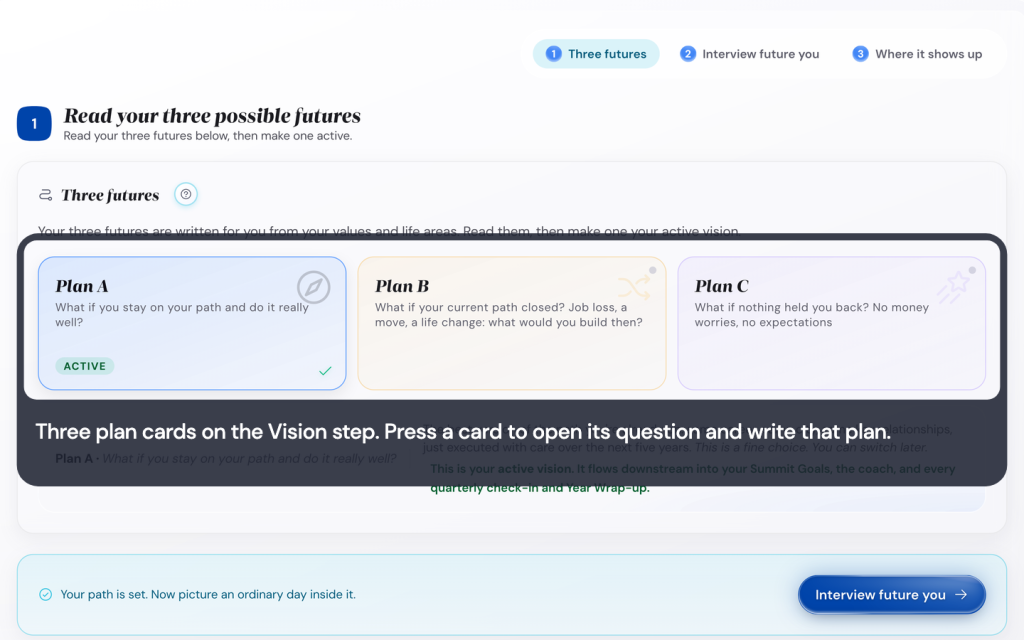
Press a card and its question opens in the bar under the row.
- On the phone, open Home, then Vision. On the computer, open Vision in the step strip.
- Read the question under Plan A on the Three futures tab, which is open already.
- Press Plan B, read its question, then press Plan C and read that one.
- Press the plan you want to write first, then press Interview future you.
- Fill in the five prompts, or write one paragraph in the field under them.
- Go back to Three futures and press the next plan.
- Press Interview future you again and write that plan.
- Repeat until you have filled three prompts, or written 80 characters, in each plan.
On a phone the same three cards stack instead.
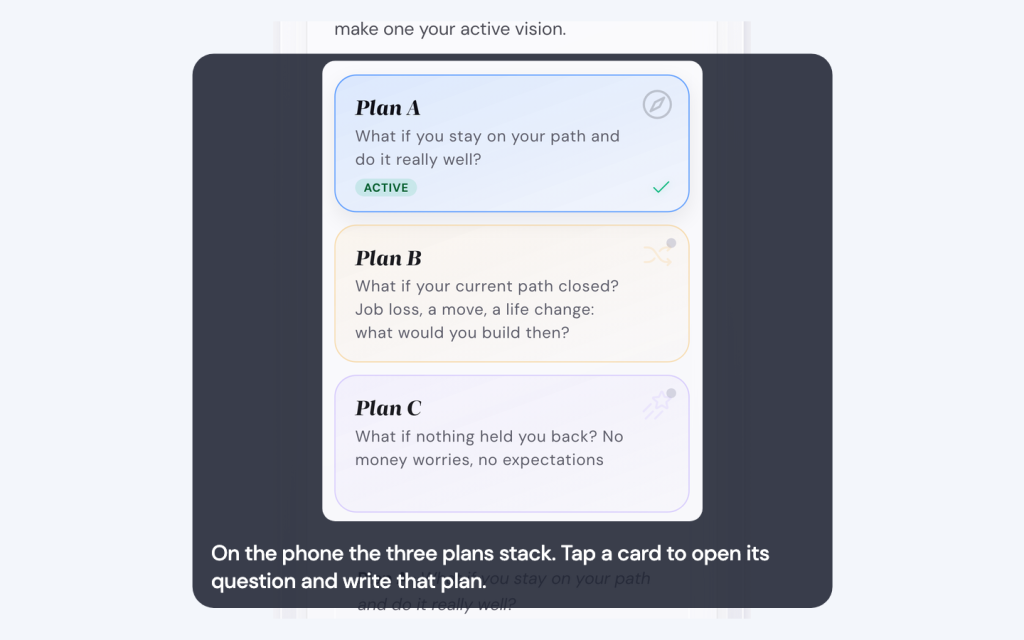
Scroll past them to reach the plan you opened.
Each plan keeps its own five answers and its own paragraph. Maya Chen, the example plan’s branch manager, wrote that she never trained before last year. She reads it again in her Plan B question. The app’s walkthrough has the same step.
Answer the five prompts as the person you are in five years
The Interview future you tab opens with your name and the year: Interview with Maya, 2031. Under that sit five half sentences for you to finish.
- I wake up in
- The first hour of my day is
- The people I spend time with are
- My work this season is
- At the end of a Tuesday I feel
In the example plan those five rows carry Maya’s answers.
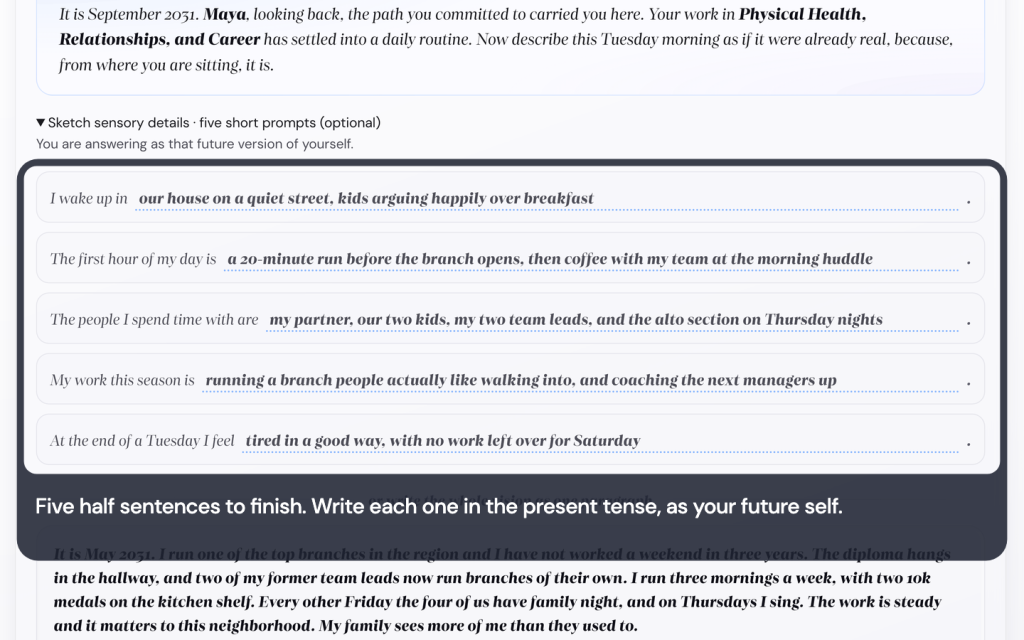
Write in the present tense, as if the five years had passed. Maya finished the first one with “our house on a quiet street, kids arguing happily over breakfast”.
Name small dull details: what is on the table, what you can hear. A line you could photograph still works in a year.
You can skip the prompts and write one paragraph instead, under or write the whole vision as one paragraph. Maya’s paragraph opens: “It is May 2031. I run one of the top branches in the region”.
Write two common past tense verbs there, such as was or went, and a small note appears: “A few past-tense verbs detected. Try present tense.” If seven questions suit you better than five, our letter to my future self builder prints one.
A prompt counts at eight characters. Until three of them do, or the paragraph holds 80 characters, you cannot press Continue to Summit Goals.
Make one plan your active vision
Read the three Tuesdays one after the other and pick the one you would be sorriest to lose. Pick Plan A to carry on with what already works. Pick Plan B for something different that you could still reach. Pick Plan C for the stretch you would never choose while playing safe.
- Press the tab of the plan you want.
- Press Make Plan B my active vision, with the letter of the plan you are reading.
- Read the message that follows: “Plan B is now your active plan. Summit Goals, Quarter Check-in, and the coach now adapt to this framing.”
You find the button at the end of the plan you are reading, under the green line with your active vision.
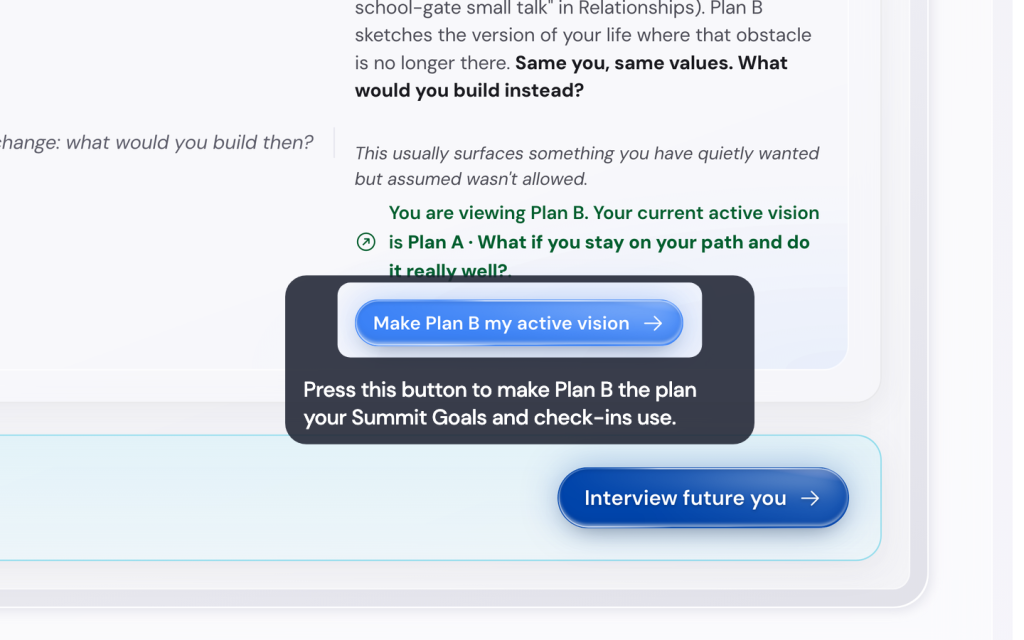
Pressing a plan changes only what you read and edit. Only one control changes which plan the later steps use, and it appears while you read a plan that is not the active one.
You will not always see that control. If your active plan is still empty and another plan reaches the gate, the app makes that plan active for you. A small Active mark shows on the tab of the active plan. The plans you did not pick keep every word.
Where your active vision comes back
Your active vision reaches five places. The Where it shows up tab names the ones that are live for you.
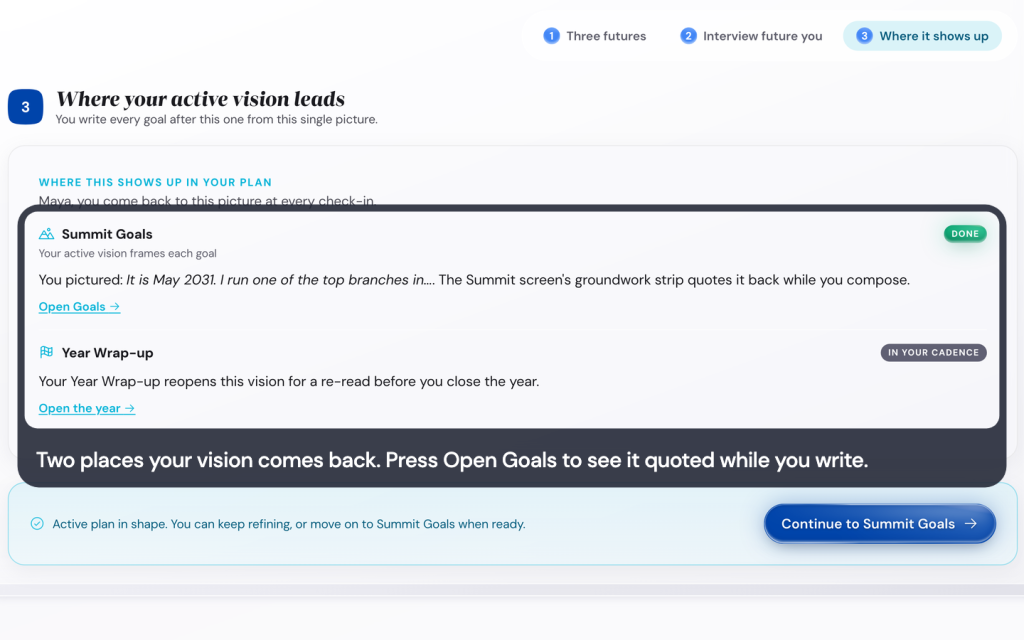
With Plan A alone the tab lists two rows, each with a link to that screen.
- On Summit Goals, open Your groundwork to read your work answer again under Future you.
- At the top of that same step you also get one line of advice on your plan. For Plan B: “build the bridge”.
- The Quarter check-in asks you to read your active vision again and decide whether it still fits.
- The Year Wrap-up asks whether this is still the life that pulls hardest.
- Insights offers your other plans under Suggested next steps, once three of your last six weeks went badly.
Two of those work with Plan A alone: Your groundwork and the Year Wrap-up. Write words into Plan B or Plan C and the other three start. That chain is what goal cascading means in the method.
Try these tips and tricks
- Do not stop after Plan A. Three plans that read alike give you one option written three times.
- Plan B should make you a little uncomfortable. If it reads like a smaller Plan A, push it further.
- Press Clear Plan A, with the letter of the plan you are reading, to empty it. Your other plans and your Summit Goals stay as they are.
- Edit your vision after your Summit Goals exist. Open Summit Goals again and read the note “You changed your Vision”. Nothing under it changes by itself.
- Press Re-read in the quarter check-in to stamp the date. After the first time the label changes to Re-confirm.
Key takeaways
- Plan A continues your path, Plan B is the pivot, Plan C drops every limit.
- Every plan has its own five answers and its own paragraph.
- Moving between plans changes only what you read. Make Plan B my active vision is the control that counts.
- Three filled prompts, or 80 characters of paragraph, open the next step.
- Read your active vision again in Your groundwork and at the Year Wrap-up.
The app’s own recipe, sketch your three futures, walks the same steps with pictures. Open Vision today, press Plan C, then press Interview future you. Finish one prompt: At the end of a Tuesday I feel. Read that line, then decide whether the life you are living is the one you chose.