Read the eleven ideas behind the app
Each of the eleven ideas belongs to one part of your plan, and each has a place in the app.
What is on this page
1. Follow one line from your values down to today
Every task you plan today should trace up to a yearly goal, then to your five-year vision, then to your purpose and your values. Each level takes its shape from the level over it.
Change a step high up and an amber dot pulses on the steps under it. That dot means you should look at them again.
Where you use it

Wall of Wins joins the row once you earn your first achievement.
Common mistake. You work on the day plan every evening and never open the year plan. After about four weeks your daily tasks no longer match your yearly goals.
2. Pick the two or three life areas you will work on
Rate each life area from 1 to 10, for satisfaction and for importance. Then mark two or three of them as focus areas for the year. The rest keep their score and get no Summit Goal this year.
Where you use it
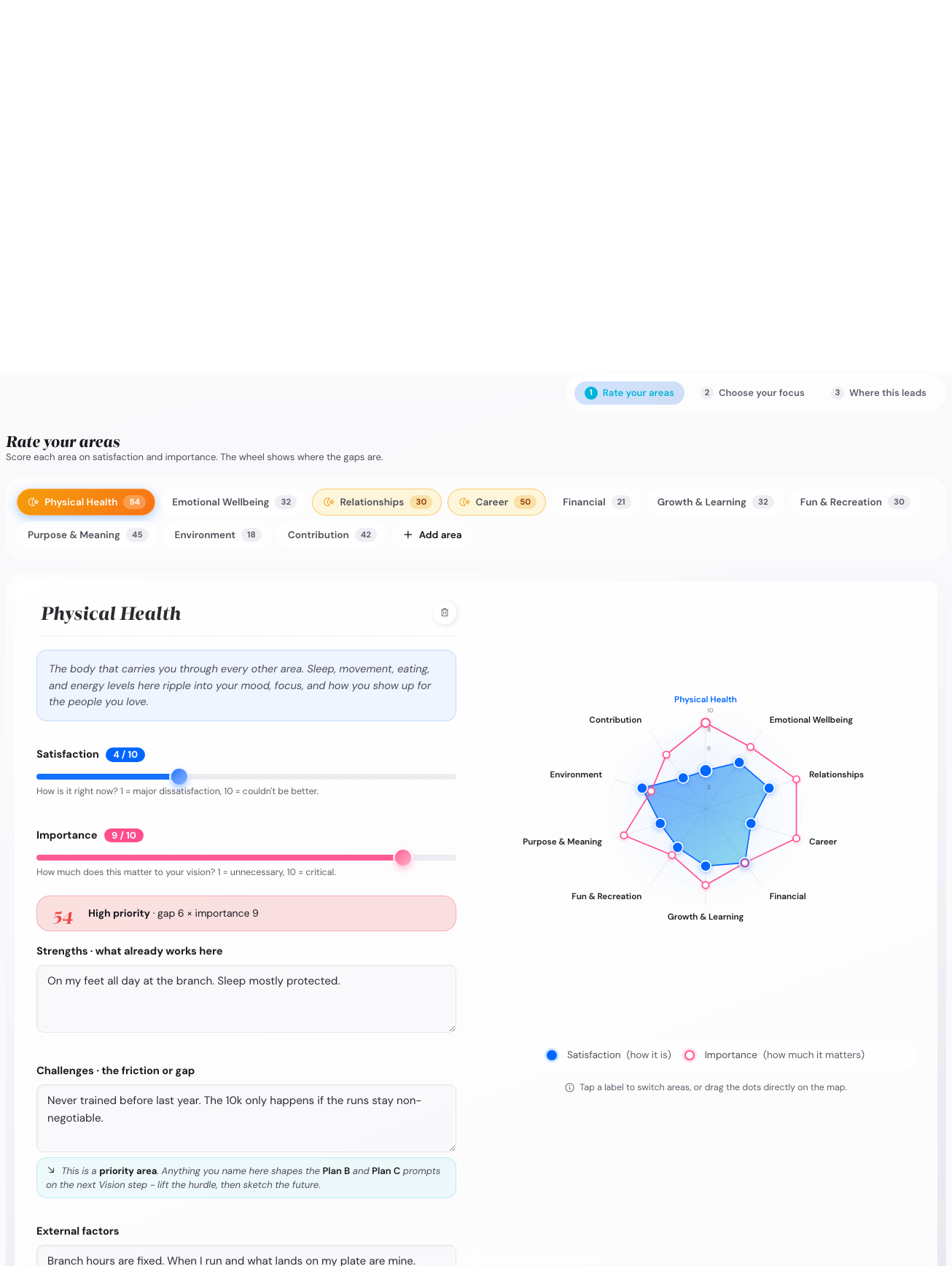
Common mistake. You mark only your weakest areas as focus areas. Pick at least one area where you are already strong.
3. Write your life five years from now
On the Vision step, answer five short questions as the person you are in five years. Write in the present tense: I run three mornings a week, and I coach the new team leads.
Where you use it
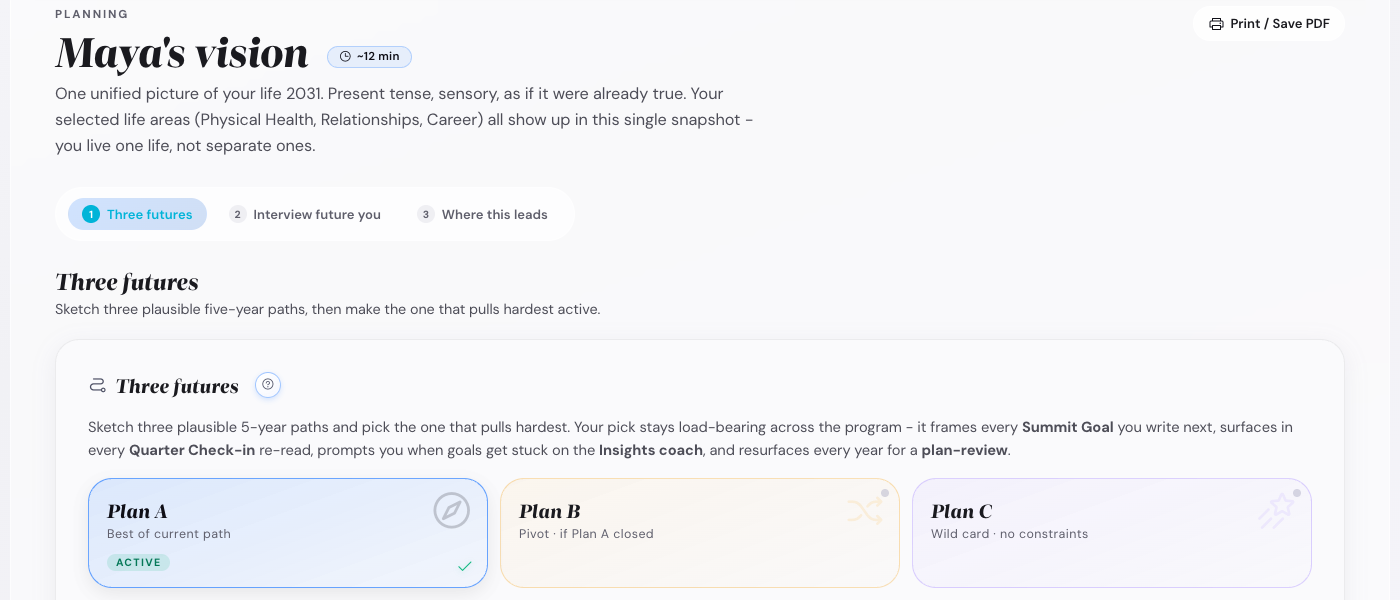
Common mistake. You write I will instead of I am. The present tense shows what you want. The future tense gives you a wish list.
4. Write three futures, then make one active
Write three plans for the same five years. They share your values and your focus areas, and they differ in the path.
- In Plan A you build on what already works.
- In Plan B you take a different path that is still within reach.
- In Plan C you stretch further than feels safe.
Where you use it
You read the three plans on the Three Futures tab and make one active. You write a plan on the Interview with your future you tab. Your active plan then shapes the prompts at Summit Goals, at the Quarter check-in and at the Year Wrap-up.
Common mistake. You write Plan A and stop. If you cannot draft Plan B and Plan C, the plan you picked may be the one you settled for.
5. Set one Summit Goal for each focus area
A Summit Goal is an outcome, never an activity. Give it a target month and year, 3, 5 or 10 years out, as you pick under Look ahead. Give it a measure you could show a friend.
Where you use it
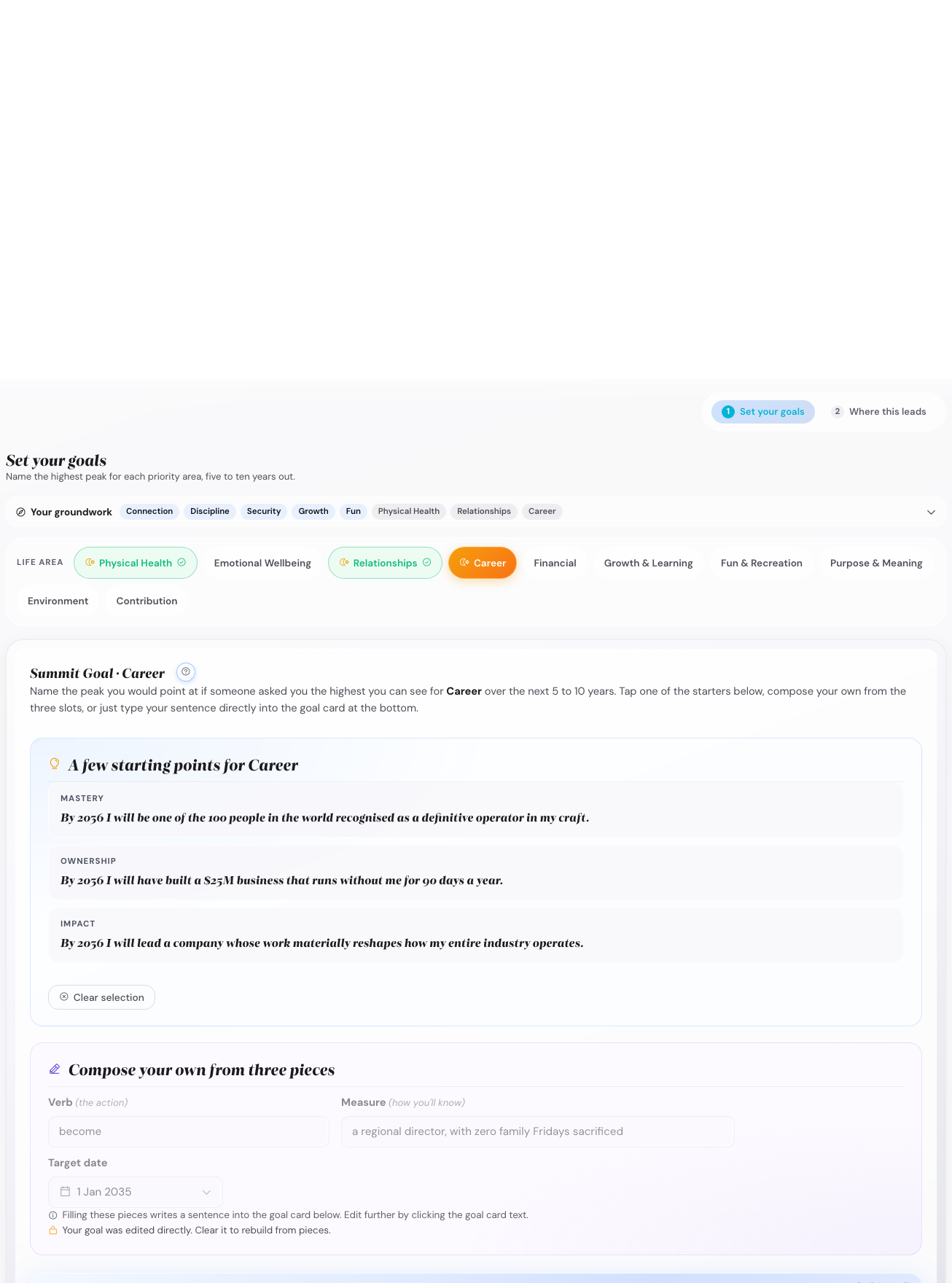
Common mistake. You write a habit where a Summit Goal belongs, such as meditate every day. A habit is the input. The outcome could be ten days of silent retreat by June 2027.
6. Name what gets in your way, and your counter-move
Every annual goal has a Friction Map tab. On the Goal tab you write the goal and what success looks like. On the Friction Map tab you list the obstacles that stopped you before, and one counter-move for each.
Where you use it
Open Execute, go to the Year cadence, then open a goal and its Friction Map tab. You read the obstacles again at every Quarter check-in.
Common mistake. You write a vague obstacle, such as I get distracted. Name the exact one: on Tuesday evenings the television runs from seven to nine in the next room.
7. Work in twelve-week quarters
Twelve weeks is short enough to stay real and long enough to finish something. Pick three to five milestones from your year plan for the current quarter. Then break them into month, week and day priorities.
Where you use it
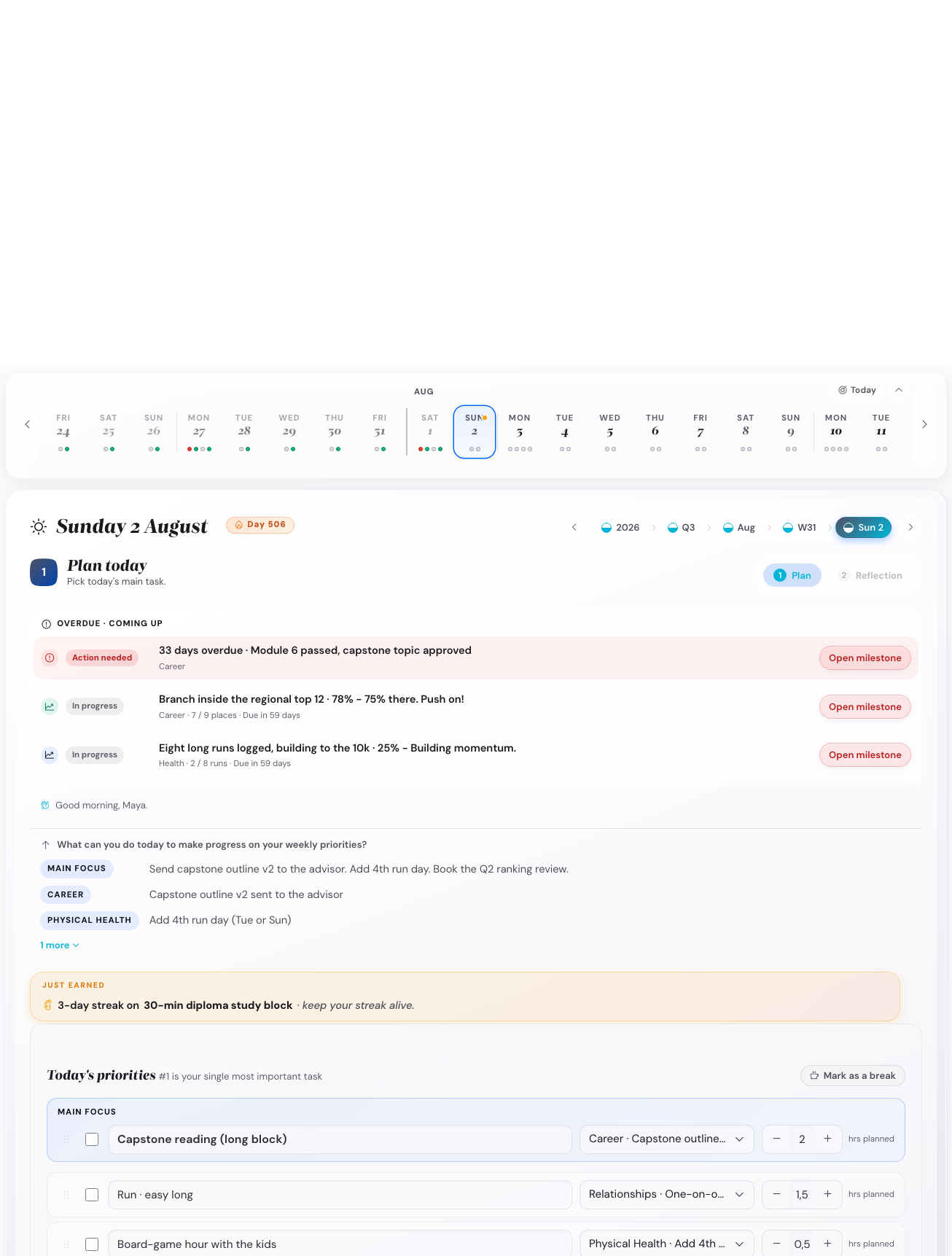
Common mistake. You treat the quarter as thirteen weeks. It is twelve. The thirteenth week is for the check-in and for planning the next quarter.
8. Build every habit from three parts
A habit lasts when something you already do starts it. Name that trigger in the Habit stack field, and keep the action small. Write a Reward you want under Reason why and reward.
Where you use it
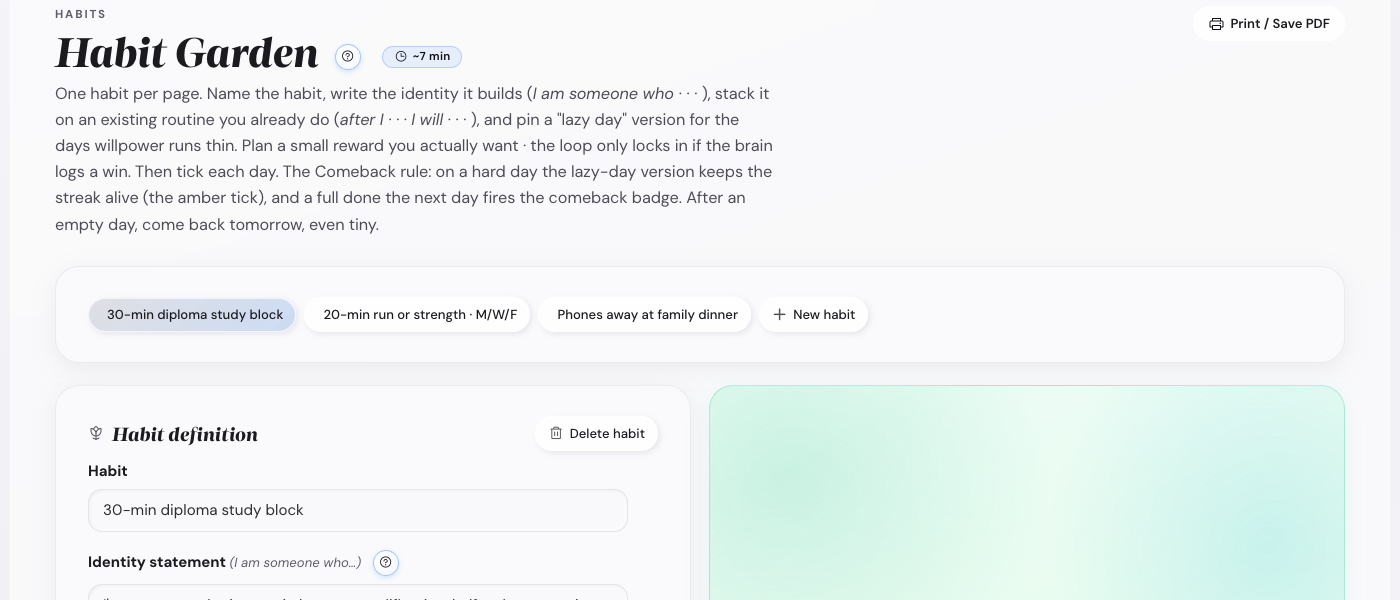
Common mistake. You leave the trigger empty. Meditate daily lasts a week. Meditate for five minutes after my morning coffee lasts a year.
9. Come back the day after you miss one
Miss one day and the habit is still there. Come back the next day, even with the lazy day version. An empty day sets the streak back to zero, and the next day starts a new one.
Where you use it
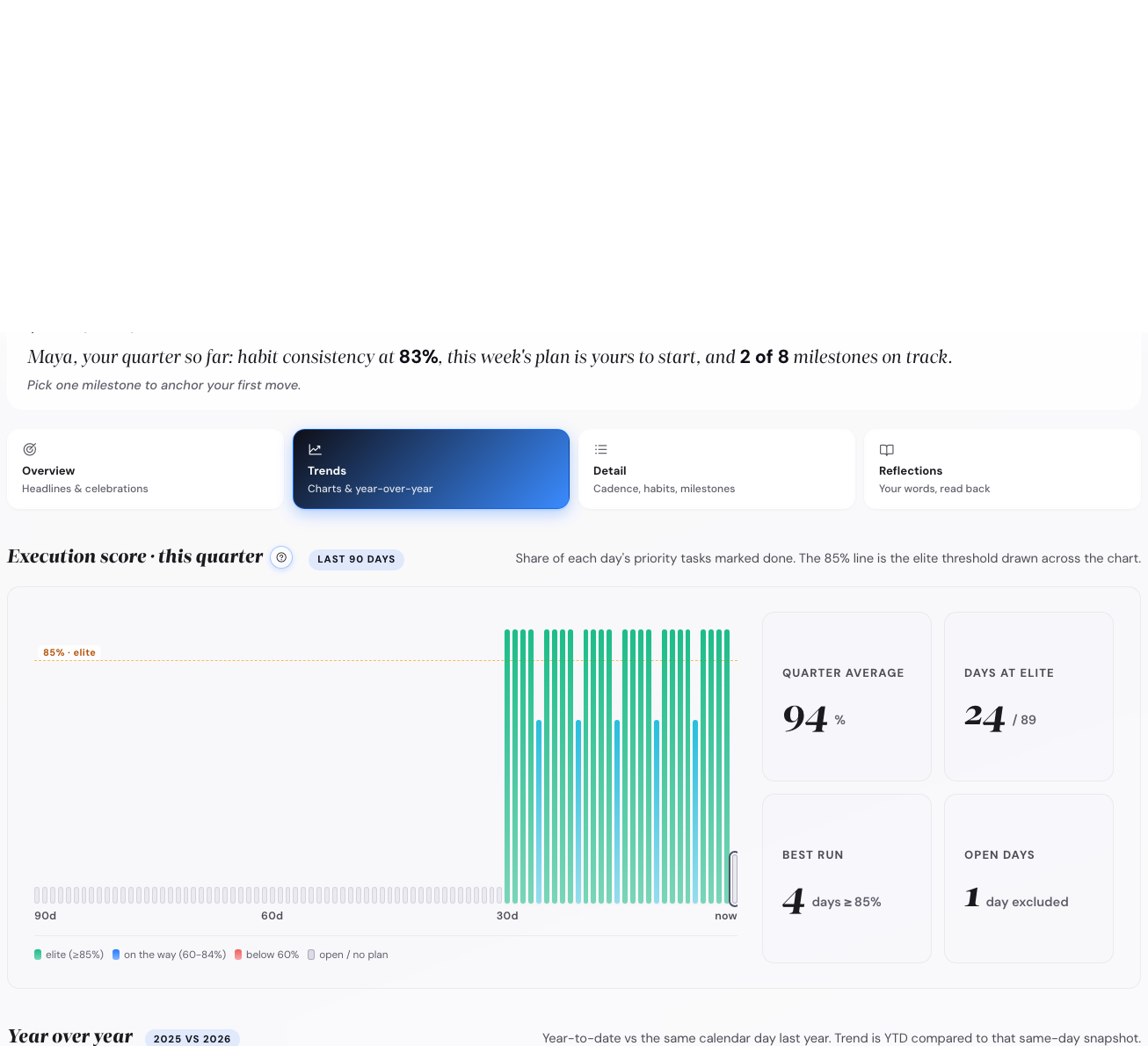
Tick a habit the day after a lazy day. The comeback badge is then yours.
Common mistake. You turn this into never miss. Then one slip feels like failure. This rule is about the day after a miss: come back then.
10. Mark each milestone green, amber or red
Green means on track. Amber means at risk, and a small correction now keeps it off red. Red means off track, so you decide what to do with it.
Where you use it
In the week reflection and at the Month check-in, each milestone that is due has a Confidence row. You pick On track, At risk or Off track. At the Quarter check-in you pick the same for each annual goal and each open target. A goal at risk or off track then gets Rescue, Move and Retire. A number target also shows a hint from your pace, such as auto · on pace.
Common mistake. You keep everything green until the deadline. Amber is what shows drift two weeks early, while you still have time.
11. Set a lazy day version for each habit
The lazy day version is the smallest action you accept on a hard day. For a thirty minute run it might be a ten minute walk. For a thousand words it might be a two minute voice memo.
Ticking the lazy day version counts as a kept day, so your streak does not break.
Where you use it
Lazy day version is a field on each habit in Habits.
Common mistake. Your lazy day is still too hard. Three hundred words on a sick day is a lot. One voice memo of a minute is not.
How the eleven fit together
- You choose where to work this year from your values and your life areas.
- Your vision and your three futures set the destination.
- Your Summit Goals are the outcome for each focus area.
- The Friction Map turns a goal into obstacles, counter-moves and milestones.
- Your quarters, weeks and days break the milestones into today's tasks.
- Your habits and your lazy days keep the daily work going.
- The Two-day Rule gets you back the day after a miss.
- The traffic lights show drift, so each check-in catches it early.
If you remember three things
- A Summit Goal is an outcome. A habit is an activity.
- Write the trigger. Habits run on what is already in your day.
- Use amber early. Green until the deadline is how a plan breaks late.
Where to go next
- Open the ten minute quick start to try the app.
- Read the six finished plans to see all eleven at work.
- Open the short answers when you have one question.