Goals & Progress



Cut ten life areas down to the two or three you work on this year
You give each of ten life areas two scores, and the Goals & Progress Life Goals App puts them in order. Then you tick two or three of them, and every goal you write this year comes from those.
Where you are in the journey
You have five ranked values and one purpose sentence. That was the guide before this one, Write your purpose sentence. After this one you turn your focus areas into a five year picture, in Write three futures and make one active.
What you will learn
- What the two scores do and how the Life Goals App ranks your areas.
- How to score all ten areas without getting stuck.
- How to tick the two or three you take into the rest of your plan.
- Why a fourth area costs you more than it gives.
What the two scores do
The app calls this step your Life Areas Map. Every area gets two scores from 1 to 10. Satisfaction is how the area is going right now, and Importance is how much weight it should carry in the life you want.
Open one area on the computer and both sliders sit together, with the result under them.
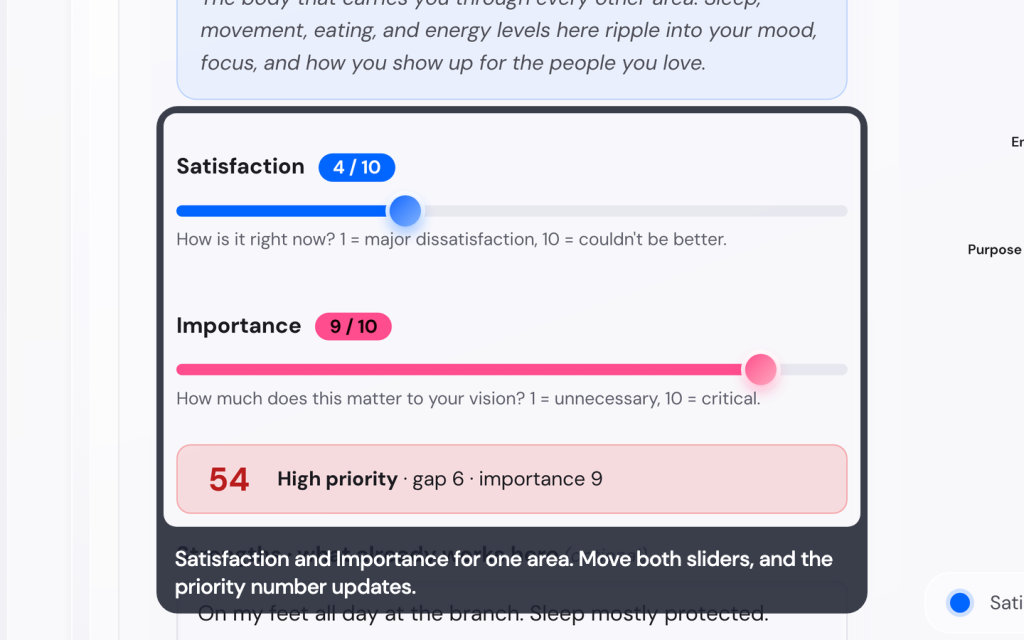
That number under the sliders is the one the app works out for you. Your gap is 10 minus your satisfaction, and your priority is that gap times your importance. Why satisfaction alone is not enough works through that arithmetic with examples.
If you know this exercise as the Wheel of Life, this is it with a second number.
Take Maya Chen, the branch manager whose plan fills the demo. Five of her ten areas:
| Life area | Satisfaction | Importance | Priority | |—|—|—|—| | Physical Health | 4 | 9 | 54 | | Career | 5 | 10 | 50 | | Purpose & Meaning | 5 | 9 | 45 | | Relationships | 7 | 10 | 30 | | Financial | 7 | 7 | 21 |
Beside each number the app puts a word: High priority from 50, Worth attention from 30, Watch from 15, Healthy under that. Maya’s 54 reads High priority.
Use the number to sort your areas, not to measure your life. That limit comes from the app’s own help page.
Score all ten areas
The ten areas are Physical Health, Emotional Wellbeing, Relationships, Career, Financial, Growth & Learning, Fun & Recreation, Purpose & Meaning, Environment and Contribution. Give yourself about eight minutes, and answer quickly. The step has three tabs, in this order: Rate your areas, Choose your focus and Where it shows up.
- On the computer, open Life Areas in the row of steps. On the phone, tap Life Areas Map on Home.
- Open Rate your areas. On the phone, tap Start rating.
- Move the Satisfaction slider for the first area.
- Move the Importance slider for the same area.
- On the computer, click the next area in the row of areas. On the phone, tap Next area.
- Repeat until all ten have moved, then tap See your map on the phone.
Under each area you can write three optional notes, on the same panel as the sliders. Strengths is for what already works, Challenges for the friction. External factors is for what you control and what you adapt to.
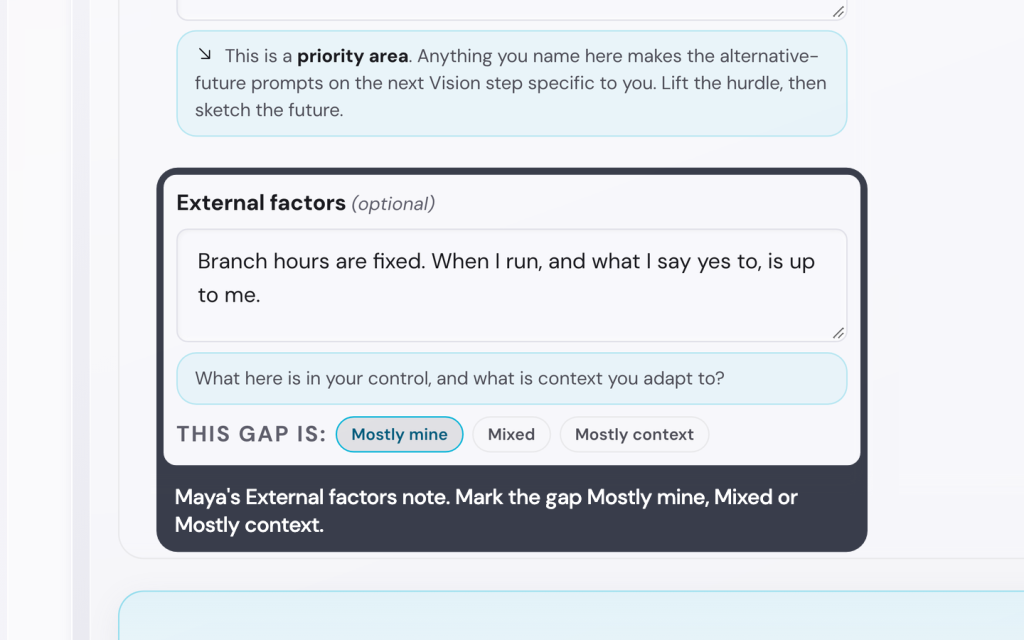
Maya marked Physical Health Mostly mine, because she cannot move the branch hours and she can move her runs.
The notes are worth two minutes on a ticked area. What you write under Challenges makes the prompts on Vision specific to you.
Every area starts at 5 and 5, and a 5 does not count as an answer. Move a slider on at least three areas, or the button to Choose your focus stays switched off.
Rate first and tick last. Moving any slider hands the pick back to the app, which drops the ticks you made by hand.
Pick two or three focus areas
Now open Choose your focus. On the phone you arrived here from See your map. Your areas come back in priority order, highest first, with the satisfaction, importance, gap and priority of each one in a row.
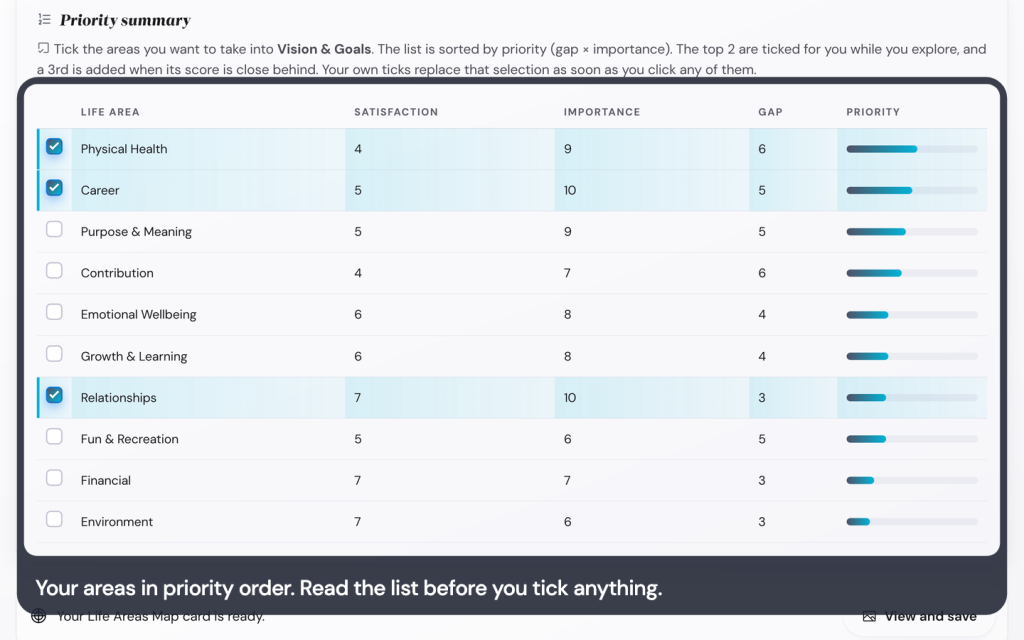
- Read the order and find where your own judgement disagrees with it.
- Tick two or three areas.
While you are still looking, the app ticks the top two for you. A third joins them when it scores within about 15 percent of your top area.
Treat that as a starting offer. Tick or untick one area yourself and your choice replaces the app’s pick. On the phone the same list runs down the screen, with a circle in front of every area.
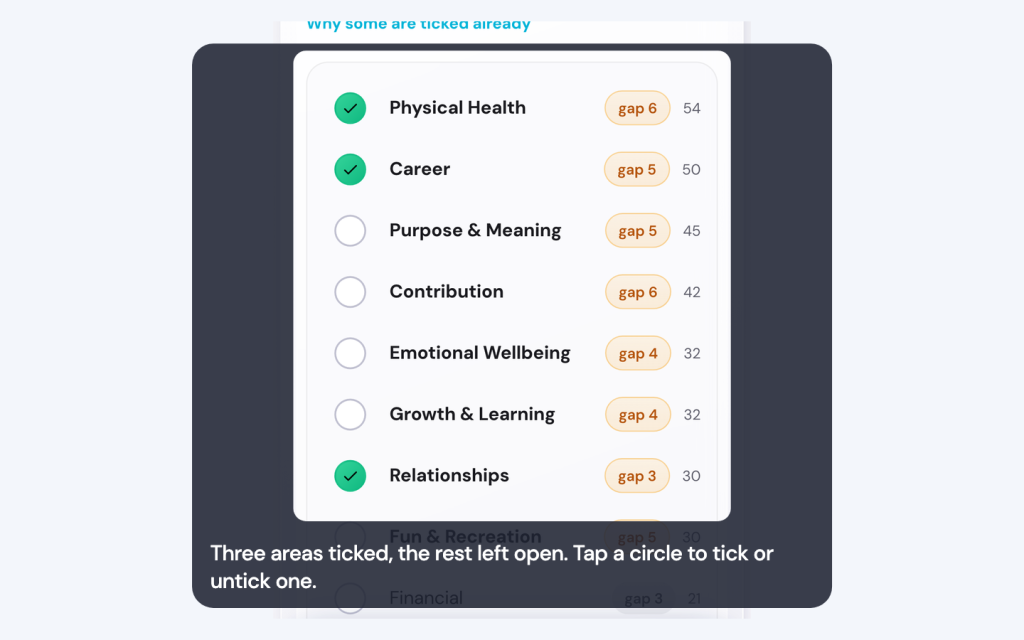
One tick is the minimum to go on.
Maya’s plan shows what that is worth. The app ticks her top three: Physical Health, Career and Purpose & Meaning. She kept the first two and ticked Relationships instead, seventh by priority, because that is where she wanted this year to go. The numbers sort the argument; you settle it.
Why a fourth area costs more than it gives
Every focus area earns one Summit Goal, and each one turns into annual goals, milestones and weekly work. The price is on screen. The estimate on your Summit Goals step is about eight minutes for one focus area, fourteen for two and twenty for three. Three areas is enough to carry on, and you add the others next year.
The screen recommends two or three, and nothing stops a fourth. Make that choice on purpose: why the cap is three covers the self-regulation research behind it.
One more rule: do not tick three weak areas. Keep one where you are already strong, so you are not rebuilding everything at once. Maya’s Relationships at 7 is the strong one in her three.
Where your focus goes next
Open the third tab, Where it shows up. On the phone that screen is headed Where your focus areas show up. Each ticked area earns a star on Summit Goals, with one goal of its own.

Your External factors note comes back as a hint when you plan that goal’s obstacles. Vision draws your ticked areas into one picture, and that is the next guide.
The Life Areas Map puts the same ten areas and six levels on paper.
Try these tips and tricks
- On the computer you can drag the dots on the map instead of moving the sliders, satisfaction in blue and importance in pink.
- Press Add area to write an area of your own. It gets the same two sliders and the same tick.
- On the phone, tap Edit the list, then tap a name to rename that area. Keep at least two areas in the list.
- Mark an area Mostly context and a Resilience line appears on Where it shows up. Goals there aim at your response, not at an outcome you cannot move.
- A satisfaction of 10 is rare. Several tens means you are rating the intention, not the week you had.
- Once a year, after your Year Wrap-up, come back and pick your areas again. This is not a decision for life.
- Change which areas you tick and an amber dot appears on Vision, Summit Goals, Execute and Habits. Go and read them again.
Key takeaways
- Every area has two scores from 1 to 10, Satisfaction and Importance.
- Priority is the gap, 10 minus satisfaction, times the importance.
- Three areas is enough to carry on, and the ticks are yours, not the ranking’s.
- Keep one focus area where you are already strong.
- Your ticked areas become your starred Summit Goals two steps later.
Open Life Areas and score the three areas you are surest about. That switches on the button to Choose your focus, and the other seven can wait. The app’s own recipe, score and pick your focus life areas, has the same steps with pictures.