Goals & Progress


Turn one Summit Goal into this year’s first slice
Your annual goal is the part of a Summit Goal you can finish in twelve months. The Goals & Progress Life Goals App writes a first draft of it from your Summit Goal. You edit that draft instead of starting from an empty page.
Where you are in the journey
You have one Summit Goal for each focus area, five to ten years out. That was the guide before this one, Set one Summit Goal for each focus area. After this one you slice the year into twelve weeks, in Plan your quarter and your month.
What you will learn
- Where the app finds the first draft of your annual goal.
- How to write the objective, the outcome and targets.
- How to date the milestones that feed your quarter.
- How many annual goals you can plan at one time.
Where your annual goal comes from
Each focus area has one Summit Goal, five to ten years out. The year is the first slice of that goal. The app’s example plan belongs to Maya Chen, a bank branch manager. Her career Summit Goal reads: “By 2035 I will be a regional director who got there without giving up a single family Friday.”
Her 2026 goal is one year of that: “Finish the banking diploma and lead the branch into the regional top 10, with zero weekend work”. Each level uses the one over it, which the app calls the Goal Cascade. Goal cascading from vision to daily tasks walks that chain down to today. Every annual goal card opens with one line: In 2026, I want to achieve this toward my Summit Goal.
Edit the goal the app drafted for you
The app drafts a goal when a focus area has a Summit Goal with no annual goal yet. It copies your Summit Goal sentence into Objective and shows it in grey. Open Execute, then Year, and the first goal card shows you that draft with its hint.
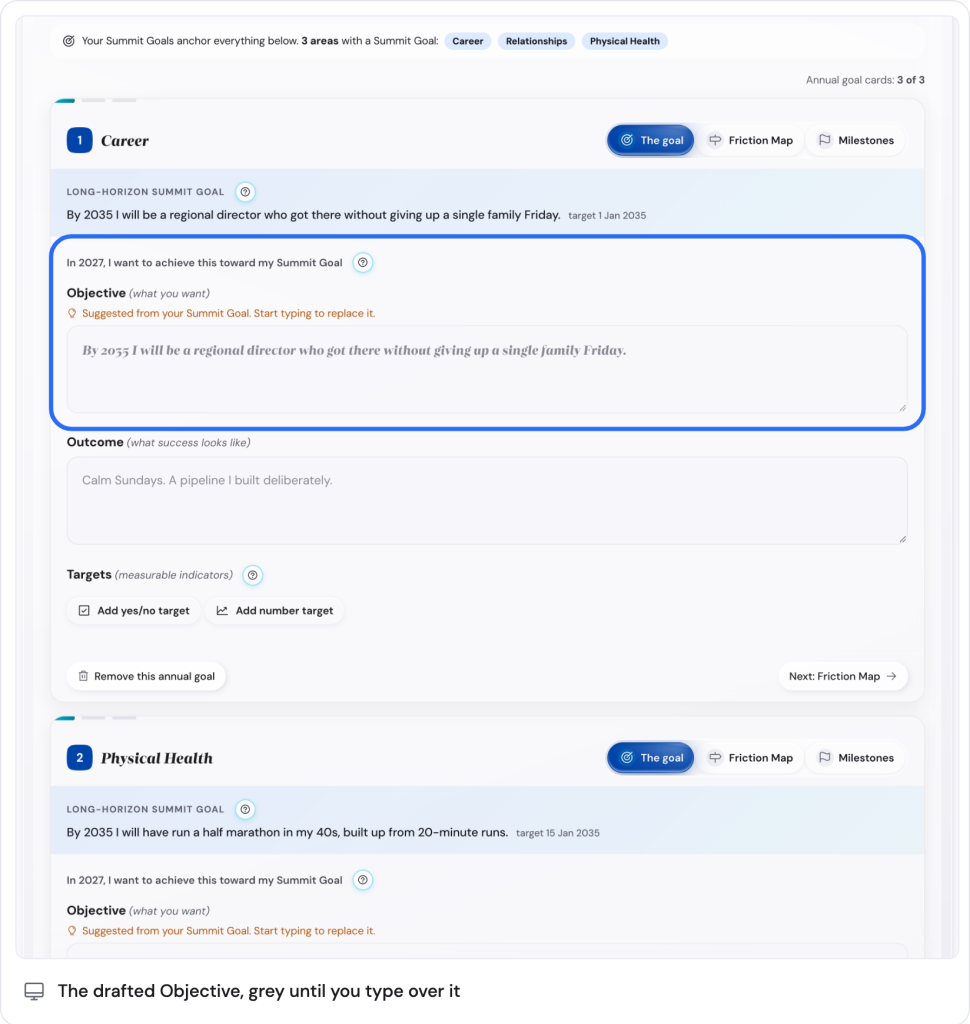
The grey text is only a suggestion, so replace it. Work down the card from there:
- Open Execute, then Year. On the phone, tap the bar title and pick the year.
- Open the goal card for one focus area.
- Type over the grey Objective in your own words.
- Fill in Outcome: what success looks like.
- Under Targets on The goal tab, tap Add number target or Add yes/no target.
- Open Friction Map and name one obstacle with its counter-move.
- Open Milestones and give each drafted checkpoint a title and a date.
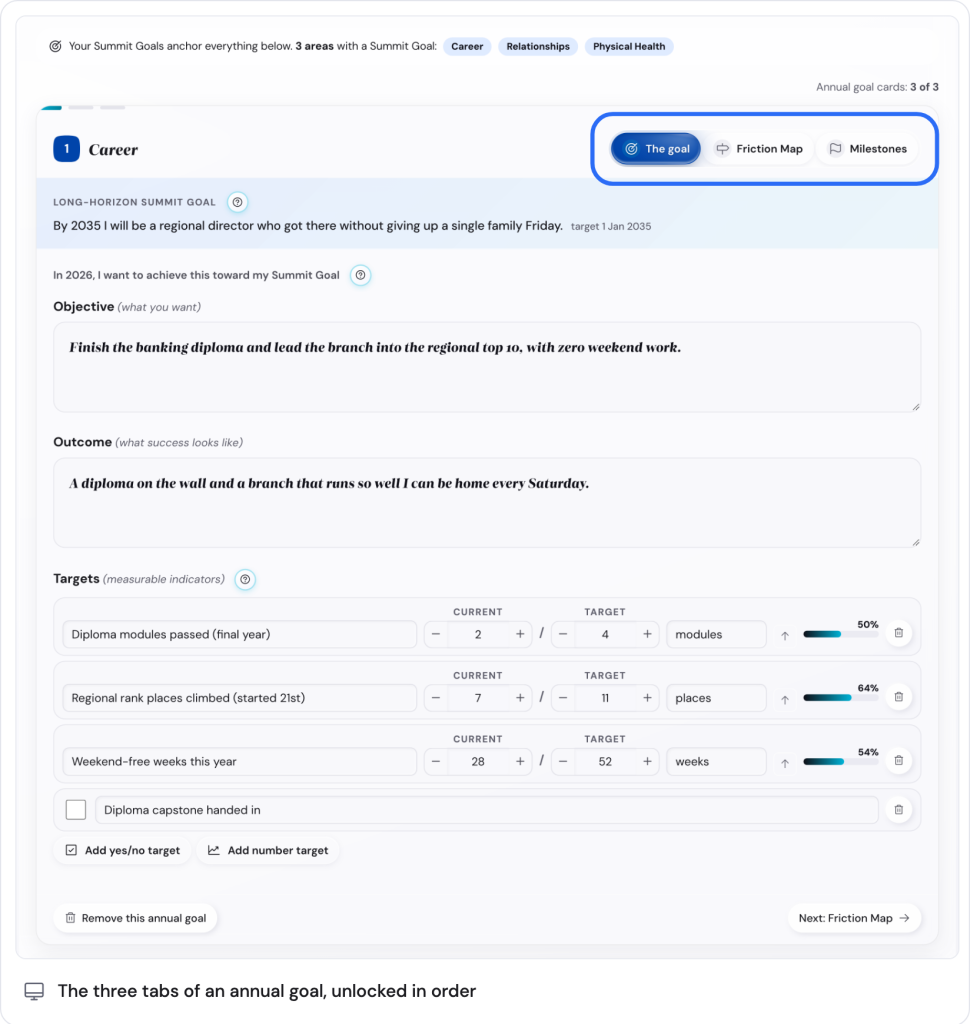
The three tabs of a goal unlock in order. Friction Map opens when the goal has words. Milestones opens when the Friction Map has one obstacle with its counter-move.
On the phone the same parts come one screen at a time.
The Friction Map is your list of the obstacles that could stop this goal. A counter-move is what you will do when one of them turns up, such as an if-then plan or a change to your setup. Sort each obstacle twice on the Friction Map: yours to move or context you adapt to, then a one-off or something that keeps coming back. The Friction Map explains when an if-then plan is the wrong fix for it.
Write the objective and the outcome
In Objective you write what you want this year. In Outcome you write what success looks like when you get there. Maya’s outcome for her career goal: “A diploma on the wall and a branch that runs so well I can be home every Saturday”. Two or three sentences in each field are enough. On the phone you fill one field per screen.
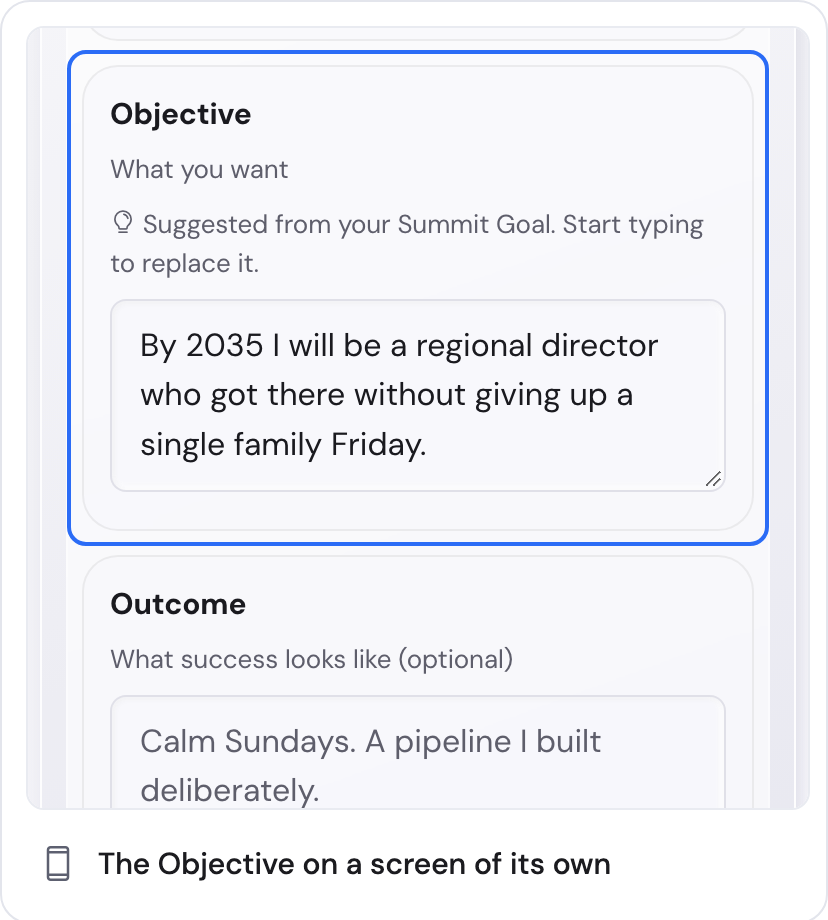
Press Next for the outcome, then the targets.
Add targets you can measure
A target is a number you move or a result you tick off. Press Add number target for a number. Fill in a title, then set a Current value and a Target value with a unit.
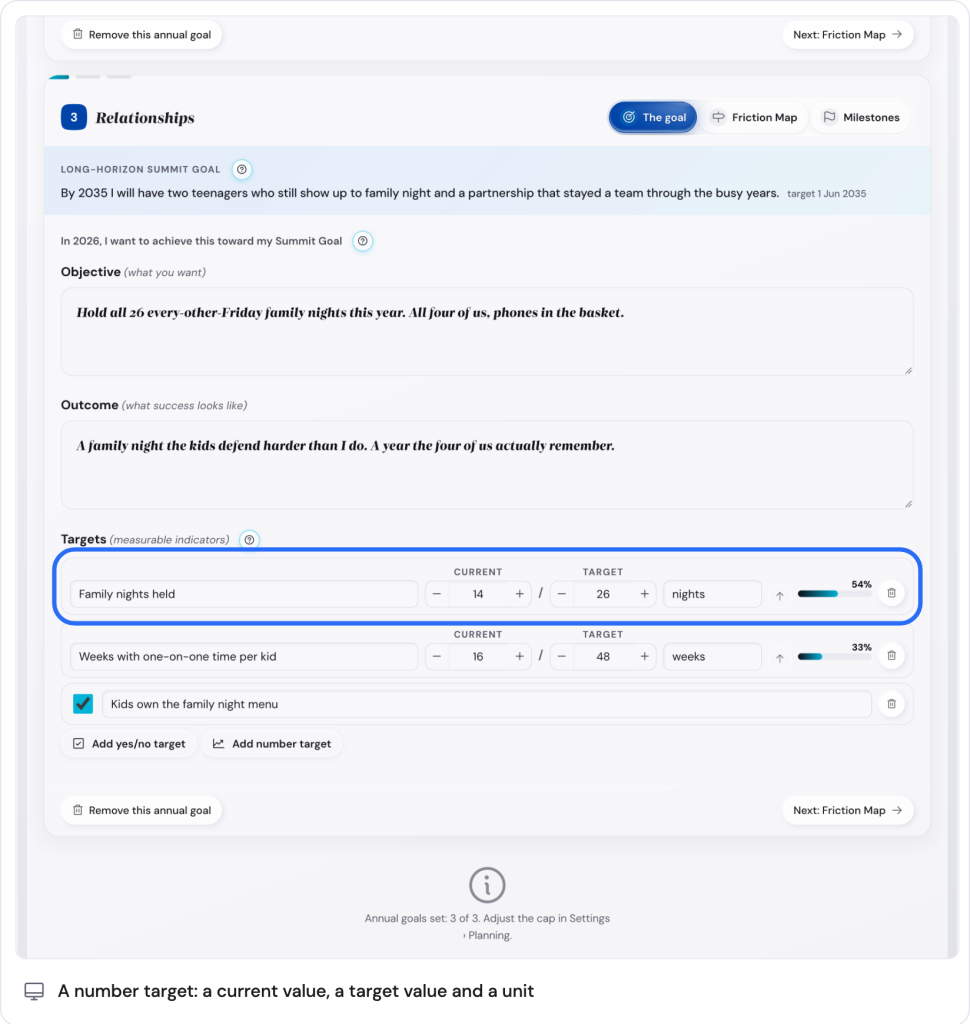
Two or three targets per goal is enough. Your quarter and month use these numbers.
Press Add yes/no target for a result with no number. Maya tracks “Family nights held” at 14 of 26 nights. She also ticks “Kids own the family night menu”, which has no number to count.
When a lower number is better, press Higher is better to flip the row to Lower is better. The second box is then called Limit, not Target. Maya’s tune-up 5k target is 28 minutes, down from 30 today. Record the number, compare it with last month and correct one thing: how to track progress for personal goals walks through that routine.
Set the milestones and their dates
Open Milestones on the goal card. The drafted checkpoints are in a list, one row for each.
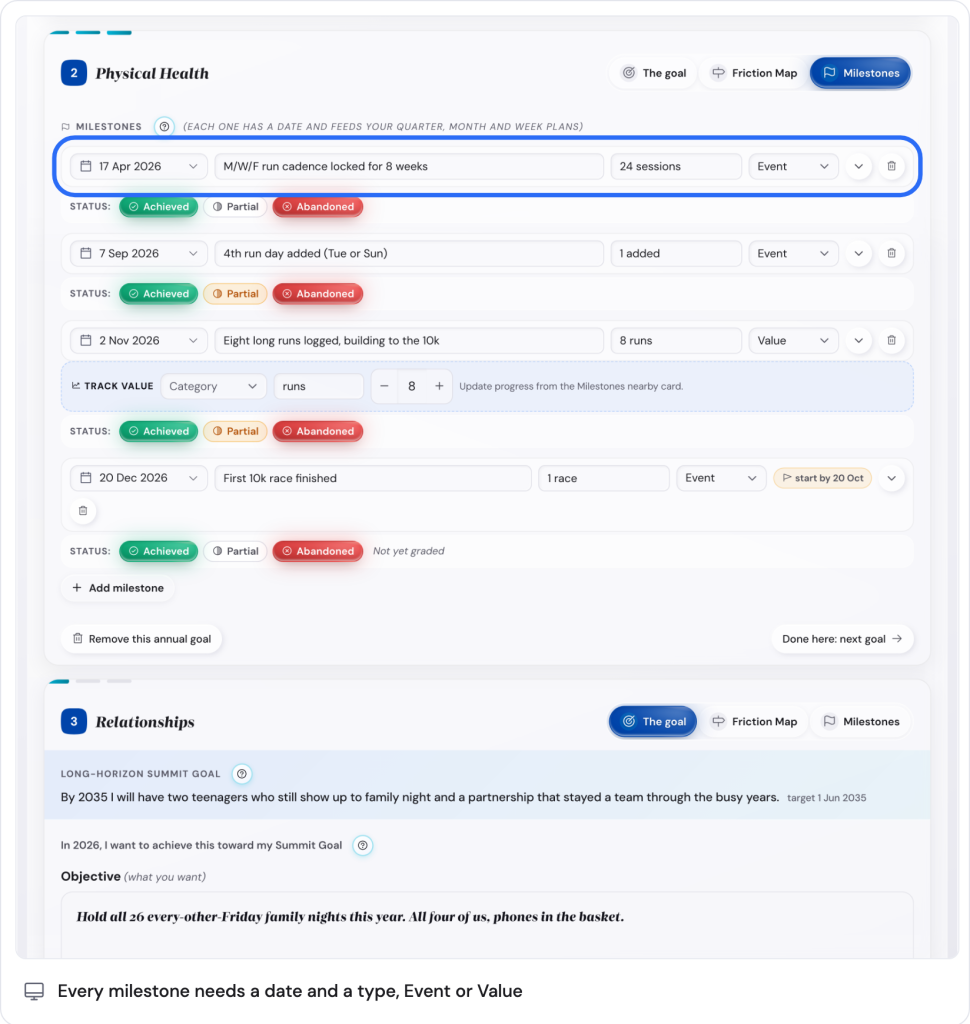
Use Event for something you either did or did not do. Use Value for a number you count up. Maya’s health goal has four milestones this year, ending with “First 10k race finished”.
The app drafts a checkpoint at the end of each remaining quarter, the last quarter too, titled Q1 milestone to Q4 milestone. It drafts one only when that quarter end is at least 60 days away, so a start in November gives you none.
Editing any field of a drafted row clears its grey marking. Press the trash icon on a checkpoint you do not want, and press Add milestone to write your own. Your quarter, month and week all use these dates.
How many annual goals should you plan?
Three across all your focus areas. The Year tab counts them for you, as in “Annual goal cards: 2 of 3”.
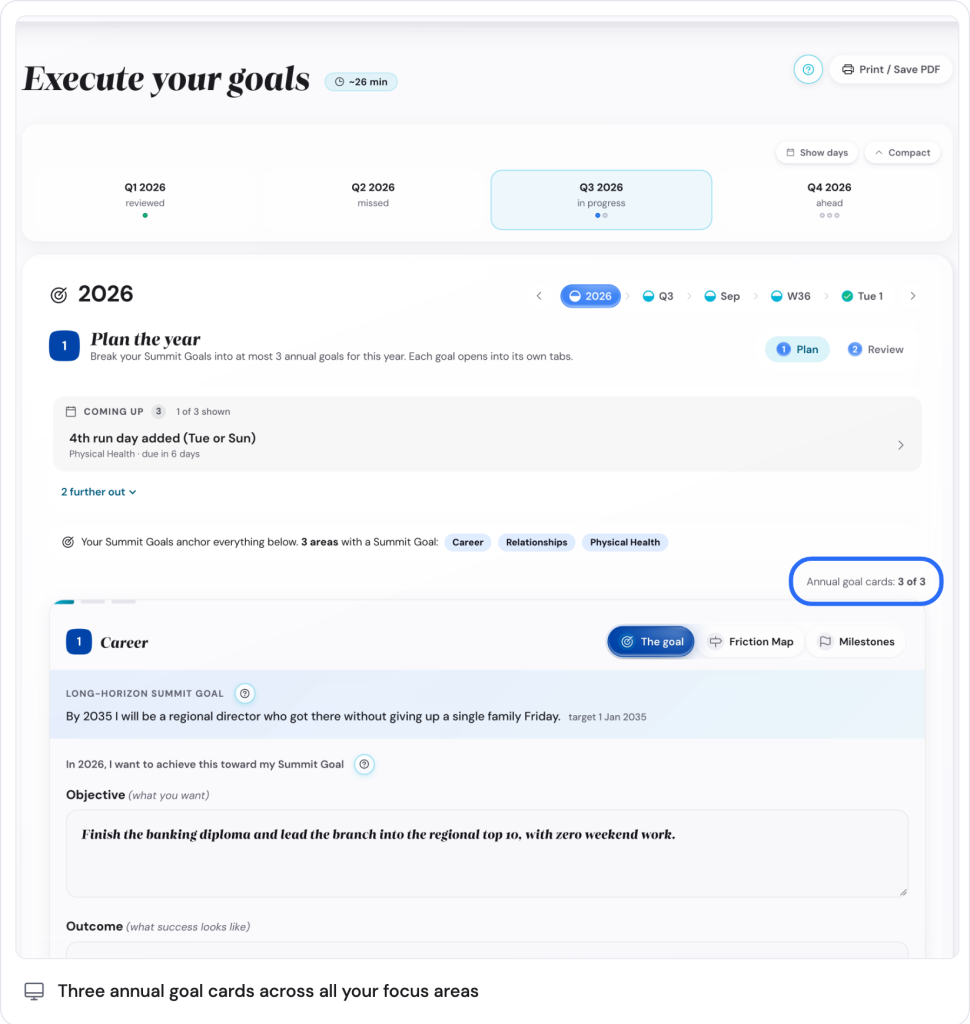
To change the number, open Settings, then Planning, then Annual goals across all areas. The hint there: “3 is the method’s cap. Raise it only if you truly need to.”
Try these tips and tricks
- Switch the drafting off under Settings, Planning, at Draft annual goals from my Summit Goals. Every goal then starts empty, and a draft you already have stays where it is.
- Rewrite a Summit Goal in May and the annual goal drafted from it keeps the old wording. Edit that goal yourself, as the app’s change a goal in the middle of the year page shows.
- Start in the last two months of your year and you get no drafted checkpoints. Write two of your own with Add milestone.
- Press Set this year’s plan when you have finished the cards. The Review tab then opens for the Year Wrap-up.
- Open Goal Check from the quarter, month, week or day to see every annual goal in one view. You can tick a milestone or change a number right there.
How your year flows down into the quarter
On Quarter you tick the milestones you commit to for the next twelve weeks, then place each one into a month on Monthly focus. That is the next guide, Plan your quarter and your month.
Key takeaways
- Your annual goal is one year of one Summit Goal, drafted from your Summit wording.
- Write what you want in Objective and what success looks like in Outcome.
- A target is a number with a Current and a Target value, or a result you tick.
- Three annual goals is the cap, and Settings, Planning is where you change it.
- The app drafts a checkpoint at each remaining quarter end that is 60 days away.
Open Execute, then Year, and read the grey Objective the app drafted for your first focus area. Type one sentence of your own over it. The two other tabs of that card can wait until tomorrow. The app’s own recipe, edit a drafted annual goal, has the same steps with pictures.