 Goals & Progress


A brain dump template that also tells you what to do with the list
A brain dump template is a sheet for writing down everything you are carrying, so it stops circling in your head. Most of them are a blank box with a nice heading. That handles the easy half. The hard part arrives about two minutes later, when you are looking at thirty things in no particular order and feel worse than when you started.
This one is three sheets: get it out, sort it, decide. The sorting sheet is the reason it exists.
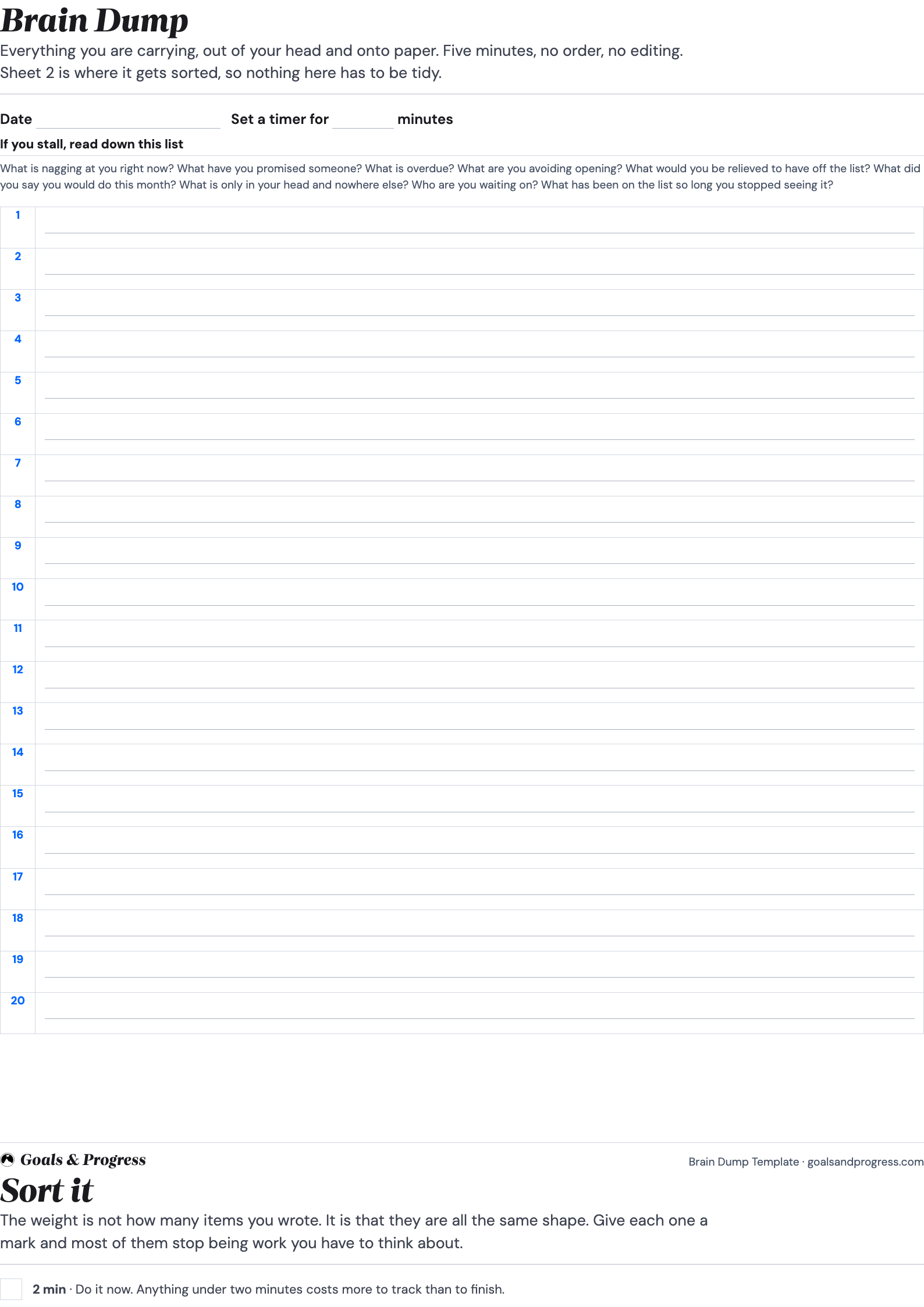
Download the brain dump template.
Three sheets, blank and ready to print. No email address needed.
- Sheet 1: twenty numbered rows, with prompts to read when you stall
- Sheet 2: the same items sorted into five marks, plus a life area
- Sheet 3: the three that move today, and what you are deliberately not doing
- A4, US Letter and A5 for a half-size notebook, plus an editable Word version
Free to use and print as often as you like. Most people need it on the same day each week.
Why a blank box is not enough
Emptying your head onto paper does genuinely help, and if that is all you want then any blank page will do it. The problem is what the blank page leaves you holding.
The weight of a mental list is not really the number of things on it. It is that they are all the same shape. “Reply to Anna”, “sort out the pension”, “book the dentist” and “figure out what I want to do with my life” sit in your head at the same size, demanding the same attention, and none of them can be finished by thinking about them harder. Writing them down in a box preserves that sameness. It just moves it onto paper.
What changes it is giving each item a mark, because most items turn out to need something other than your time.
The five marks on sheet two
- 2 min. Do it now. Anything under two minutes costs more to carry and track than to finish.
- Slot. Real work that needs real time. Write when, not just what. An unscheduled task is still an open loop.
- Waiting. Blocked on someone else. Note who, and when you will chase. It stops being yours until then.
- Not mine. It landed on your list but belongs to someone else. Hand it back.
- Let go. You are not going to do it. Deciding that on purpose is different from carrying it around unfinished for another year.
There is also a column for the life area each item belongs to. It takes seconds and it usually shows you something: that every item on the page came from one part of your life, and the parts you would say matter most produced nothing at all.
The sheet people skip
Sheet three has a box headed deliberately not this week, and it is the one that actually makes the week lighter.
An item you have decided against stops following you. An item you simply have not got to yet follows you everywhere, and costs a little attention every time it surfaces. Writing the second kind down as a decision converts it into the first kind. It is allowed to come back next week. It just stops being owed.
How to use it
- Set a timer, five minutes. Write on sheet one without stopping to judge anything. If you stall, read the prompt line at the top.
- Copy the items across to sheet two and mark each one. Do not think hard. First instinct is usually right, and re-reading is what makes this take an hour instead of ten minutes.
- Do the 2 min ones immediately. Before you go any further. It is normally a third of the page.
- Fill in sheet three. Three that move today, and everything you are consciously not doing.
- Bin sheets one and two. They have done their job. Keep sheet three where you will see it.
Common questions
How often should I do a brain dump?
Weekly works for most people, at a fixed time so it does not depend on feeling overwhelmed enough to remember. Doing it only when you are already at capacity means doing it at the worst possible moment.
What if I fill all twenty rows?
Print a second sheet. Twenty is not a limit, it is what fits legibly on a page. If you regularly go past forty, the sorting sheet matters more for you than for most people, not less.
Can I type into it instead of printing?
Yes. The Word version has the same three sections built as tables, so you can tab between cells. It is the same content shaped for typing rather than handwriting.
Is this the same as a to-do list?
No, and it works better if you keep them separate. A to-do list holds work you have already decided to do. A brain dump holds everything, including the things you should not do, will not do, and were never responsible for. Sorting is what turns part of the second into the first.
Related templates and tools
- Weekly review template – the five-minute review this pairs with
- Journal Prompt Builder – when what surfaced needs writing about rather than doing
- Friction Map – for the items that keep coming back no matter how you sort them
- Life Goals Command Center – the ten life areas, scored for priority
