 Goals & Progress


The habits you never chose are still running
Most of your day is already decided. Somewhere between a third and a half of everyday behaviour runs as habit, performed almost daily and usually in the same place, which means the question is not what you will start doing. It is what you are already doing, and whether any of it is taking you where you want to go.
This audit makes you look. List a normal day, mark each thing as serving the life you want, neutral, or working against it, and tag it to a life area. What comes back is a count, a map of where your day is actually going, and a short list of habits that are quietly occupying a slot without paying for it.
See where your day actually goes
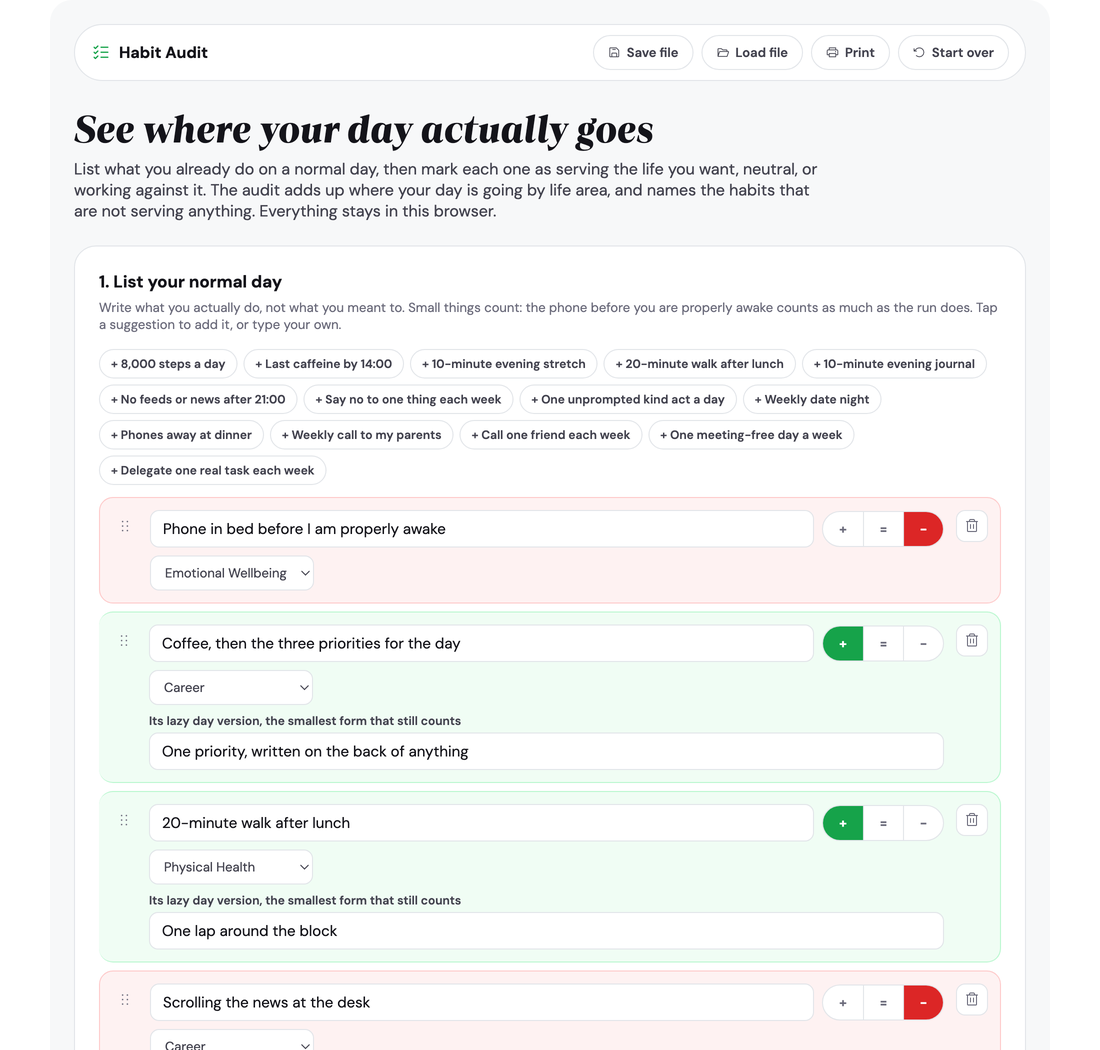
List what you already do on a normal day, then mark each one as serving the life you want, neutral, or working against it. The audit adds up where your day is going by life area, and names the habits that are not serving anything. Everything stays in this browser.
1. List your normal day
Write what you actually do, not what you meant to. Small things count: the phone before you are properly awake counts as much as the run does. Tap a suggestion to add it, or type your own.
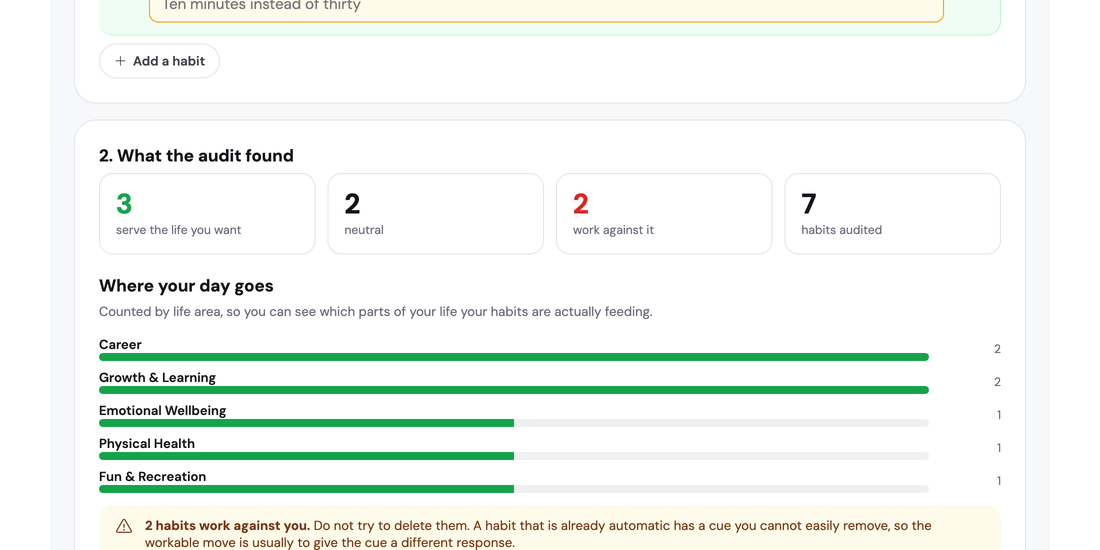
2. What the audit found
Where your day goes
Counted by life area, so you can see which parts of your life your habits are actually feeding.
The idea of scoring your existing habits one by one comes from the Habits Scorecard in James Clear's Atomic Habits, which is worth reading. This version adds three things to it: every habit is tagged to one of ten life areas so you can see where the day is going, anything you keep has to be given a lazy day version, and habits that serve no current goal are called out rather than left on the list.
How to run the audit
- List a normal day, not a good one. The phone before you are awake counts as much as the run does. Tap a suggestion or type your own.
- Mark each one +, = or −. Does it serve the life you want, do nothing, or work against it? Answer fast. The first instinct is usually the honest one.
- Tag each habit to a life area. This is what turns a list into a map.
- Give every keeper a lazy day version. The smallest form that still counts on a bad day. Anything without one gets flagged.
- Read the findings, then print it or save the file.
What it looks like
The category everyone misses
People come to an audit expecting to find bad habits. Those are rarely the discovery, because you already know about them. The uncomfortable column is the neutral one.
A neutral habit is not free. It occupies a slot in the day and a share of the attention a new habit would need, and it returns nothing. Three or four of those is usually the reason there is no room for the thing you keep saying you want to start. That is why the audit counts them separately rather than lumping them in with the good.
Why every keeper needs a lazy day version
A habit that only exists in its full form has one failure mode: the day you cannot do the full form. Deciding in advance what counts on a bad day, while you are calm enough to be honest about it, is what keeps a chain alive through a bad week. Ten minutes instead of thirty. One page instead of a chapter. One lap instead of the walk.
The audit will not let a keeper through without one. That is deliberate, and it is the part people skip.
What to do with the result
- The red ones: do not try to delete them. An automatic habit has a cue you cannot easily remove, so the workable move is to give that same cue a different response.
- The neutral ones: pick the one occupying the best slot in your day and put something that pays into it.
- The green ones: protect them, and make sure each has its lazy day version.
- The empty areas: if a life area has no habits at all, that is worth a conversation with yourself before it is worth a new habit.
Credit where it is due
The idea of scoring your existing habits one by one comes from the Habits Scorecard in James Clear's Atomic Habits, and the book is worth reading in full. This version adds three things his exercise does not: every habit is tagged to one of ten life areas so the distribution becomes visible, anything you keep has to be given a lazy day version, and habits serving nothing are counted separately instead of disappearing into the middle of the list.
Related guides and tools
- Habit stacking - how to attach a new habit to one that already works
- Habit Stack Builder - build the chain once you know which habits are worth keeping
- Habit formation: the complete guide - how habits form in the first place
- Why habits fail - the diagnosis when a keeper keeps collapsing
- Life Goals Command Center - the same ten life areas, scored for priority


