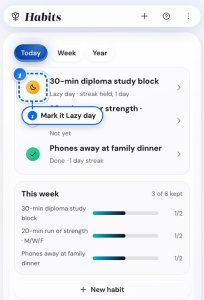
Goals & Progress


Two books, two different problems
In the atomic habits vs tiny habits debate, the short answer is that the two books solve different problems. Tiny Habits is built to get a behavior started when you cannot get off the ground. Atomic Habits is built to sustain and compound a behavior once you can. You have read the reviews and seen both recommended in every productivity thread, yet most comparisons end with "both are great," which is no help at all when you have to pick one. The right choice depends on where you are stuck right now.
The two books are not answering the same question. Each one is built for a different part of habit-building, and the one you need depends on which part you are stuck on. James Clear, in Atomic Habits, is interested in how you redesign your systems, your identity, and the way small actions compound over years [1]. BJ Fogg, in Tiny Habits, is interested in how you get unstuck on the very first day by pairing emotion with a behavior small enough that it cannot intimidate you [2]. Which one you need depends on where you are stuck, a question our habit formation complete guide helps you answer step by step.
Atomic Habits vs Tiny Habits is a comparison between two behavior-change frameworks: James Clear's identity-based system design using four laws of behavior change, and BJ Fogg's method of anchoring micro-behaviors to existing routines with immediate celebration. They differ in starting scale, motivational philosophy, and how deeply they tie personal identity to lasting behavior change.
Quick answer: Tiny Habits is the better starting point, and Atomic Habits is the better sustaining system. If you cannot get a new behavior off the ground at all, start with Fogg, because he shrinks the action until motivation barely matters. If your habits start fine but fade after the first few weeks, start with Clear, because identity and systems are built to survive the inevitable drop in motivation. You need one of these two more than the other right now, and naming which one is the point of this guide.
Most comparisons end with some version of "both are great, pick whichever appeals to you." That advice is true and useless. It never separates the reader who cannot start a habit from the reader who starts fine but cannot keep one going, and those are two different problems with two different answers. This guide closes that gap with the Goals and Progress Fit-First Filter, a simple rule that points you to the book built for the part of habit-building where you are stuck.
What you will learn
- Atomic Habits vs Tiny Habits: how they compare on what actually matters
- What atomic habits gets right about identity and systems
- What tiny habits gets right about starting small
- How habit stacking differs between the two
- The Atomic Habits vs Tiny Habits decision tree
- Where both methods fall short
Key takeaways
- Atomic Habits builds through identity shifts and system design; Tiny Habits builds through emotional anchoring and micro-actions
- Clear's four laws of behavior change address cue, craving, response, and reward at every habit size [1]
- Fogg's B=MAP model requires motivation, ability, and a prompt to hit at the same moment [2]
- The Goals and Progress Fit-First Filter matches your current sticking point to the right method: starting problem points to Fogg, sustaining problem points to Clear
- The celebration technique in Tiny Habits pairs the new behavior with a positive emotion, which Fogg argues helps the brain code it as worth repeating [2]
- Habit stacking appears in both books but starts at different scales and uses different emotional mechanics
- Beginners overwhelmed by failure often do better starting with Fogg; systems thinkers gravitate toward Clear
- Combining both frameworks gives you tools for both starting and sustaining, covering gaps that either framework alone leaves open
Atomic Habits vs Tiny Habits: how they compare on what actually matters
Atomic Habits designs systems and identity for someone who is already engaged enough to start. Tiny Habits engineers the friction of starting down to almost nothing, so that engagement can build in the first place. Clear assumes you can show up and asks what should happen once you do. Fogg assumes you cannot yet show up reliably and asks what version of the behavior is small enough to fire on your worst day. Both aim at the same destination, just from opposite starting points.
What is Atomic Habits?
Atomic Habits is a 2018 book by James Clear. It teaches readers to build lasting habits through identity change, environment design, and four behavioral laws: make the cue obvious, the craving attractive, the response easy, and the reward satisfying. Clear's central image is compounding, the idea that improving by one percent a day produces results that look dramatic only in hindsight.
What is Tiny Habits?
Tiny Habits is a 2019 book by Stanford behavior scientist BJ Fogg. It teaches readers to install new behaviors by shrinking them to their smallest workable size, anchoring them to a routine that already happens, and celebrating the instant each repetition is done. His B=MAP model, where behavior equals motivation plus ability plus prompt, is the theory underneath the method.
The shared scientific lineage behind both frameworks
Neither framework sprang fully formed from its author. Both draw on a single line of behavioral science. B.F. Skinner's operant conditioning established, in the mid-twentieth century, how consequences shape whether a behavior repeats. Charles Duhigg's 2012 book The Power of Habit later put the cue-routine-reward loop in front of general readers, framing a habit as a three-part neurological pattern [7].
Wendy Wood and David Neal then studied something both Fogg and Clear lean on: habits depend on context. If you keep performing an action in the same stable setting, the setting itself eventually triggers the behavior with no conscious effort [8]. Clear's Four Laws and Fogg's B=MAP are two arrangements of the same parts: a reliable cue, a low-friction response, and a consequence that reinforces. The books differ in tone far more than in mechanism. The two frameworks draw from that same foundation.
Before going deeper, it helps to see the two systems side by side. Both authors address the same six dimensions of behavior change; what divides them is how much weight each one places on each dimension [1][2].
| Dimension | Atomic Habits (James Clear) | Tiny Habits (BJ Fogg) |
|---|---|---|
| Author background | Behavior change synthesizer and writer | Stanford behavior scientist, 20+ years research |
| Core framework | Four Laws of Behavior Change | B=MAP (Motivation + Ability + Prompt) |
| Starting scale | Small, but no hard minimum | Extremely tiny (30 seconds or less, always) |
| Identity focus | Central: "become the type of person who…" | Minimal, focus on mechanics first |
| Motivation philosophy | Reduce friction; motivation is unreliable | Start small enough that motivation becomes irrelevant |
| Signature technique | Habit stacking + environment design | Anchor-Behavior-Celebration (ABC) |
Quick facts
| Detail | Atomic Habits | Tiny Habits |
|---|---|---|
| Published | 2018 | 2019 |
| Pages | 320 | 320 |
| Author | James Clear | BJ Fogg (Stanford) |
| Audiobook | Yes (narrated by author) | Yes (narrated by author) |
Both books agree that willpower is a losing strategy. They disagree on what should replace it: Clear replaces it with systems, identity, and a redesigned environment, while Fogg replaces it with emotional reinforcement and a behavior shrunk until it barely asks anything of you.
The best habit method is the one that matches the part of habit-building where you are stuck, not the one with more five-star reviews.
What atomic habits gets right about identity and systems
James Clear frames habit formation as an identity project. His best-known line, that you do not rise to the level of your goals but fall to the level of your systems, has reached an enormous readership. Atomic Habits has sold well over twenty million copies worldwide [1]. Underneath the slogan is a real finding from behavioral science: the gap between what people say they want and what their environment and self-image actually support.

The four laws of behavior change are James Clear's framework for building or breaking any habit: make the cue obvious, make the craving attractive, make the response easy, and make the reward satisfying. Invert those four laws, so the cue becomes invisible, the craving unattractive, the response difficult, and the reward unsatisfying, and you have a system for breaking bad habits [1].
When a habit refuses to stick, the four laws let you diagnose which one is failing [1]. Perhaps the cue is invisible, or the craving is weak, or the response asks for too much effort, or the reward arrives too late to register. That diagnostic quality is what gives Clear's framework reach beyond any single behavior; it is a lens, not a checklist.
The same four laws run in reverse for a habit you want to quit. To break one, Clear says make the cue invisible by hiding the trigger, and make the craving unattractive by reframing what it really gives you. Then make the response difficult by adding friction, and make the reward unsatisfying by attaching an immediate cost [1]. Anyone trying to build one habit while ending another can run the diagnostic in both directions at once.
The deepest idea in the book is identity-based habits. Instead of aiming at an outcome ("lose weight") or even a process ("run three times a week"), you aim at a self-image ("I am a runner") and let the behavior follow from it. Research led by Philippa Lally at University College London found that habits become automatic through repetition over a median of 66 days. Individuals ranged anywhere from 18 to 254 days, depending on the behavior and the person [3].
Habit formation takes about a median of 66 days, with real timelines running anywhere from 18 to 254 days depending on the behavior and the person [3]. Clear's claim is that what happens to your identity during that window decides which habits survive the moment motivation fades [1]. At Goals and Progress we treat that shift, from a behavior you do to a behavior you are, as the real finish line. It is the shift the habit-tracking phase of our workbook is built to support.
Atomic Habits works best when the task is to redesign several behaviors as one interlocking system rather than to rescue a single habit. Habit stacking chains a new behavior to one that already runs on autopilot, and the chapter on environment design shows how rearranging a room can make the good behavior the path of least resistance. For the mechanics in practice, our habit stacking guide goes a level deeper.
Environment design is one of Clear's most practical tools, and it deserves a sharper definition than the scattered examples imply. The principle is plain: arrange your surroundings so the good behavior is the easiest thing to reach and the bad behavior is the hardest. Running shoes by the door, fruit on the counter, the phone charging in another room; these are one move, not three, all of them reshaping the cues around you so willpower has less work to do. Clear treats the space you live in as something that either supports the identity you want or works against it.
The two-minute rule is the companion tactic for getting started at all. Clear suggests scaling any new habit down to a version you can finish in two minutes, so "read before bed" becomes "read one page" and "do yoga" becomes "take the mat out." The aim is not to stay at two minutes forever. It is to make the act of starting so trivial that showing up becomes the habit, after which the behavior tends to grow on its own. The two-minute rule is the closest Atomic Habits comes to Fogg's radical smallness, and it is the clearest overlap between the two books.
Identity is the deepest point of change. Change what you believe about yourself, and your behavior follows.
What tiny habits gets right about starting small
Fogg's central insight is that motivation is the least reliable ingredient in behavior change, so the smart move is to shrink the behavior until motivation barely matters [2]. He studied behavior at Stanford for more than two decades before publishing Tiny Habits in 2019. His Behavior Model holds that a behavior happens only when motivation, ability, and a prompt arrive at the same moment [2]. Miss any one of the three and the behavior never fires.

The B=MAP model states that behavior (B) happens when three elements show up at the same time: motivation (M), ability (A), and a prompt (P). Developed by BJ Fogg at Stanford's Behavior Design Lab, the model has been widely adopted across academic research in behavior change, persuasive technology, and health psychology [5].
Instead of trying to boost motivation, which is what most self-help advice does, Fogg makes the behavior so small that motivation barely matters [2]. A new exercise habit becomes two push-ups. Flossing starts with one tooth. The tininess is not a stepping stone to the "real" habit; the tiny version is the recipe, and growth follows naturally.
The celebration technique is Fogg's most distinctive contribution. The instant you finish the tiny behavior, you generate a genuine flash of positive emotion: a quiet "yes," a small fist pump, whatever does not feel forced. The underlying reward science is well established. Dopamine neurons encode reward prediction, signaling how rewarding an event is expected to be rather than simply registering pleasure after the fact [4]. Fogg builds on that kind of reward learning, arguing that celebrating immediately pairs the behavior with positive emotion so the brain is more likely to register it as worth repeating [2]. Celebration links emotion to the behavior, which Fogg argues is what makes the brain treat it as worth doing again.
Fogg's ABC method hands beginners a concrete formula: after I [anchor], I will [tiny behavior], then I will [celebrate]. The anchor is a routine that already happens, the behavior is scaled to its smallest workable version, and the celebration seals the emotional association. For anyone who has tried and failed at habit building, this removes the hardest part, which is deciding when, where, and how to begin. Our ADHD habit-building guide looks at why Fogg's approach helps so much with executive-function challenges.
The smallest behavior you can't fail at is worth more than the ambitious behavior you keep quitting.
How habit stacking differs between atomic habits and tiny habits
Both Clear and Fogg teach habit stacking, but the two versions differ more than most comparisons admit. Clear's formula, "after I [current habit], I will [new habit]," treats stacking mainly as a scheduling and cueing move, and the new habit can be any size [1]. Fogg insists the new habit stay tiny, and he adds the one step Clear leaves out: the celebration [2].

The difference shows up most clearly in how each version fails. Clear's can break when you bolt an ambitious behavior onto a weak cue. Fogg's rarely breaks on execution, since two push-ups is hard to skip, but it can stall on progression if you settle into the tiny version and never grow it. Run the two together and each one covers the other's blind spot.
| Habit stacking element | Atomic Habits approach | Tiny Habits approach |
|---|---|---|
| Formula | "After I [X], I will [Y]" | "After I [anchor], I will [tiny Y], then celebrate" |
| Starting size | Small, no strict minimum | Must be under 30 seconds |
| Emotional component | Not specified | Celebration is mandatory |
| Scaling strategy | Two-minute rule as a gateway | Natural growth after behavior feels automatic |
| Common failure | New behavior too big for the cue | Never progressing beyond the tiny version |
In practice, the strongest habit stacking borrows from both, pairing Fogg's tiny starting size with Clear's identity-driven scaling. Begin with a behavior so small you cannot fail at it, then, once it feels automatic, use "I am the kind of person who…" framing to let it grow. For how stacking plays out across different parts of life, our guide on habit stacking for productivity breaks it down by domain.
So far this has been about how the two methods work. Now it gets personal. Which one matches where you are stuck?
The Atomic Habits vs Tiny Habits decision tree
The Goals and Progress Fit-First Filter is a simple decision rule that matches your current sticking point to the method most likely to help. Most articles close with "both are good, pick whichever appeals to you," which is a way of not answering. You came here to decide, so start here: figure out which part of habit-building is giving you trouble, then read the book built for that part.
The filter comes down to one question. Which part of habit-building is failing for you? If the problem is strategic, meaning you start habits but they fade, or each habit sits in isolation instead of building toward something, Clear's systems-level thinking is aimed exactly there. If the problem is tactical, meaning you know what to do but cannot get started, or ambitious plans collapse by day three, Fogg's micro-behavioral approach is aimed exactly there.
Think of them as two separate problems. Fogg's method solves the problem of starting, because shrinking the behavior pushes your ability so high that motivation almost stops mattering [2]. Clear's method solves the problem of sustaining, because identity and systems build structures that hold up when motivation dips [1].
Picture someone who keeps failing to build a daily reading habit. If they never open the book at all, that is a starting problem, and Fogg's answer is to read one paragraph right after pouring the morning coffee, then celebrate. If they read for a week and quit once the novelty wears off, that is a sustaining problem. Clear's answer is to reframe from "someone trying to read more" into "a reader," then build the habit into the environment and the routines already in place.
The same split applies to exercise. If getting to the gym at all feels impossible, that is Fogg's territory: two push-ups after you brush your teeth. If you go now and then but fall off every few weeks, that is Clear's: redesign the environment, with shoes by the door and the gym bag packed the night before, and anchor the habit to a statement about who you are.
Quick decision guide
| Starting point | Best starting method | Why |
|---|---|---|
| Brand new to habit building | Tiny Habits | Lower barrier, faster first win, builds confidence |
| Tried habits before and they faded | Atomic Habits | Identity and systems address the sustaining layer |
| Overwhelmed and want immediate action | Tiny Habits | ABC method is a single formula usable in 5 minutes |
| Want to redesign multiple life areas | Atomic Habits | Four Laws provide a diagnostic framework for any behavior |
| Dealing with ADHD or executive function challenges | Tiny Habits first, then add Clear's identity work | Micro-behaviors bypass the executive function demands that stall larger changes |
| Already consistent with some habits | Atomic Habits | Systems architecture connects individual habits into compounding routines |
Who should NOT read each book
Atomic Habits is not for: people who have never yet kept a habit consistently and need a tactical first-day recipe rather than a framework; readers who want a clinical, peer-reviewed citation behind every claim; deep procrastinators who need permission to start absurdly small more than they need a system to redesign; and anyone hoping for a quick weekend read, since the four laws reward rereading and note-taking.
Tiny Habits is not for: people who already have a working habit system and want to scale or compound it; readers who prefer depth of principle over tactical scaffolding; anyone designing long-term behavior across several areas of life at once; and anyone who finds the celebration step too awkward to perform, since celebration is the mechanism that creates that link.
If you simply want the best habit book for a beginner, Tiny Habits has the lower barrier, because you can put Fogg's ABC method to work within minutes of finishing the first chapter.
The option nobody mentions: use both. Start with Fogg's ABC to get moving, then add Clear's identity framing and environment design once the behavior runs on its own. The two are not rivals. They solve different parts of the same problem.

Where both methods fall short
Atomic Habits: big picture without a concrete first step
Atomic Habits offers no structured method for getting one specific behavior off the ground [1]. Its strength is the wide view, which is exactly what can feel overwhelming when you need to know what to do this morning. The framework answers "why" and "what system" with real depth, but it leaves "how do I actually start this habit on Monday" to you.
Tiny Habits: starting without a scaling plan
Tiny Habits has little to say about the jump from tiny to meaningful. Fogg writes that growth follows naturally [2], and for some people it does, but others settle into the tiny version and stay there. Two push-ups a day after three months is still consistent, but it has not grown into anything bigger.
Both books: individual solutions for structural problems
Both books also lean almost entirely on individual effort and underplay context, a gap that newer environment design and habit system research helps fill. If your day is genuinely packed from six in the morning to ten at night, no amount of habit stacking solves a time problem. And the research is more cautious than either book: a 2024 review by Gardner, Rebar, de Wit, and Lally argues that habit formation on its own may be neither necessary nor sufficient to sustain real-world behavior change, so treating either method as a guarantee claims more than the science does [6]. Knowing those limits keeps you from blaming yourself when a method fails in a situation it was never built for.
The habit book that works best is the one designed for the problem you actually have.
Should you read both?
Yes, but only once you have traction with one of them. Reading Tiny Habits after Atomic Habits fills in the emotional mechanics Clear skips. Reading Atomic Habits after Tiny Habits adds the systems thinking that Fogg never builds out. The second book pays off once a habit is already underway, not before. The habit-tracking phase of the Goals and Progress workbook, one of its four phases across 29 pages, is built to apply either lens to the behaviors you are already trying to install.
Ramon's take
If you ask me which to read first: Tiny Habits. Fogg gives you something to do in the next three minutes, and Clear gives you something to think about for the next three months. Start with the one that gets you moving today.
Conclusion
The atomic habits vs tiny habits debate resolves faster than you would expect once you stop asking "which is better" and start asking "where am I stuck." Fogg wins on getting started. The ABC method, the celebration, and the radical smallness make the first day easy. Clear wins on staying the course. The four laws, identity framing, and systems thinking build structures that survive both flat motivation and a disrupted week.
The best approach borrows from both. Start tiny, celebrate at once, and anchor each new behavior to a routine that already happens; that is Fogg. Then tie those behaviors to your identity, redesign the environment so the right choice is the default, and treat your habits as one connected system rather than a checklist; that is Clear.
This debate was never really about which book to read. It was always about which part of habit-building needs your attention right now.
Next 10 minutes
- Pick one habit you have been meaning to start and shrink it to the smallest possible version (under 30 seconds)
- Identify an existing daily routine that can serve as your anchor for that tiny behavior
- Practice the celebration step once right now to see how it feels (yes, even before you do the habit)
This week
- Run the Goals and Progress Fit-First Filter: identify whether your biggest habit challenge is a starting problem or sustaining problem
- Use the ABC method for three days with your tiny behavior to build an emotional foundation
- Write down an identity statement ("I am the type of person who…") for the habit you are building
Keep going
Name your sticking point with the Fit-First Filter, then choose one tiny behavior to practice this week. To go deeper, our guide on why habits fail covers the most common breakdowns, and our precommitment psychology guide explains how to lock in a commitment before motivation fades. Progress compounds from showing up, not from doing it perfectly.
Related articles in this guide
- Behavior Design Hacks to Form Good Habits
- Best Habit Tracking Apps Comparison
- Beyond the 21-Day Myth: How Long Does It Actually Take to Form a Habit
- The Goldilocks Rule for Lasting Habits
- Environment Design for Habits
FAQ
Which book should I read first: Atomic Habits or Tiny Habits?
Start with Tiny Habits if you want to be practicing a new behavior tonight, because chapters 1-3 give you everything you need. Read Atomic Habits first if you want to understand why your past attempts failed before trying again. If you read both, Tiny Habits first and Atomic Habits second mirrors the natural progression from action to architecture.
What is the main difference between the Behavior Model and the Four Laws?
The Behavior Model (B=MAP) focuses on getting one behavior to happen: motivation, ability, and prompt must line up. The Four Laws create an entire system: making cues obvious, cravings attractive, responses easy, and rewards satisfying. B=MAP gets you started; Four Laws keep you going.
How long does it actually take to form a habit?
In Lally et al.'s 2010 study at University College London, habits took a median of about 66 days to become automatic, with a wide range from 18 to 254 days depending on the behavior and the person. The popular '21 days' figure is a myth, and the takeaway is that simpler behaviors solidify faster while harder ones can take several months of consistent repetition.
Can I combine both methods in one habit system?
Yes. A practical combined approach: weeks 1-2, use Fogg's ABC method on its own to connect the behavior with celebration. Week 3 onward, add Clear's identity framing by writing down 'I am the type of person who [does this behavior]' each morning. The order matters because that emotional connection usually needs to form before identity work.
What happens if I follow Tiny Habits but never scale up?
Some people get comfortable with the tiny version (two push-ups) and stay there. That is fine; consistency at any size beats inconsistency at a bigger size. But if you want to progress, once the behavior feels automatic, gradually increase the scale and use Clear's identity framing to keep it tied to your sense of self.
Which method works better for people with ADHD?
Tiny Habits works better initially because the ABC method bypasses executive function demands, since there is no planning, prioritizing, or willpower required. Specifically, anchoring to an existing routine (the 'A' in ABC) removes the working-memory load of remembering when to do the new behavior. Once the behavior is automatic, Clear's environment design chapter is especially useful for ADHD because it externalizes cues you would otherwise need to hold in working memory.
This article is part of our Habit Formation complete guide.
References
- Clear, J. (2018). Atomic Habits: An Easy and Proven Way to Build Good Habits and Break Bad Ones. Avery/Penguin Random House. https://jamesclear.com/atomic-habits
- Fogg, BJ. (2019). Tiny Habits: The Small Changes That Change Everything. Houghton Mifflin Harcourt. https://www.tinyhabits.com/
- Lally, P., van Jaarsveld, C.H.M., Potts, H.W.W., and Wardle, J. (2010). How are habits formed: Modelling habit formation in the real world. European Journal of Social Psychology, 40, 998-1009. https://doi.org/10.1002/ejsp.674
- Schultz, W., Dayan, P., and Montague, P.R. (1997). A neural substrate of prediction and reward. Science, 275(5306), 1593-1599. https://doi.org/10.1126/science.275.5306.1593
- Fogg Behavior Model. Behavior Design Lab, Stanford University. Retrieved March 2026 from https://behaviordesign.stanford.edu/resources/fogg-behavior-model
- Gardner, B., Rebar, A.L., de Wit, S., and Lally, P. (2024). What is habit and how can it be used to change real-world behaviour? Narrowing the theory-reality gap. Social and Personality Psychology Compass, 18(6), e12975. https://doi.org/10.1111/spc3.12975
- Duhigg, C. (2012). The Power of Habit: Why We Do What We Do in Life and Business. Random House.
- Wood, W., and Neal, D.T. (2016). Healthy through habit: Interventions for initiating and maintaining health behavior change. Behavioral Science & Policy, 2(1), 71-83. https://doi.org/10.1353/bsp.2016.0008