 Goals & Progress


Your system works for 47 reminders, zero habits
You downloaded the tracker. Set the alarms. Read the book that swears this time will be different. Six days in, you’re still running. Then Wednesday hits. The alerts blur into white noise. By Friday the whole apparatus has vanished from your awareness – not from laziness, but because your brain actually operates on a different architecture than the system was built for.
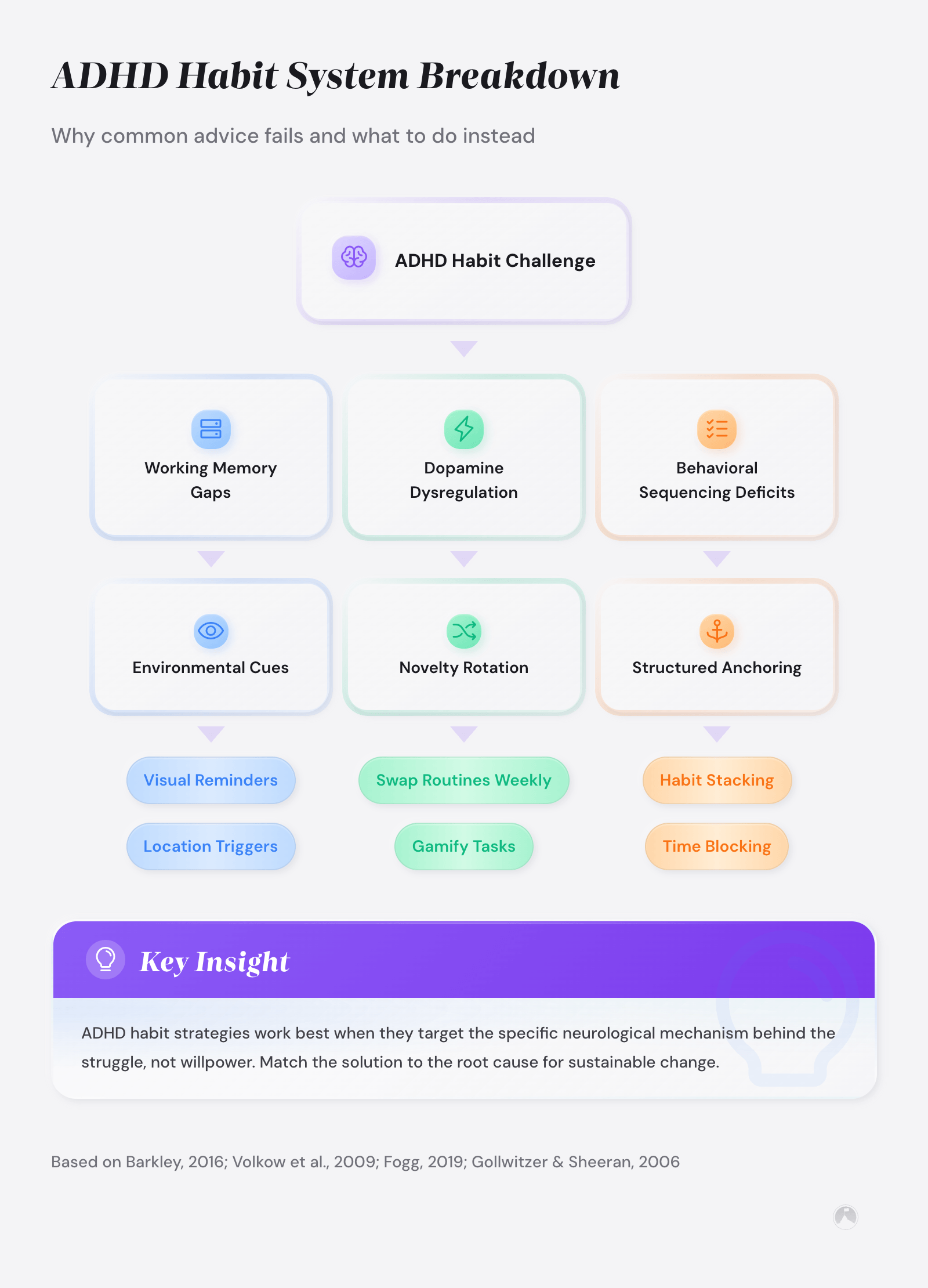
The problem is not discipline. It’s that habit building for ADHD requires addressing three executive function gaps that standard advice ignores: working memory (you won’t remember the action at the right moment), dopamine regulation (moderate rewards won’t sustain motivation after novelty fades), and behavioral sequencing (repetition alone won’t create automaticity the way it does for neurotypical brains). For neurotypical brains, those assumptions mostly hold. For ADHD brains, they collapse on contact with reality.
Habit building for ADHD is the practice of designing behavior-change systems that account for executive function differences, dopamine regulation gaps, and working memory limitations characteristic of ADHD, rather than relying on neurotypical assumptions about consistent internal motivation.
Executive function is the set of mental processes that govern planning, working memory, impulse control, and goal-directed behavior. These are the cognitive processes that habit formation assumes are working reliably. In ADHD, executive function operates at reduced efficiency, which is why strategies built around consistent internal self-regulation tend to fail.
To build habits with ADHD, replace the internal motivation systems your brain lacks with four external structures: environmental cues that bypass working memory, novelty rotation that feeds your interest-based nervous system, short habit stacks anchored to existing behaviors, and pre-built recovery protocols for inevitable breaks.
How to start building habits with ADHD: the quick-start sequence
- Pick one habit only. One action, not a routine. Taking a vitamin. Drinking a glass of water after waking. One.
- Place a physical cue in your direct daily path. Vitamin bottle on top of the coffee maker. Running shoes on top of your laptop bag. Make it impossible to miss.
- Define the two-minute version. What is the smallest possible version of this habit you could do on your worst day? Write it down.
- Write a one-sentence restart script. Before you miss a day, write: “When I miss, I do the two-minute version and that counts.”
- Track weekly frequency, not daily streaks. Four out of seven days is success. Five is excellent. A missed day is data, not failure.
What you will learn
- Why ADHD habit formation is not a discipline problem – it is a neurobiology problem with a structural solution
- The four external structures that replace the internal systems your brain does not provide
- How to build habits that survive the inevitable breaks without the shame spiral
- Why novelty rotation, not willpower, is your actual advantage
- A practical toolkit for matching your specific ADHD challenge to the strategy that addresses it
- How medication status (medicated vs. unmedicated days) affects which pillars carry the most load – and how to adjust without starting over
Key takeaways
- ADHD habit failure stems from three executive function gaps – working memory, dopamine regulation, and behavioral sequencing – that standard advice ignores entirely [2].
- The Dopamine Scaffold Method provides four external pillars – environmental cues, novelty rotation, structured anchoring, and recovery protocols – each addressing a specific ADHD executive function gap [2][3].
- Single-action habits (taking a vitamin, drinking a glass of water) can approach automaticity in weeks, while multi-step routines require months of consistent practice – so starting with one-action habits before building sequences is the lowest-risk path [1][5].
- Neurotypical habit formation takes a median of 66 days [1], but ADHD researchers suggest adults with ADHD frequently need longer because dopamine signaling and executive function differences slow automaticity development [2][3].
- Environmental cues positioned directly in your daily path are more effective than phone reminders for ADHD brains because they bypass the working memory step that notifications require [4].
- The interest-based nervous system [6] means novelty is not optional – rotating how you perform a habit (not what habit you perform) keeps dopamine above the engagement threshold [3].
- Recovery from a missed week is not starting over. The neural pathway still exists. Reactivating it takes less effort than building it from scratch.
- Short habit stacks (two to three behaviors chained together) tend to work better for ADHD than the longer chains neurotypical advice recommends, because each transition demands fresh executive function [2].
Why does habit building for ADHD require a completely different approach?
The neurobiology is specific. Russell Barkley, a leading ADHD researcher, has spent decades documenting how ADHD affects the executive function systems that habit formation depends on: working memory (holding the intention to act), inhibitory control (stopping competing behaviors), and self-directed motivation (sustaining effort without external reward) [2]. When these three systems operate at reduced efficiency, the habit formation architecture that neurotypical brains run automatically falls apart.

The dopamine component adds another layer. Nora Volkow’s neuroimaging research found that adults with ADHD show lower dopamine transporter and receptor binding in the brain’s reward pathway, suggesting a neurobiological basis for reduced sensitivity to delayed rewards [3]. That means the slow, mild satisfaction that keeps neurotypical people engaged with habits – the gradual health improvement, the incremental progress – often falls below the threshold your brain registers as worthwhile. Not from lack of willpower. From receptor biology.
Volkow and colleagues found that adults with ADHD showed lower dopamine transporter and D2/D3 receptor binding in the brain’s reward pathway compared to controls, a reduction in dopamine synaptic markers that was associated with symptoms of inattention [3].
Then comes the interest-based nervous system – a concept developed by psychiatrist William Dodson to describe how ADHD motivation runs on interest, novelty, challenge, and urgency rather than on importance or long-term consequence [6]. A habit that held your attention Monday becomes invisible by Thursday not from personal failure but from a nervous system that’s already moved on. This is not something willpower fixes. It is how the system is wired.
Standard habit advice assumes internal wiring does the work. ADHD habit formation requires replacing that internal wiring with four external structures.
For context on how all habit formation works neurologically, read our guide on the neuroscience of habit formation. Understanding that foundation helps you see exactly where ADHD diverges – and where external structures need to step in. Our complete guide to habit formation covers the broader framework.
The four pillars: how to actually build ADHD habits
Here is a system drawn from both ADHD research and habit science. None of these ideas are new individually – what makes them a system is that each one addresses a specific executive function gap in sequence.
We call this the Dopamine Scaffold Method – a framework we developed to organize established strategies into a coherent sequence. The Dopamine Scaffold Method is a four-pillar external support system for ADHD habit building that compensates for working memory gaps, interest-based motivation crashes, sequencing difficulties, and all-or-nothing thinking by replacing internal neurological systems with environmental cues, novelty rotation, structured anchoring, and recovery protocols. The order matters. Start with environmental cues – they require the least willpower to set up. Add novelty rotation once the habit exists but motivation crashes. Layer in structured anchoring when you’re ready to connect multiple habits. Build the recovery protocol before you need it – and you will need it.

| Pillar | ADHD Challenge it Addresses | Strategy and Example |
|---|---|---|
| Environmental cues | Working memory gaps | Make the habit physically unavoidable. Running shoes on top of your work laptop bag. |
| Novelty rotation | Interest-based motivation crash | Change the how, keep the what. Alternate between running, yoga, dance video each day. |
| Structured anchoring | Sequencing and self-regulation | Pair new behavior with existing anchor (habit stacking). Take vitamins immediately after pouring morning coffee. |
| Recovery protocol | All-or-nothing thinking collapse | Plan the restart before you need it. Pre-written one-sentence restart script: “I do the two-minute version today.” |
What this looks like in practice: one week using all four pillars
Maya, 34, combined-type ADHD, wants to build a daily movement habit. Here is how the four pillars work together across one real week:
Pillar 1 (environmental cue): She places her running shoes directly on top of her laptop bag on Sunday night. No alarm. No reminder app. The shoes are the trigger – she cannot grab her bag to start work without physically picking them up first.
Pillar 2 (novelty rotation): She pre-decides three movement options for the week: Monday running, Wednesday yoga video, Friday dance playlist. The activity changes; the commitment to movement does not. Thursday she spontaneously chooses a 20-minute walk when the yoga feels impossible. That counts.
Pillar 3 (structured anchoring): She stacks movement immediately after her first cup of coffee. Not after breakfast. Not after email. After coffee – the one anchor she never misses. Two behaviors chained. No third link yet.
Pillar 4 (recovery protocol): Tuesday she skips entirely. High-stress meeting, medication wore off early, RSD spiral after a critical email. She had already written her restart script on Sunday: “When I miss, I put on shoes and walk to the end of the street. That is the full habit for today.” Wednesday morning she does the walk. Thursday she does yoga. The week ends at four out of seven days. That is success.
The system did not hold because Maya had exceptional willpower Tuesday. It held because the shoes were still on the bag Wednesday, the restart script was already written, and the bar for “counts” was low enough to be true.
Pillar 1: Environmental cues that bypass working memory
Phone reminders fail for a structural reason: they require working memory to translate a notification into action. The alert pops up, you dismiss it, and your brain has already moved on. By the time the gesture finishes, the intention is gone.
A related mechanism that compounds this problem is time blindness, a distinct ADHD-specific deficit separate from working memory gaps. Time blindness refers to difficulty perceiving and tracking the passage of time internally, which is why clock-based cues (alarms at 8:15 AM) tend to fail for ADHD brains. Event-based anchoring addresses this directly: instead of scheduling a habit at a specific time, you attach it to an event you already experience (pouring coffee, sitting down at your desk, putting on shoes). The event acts as a reliable trigger regardless of what the clock says, because it meets you where your brain actually is rather than where a schedule assumes it should be.
Environmental cues work because they’re unavoidable. Physical. Present. A meta-analysis by Peter Gollwitzer and Paschal Sheeran found that implementation intentions – pairing a planned behavior with a specific situational trigger – significantly improved follow-through rates (d = 0.65) across 94 independent studies [4]. For ADHD brains specifically, the cue works best when it’s positioned directly in the path of existing behavior. Vitamins next to the coffee maker work. Vitamins in a cabinet do not.
Here’s the catch: single static cues habituate in days. ADHD brains adapt to repetition in the physical environment quickly – you stop seeing the Post-it after Thursday.
So layer your cues. Move the position. Add a tactile element. One approach that works: taping the habit trigger to your phone screen so you physically have to move it before scrolling. The friction of moving the cue reactivates the intention.
Environmental cues for ADHD must be positioned in your direct daily path and rotated or adjusted weekly to prevent habituation.
Pillar 2: Novelty rotation for the interest-based nervous system
The interest-based nervous system is a concept developed by psychiatrist William Dodson to describe how ADHD motivation is driven by interest, novelty, challenge, and urgency rather than by importance or long-term consequence. Where neurotypical motivation can sustain effort toward a reward that is distant and moderate, the interest-based nervous system requires engagement in the present moment. A task that is important but not interesting will not generate sufficient dopamine to sustain it [6].
Novelty rotation is the practice of changing how you perform a habit – varying the method, setting, or format – while keeping the underlying behavior constant, so dopamine stays above the engagement threshold that ADHD brains require for sustained motivation.
The predictable arc: intense focus Monday, fading interest Tuesday, invisible by Thursday. Most habit advice tells you to push through that dip. That advice works for brains where steady dopamine maintains effort. Your brain works differently. Do not fight it. Use it.
Keep the core habit constant but rotate the method. If daily movement is the goal, cycle between running, yoga, a dance video, a walk. Same underlying behavior. Fresh dopamine each day. One caveat: if you have comorbid anxiety alongside ADHD, introduce novelty rotation gradually, starting with just two options before expanding, because too many choices at once can trigger decision paralysis rather than the engagement boost that novelty rotation is designed to provide.
Behavior scientist BJ Fogg’s Tiny Habits method emphasizes making behavior small enough (under 30 seconds) that motivation becomes secondary to friction reduction [7]. For ADHD brains, we extend this principle: “easy” also means “interesting.” A two-minute meditation in the same app every day will bore you into abandoning it within days. A two-minute meditation rotating between breathing, body scan, and visualization keeps the neural reward circuitry engaged.
The reframe: novelty rotation is not indulgence. It’s the load-bearing structure of the system. Without it, the dopamine crash that Volkow’s research documents [3] makes disengagement inevitable. With it, you’re feeding the interest-based nervous system exactly what it needs to maintain consistent behavior.
Novelty rotation means changing how you perform a habit, not what habit you perform, so the behavior strengthens while dopamine stays above engagement threshold.
Pillar 3: Structured anchoring through short habit stacks
ADHD executive function deficits make sequencing genuinely difficult [2]. You might nail a single habit but struggle to string five together into a coherent ADHD morning routine. Each transition requires a fresh decision, and decision-making draws from a depleted pool. The standard advice of building elaborate morning routines backfires for this exact reason: each step is a new executive function cost.
Habit stacking anchors new behaviors to existing ones, removing the sequencing requirement. “After I pour my coffee” becomes automatic. “After coffee, I take my vitamins” piggybacks on that existing neural pathway. You’re outsourcing the decision-making to a system. For more on how stacking works, see our guide on habit stacking for beginners.
One adjustment that ADHD clinical practice suggests: keep your stacks short. Two habits chained together. Three maximum. Standard habit stacking guides often recommend chains of five or six – each additional link is a potential break point where distraction enters and the whole chain collapses. Barkley’s research on executive function limitations [2] explains why: every transition in a chain requires working memory and inhibitory control that ADHD brains have less of. Short stacks with strong anchors tend to hold better than long chains with weak links.
Body doubling – doing the habit alongside another person, in person or virtually – is a widely reported strategy among adults with ADHD. Many find that the presence of another person helps maintain focus and follow-through, though formal research on the mechanism is limited. The accountability operates through social presence rather than social pressure: another person working nearby creates just enough external structure to keep your executive function engaged without adding performance anxiety. Practical formats include platforms like Focusmate (scheduled 50-minute video coworking sessions with a stranger), informal video coworking with a friend who works alongside you on camera, or an in-person accountability partner who does their own tasks in the same room while you do yours. The key is matching the format to your tolerance: some ADHD adults find stranger-based body doubling less distracting than working with someone they know. For more on external accountability structures, see our guide on accountability systems for ADHD.
Short stacks with strong anchors beat long chains with weak links – every transition is a decision point your executive function has to fund.
Pillar 4: Recovery protocols for the inevitable collapse
Every ADHD habit system will break down. Not if. When. The all-or-nothing thinking pattern common in ADHD turns a missed day into a missed week into a permanent identity: “I’m the kind of person who can’t stick to anything.” That narrative does more damage than the missed habit.
Part of why the shame spiral after a habit break hits harder for ADHD brains is rejection-sensitive dysphoria (RSD), a concept developed by psychiatrist William Dodson to describe the intense emotional pain triggered by perceived failure or self-criticism. RSD means that missing a habit does not register as a neutral data point the way it might for a neurotypical brain. It registers as proof of a fundamental flaw, and that emotional intensity can shut down the executive function resources needed to restart. Understanding that this response is neurological, not a character defect, is the first step in designing a recovery protocol that accounts for it.
Research by Anastasia Buyalskaya and colleagues, published in PNAS, used machine learning analysis of gym attendance and hygiene data to show that simpler behaviors reach automaticity faster while complex routines require substantially more repetition [5]. For ADHD brains, this means a two-week gap does not erase your progress the way it feels. The neural pathway is still there. Reactivating it requires less effort than building it from scratch.
“ADHD involves deficits in self-regulation that compromise the ability to organize behavior across time toward future goals – but these are deficits in performance, not knowledge” [2].
Build the recovery protocol before you need it. Write a one-sentence restart script: “I do the two-minute version of [habit] today.” Tape it somewhere visible. The goal after a break is not resuming at full intensity – it’s reactivating the pathway. Two minutes after a two-week gap counts as a win because it prevents the shame spiral from cementing into identity.
A habit restart is reactivating a neural pathway that still exists, not starting from zero. Every restart makes that pathway stronger.
When every system fails at once: flexible consistency
What we call flexible consistency is an ADHD-adapted approach to habit maintenance that defines success by weekly frequency rather than daily streaks, incorporating minimum viable versions of each habit for low-functioning days.
Define consistency by weekly frequency rather than daily streaks. Five out of seven days is consistent. So is four. Sleep disruption, medication changes, hormonal shifts, and stress can drop executive function below the threshold for even basic habits. The specific daily count matters far less than the permission to have those days without categorizing them as failure.
Create a minimum viable version of each habit for low-functioning days. Normal workout: 30 minutes. Minimum viable version: putting on workout clothes and stretching for two minutes. Normal journaling: a full page. Minimum viable version: a single sentence. These micro-versions keep the neural pathway active without demanding resources you do not have.
“The time it takes for behavior to reach automaticity ranges from 18 to 254 days, with a median of 66 days, and missing a single day did not materially affect the habit formation process” [1].
That finding from Phillippa Lally’s research at University College London [1] is liberating for ADHD habit formation. Missing one day does not reset progress to zero. Missing several does not erase the work. The path is still there, just weaker. For context on why habits fail broadly, read about understanding why habits fail, and explore how much time building a habit actually takes – both are relevant for ADHD timelines.
One important note: stimulant medication affects dopamine availability and may change which strategies are most relevant on a given day. Medicated and unmedicated states can shift how much external structure you need from environmental cues and novelty rotation. The behavioral strategies in this article are designed to work alongside medication, not as replacements. Consult a clinician for guidance on how your specific medication regimen interacts with habit building.
Flexible consistency means defining success by weekly frequency, not daily streaks, with minimum viable versions for low-functioning days built in from day one.
Matching your specific challenge to the right ADHD habit strategies
Different ADHD challenges respond to different adhd habit strategies. Here’s a quick diagnostic to identify where your system is actually breaking.
Your ADHD presentation type also shapes which pillars to prioritize. Primarily inattentive presentations tend to struggle most with environmental cue detection and working memory gaps, making Pillar 1 (environmental cues) and Pillar 3 (structured anchoring) the highest priority. Hyperactive/impulsive presentations often face more difficulty with sequencing disruption and impulsivity breaking chains mid-action, where Pillar 3 (short stacks) and Pillar 4 (recovery protocols) address the most frequent failure points. Combined presentations face challenges across all four pillars simultaneously, which is why starting with a single pillar and layering gradually matters more for combined types than for any other presentation [2].
Adults diagnosed later in life – in their 30s, 40s, or 50s – face a distinct challenge that early-diagnosis frameworks do not address: years of failed neurotypical systems have often created a layer of identity damage on top of the neurological challenges. If you spent decades believing the problem was your character rather than your neurobiology, the first thing the Dopamine Scaffold Method has to work against is not a missing cue or a weak stack. It is the assumption that you are not someone who can build habits at all. For late-diagnosed adults, Pillar 4 (recovery protocols) is not just the last pillar – it is often the first place to start, because the RSD response to a single missed day is frequently the mechanism that collapses every prior attempt. Building the restart script before building the habit itself resets the most damaging pattern first.
| Your Main Struggle | Solution | Quick Start |
|---|---|---|
| You forget the habit entirely | Multi-sensory cue layering (working memory gap) | Place the habit cue on your phone screen tonight |
| Intense focus fades by Thursday | Novelty rotation protocol (interest-based motivation crash) | List three ways to do the same habit differently tomorrow |
| Individual habits work but routines collapse | Short-chain habit stacking (sequencing and transition demand) | Attach one new habit to your strongest existing anchor |
| One missed day becomes permanent | Pre-written recovery protocol (all-or-nothing thinking spiral) | Write a one-sentence restart script right now |
| Overwhelm from multiple simultaneous habits | One-habit-at-a-time sequencing (executive function bandwidth limit) | Identify the single habit with highest daily impact |
For tracking these adhd daily habits without adding friction, see our comparison of habit tracking apps – focus on visual progress and flexible scheduling. But keep tracking itself minimal. If the tracking system demands more executive function than the habit, the system is the problem.
Ramon’s take
Most ADHD habit content gets one thing wrong: the goal is not automaticity. Neurotypical habit advice uses automaticity as the finish line. You build the habit until it runs without conscious thought, then you are done. But for most adults with ADHD I have talked to, that finish line does not exist in the same way. The external structures do not fully disappear. The vitamin still needs to be on the coffee maker. The novelty rotation still needs refreshing every week or two. And that is not failure. That is just how the system operates. Building toward automaticity as your goal sets you up for a permanent sense of not quite getting there. Building toward a permanently lightweight external structure you maintain willingly is a different target, and I think it produces better outcomes.
The practical implication: do not try to remove the cues once the habit feels solid. Most ADHD adults who do that find the habit falls apart within weeks. The cue was never training wheels. It was the load-bearing wall.
One more thing I would emphasize: start with environment, not apps. The people I see struggling most with ADHD routine building are running sophisticated tracking systems that demand more executive function than the habits themselves. One physical cue in your daily path beats any app notification. Get the physical world right first. Digital tools come later, if at all.
Habit building for ADHD: conclusion
Creating habits with ADHD is not about forcing a neurotypical system to work through willpower. It’s about designing systems that match how your brain actually operates: interest-driven, externally supported, novelty-fed, resilient to breaks. The Dopamine Scaffold Method gives you four clear pillars: environmental cues, novelty rotation, structured anchoring, and recovery protocols. Each one directly compensates for a specific executive function gap rather than pretending that gap does not exist.
ADHD habit systems are not built despite failure – they are built from failure. Every break makes the comeback architecture stronger.
Next 10 minutes
- Pick one habit you want to build and place a physical cue directly in your daily path
- Write a one-sentence restart script for that habit and place it somewhere visible
- Define the minimum viable two-minute version of the habit for low-functioning days
This week
- Practice the one habit with its physical cue for five days, tracking weekly frequency instead of daily streaks
- List three different ways to perform the same habit for novelty rotation next week
- Identify one existing daily anchor habit you could stack a new behavior onto
There is more to explore
If you’re building habits as a parent, our guide on habits for working parents addresses similar time and energy constraints. For pairing habits with your natural energy patterns, explore our guide on habit pairing and energy management. And if you want to identify the single habit with the biggest ripple effect, start with our keystone habits guide. To understand why habits break down more broadly, see our diagnostic guide on why habits fail.
Related articles in this guide
- Habit pairing: how to match your habits to your natural energy
- habit-stacking-for-beginners
- habit-stacking-productivity-creativity
Frequently asked questions
Why is building habits with ADHD so much harder than standard advice suggests?
ADHD presentations affect habit formation differently. Primarily inattentive types tend to struggle most with environmental cue detection and working memory gaps, while combined types face additional challenges from impulsivity disrupting habit sequences mid-chain [2]. Unlike neurotypical habit failure, which often stems from motivation decline alone, ADHD habit failure involves simultaneous breakdowns across working memory, dopamine regulation, and sequencing – requiring external structure at every level rather than a single fix.
How long does it actually take someone with ADHD to form a habit?
Timeline depends heavily on habit complexity. Single-action habits (taking a vitamin) may approach automaticity within weeks, while multi-step routines (a morning sequence) can require months of supported practice [1][5]. For ADHD specifically, ‘formed’ often means the behavior is semi-automatic with lightweight external support still in place – medication status, sleep quality, and stress levels can all shift formation timelines significantly [2][3]. Building in permanent minimal cues rather than expecting full autopilot tends to produce more durable results.
How should you adjust your ADHD habit system on unmedicated days or during high-stress periods?
Unmedicated days and high-stress periods reduce the dopamine availability and executive function bandwidth that your habits rely on, which means the same system that works Monday may not hold Thursday. The practical adjustment is to shift more load onto environmental cues – the pillar that demands the least internal regulation – and activate minimum viable versions of every habit rather than attempting full-length sessions. On these days, completing the two-minute version counts as a full win. If stimulant medication is part of your regimen, tracking which habits hold without medication versus which collapse entirely can help you identify which pillars are doing real work and which are relying on pharmaceutical support you cannot always count on.
Can people with ADHD actually form habits?
Yes, but differently. ADHD slows automaticity development and may require ongoing external support (environmental cues, accountability, novelty rotation) even after a behavior becomes semi-automatic [2]. Neurotypical habits eventually run on autopilot with minimal support. ADHD habits benefit from permanently lightweight external support – not a flaw, but a structural difference worth designing for from day one.
What habit tracking system actually works for ADHD?
The best system is the one with the lowest friction to use. Visual trackers like wall charts or whiteboard grids often outperform apps because they do not compete with phone notifications. If you use an app, look for simple interfaces, flexible scheduling (not streak-dependent), and visual progress indicators. More important than the tool: keep tracking to one location you already look at daily. If tracking demands more executive function than the habit itself, eliminate the tracker.
How do you create a stable routine with ADHD when transitions are hard?
Transition difficulty is an executive function challenge, not motivation [2]. Use short habit stacks – two to three behaviors chained together, not six to eight – anchored to strong existing habits (coffee, teeth brushing, shower). Add a physical transition cue like a specific song or changing rooms between activities. Keep morning and evening routines to four steps maximum and expand only after those become automatic.
This article is part of our Habit Formation complete guide.
References
[1] Lally, P., van Jaarsveld, C. H. M., Potts, H. W. W., and Wardle, J. “How are habits formed: Modelling habit formation in the real world.” European Journal of Social Psychology, 2010. https://doi.org/10.1002/ejsp.674
[2] Barkley, R. A. “Attention-Deficit/Hyperactivity Disorder and Self-Regulation: Taking an Evolutionary Perspective on Executive Functioning.” In Handbook of Self-Regulation: Research, Theory, and Applications, 3rd ed., edited by K. D. Vohs and R. F. Baumeister. Guilford Press, 2016. https://www.guilford.com/books/Handbook-of-Self-Regulation/Vohs-Baumeister/9781462520459
[3] Volkow, N. D., Wang, G.-J., Kollins, S. H., et al. “Evaluating Dopamine Reward Pathway in ADHD.” JAMA, 2009. https://doi.org/10.1001/jama.2009.1308
[4] Gollwitzer, P. M. and Sheeran, P. “Implementation Intentions and Goal Achievement: A Meta-Analysis of Effects and Processes.” Advances in Experimental Social Psychology, 2006. https://doi.org/10.1016/S0065-2601(06)38002-1
[5] Buyalskaya, A., Ho, H., Milkman, K. L., Li, X., Duckworth, A. L., and Camerer, C. “What can machine learning teach us about habit formation? Evidence from exercise and hygiene.” Proceedings of the National Academy of Sciences, 2023. https://doi.org/10.1073/pnas.2216115120
[6] Dodson, W. W. “Secrets of the ADHD Brain.” ADDitude Magazine. https://www.additudemag.com/secrets-of-the-adhd-brain/
[7] Fogg, B. J. Tiny Habits: The Small Changes That Change Everything. Houghton Mifflin Harcourt, 2019. https://tinyhabits.com/


