 Goals & Progress


What if your beliefs about intelligence determine every decision you make?
Growth mindset development starts with a deceptively simple finding. In 1998, psychologist Carol Dweck ran a study with 128 fifth graders that upended decades of assumptions about praise and motivation [1]. Here’s what happened: one group was praised for being smart. The other was praised for working hard. Then both groups faced a choice – an easy task or a hard one.
This guide is part of our Growth collection.
The behavioral gap between intelligence-praised and effort-praised children is significant. The kids praised for intelligence overwhelmingly picked the easy option. The kids praised for effort picked the challenge. It suggests your beliefs about whether abilities are fixed or changeable determine how you respond to struggle.
This article is a complete guide to growth mindset development – what it actually is (and isn’t), why neuroscience validates it, where your fixed thinking hides, and concrete daily practices that shift both belief and behavior. The goal isn’t motivation puffery. It’s understanding how your mind works so you can change it – whether you’re an adult rethinking career abilities or a parent wondering how to talk to your kids about effort.
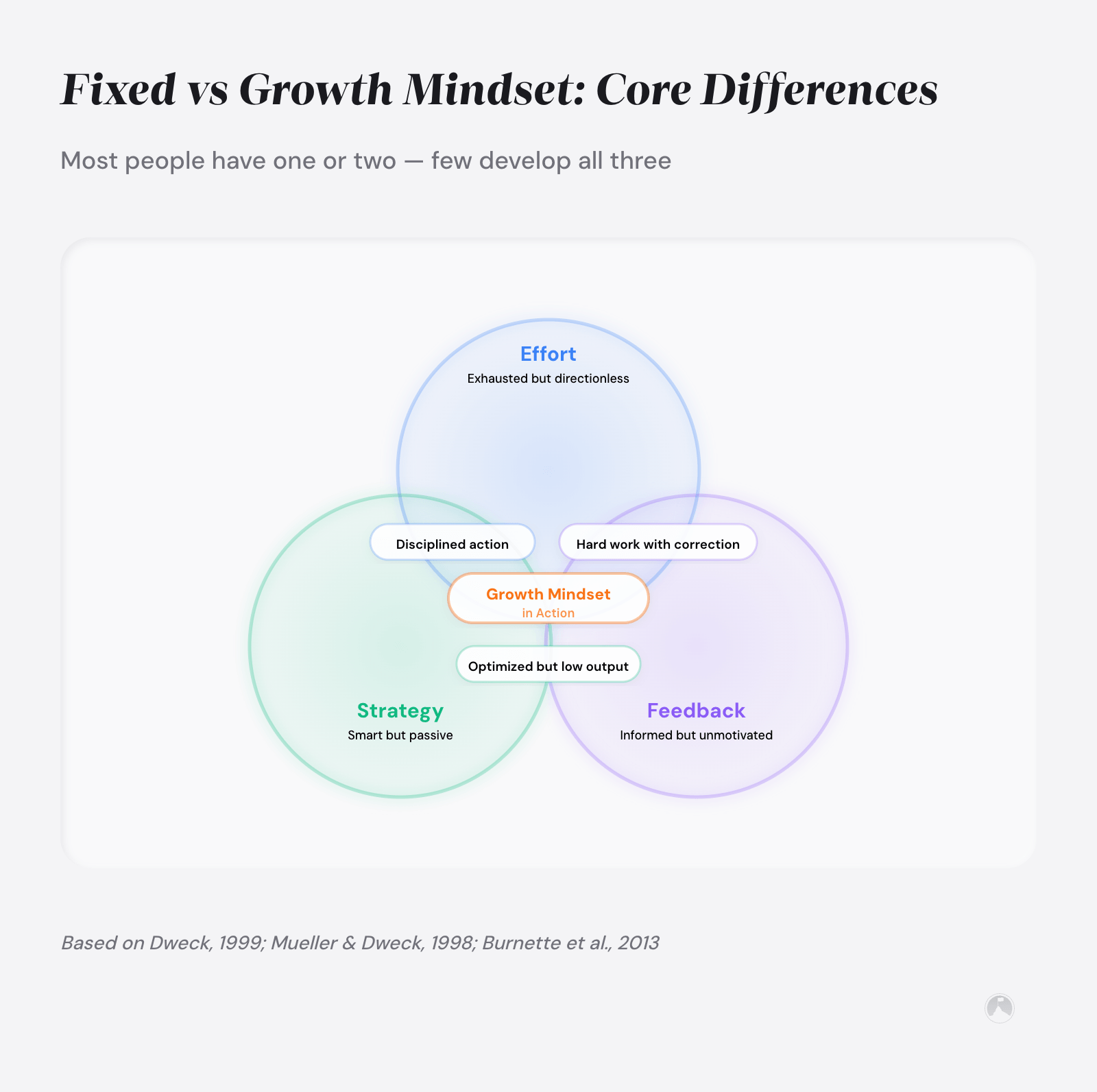
Growth mindset is the belief that abilities and intelligence develop through effort, effective strategies, and feedback – not fixed traits handed out at birth. People with growth mindsets treat failure as data about what to try next, not proof of permanent limitation.
What you will learn
- How growth mindset and fixed mindset show up differently in the brain and in actual behavior
- Why neuroplasticity research proves abilities aren’t locked in at birth
- A practical framework for finding where fixed thinking is hiding in your life
- Seven concrete strategies for building growth mindset across different life domains
- Daily exercises under 10 minutes that rewire your brain toward growth
- Five common traps that sabotage mindset development and what actually works instead
- What the latest research reveals about which growth mindset interventions move the needle
Key takeaways
- Growth mindset isn’t motivation talk – it’s a measurable belief that abilities develop through effort, strategy, and feedback rather than fixed talent.
- Your brain physically restructures itself when you practice hard things – neuroplasticity studies show gray matter growth in response to sustained learning [5].
- Growth mindset is associated with stronger neural error-detection signals: the Moser et al. (2011) EEG study found a correlation between growth mindset beliefs and greater Pe amplitude, reflecting heightened attention to mistakes [6].
- Most people hold mixed mindsets – growth in some domains and fixed in others – so development is domain-specific, not all-or-nothing.
- Process praise works better than trait praise: “You worked hard on that strategy” builds growth mindset; “You’re so smart” reinforces fixed thinking [1].
- Growth mindset interventions show real effects but modest ones – context and structure matter as much as mindset alone [3].
- The daily practice that matters most isn’t motivation – it’s reframing failure as information, not identity evidence [6].
Growth mindset vs fixed mindset: the brain difference that matters
Fixed mindset is the belief that intelligence and abilities are static traits you either have or don’t – largely set at birth and resistant to meaningful change. Growth mindset holds the opposite view: abilities are developable through effort, strategy, and feedback. The two beliefs produce starkly different behaviors when things get difficult.
These aren’t just different philosophies. They show up in measurable behavior. When you believe intelligence is set at birth, every test becomes a referendum on who you are. To someone with a fixed mindset, a difficult problem means “I’m not good enough.”
So you avoid challenges. You give up faster. You feel threatened when others succeed.
When you hold a growth mindset, failure becomes information about what to try next, not evidence of permanent limitation. You seek challenges because struggle signals learning, not inadequacy. You push through harder obstacles. And you learn from criticism instead of taking it as personal attack [2].
The table below shows how these mindsets branch into completely different reactions to the same situation:
| Situation | Fixed mindset response | Growth mindset response |
|---|---|---|
| You fail a test | Avoid similar challenges in future | Analyze what to study differently |
| Something takes effort | “If it’s hard, I’m not good at it” | “Effort is how I get better” |
| Someone else succeeds | Feel threatened or jealous | Ask what they did and learn from it |
| You get critical feedback | Reject it or become defensive | Look for the useful part |
| You hit a frustration point | Give up – “I’m just not built for this” | Try a different strategy or get help |
Neuroscience research shows these responses correspond to distinct brain patterns: fixed mindset triggers defensive threat activation, while growth mindset engages exploratory, prefrontal processing [6].
What are the 5 characteristics of a growth mindset?
People with a developed growth mindset share five observable characteristics that distinguish them from fixed-mindset thinkers in real situations:
- Embraces challenges – Treats difficulty as a signal that learning is happening, not as evidence of inadequacy.
- Persists through obstacles – Stays engaged when tasks get hard, because struggle means growth, not failure.
- Treats effort as the path – Views sustained effort as the mechanism of improvement, not a sign that talent is lacking.
- Learns from criticism – Looks for the actionable information in negative feedback rather than rejecting it as a personal attack.
- Finds lessons in others’ success – Uses other people’s achievements as data about what is possible and what strategies work, not as a threat to self-image [2].
But here’s what gets overlooked: this isn’t binary. You’re not “growth mindset person” or “fixed mindset person.” Dweck herself has repeatedly clarified in her 2016 Harvard Business Review piece that most people hold both beliefs across different domains [11]. You might have a genuine growth mindset about cooking but a rock-solid fixed mindset about your ability to do public speaking. If you want to explore how your own mindset patterns vary across domains, a structured self-assessment framework can help you map that variation.
The mindset you hold in any given moment depends on the domain, the stakes, and what you believe about that specific ability.
The neuroscience of neuroplasticity: your brain rewires when you struggle
What is neuroplasticity?
Neuroplasticity is the brain’s ability to physically reorganize itself – forming new neural connections and altering existing ones – in response to learning, experience, and deliberate practice, throughout life [5]. It is not a metaphor. MRI and EEG studies have measured these structural and functional changes directly in adults and children. The key finding: the brain does not come pre-specialized for fixed abilities. It adapts based on what you practice.
How does neuroplasticity relate to growth mindset?
Growth mindset works because it is aligned with what neuroplasticity research shows about how brains actually change. When you hold a growth belief, you approach difficulty differently – and that difference in approach produces measurable neural changes over time. For a deeper look at the brain science behind these two mindsets, see our article on fixed vs growth mindset neuroscience.
Here’s the specific evidence: neuroscientist Bogdan Draganski studied people learning to juggle. Using MRI scans, he measured their brain tissue before training, during training, and after they stopped. The people who practiced showed measurable increases in gray matter in brain regions associated with visual-spatial processing. When they stopped practicing, those areas shrank back [5].
The human brain physically restructures itself through sustained practice – new neural pathways form, making previously difficult tasks progressively automatic [5]. Brain restructuring through practice is not a metaphor. MRI scans show structural changes in gray matter after focused skill development. It’s why musicians’ brains look different from non-musicians, why London taxi drivers who spend years memorizing complex city routes develop significantly enlarged hippocampi compared to control subjects [8].
Maguire et al. (2000) found that right hippocampal volume in licensed London taxi drivers correlated with the amount of time spent as a driver, suggesting that sustained navigation experience drives structural brain changes. [8]
While the Maguire study was observational (taxi drivers self-selected into the profession), subsequent experimental studies including Draganski’s juggling research [5] confirmed that training itself drives structural brain changes.
Even more specific to mindset: neuroscientist Jason Moser ran an EEG study where people who endorsed growth mindset beliefs made errors on a task. Their brains showed a stronger signal called the “error positivity” response (Pe). This signal reflects conscious awareness of and attention to mistakes [6]. What does that mean? People who believe they can improve literally pay more attention to their own errors at the neural level. Their brains allocate processing power differently.
Moser et al. (2011) found that a growth mindset was associated with an enhanced error positivity (Pe) signal, indicating greater neural attention to mistakes and more adaptive post-error adjustments. [6]
When someone says “I just can’t learn math” or “I’m not a creative person,” they’re making a claim that neuroscience directly contradicts. The brain doesn’t come pre-specialized for specific abilities. It comes pre-wired for adaptation. What you practice, you develop. What you avoid, you don’t.
Where does your fixed mindset actually hide? The domains that get missed
It is easy to read about growth mindset and nod along, thinking, “Yes, I believe abilities develop through effort.” But believing growth mindset in theory is different from living it across your actual life. This gap between stated belief and domain-specific behavior is what you might call Domain-Locked Thinking – the pattern where fixed beliefs persist in specific domains even when a person holds genuine growth beliefs everywhere else. Growth beliefs in one area sit next to fixed beliefs in another.

What Dweck calls domain-specific mindset means you can genuinely believe your cooking skills are improvable while simultaneously believing your public speaking ability is locked in at “terrible.” Research shows implicit theories of ability are domain-specific, not universal [2].
This variation is actually good news. It means you don’t need to overhaul your entire thinking. You need to identify the specific domains where fixed beliefs are limiting you, then do targeted work in those areas. Dweck’s research identifies several domains where mindset varies independently [2]. Here are five where fixed thinking tends to hide:
1. Intelligence – Do you believe you can get meaningfully smarter, or is IQ mostly locked in? People with fixed intelligence beliefs avoid intellectual challenges because struggle feels like proof of low ability, not evidence of learning.
2. Talent and skill – Can creative or athletic skills be built through practice, or does “natural talent” determine your ceiling? Fixed talent beliefs cause people to quit new skills too early because initial difficulty feels like a stop sign rather than normal struggle.
3. Personality – Is your temperament changeable, or is “this is just who I am” the final truth? Fixed personality beliefs feel like self-acceptance but often function as self-limitation. This is one of the stickiest mindsets to shift because it feels like you’re being honest with yourself rather than limiting yourself. If you suspect certain deeply held beliefs are operating as ceilings, our guide on overcoming limiting beliefs covers how to identify and dismantle them.
4. Relationships and social skills – Can you improve how you communicate and connect, or is compatibility either there or it isn’t? Fixed relationship beliefs cause people to abandon relationships or avoid socializing when conflict appears instead of treating conflict as a skill to develop.
5. Career abilities – Can you develop new professional competencies, or are you locked into what you’re “naturally good at”? Fixed career beliefs keep people stuck in roles they’ve outgrown because switching fields feels impossibly risky. If you’re considering a career change, the mindset shifts for career changers article breaks down how to approach that transition.
Quick mindset check: For each domain below, rate yourself 1-5 on whether you believe this ability is fixed (1) or fully growable (5). Intelligence __, Talent and skill __, Personality __, Relationships __, Career abilities __. Any domain you rated 1-2 is where growth mindset development work will have the biggest impact.
The first step is honest self-assessment. Tools like self-discovery exercises can help you map your own beliefs across these domains so you know exactly where to focus your growth mindset development work.
Growth mindset development isn’t about becoming a different person. It’s about finding the two or three domains where fixed beliefs are costing you the most.
Growth mindset development strategies: seven practices that work
This is where theory meets daily life. Developing a growth mindset is not a single mental shift – it is a set of specific practices applied consistently across the domains where fixed beliefs are costing you. The seven strategies below form what this guide calls the Domain-Targeted Practice Set: a sequenced collection of rewiring practices that work at the belief, interpretation, and behavioral levels. They shift how you think about difficulty in the specific domains where Domain-Locked Thinking is active.
Here is how effort, strategy, and feedback work together in practice. Say you are trying to improve at giving presentations. You do a five-minute talk at a team meeting (effort). Afterward, you ask a colleague to point out the one moment where you lost the room (feedback). You identify that you spoke too fast when nervous and decide to pause after each key point (strategy). You try that adjustment at the next meeting. That cycle – effort, feedback, revised strategy – is what builds a growth mindset in real life. The belief follows the evidence from the cycle, not the other way around.

1. Reframe effort language
Instead of “This is hard, maybe I’m not good at this,” try “This is hard, which means my brain is growing.” The struggle itself becomes the point, not evidence you’re failing. When your brain encounters genuine difficulty, new neural connections form [5]. Struggle is literally the mechanism of learning. Once you recognize that, effort feels different – less like punishment, more like progress.
2. Practice process praise (with yourself)
Dweck’s original research showed that people praised for effort outperform people praised for intelligence [1]. The same principle applies to self-talk. Instead of “I’m so smart,” try “I worked through that systematically” or “I found a strategy that worked.” Self-praise focused on process builds malleable beliefs. Self-praise focused on traits reinforces fixed thinking.
Mueller and Dweck (1998) found that children praised for intelligence displayed less persistence, more low-ability attributions, and reduced task enjoyment after experiencing failure, while children praised for effort maintained motivation and performance. [1]
3. Seek difficulty deliberately
Growth happens at the edge of current ability, not in the comfortable zone. Deliberately pick tasks that are hard enough to require your full attention but not so hard that they feel impossible. Psychologist Lev Vygotsky called this the “zone of proximal development” – the sweet spot between what you can do independently and what you can accomplish with guidance [10]. If you want to develop public speaking, don’t start with a keynote at a conference. Start with a two-minute update at a team meeting. That’s your zone. The right amount of difficulty feels uncomfortable but not crushing.
4. Build a failure resume
Princeton researcher Johannes Haushofer published his “CV of Failures” listing rejections, failed projects, and courses he didn’t get into [7]. The practice normalizes failure as part of progress, not as shameful evidence of inadequacy. Start tracking your own – rejections you’ve received, projects that flopped, mistakes you made and learned from. The longer the list, the more you’ve actually tried and grown.
5. Study other people’s growth stories
When you see someone skilled, most people assume they were “naturally gifted.” But research on skill development shows that deliberate practice – focused, effortful engagement with tasks just beyond your current ability, with specific feedback and targeted adjustment – matters far more than initial talent [2]. When you encounter someone good at something, ask about their journey. “I failed at this for years before it clicked” is more useful than “I was always good at this.” For a structured approach to resilience through setbacks, explore how building an antifragile mindset turns failure into fuel.
6. Use “yet” as a cognitive tool
“I can’t code” becomes “I can’t code yet.” “I’m bad at public speaking” becomes “I’m bad at public speaking yet.” That single word shifts your brain from fixed identity to temporary state. It opens possibility. It signals to yourself that this is a skill to develop, not a permanent fact about you.
7. Connect mindset to actual systems and habits
Believing you can improve means nothing without specific practices that build improvement. If you want to develop growth mindset about writing, you need a daily writing habit, not just positive thoughts about writing. If you want to grow as a public speaker, you need a recurring calendar slot for practice sessions, not just a belief that you could get better. The belief becomes real only when you embed it in actual behavior – in systems, practices, and routines. The GROW framework gives you a structure for translating growth beliefs into concrete, trackable progress.
Research shows growth mindset interventions produce larger effects when paired with concrete behavioral systems and supportive environments [3][4]. Growth mindset without a system is just wishful thinking. Systems without growth mindset are just going through the motions.
The strategies above shift how you think. To make them stick, pair each one with a daily practice. Strategy 1 (reframe effort language) pairs naturally with the morning mindset check – you prime the reframe before the day starts. Strategy 4 (build a failure resume) pairs with the evening effort journal – you log the attempt and what you learned from it. Strategy 7 (connect mindset to systems) provides the architecture that makes all four exercises sustainable over time. If you are starting out, pick one strategy and one matching exercise, and run that pairing for two weeks before adding more. The exercises below create the daily structure that makes those shifts stick.
What are the best daily exercises for developing a growth mindset?
Growth mindset exercises are brief daily practices – typically 2-10 minutes – that train your brain to respond to difficulty with curiosity instead of defensiveness. Four exercises with the strongest evidence base include a morning mindset check, an evening effort journal, a weekly challenge stretch, and a failure reframe practice. These aren’t affirmations. They’re concrete practices that build neural patterns over time [5].

Morning mindset check (2 minutes)
Before your day starts, identify one area where you’re likely to face difficulty. Ask yourself: “What’s one specific thing I can try if I get stuck?” Not “I’ll try harder” or “I’ll be positive.” Concrete – “I’ll ask for help,” “I’ll try a different approach,” “I’ll look for a tutorial.” This primes your brain to problem-solve rather than defend.
Evening effort journal (5 minutes)
Before bed, write down one moment where you struggled that day. Not to beat yourself up – to notice what you tried. “I spent an hour debugging that code and tried three different solutions” or “I asked for feedback even though it was uncomfortable.” Highlight the effort and the learning process, not the outcome.
Weekly challenge stretch
Pick one small thing that genuinely scares you a little (not terrifies, just uncomfortable). It should take less than an hour. Learn a skill you thought you “couldn’t” learn. Start a conversation you’ve been avoiding. Try a physical activity outside your comfort zone. The point is to collect evidence that difficulty doesn’t mean failure.
The “what did I learn?” reframe
When something doesn’t work, stop and ask: “What did I learn from this?” Not as forced positivity – as genuine investigation. What worked? What didn’t? What would you do differently? This converts frustration into data, which is the core of growth mindset thinking.
Growth mindset exercises for adults work best when they’re brief, specific, and embedded in existing routines. You don’t need a 30-minute ritual. You need a 2-minute habit attached to something you already do.
The exercise that changes your brain isn’t the one that sounds impressive. It’s the one you actually do every day.
Five traps that sabotage mindset development (and what actually works)
Trap 1: “I already have a growth mindset”
Growth mindset isn’t a fixed trait you either have or don’t. It’s a practice. Growth beliefs in some domains sit next to fixed beliefs in others. The moment you stop noticing where you’re stuck, you stop developing. Growth mindset development is an ongoing process, not a destination. If you’re not sure whether you’re actually stuck, these signs you need a mindset shift can help you find your blind spots.
Trap 2: “Effort is all that matters”
Effort alone doesn’t produce improvement. You also need feedback, strategy, and sometimes better resources. “If you just try harder, you’ll succeed” is sometimes true but often harmful – it ignores genuine structural barriers, lack of access, or poor strategy. Growth mindset without smart strategy is just grinding.
Trap 3: Using mindset to dismiss structural barriers
“You just need a better mindset” is a harmful response to someone facing systemic discrimination, poverty, or lack of resources. A meta-analysis across 273 studies found that growth mindset interventions have real effects, but they’re modest and don’t override structural disadvantages [3]. Mindset matters. Context matters more. You can have the strongest growth mindset in the world and still hit barriers no individual belief can overcome.
Trap 4: Praising effort on poor work
Telling someone “great effort” when their work is objectively below standard isn’t growth mindset – it’s false comfort. Real growth mindset feedback is honest: “You put in real work. The result isn’t where it needs to be yet. Let’s look at what strategy might close the gap.” It’s both kind and forward-looking, not just pleasant.
Trap 5: Ignoring your fixed mindset triggers
Everyone has situations that activate defensive, self-protective thinking even in otherwise growth-oriented people. Public criticism. Being compared to someone more skilled. Entering a domain where you’re a beginner. High-stakes evaluation. Recognizing your specific triggers is more useful than pretending you don’t have them. Once you know what sets off fixed thinking, you can prepare for it.
The biggest trap is thinking you’re done. Growth mindset development has no finish line – only checkpoints.

What does growth mindset research actually show? The honest picture
Growth mindset is real and evidence-backed. But the research is more nuanced than popular versions suggest.

Yeager et al. (2019) tested growth mindset interventions across 65 public high schools and 12,000+ ninth-graders in a national experiment published in Nature, finding measurable grade improvements for lower-achieving students [4]. But the effect was modest and context-dependent: in schools where peer norms already supported growth-oriented effort, the intervention worked. In schools where peer norms did not support the growth message, the intervention produced no detectable benefit.
A 2018 meta-analysis by Victoria Sisk and colleagues across 273 growth mindset studies found: Yes, growth mindset interventions produce real effects. But the effects are modest, not transformative [3]. They work better for students already struggling than for high-achievers. They work better when combined with concrete support than when delivered alone. And they don’t automatically overcome systemic barriers or lack of resources.
Sisk et al. (2018) found that overall effects of growth mindset interventions on academic achievement were weak, though effects were somewhat larger for academically at-risk students. [3]
The finding that growth mindset is effective but not magical is more useful than hype because it means your energy goes to realistic practices, not false hope. The research reveals growth mindset as genuinely effective – it amplifies what’s already working, helps people push through difficulty, but can’t substitute for poor teaching, lack of access, or structural disadvantage [3].
And there’s an important caveat about the state of the research itself. A 2013 meta-analysis by Burnette and colleagues examined how implicit theories of ability relate to self-regulation across 113 studies involving over 28,000 participants and found that mindset effects are heterogeneous – they show up strongly in some contexts and barely register in others [9]. Li and Bates (2019) ran a pre-registered series of studies in school-age children and found that growth mindset scores did not predict academic achievement as the theory predicted, adding to a body of null results that have sharpened the field’s understanding of scope conditions [12]. The field has moved toward understanding when and for whom growth mindset interventions work, rather than debating whether they work at all. These critiques have actually strengthened the research by pushing for more rigorous study design.
Honest research makes growth mindset more useful, not less. Knowing the limits tells you exactly where to invest your effort.
Ramon’s take
Praising effort over talent sounds like a minor tweak until you see what the Mueller and Dweck studies actually found: kids told they were smart quit when things got hard. Kids praised for trying kept going. That gap hit me harder than I expected.
My own fixed-mindset domain is math. I carried the belief that I was “not a math person” for years – it felt like honest self-knowledge. What I’ve come to understand is that I avoided the kind of sustained, effortful practice that would have changed that. The fixed belief was self-fulfilling. When I finally treated math as a skill to build rather than a talent I lacked, what shifted first wasn’t my ability – it was my tolerance for sitting with confusion instead of quitting. That tolerance is what eventually moved the needle. This is my experience, and while the research supports the general mechanism, individual results depend on domain, practice quality, and context – which is exactly what the Sisk and Li findings show.
The one belief worth testing
Growth mindset development isn’t about positive thinking or forcing yourself to believe something that feels untrue. It’s about recognizing that your brain is built to adapt, testing the beliefs that hold you back, and building small daily practices that rewire how you respond to difficulty. The research backs this up – not as a magic fix, but as a genuine lever for change when paired with strategy and support.
Next 10 minutes
Pick one domain where you currently believe “this is just not my strength.” Write it down. Then write next to it: “not yet.” That’s it. Two minutes, one reframe.
This week
Spend the week noticing when fixed thinking shows up in that domain. When you face difficulty, say “not yet” instead of “I can’t.” Track what you learn from mistakes instead of avoiding them. The irony of growth mindset is that the moment you believe you’ve fully developed one, you’ve slipped back into fixed thinking. Growth has no finish line – only the next domain where you haven’t tried yet.
There is more to explore
Growth mindset is one piece of developing yourself. These related articles deepen specific angles:
- Overcoming limiting beliefs – How to identify and dismantle specific fixed beliefs that hold you back
- Self-assessment frameworks compared – Tools for understanding your current mindset patterns across domains
- Self-discovery exercises and tools – Hands-on practices for building awareness of your beliefs and behaviors
- The GROW framework for goal development – A structure for translating growth beliefs into concrete progress
- Fixed vs growth mindset neuroscience – The brain science behind how these mindsets form and change
- Building an antifragile mindset system – How to build a mindset that gets stronger from setbacks
- Mindset shifts for career changers – Growth mindset applied to career transitions
- Signs you need a mindset shift – How to recognize when fixed thinking is holding you back
FAQ
Is growth mindset the same as positive thinking?
No. Growth mindset isn’t about positive self-talk or forced optimism. It’s the belief that abilities develop through effort, strategy, and feedback – which is grounded in neuroscience [5]. You can have a growth mindset about a skill while being realistic about current limitations.
Can you have a growth mindset in some areas and a fixed mindset in others?
Yes, and this is actually the norm. To identify which domains hold your strongest fixed beliefs, try a simple test: think about a recent failure in different areas of your life. Where you felt shame or wanted to quit, that’s likely a fixed-mindset domain. Where you felt curious about what went wrong, that’s where growth mindset is already active. Relationships are a particularly revealing domain – growth beliefs about career skills often sit next to fixed beliefs about communication and conflict.
How long does it take to develop a growth mindset?
It depends on the domain and how deliberately you practice. Small shifts in perspective can happen in weeks. Deep belief change usually takes months of consistent reframing. The neuroscience shows that repeated practice creates structural brain changes [5], so the timeline matches how long you sustain the practices.
Does growth mindset guarantee success?
No. Growth mindset helps you persist and learn from difficulty, but it cannot overcome every obstacle alone. A useful rule of thumb: if removing the mindset barrier would still leave a structural barrier (no access to capital, no mentorship, an environment that punishes effort), the structural barrier is the real problem and mindset work alone will not move the needle. Growth mindset is most powerful when the path forward exists but you are not taking it. It is least powerful when the path is genuinely blocked. Sisk’s meta-analysis confirmed this: effects were largest for students who were academically at risk but still within a functioning school environment [3].
What is the difference between growth mindset and self-efficacy?
Growth mindset is a belief about whether abilities are developable at all. Self-efficacy is a belief in your ability to succeed at a specific task right now. You can have strong self-efficacy (confidence you’ll pass this exam) without growth mindset (belief that you can improve over time). They work together but measure different things.
Can negative thinking habits undermine growth mindset?
Yes, and you can spot the erosion with specific signs: you start avoiding feedback that used to feel useful; you frame recent failures as character evidence rather than skill gaps; you feel relief when a challenge disappears rather than curiosity about why you struggled. These signals mean negative self-talk is winning. The fix is not to fight the self-talk directly – it is to use behavioral evidence to override it. When you see a log entry showing you worked on something difficult yesterday, the negative narrative has something concrete to argue with. That is why the evening effort journal matters more than affirmations.
Is growth mindset more important than environment and resources?
Environment often matters more than individual mindset. No individual belief can fully compensate for the absence of resources, access, or supportive conditions. Yeager et al. (2019) showed this clearly: growth mindset interventions worked in schools where the peer environment supported growth norms, but fell flat where the environment did not [4]. Family environments where failure is treated as data rather than shame tend to produce children who develop growth-oriented thinking, while classrooms that reward correct answers over process-oriented effort work against it. The most effective approach combines both: building personal growth mindset while actively shaping your immediate environment to support learning over performance.
Should I tell my kids they are smart or praise their effort?
Praise effort and strategy [1]. Praising intelligence builds fixed mindset – kids start avoiding challenges to protect their image. Praising effort builds growth mindset – kids seek challenges as opportunities to grow. The difference shows up in behavior immediately.
Explore the full Growth Mindset library
Go deeper with these related guides from our Growth Mindset collection:
- Future Self Planning
- Self Affirmation Techniques
- Multi-Year Goal Persistence
- Long-Term Motivation
- Personal Growth Strategies
Glossary of related terms
Fixed mindset – The belief that abilities and intelligence are static traits, largely determined at birth and difficult or impossible to change significantly.
Neuroplasticity – The brain’s ability to physically reorganize itself and form new neural connections in response to learning, experience, and practice throughout life.
Implicit theories of ability – Unconscious, foundational beliefs people hold about whether intelligence and abilities are fixed or malleable, which shape how they approach learning and respond to difficulty.
Process praise – Feedback that acknowledges effort, strategy, and learning process rather than innate ability, reinforcing belief in the power of controlled actions.
Zone of proximal development – A concept from learning theory developed by Lev Vygotsky [10], the range of tasks someone cannot yet do independently but can accomplish with guidance, representing the optimal challenge level for learning.
Error positivity (Pe) – A neural signal measured by EEG that reflects conscious awareness of errors, which is stronger in individuals with growth mindsets [6].
Self-efficacy – Belief in one’s ability to succeed at specific tasks right now, distinct from growth mindset which is about whether abilities are developable over time.
Deliberate practice – Focused, effortful engagement with challenging tasks at the edge of current ability, with immediate feedback and targeted adjustment – the primary driver of skill development.
References
[1] Mueller, C.M. and Dweck, C.S. “Praise for Intelligence Can Undermine Children’s Motivation and Performance.” Journal of Personality and Social Psychology, 75(1), 33-52, 1998. https://doi.org/10.1037/0022-3514.75.1.33
[2] Dweck, C.S. “Self-theories: Their Role in Motivation, Personality, and Development.” Psychology Press, 1999.
[3] Sisk, V.F., Burgoyne, A.P., Sun, J., Butler, J.L., and Macnamara, B.N. “To What Extent and Under Which Circumstances Are Growth Mind-Sets Important to Academic Achievement? Two Meta-Analyses.” Psychological Science, 29(4), 549-571, 2018. https://doi.org/10.1177/0956797617739704
[4] Yeager, D.S., Hanselman, P., Walton, G.M., et al. “A National Experiment Reveals Where a Growth Mindset Improves Achievement.” Nature, 573, 364-369, 2019. https://doi.org/10.1038/s41586-019-1466-y
[5] Draganski, B., Gaser, C., Busch, V., Schuierer, G., Bogdahn, U., and May, A. “Neuroplasticity: Changes in Grey Matter Induced by Training.” Nature, 427, 311-312, 2004. https://doi.org/10.1038/427311a
[6] Moser, J.S., Schroder, H.S., Heeter, C., Moran, T.P., and Lee, Y.H. “Mind Your Errors: Evidence for a Neural Mechanism Linking Growth Mind-Set to Adaptive Posterror Adjustments.” Psychological Science, 22(12), 1484-1489, 2011. https://doi.org/10.1177/0956797611419520
[7] Haushofer, J. “CV of Failures.” Princeton University, 2016. https://www.princeton.edu/~joha/Johannes_Haushofer_CV_of_Failures.pdf
[8] Maguire, E.A., Gadian, D.G., Johnsrude, I.S., Good, C.D., Ashburner, J., Frackowiak, R.S., and Friston, K.J. “Navigation-related Structural Change in the Hippocampi of Taxi Drivers.” Proceedings of the National Academy of Sciences, 97(8), 4398-4403, 2000. https://doi.org/10.1073/pnas.070039597
[9] Burnette, J.L., O’Boyle, E.H., VanEpps, E.M., Pollack, J.M., and Finkel, E.J. “Mind-sets Matter: A Meta-analytic Review of Implicit Theories and Self-regulation.” Psychological Bulletin, 139(3), 655-701, 2013. https://doi.org/10.1037/a0029531
[10] Vygotsky, L.S. “Mind in Society: The Development of Higher Psychological Processes.” Harvard University Press, 1978.
[11] Dweck, C.S. “What Having a Growth Mindset Actually Means.” Harvard Business Review, January 2016. https://hbr.org/2016/01/what-having-a-growth-mindset-actually-means
[12] Li, Y. and Bates, T.C. “You Can’t Change Your Basic Ability, but You Work Harder? Testing the Role of Growth Mindset on Response to Setbacks, Educational Attainment, and Cognitive Ability.” Journal of Experimental Psychology: General, 148(9), 1640-1655, 2019. https://doi.org/10.1037/xge0000669


