Goals & Progress


What an implementation intention is
Implementation intentions are if-then plans that link a situational cue to a specific behavior: "if [cue], then I will [behavior]." Peter Gollwitzer introduced the construct in 1999. Gollwitzer and Sheeran (2006) meta-analyzed 94 independent tests and reported a mean effect size of d = 0.65, a medium-to-large improvement in goal attainment over holding a goal intention alone [2].
More on the life goals planning guide.
"I have the intention. I have the plan. I do not have the behavior. What is the missing piece?" That question is the practical core of the intention-behavior gap, and it is the question this article answers. The reader who keeps setting goals and then failing to act on them does not usually have a motivation problem. The reader has an architecture problem, and implementation intentions are the architectural fix. Philosophers call the gap itself akrasia, and the history of that word explains why willpower alone rarely closes it.
TL;DR. Implementation intentions are a self-regulatory technique for behavior change developed by Peter Gollwitzer (1999) that bridges the gap between intending to do something and actually doing it [1]. The structure is a single sentence of if-then planning: "if [situation X], then I will [behavior Y]." The empirical backbone is the Gollwitzer and Sheeran (2006) meta-analysis of 94 independent tests, which reported a mean effect size of d = 0.65 (Cohen medium-to-large band) for implementation intentions on goal attainment over goal intentions alone [2]. The mechanism is strategic automation: the if-then sentence delegates the initiation of the behavior to the situational cue, so the actor does not have to decide in the moment. This article walks the empirical case, names the failure modes, and maps the technique to the Goal Plan, the Friction Map, and the Trigger, Action, Reward habit row in the Goals and Progress system.

An implementation intention in one frame: the if-cue is a detectable feature of the world, the then-response is a specific behavior, and the link between them is automatic situation-detection rather than deliberation. The boundary conditions on the perimeter are the failure modes the literature documents.
Who this article is for. The reader who wants the primary research and the operational version, not a motivational distillation. This is the framework piece that sits upstream of practical execution, and it pairs with the goal-setting theory explainer that covers the goal-intention layer beneath it. If you came here for a few quick if-then templates rather than the empirical case, the goal-setting frameworks guide is a friendlier entry point.
What implementation intentions actually are
Implementation intentions are pre-decided plans in the form "if situation X occurs, then I will perform behavior Y" that link an anticipated situational cue to a specified goal-directed response, delegating the initiation of the behavior from conscious deliberation to automatic situation-detection. The construct was introduced by Peter M. Gollwitzer in his 1999 American Psychologist paper "Implementation intentions: Strong effects of simple plans" [1]. Implementation intentions are distinct from goal intentions, which take the form "I intend to reach outcome Z." A goal intention names the destination. An implementation intention specifies the if-then conditions under which the actor will take the steps toward it.
The structural specification is precise. The if-clause names a situational cue that the actor expects to encounter: a time ("when my alarm goes off at 6am"), a location ("when I walk into the kitchen"), an event ("when my colleague brings up the deadline"), an internal state ("when I notice myself opening a social app"), or a preceding action ("after I finish dinner"). The then-clause names a single, observable, goal-directed behavior that the actor will perform when the cue appears ("I will put my shoes on and start the run," "I will brew coffee and open the manuscript file").
The behavioral function of implementation intentions, in the language Gollwitzer (1999) used, is to produce strategic automation: the actor strategically pre-decides the response, and the response then runs automatically when the cue fires, removing the moment of deliberation at the point of execution. This is distinct from a conditioned reflex formed through repetition, because the link is installed by a single act of planning rather than by many trials. It is why implementation intentions can outperform pure willpower or repeated goal-restatement: the decision has been outsourced to the situation, so it no longer competes with fatigue, distraction, or rival motivation at the exact moment it usually loses.
The implementation intentions effect size, traced to its actual primary source
The widely cited "medium-to-large effect" figure for implementation intentions is often attributed to Gollwitzer's 1999 American Psychologist paper. The 1999 paper introduces the construct and summarizes early studies, but the canonical quantitative claim comes from a different paper. Gollwitzer and Sheeran (2006) is the meta-analysis that established d = 0.65 across 94 independent tests and more than 8,000 participants [2]. Popular treatments compress these into one citation. The distinction matters because the 2006 figure aggregates two decades of replication, not the original handful of demonstrations.
| Source | What it actually reports | Why it matters |
|---|---|---|
| Gollwitzer (1999) American Psychologist [1] | Introduces the implementation-intention construct, summarizes early studies, argues for the strategic-automation mechanism | The construct paper. Cited for the definition and the mechanism, not the precise effect size |
| Gollwitzer and Sheeran (2006) Advances in Experimental Social Psychology [2] | Meta-analysis of 94 independent tests, more than 8,000 participants, mean d = 0.65 (Cohen medium-to-large band) for goal attainment over goal intentions alone | The empirical backbone. The actual primary source for the "medium-to-large effect" claim |
| Sheeran, Listrom, Gollwitzer (2024) European Review of Social Psychology [14] | The freshest meta-analytic update, aggregating 642 independent tests of implementation intentions | The freshness anchor. Confirms the effect has held across a far larger evidence base, with size depending on plan format and motivation |
The "65 percent" framing in popular writing translates d = 0.65 into the rough percentage of participants in the implementation-intention condition who outperformed the median of the control condition. This is a reasonable shorthand for a medium-to-large effect, though d = 0.65 is more precisely described in standard-deviation units than in percentage-lift units. The defensible statement is simple. Implementation intentions produce a medium-to-large improvement in goal attainment across 94 studies and more than 8,000 participants, and the effect has held in a later meta-analysis covering 642 tests.
The most recent meta-analytic update, Sheeran, Listrom, and Gollwitzer (2024), aggregated 642 independent tests of implementation intentions [14]. Rather than reporting a single fixed number, this synthesis frames the effect as depending on plan format and motivational context rather than on one universal value. This is the most defensible current evidence for the technique, because it is the largest and most recent, and it belongs in the body narrative rather than buried as a footnote.
This is meaningfully larger than the follow-through most psychological interventions deliver. Webb and Sheeran's (2006) meta-analysis on the broader intention-behavior gap found that a medium-to-large change in intention (d = 0.66) produces only a small-to-medium change in behavior (d = 0.36) [3]. Implementation intentions, layered on top of an intention, add a medium-to-large lift in the actual behavior. That additional lift is the contribution, and it is the reason if-then planning has held its place in the self-regulation literature.
Why implementation intentions work: cognitive automation, not motivation
Implementation intentions produce behavior change through cognitive automation rather than through motivation: the if-then sentence installs a privileged link between the specified cue and the specified response, so when the cue appears the response is initiated automatically and does not require deliberation, willpower, or felt motivation in the moment. Implementation intentions do not make the actor want to do the behavior more. They make the behavior easier to start when the cue appears. Several converging lines of evidence support the cognitive-automation account.
First, the foundational completion evidence is robust. Gollwitzer and Brandstatter (1997) found that difficult goal intentions were completed about three times as often when participants had furnished them with implementation intentions than when they held only the goal intention [12]. The size of that gap on hard tasks is consistent with a mechanism that does its work at the point of initiation, where hard tasks tend to stall, rather than with a general boost to enthusiasm.
Second, the proposed mechanism is automatic situation-detection rather than effortful control. Wieber, Thurmer, and Gollwitzer (2015) studied the behavioral effects and physiological correlates of implementation intentions, a line of work consistent with the view that a formed if-then plan installs a link between cue and response that does not depend on deliberation in the moment [8]. The framing here is deliberately careful: the supportable claim is that the technique behaves as if the cue has become a privileged trigger, not that any specific brain-imaging signature has been documented.
Third, the predictions of the cognitive-automation account hold even when the actor is cognitively loaded, distracted, or fatigued. If implementation intentions worked through motivation, they should fail under cognitive load, because motivation is sensitive to mental resources. Instead, they tend to continue firing under load, which is what the strategic-automation account predicts: a pre-decided response does not require resources at the moment of execution.
The practical consequence for if-then planning is direct. Implementation intentions work best for behaviors the actor already wants to do but tends to skip when the moment arrives. They are a friction-removal technique, not a motivation-boosting technique. When the moment arrives, the if-then plan executes. When the underlying motivation is absent, no if-then sentence can rescue it, a boundary the Adriaanse et al. (2011) review makes concrete (see below) [4].
How to write an effective if-then plan
An effective if-then plan is a single sentence that names one unambiguous situational cue and one specific behavior, written in the form "if [detectable cue], then I will [observable response]," with the cue precise enough that a stranger watching you would know it had occurred and the response specific enough that the same stranger would know how to perform it. The specification is short. One sentence. One cue. One response. This sounds trivial, but most failed if-then planning attempts violate one or both rules.

Effective if-then plans share five properties:
- The cue is detectable in the world (a time, a place, an event, an action), not a feeling or a wish.
- The response is a single behavior, expressible in five words or less.
- The cue-response link is contiguous in time: the response begins within seconds or minutes of the cue, not "later that day."
- The plan is written down, not merely memorized.
- The plan has been rehearsed at least once, by mentally simulating the cue-and-response sequence or by physically performing it.
The Bieleke, Keller, and Gollwitzer (2021) review of if-then planning is consistent with a second important principle: one cue, one response, one plan per behavior [7]. Stacking multiple if-then plans onto the same cue tends to produce interference, because the cognitive system cannot delegate equally well to a cue that triggers three different responses. If a behavior requires multiple sequenced actions, the if-then plan should specify only the initiation step, and the rest of the sequence will follow once the initiation has been triggered.
Implementation intention examples
The clearest way to learn the format is to read examples that satisfy all five properties. Each example below pairs one detectable cue with one specific behavior, contiguous in time. Note that the cue is always something a stranger watching you could confirm had happened, and the response is always five words or fewer.
- Exercise: "If my alarm shows 6:00am, then I will put my running shoes on and step outside."
- Writing: "If I finish breakfast and clear my plate, then I will open the manuscript file and write 200 words."
- Study: "If I sit down at my desk after lunch, then I will close every browser tab and open the problem set."
- Medication adherence: "If I pour my morning coffee, then I will take my tablet with the first sip."
- Email focus: "If the clock shows 11:00am, then I will reply to the three flagged messages before opening anything else."
Each of these is a single sentence with one cue and one response. To convert a vague goal of your own into this shape, name the exact moment the behavior should begin, then name the first physical action you will take. If you want a structured place to draft and store your own examples one goal at a time, the Goal Plan and Friction Map walkthrough provides the if-then column the workbook uses for exactly this.
Approach plans versus avoidance and suppression plans
Most of the examples above are approach plans: they tell the actor what to start doing when the cue fires. Plans for stopping or avoiding a behavior need a different cue structure, because the trigger is usually an internal impulse rather than a clock or a calendar slot. A suppression plan names the unwanted impulse as the cue and a competing, incompatible response as the action: "if I notice myself reaching for my phone, then I will place it face-down and start the next task." The Adriaanse et al. (2011) review of implementation intentions for healthy eating reported that effects were stronger for promoting a desired behavior than for restricting an unwanted one (d = 0.51 for promoting healthy eating versus d = 0.29 for reducing unhealthy snacking) [4]. The practical reading is that avoidance plans are worth writing, but they are harder, so the response should be a concrete substitute action rather than a bare instruction to not do the thing.
How long until an if-then plan fires on its own
The Bieleke, Keller, and Gollwitzer (2021) review identifies rehearsal as a factor in how reliably an if-then plan fires [7]. The honest answer to "how long until it feels automatic" is that the research does not pin a single number, and it depends on how often the cue actually appears. A reasonable working expectation is that the link strengthens with repeated firing rather than with calendar time, so a cue that appears several times a week will feel automatic sooner than one that appears once a month. Treat the first few weeks as a calibration window: if the cue fires and the response does not follow, the plan needs rewriting, not more patience.
Adding the motivational layer (MCII)
The MCII integration (mental contrasting with implementation intentions), developed by Gabriele Oettingen and Peter Gollwitzer through the 2000s and 2010s, adds an upstream step: before writing the if-then plan, the actor mentally contrasts the desired outcome with the present-reality obstacle. Mutter, Oettingen, and Gollwitzer (2020) report a smoking-cessation randomised controlled trial in this tradition, and the broader MCII literature is consistent with the view that combining mental contrasting with if-then planning helps most for behaviors where the underlying motivation is genuinely contested, such as smoking or eating change [13]. For behaviors where the motivation is unambiguous, the implementation intention alone is usually sufficient.
Implementation intentions, habit stacking, and action planning
Three techniques are easy to confuse, and the difference is in the cue. An implementation intention attaches a behavior to any detectable situational cue: a time, a place, an event, an internal state, or a preceding action. Habit stacking is the narrower case where the cue is specifically a habit the actor already performs reliably ("after I pour my morning coffee, then I will read one page"); it is one useful sub-type of the if-then format rather than a separate mechanism. Action planning is the broadest of the three and often specifies only the when and where of a behavior without the contingent if-then link, so it does not necessarily delegate initiation to a cue at all. The practical reading is that habit stacking is worth using when a dependable existing routine is available to borrow as the cue, and the general implementation-intention format is the fallback when no such routine exists. The Trigger, Action, Reward habit tracker guide shows how the stacking case is built into a daily habit row.
Why most implementation intentions fail: a vague-versus-unambiguous diagnostic
Most failed implementation intentions fail not because the technique does not work, but because the plan does not meet the structural specification. Six common anti-patterns appear repeatedly in self-help adaptations of the research.
| Anti-pattern | Failed phrasing | Why it fails | Corrected phrasing |
|---|---|---|---|
| Vague trigger | "If I feel motivated, then I will go to the gym after work" | "Feeling motivated" is not a detectable cue, so the actor cannot know when it has fired | "If my work calendar shows 5pm Tuesday, then I will pack the gym bag and leave the office" |
| Abstract action | "If it is Sunday morning, then I will work on my goals" | "Work on my goals" is not a specific behavior, so the actor still has to decide what to do | "If it is Sunday 9am, then I will open the Goal Plan page and rate each Success Measure with a Traffic Light" |
| Non-specific time | "If I have time today, then I will write" | "Have time" depends on after-the-fact judgment, so the cue never cleanly fires | "If I finish dinner before 8pm, then I will sit at the desk and write 200 words" |
| Conditional commitment | "If it is convenient, then I will call my friend" | "Convenient" is an exit ramp, so the cue triggers re-deliberation rather than action | "If my Friday calendar shows 5pm free, then I will call my friend before doing anything else" |
| Embedded escape hatch | "If work permits, then I will leave the office at 6pm" | "Work permits" is permission-seeking, so the actor will always find work to permit staying | "If the clock shows 6pm, then I will close the laptop and walk to the door" |
| Too many parallel plans | "If 5pm, then gym or finish report or call a friend or..." | Stacked plans on the same cue produce interference, so none fires reliably | "If 5pm Monday, then gym. If 5pm Tuesday, then call a friend. If 5pm Wednesday, then finish the report" |
Across all six if-then planning anti-patterns, the structural flaw is the same: the cue or response leaves room for in-the-moment deliberation. The whole point of an implementation intention is to remove that room. A well-formed if-then plan reduces the moment of execution to a near-reflex, where the cue appears and the response runs. If the actor still has to decide, the plan has failed structurally before it ever met a real-world obstacle.
Implementation intentions versus goal intentions, mental contrasting, and MCII
Public discourse on the technique conflates four distinct constructs. The table below names them, distinguishes their structures, and folds the primary citation and effect size into a single evidence column so it stays readable on a phone.
| Construct | Structural form | What it does | Evidence (primary source and effect) |
|---|---|---|---|
| Goal intention | "I intend to reach outcome Z" | Names the destination; does not specify the steps or the conditions under which they will be taken | Locke and Latham (2002) [9]. Effect varies with commitment, feedback, task complexity, ability, and situational constraints |
| Implementation intention | "If situation X, then I will perform behavior Y" | Pre-decides the response to a specified cue; delegates initiation to automatic situation-detection | Gollwitzer (1999) [1]; Gollwitzer and Sheeran (2006) [2]. d = 0.65 (medium-to-large), 94 studies |
| Mental contrasting | Imagine the desired outcome, then the present-reality obstacle, and let the two contrast | Increases commitment to feasible goals; releases commitment from infeasible ones | Oettingen, Pak, Schnetter (2001) [6]; Oettingen (2014) [5]. Binding on feasible goals, releasing on infeasible ones |
| MCII | Mental contrasting plus if-then plan | Combines the motivational anchor of mental contrasting with the execution mechanism of implementation intentions | Mutter, Oettingen, Gollwitzer (2020) [13]. Most useful in contested-motivation domains such as smoking and diet change |
A reader new to the literature might assume these are interchangeable. They are not. Goal intentions are the necessary upstream layer, because without an underlying goal an if-then plan has nothing to serve. Mental contrasting is the diagnostic and commitment-building layer, because without it an if-then plan can be deployed against goals the actor does not actually hold. Implementation intentions are the execution layer, because without them goal intentions tend to stall in the intention-behavior gap. MCII is the integrated three-layer technique, and it is the combination the literature points to for behaviors where motivation is contested.
In the Goals and Progress system, all three layers appear. The Summit Goal and the Outcome Map carry the goal-intention work. The Three Futures and Vision Interview exercises support the mental-contrasting step, where the actor imagines a desired future and weighs it against present reality. The Friction Map's if-then column carries the implementation-intention work. Used together, those exercises walk the same upstream-to-execution path that the MCII literature describes, even though the workbook does not use the acronym.
When implementation intentions fail and what replaces them
Implementation intentions fail predictably in three documented conditions: when the underlying goal motivation is weak or absent, when two if-then plans compete for the same cue or cognitive resource, and when severe fatigue or overload compromises the cue-detection step. Each failure mode has a research-informed workaround that restores the behavior-change effect. The literature is unusually clear about when implementation intentions stop working, and each failure mode comes with a named fix.
- The goal is not actually wanted. Adriaanse et al. (2011) found that implementation intentions for healthy eating worked better for promoting a desired behavior than for restricting an unwanted one, consistent with the broader observation that the technique depends on real underlying motivation [4]. When the actor adopted the goal from someone else's playbook, a partner's expectation, or a workshop, the if-then plans target behaviors the actor does not genuinely want, and the effect weakens. This is also where the "false-hope" pattern lives, the cycle of repeatedly committing to self-change that does not stick (Polivy and Herman, 2002) [10].
Workaround: do the mental-contrasting work first to confirm the goal is the actor's own. If it is not, drop the goal rather than trying to engineer it; a plan cannot rescue a goal the actor was never committed to. - Two plans compete for the same cue. The Bieleke, Keller, and Gollwitzer (2021) review of if-then planning is consistent with the observation that when two implementation intentions target the same time-slot or cognitive resource, they interfere and neither fires reliably [7]. The classic example pairs "if 6am, then go for a run" with "if 6am, then make breakfast for the kids." Both cannot win.
Workaround: sequence them. Re-cue the second plan to a downstream trigger ("after the run, then make breakfast") so the two cues no longer collide. - Severe fatigue or overload. Under chronic load, sleep deprivation, or acute stress, even pre-decided responses can fail to execute, because the cue-detection step still needs minimal attention. The ego depletion model is contested in its strong form, so the operative point here is the observation itself, not the mechanism: when you are badly depleted, cue-detection gets less reliable, regardless of why.
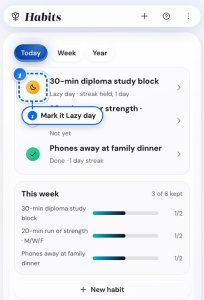
Workaround: move the trigger into the environment. Pre-packing the gym bag the night before does not just make the response easier; it converts the plan from a cue-initiated response to an environment-initiated one, because the bag by the door becomes the new cue. The Lazy Day rule in the Goals and Progress system is the workbook-level version: define a minimum-viable behavior the depleted actor can still execute when the full version is out of reach.
A fourth boundary condition is worth naming for completeness: implementation intentions are designed for behaviors, not for outcomes. "If Friday 5pm, then I will weigh 5 kilograms less" is a category error, because weight loss is not a behavior, it is an outcome. The if-then plan can only specify the behavior that drives the outcome ("if Friday 5pm, then I will weigh in and log the number"). This is the boundary the workbook handles by separating the Outcome Map, which holds Success Measures and outcomes, from the Friction Map, which holds if-then plans and behaviors.
How Goals and Progress operationalizes implementation intentions
The Goal Plan and the Habit Tracker in the Goals and Progress workbook are practical operationalizations of the implementation-intention research, rebuilt as a personal-planning system rather than an experimental protocol. The mapping below shows which workbook artefact addresses which empirical element. The intent is conceptual alignment, not a claim that the templates reproduce any study.
| Implementation-intention element | Goals and Progress artefact |
|---|---|
| If-cue and then-response, written down | Friction Map (the if-then column of the Goal Plan) |
| Cue-based habit initiation | Trigger field in the Trigger, Action, Reward habit row |
| Specific behavior in five words or less | Action field in the Trigger, Action, Reward row |
| Minimum-viable response for depleted contexts | Lazy Day version of the habit |
| Threshold-based course-correction trigger | Success Measure with Traffic Light status (amber or red means revise) |
| Recovery trigger after a missed day | Two-day rule (if missed yesterday, then must execute today) |
| Re-plan trigger after sustained failure | Quarterly Review (if a Success Measure is red at quarter end, then revise the Goal Plan) |
The mapping is not decorative. Each artefact implements a version of the if-cue-then-response structure. The Friction Map is the most direct version, a literal if-then sentence per row. The Habit Tracker is the daily-cadence version, where the Trigger field is the if-cue and the Action field is the then-response. The Two-day rule is the recovery-trigger version, a meta-if-then plan ("if I missed yesterday, then I must execute today") that protects the habit from cascading abandonment. The Quarterly Review is the re-plan-trigger version, an if-then plan one level above the goal that prompts revision when Success Measures stay amber or red. For the broader tracking and review machinery around this, the goal tracking systems guide covers the measure-and-adjust loop in detail.
The workbook is not the only way to use the technique. It is one operationalized way that takes the structural specification seriously enough to build it into the templates. If you want a guided version of the mapping above, the Life Goals Workbook walks through the Goal Plan, the Habit Tracker, and the Two-day rule in sequence. Neither the workbook nor any other tool is required to apply the technique. A page and twenty minutes are enough to write your first few if-then plans.
Key takeaways
- Implementation intentions are if-then plans: "if [cue], then I will [behavior]." Peter Gollwitzer introduced the construct in 1999 [1].
- The empirical anchor is Gollwitzer and Sheeran (2006): a medium-to-large effect (d = 0.65) on goal attainment across 94 studies, layered on top of goal intentions [2].
- The freshest evidence, Sheeran, Listrom, and Gollwitzer (2024), spans 642 tests and frames the effect as depending on plan format and motivation rather than one fixed number [14].
- The mechanism is strategic automation, not motivation: the cue triggers the response, so action does not depend on willpower in the moment.
- A valid plan needs one detectable cue, one specific behavior, and contiguous timing. Vague cues and abstract actions are the most common failure.
- Plans fail when the goal is not truly wanted, when two plans share a cue, or when fatigue breaks cue-detection. The fixes are motivation work, sequencing, and environmental friction-removal.
- Implementation intentions specify behaviors, never outcomes. "Weigh in and log the number" is a plan; "weigh 5 kilograms less" is not.
A note before you sit down with the literature
If you are the academic reader, the right next move is to read the primary sources in order: Gollwitzer 1999 [1], Gollwitzer and Sheeran 2006 [2], Webb and Sheeran 2006 [3], and Sheeran, Listrom, and Gollwitzer 2024 [14] for the latest synthesis. Then read Adriaanse et al. 2011 [4] for the boundary conditions and Mutter, Oettingen, and Gollwitzer 2020 [13] for the MCII integration. That sequence is the actual core of the literature, and most popular treatments are downstream of those pieces.
If you arrived here looking for the short operational version, it is this. Pick one behavior you intend to do but tend to skip. Write one if-then plan: a detectable cue ("if Sunday 9am arrives") and a specific behavior in five words or less ("then I will open the Goal Plan"). Put the sentence somewhere you will see it the day the cue fires, and try it for two weeks. If it does not fire reliably, diagnose it against the six-row anti-pattern table above and rewrite it. The short and long term planning guide shows how a single if-then plan connects upward to the rest of your goals.
The single idea to carry away is the one this article opened with. The intention-behavior gap is not, for most people, a motivation problem. It is an architecture problem, and if-then planning is the architectural fix. You do not need more willpower at the moment of action. You need to have already decided, in advance, exactly what will happen when the cue appears. Decide once, in writing, and let the situation do the remembering.
Ramon's Take
The evidence here is unusually solid for this field, with a large meta-analysis behind it. What convinced me is the mechanism, not the hype. It works best on clear behaviors, and it does not rescue a goal you do not actually want.
FAQ
Who developed implementation intentions? Peter M. Gollwitzer (New York University and University of Konstanz), in his 1999 American Psychologist paper "Implementation intentions: Strong effects of simple plans" [1]. The construct has been refined and meta-analyzed across two decades by Gollwitzer with collaborators including Paschal Sheeran, Veronika Brandstatter, Frank Wieber, and Maik Bieleke.
Can implementation intentions be used for avoidance goals, such as stopping a behavior? Yes, but they are harder to get right than approach plans. A suppression plan names the unwanted impulse as the cue and a concrete competing action as the response ("if I notice myself reaching for my phone, then I will place it face-down and start the next task"). Adriaanse et al. (2011) found smaller effects for restricting an unwanted behavior than for promoting a desired one, so the substitute action needs to be specific rather than a bare instruction to stop [4].
How many if-then plans can one person maintain at once? The literature does not give a hard number, so treat the constraint as cue-collision rather than total count: ten plans tied to ten genuinely distinct cues spread across the day are easier to sustain than three plans crowded onto the same morning slot, because interference is what degrades reliability, not quantity alone [7]. A useful test when adding a new plan is to ask whether its cue already triggers something else; if it does, re-cue it downstream before committing. If you are tracking many goals at once, the higher-leverage move is usually to cut the number of active goals rather than to ration the plans, since each unwanted goal contributes a plan the actor will not reliably fire.
How long before an if-then plan feels automatic? The research does not fix a single figure, so the more useful distinction is between a plan that fires and one that feels effortless. A well-formed plan can fire on its very first exposure to the cue, because the link is installed by the act of planning, not by repetition; what builds over subsequent firings is the reduction in conscious effort. That reframes the early period: you are not waiting for the plan to start working, you are checking whether it fires at all. If it fires but still feels deliberate, that is normal and resolves with exposure. If it does not fire when the cue clearly appeared, the cue or response is mis-specified and the plan needs rewriting rather than more time.
Do implementation intentions still work when I am exhausted or overloaded? Less reliably, but the practical fix is to plan for the depleted state in advance rather than to abandon the plan on bad days. Write a second, smaller if-then plan whose response is the floor version of the behavior ("if it is 6am and I slept badly, then I will walk for ten minutes") and keep it standing alongside the full plan, so a hard day routes to the floor instead of to nothing. The reason this matters is that the most common cost of a bad day is not the missed session itself but the broken streak that follows; a floor plan keeps the behavior alive so the next firing is not starting from zero. This is the same logic as the Lazy Day rule at the habit level.
When should I add the MCII step, and when is it overkill? MCII (mental contrasting with implementation intentions) prepends a motivational diagnostic to the if-then plan: you imagine the desired outcome, contrast it with the present-reality obstacle, and only then write the plan. The honest practitioner guidance is that the contrasting step earns its overhead mainly when motivation is genuinely contested, such as smoking or diet change, which is the domain Mutter, Oettingen, and Gollwitzer (2020) studied [13]. For a behavior you already clearly want and simply forget to start, the contrasting step adds friction without changing the outcome, and the bare implementation intention is the better tool. A simple decision rule: if you can state out loud why you want the behavior and believe it, skip the contrasting; if you cannot, do the contrasting first, because that hesitation is the signal the plan would otherwise fail on.
Is "65 percent" a real statistic from the research? Not as a literal percentage. It is a popular-writing translation of the d = 0.65 effect into the rough share of implementation-intention participants who outperform the control median. The defensible version is that implementation intentions produce a medium-to-large improvement in goal attainment (Gollwitzer and Sheeran, 2006), not that "65 percent" of people succeed [2].
Glossary
- Implementation intention: A pre-decided plan in the form "if situation X occurs, then I will perform behavior Y," developed by Peter Gollwitzer (1999), that links a specified situational cue to a specified goal-directed response.
- If-then planning: The colloquial term for the technique of writing implementation intentions: writing the sentence, putting it where you will see it, and rehearsing it once.
- Goal intention: A statement of the form "I intend to reach outcome Z." Names the destination; does not specify the conditions under which the steps will be taken.
- Behavior change: The change in observable behavior that follows from an intervention. The intention-behavior gap (Webb and Sheeran, 2006) is the finding that intention change alone produces only modest behavior change.
- The d = 0.65 finding: Gollwitzer and Sheeran's (2006) meta-analytic effect size across 94 independent tests for implementation intentions on goal attainment over goal intentions alone. The empirical backbone of the technique.
- Strategic automation: this article's rendering of Gollwitzer's strategic automaticity, the mechanism by which an if-then plan delegates initiation of a behavior to automatic situation-detection, removing the moment of deliberation at the point of execution, distinct from a conditioned reflex formed through repetition.
- Mental contrasting: Gabriele Oettingen's technique of imagining a desired future outcome and contrasting it with the present-reality obstacle. Increases commitment to feasible goals; releases commitment from infeasible ones.
- MCII: Mental contrasting with implementation intentions. The integrated technique combining Oettingen's mental contrasting with Gollwitzer's implementation intentions.
- Intention-behavior gap: The finding (Webb and Sheeran, 2006; Sheeran and Webb, 2016) that a medium-to-large change in intention produces only a small-to-medium change in behavior. The gap implementation intentions exist to close.
- Friction Map: The Goals and Progress sub-template of the Goal Plan that names likely frictions, writes an if-then plan, and names the early warning sign. The workbook's direct operationalization of implementation intentions.
- Trigger, Action, Reward: The Goals and Progress habit-row structure. The Trigger field is the if-cue, the Action field is the then-response, and the Reward field is the immediate reinforcement. The daily-cadence operationalization of if-then planning.
- Two-day rule: The Goals and Progress habit-recovery convention. If a habit was missed yesterday, then it must be executed today. A meta-if-then plan that protects against cascading abandonment.
References
Every DOI below was checked against Crossref on 7 August 2026. Where a claim in this article rests on a specific number, the entry says which paper the number comes from.
- Gollwitzer, P. M. (1999). Implementation intentions: Strong effects of simple plans. American Psychologist, 54(7), 493-503. The originating paper: cited here for the construct and the mechanism, not for an effect size. https://doi.org/10.1037/0003-066X.54.7.493
- Gollwitzer, P. M., and Sheeran, P. (2006). Implementation intentions and goal achievement: A meta-analysis of effects and processes. Advances in Experimental Social Psychology, 38, 69-119. The source of d = 0.65 across 94 independent tests. https://doi.org/10.1016/S0065-2601(06)38002-1
- Webb, T. L., and Sheeran, P. (2006). Does changing behavioral intentions engender behavior change? A meta-analysis of the experimental evidence. Psychological Bulletin, 132(2), 249-268. https://doi.org/10.1037/0033-2909.132.2.249
- Adriaanse, M. A., Vinkers, C. D. W., de Ridder, D. T. D., Hox, J. J., and de Wit, J. B. F. (2011). Do implementation intentions help to eat a healthy diet? A systematic review and meta-analysis of the empirical evidence. Appetite, 56(1), 183-193. The boundary condition: planning needs motivation underneath it. https://doi.org/10.1016/j.appet.2010.10.012
- Oettingen, G. (2014). Rethinking Positive Thinking: Inside the New Science of Motivation. Current (Penguin). Popular synthesis, not the empirical anchor; for that see entry 6. ISBN 978-1591846871.
- Oettingen, G., Pak, H., and Schnetter, K. (2001). Self-regulation of goal-setting: Turning free fantasies about the future into binding goals. Journal of Personality and Social Psychology, 80(5), 736-753. https://doi.org/10.1037/0022-3514.80.5.736
- Bieleke, M., Keller, L., and Gollwitzer, P. M. (2021). If-then planning. European Review of Social Psychology, 32(1), 88-122. https://doi.org/10.1080/10463283.2020.1808936
- Wieber, F., Thurmer, J. L., and Gollwitzer, P. M. (2015). Promoting the translation of intentions into action by implementation intentions: Behavioral effects and physiological correlates. Frontiers in Human Neuroscience, 9, 395. https://doi.org/10.3389/fnhum.2015.00395
- Locke, E. A., and Latham, G. P. (2002). Building a practically useful theory of goal setting and task motivation: A 35-year odyssey. American Psychologist, 57(9), 705-717. https://doi.org/10.1037/0003-066X.57.9.705
- Polivy, J., and Herman, C. P. (2002). If at first you don't succeed: False hopes of self-change. American Psychologist, 57(9), 677-689. https://doi.org/10.1037/0003-066X.57.9.677
- Sheeran, P., and Webb, T. L. (2016). The intention-behavior gap. Social and Personality Psychology Compass, 10(9), 503-518. https://doi.org/10.1111/spc3.12265
- Gollwitzer, P. M., and Brandstatter, V. (1997). Implementation intentions and effective goal pursuit. Journal of Personality and Social Psychology, 73(1), 186-199. The source of the completion-rate finding cited in the mechanism section. https://doi.org/10.1037/0022-3514.73.1.186
- Mutter, E. R., Oettingen, G., and Gollwitzer, P. M. (2020). An online randomised controlled trial of mental contrasting with implementation intentions as a smoking behaviour change intervention. Psychology and Health, 35(3), 318-345. https://doi.org/10.1080/08870446.2019.1634200
- Sheeran, P., Listrom, O., and Gollwitzer, P. M. (2024). The when and how of planning: Meta-analysis of the scope and components of implementation intentions in 642 tests. European Review of Social Psychology, 36(1), 162-194. https://doi.org/10.1080/10463283.2024.2334563