 Goals & Progress


You already know what you want – so why is clarity still missing?

You have a goal in mind. You can picture it clearly. But when someone asks “what’s your actual next step?” your mind goes blank. Or you rattle off five half-formed ideas that never turn into anything.
The GROW Framework was built for this exact moment – when you know the destination but can’t find the path.
GROW Framework is a four-stage structured conversation model – Goal, Reality, Options, Will – that moves a person from a vague aspiration to a concrete action plan through targeted questions at each stage. Unlike linear goal-setting methods that focus only on defining targets, GROW requires honest assessment of current reality and systematic option exploration before committing to action.
Sir John Whitmore, Graham Alexander, and Alan Fine developed the GROW model in the late 1980s as a coaching conversation structure for managers helping employees think through problems, as detailed in Coaching for Performance [1]. But the real value shows up when you turn it inward and coach yourself.
Theeboom and colleagues’ 2014 meta-analysis of 18 peer-reviewed studies found significant positive effects of structured coaching on performance and skills, well-being, coping, work attitudes, and goal-directed self-regulation [2]. The GROW model is one of several structured methods covered in the personal development strategies guide – and among the most useful when you have a goal but lack a clear path to it. The four stages give your thinking a structure so you stop circling the same worry and actually move.
What you will learn
- How the four GROW stages connect and build on each other
- A complete walkthrough of all four stages with a real goal
- How to use the GROW Framework on yourself without a coach
- Where GROW typically breaks down and how to fix each failure point
Key takeaways
- The GROW model uses four stages – Goal, Reality, Options, Will – to turn vague aspirations into specific action plans.
- Structured coaching produces measurable gains in performance, well-being, coping, work attitudes, and goal-directed self-regulation across 18 peer-reviewed studies [2].
- Most people skip over the Reality stage, which causes action plans to solve the wrong problem.
- The Self-Coaching Dialogue applies the GROW method as an internal conversation you can run without anyone else present.
- Generating at least five options before choosing prevents premature commitment to your first idea.
- GROW works best for goals where you have knowledge but lack clarity on next steps.
How do the four GROW stages work?
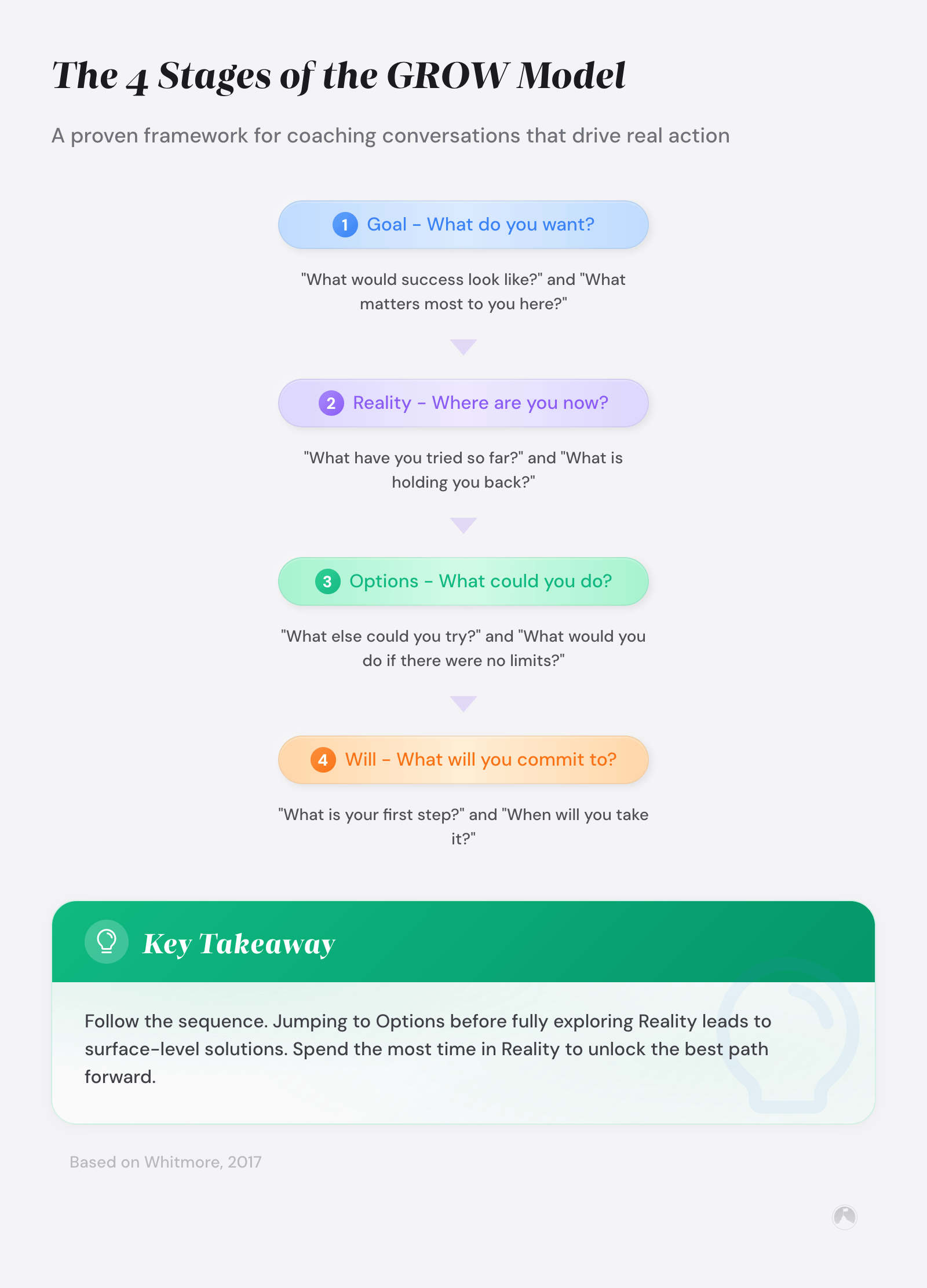
The GROW coaching model moves through four sequential stages: Goal, Reality, Options, and Will. Each stage has a specific job. And if you skip or rush any one, everything that follows gets weaker.

Goal is the stage that defines a specific, measurable target with a clear success condition. “Get healthier” doesn’t work here. “Run a 5K by September” does. A well-formed Goal answers three questions: What do you want, how will you know when you have achieved it, and why does this matter now?
Reality is the honest inventory of where you stand today relative to your stated goal. The Reality stage requires more courage than defining the goal itself. What have you tried, what’s working, and what’s in your way? The Reality stage separates the GROW goal setting framework from other goal-setting methods because it forces you to close the gap between where you think you are and where you actually are.
Options is the structured brainstorming stage that generates the full range of possible paths forward before evaluating any of them. The question shifts to “what could you do?” instead of “what should you do?” The distinction between generating and evaluating matters because separating these two activities produces more and better ideas. Following Osborn’s foundational principle of separating idea generation from evaluation, deferred judgment increases both the quantity and quality of solutions generated [3]. The first two or three options that come to mind are typically pre-formed ideas you already had before sitting down. Options four and five require deliberate creative effort, and that is where the genuinely new thinking appears.
Will (sometimes called Way Forward) is the stage that converts selected options into a concrete action plan with a named deadline and an accountability structure. It answers: What exactly will you do, when will you do it, and what obstacles might appear? Without a Will commitment, options stay theoretical.
| Stage | Core question | Output |
|---|---|---|
| Goal | What do I want? | A specific, measurable target (10-15% of session) |
| Reality | Where am I now? | Honest assessment of current state (30-40% of session) |
| Options | What could I do? | 5+ possible paths forward (25-30% of session) |
| Will | What will I do? | Actions with deadlines and accountability (20-25% of session) |
Notice the time split. Most people spend too long on Goal (they already know what they want) and too little on Reality (they don’t want to confront where they actually are). In Whitmore’s original GROW methodology, the Reality stage is treated as the most diagnostic phase, typically accounting for 30-40% of a coaching session [1]. Accurate diagnosis drives better options.
“Coaching is unlocking a person’s potential to maximize their own performance. It is helping them to learn rather than teaching them.” – Sir John Whitmore, Coaching for Performance [1]
An example you can follow stage by stage
But abstract explanations only take you so far. Here’s the GROW model coaching process applied to an example scenario: someone switching careers from accounting to UX design within 12 months.
Goal stage: “I want to land a junior UX design role at a mid-size tech company within 12 months.” Specific. Has a timeline. And the follow-up questions dig deeper: Why UX design and not something else? (Genuine interest in user research, not just escape.) How will you know you’ve succeeded? (A signed offer, not a portfolio that impresses friends.)
Reality stage: “I have zero formal UX training, but I’ve spent two years doing informal usability testing in my current job. I can dedicate 8 hours per week to learning. I have savings to cover three months without income if needed. I don’t have a portfolio or professional network in design.” So this reality check reveals both hidden strengths (existing usability experience) and real constraints (no portfolio, limited time).
Options stage: This is where most people stop too early. The obvious first idea – “enroll in a UX bootcamp” – lands fast. But pushing for five more options changes the thinking:
- Take the free Google UX certificate first
- Volunteer for a nonprofit redesign project
- Shadow a UX designer at a friend’s company
- Start a case study blog documenting redesigns for apps you use daily
- Attend three local UX meetups this month
So now you have six paths instead of one. The first option (bootcamp) was already formed before the session started. Options 4-6 required genuine creative effort and tend to produce the most actionable ideas.
Will stage: “This week, I’ll register for the Google UX certificate and block 8 hours on my calendar. By month’s end, I’ll finish the first two modules and message three designers on LinkedIn for informational chats. My Sunday evening review is the accountability check.” Will fails when it produces intentions (“I should network more”) instead of commitments (“I’ll message three people by Friday”).
The Self-Coaching Dialogue: using GROW on yourself
Most search results frame the GROW model as something a coach does to someone else, or a manager does with an employee. That is actually the original use case: Whitmore developed GROW for managers who needed a structured way to help direct reports work through performance challenges without simply telling them what to do. In a manager-employee GROW conversation, the manager asks the questions and the employee generates the answers. This matters because answers people reach themselves tend to produce stronger follow-through than instructions handed down from above. But the real advantage beyond that application shows up when you coach yourself using what we call the Self-Coaching Dialogue.

Self-Coaching Dialogue is a structured internal conversation where you alternate between asking GROW questions and answering them honestly – on paper, not in your head. And the mechanism is simple: forced specificity. Your inner voice can say “everything’s fine.” But your written Reality section reveals three obvious gaps you’ve been skating past.
According to Anthony Grant’s 2003 study of 20 life coaching participants, structured coaching was associated with increased goal attainment, improved metacognitive insight, and better mental health compared to the pre-coaching baseline [4]. Grant found that metacognitive insight increased distinctly from self-reflection, which the study measured as a separate variable. So the evidence supports what the practice suggests: writing your answers down produces different results than thinking them through silently.
Here’s the critical difference from talking through it: writing slows you down. Research on expressive writing by Pennebaker demonstrates that translating experiences into written language requires cognitive organization that produces measurable changes in how people process and understand their own situations [5]. Your brain glosses over Reality (“yeah, I know where I am”) and jumps to Will (“I’ll try harder”). But writing forces you to catch those shortcuts.
Self-coaching GROW questions
| Stage | Self-coaching question |
|---|---|
| Goal | If I achieved this perfectly, what would be different in six months? |
| Goal | On a scale of 1-10, how committed am I to this? If below 8, what would make it an 8? |
| Reality | What have I already tried? What worked partially? |
| Reality | What am I pretending not to know about my situation? |
| Options | If time and money were unlimited, what would I try? |
| Options | What would someone I admire do here? |
| Will | What is the one action I’ll complete before this time next week? |
| Will | Who will I tell about this commitment? |
The question “what am I pretending not to know?” is the single most powerful prompt in this entire framework. It bypasses the comfort zone that keeps self-assessments shallow and polished. So if your Reality section reads like a resume instead of an honest inventory, you haven’t dug deep enough.
So what does honest writing look like? Not “I haven’t made progress because I’ve been busy” but “I haven’t made progress because I’m afraid of what will happen if I fail, so I’ve been telling myself I’ll start next month.” And that level of honesty is where the real thinking begins.
The International Coaching Federation’s 2009 Global Coaching Client Study found that 80% of coaching clients reported a positive change in self-esteem and self-confidence, and over 70% reported benefits including improved work performance, relationships, and communication skills [6]. And that gain comes not from receiving answers but from asking better questions of yourself. If you want to build a broader self-coaching practice, a personal development plan can provide the structure around your GROW sessions.
Where does GROW break down?
GROW isn’t magic. It’s a thinking structure. And thinking structures fail when people use them mechanically instead of honestly. Here are the three most common failure points and how to fix each one.
Failure 1: fuzzy goals that can’t be measured
“I want to be more productive” passes as a goal in most people’s heads, but it shouldn’t. But a fuzzy goal makes every other stage worthless – you can’t assess where you stand relative to a target you haven’t defined. And you can’t generate real options if you don’t know what outcome you’re chasing.
The fix: apply the “how will I know?” test. If you can’t describe what success looks like in observable terms, your goal needs another round of specificity. This is closely related to how goals that stick are built – the same principle of measurability applies across frameworks.
Failure 2: shallow reality assessments
People rush through Reality. It’s uncomfortable to write down “I’ve been saying I’ll do this for two years and haven’t started.” And shallow Reality leads to options that address surface problems instead of root causes.
If your career-change Reality doesn’t acknowledge that fear of failure – not lack of time – is the actual blocker, your Options will address scheduling instead of courage. And when the real obstacle is emotional, no tactical planning fixes it. Working with a mentor or coach can help surface blind spots that self-assessment misses. Spend at least five minutes in the Reality stage before moving on.
Failure 3: settling for the first option
The most common GROW mistake is generating two or three options and picking the most obvious one. But the Options stage exists to expand thinking, not confirm your default plan. Jones and colleagues’ 2016 meta-analysis of workplace coaching found large positive effects on individual-level results (delta = 1.24), reinforcing that structured exploration of multiple paths produces stronger outcomes than defaulting to a single approach [7].
Force yourself to list at least five. Your first two or three options were already sitting in your head before you started. The fourth and fifth require deliberate effort to generate, and that effort is exactly what produces ideas you would not have reached otherwise.
“Coaching had significant positive effects on performance and skills, well-being, coping, work attitudes, and goal-directed self-regulation.” – Theeboom et al., meta-analysis of coaching effectiveness [2]
But these coaching gains depend on working the full GROW framework honestly. A rushed GROW session delivers barely any value – the structure only works when the honesty does.
How the GROW Framework compares to other goal-setting frameworks
GROW isn’t the only structured approach. If you’re choosing between frameworks, understanding where each one performs best helps you pick the right tool. See our guide on goal-setting methods compared for a broader view.
| Framework | Best for | How it pairs with GROW |
|---|---|---|
| SMART goals | Defining specific targets with deadlines | Use SMART to sharpen the Goal stage; GROW handles the rest |
| BSQ framework (Think Big, Act Small, Move Quick) | Big-picture vision with sequential planning | BSQ sets the big picture; GROW breaks it into specific action |
| WOOP (Wish-Outcome-Obstacle-Plan) | Single-habit formation with mental contrasting | WOOP handles habits; GROW handles complex multi-step goals |
GROW fills the gap between knowing what you want and knowing what to do next – a gap most frameworks skip entirely. So it pairs well with SMART goals (which define the target) or the kaizen approach (which handles incremental execution after you’ve picked a path).
Quick GROW self-check worksheet
Use this for your next goal. Write your answers – the act of writing is what makes the goal reality options will sequence work.
| Goal | What specifically do I want? How will I measure it? By when? |
|---|---|
| Reality | Where am I now? What have I tried? What am I avoiding? |
| Options | What are at least 5 possible next steps? (No judging yet.) |
| Will | What will I do this week? When exactly? Who will I tell? |
Ramon’s take
Four stages sounds manageable until you hit Options and realize you’ve been staring at the same two bad choices for twenty minutes. Does everyone get stuck there, or is that just me?
Here’s the honest limitation: GROW doesn’t work well for goals where you’re still figuring out what you want. If you’re exploring direction, try a personal mission statement exercise first. GROW assumes you have a goal and helps you get unstuck on achieving it. And that’s narrower than it sounds – recognizing the distinction saves frustration.
One more thing the framework doesn’t address explicitly: what happens when the Reality stage reveals your original Goal was wrong. This comes up more than people expect. You start a GROW session on “how do I get promoted?” and the Reality work surfaces that what you actually want is a role change entirely. The right move is to loop back and rewrite the Goal before generating any Options. Treating the revised Goal as a failure of the process misses the point – accurate Reality diagnosis is supposed to surface this kind of misalignment, and finding it early is the whole reason the stage exists.
My recommendation: pick the goal that’s been sitting on your list the longest, spend 20 minutes on a Self-Coaching Dialogue, and notice what the Reality stage reveals. The gap between what you thought was true and what you wrote down is where the real insight lives.
Put the GROW Framework to work
The GROW Framework gives you four questions that organize your thinking when a goal feels stuck: what do I want, where am I now, what could I do, and what will I do. And they’re not complicated. They don’t need to be.

And what makes it work is answering them honestly and in sequence – especially the Reality stage, where most people skip the part that matters most. Whether you use the GROW method as a self-coaching tool, in a coaching conversation, or as part of a broader personal development strategy, the framework works by respecting something most goal-setting advice ignores: you already know more than you think.
The best coaching framework is the one that makes you more honest, not more organized.
Next 10 minutes
- Pick one goal that’s been on your list for more than a month without progress.
- Write down your answer to this one question: “What am I pretending not to know about this goal?”
This week
- Complete a full Self-Coaching Dialogue for that goal using the worksheet above (20 minutes total).
- Share your Will commitment with one person who will check in next week.
There is more to explore
For more on structured goal setting, see our guides on personal development strategies and setting personal growth goals that stick. If you’re comparing GROW to other approaches, our best goal-setting methods compared guide covers the broader landscape.
Related articles in this guide
- Kaizen for personal productivity
- Kaizen vs. GROW frameworks
- Multi-domain personal development orchestration
Frequently asked questions
What is the difference between GROW and SMART goals?
SMART goals define what a good goal looks like (Specific, Measurable, Achievable, Relevant, Time-bound). The GROW model provides the process for achieving goals – diagnosing current reality, generating options, and committing to specific actions. SMART sharpens the Goal stage of GROW. So they work together rather than as alternatives.
How do you use the GROW model for self-coaching?
The most common mistake in self-coaching is treating GROW as a one-time checklist rather than a recurring practice. Run a 20-minute Self-Coaching Dialogue session weekly for any active goal, and monthly for goals that are progressing on their own. If you find yourself writing the same Reality answers three sessions in a row without new insight, that is a signal a human coach adds value: external challenge surfaces blind spots that honest self-assessment cannot reach on its own.
Who created the GROW model and when?
Sir John Whitmore, along with colleagues Graham Alexander and Alan Fine, developed the GROW model in the late 1980s as a coaching framework for performance improvement. Max Landsberg later coined the GROW acronym. Whitmore popularized the model in his 1992 book Coaching for Performance, which remains the primary reference for GROW methodology [1].
Is the GROW model effective according to research?
Two independent meta-analyses support coaching’s effectiveness. Theeboom et al. (2014) found an overall effect size of g = 0.66 across 18 studies, with the strongest effects on goal-directed self-regulation (g = 0.74) [2]. Jones et al. (2016) found coaching produced a large effect on individual-level results (delta = 1.24) in organizational settings [7]. These effect sizes indicate coaching frameworks produce meaningfully stronger outcomes than unstructured goal discussions.
What is the T-GROW model?
T-GROW adds a Topic stage before the standard four GROW stages. The Topic stage establishes the broad subject area before narrowing to a specific Goal. Use T-GROW when the person arrives without a defined issue and needs to identify what to focus on first; use standard GROW when they already have a specific goal and need help achieving it.
What are the limitations of the GROW model?
GROW assumes the person already has a defined goal and some knowledge of the domain. The GROW coaching model is less effective for exploratory situations where someone needs to identify their direction before setting targets. GROW requires honest self-assessment in the Reality stage – without genuine honesty, the options generated will address surface problems rather than root causes.
How long should a GROW coaching session take?
A typical GROW coaching session runs 30 to 60 minutes. Self-coaching sessions using the Self-Coaching Dialogue can be effective in as little as 20 minutes if the person writes their answers. Whitmore’s original methodology suggests spending 30-40% of the total time on the Reality stage, which tends to produce the strongest action plans [1].
This article is part of our Personal Development complete guide.
References
[1] Whitmore, J. “Coaching for Performance: GROWing Human Potential and Purpose – The Principles and Practice of Coaching and Leadership.” Nicholas Brealey Publishing, 5th edition, 2017. Link
[2] Theeboom, T., Beersma, B., and van Vianen, A.E.M. “Does coaching work? A meta-analysis on the effects of coaching on individual level outcomes in an organizational context.” The Journal of Positive Psychology, vol. 9, no. 1, 2014, pp. 1-18. DOI
[3] Osborn, A.F. “Applied Imagination: Principles and Procedures of Creative Problem-Solving.” Charles Scribner’s Sons, 3rd edition, 1963. (Originally published 1953.)
[4] Grant, A.M. “The impact of life coaching on goal attainment, metacognition and mental health.” Social Behavior and Personality: An International Journal, vol. 31, no. 3, 2003, pp. 253-264. DOI
[5] Pennebaker, J.W. “Writing about emotional experiences as a therapeutic process.” Psychological Science, vol. 8, no. 3, 1997, pp. 162-166. DOI
[6] International Coaching Federation. “ICF Global Coaching Client Study: Executive Summary.” PricewaterhouseCoopers, 2009. Link
[7] Jones, R.J., Woods, S.A., and Guillaume, Y.R.F. “The effectiveness of workplace coaching: A meta-analysis of learning and performance outcomes from coaching.” Journal of Occupational and Organizational Psychology, vol. 89, no. 2, 2016, pp. 249-277. DOI


