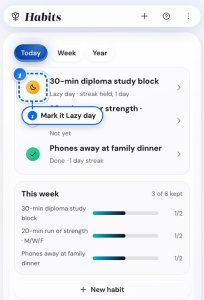
Goals & Progress


When protection becomes productive
Boundary setting for self-care is the practice of placing clear, enforced limits on your time, energy, and attention so your capacity stays intact under sustained demand. For high performers, it is the foundational system that keeps the calendar, the inbox, and the weekend from bleeding into one another.
You’re already succeeding. The promotions, the completed projects, the appreciation emails are coming regularly enough that you’ve stopped counting them.
But lately, success has started feeling like someone else is living your life. Your calendar is packed with meetings you never agreed to. Your inbox is a living thing with its own agenda. Your weekends have soft edges where work bleeds through, and you can’t quite remember the last time you felt truly unavailable.
The problem isn’t that you lack discipline. It’s that you lack boundaries. Recovery research helps explain why this matters. As Sonnentag and Fritz set out in their 2015 stressor-detachment framework, psychological detachment from work during non-work hours is an important recovery experience that predicts subsequent engagement and well-being [1]. When the boundary between work and life dissolves, that detachment never happens, and the recovery it produces never lands. If you’re working on self-care for high performers, boundaries aren’t a luxury add-on. They’re the structural protection that keeps your capacity intact.
This article shows you how to build that system. The framework at its center, the Boundary Architecture Method, is a Goals and Progress framework developed for this guide, and it pairs naturally with the goal-setting tools in our workbook.
Boundary setting for self-care is the practice of establishing clear limits on your time, energy, emotional availability, and attention to protect your capacity for meaningful work and personal wellbeing. Boundaries require communication, enforcement, and regular adjustment as circumstances change.
Emotional boundaries are the limits you set on how much of your emotional energy you give to others, preventing you from absorbing other people’s problems as your own responsibility.
Time boundaries are explicit limits on when you’re available and unavailable, protecting dedicated blocks for work, rest, and personal priorities.
Digital boundaries are rules governing your access to work communication outside designated hours, protecting your mental space from constant connectivity.
Perfectionism boundaries are limits you set on effort invested in tasks where “good enough” serves your actual goals better than perfect.
The five types of boundaries essential for self-care are:
- Workplace boundaries: communication and project limits
- Time boundaries: calendar protection
- Emotional boundaries: energy allocation
- Perfectionism boundaries: effort limits
- Digital boundaries: screen and notification rules
Each type addresses a different drain on your capacity, and each requires its own identification, communication, and enforcement strategy.
What you will learn
- How to identify where boundaries are missing in your life (before resentment builds)
- The Boundary Architecture Method: a framework for building boundaries that actually hold
- Communication scripts for five specific scenarios (work, family, email, social media, perfectionism)
- Why setting boundaries prevents burnout better than any other single intervention
- How to maintain boundaries when people push back (and they will)
Key takeaways
- Boundary-setting is preventative maintenance for mental health, not a selfish act. Recovery research shows that protecting non-work time supports the psychological detachment that sustains well-being [1]
- The Boundary Architecture Method uses three layers: identification, communication, and enforcement, applied consistently to create lasting change
- Clear boundaries with supervisors, family, and digital communication protect your time and psychological safety
- Most boundaries fail not because they’re unclear but because they’re not enforced consistently
- Guilt is the friction of boundary-setting. It doesn’t mean your boundary is wrong, it means it’s working
- Maintaining boundaries requires regular review and adjustment, not a one-time conversation
Why boundary setting for self-care is not selfish
Most high performers have an internal story: boundaries are what other people set. Setting one yourself feels like failure. Like you’re weak. Like you can’t handle your responsibilities without making excuses.
That internal narrative is wrong. It’s also expensive.
Research on work-nonwork boundary management points the other way. Kossek, Ruderman, Braddy, and Hannum found in 2012 that people with high control over the boundaries between their work and personal lives report better well-being than those with reactive, low-control boundary profiles [2]. People without limits don’t perform better. They lose the recovery that sustains performance, and they burn out faster.
The mechanism is worth naming, because it explains why this is structural rather than a matter of willpower. Burnout is what happens when demand outpaces recovery for long enough. Every hour you work draws down a finite reserve, and that reserve only refills when you genuinely step away. Sonnentag and Fritz describe psychological detachment, mentally switching off from work during non-work hours, as a central recovery experience that predicts later engagement and well-being [1]. A boundary is the thing that makes detachment possible. Without one, the demand never stops, the recovery window never opens, and capacity erodes.
Boundaries protect your capacity to perform. They’re not about doing less but about protecting your energy for the things that matter most. A boundary is the difference between choosing what you do and reacting to what everyone asks of you.
The guilt that comes with setting boundaries is real. But it’s not a signal that your boundary is wrong. It’s a signal that the boundary is new. Your nervous system is used to the old pattern, and change creates friction. The guilt fades when the boundary holds.
Introducing the Boundary Architecture Method
The Boundary Architecture Method is a Goals and Progress framework we developed for this guide. It is a three-layer system for building boundaries that stick, and it works because it treats boundaries as systems rather than as one-off conversations.
Layer 1: Identify. Where do you feel resentful, overwhelmed, or out of control? These are your boundary gaps. Resentment is the diagnostic signal of a violated boundary you haven’t named yet. It tells you a limit has been crossed before you consciously recognize it.
Layer 2: Communicate. Make the boundary explicit, specific, and kind. You’re not punishing anyone. You’re clarifying how you work best.
Layer 3: Enforce. Follow through consistently. Consistent enforcement is where most boundaries fail. You communicate the boundary, someone tests it, and you cave. The boundary doesn’t hold because enforcement is inconsistent.
The method is named for its architectural approach. Like a building’s structural system, boundaries require a foundation (identification), walls (communication), and regular maintenance (enforcement). Skip any layer and the whole system weakens.
Layer 1: Identify where boundaries are missing
The five types below represent distinct drains on your capacity, not mutually exclusive categories. A single situation, like responding to after-hours email, can involve multiple boundary types at once (time, digital, and workplace). Use the types as diagnostic lenses, not rigid boxes.
Before you communicate a boundary, you need to know where one is needed. Most people skip this step and jump straight to “I should say no more” without knowing to what.
The diagnostic question is simple: Where do you feel resentful?
Resentment isn’t an emotion you should push through. It’s data. It tells you that a boundary has been crossed. Sometimes it’s a boundary you should have set with someone else. Sometimes it’s a boundary you need to set with yourself. If you’re building a personalized self-care system, knowing where your boundaries are weakest is the starting point.
Common boundary gaps for high performers:
Workplace boundaries. You’re responding to emails at 9 PM because you haven’t set office hours. Your boss assumes you’re available anytime because you’ve never said otherwise. A colleague delegates their work to you because you’ve never said no. Pick one: emails after 6 PM, meetings before 10 AM, or one project per quarter that you own completely.
Time boundaries. Your calendar has no white space. You’ve committed to three major projects simultaneously. You take on more because saying no feels impossible. The boundary here is often stated as “I can commit to one major project per quarter” or “I don’t schedule meetings before 10 AM on Tuesdays.”
Emotional boundaries. You’re the person people vent to. You absorb their problems and spend emotional energy trying to solve them. A boundary might be: “I can listen for 15 minutes, and then I need to focus on my work” or “I care about you, and I can’t solve this problem for you.”
Perfectionism boundaries. You’re doing the work perfectly but finishing it days later than necessary. The boundary here is different. It’s a boundary with yourself: “Good enough by Friday beats perfect by next Wednesday.” Perfectionism boundaries apply the identify and enforce layers directly, but the communicate layer is internal. You’re making an explicit agreement with yourself about when good enough is sufficient, not communicating a limit to another person.
Digital boundaries. Your phone is always on. You’re checking work Slack from home. You’re responding to texts during family time. The boundary could be: “I’m not checking email after 6 PM on weekdays” or “My phone stays in another room during dinner.”
Physical and recovery boundaries. These are easy to forget on a self-care audit, and they protect the body rather than the calendar. A protected sleep window (“laptop closed by 10 PM so I get seven hours”), a physical separation between where you work and where you rest (“the laptop does not come to the kitchen table”), and protected exercise time that you treat as a real appointment all belong here. When recovery has no boundary of its own, it is the first thing every other demand eats.
Identify one area where you feel consistently resentful or overwhelmed. That’s your first boundary.
Layer 2: Communicate the boundary clearly
A boundary that isn’t communicated is just a fantasy. You need to make it explicit. Most people either communicate too vaguely (“I’m going to be busier”) or too harshly (“I’m not doing this anymore”). The Boundary Architecture Method uses a specific formula.
The three-part boundary statement:
- State the boundary clearly and calmly
- Provide brief context (optional)
- Confirm understanding
Here is the same formula with each part labeled:
“I’m not checking email after 6 PM on weekdays [State the boundary]. This helps me be more focused during working hours and present with my family in the evenings [Context]. Does that work for you? [Confirm]”
That is the entire formula. No apology. No over-explanation. Just the three parts in the right order.
Or with family: “I’m blocking my Sunday mornings for personal time. It’s 90 minutes for a walk or reading before the week starts. This helps me reset. I’m still available for emergencies, but I won’t check my phone during this time.”
The formula is simple because it removes the emotional charge. You’re not asking for permission. You’re clarifying how you work best. You’re not apologizing for having limits. You’re being responsible about them.
Communication scripts for five scenarios:
Boundary script for supervisors: “I want to make sure I’m delivering quality work on the projects I’m already committed to. Right now I have [list projects]. Can we discuss timeline or priority so I can say yes or no to this new project based on actual capacity rather than goodwill?”
Boundary script for colleagues who offload: “I can’t take on [task]. I have capacity to help with [specific alternative], or I can give you feedback on your approach, but I can’t own this project.”
Boundary script for family: “I’m not available for calls after 8 PM on weekdays because I need to wind down. Let’s schedule a specific time on [day] when I can give you my full attention.”
Boundary script for email and Slack: “I check email twice a day: 10 AM and 3 PM. If something is urgent, call or text me. This helps me focus on deep work without constant context switching.” Pairing this with a self-care approach that protects focus time makes the digital boundary easier to hold.
Boundary script for perfectionism: “I’m shipping this by Friday instead of waiting for it to be perfect. Good enough for this goal is better than perfect for no one.” This is also part of overcoming self-care resistance. The perfectionism trap is one of the most common reasons high performers delay protecting their own capacity.
Layer 3: Enforce the boundary consistently
This is where boundaries live or die. You communicate the boundary, someone tests it immediately, and you cave because you feel bad or because the pressure is real.
The first time someone violates your boundary, they’re testing whether it’s real. If you hold firm, they stop testing. If you cave, they learn that your boundary is negotiable.
Here’s what consistent enforcement looks like:
| Scenario | Temptation | Response |
|---|---|---|
| Urgent email arrives at 7 PM | Respond immediately to seem reliable | Wait until your 10 AM email check the next morning |
| Boss requests a second major project | Say yes to avoid conflict | “I’m at capacity with [project]. I can take this on after [date].” |
| Colleague texts during family dinner | Reply quickly to be helpful | Respond the next morning during work hours |
The hardest part of enforcement is handling guilt. You feel bad. You feel like you’re being unhelpful. You feel selfish. Feeling guilty and unhelpful is true sometimes. But it’s not a reason to violate your own boundary. Guilt is the friction of boundary-setting. It doesn’t mean your boundary is wrong, it means your nervous system is adjusting to change.
Journal the guilt if it helps. Name it: “I’m feeling guilty because Sarah seemed annoyed when I didn’t respond to her email after 6 PM.” Then remember: your boundary isn’t about Sarah’s feelings. It’s about your capacity. Her annoyance is her problem to solve, not yours to prevent.
Consistency over perfection. You will slip sometimes. You’ll respond to an email after hours. You’ll commit to too much on a busy week. When you do, notice it without judgment and return to the boundary the next day. Boundaries are systems, not moral judgments.
What all three layers look like in practice. A senior marketing director notices resentment every Monday morning and traces it to Sunday Slack messages she answers to seem responsive. She names the boundary (Layer 1): no Slack outside work hours. She messages her team: “I’m not responding to Slack after 6 PM or on weekends. Urgent issues: email with URGENT in the subject line.” (Layer 2). Her manager sends a Sunday note on day four. She does not reply until Monday morning (Layer 3). He stops. By week two, the team has adjusted and the Monday resentment is gone.
Maintaining boundaries: the 90-day review
A boundary is not a one-time decision. It’s a living agreement that needs maintenance, because the demands on your time shift as projects, roles, and relationships change. The simplest way to keep boundaries healthy is a standing review every 90 days, which fits neatly alongside the quarterly planning rhythm in the Goals and Progress workbook.
Run each boundary you have set through three questions:
- Is it still protecting what it was designed to protect? A boundary built for last quarter’s workload may no longer fit this one.
- Is it causing more friction than it prevents? If a rule has become a daily fight with reality, the rule, not your resolve, may need adjusting.
- Does it need to be tighter or looser? Adjust deliberately rather than letting the boundary erode by accident.
Boundaries are living agreements, not permanent rules. Adjust them when circumstances change rather than abandoning them silently.
Common mistakes in boundary-setting
Most boundary failures fall into three categories.
Mistake 1: Identifying the boundary but not communicating it. You decide you won’t work after 6 PM. You don’t tell anyone. Your boss is confused when you don’t respond to evening emails. She assumes there’s a problem and starts calling instead. The boundary fails because it was invisible.
Fix: Make it explicit. Tell your boss, your team, your family. The boundary only works when people know it exists.
Mistake 2: Communicating the boundary but not enforcing it consistently. You tell your family you’re not available on Sunday mornings. Week one, you hold it. Week two, your mom asks if you can call her Sunday morning, just this once. You make an exception. By week four, Sunday mornings are back to normal.
Fix: The first violation is a test. Hold firm. In our experience, once the boundary has held for about two weeks consistently, people stop testing.
Mistake 3: Setting a boundary that’s too rigid for your actual life. You decide “absolutely no emails after 6 PM.” But you’re in a client service role where emergencies do happen. The boundary is legitimate, but the execution is unrealistic. You either violate it constantly or you’re lying to people about your availability.
Fix: Build flexibility into the boundary without killing it. “I don’t check email after 6 PM on weekdays except for [specific client situation]. If you need me, call or text.” This is honest and maintainable.
When people don’t respect your boundaries
Boundaries only work if they’re enforced. But sometimes people test them repeatedly. They push back. They express disappointment. They find loopholes.
This usually happens for one of three reasons:
You’re changing an old pattern. People got used to having access to you. The new boundary disrupts their expectations. They’ll keep testing until they accept the new normal. In our experience, this adjustment typically takes about three weeks of consistent enforcement.
The boundary affects them negatively. Your boss preferred getting evening emails. Your friend liked your availability. Your family expected flexibility. The boundary is real and necessary, but it requires them to adjust their behavior. Some people will keep trying to change your mind instead of accepting the boundary.
You haven’t been clear enough. You suggested a boundary rather than stating it. You apologized for having it. You framed it as something you’re “trying” rather than something you’re doing. Clarity matters. Boundaries stated as experiments are treated as experiments. State them as decisions and people treat them as decisions.
The response to pushback is consistency, not explanation. You don’t need to defend your boundary. You don’t need to convince anyone it’s right. You need to hold it while remaining kind.
When someone pushes back: “I understand this is different. This is how I’m working now. I’m still available [specific alternative].”
You’re not being unkind. You’re being clear. And clear boundaries are the foundation of good relationships, not the enemy of them. Speed, Goldstein, and Goldfried, in their 2018 review, document assertiveness training, learning to state needs and limits directly, as a clinically evidence-based treatment with demonstrated benefit for anxiety, depression, and interpersonal difficulties in clinical populations [3]. The skill of communicating limits clearly has a real clinical track record behind it.
A note on power asymmetry, and when a boundary is not enough. The guidance above assumes you can hold firm without serious professional or relational consequences. When the violator is a supervisor with firing authority, or a family member with caregiving dependence, the calculus changes. A useful test: if you have stated the boundary clearly and enforced it consistently for several weeks and the violations continue or escalate, the problem is no longer your enforcement. At that point, hold firm alongside concrete escalation. Document the pattern in writing, raise it with HR or a trusted manager, or speak with a therapist if the relationship is personal. If the structure itself makes any healthy boundary impossible, changing the situation, whether that means moving teams, renegotiating the role, or stepping back from the relationship, is sometimes the real boundary.
Ramon’s take
I changed my mind about boundaries about five years ago. I used to see them as rigid, unhelpful, and a sign that I wasn’t capable enough to handle everything without limits. I saw high performers as people who could manage anything, help anyone, and still be effective. Boundaries felt like weakness. Then I had my son. And I realized I couldn’t keep all the plates spinning. I had finite time and energy, and I had to choose what mattered most. I started setting boundaries with work: specific office hours, no email after 6 PM, one strategic project per quarter. I expected it to hurt my career. It didn’t.
What actually happened is that I became more focused. Because I had hard constraints on my time, I got clearer about what was actually important. And people respected the boundaries more than I expected. When you’re clear about your limits, people adjust. When you’re vague about your availability, they exploit it. The thing I see most often is people who set a boundary once and then feel disappointed when someone tests it. That’s not a failed boundary. Testing a boundary is the normal process of the other person learning that you’re serious. The boundary succeeds on the second test, when you hold it again, not on the first announcement.
My takeaway after five years of this: boundaries don’t damage careers. They force the focus that high performers already claim to want.
Conclusion
Boundary setting isn’t a personality type. It’s not something you’re either good at or bad at. It’s a system. And systems can be learned.
The Boundary Architecture Method works because it treats boundaries as what they actually are: infrastructure for sustainable performance. You identify where boundaries are missing, you communicate them clearly, you enforce them consistently. And when you do, you protect your capacity to perform at the level you actually want.
High performance requires boundaries. Not because you’re weak. Because you’re serious.
Next 10 minutes
- Identify one area where you feel resentful or overwhelmed (work, time, emotional availability, perfectionism, or digital)
- Write a one-sentence boundary for that area using the formula: “I’m [boundary]. This helps me [outcome].”
- Tell one person about this boundary today
This week
- Communicate the boundary clearly to everyone it affects
- Notice the first time someone tests the boundary and hold firm
- Journal what happens, both externally and the guilt you feel, so you can separate real problems from friction
There is more to explore
For deeper strategies on protecting your wellbeing, explore our guides on building a self-care routine for high performers and strategies for overcoming self-care resistance. Learn more about self-care approaches to find what works for your life.
Related articles in this guide
- Building a personalized self-care system
- Building a self-care routine for high performers
- Overcoming self-care resistance
Frequently asked questions
What are healthy boundaries for self-care?
Healthy boundaries are clear limits that protect your time, energy, and mental health while maintaining respect for yourself and others. Examples include not checking work email after 6 PM, declining commitments you don’t have capacity for, and setting aside personal time that’s non-negotiable. The key difference between healthy and unhealthy boundaries is whether they protect your wellbeing (healthy) or isolate you from others (unhealthy). Healthy boundaries often include flexibility and acknowledge legitimate exceptions while maintaining the core limit.
How do I start setting boundaries if I’ve never done it before?
Start small with one boundary in one area where you feel resentment or overwhelm. Use the three-layer method: identify it clearly, communicate it simply to the people it affects, and enforce it consistently for at least two weeks. Most people find it easier to start with boundaries in lower-stakes areas (like email response times) before setting boundaries with supervisors or family members. Expect pushback and guilt. Both are normal and pass within a few weeks when the boundary holds consistently.
What should I do if someone repeatedly violates a boundary I’ve already enforced?
When you have already communicated a boundary clearly and held it consistently for two to three weeks and the violations continue, the issue is no longer your enforcement. It is time for one direct escalation conversation. Name the specific pattern you have noticed, restate the boundary in one sentence, and state what you will do if it keeps happening. In a work setting, that may mean involving your manager or HR and documenting the pattern in writing. In a personal relationship, it may mean a frank conversation about whether the relationship can hold the limit. That single escalation conversation is usually the turning point.
How long does it take for a new boundary to feel natural?
Most people find that new boundaries start feeling natural after two to three weeks of consistent enforcement. The first week is the hardest because your nervous system is still wired for the old pattern, so guilt, anxiety, and second-guessing are common. By week two, the external pushback typically decreases as people around you adjust. By week three, the boundary begins to feel like a normal part of how you operate rather than something you have to actively defend.
How do boundaries help prevent burnout?
Burnout happens when demands exceed capacity and there is no recovery. Boundaries protect both sides of that equation: they limit excessive demands by saying no to what doesn’t fit, and they protect recovery time by guarding personal time, sleep, and rest. Recovery research describes psychological detachment from work during off-hours as a key experience that supports later engagement and well-being [1]. Boundaries are what make that detachment possible. They aren’t a cure for an impossible workload, but they’re the foundational system that keeps gradual overload from eroding your health.
What if someone I love interprets my boundary as rejection?
This is one of the most common fears, and it deserves a direct answer: a boundary is a statement about your capacity, not a judgment of the other person. When someone you love reacts with hurt or withdrawal, that reaction is real, and it is still not evidence that your boundary was wrong. What helps is naming the difference explicitly: ‘I need Sunday mornings to myself. That’s about what I need to function well, not about how much I value you.’ Some people, especially family members who have long had open access to you, will genuinely grieve the change. That grief is worth acknowledging with warmth, not reversing with a cave. Most people stop interpreting limits as rejection once they see the relationship continues normally within the new structure.
How do I say no without feeling guilty?
You probably won’t stop feeling guilty right away, and that is fine. Guilt is friction, not a verdict on whether the boundary is right. A practical routine helps more than willpower: keep a short running note where, each time guilt shows up, you write one line naming the trigger (‘felt guilty declining the 7 PM request’) and one line naming the cost the boundary protects (‘needed the evening to recover’). Reviewing that note weekly trains your brain to read guilt as a normal side effect rather than a reason to cave. In the moment, pair a one-line acknowledgement with a clear no: ‘I want to help, and I’m at capacity. I can help with [alternative] instead.’
This article is part of our Self-Care complete guide.
References
[1] Sonnentag, S., & Fritz, C. “Recovery from job stress: The stressor-detachment model as an integrative framework.” Journal of Organizational Behavior, 36(S1), S72-S103, 2015. DOI
[2] Kossek, E. E., Ruderman, M. N., Braddy, P. W., & Hannum, K. M. “Work–nonwork boundary management profiles: A person-centered approach.” Journal of Vocational Behavior, 81(1), 112-128, 2012. DOI
[3] Speed, B. C., Goldstein, B. L., & Goldfried, M. R. “Assertiveness training: A forgotten evidence-based treatment.” Clinical Psychology: Science and Practice, 25(1), e12216, 2018. DOI