The eleven frameworks
Eleven techniques run under the hood. None are new. Locke and Latham wrote about specific goals in 1990. Bill Burnett and Dave Evans wrote about three futures in 2016. James Clear codified the two-day rule. The interesting question is not whether the techniques work (they do, each one has decades of evidence) but how they wire together, and where each one lives in the app so you can see it doing its job. That is what this page is for.
Contents
1. Goal Cascade
Rooted in Locke & Latham goal-setting theory; popularized as the OKR cascade.The Goal Cascade is the spine of the app. It says: every today-sized task should trace upward to a year-sized goal, which traces upward to a five-year vision, which traces upward to your purpose, which sits on your values. Each level inherits from the one above.
If you change something at a higher level, the lower levels go stale until you reconfirm them. The app shows this with an amber dot on the stepper called the upstream-change ripple.
Where it shows up

The Execute step has five sub-tabs (Year/Quarter/Month/Week/Day) that are the cascade-in-time. Same shape, smaller and smaller time units.
Common misuse. Editing the Day or Week tab repeatedly without ever revisiting the Year tab. The cascade fails silently if you only operate at the bottom; today's tasks drift from this year's outcomes within about 4 weeks.
2. Life Areas Map
Descends from the Wheel of Life (coaching tradition).Score every life area today on a 0-10 slider, then mark two or three as focus areas for the year. The unscored areas are not abandoned, they just do not get Summit Goals this year.
The map gives the app a way to refuse to overplan. A user trying to set Summit Goals in seven areas at once gets a soft warning. Three is the cap.
Where it shows up
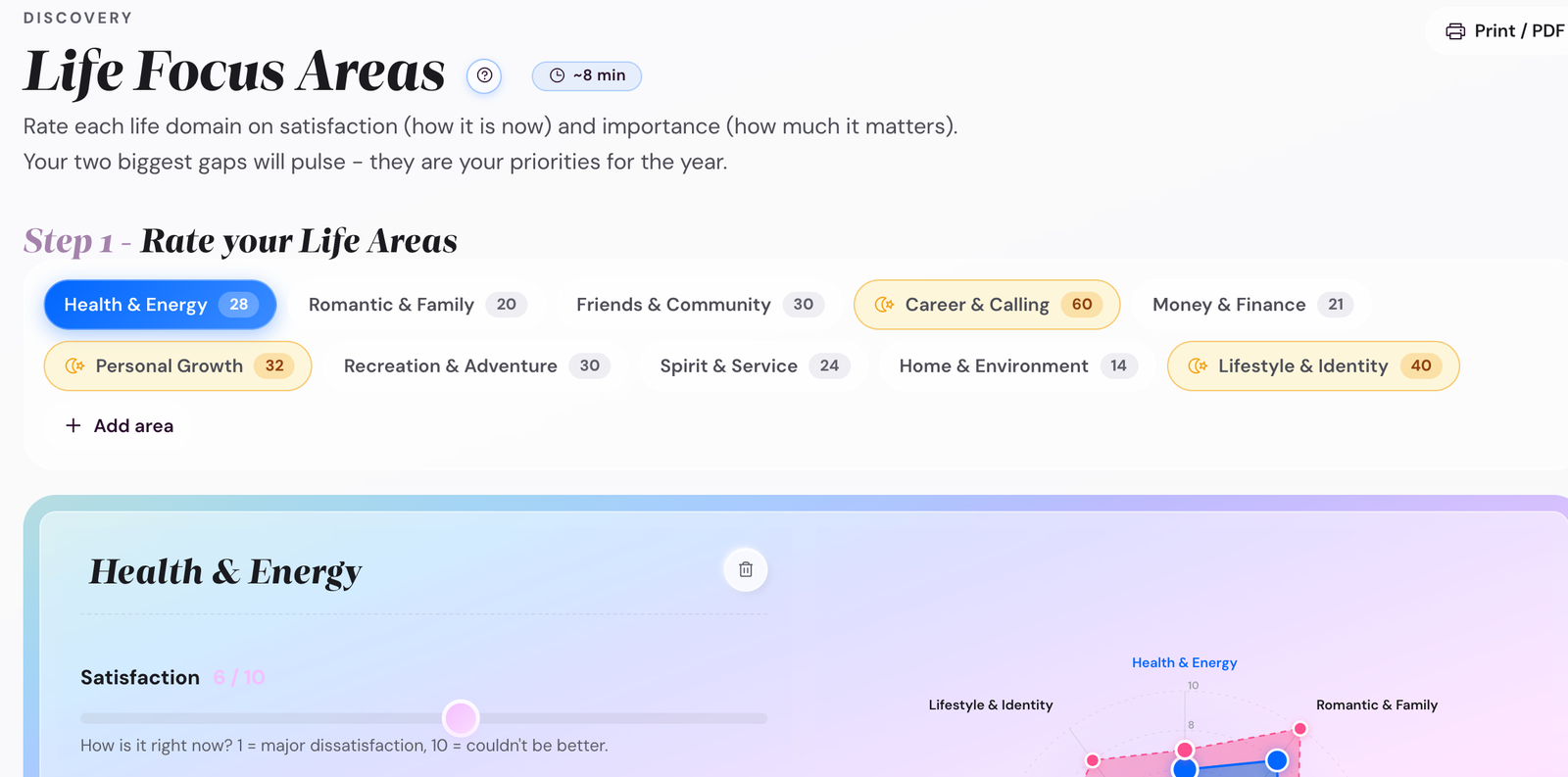
Common misuse. Marking the LOW-scoring areas as focus by default. "I am at a 3 in Health, so I must focus on Health." That math is incomplete: pick at least one focus area where you are already strong, so the plan is not a brutal climb on three weak fronts.
3. Vision Interview
Derives from Designing Your Life (Burnett & Evans, 2016).Instead of asking "what are your goals," the Vision Interview asks "what does an honest 5-year version of your life look like, written in present tense, as if you are already there." The shift from prescriptive (what should I do?) to descriptive (what would actually feel right?) unsticks people who freeze when asked to plan.
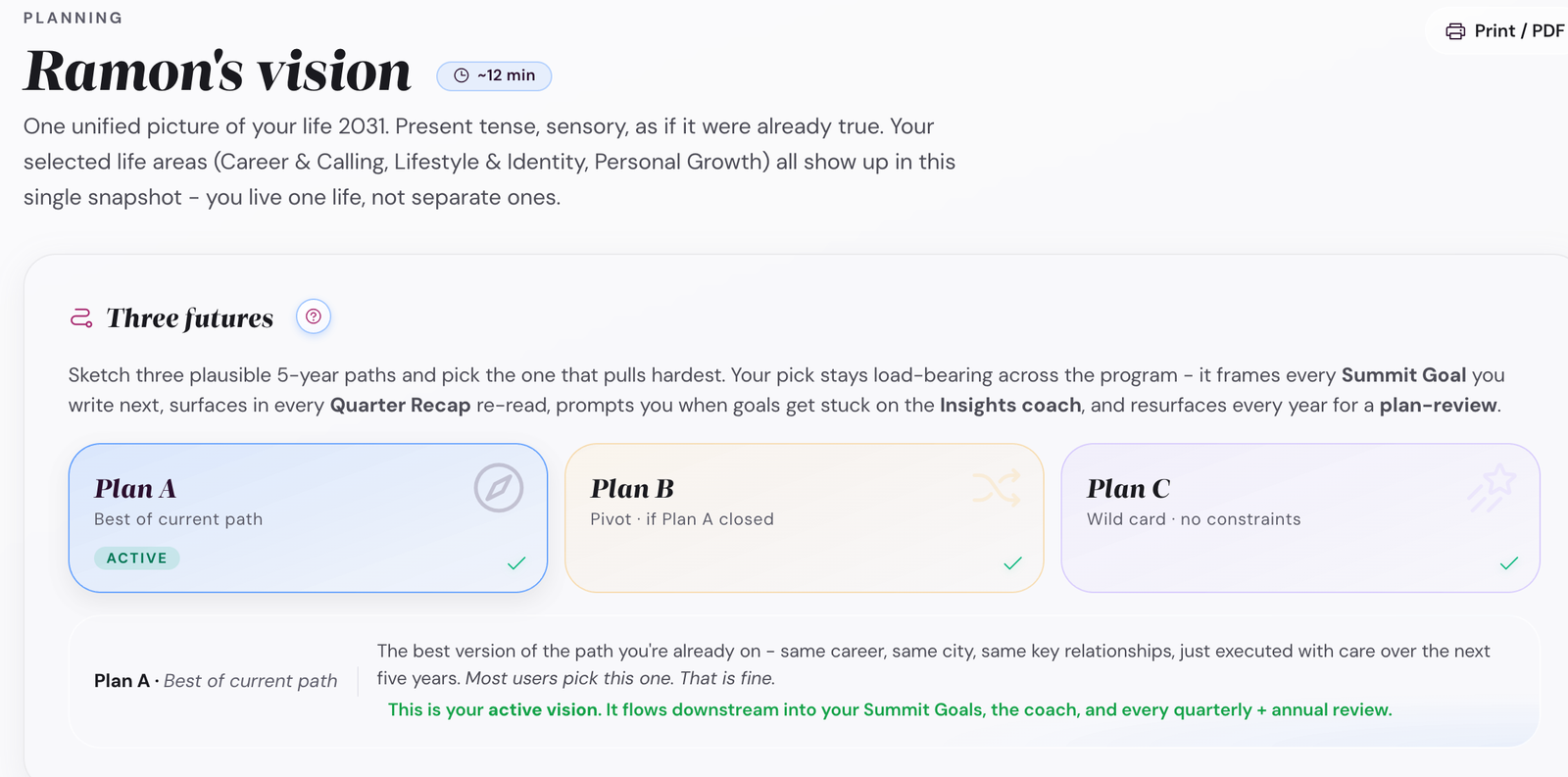
In the app you answer five short prompts as your future self on the Vision step's Interview future you tab, and it assembles one present-tense picture. You can also sketch up to three alternate paths first (see Three Futures next).
Where it shows up
Common misuse. Writing in future tense ("I will...") instead of present ("I am..."). The tense matters. Present-tense writing reveals what you actually want; future-tense becomes a wish list.
4. Three Futures
Designing Your Life (Burnett & Evans, 2016), adapted.Write three plausible alternate five-year futures. They share your values and your focus areas but differ in the path:
- Plan A compounds what is already working.
- Plan B is the bridge: different but reachable, uncomfortable one year out.
- Plan C is the deliberate stretch: the one your safest self would never choose.
You pick one to make active. The other two are not deleted; they sit as comparison surfaces during quarterly check-ins. Classroom and coaching evidence shows the comparison dramatically outperforms imagining a single future. Most people's "default" plan is the safest one. The comparison surfaces what they actually want.
Where it shows up
Same Vision step as above (T2A). The three tabs are how you toggle between plans. The active plan becomes load-bearing metadata: it stamps a key (A/B/C), framing, picked-at timestamp, and last-reconfirmed timestamp. Every later surface (Summit Goals, Quarter Check-in, the Insights coach, the Annual Wrap-up) adapts its prompts to whichever plan is active.
Common misuse. Writing Plan A only and stopping. The whole power is in the comparison. If you cannot draft Plan B and C, the plan you picked is suspect; it may be the one you settled for, not the one you actually want.
5. Summit Goal
Hybrid of Locke & Latham goal-setting theory (1990) and the BHAG concept from Built to Last (Collins & Porras, 1994).A Summit Goal is one big-enough goal per focus area. It is:
- Outcome-shaped. Describes the destination, not the activity.
- Dated. Has a target year-month, usually 12-36 months out.
- Defensible. If a friend asked "how will you know you got there?" you have an answer.
Locke & Latham's research shows specific and difficult goals outperform vague or easy ones. The Summit is the highest-altitude version of that finding, calibrated to one or two life-changing outcomes per year rather than a dozen quarterly KPIs.
Naming the goal a Summit is not decoration. Summits have altitude (a target date a year or more out), a route (the milestones cascading from the year plan), basecamp (the quarterly milestones where you stop, rest, reassess), and weather (the obstacles in the Goal Plan that can turn back a strong climber on the wrong day). If your Summit reads as a single bullet point with no altitude, no route, no basecamp, it is a hill, not a Summit. Hills are fine; they just do not need this whole apparatus.
Where it shows up
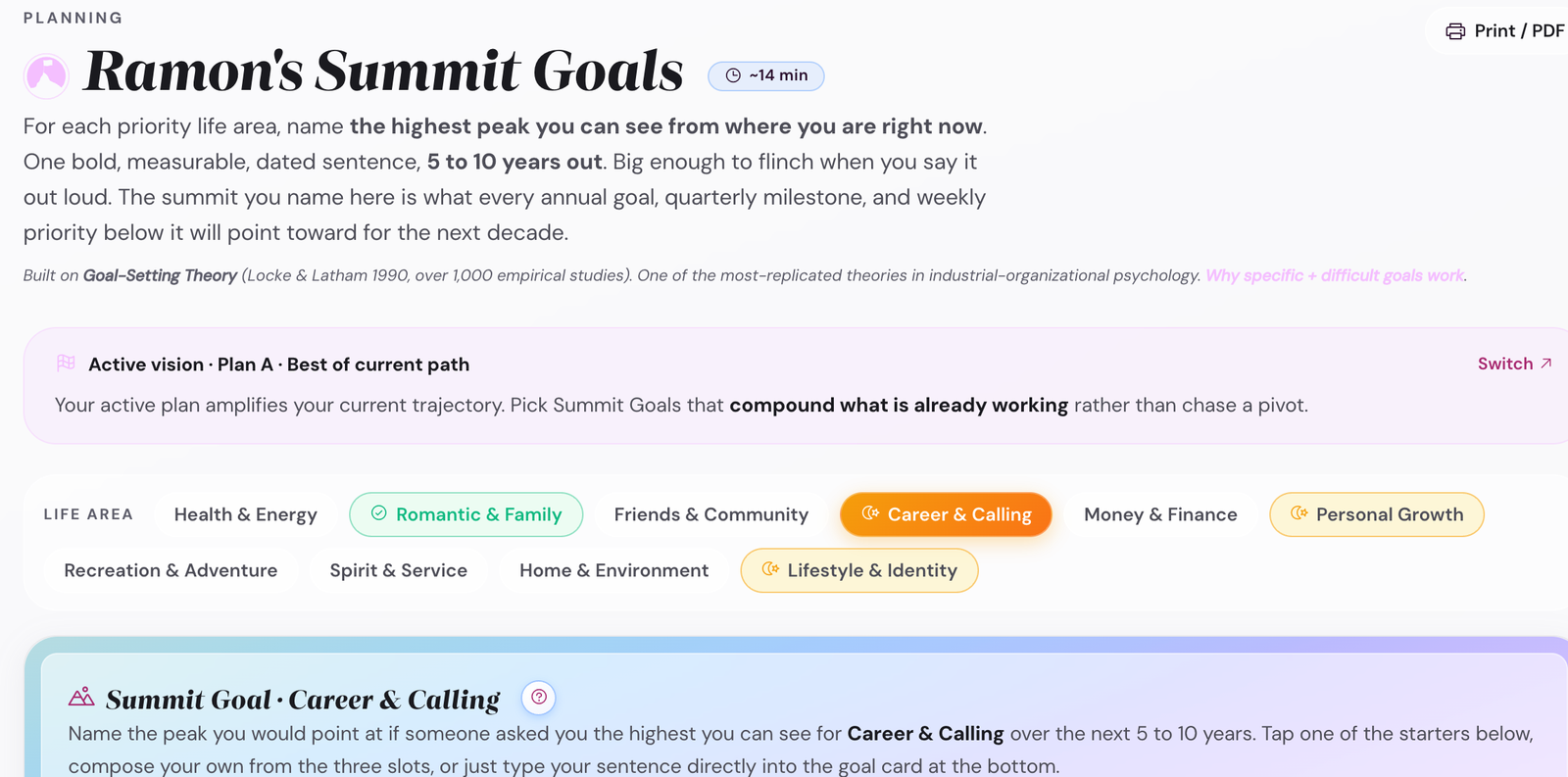
Common misuse. Writing a Summit that is actually a habit ("meditate every day"). Habits are inputs; Summits are outcomes. The Summit for a meditation habit would be something like "complete a 10-day silent retreat by June 2027." The habit is the input; the retreat is the Summit.
6. Goal Plan
Combines WOOP (Oettingen, 2014) with implementation intentions (Gollwitzer) and friction-removal patterns from BJ Fogg.A Goal Plan turns a Summit Goal into something tractable. For each Summit, you sketch:
- The wish: the outcome you want (your Summit, restated).
- The outcome: what changes in your life if you achieve it.
- The obstacles: the friction that has stopped you before. Real and specific.
- The plan: if-then statements that route around each obstacle.
The "if-then" structure is implementation intention research: people who specify when and where they will act follow through 2-3x more often than people who just intend to act.
Where it shows up
Same Summit Goals step (T2B). Under each Summit there is an expandable Goal Plan section with the four fields above. The quarterly check-in rereads the obstacles + if-then list.
Common misuse. Vague obstacles ("I get distracted"). Obstacles must be specific enough to route around. "On Tuesday evenings my partner watches the news from 7-9pm at the volume I cannot read through" is a real obstacle. "I get distracted" is a wish for an obstacle.
7. Focus Quarter
Adapted from The 12 Week Year (Moran & Lennington, 2013).Twelve weeks is short enough to feel finite, long enough to ship something real. The app's Execute step centers on a Focus Quarter: pick 3-5 milestones from your year plan that belong to the current 12-week block, then break those down into month, week, and day priorities.
At the end of the quarter, you do a Quarter Check-in: reread the active vision, decide if the Summit Goals still pull, and set the next 12-week focus. This rhythm replaces the annual-only review most people fail at.
Where it shows up

Common misuse. Treating the quarter as 13 weeks. It is 12. The 13th week is the gap, used for the check-in itself + planning the next quarter. Compressing the gap into the next quarter is how people burn out.
8. Trigger / Action / Reward
Habit loop from The Power of Habit (Duhigg, 2012), refined by BJ Fogg (Tiny Habits, 2019).Every habit in the Habit Garden has three slots:
- Trigger: the time or context that fires the habit. "Right after my morning coffee." "When I close the laptop at 5pm."
- Action: the smallest version of the behavior. "Lace up and step outside" not "go for a 10k."
- Reward: the immediate good feeling that closes the loop. Often as small as marking the habit done in the Habit Garden.
The point of writing the trigger explicitly is that habits do not stick on willpower. They stick on context. Wiring the trigger to a thing you already do every day (coffee, laptop close, bedtime) borrows reliability from an existing behavior.
Where it shows up
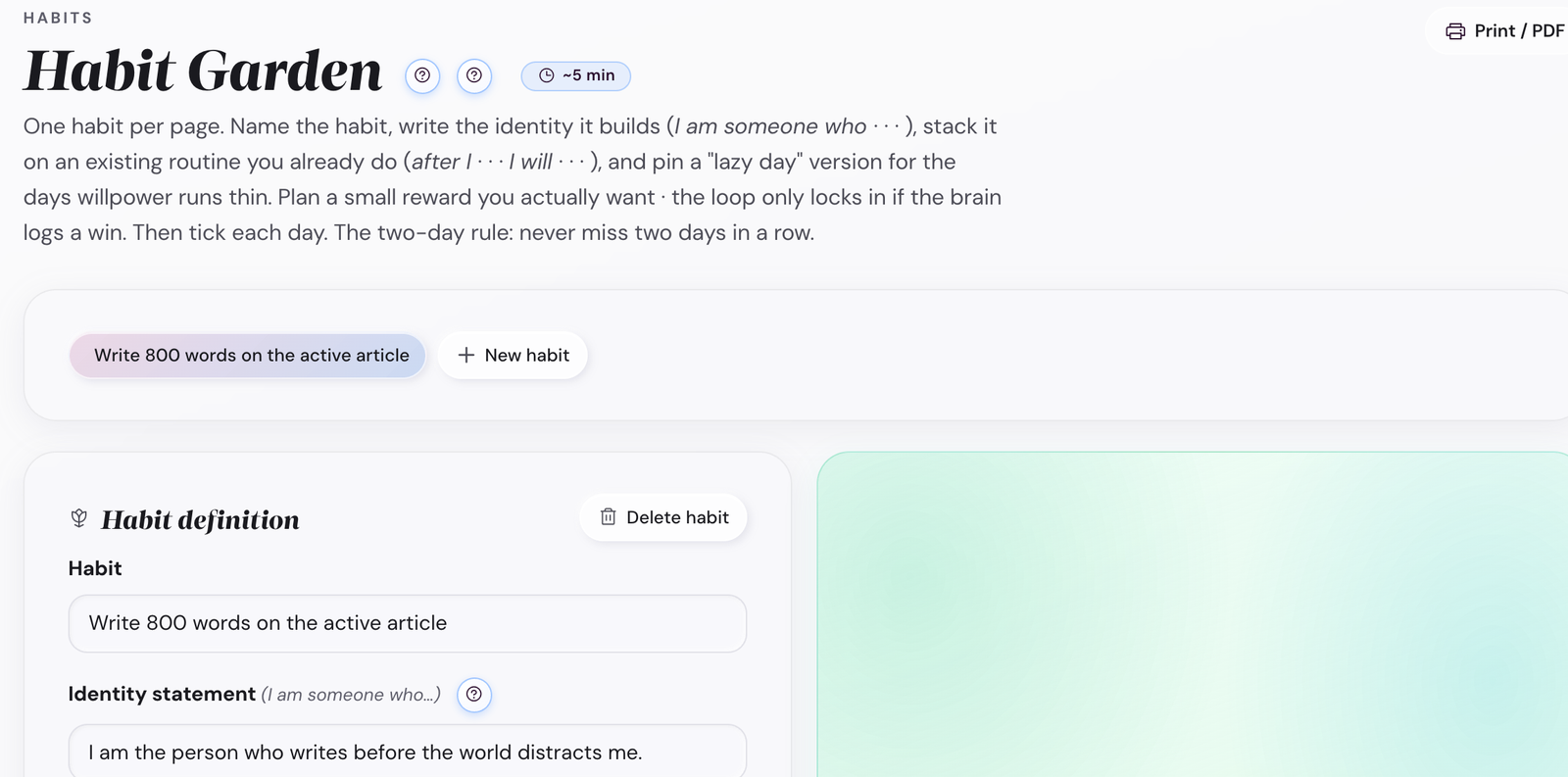
Common misuse. Skipping the trigger field. A habit without a trigger is a wish. "Meditate daily" lasts a week; "meditate for 5 minutes right after I pour my morning coffee" lasts a year.
9. Two-day rule
Folk wisdom in the running community, codified by James Clear and others.Miss one day, you are human. Miss two days in a row, you are quietly building a new habit (the habit of not doing it). The two-day rule says: never miss the same habit two days in a row. One slip is a rest day; two slips is a problem.
The app watches your habit log. If a habit goes two consecutive scheduled days unchecked, it flags it in the Insights view with a gentle nudge, not a guilt-trip.
Where it shows up
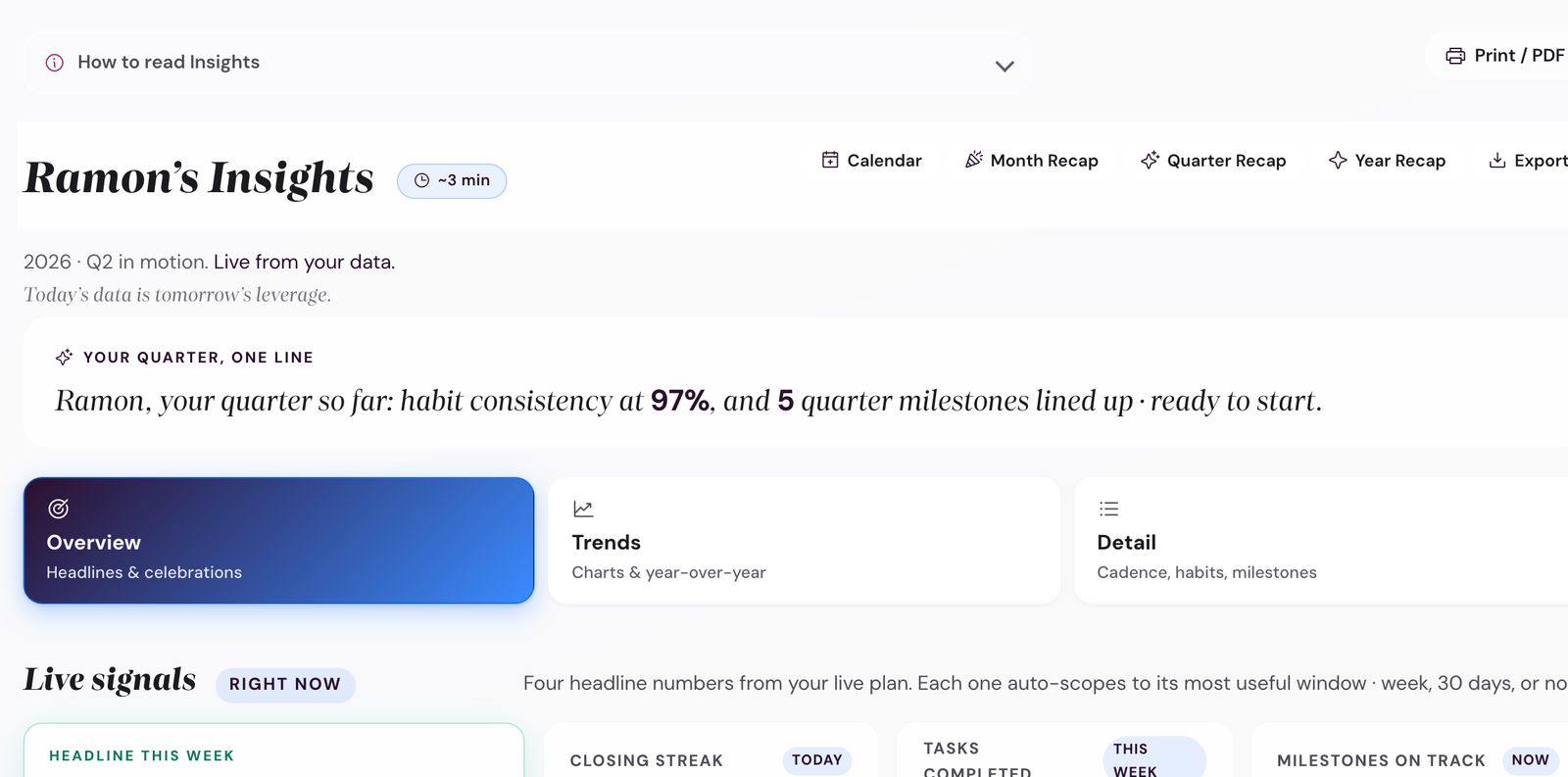
Common misuse. Trying to make the rule "never miss." Then a single slip becomes catastrophic. The rule is specifically about the second miss. Miss one, no problem. The lazy-day version (next framework) is the safety net for the second day.
10. Traffic Light
Project management standard (RAG status reporting). Adapted for personal goals.Each milestone gets a Red / Amber / Green dot:
- Green: on track. No intervention needed.
- Amber: at risk. A small course-correction now prevents Red later.
- Red: off track. Needs a decision: rescue, reschedule, or retire.
The honest use of Amber is the key. Amber is what catches drift early. The temptation is to color everything Green until the deadline hits, then jump to Red. The monthly check-in reviews every milestone's traffic light and asks "is this still Green, or am I being polite to myself?"
Where it shows up
Execute step (Year and Quarter views) milestone rows have a small dot toggle. The Insights coach surfaces Reds first when you open the Insights view.
Common misuse. Polite-Green ratings. People keep things Green until the deadline arrives. The amber dot is the entire point: it lets you catch drift two weeks before the missed deadline, while there is still time to course-correct.
11. Lazy Day
Original to the Life Goals Program workbook (Landes, 2025), adapted from minimum-viable-action habit research.For every habit, you define a "lazy day" version: the smallest acceptable action when the full habit is not feasible. For a 30-minute run, the lazy day might be "10-minute walk + 5 push-ups." For a 1,000-word writing session, the lazy day might be "200-word voice memo."
The lazy day is the difference between "I missed today" (which becomes a streak-killer) and "I shrunk today" (which keeps the rhythm). It also makes the two-day rule actually work: you can almost always do the lazy version, even on the worst day.
Where it shows up
Each habit row in the Habit Garden (T4A) has a lazy-day field. Checking the lazy version counts as a completed habit, not a missed day. The Insights view's streak counter treats both as a "kept" day.
Common misuse. Lazy-day versions that are still too ambitious. If your lazy day for a 1,000-word writing habit is "300 words," that is still hard on a sick day. Better: "voice memo, one minute." The lazy day exists to keep the streak from ever truly dying. Set it embarrassingly low.
How the frameworks connect
The eleven techniques are not stand-alone. They feed each other:
- Values + Life Areas Map set the field of play.
- Vision Interview + Three Futures set the destination.
- Summit Goals + Goal Plan turn the destination into trackable outcomes.
- Focus Quarter + Goal Cascade break those outcomes into 12-week and 5-minute units.
- Trigger / Action / Reward + Lazy Day + Two-day rule make daily execution sustainable.
- Traffic Light is the visibility layer that lets the cadence (daily reflection → weekly reflection → monthly check-in → quarterly check-in → annual wrap-up) catch drift early.
The companion app is the connective tissue. Each step's UI is a single framework in action, and the next step inherits from it.
If you only remember three things
- Outcome over activity. Summits are outcomes; habits are activities. Confusing them is the most common error.
- Trigger over willpower. Habits stick on context, not motivation. Write the trigger field.
- Amber over Green. Honest mid-state ratings catch drift early. Polite-Green ratings cause Q4 collapses.
Where to next
- Ready to apply these? Open the app and try the 10-minute quick start.
- Want a worked example of all eleven in action? Read a persona scenario like Maya or David.
- Have a specific question? Browse the How do I… recipes.