
Why your last self-improvement attempt probably stalled
Most personal development strategies fail before they produce anything meaningful. A meta-analysis by Sin and Lyubomirsky reviewing 51 studies with 4,266 participants found a mean effect size of r=0.29 for well-being improvement – real, but modest [1]. The gap between desired outcomes and actual results explains why people cycle through self-improvement books, planners, and courses without lasting change. The problem isn’t usually motivation. The core problem is that popular personal development advice skips two things: matching strategies to specific growth areas, and measuring whether anything is actually working.
This guide is part of our Growth collection.
This guide covers what research supports across all five areas of personal development, where conventional advice falls apart, and how to build a personal development plan grounded in evidence rather than optimism.
Personal development strategies are deliberate, structured approaches to improving specific capabilities across mental, emotional, professional, physical, and relational domains. Unlike general self-help, personal development strategies tie specific methods to measurable outcomes within defined growth areas.
Personal development strategies with the strongest research support include goal setting with specific targets, mindfulness meditation for anxiety and depression, coaching paired with structured goals, mental contrasting with implementation intentions, and positive psychology interventions for well-being. Each works best when matched to the right growth area and measured over a 90-day cycle.
What you will learn
- The five areas of personal development and which ones most people ignore
- Why personal development strategies fail – and the research explaining each failure mode
- Which self-improvement strategies actually have strong evidence behind them
- How goal setting changes personal development outcomes based on 35 years of research
- A concrete framework for measuring personal growth across all five areas
- How to build a personal development plan that actually survives real life
- What personal development strategies look like when you’re busy, a parent, or have ADHD
Key takeaways
- Personal development spans five areas: mental, emotional, professional, physical, and relational growth.
- Specific, challenging goals outperform vague intentions in roughly 90% of studies [2].
- Positive affirmations can actually backfire for people with low self-esteem.
- Growth mindset interventions show weak effects (d=0.08) on overall achievement [4].
- The Development Audit Loop connects strategy selection to quarterly measurement and course correction.
- Mental contrasting beats pure positive visualization for translating intentions into actual effort.
- Coaching produces the strongest effect sizes in personal development research.
The five areas of personal development
Personal development spans five interconnected domains – mental, emotional, professional, physical, and relational – and neglecting any single area eventually undermines progress in the others. Most people focus heavily on one or two and neglect the rest, which creates the lopsided growth that leads to burnout.
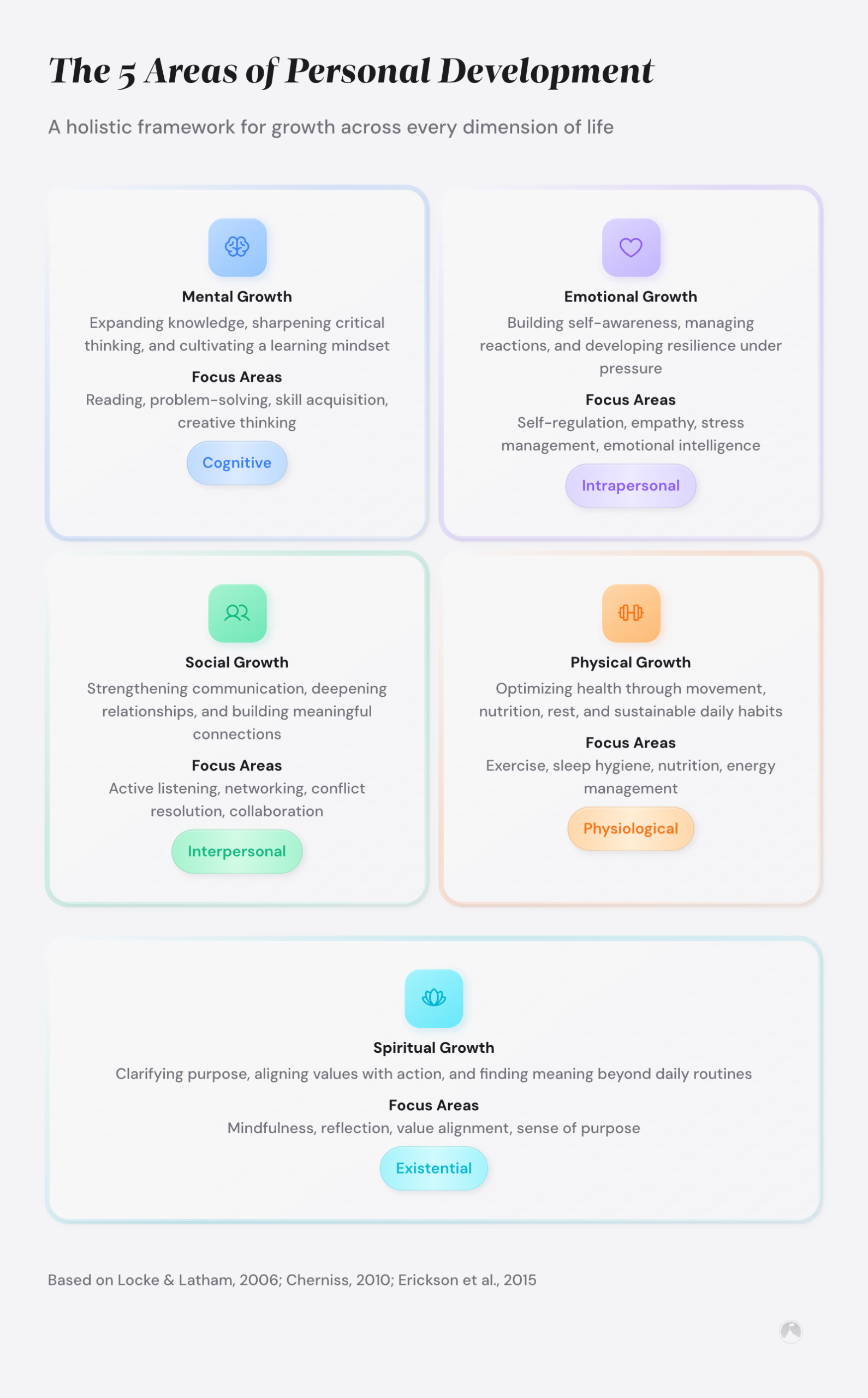
Mental growth covers learning new personal development skills, expanding knowledge, and building cognitive capabilities. Emotional growth means developing self-awareness, managing difficult feelings, and understanding your own patterns. Professional growth is career-specific development – skills, credentials, advancement.
Physical growth is health, energy, strength, and movement capacity. And relational growth means deepening connections with others, improving communication, and building trust.
| Area | Example Strategy | Measurement Signal |
|---|---|---|
| Mental | Structured learning with spaced repetition | Concepts applied per week |
| Emotional | Mindfulness meditation (10-15 min daily) | Daily mood and anxiety ratings |
| Professional | Coaching with specific goals | Peer feedback scores quarterly |
| Physical | Regular exercise (150+ min/week) | Energy levels and sleep quality |
| Relational | Active listening practice | Meaningful conversations per week |
The trap is treating these as separate buckets when they actually function as one system. Research on emotional intelligence demonstrates that emotional growth directly impacts professional effectiveness. Cherniss argued that emotional intelligence likely contributes to job performance, particularly in roles involving interpersonal interaction, though measurement and definitional challenges remain [9]. A review by Erickson and colleagues showed that regular physical activity improves executive function and processing speed – cognitive capacities that fuel mental growth [10]. And Cohen and Wills’s influential review found that strong social relationships buffer individuals against the negative effects of stress and help them maintain motivation through difficult stretches [11].
When one area deteriorates significantly, the others eventually suffer too. Consider a professional who invests heavily in career development while neglecting sleep, stress management, and relationships. Two things happen: the professional development itself becomes less effective (stress impairs learning), and they experience diminishing fulfillment even as external success grows.
Why personal development strategies fail
Personal development strategies typically break down for one of three reasons: they’re based on weak evidence, they don’t match the person’s actual constraints, or they lack measurement to track whether anything is actually changing.
Weak evidence is the most common culprit. Growth mindset interventions are a prime example – widely promoted as transformative despite a meta-analysis showing just a d=0.08 effect on achievement for the general population [4]. Strategies built on overpromised research waste effort and erode trust in the process.
Wrong constraints means applying generic advice to a life it wasn’t designed for. A personal growth strategy built around hour-long morning routines collapses for a parent with unpredictable sleep or a professional working 50-hour weeks. The situational adaptations later in this guide address how to modify strategies for real constraints.
No measurement is what allows people to cycle through strategies indefinitely without knowing whether any worked. The Development Audit Loop below closes this gap by connecting strategy selection to quarterly outcome tracking across all five areas.
What self-improvement strategies have the strongest research behind them
Positive psychology interventions
Positive psychology interventions – structured practices designed to boost well-being – show consistent benefits across multiple meta-analyses. Sin and Lyubomirsky reviewed 51 studies involving 4,266 participants and found a mean effect size of r=0.29 for well-being improvement and r=0.31 for reducing depressive symptoms [1]. These are real effects, not trivial ones. But they’re modest enough that “life-changing” isn’t the right expectation.
Positive psychology interventions produce genuine improvements, but the effect sizes are modest enough to require patience and consistency. A separate meta-analysis by Bolier and colleagues confirmed these findings with slightly larger effects on subjective well-being (d=0.34) and smaller effects on psychological well-being (d=0.20) [8]. The message is consistent: these interventions work, but they’re not transformative by themselves.
Mindfulness meditation
Mindfulness meditation has the strongest evidence in the emotion-regulation department. A large meta-analysis published in JAMA Internal Medicine by Goyal and colleagues reviewed 47 trials with 3,515 participants and found moderate evidence that mindfulness improves anxiety (d=0.38), depression (d=0.30), and pain (d=0.33) [3]. The anxiety (d=0.38) and depression (d=0.30) effect sizes for mindfulness are meaningful – roughly comparable to mild antidepressant medication.
But here’s the catch: the evidence for general stress reduction and overall mental health quality of life was weak. Meditation isn’t a cure-all wellness practice. It works best when you’re targeting specific symptoms like anxiety or depression, not vague wellness goals.
“Mindfulness meditation programs had moderate evidence of improved anxiety, depression, and pain, but low evidence of improved stress and mental-health-related quality of life.” – Goyal et al., JAMA Internal Medicine (2014) [3]
Knowing when mindfulness works and when it doesn’t tells you when to use it and when to try something else. If you experience daily anxiety about presentations, mindfulness with 10-15 minutes of daily practice would be a targeted personal development strategy with moderate-to-strong evidence. If you’re seeking general wellness, you’d need to pair it with other self-improvement strategies.
Growth mindset interventions
Growth mindset is the belief that abilities and intelligence develop through effort, learning, and persistence. Carol Dweck’s original research proposed that people with this belief outperform those with fixed mindsets across academic and professional settings.
And here’s where popular personal development advice diverges sharply from the research. A large meta-analysis by Sisk and colleagues examined 273 studies with 365,000+ participants and found that growth mindset interventions have a weak overall effect on academic achievement – just d=0.08 [4]. That’s close to zero. The interventions work slightly better for at-risk populations, but for the general population the effect is minimal.
Growth mindset is worth developing, but the popular version vastly overpromises what a belief shift alone delivers. Believing you can improve is a starting point, not a complete strategy. Without specific, evidence-based methods attached to that belief, mindset work produces little measurable change. For a fuller picture, see our guide on developing a growth mindset.
Coaching and mentorship
Workplace coaching has some of the strongest effect sizes in the personal development literature. Theeboom, Beersma, and van Vianen’s meta-analysis found positive effects on performance (g=0.60), well-being (g=0.46), coping (g=0.43), and goal-directed self-regulation (g=0.74) [5]. The goal-directed self-regulation effect size (g=0.74) is particularly striking – it’s large by any research standard.
“Coaching had significant positive effects on all outcome categories, with the strongest effects on goal-directed self-regulation.” – Theeboom, Beersma, and van Vianen (2014) [5]
The critical qualifier: coaching works best when paired with specific, measurable personal development goals. A coach asking “what do you want to work on?” without a structured goal framework produces weaker outcomes. For practical guidance on finding the right coach, see our guide on finding a mentor and coaching.
Mental contrasting with implementation intentions
Mental contrasting – visualizing your desired future while also imagining specific obstacles you’ll face – beats pure positive visualization for translating intentions into actual effort. Researchers Oettingen and Gollwitzer found that participants instructed to mentally contrast their desired outcome with specific obstacles spent more hours on difficult tasks and performed better than those who only visualized success [7]. It’s a small tweak in how you think about personal development goals, but it produces measurable differences in follow-through.
Positive affirmations
This one’s counterintuitive. Positive affirmations can actually backfire. Research by Wood, Perunovic, and Lee found that among participants with low self-esteem, those who repeated positive self-statements felt worse than those who didn’t [6]. Among participants with already moderate-high self-esteem, positive affirmations helped.
The mechanism: for people with fragile self-worth, positive statements create cognitive dissonance. Positive affirmations work for people who already believe they have some worth, but can backfire for those who need the boost most. The backfire effect of affirmations for low self-esteem is why evidence-based strategy selection matters more than generic personal development tips.
Journaling and reflective writing
Expressive writing has a surprisingly robust evidence base. Pennebaker and Smyth’s research – where participants write about emotional experiences for 15-20 minutes over 3-4 consecutive days – has been replicated across dozens of studies. A meta-analysis by Frattaroli (2006) found a weighted average effect size of d=0.075 for overall health outcomes, with stronger effects for physical health (d=0.21) when participants wrote about particularly stressful events [13]. Journaling works best as an emotional processing tool – writing about stressful experiences produces better outcomes than writing about neutral topics or daily to-do lists.
Personality assessments as self-awareness tools
Validated personality assessments – particularly the Big Five model (openness, conscientiousness, extraversion, agreeableness, neuroticism) – serve as useful self-awareness tools for personal development planning. Unlike the popular but psychometrically weak MBTI, the Big Five has strong test-retest reliability and predictive validity. Barrick and Mount’s meta-analysis found that conscientiousness consistently predicts job performance across occupational groups (corrected correlation of 0.22) [14]. Using Big Five results to identify strengths and growth areas adds structure to the Development Audit Loop’s baseline assessment step.
| Strategy | Key Finding | Best For |
|---|---|---|
| Positive psychology interventions | r=0.29 for well-being (51 studies) | General well-being, mild depression |
| Mindfulness meditation | d=0.38 for anxiety (47 trials) | Anxiety, depression, chronic pain |
| Growth mindset interventions | d=0.08 for achievement (273 studies) | At-risk students |
| Coaching | g=0.74 for goal-directed self-regulation | Goal attainment, professional growth |
| Mental contrasting | Significant vs. positive visualization alone | Goal pursuit and follow-through |
| Positive affirmations | Negative for low self-esteem | People with moderate-high self-esteem |
| Journaling | d=0.21 for physical health outcomes | Emotional processing, stress recovery |
| Personality assessments (Big Five) | Conscientiousness r=0.22 with job performance | Self-awareness, development planning |
Personal development goal setting: what the research shows
If one piece of personal development research has actually earned its reputation, it’s goal-setting theory. Locke and Latham’s work represents 35 years of research across hundreds of studies, and the finding is remarkably consistent: specific, challenging goals produce higher performance than vague goals in approximately 90% of the studies examined [2].
Goal-setting theory is the research principle developed by Edwin Locke and Gary Latham showing that specific, challenging goals direct attention, mobilize effort, increase persistence, and encourage development of new task strategies – producing measurably higher performance than vague goals.
But popular interpretations often miss the details that make goal setting work. The research shows goals produce results through four distinct mechanisms:
- Direction: Goals focus attention on goal-relevant activities and away from distractions
- Effort: Challenging goals produce greater effort than easy or vague goals
- Persistence: Specific goals increase how long people stick with a task
- Strategy development: When goals exceed current ability, people develop new approaches rather than repeating old methods
“Specific, challenging goals lead to the highest level of performance… they direct attention toward goal-relevant activities, energize the person, increase persistence, and lead to discovery of task-relevant strategies.” – Locke and Latham, Current Directions in Psychological Science (2006) [2]
Specific, challenging goals activate all four mechanisms simultaneously – that’s why they produce such consistent performance gains. The implication for personal growth strategies is clear: “improve my emotional intelligence” is not a goal. “Complete one structured feedback conversation per week for the next quarter and document response patterns” is. The difference matters because the second version activates all four mechanisms while the first activates none.
One caveat: goals that feel impossible decrease performance. The research sweet spot is goals that feel achievable but require stretching beyond current habits. For a detailed treatment of goal-setting mechanics, see our guide on personal growth goals that stick.
Self-improvement strategies for measuring personal growth
The biggest gap in personal development advice is measurement. Most guides tell you what to do but never explain how to know if it’s working. This section introduces what we call the Development Audit Loop – a framework we developed for this guide that synthesizes coaching and goal-setting research into a practical quarterly review cycle for tracking progress across all five growth areas.
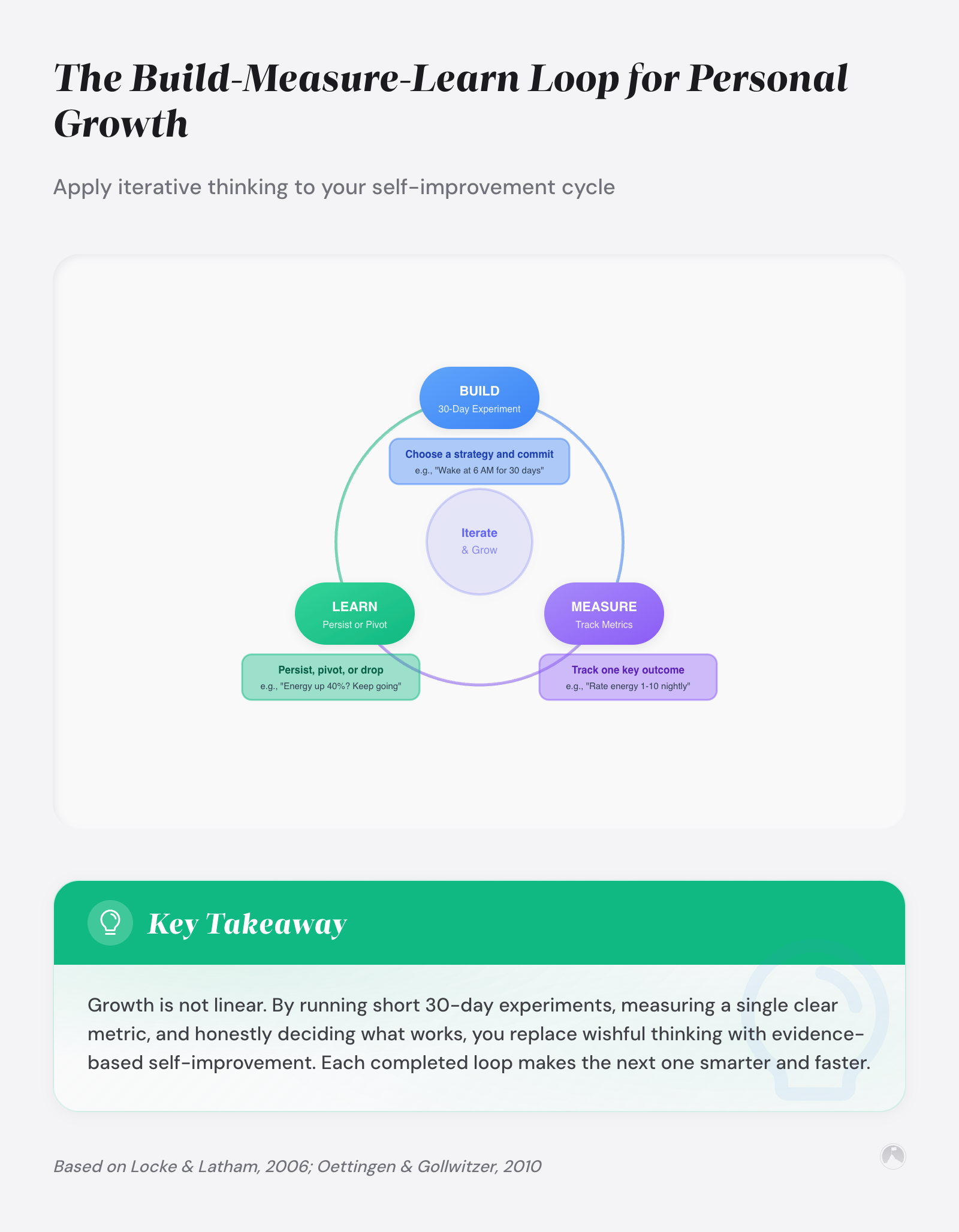
The development audit loop
The Development Audit Loop is a framework we created for this guide, synthesizing coaching and goal-setting research into a quarterly review cycle. The loop follows four steps: assess current state across all five areas, select strategies targeting the weakest area, implement for 90 days with weekly input tracking, then audit outcomes against baseline measurements before selecting the next quarter’s focus.
The Development Audit Loop borrows from what makes coaching effective – specific goals combined with structured review cycles – while staying simple enough to maintain without external accountability. Here’s how each step works:
Step 1: Baseline assessment. Rate yourself 1-10 in each of the five areas. Be honest. Then pick one specific signal per area (energy levels for physical, number of meaningful conversations for relational, pages read for mental growth). These become your measurement anchors.
Step 2: Select two focus areas. Not five. Not three. Two. Goal-setting research consistently shows that spreading effort across too many goals dilutes the direction and effort mechanisms [2]. Pick the two areas where improvement would have the biggest ripple effect on the others.
Step 3: Implement for 90 days. Choose one specific strategy per focus area from the evidence-backed options listed earlier. Track weekly inputs (did you do the thing?) and monthly outcomes (is the measurement signal moving?).
Step 4: Quarterly audit. Re-rate yourself 1-10 in all five areas. Compare to baseline. Did the focus areas improve? Did the non-focus areas decline? Adjust strategy selection for the next quarter based on what the data shows.
Development audit loop – quarterly review template
| Growth Area | Rating (Baseline -> Current) | Strategy Used |
| Mental | ___ -> ___ | ___ |
| Emotional | ___ -> ___ | ___ |
| Professional | ___ -> ___ | ___ |
| Physical | ___ -> ___ | ___ |
| Relational | ___ -> ___ | ___ |
Measurement signals by area: Mental (hours learning, concepts applied), Emotional (mood ratings, healthy coping instances), Professional (projects completed, peer feedback), Physical (energy levels, exercise consistency), Relational (meaningful conversations, communication quality).
Decision rule: If a focus area improved less than 1 point, change the strategy. If it improved 2+ points, consider maintaining or shifting focus to a weaker area.
The Development Audit Loop prevents the most common personal development mistake – changing strategies before giving any single approach enough time to work. Ninety days is specific for a reason. Lally and colleagues found that habit formation takes a median of 66 days, with a range of 18 to 254 days depending on the behavior’s complexity [12]. The 90-day window accommodates this range while remaining short enough to course-correct before wasting a year on something that isn’t working. For more on building consistent habits that support your development plan, see our guide on habit formation.
Personal development plans: how to build one that survives real life
A personal development plan is only as good as the system around it. Most plans fail not from having the wrong goals, but from lacking the structure to survive real-life disruptions. Here’s a practical framework for building a plan that connects your development goals to daily behavior.
A personal development plan is a structured document connecting self-assessed growth areas to specific goals, evidence-based strategies, timelines, and measurement criteria. A functional plan includes both leading indicators (daily/weekly actions) and lagging indicators (quarterly outcome changes).
Start with the Development Audit Loop baseline assessment from the previous section. That gives you a snapshot of all five areas. Then follow these steps:
Step 1: Pick your two priority areas. The temptation is to work on everything at once. Resist it. Goal-setting research consistently shows that fewer, more specific goals outperform sprawling lists [2]. Look at your baseline scores and ask: which two areas, if improved, would create the most positive spillover into the other three?
Step 2: Set one specific goal per area. Apply Locke and Latham’s criteria. The goal must be specific enough to measure, and challenging enough to require new behaviors. “Improve my communication skills” fails both tests. “Have one structured feedback conversation per week and document patterns” passes both.
Step 3: Choose evidence-backed strategies. Match your goal to a strategy with demonstrated effects. If your goal targets emotional regulation, mindfulness meditation has moderate evidence [3]. If your goal targets professional development, coaching with specific goals shows strong effects [5]. Pick strategies for their demonstrated effects on your specific outcome, not for their popularity.
Step 4: Define your leading and lagging indicators. Leading indicators are the daily or weekly behaviors you control (minutes meditated, feedback conversations held, pages read). Lagging indicators are the outcomes you’re targeting (stress levels, peer feedback scores, energy ratings). Track leading indicators weekly. Check lagging indicators monthly or quarterly.
A personal development plan without both leading and lagging indicators is a wish list, not a plan. The leading indicators keep you accountable to the process. The lagging indicators show whether the process is working. For a step-by-step walkthrough, see our guide on how to create a personal development plan.
One more thing: build in a quarterly review date on your calendar. This is when you run the audit loop, compare lagging indicators to baseline, and decide whether to keep your current strategy, adjust it, or switch focus areas. Without this checkpoint, plans become forgotten documents within weeks. Your personal mission statement can anchor these quarterly reviews by connecting specific goals to broader life direction.
What do personal development strategies look like for different situations
Personal development strategies for constrained schedules require integration with existing routines, shorter time horizons, and measurement signals that fit the constraints rather than requiring separate time blocks. Generic advice assumes unlimited time, stable routines, and no competing demands. Here’s how to adapt personal growth strategies for four common situations where standard advice breaks down.
Personal development for busy professionals
When work takes 50+ hours per week, personal development can’t become another full-time project. The research on coaching effectiveness suggests that even brief, structured interventions produce meaningful results when paired with specific goals [5]. Professionals benefit most from strategies that integrate with existing workflows rather than requiring separate time blocks.
Practical adaptations: use existing meetings as feedback collection opportunities (professional area), practice mindfulness during commute time (emotional area), and apply the kaizen approach of one small improvement per week. Integrating development into meetings, commutes, and small weekly improvements are personal development tips that work within constraints you already have.
Personal development for parents
Parents face a unique constraint: their schedule isn’t fully their own. The standard advice to wake up early ignores that many parents are already sleep-deprived. The better approach is to identify strategies that overlap with parenting responsibilities.
Relational growth happens naturally through parenting conversations when you practice active listening. Physical growth can happen during playground time instead of requiring a gym slot. Emotional regulation practice gets daily reps through managing tantrums (yours and theirs). The Development Audit Loop works for parents too – just adjust measurement signals to fit a schedule you don’t fully control.
Personal development with ADHD
Standard self-development strategies assume consistent executive function. For people with ADHD, the gap isn’t between knowing and wanting – it’s between intention and execution on any given day. Interest-based motivation means strategies need to be novel, urgent, or personally meaningful to activate effort.
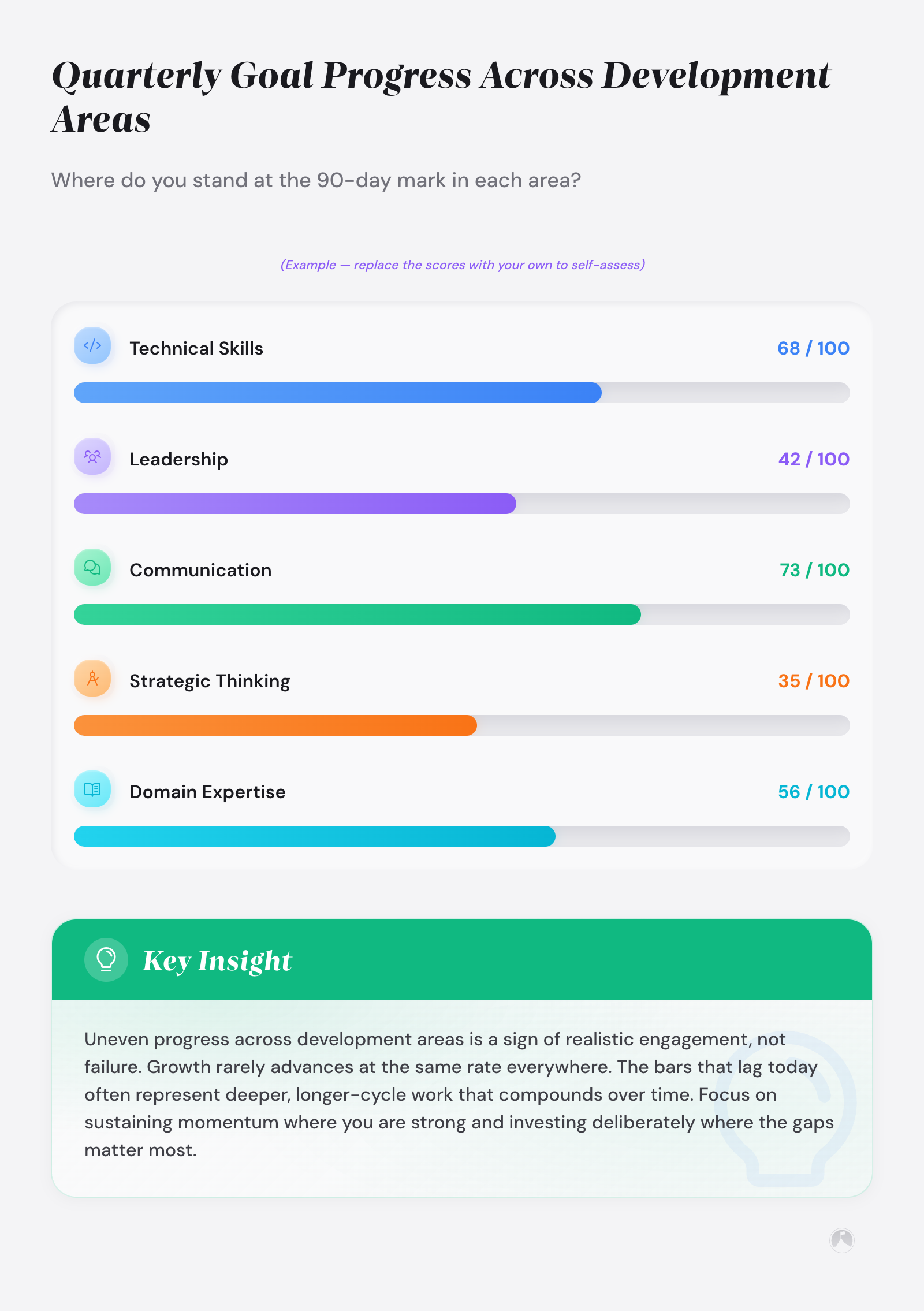
The most effective adaptation for ADHD is shrinking the time horizon from quarterly cycles to 2-week sprints with daily check-ins, because interest-based motivation requires shorter feedback loops to sustain effort. Use body doubling or accountability partners for the implementation phase. Choose strategies that produce immediate feedback – coaching sessions rather than solo reading, active skill practice rather than passive learning. For more on building habits with ADHD wiring, see our guide on habit building for ADHD.
Personal development when feeling stuck
Feeling stuck usually signals you’re working on the wrong growth area, not that you lack effort. If your professional development is strong but you feel unfulfilled, the bottleneck might be emotional or relational growth. If you have strong relationships but feel stagnant, the missing piece might be mental growth through new learning or creative challenge.
The feeling of being stuck in personal development usually points to an imbalance across the five areas rather than a failure in any single area. The baseline assessment in the Development Audit Loop is designed to surface these imbalances. Rate yourself honestly across all five areas, and the pattern usually becomes obvious. For strengthening your ability to push through stagnation, our guide on growth mindset development addresses the psychological skills that support sustained growth.
What separates personal development from professional development
People often use these terms interchangeably, but the distinction matters for strategy selection. Professional development targets career-specific skills, credentials, and competencies. Personal development includes professional growth but extends to emotional, relational, physical, and mental dimensions that professional development rarely touches.
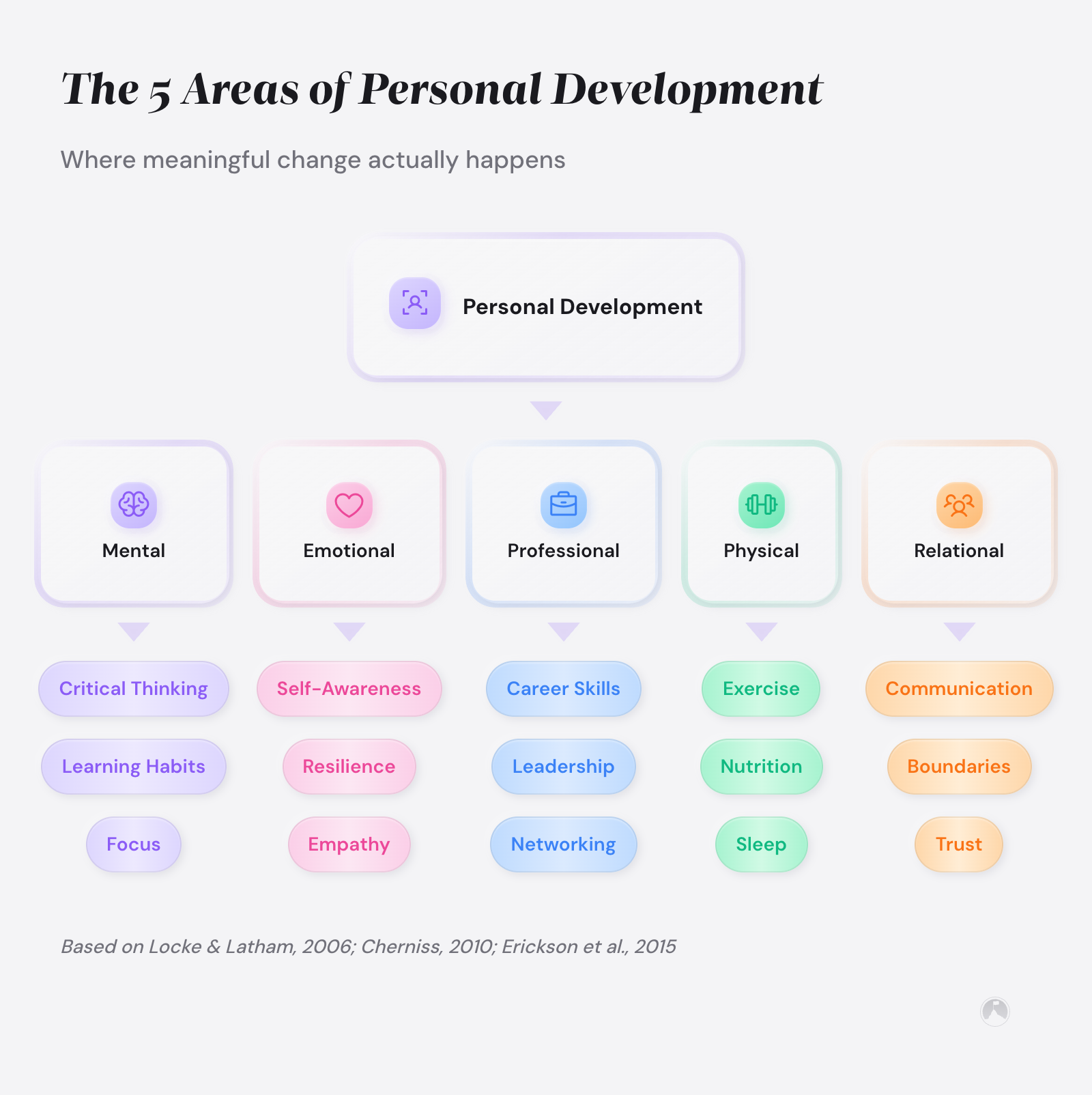
Professional development is the subset of personal development focused on career-relevant skills, knowledge, credentials, and competencies. Professional development addresses one of the five personal development areas and often overlaps with mental growth through skill acquisition.
This distinction matters because someone investing exclusively in professional development may advance their career as emotional regulation, physical health, and relationships deteriorate. Theeboom, Beersma, and van Vianen’s coaching meta-analysis found strong effects on both goal-directed self-regulation and well-being [5] – effective coaching addresses the whole person, not just the job title. For a deeper treatment of career-specific growth, see our guide on career growth strategies.
The most effective personal development strategies treat professional growth as one component of a larger system rather than the entire system. People who balance professional development with emotional and relational growth tend to sustain career progress longer and avoid burnout from one-dimensional optimization.
Ramon’s take
My bet is you already know which area needs the most work. Skip the assessment. Pick one specific goal, ignore everything else for 90 days. The overwhelm isn’t usually the problem. The narrowing down is.
When I started tracking my energy levels (physical) alongside project output (professional) alongside relationship quality (relational), patterns emerged that I never would have spotted otherwise. My best professional months consistently coincided with regular exercise and at least two meaningful conversations per week with people outside work. My worst months had one thing in common – I’d dropped the physical and relational habits to “focus on work.”
Seeing those cross-area patterns is when the Development Audit Loop made sense. You can’t optimize everything at once. But you can measure all five areas and notice when your strengths in one domain are being undercut by neglect in another. The quarterly review is what forces that conversation with yourself.
Conclusion
Personal development strategies work when they’re matched to specific growth areas, grounded in evidence, and connected to measurable outcomes. The research is clear: specific goals beat vague intentions, coaching produces the strongest effects when paired with structured frameworks, and positive psychology interventions produce real but modest improvements. The Development Audit Loop ties these findings together into a quarterly cycle you can actually maintain.
The question was never whether personal development works. It was whether you’re measuring the right things.
Next 10 minutes
Rate yourself 1-10 across the five personal development areas: mental, emotional, professional, physical, and relational. You don’t need to be precise – just a gut feeling of where you stand. That baseline becomes your starting point.
This week
Pick one area where a small improvement would create ripple effects across the others. One area. Pick one evidence-backed strategy from the table earlier that targets that growth area. For the next 90 days, implement that strategy and track one leading indicator (the behavior) and one lagging indicator (the outcome). You’ll know by the end of the quarter whether it’s actually working.
Take the next step
Ready to put these principles into practice? The Life Goals Workbook gives you structured templates for setting specific, measurable goals across all five development areas – including the quarterly audit framework covered in this guide.
There is more to explore
Once you understand evidence-based personal development strategies, the next step is going deeper into specific areas. Explore our guides on personal growth goals that stick, crafting a personal mission statement, self-determination theory for sustained growth, and continuous learning research.
Frequently asked questions
Explore the full Personal Development library
Go deeper with these related guides from our Personal Development collection:
- personal-development-introverts
- kaizen-personal-productivity
- self-paced-vs-structured-personal-development
- personal-development-podcasts-for-professionals
- building-a-daily-learning-habit
- personal-development-overwhelm-solutions
- say-no-without-guilt
- how-to-master-the-grow-framework-a-step-by-step-guide-for-real-results
- personal-development-for-remote-professionals
- multi-domain-personal-development-orchestration
- personal-development-burnout
- best-personal-development-apps-and-resources
- personal-development-books-that-changed-lives
How long should personal development take to show results?
The Development Audit Loop uses 90 days as the measurement window because Lally and colleagues found habit formation takes a median of 66 days, with a range of 18-254 days depending on behavior complexity [12]. You should see directional movement (1-2 point improvement on your 1-10 scale) within this timeframe. Expect continued improvement beyond the first 90 days as new behaviors compound.
What if I don’t have time for a personal development plan?
The most effective plans integrate with existing routines rather than requiring separate time blocks. Busy professionals can use coaching during work meetings, practice mindfulness during commutes, and adjust fitness routines to align with relational goals (walking meetings, group exercise). The Development Audit Loop requires roughly 30 minutes every three months for the quarterly review.
Can I work on all five growth areas simultaneously?
Research on goal dilution suggests that working on more than three goals simultaneously reduces effort and persistence on each one [2]. Focus on two areas per quarter for the strongest results. After two consecutive quarters of 2+ point improvement in your focus areas, consider adding a third. Measure all five areas quarterly to catch imbalances, but direct your active strategy implementation at no more than two or three.
Why do growth mindset interventions have such weak effects?
Growth mindset is a useful belief to develop, but belief alone doesn’t change behavior. The research shows that mindset interventions work better when paired with specific skills, strategies, or feedback. The effect size of d=0.08 reflects mindset work in isolation [4]. When combined with evidence-backed strategies like goal-setting or coaching, the combined effect is much stronger.
Should I hire a coach for personal development?
The coaching meta-analysis shows strong effects (g=0.74 for goal-directed self-regulation) [5], but coaching is most effective when you arrive with specific goals and a structured approach. Before hiring a coach, clarify what you’re trying to develop and measure. A coach accelerates progress but isn’t strictly necessary if you can self-manage using the Development Audit Loop and clear goals.
What measurement signals work best for each growth area?
Mental: hours spent learning, books completed, new concepts applied. Emotional: daily mood ratings, instances of healthy coping, regular reflection practice. Professional: completed projects, skill milestones, peer feedback. Physical: energy levels, exercise consistency, sleep quality. Relational: number of meaningful conversations, quality of communication, time spent with important relationships. Pick signals that matter to you and that you can track consistently.
Why isn’t positive affirmation on the list of recommended strategies?
Positive affirmations can backfire for people with low self-esteem, making them feel worse [6]. They work for people who already have moderate-high self-worth. Evidence-backed alternatives like cognitive reframing, mindfulness, or structured goal-setting produce more consistent results regardless of baseline self-esteem.
How does the Development Audit Loop prevent burnout?
Burnout typically results from imbalanced growth across the five areas – usually caused by overinvestment in professional development while neglecting physical, emotional, and relational growth. The quarterly audit forces you to notice these imbalances before they compound. When you measure all five areas, you’re naturally prompted to rebalance if one area drops significantly.
Glossary of related terms
Self-improvement strategies are intentional methods for enhancing personal capabilities, behaviors, or outcomes. The term carries a broader scope than personal development strategies, often including informal approaches like reading and habit changes that lack structured measurement.
Personal growth strategies are approaches focused on expanding self-awareness, emotional maturity, and life satisfaction. Personal growth strategies tend to emphasize internal transformation rather than external skill acquisition.
Personal development goals are specific, measurable targets set within one or more of the five personal development areas. Unlike vague aspirations, personal development goals meet the criteria established by goal-setting theory: they are specific enough to measure and challenging enough to require new behaviors.
Personal development skills are learnable capabilities that support growth across all five development areas. Examples include active listening (relational), emotional regulation (emotional), and time management (professional).
Self-development strategies are growth approaches driven by personal initiative rather than formal instruction or coaching. Common examples include self-assessment using validated tools, independent study of skill-specific material, and reflective journaling.
Personal development tips are specific, actionable recommendations targeting a single aspect of personal growth. Effective tips connect a concrete behavior to a researched outcome rather than offering generic motivation.
Mental contrasting is a goal-pursuit technique developed by Gabriele Oettingen that combines positive visualization of a desired outcome with realistic assessment of obstacles. Research shows mental contrasting outperforms pure positive visualization for effort and follow-through [7].
Implementation intentions are specific if-then plans that link situational cues to goal-directed responses (e.g., “If it’s 7 a.m., then I will meditate for 10 minutes”). When paired with mental contrasting, implementation intentions increase the likelihood of translating goals into action.
References
[1] Sin, N. L., & Lyubomirsky, S. (2009). Enhancing well-being and alleviating depressive symptoms with positive psychology interventions: a practice-friendly meta-analysis. Journal of Clinical Psychology, 65(5), 467-487. https://doi.org/10.1002/jclp.20593
[2] Locke, E. A., & Latham, G. P. (2006). New directions in goal-setting theory. Current Directions in Psychological Science, 15(5), 265-268. https://doi.org/10.1111/j.1467-8721.2006.00449.x
[3] Goyal, M., et al. (2014). Meditation programs for psychological stress and well-being: a systematic review and meta-analysis. JAMA Internal Medicine, 174(3), 357-368. https://doi.org/10.1001/jamainternmed.2013.13018
[4] Sisk, V. F., Burgoyne, A. P., Sun, J., Butler, J. L., & Macnamara, B. N. (2018). To what extent and under which circumstances are growth mind-sets important to academic achievement? Two meta-analyses. Psychological Science, 29(4), 549-571. https://doi.org/10.1177/0956797617739704
[5] Theeboom, T., Beersma, B., & van Vianen, A. E. (2014). Does coaching work? A meta-analysis on the effects of coaching on individual level outcomes in an organizational context. The Journal of Positive Psychology, 9(1), 1-18. https://doi.org/10.1080/17439760.2013.837499
[6] Wood, J. V., Perunovic, W. Q., & Lee, J. W. (2009). Positive self-statements: power for some, peril for others. Psychological Science, 20(7), 860-866. https://doi.org/10.1111/j.1467-9280.2009.02370.x
[7] Oettingen, G., & Gollwitzer, P. M. (2010). Strategies of setting and implementing goals: Mental contrasting and implementation intentions. In J. E. Maddux & J. P. Tangney (Eds.), Social psychological foundations of clinical psychology (pp. 114-135). Guilford Press.
[8] Bolier, L., Haverman, M., Westerhof, G. J., Riper, H., Smit, F., & Bohlmeijer, E. (2013). Positive psychology interventions: a meta-analysis of randomized controlled studies. BMC Public Health, 13(1), 119. https://doi.org/10.1186/1471-2458-13-119
[9] Cherniss, C. (2010). Emotional intelligence: toward clarification of a concept. Industrial and Organizational Psychology, 3(2), 110-126. https://doi.org/10.1111/j.1754-9434.2010.01231.x
[10] Erickson, K. I., Hillman, C. H., & Kramer, A. F. (2015). Physical activity, brain, and cognition. Current Opinion in Behavioral Sciences, 4, 27-32. https://doi.org/10.1016/j.cobeha.2015.01.005
[11] Cohen, S., & Wills, T. A. (1985). Stress, social support, and the buffering hypothesis. Psychological Bulletin, 98(2), 310-357. https://doi.org/10.1037/0033-2909.98.2.310
[12] Lally, P., van Jaarsveld, C. H. M., Potts, H. W. W., & Wardle, J. (2010). How are habits formed: Modelling habit formation in the real world. European Journal of Social Psychology, 40(6), 998-1009. https://doi.org/10.1002/ejsp.674
[13] Frattaroli, J. (2006). Experimental disclosure and its moderators: A meta-analysis. Psychological Bulletin, 132(6), 823-865. https://doi.org/10.1037/0033-2909.132.6.823
[14] Barrick, M. R., & Mount, M. K. (1991). The Big Five personality dimensions and job performance: A meta-analysis. Personnel Psychology, 44(1), 1-26. https://doi.org/10.1111/j.1744-6570.1991.tb00688.x