The 43% problem you didn’t know you had
You already run on habits. According to psychologist Wendy Wood’s research at the University of Southern California, habit formation drives roughly 43% of your daily actions while you’re thinking about something else entirely [1]. Nearly half your day is on autopilot. The question isn’t whether habits control your life – they already do. The real question is whether you built those habits on purpose or inherited them by accident.
Many people searching for help with habit formation have already tried and stalled at least once. That’s not a character flaw. Habit formation fails most often because people rely on motivation instead of systems designed to make the behavior automatic [1]. This guide gives you the system: the neuroscience behind why habits form, the framework for building them deliberately, and the failure patterns that derail most attempts before they take root.
This guide is part of our Growth collection.
Habit formation is the neurological process by which repeated behaviors become automatic responses to specific cues, driven by the brain’s basal ganglia encoding behavior sequences into efficient neural chunks. Unlike routines, which require conscious effort each time, fully formed habits execute with minimal cognitive demand once the triggering cue is present.
What you will learn
- How your brain encodes habits through dopamine, the basal ganglia, and neuroplasticity
- The cue-routine-reward loop and how to engineer each component for the habit formation process
- Why the 21-day habit myth is wrong and what the research actually says about how long it takes to form a habit
- A step-by-step habit building framework for building good habits that stick
- The five most common reasons habits fail and how to fix each one
- How to design your physical space so good habits become the default
- Advanced habit formation strategies including identity-based habits, keystone habits, and framework comparison
Key takeaways
- Habits account for roughly 43% of daily actions, making habit design the highest-impact behavior change strategy [1].
- The habit loop (cue, routine, reward) is the neurological mechanism behind every automatic behavior.
- Habit formation takes 18 to 254 days with a 66-day median, not 21 days as commonly claimed [6].
- Starting with behaviors under two minutes dramatically increases habit formation success rates [7].
- Environment design beats willpower because it removes the decision from the moment of action [1].
- Identity-based habits outperform outcome-based habits because your brain reinforces who you are faster than what you want [8].
- Habit stacking anchors new behaviors to existing ones, reducing the cognitive load of remembering.
- The Habit Formation Flywheel means each completed cue-routine-reward cycle reduces friction for the next, accelerating automaticity over time.
- Missing one day doesn’t break a habit [6]. Missing multiple days in a row risks starting a competing pattern.
How does habit formation work in your brain
Your brain is constantly looking for ways to conserve energy. Neuroscientist Ann Graybiel at MIT spent decades studying how the basal ganglia – structures deep in your brain – encode repeated behavior sequences into single “chunks” that execute automatically [2]. When you first learn to drive a car, every action requires focused attention. After months of repetition, the basal ganglia package the entire sequence into one fluid chunk.
This chunking process is what separates a habit from a decision. It’s the same mechanism whether the habit is healthy or harmful. Your brain doesn’t judge the behavior. It only tracks the repetition. For a deeper look at the brain structures involved, see the neuroscience of habit formation.
“The basal ganglia encode repeated behavior sequences as single neural chunks, allowing complex actions to run on autopilot without conscious decision-making.” [2]
Dopamine doesn’t just reward you after a behavior – it operates through reward prediction error. Stanford neuroscientist Andrew Huberman explains on the Huberman Lab podcast that dopamine surges when an outcome is better than expected and drops when reality matches your prediction [3]. This is why new habits feel exciting at first but lose their pull over time. Your brain adjusts its expectations and needs something fresher to maintain the signal.
Dopamine operates through surprise, not satisfaction [3]. This mechanism explains why variable rewards (like checking social media where the outcome is unpredictable) are so habit-forming. The unpredictability keeps dopamine elevated. For positive habits, the implication is clear: occasionally increase the reward to keep the signal fresh. A tracked streak showing progress triggers more dopamine than a reward you’ve come to expect.
“Dopamine operates through reward prediction error – it surges when outcomes exceed expectations and drops when outcomes match predictions. Variable rewards maintain the signal longer than predictable ones.” [3]
Once a habit is deeply encoded, it persists even after the original reward disappears. Graybiel’s research found that habitual behavior patterns remain stored in the basal ganglia long after you stop doing the behavior [2]. This is why ex-smokers still crave cigarettes years later when they encounter the original cue. The neural pathway never fully erases. It only goes dormant.
But this cuts both ways. Bad habits are hard to erase, but good habits are equally durable once they take root. The goal of habit formation isn’t to fight the brain’s chunking mechanism – it’s to use basal ganglia encoding deliberately.
What is the habit loop and how do you use it
Charles Duhigg popularized the habit loop model based on research from MIT’s habit labs: every habit operates through a three-part cycle of cue, routine, and reward [4]. The cue triggers the behavior. The routine is the behavior itself. The reward reinforces the loop, making it more likely to fire again next time. For a full breakdown of this mechanism, see habit stacking for beginners, which builds directly on the habit loop cue routine reward cycle.
| Component | Definition | Example |
|---|---|---|
| Cue | The trigger that initiates the behavior | Alarm goes off (morning coffee) or walking through the door after work (evening run) |
| Routine | The behavior itself | Making and drinking coffee, or changing clothes and running 20 minutes |
| Reward | The reinforcement that closes the loop | Caffeine boost and warm ritual, or runner’s high and shower relaxation |
Cue design is the most overlooked part of habit building. Most people focus on the routine (the behavior they want) and ignore the trigger that starts it. Without a clear cue, you’re relying on memory and motivation, both of which are unreliable.
The strongest cues fall into five categories: time, location, preceding event, emotional state, and other people [4]. “After I pour my morning coffee” is a preceding-event cue. “When I sit at my desk at 9 AM” combines time and location. The more specific your cue, the more reliably the habit fires.
Reward engineering closes the loop. The reward doesn’t need to be elaborate, but it must be immediate. Checking off a habit on a tracker, saying “done” out loud, or simply noticing how you feel after the behavior all count. Immediate rewards reinforce habits faster than delayed rewards because the brain connects the behavior to the outcome within seconds, not hours [3].
It helps to distinguish habits from their cousins. A habit fires automatically in response to a cue. A routine requires conscious effort every time (you have to remember to do it). A ritual is a routine you’ve infused with meaning. Your morning run might be all three – it became a habit (fires automatically after your alarm), used to be a routine (you had to remember), and now it’s a ritual because you’ve connected it to reflection time and gratitude.
The habit loop isn’t just a framework. It’s the operating system your brain already runs on.
How long does it really take to build a habit
The “21 days to form a habit” claim traces back to plastic surgeon Maxwell Maltz, who observed in his 1960 book Psycho-Cybernetics that patients took roughly 21 days to adjust to their new appearance [5]. He was talking about self-image adjustment, not habit formation. The number stuck because it sounded achievable.
The actual research tells a different story. In 2010, Phillippa Lally and her team at University College London tracked 96 participants trying to form new habits over 12 weeks. They found that habits took anywhere from 18 to 254 days to become automatic, with a median of 66 days [6]. Habit formation takes a median of 66 days according to the largest controlled study on the topic, with individual timelines ranging from 18 to 254 days depending on behavior complexity [6].
Not all habits are created equal. Drinking a glass of water after breakfast reached automaticity faster than doing 50 sit-ups before dinner in Lally’s study [6]. Several factors shift your timeline:
| Factor | Faster formation | Slower formation |
|---|---|---|
| Behavior complexity | Simple (drink water) | Complex (full workout) |
| Consistency of cue | Same time/place daily | Variable context |
| Intrinsic motivation | Aligned with identity | Externally imposed |
| Physical effort | Low effort | High effort |
| Existing routine | Attached to anchor habit | Standalone |
Here’s the good news from that same research: missing a single day did not significantly affect the overall habit formation process [6]. Consistency matters, but perfection doesn’t. For deeper context on the research behind these numbers, see the truth about how long it takes to form a habit.
“On average, it takes more than 2 months before a new behavior becomes automatic – 66 days to be exact. And how long it takes a new habit to form can vary widely depending on the behavior, the person, and the circumstances.” [6]
The number of days to form a habit matters less than the system architecture you use.
The system for building habits that stick
This framework synthesizes the strongest elements from multiple research-backed approaches into one cohesive system. It draws on BJ Fogg’s Tiny Habits research at Stanford [7], James Clear’s Atomic Habits framework [8], and Duhigg’s habit loop model [4].
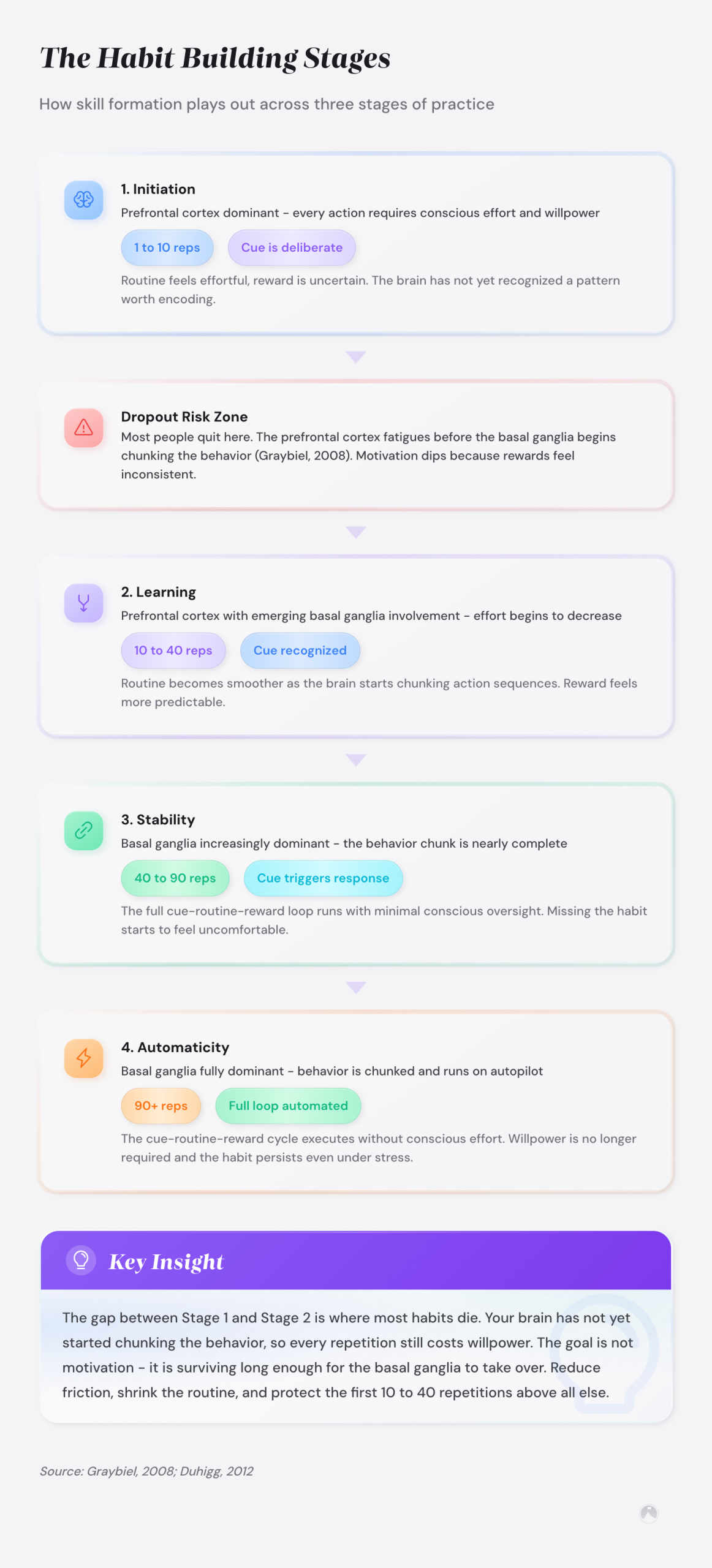
The six steps to building a lasting habit:
- Choose one habit and define it precisely using an if-then plan.
- Design your cue by anchoring to an existing automatic behavior.
- Start impossibly small so the behavior takes under two minutes.
- Stack it onto an existing habit to borrow an established neural pathway.
- Engineer your reward within seconds of completing the behavior.
- Track and review daily to catch missed days early and maintain momentum.
We call this the Habit Formation Flywheel – our framing for how the cue-routine-reward loop accelerates over time. The concept synthesizes findings from BJ Fogg’s Tiny Habits [7], James Clear’s Atomic Habits [8], and Duhigg’s habit loop model [4]. Unlike linear step-by-step models, the Flywheel recognizes that habit formation accelerates over time. Each completed cycle strengthens the neural pathway, making the next cycle easier to initiate and harder to skip.
Habit Formation Flywheel – A self-reinforcing cycle where each successful repetition of a cue-routine-reward loop reduces friction for the next repetition, accelerating the transition from effortful decision to automatic behavior. Unlike linear step-by-step models, the Flywheel captures how habit formation accelerates over time as neural pathways strengthen.
The Flywheel works because of how the basal ganglia process repetition [2]. Early repetitions require conscious effort and feel slow. But each repetition slightly strengthens the neural chunk, reducing the cognitive cost of the next one. After enough cycles, the behavior shifts from effortful decision to automatic response. That transition point is what researchers call “automaticity” [6].
Here’s a concrete example: in BJ Fogg’s research, a participant wanted to build a flossing habit. On Day 1, she flossed one tooth after brushing. By Day 10, she was flossing all her teeth without thinking about it. The Flywheel spun faster with each repetition because the cue (brushing) was already automatic and the initial behavior (one tooth) was so small it required zero motivation [7].
Step 1: Choose one habit and define it precisely
Implementation intentions – the research term for specific if-then plans – increase follow-through rates dramatically [9]. Psychologist Peter Gollwitzer’s research found that if-then plans roughly double the likelihood of following through on a behavior [9]. “I’ll exercise more” is a wish. “I’ll do 10 pushups after I turn off my alarm” is an implementation intention.
Write your habit in this format: “After [CUE], I will [BEHAVIOR] for [DURATION/AMOUNT].” Keep the behavior specific enough that someone watching you could verify whether you did it. For more implementation strategies and tiny starting points, see habit system design architecture.
Step 2: Design your cue
The strongest cues are existing behaviors you already do without thinking. Pouring coffee, sitting down at your desk, closing your laptop at the end of the day. These “anchor habits” provide a reliable trigger without requiring a separate reminder.
Avoid time-based cues when you can (“I’ll exercise at 6 AM”) because external events can disrupt them. Location and preceding-event cues are more durable. Attach your new habit to something that already happens reliably.
Step 3: Start impossibly small
The biggest mistake in building good habits is making the behavior too ambitious. You’re not trying to transform your life in week one. You’re trying to build a neural pathway. So shrink the behavior until it takes under two minutes and requires almost no willpower [7].
Want to build a meditation habit? Start with 30 seconds, not 20 minutes. Want to start exercising? Do 5 pushups, not a full workout. Want to read more? Read one page, not a chapter. The goal is repetition and automaticity, not performance. You can expand it later once the cue-routine-reward loop is firmly encoded.
Step 4: Stack it onto an existing habit
Habit stacking – attaching a new habit to an existing one – is one of the most effective techniques in any habit building framework because it solves three problems at once: it provides a reliable cue, it fits into your existing rhythm, and it requires fewer decision-making moments [7].
The formula is simple: “After [EXISTING HABIT], I will [NEW HABIT].” Some examples:
- After I pour my morning coffee, I will drink a glass of water
- After I close my laptop at the end of the day, I will do 10 squats
- After I get into bed, I will write down three things I’m grateful for
The existing habit is your trigger. You’re piggybacking on a behavior that’s already automatic. See how to master habit stacking for deeper exploration of anchor habit selection and stacking sequences.
Step 5: Engineer your reward
Add an immediate reward within seconds of completing the behavior. Not tomorrow. Not after a week. Within seconds. Even a mental “yes” or a checkmark counts. The reward closes the loop and tells your brain: this sequence deserves to be remembered [3].
Some immediate rewards:
- Checking off a calendar or habit tracker
- Saying “done” out loud
- A small physical sensation (a fist bump, a stretch)
- Noticing how you feel after the behavior
Variable rewards work best for long-term motivation [3]. Don’t always give yourself the same reward. Mix it up so there’s an element of unpredictability that keeps dopamine elevated. For app-based tracking approaches, see the best habit tracking apps.
Step 6: Track and review
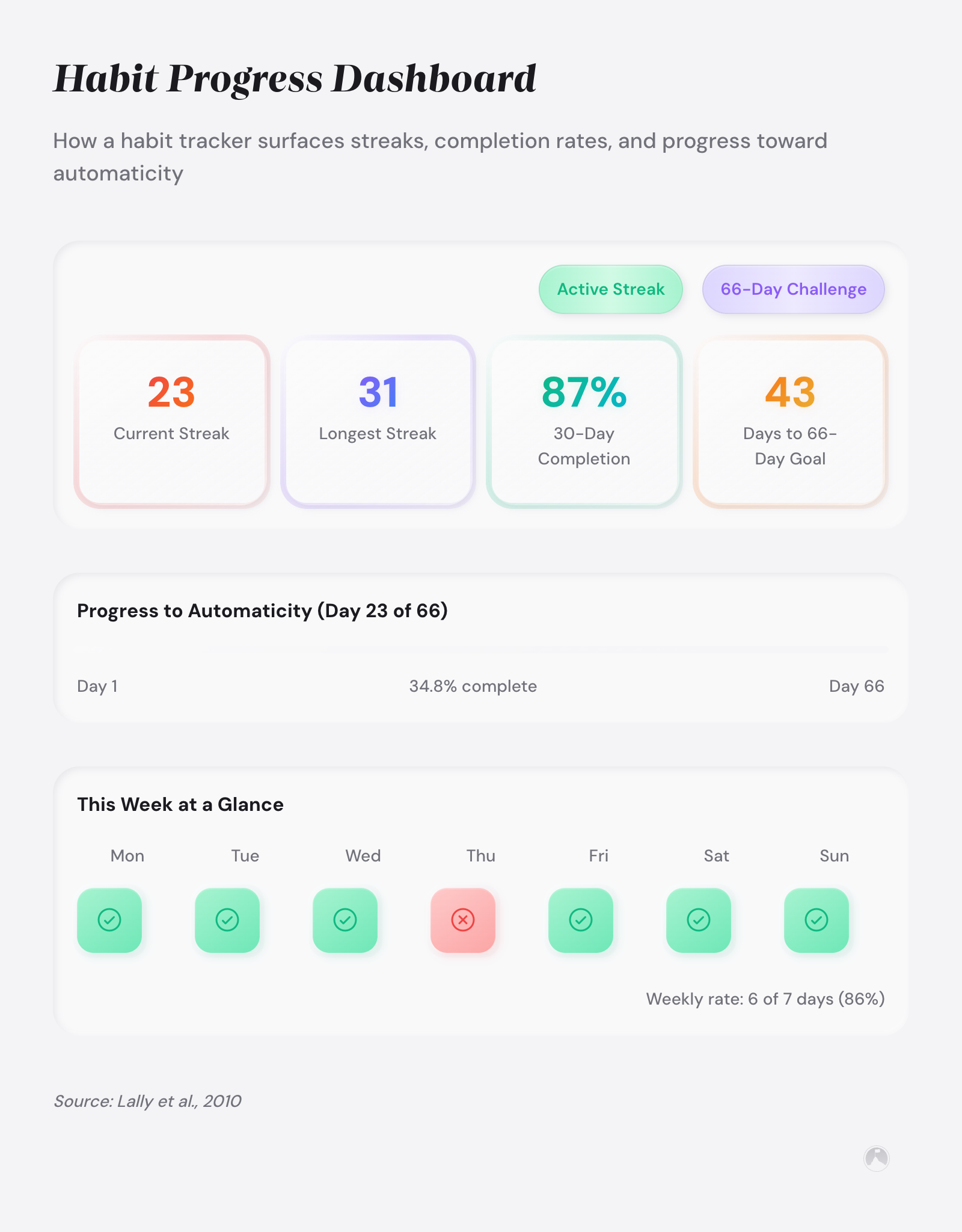
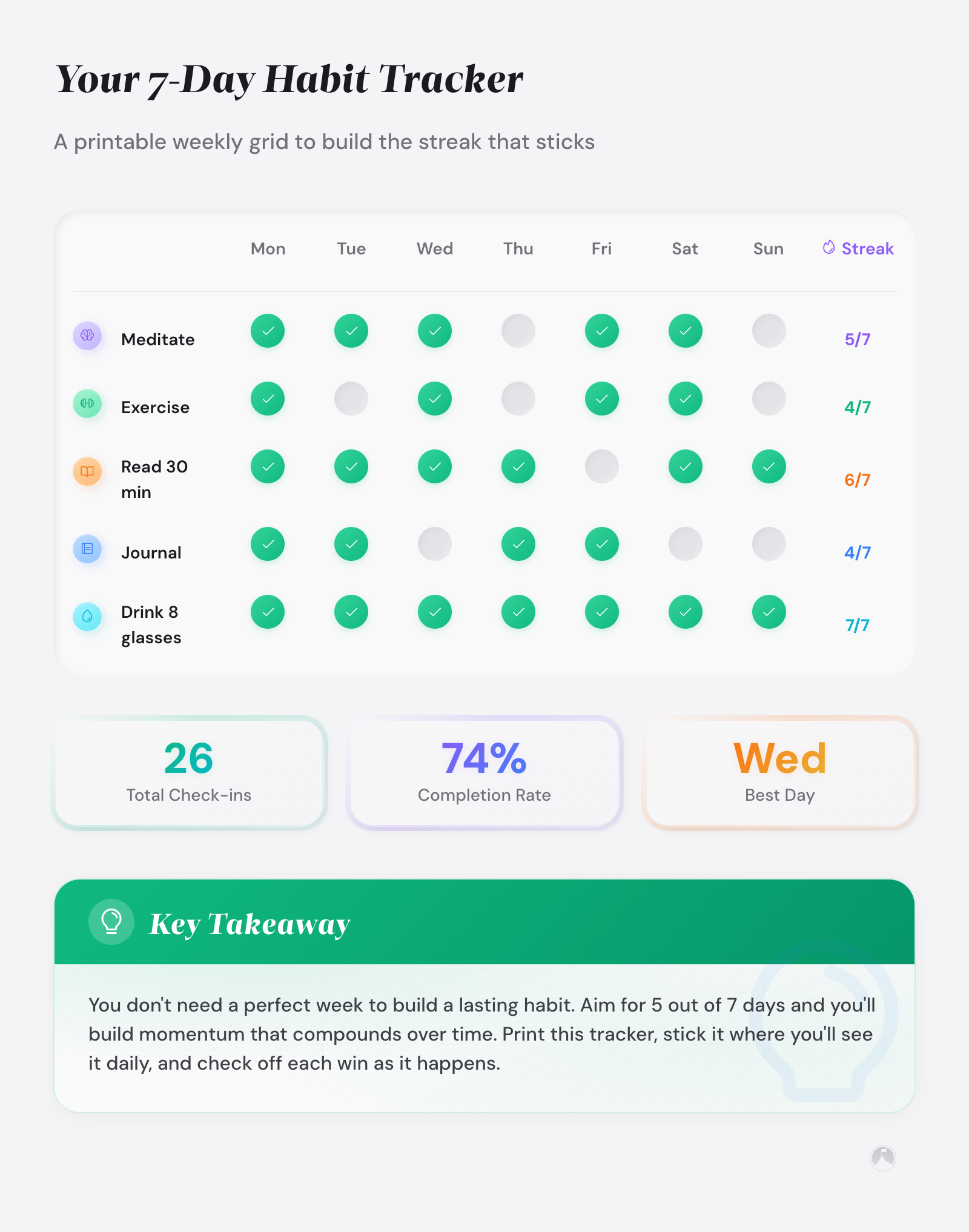
Mark completion daily. Review weekly. The visual streak becomes its own reward because your brain sees the pattern and wants to maintain it. There’s a reason Seinfeld used a calendar to mark off days without breaking his chain – visual progress is deeply motivating.
Tracking serves two purposes: it provides a daily reward signal, and it lets you catch patterns. If you miss a day, you can see it immediately. If you miss multiple days in a row, you know a competing pattern is starting to form. Early detection lets you restart before the new pattern becomes habitual.
The Habit Formation Flywheel isn’t six separate steps. Each cycle of cue-routine-reward gets easier every time it spins.
Why most habits fail and how to fix the five failure patterns
Habits fail for predictable reasons. Understanding which failure pattern is derailing you lets you fix the root cause instead of just trying harder. For a complete diagnostic framework, see why habits fail.
Failure pattern 1: No clear cue. You’re relying on memory and motivation. Wood’s research shows that habits depend on consistent contextual cues to activate automatically [1]. The fix is to attach your habit to an existing behavior or a consistent time and place. Don’t leave it to willpower.
Failure pattern 2: Behavior is too ambitious. You started with a 30-minute workout when you should have started with 5 minutes. BJ Fogg’s Tiny Habits research confirms that shrinking the behavior to under two minutes dramatically increases the chance of repetition [7]. The neural pathway isn’t encoded yet, so bigger isn’t better. Shrink it down. Build the automaticity first.
Failure pattern 3: No immediate reward. You finished the behavior but didn’t close the cue-routine-reward loop. Duhigg’s habit loop model shows that without a reward signal, the brain has no reason to remember or repeat the sequence [4]. Add a tiny reward within seconds.
Failure pattern 4: Wrong anchor habit. You attached your new habit to an existing habit that’s inconsistent or disappearing. Coffee runs are inconsistent. Sitting at your desk is reliable. Pick an anchor you do every single day without thinking.
Failure pattern 5: Trying to change too much at once. You’re attempting three new habits simultaneously. Your brain can’t encode three new neurological pathways in parallel. Pick one. Master it over 66 days. Then add the next one.
The most common pattern? People skip the cue design phase entirely and just try to rely on motivation. Wood’s research demonstrates that motivation depletes but automatic cue-triggered behavior does not [1]. You don’t fail at habits because you lack discipline. You fail because you skipped the design phase.
Design your environment so good habits become the default
Environment design is the practice of structuring your physical and digital spaces so desired behaviors require less effort than undesired ones. Research by Wendy Wood shows your brain takes the path of least resistance [1]. If good habits are easy and bad habits are hard, you’ll gravitate toward the good ones without willpower.
Make good habits obvious. Put your gym clothes on your bed so you see them first thing. Put your journal on your pillow. Put your water bottle on your desk. Visibility increases the chance you’ll think of the cue and execute the habit.
Make good habits easy. Remove friction from the desired behavior. Prep your workout clothes the night before. Leave your meditation cushion out. Have your reading book on the nightstand. Every extra step you remove increases the chance you’ll follow through.
Make bad habits invisible. Put your phone in another room instead of on your desk. Cover the TV remote with a blanket. Move the junk food to the back of the pantry. If you don’t see it, the cue never fires.
Make bad habits hard. Add friction. Uninstall the app that tempts you. Delete your saved passwords for the sites that distract you. Use app blockers. The harder the behavior, the more likely you’ll lose motivation before you start.
Environmental design beats willpower because it removes the decision from the moment of action [1]. You’re not choosing to be disciplined. The environment is choosing for you. For specific architectural strategies you can apply room by room, see habit pairing and energy management.
You don’t need more discipline. You need fewer decisions.
Advanced habit formation strategies
Identity-based habits
Most people focus on outcomes: “I want to lose weight” or “I want to run a marathon.” But research on self-concept consistency shows that identity-based habits are stronger. Instead of chasing an outcome, you anchor the habit to an identity [8].
Instead of “I want to exercise,” you say “I’m a person who exercises.” Instead of “I want to read more,” you say “I’m a reader.” Psychologist James Clear, whose work synthesized behavioral psychology research on self-concept alignment, calls this the “identity layer” of habit formation [8]. The identity is more stable than the outcome because your brain reinforces behaviors that align with your self-image.
Each habit votes for the person you’re becoming [8]. Do 10 pushups, and you’re voting for being “someone who works out.” Read one page, and you’re voting for being “a reader.” Over time, these votes accumulate into a new identity. Identity is not the reward of habit change. Identity is the engine that sustains it.
Keystone habits
Some habits are keystones – they trigger a cascade of other habits without requiring additional effort [4][8]. Exercise is frequently cited as a keystone habit. Once you start exercising regularly, sleep improves, eating habits change, and energy increases. Those changes weren’t the goal – they happened because the keystone habit shifted your baseline.
Other keystone habits: keeping a to-do list, taking a daily walk, writing in a journal. These behaviors create momentum that influences surrounding habits.
To find your keystone habit, ask: “Which single habit, if I nailed it, would make everything else easier?” For some people it’s exercise. For others it’s sleep. For some it’s a morning routine. The keystone habit is different for everyone, but it’s worth finding because it’s a single lever that moves multiple areas of your life. See the keystone habits guide for identification strategies.
The Goldilocks rule: difficulty calibration
The Goldilocks rule – derived from Mihaly Csikszentmihalyi’s research on optimal challenge and flow states [10] – states that motivation is highest when a task is at the edge of your current ability. Not too easy, not too hard, but just challenging enough to require focus. For habit formation, the behavior should sit at the edge of your current ability: challenging enough to feel like progress, easy enough that you’ll actually follow through.
If a habit is too easy, you get bored and it stops being reinforcing. If it’s too hard, you fail and motivation crashes. As the behavior becomes automatic over weeks, increase the difficulty slightly. You started with 5 pushups. After two weeks it feels effortless. Now do 10. Keep the difficulty in the Goldilocks zone so the behavior stays engaging. For a deeper look at how to calibrate difficulty over time, see the Goldilocks rule for habits.
Habit pairing for energy management
Habit pairing is about stacking new habits onto existing ones in ways that amplify rather than compete. As behavior researcher BJ Fogg recommends, choose your anchor habits strategically – they should be consistent, reliable, and ideally complementary to the new habit you’re building [7].
Think about the energy profile of the habit you want to build and pair it with an anchor habit that’s complementary. Stacking a calming meditation habit onto an energizing morning workout (combining energy boost and calm reflection) is more sustainable than stacking it onto your commute when you’re already stressed and cognitively depleted.
Comparing frameworks: Atomic Habits vs. Tiny Habits
You’ll encounter multiple habit building frameworks. The most popular are Atomic Habits (James Clear) [8], Tiny Habits (BJ Fogg) [7], and The Power of Habit (Charles Duhigg) [4]. They’re not contradictory – they’re describing the same habit formation process from different angles. For a detailed side-by-side breakdown, see Atomic Habits vs. Tiny Habits.
| Framework | Core Principle | Starting Point | Reward Approach | Best For |
|---|---|---|---|---|
| Atomic Habits (Clear) | Small improvements compound; identity drives behavior | 1% better each day; identity-based framing | Environment design and habit stacking create self-reinforcing loops | People who want a comprehensive system linking identity, environment, and incremental growth |
| Tiny Habits (Fogg) | Start absurdly small; celebrate immediately | Under 2 minutes; often under 30 seconds | Immediate celebration after each repetition | People who struggle to start or who have failed with ambitious goals |
| The Power of Habit (Duhigg) | Cue-routine-reward loop governs all habits | Identify the existing loop, then modify the routine | Understand the craving behind the reward to reshape the loop | People who want to change existing bad habits rather than build new ones |
The best habit system is the one you’ll actually use. Consistency with any framework beats perfection with none.
Habit formation for specific populations
For people with ADHD
Research on ADHD executive function shows that ADHD brains struggle with working memory and impulse control [11], but they respond well to external structure. Skip the “remember to do your habit” approach. Instead, embed the habit into your physical environment.
Use timers, alarms, and visual cues relentlessly [12]. Put a sticky note on your bathroom mirror. Set a phone reminder. Put the gym clothes in your entry doorway. The cue needs to be impossible to miss because your working memory won’t hold it. For ADHD brains, the more rigid and external the structure, the more likely the habit will stick.
Stack your habit onto something you already do that fires consistently. If you struggle with routine, create a rigidly structured morning that includes your habit. For a full ADHD-adapted approach to habit building, see habit building for ADHD.
And celebrate aggressively. ADHD brains need high-frequency dopamine hits. Don’t wait for the habit to feel automatic. Celebrate every single repetition for the first few weeks.
For working parents
You have less time and more competing priorities. The key is anchoring habits to existing non-negotiables (like getting the kids ready or lunch prep) rather than trying to carve out new time blocks. For parent-specific anchoring strategies, see habits for working parents.
Start even smaller than the standard small. If the recommendation is 2 minutes, aim for 30 seconds. Your time is fragmented, so habits need to fit into the cracks.
And be willing to let habits flex slightly based on what day it is. Weekday vs. weekend habits are fine. A habit that disappears on Mondays when the week is chaos is still building neural pathways the other 6 days. Progress beats perfection.
For remote workers
You lack the environmental cues that come from traveling to an office. Create artificial boundaries instead. Designate a specific workspace. Use the same start time every day. Have a ritual that marks the transition from personal time to work time.
Habit stacking works especially well for remote workers because you control your environment fully. Stack a focus habit (deep work time) onto pouring your morning coffee. Stack a movement habit onto your lunch break. The consistency is entirely within your control.
For knowledge workers and creatives
Willpower and motivation matter less than environmental setup and protecting your focus. Creative habits are best built at the edge of your ability (the Goldilocks rule [10]) so you stay engaged without burning out.
Don’t stack a creative habit onto an energy-draining habit. Stack it onto something that elevates your baseline: exercise, good sleep, or a walk. Your creative output depends on your cognitive resources being available.
And track these habits in a way that shows momentum and progress. Creatives respond strongly to visible progress and evidence that the habit is working. For morning routine frameworks that support creative output, see morning routines for habit building.
Ramon’s take
43% of your day runs on autopilot before you even notice. That number wrecked me a little. Does that mean I should be designing more habits deliberately, or have I just been assigning blame to the wrong thing this whole time?
Conclusion
Habit formation isn’t a mystery. It’s a neuroscience process driven by cue design, behavior encoding, and reward signaling. The 43% of your daily actions that run on autopilot prove that habits are the most powerful behavior change mechanism available [1]. Most people fail at building good habits not because they lack willpower, but because they skip the system design phase and rely on motivation instead.
The habit building framework in this guide – from cue design through reward engineering and tracking – works because it aligns with how your basal ganglia actually encode behavior [2]. It takes 18 to 254 days with a 66-day median, not 21 days [6]. Start absurdly small. Stack onto existing habits. Engineer your environment. Track your progress. This isn’t inspiration. It’s architecture.
Next 10 minutes
Pick one habit you want to build. Write it in the format “After [CUE], I will [BEHAVIOR].” Make sure the behavior takes under 2 minutes and stacks onto a habit you already do daily. That’s it. You’ve done the hardest part, which is deciding what you’re building.
This week
If you picked your habit, do it at least once. Just once. Your job this week isn’t consistency – it’s proving to yourself that the cue-behavior-reward loop works. One repetition. One neural pathway starter.
There is more to explore
Go deeper on specific habit topics: Habit stacking for beginners covers foundational stacking techniques for your first habit. Beyond the 21-day myth: how long it really takes to form a habit provides a detailed research breakdown of the Lally study. For deeper neuroscience, the neuroscience of habit formation covers brain mechanisms including basal ganglia and dopamine. And why habits fail gives you a diagnostic framework for identifying your failure pattern.
Take the next step
Ready to build a lasting habit? Start with the system in this guide. Pick your cue. Define your behavior. Start small. Stack it. Reward it. Track it. The research is clear: this habit formation process works. Your only job is to follow the architecture, not to rely on willpower.
For specific implementation strategies, see habit system design architecture or the 30-day habit challenge framework.
Frequently asked questions
Explore the full Habit Formation library
Go deeper with these related guides from our Habit Formation collection:
- reward-system
- behavior-design-hacks-to-form-good-habits
- precommitment-psychology
- daily-schedule-with-seinfeld-strategy
- uncommon-accountability-systems
- home-environment-design-for-better-habits
- goldilocks-rule-lasting-habits
- review-cadence-framework
- productivity-gamification-system-guide
- why-habits-fail-diagnostic
- habit-stacking-productivity-creativity
How long does it actually take to form a habit?
Research by Lally et al. (2010) found that habits take a median of 66 days to form, with a range of 18 to 254 days depending on the behavior, person, and circumstances [6]. Simple habits like drinking water reach automaticity in as few as 18 days, while complex habits like a gym routine can take over 8 months. The popular 21-day claim originated from plastic surgeon Maxwell Maltz’s 1960 observation about self-image adjustment, not habit formation [5].
Can you build a habit even if you miss one day?
Lally’s research found that missing a single day did not significantly disrupt the habit formation process [6]. The automaticity curve barely dipped after a single missed day, though no study has tested what happens after three or more consecutive misses. Getting back on track quickly matters more than never missing, because the neural pathway remains intact even after a brief gap.
What is habit stacking and why does it work?
Habit stacking is anchoring a new behavior to an existing automatic habit using the formula ‘After [EXISTING HABIT], I will [NEW HABIT]’ [7]. It works because it uses an existing neurological pathway as a cue, reducing the cognitive load of remembering and providing a reliable trigger that doesn’t depend on motivation. The most effective anchor habits have three traits: they happen at the same time daily, require no decision, and end with a clear physical marker like putting down your toothbrush.
Why is starting small so important for habit formation?
Starting small (under 2 minutes) reduces reliance on willpower and motivation, which are unreliable [7]. The goal in early habit formation is building the neurological pathway through repetition, not performance. BJ Fogg’s participants who started with flossing one tooth expanded to full flossing within 10 days without being told to scale up. You’re encoding the cue-routine-reward loop, not training capacity.
What role does dopamine play in habit formation?
Dopamine operates through reward prediction error – it surges when outcomes exceed expectations and diminishes when they match predictions [3]. This is why habits lose momentum over time (the brain adjusts expectations) and why variable rewards keep habits stronger than predictable ones. This is also why tracking streaks work: the visual progress bar creates a new source of variable reward separate from the habit itself.
How do you fix a habit that keeps failing?
Identify which of the five failure patterns is derailing you: (1) No clear cue – attach to an existing habit [4], (2) Behavior too ambitious – shrink it to under 2 minutes [7], (3) No immediate reward – add celebration within seconds, (4) Wrong anchor habit – find a more consistent existing habit, (5) Too many habits at once – focus on one at a time for 66 days. The fastest diagnostic: if you cannot name your cue in one sentence, start there – cue failure accounts for most habit breakdowns.
Is environment design more effective than willpower for building habits?
Research shows that environmental design (making good habits obvious and easy, bad habits invisible and hard) is more reliable than willpower because it removes decision-making from the moment of action [1]. Your brain takes the path of least resistance, so designing the environment to favor good behaviors produces better outcomes than trying to override impulses.
What are identity-based habits and why are they stronger?
Identity-based habits anchor behavior to self-image rather than outcomes [8]. Instead of ‘I want to lose weight,’ the framing becomes ‘I’m someone who exercises.’ Research on self-concept consistency shows the brain reinforces behaviors that align with identity automatically, making identity-based habits more durable than outcome-based ones over time.
Glossary of related terms
Basal ganglia – Structures deep in the brain that encode repeated behavior sequences into neural chunks, allowing complex actions to execute automatically without conscious effort [2]. The neurological foundation of habit encoding.
Automaticity – The point at which a behavior becomes so well-encoded in the basal ganglia that it executes in response to a cue without conscious decision-making or willpower [6]. The transition from routine to habit, typically reached after a median of 66 days.
Habit stacking – The technique of anchoring a new habit to an existing automatic behavior using the formula “After [EXISTING HABIT], I will [NEW HABIT]” [7]. Uses established neural pathways to reduce friction for new habits.
Cue – The trigger that initiates a habitual behavior sequence. Cues fall into five categories: time, location, preceding event, emotional state, and other people [4]. Cue design is the foundation of any effective habit building framework.
Implementation intention – A specific if-then plan that increases follow-through by precommitting to a behavior in a particular context [9]. Example: “After my morning coffee, I will meditate for 30 seconds.” More effective than general goals because it removes the decision from the moment of action.
Reward prediction error – The neurological mechanism where dopamine releases based on the gap between expected and actual outcomes [3]. When outcomes exceed expectations, dopamine surges. When they match predictions, dopamine drops. This mechanism drives both habit formation and habit decay.
Keystone habit – A habit that triggers a cascade of other positive habits without requiring additional effort [4][8]. Exercise often functions as a keystone habit, leading to improved sleep, better eating, and increased energy.
Environment design – The practice of structuring physical and digital spaces to make desired habits obvious and easy while making undesired habits invisible and difficult [1]. More reliable than willpower because it removes decision-making from the moment of action.
References
[1] Wood, W., & Runger, D. (2016). Psychology of habit. Annual Review of Psychology, 67, 289-314. https://dornsife.usc.edu/assets/sites/545/docs/Wendy_Wood_Research_Articles/Habits/wood.runger.2016.pdf
[2] Graybiel, A.M. (2008). Habits, rituals, and the evaluative brain. Annual Review of Neuroscience, 31, 359-387. DOI
[3] Huberman, A. (2022). The science of making and breaking habits. Huberman Lab Podcast. https://hubermanlab.com/the-science-of-making-and-breaking-habits/
[4] Duhigg, C. (2012). The Power of Habit: Why We Do What We Do in Life and Business. Random House.
[5] Maltz, M. (1960). Psycho-Cybernetics. Prentice-Hall.
[6] Lally, P., van Jaarsveld, C.H.M., Potts, H.W.W., & Wardle, J. (2010). How are habits formed: Modelling habit formation in the real world. European Journal of Social Psychology, 40(6), 998-1009. https://onlinelibrary.wiley.com/doi/abs/10.1002/ejsp.674
[7] Fogg, B.J. (2020). Tiny Habits: The Small Changes That Change Everything. Houghton Mifflin Harcourt.
[8] Clear, J. (2018). Atomic Habits: Tiny Changes, Remarkable Results. Avery.
[9] Gollwitzer, P.M. (1999). Implementation intentions: Strong effects of simple plans. American Psychologist, 54(7), 493-503.
[10] Csikszentmihalyi, M. (1990). Flow: The Psychology of Optimal Experience. Harper & Row.
[11] Barkley, R.A. (2015). ADHD in Adults: What the Science Says. Guilford Press.
[12] Dawson, P., & Guare, R. (2018). Executive Skills in Children and Adolescents (3rd ed.): A Practical Guide to Assessment and Intervention. Guilford Press.