Why your habits keep dying at the three-week mark
You started strong. The first week felt manageable. By week three, something shifted – the whole thing collapsed. Not from laziness. From a precise mathematical mismatch: your habit had drifted into the boredom zone or the anxiety zone. Neither kills motivation immediately, but both kill it reliably.
Researchers Robert Wilson, Amitai Shenhav, Mark Straccia, and Jonathan Cohen published a 2019 study in Nature Communications that pinpointed this problem. They found that the optimal error rate for learning is roughly 15%, meaning you should succeed about 85% of the time to stay maximally engaged [1]. The narrow band between 85% success and 15% failure is where habits actually stick. Most people never find it because they don’t know how to look. And if your habits have been falling apart without explanation, our guide on why habits fail breaks down the other common culprits.
The goldilocks rule is the principle that peak motivation occurs when a task sits just beyond your current ability level – not so easy it bores you, not so hard it overwhelms you. Research suggests the optimal target is succeeding about 85% of the time and failing about 15%, applicable to habit formation, skill development, and sustained engagement across any domain [1].
What you will learn
- Why the goldilocks rule works at the brain chemistry level
- The 85% Rule and how to apply it to your habits
- How to build a personal difficulty scale for any habit
- How ADHD, anxiety-prone, and other brain types experience the goldilocks zone differently
- What feedback systems keep you in the zone week after week
Key takeaways
- Peak motivation happens when tasks sit just beyond your current ability – the zone where you succeed 85% of the time and fail 15% [1].
- Wilson, Shenhav, Straccia, and Cohen’s 2019 study provides a concrete 85% success target backed by neuroscience research [1].
- Dopamine surges during uncertain-but-achievable challenges, not guaranteed wins or impossible tasks [2].
- A personal difficulty scale (1-10) helps you rate and adjust habits weekly to stay in the growth zone.
- ADHD brains show faster habituation to routine tasks, requiring shorter intervals and higher novelty to hold the goldilocks zone [3][12].
- The two-signal feedback system (completion + difficulty ratings) tells you exactly where you stand and what to adjust.
Why does the goldilocks rule work? The neuroscience
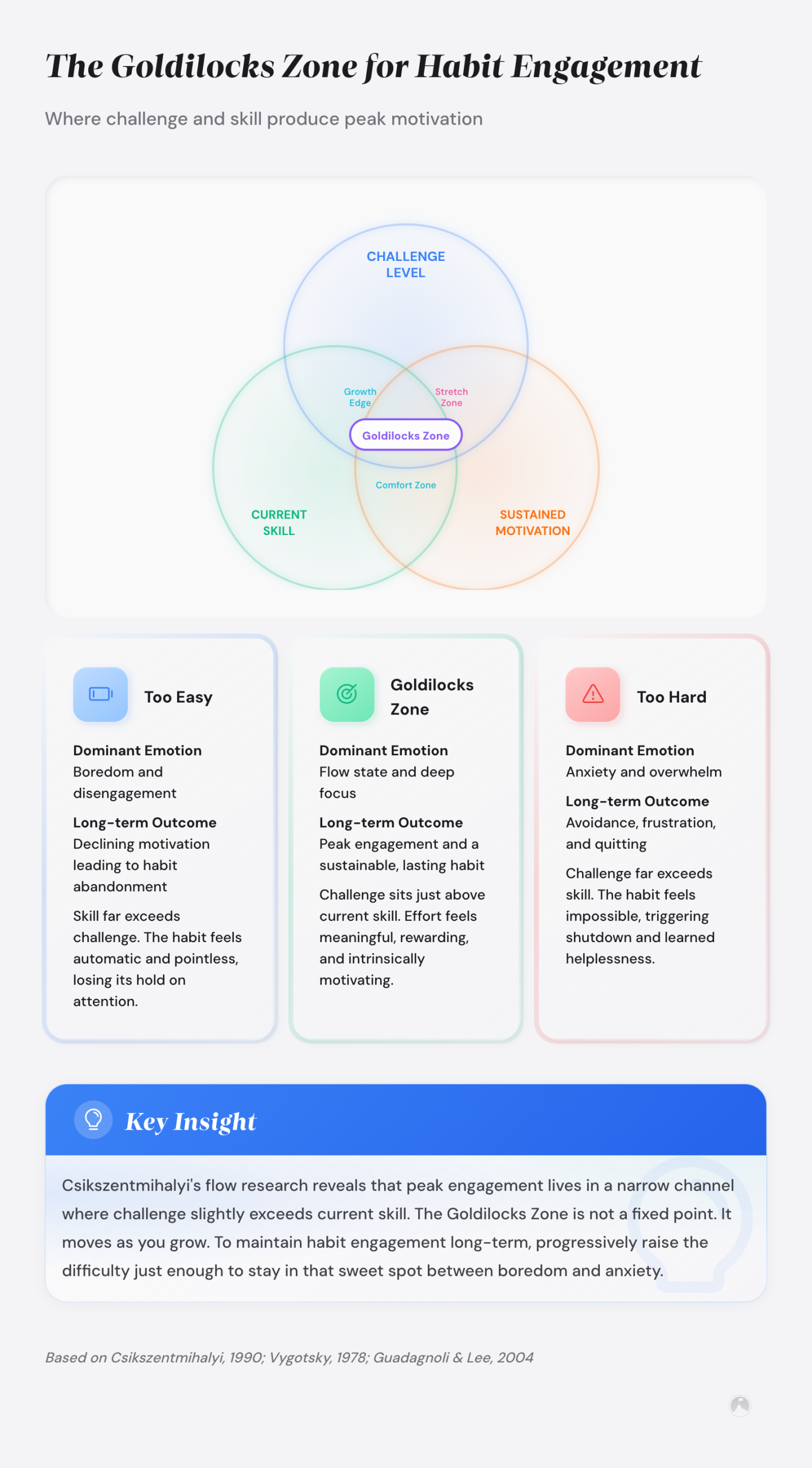
Humans quit when things get boring. Humans also quit when things get overwhelming. Between those two exits sits the goldilocks zone – where sustained motivation actually lives. The flow channel is Csikszentmihalyi’s term for the psychological zone where task difficulty precisely matches a person’s skill level, producing sustained engagement and what he called “optimal experience” – distinct from general motivation or interest because it requires the specific balance of challenge and competence [5]. For a deeper look at how your brain wires these patterns, see our guide on the neuroscience of habit formation.
In the goldilocks zone, you succeed most of the time but fail just often enough to stay engaged. The tension between succeeding most of the time and failing just often enough is what keeps your brain locked in. The mechanism is neurological, not philosophical.
A guitar player practicing a song they have mostly mastered – maybe hitting 8 out of 10 runs clean – is in the flow channel. The runs they miss are what keep their attention locked in. The moment they can play it flawlessly every time, the flow channel closes and boredom opens.
Neuroscientist Wolfram Schultz’s 2016 research on reward prediction errors documented how dopamine neurons fire most strongly when rewards are uncertain yet achievable [2]. A reward prediction error is the difference between the reward a person’s brain expected and the reward actually received – the mismatch signal that drives dopamine neurons to fire and sustain motivation through uncertain-but-achievable challenges [2]. A guaranteed reward barely registers. An impossible one triggers shutdown. But a reward you might earn? That uncertainty creates dopamine surges that drive you to try again. This is the biological foundation of the goldilocks rule and the goldilocks effect on habits.
The Yerkes-Dodson law, established by Robert Yerkes and John Dodson in 1908 using studies of mice and stimulus intensity, is commonly interpreted as showing an inverted-U relationship between arousal and performance [4]. While the original study was narrower in scope, the general principle – that moderate difficulty outperforms both extremes – has been supported by subsequent research across human cognitive tasks. The goldilocks rule is the Yerkes-Dodson curve applied to habit design – your sweet spot lives at moderate challenge, not at either extreme.
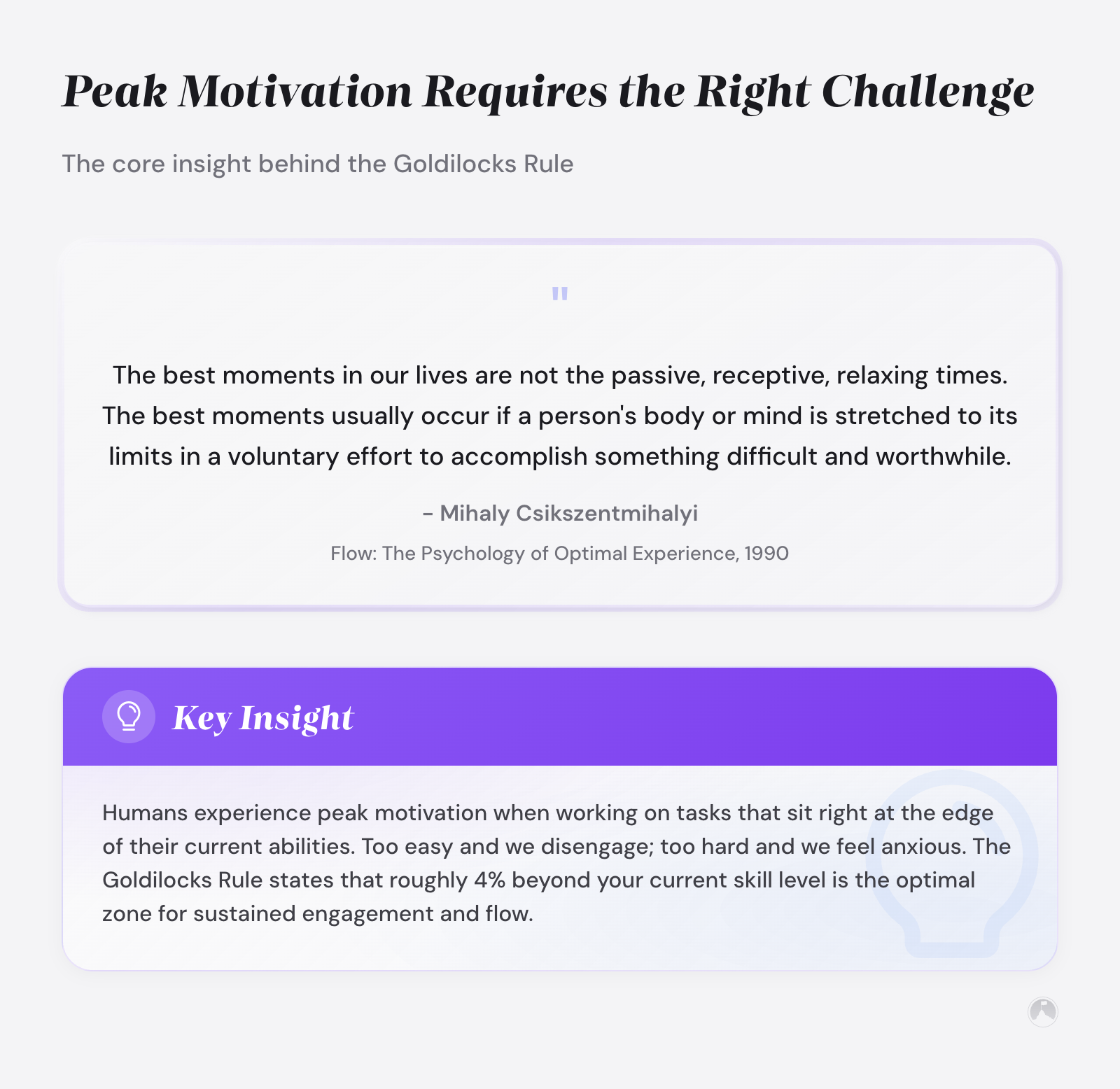
“The best moments in our lives are not the passive, receptive, relaxing times. The best moments usually occur if a person’s body or mind is stretched to its limits in a voluntary effort to accomplish something difficult and worthwhile.”
Mihaly Csikszentmihalyi, Flow: The Psychology of Optimal Experience (1990) [5]
Three research traditions that all point to the same place
The goldilocks rule isn’t one theory. It’s where three independent lines of research land on the same answer.
| Research tradition | Researcher | Finding and habit implication |
|---|---|---|
| Flow state | Csikszentmihalyi (1990) | Optimal experience when challenge = skill – adjust habits to match current ability [5] |
| Zone of proximal development | Vygotsky (1978) | Learning happens just beyond current ability – work slightly harder than feels automatic [6] |
| Arousal-performance | Yerkes and Dodson (1908) | Performance peaks at moderate arousal – the challenge should feel like a dare, not a threat [4] |
Vygotsky’s zone of proximal development is the gap between what a learner can do independently and what they can achieve with guidance – the space where growth happens because the task is just beyond unassisted ability but within reach with support [6].
When James Clear popularized the goldilocks rule in Atomic Habits, he was packaging decades of overlapping research under a memorable label. Clear’s approach suggests working at roughly 4% beyond your current ability – a practical rule of thumb that circulates in productivity circles, though this specific percentage does not trace to any single peer-reviewed study [11]. The underlying principle – that optimal difficulty sits just beyond current competence – is well supported, even if the exact ratio varies by person and domain. If you’re comparing different habit-building systems, our Atomic Habits vs Tiny Habits comparison breaks down which framework fits which personality type.
What is the 85% Rule for optimal learning?
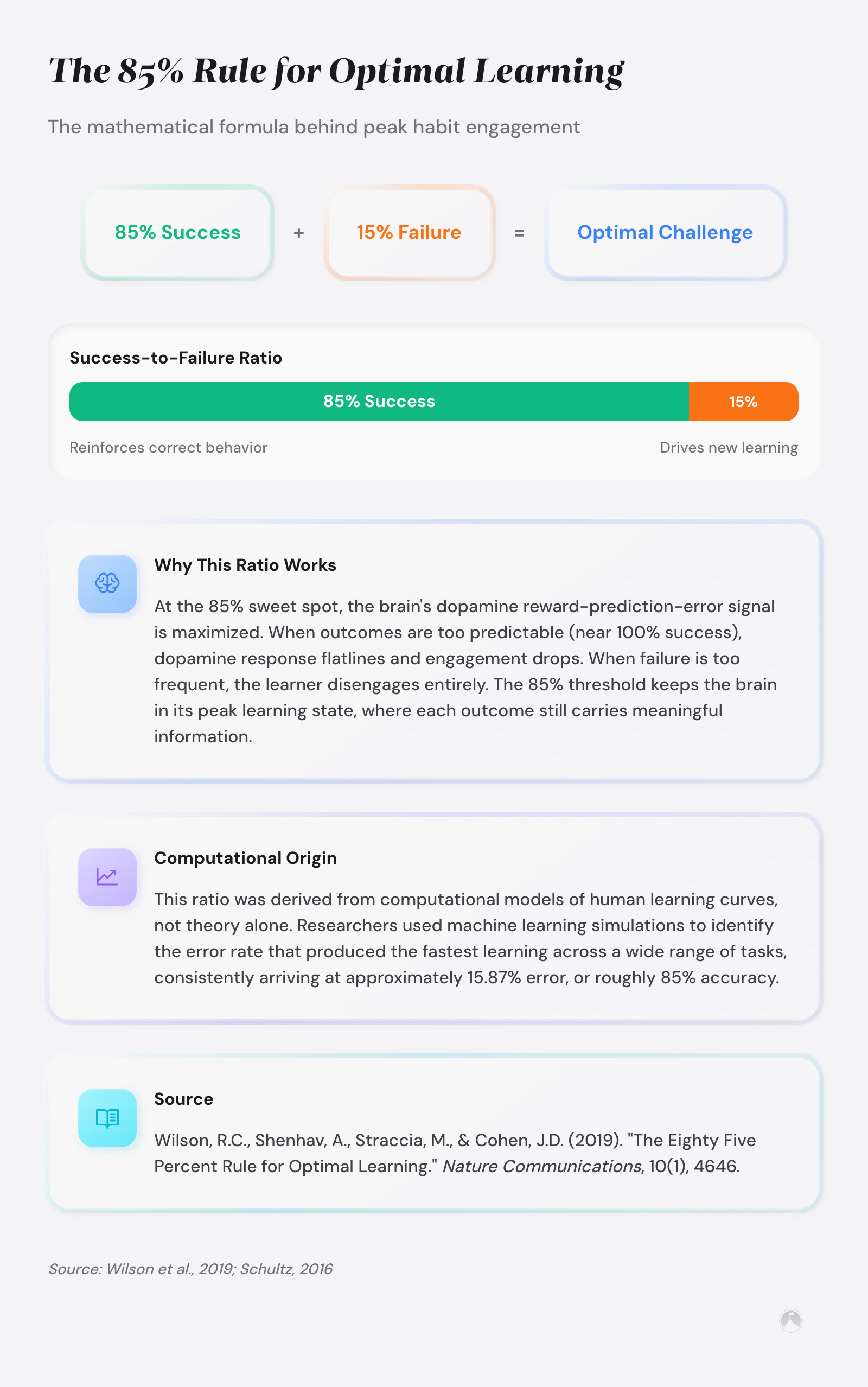
The biggest problem with “find the right challenge level” as advice: it tells you nothing about where that level actually is. Wilson, Shenhav, Straccia, and Cohen solved this in their 2019 Nature Communications study. They tested learners across multiple tasks and found that the mathematically optimal error rate is approximately 15.87%, meaning you should get it right about 85% of the time [1].
The 85% Rule states that optimal learning and engagement happens when a person succeeds roughly 85% of the time and fails roughly 15% of the time. The shift from subjective feel to a measurable 85% success rate is what makes the goldilocks principle actionable for habits.
What does this look like in actual life? If you run 5K comfortably, your goldilocks target isn’t jumping to 10K. It’s pushing to 5.4K or completing your usual 5K slightly faster. If meditation for 10 minutes feels automatic, you don’t jump to 30 minutes. You try 12 minutes, or you sit for 10 minutes in a noisier environment. The key is the 85% success rate: are you completing the habit most sessions and occasionally struggling? Then you’re in the zone. Are you breezing through every session without any effort? You’ve drifted below it.
How do you build a personal difficulty scale?
A personal difficulty scale converts vague feelings about “too easy” and “too hard” into something you can actually track and adjust. Here is the framework we use for finding your just right challenge level.
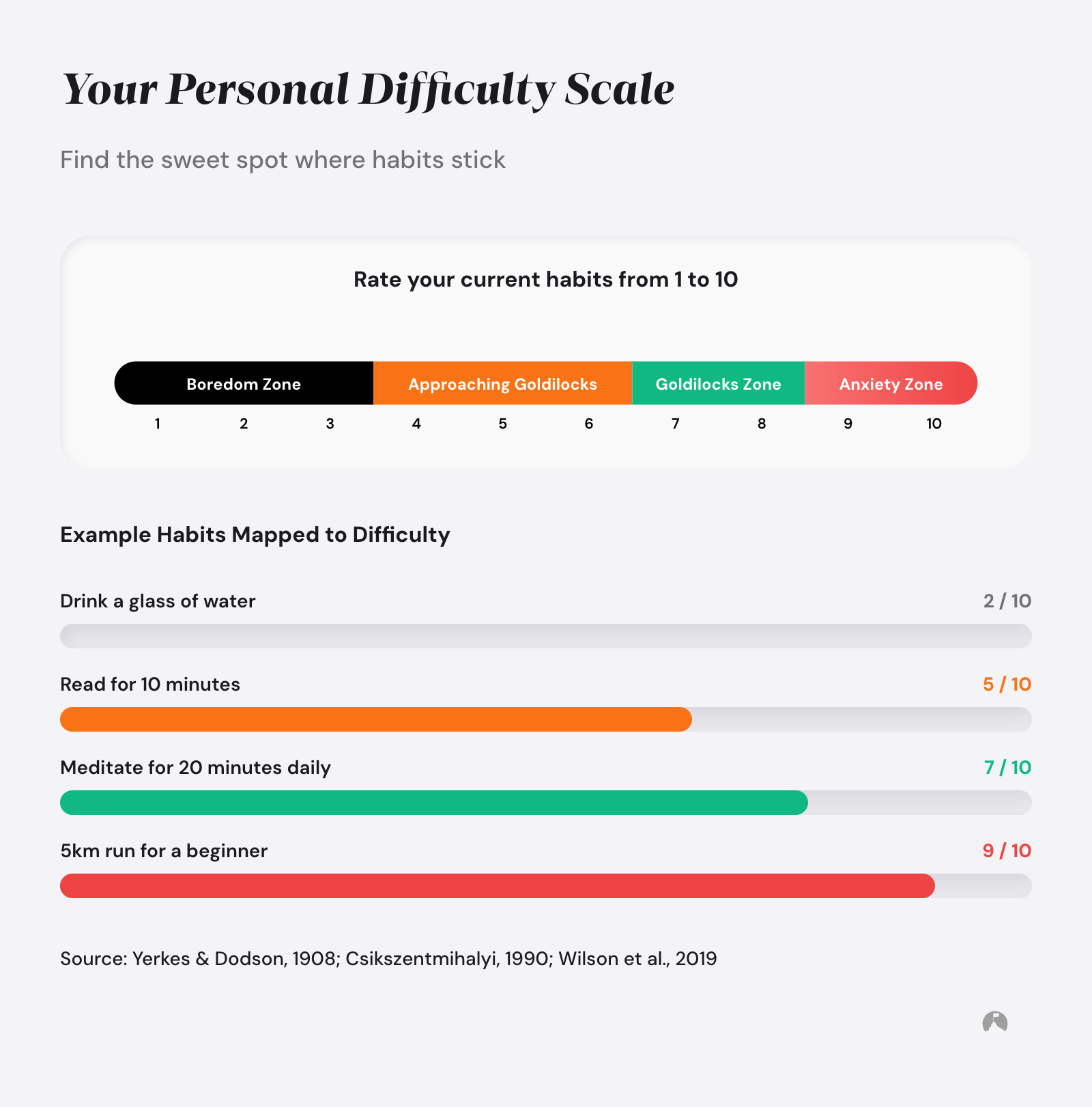
Step 1: Create your 1-10 rating framework
| Rating | Zone | How it feels | What to do |
|---|---|---|---|
| 1-3 | Boredom zone | Automatic, no mental effort required | Increase difficulty by 10-15% |
| 4-6 | Goldilocks zone | Engaged, slightly stretched, you can feel yourself improving | Stay here and adjust as you grow stronger |
| 7-8 | Upper growth zone | Challenging but not panicked, you might fail occasionally | Maintain for short bursts, then scale back |
| 9-10 | Anxiety zone | Overwhelmed, dread before starting, avoidant | Scale back until you hit 5-6 |
Step 2: Rate your current habits honestly
Take each habit and rate where it sits on your 1-10 scale. A morning walk you’ve done for two years? Probably a 2. A new language learning app you started last month? Likely a 7. Write these numbers down. The gaps show you exactly where your motivation leaks are hiding.
Step 3: Make small targeted adjustments
For habits rated 1-3, add a small constraint that makes the activity noticeably harder without changing its essence. Walk faster. Add an incline. Listen to a podcast in your target language instead of your native language. Locke and Latham’s 35-year review of goal-setting research confirms that specific, challenging goals consistently outperform vague or easy goals [7]. The adjustment doesn’t need to be dramatic. It needs to be noticeable.
For habits rated 8-10, reduce the friction without abandoning the habit. Shorten the duration. Reduce the weight or resistance. Go back to material you understood instead of pushing ahead into frustration. Scaling back a habit to stay in the goldilocks zone isn’t failure – it’s the single most effective move for long-term consistency.
“The most effective performance occurs when goals are specific and challenging, as opposed to when goals are vague or easy.”
Edwin A. Locke and Gary P. Latham, “Building a Practically Useful Theory of Goal Setting and Task Motivation” (2002) [7]
Step 4: Reassess weekly
Habit automaticity develops over time. Lally, van Jaarsveld, Potts, and Wardle found in their 2010 study that this takes a median of 66 days, with a range of 18 to 254 days depending on the person and the behavior [8]. What rates as a 5 in week one will feel like a 3 by week eight. Schedule a 5-minute check-in each week using the 85% Rule: rate each habit, identify which ones drifted out of the goldilocks zone, make one targeted adjustment per habit. For realistic expectations on that timeline, see our breakdown of how long habits actually take to form.
| Habit | This week (1-10) | Zone | Adjustment |
|---|---|---|---|
| _______________ | ___ | ___ | _______________ |
| _______________ | ___ | ___ | _______________ |
| _______________ | ___ | ___ | _______________ |
The habit that survives isn’t the one you muscled through. It’s the one you kept recalibrating until the difficulty felt earned.
Why does the goldilocks zone differ for ADHD and anxiety-prone brains?
The goldilocks rule is universal in principle. But the actual experience varies significantly based on neurological differences, especially in dopamine processing. One person’s goldilocks zone might be another person’s anxiety zone.
ADHD brains: narrower window, faster shifts
Research by Volkow, Wang, Newcorn, and colleagues documented that ADHD involves reduced dopamine signaling in reward pathways in the striatum and midbrain [3]. A 2024 review by Sharma and Couture in Frontiers in Psychiatry adds an important layer: people with ADHD show reduced habituation to familiar tasks, meaning routine challenges lose their stimulation faster than they do for neurotypical brains [12]. The practical consequence: tasks that produce adequate dopamine stimulation for neurotypical brains register as boring for ADHD brains. The goldilocks zone is narrower and shifts faster.
If you have ADHD, the goldilocks zone moves out from under you faster because your brain habituates to routine difficulty at a higher rate [3][12]. Try shorter habit sessions (10-15 minutes instead of 30), rotate between two or three variations of the same habit, and use tracking tools that provide instant visual feedback. See our full guide on building habits with ADHD for detailed strategies.
Anxiety-prone brains: lower starting point, slower progression
If your baseline anxiety is already elevated, your goldilocks zone starts lower on the difficulty scale. Eysenck, Derakshan, Santos, and Calvo’s attentional control theory shows that high-anxiety individuals allocate cognitive resources to threat monitoring, leaving fewer resources for task performance – effectively making moderately challenging tasks feel harder than they would for low-anxiety individuals [13]. And there’s a mechanical reason this compounds: psychologist Timothy Moran’s 2016 meta-analysis found that anxiety consumes working memory resources, impairing performance on effortful tasks while leaving easy tasks mostly unaffected [14].
So if you have baseline anxiety, moderately challenging tasks consume extra cognitive resources just managing the anxiety, leaving fewer resources for actual performance [14]. Start at what feels almost too easy – the kind of habit you could do while tired or distracted. Then increase difficulty by the smallest increment you can measure. Process beats outcome here: showing up matters more than performing.
Planning-oriented brains: structured progression maps
If you thrive on structure, build a written progression plan that maps when and how difficulty increases. Guadagnoli and Lee’s Challenge Point Framework shows that optimal difficulty should increase as a function of both your skill level and the feedback available during practice [9]. Spreadsheet lovers: this is your section. Map it all out.
We’ve organized habit builders into four profiles based on research on neurological differences and goal-setting preferences. Each type experiences the goldilocks zone differently and benefits from different tracking approaches:
| Brain type | Goldilocks zone and adjustment | Best tracking method |
|---|---|---|
| ADHD | Narrower zone, higher novelty needed; adjust every 3-5 days [3][12] | Gamified apps, visual streak counters |
| Anxiety-prone | Lower starting difficulty; adjust every 2-3 weeks [14] | Process-focused journaling |
| Planning-oriented | Structured progression; adjust weekly at preset milestones [9] | Spreadsheets, progression charts |
| Creative/intuitive | Flexible, meaning-driven; adjust when engagement drops | Qualitative reflection |
Your brain type doesn’t change the goldilocks rule. It changes where the zone starts and how fast it moves.
What feedback systems keep you in the goldilocks zone?
The goldilocks rule only works if you know where you are relative to the zone. That requires feedback – and the faster the feedback, the more effective it is. Ericsson, Krampe, and Tesch-Romer’s 1993 research on expert performance established that immediate feedback is a core requirement for skill development [10]. Without it, you can’t tell whether you’re drifting toward boredom or anxiety until it’s too late.
“The subjects should receive immediate informative feedback and knowledge of results of their performance.”
K. Anders Ericsson, Ralf Krampe, and Clemens Tesch-Romer, “The Role of Deliberate Practice in the Acquisition of Expert Performance” (1993) [10]
Immediate feedback closes the gap between performing a habit and knowing whether you performed it well. The closure of that gap is the mechanism that keeps behavior anchored in the goldilocks zone week after week. The goldilocks zone motivation you felt on day one fades without a feedback loop to sustain it.
Digital feedback: apps and wearables
Habit tracking apps like Streaks, Habitica, and Loop provide instant visual confirmation when you complete a session. The streak mechanic works because loss aversion makes you reluctant to break a visible chain. For physical habits, wearables give real-time heart rate and effort data so you can see whether your workout is actually in the challenge zone or coasting through. Check out our comparison of habit tracking apps for specific recommendations based on your brain type.
Analog feedback: paper and physical systems
A wall calendar with X marks. A jar where you move a marble after each session. A notebook entry about how the habit felt. These analog systems work because they’re frictionless and visible – the feedback is already in your environment, reinforcing the behavior passively without requiring any app to open.
The two-signal feedback system
What we call the two-signal feedback system combines a completion signal (did you do it?) with a difficulty signal (how hard was it?). Track both. If completion stays at 100% but difficulty drops to 2, you’ve slipped into boredom. If completion drops below 70% and difficulty is at 8, you’ve crossed into anxiety territory. The two signals together tell you exactly where you stand relative to the goldilocks zone and what to adjust next.
And if you want to layer this feedback system onto an existing routine, habit stacking is the simplest way to attach a new tracking behavior to something you already do.
Ramon’s take
My honest read: the 85% target sounds precise, but I’m not sure most people can actually feel the difference between 80% and 90% hard. Maybe the real skill is noticing when something stops feeling interesting. Is that what the research is actually measuring?
That shifted how I thought about it. The goldilocks rule isn’t about finding a comfortable level. It’s about finding the uncomfortable level you can actually sustain. Comfort is a 2. Goldilocks is a 5 where you occasionally fumble. And the fumbling is the part that matters because that’s what keeps your brain from checking out.
One thing that matters more than the research acknowledges: your goldilocks zone compresses dramatically when you’re tired, stressed, or juggling too many competing priorities. My goldilocks zone on a Friday evening looks completely different from my goldilocks zone on a Saturday morning.
As a parent with a demanding corporate job and this blog to maintain, I’ve learned that matching the challenge to your current energy state matters more than matching it to your skill level. A goldilocks 5 on Saturday morning becomes a goldilocks 2 on Friday at 9 PM after three back-to-back Zoom calls.
Matching the challenge to your current energy state – not just your skill level – has saved more of my habits than any framework or app.
Conclusion
The goldilocks rule answers the question that kills most habits: “Why did I stop?” You stopped because the challenge drifted out of range. Too easy and your brain found something more interesting. Too hard and your brain found something less painful. The fix isn’t more willpower. It’s better tuning, week after week, using your personal difficulty scale and honest feedback about where each habit sits.
The habits that survive aren’t the ones you white-knuckle through. They’re the ones you keep adjusting until the difficulty feels like a dare you can actually win. For the complete system behind building habits that last, start with our habit formation complete guide.
Next 10 minutes
- Pick your three most important current habits and rate each from 1-10 on the difficulty scale.
- For any habit rated below 4, write down one small way to increase the challenge without changing the core activity.
- For any habit rated above 7, write down one way to scale it back without dropping it entirely.
This week
- Track both completion and perceived difficulty for each habit every day using the weekly goldilocks check-in above.
- At the end of the week, review your ratings and identify which habits drifted toward boredom and which ones drifted toward anxiety.
- Make one targeted adjustment per habit based on the data.
There is more to explore
For readers who want to build their habits into a layered system, our keystone habits guide shows how to pick the habits that cascade into other changes.
Related articles in this guide
Frequently asked questions
What is the goldilocks rule in Atomic Habits?
The goldilocks rule in Atomic Habits refers to James Clear’s principle that humans experience peak motivation when working on tasks at the edge of their current abilities [11]. Clear borrowed from Csikszentmihalyi’s flow state research [5] and applied it to habit formation: tasks should sit just beyond your comfort level to maintain engagement without triggering avoidance.
What is the optimal challenge point for building habits?
Research by Wilson, Shenhav, Straccia, and Cohen (2019) identified the optimal challenge point as approximately 85% success rate, meaning you should fail about 15% of the time [1]. This specific ratio maximizes learning speed across a range of cognitive and motor tasks. For practical habit design, this means a 20-minute meditation habit should feel manageable in about 17 of every 20 sessions.
How do you apply the goldilocks principle to exercise habits?
Rate your current exercise difficulty on a 1-10 scale after each session. If you consistently rate below 4, add one variable: increase duration by 5%, add a new movement, or reduce rest intervals. If you rate above 7, scale back one variable. Guadagnoli and Lee’s Challenge Point Framework suggests adjusting difficulty based on both skill level and the complexity of available feedback [9].
Can the goldilocks rule help with procrastination?
Procrastination often signals a task sitting outside the goldilocks zone. If you are avoiding a task, rate its difficulty on a 1-10 scale. A rating of 8-10 means the task feels overwhelming — break it into smaller pieces until difficulty drops to 5-6. A rating of 1-2 may indicate boredom, which can also trigger avoidance. Adding a small constraint or time pressure often restores engagement.
What happens if you stay in the boredom zone too long?
Extended time in the boredom zone erodes habit identity. When a habit feels effortless for weeks, your brain stops registering it as meaningful behavior and begins treating it as invisible background activity. The risk is not quitting — the risk is the habit becoming so automatic that it stops producing growth. Regular difficulty increases prevent stagnation and keep the habit psychologically active.
Can you use the goldilocks rule for learning and studying?
Vygotsky’s zone of proximal development directly supports this application [6]. Study material should sit slightly beyond your current grasp but not be incomprehensible. Practical application: if you can answer 85% of practice questions correctly, the difficulty level is well calibrated. If you score above 95%, the material is too easy to drive learning gains.
References
[1] Wilson, R. C., Shenhav, A., Straccia, M., & Cohen, J. D. (2019). “The Eighty Five Percent Rule for Optimal Learning.” Nature Communications, 10, 4646. https://doi.org/10.1038/s41467-019-12552-4
[2] Schultz, W. (2016). “Dopamine reward prediction error coding.” Dialogues in Clinical Neuroscience, 18(1), 23-32. https://doi.org/10.31887/DCNS.2016.18.1/wschultz
[3] Volkow, N. D., Wang, G. J., Newcorn, J. H., et al. (2011). “Motivation deficit in ADHD is associated with dysfunction of the dopamine reward pathway.” Molecular Psychiatry, 16(11), 1147-1154. https://doi.org/10.1038/mp.2010.97
[4] Yerkes, R. M., & Dodson, J. D. (1908). “The relation of strength of stimulus to rapidity of habit-formation.” Journal of Comparative Neurology and Psychology, 18(5), 459-482. https://doi.org/10.1002/cne.920180503
[5] Csikszentmihalyi, M. (1990). Flow: The Psychology of Optimal Experience. Harper & Row.
[6] Vygotsky, L. S. (1978). Mind in Society: The Development of Higher Psychological Processes. Harvard University Press.
[7] Locke, E. A., & Latham, G. P. (2002). “Building a practically useful theory of goal setting and task motivation: A 35-year odyssey.” American Psychologist, 57(9), 705-717. https://doi.org/10.1037/0003-066X.57.9.705
[8] Lally, P., van Jaarsveld, C. H. M., Potts, H. W. W., & Wardle, J. (2010). “How are habits formed: Modelling habit formation in the real world.” European Journal of Social Psychology, 40(6), 998-1009. https://doi.org/10.1002/ejsp.674
[9] Guadagnoli, M. A., & Lee, T. D. (2004). “Challenge Point: A Framework for Conceptualizing the Effects of Various Practice Conditions in Motor Learning.” Journal of Motor Behavior, 36(2), 212-224. https://doi.org/10.3200/JMBR.36.2.212-224
[10] Ericsson, K. A., Krampe, R. T., & Tesch-Romer, C. (1993). “The role of deliberate practice in the acquisition of expert performance.” Psychological Review, 100(3), 363-406. https://doi.org/10.1037/0033-295X.100.3.363
[11] Clear, J. (2018). Atomic Habits: An Easy & Proven Way to Build Good Habits & Break Bad Ones. Avery/Penguin Random House.
[12] Sharma, A., & Couture, J. (2024). “The dopamine hypothesis for ADHD: An evaluation of evidence accumulated from human studies and animal models.” Frontiers in Psychiatry, 15, 1492126. https://doi.org/10.3389/fpsyt.2024.1492126
[13] Eysenck, M. W., Derakshan, N., Santos, R., & Calvo, M. G. (2007). “Anxiety and cognitive performance: Attentional control theory.” Emotion, 7(2), 336-353. https://doi.org/10.1037/1528-3542.7.2.336
[14] Moran, T. P. (2016). “Anxiety and Working Memory Capacity: A Meta-Analysis and Narrative Review.” Psychological Bulletin, 142(5), 831-863. https://doi.org/10.1037/bul0000051