
The 76% difference between writing goals down and keeping them in your head
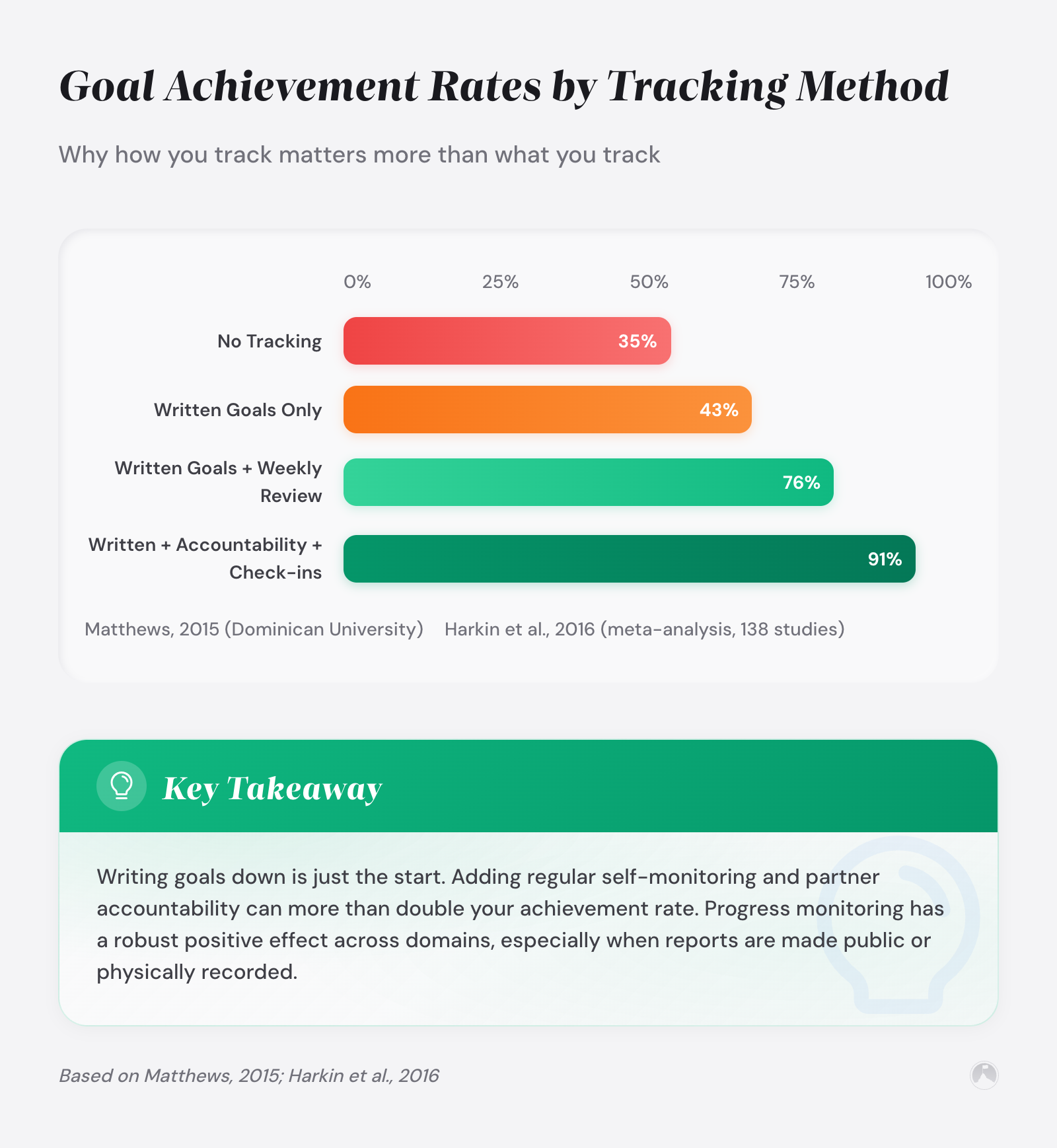
You set a goal in January. By March, you can’t remember the exact wording. By June, it’s a vague memory you feel guilty about. A 2015 study by psychologist Gail Matthews at Dominican University found that people who wrote down their goals, committed to action steps, and sent weekly progress reports to a friend achieved 76% of their goals, compared to 35% for those who simply thought about them [1]. That’s not a marginal difference. Goal tracking systems are the structural bridge between intention and outcome. And the gap between people who track and people who don’t isn’t willpower or talent. It’s architecture.
This guide connects the science of goal setting with the psychology of accountability. You’ll find the tracking methods, review cadences, and accountability frameworks that turn ambitious plans into finished projects.
Goal tracking systems are structured methods for recording, measuring, and reviewing progress toward defined objectives over time. Unlike simple to-do lists that track tasks, goal tracking systems connect daily actions to larger outcomes through measurable milestones, regular reviews, and feedback loops that inform course corrections.
What you will learn
- Why goal tracking raises achievement rates and what the research actually shows
- How to choose the right goal tracking method for your situation and personality
- The Track-Measure-Adjust Loop: a framework for connecting daily data to monthly decisions
- How accountability frameworks work and which level of external pressure you actually need
- Which goal tracking tools, apps, and templates fit different workflows
- The review cadences that prevent tracking from becoming busywork
- When goal tracking hurts performance and how to recognize the warning signs
Key takeaways
- Writing down goals and reporting progress weekly raises achievement rates from 35% to 76% compared to mental-only goals [1].
- Goal tracking methods work best when paired with external monitoring, not self-monitoring alone [2].
- The Track-Measure-Adjust Loop connects daily tracking data to weekly reviews and monthly course corrections.
- Accountability frameworks range from self-tracking to professional coaching, and matching the right level to the goal matters more than maximum pressure.
- The goal gradient effect shows motivation increases as people perceive themselves closer to a finish line [3].
- Feedback and progress tracking are essential moderators in goal-setting theory, not optional add-ons [4].
- Excessive tracking can trigger anxiety, perfectionism, and goal abandonment in certain personality types and contexts.
- Habit goals and achievement goals require different tracking cadences, metrics, and review structures.
- Weekly reviews are the minimum viable feedback loop for most personal and professional goals.
Why does goal tracking actually raise achievement rates?
Goal tracking isn’t a motivational trick. It’s a cognitive mechanism. When you record progress toward a specific objective, you activate three psychological processes that untracked goals don’t trigger.
First, tracking creates what psychologists call a feedback loop. Edwin Locke and Gary Latham’s goal-setting theory, built across four decades of research, identifies feedback as one of the essential moderators of goal effects [4]. Goals without feedback are like running a race with no mile markers. You might be going fast, but you have no idea if you’re on pace. Goal tracking converts vague effort into concrete data that informs whether to accelerate, adjust, or hold course.
Second, tracking triggers the goal gradient effect. Research by Kivetz, Urminsky, and Zheng found that motivation increases as people perceive themselves moving closer to a target [3]. A coffee loyalty card with two stamps already filled gets completed faster than a blank one, even when both require the same number of purchases. Tracking goals creates that same acceleration effect. You can see the finish line getting closer.
Third, the act of recording progress generates a form of commitment. Gail Matthews’ Dominican University study didn’t just test writing goals down. It tested a sequence: written goals, action commitments, and weekly accountability reports [1]. Each layer added measurable improvement. Written goals with weekly accountability reports produced a 76% achievement rate, more than double the 35% rate of unwritten goals. The tracking itself became part of the commitment structure.
A 2018 meta-analysis confirmed this pattern at scale. Goal setting combined with external monitoring produced significantly larger effect sizes than goal setting alone [2]. The mechanism isn’t mysterious: when someone else sees your numbers, you take the numbers more seriously. The research on accountability psychology unpacks exactly why that external visibility changes behavior.
Goal tracking methods: which approach fits your situation?
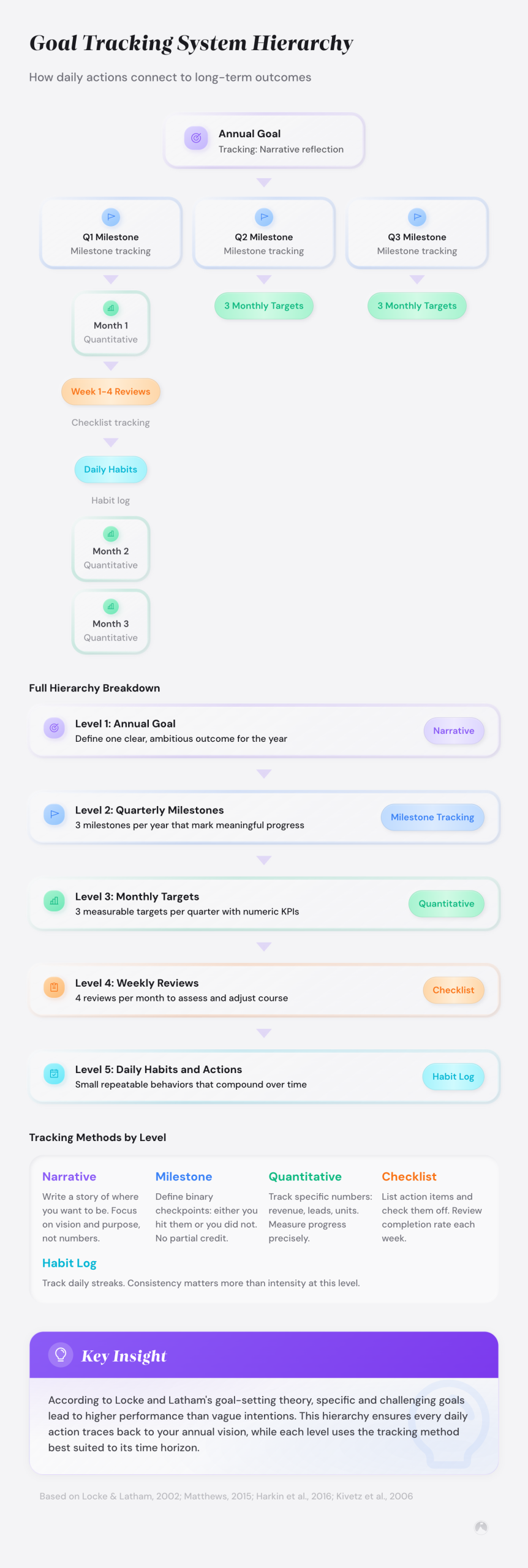
Not all goal tracking methods work the same way. The best method depends on the type of goal, your personality, and the complexity of what you’re pursuing. A detailed comparison of goal tracking methods reveals four main categories, each with distinct strengths.
Quantitative tracking
Numbers-first tracking works best for goals with clear metrics: revenue targets, weight loss, savings rates, or daily word counts. You record a number, compare it to your target, and the gap tells you everything. Digital spreadsheets are the classic tool here. Simple, flexible, and free. But quantitative tracking fails when the metric becomes the master. Tracking goals effectively requires choosing metrics that reflect genuine progress, not just numbers that are easy to count.
Milestone tracking
Milestones work better for complex projects with defined phases. Finishing a manuscript, launching a product, or completing a certification all have natural checkpoints. You track completion of each phase rather than a daily metric. OKR tracking systems and personal OKRs use this approach, pairing high-level objectives with measurable key results that mark genuine progress.
Habit tracking
Some goals aren’t about hitting a number. They’re about showing up. Exercise daily, meditate for ten minutes, write every morning. Habit goals and achievement goals require fundamentally different tracking approaches. For habits, the metric is binary: did you do it today or not? The no zero days technique builds on this principle by making the threshold as low as possible. One pushup still counts.
Narrative tracking
Journals and reflective logs capture the qualitative side that numbers miss. How did the work feel? What obstacles appeared? What surprised you? This approach connects naturally with journaling and self-reflection practices and works well for goals where the path is uncertain or the definition of success is evolving.
| Tracking method | Best for | Key metric | Common pitfall |
|---|---|---|---|
| Quantitative | Measurable targets (revenue, weight, savings) | Numbers vs. target | Metric becomes the master |
| Milestone | Complex projects with phases | Phase completion | Ignoring progress between milestones |
| Habit | Daily consistency goals | Yes/no per day | Streak obsession after a miss |
| Narrative | Evolving or qualitative goals | Written reflections | No clear decision triggers |
Most people benefit from combining two methods. Track the numbers and write the narrative. Hit the milestones and maintain the habits. The best goal setting methods all share one trait: they make progress visible. How you make it visible is a matter of fit.
The Track-Measure-Adjust Loop: turning raw data into course corrections
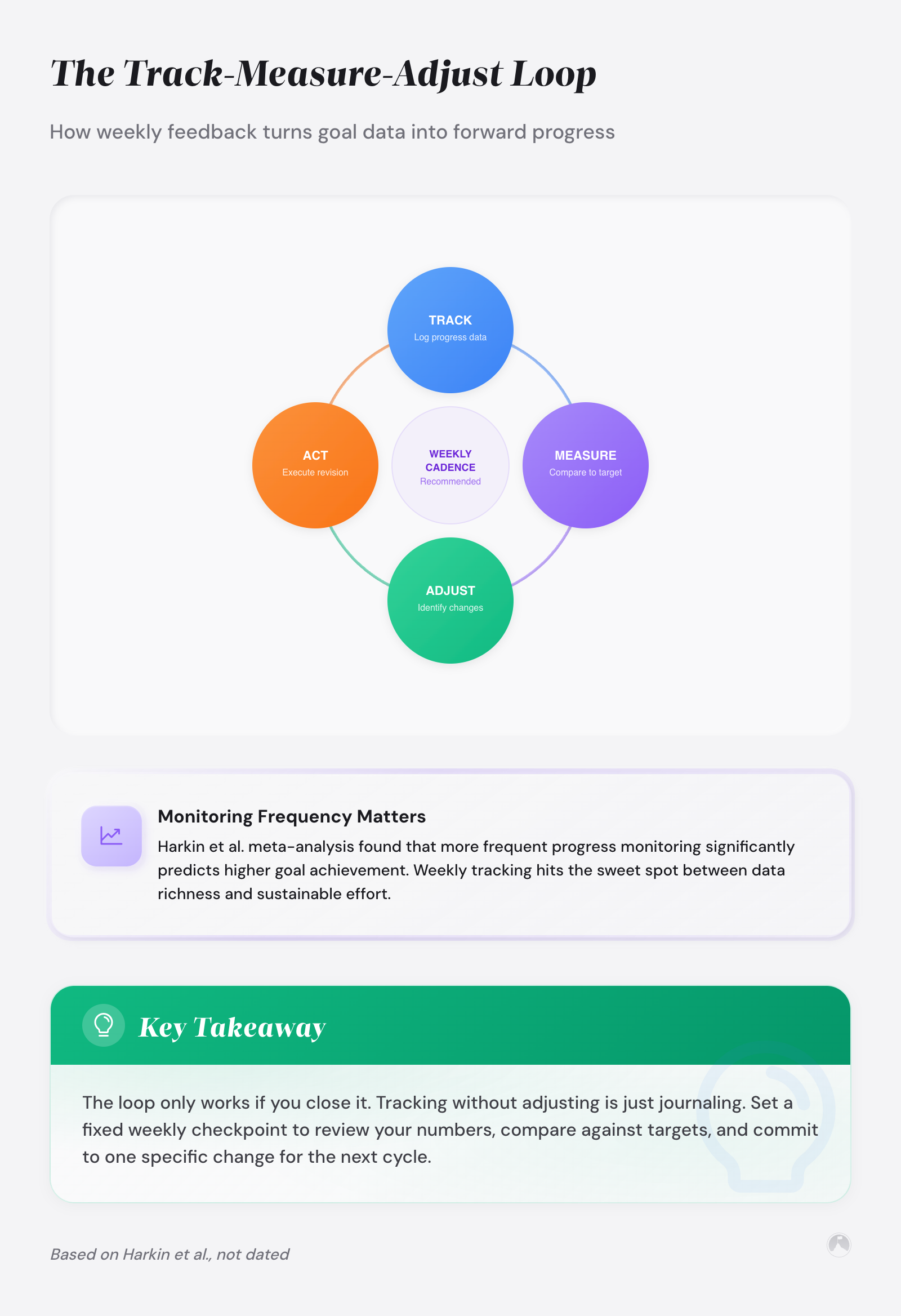
Tracking without a system for interpreting the data is just record-keeping. What we call the Track-Measure-Adjust Loop at goalsandprogress.com is a three-phase cycle that converts tracking data into informed decisions about your goals.
Track-Measure-Adjust Loop is a recurring three-phase cycle for goal management: Track (record daily actions and outcomes), Measure (compare data against targets during scheduled reviews), and Adjust (modify goals, methods, or timelines based on what the data reveals). The loop runs at three cadences: daily tracking, weekly measurement, and monthly adjustment.
Phase 1: Track
Recording happens daily. The rule is: capture the minimum data that would let your future self make a decision. For a fitness goal, that might be workout duration and weight lifted. For a writing goal, word count and time spent. For a career goal, hours invested in skill building and opportunities created. The goal tracking templates and worksheets section of this cluster provides ready-made formats for different goal types.
Don’t track everything. Track what changes your decisions. If a data point wouldn’t cause you to do something differently next week, drop it.
Phase 2: Measure
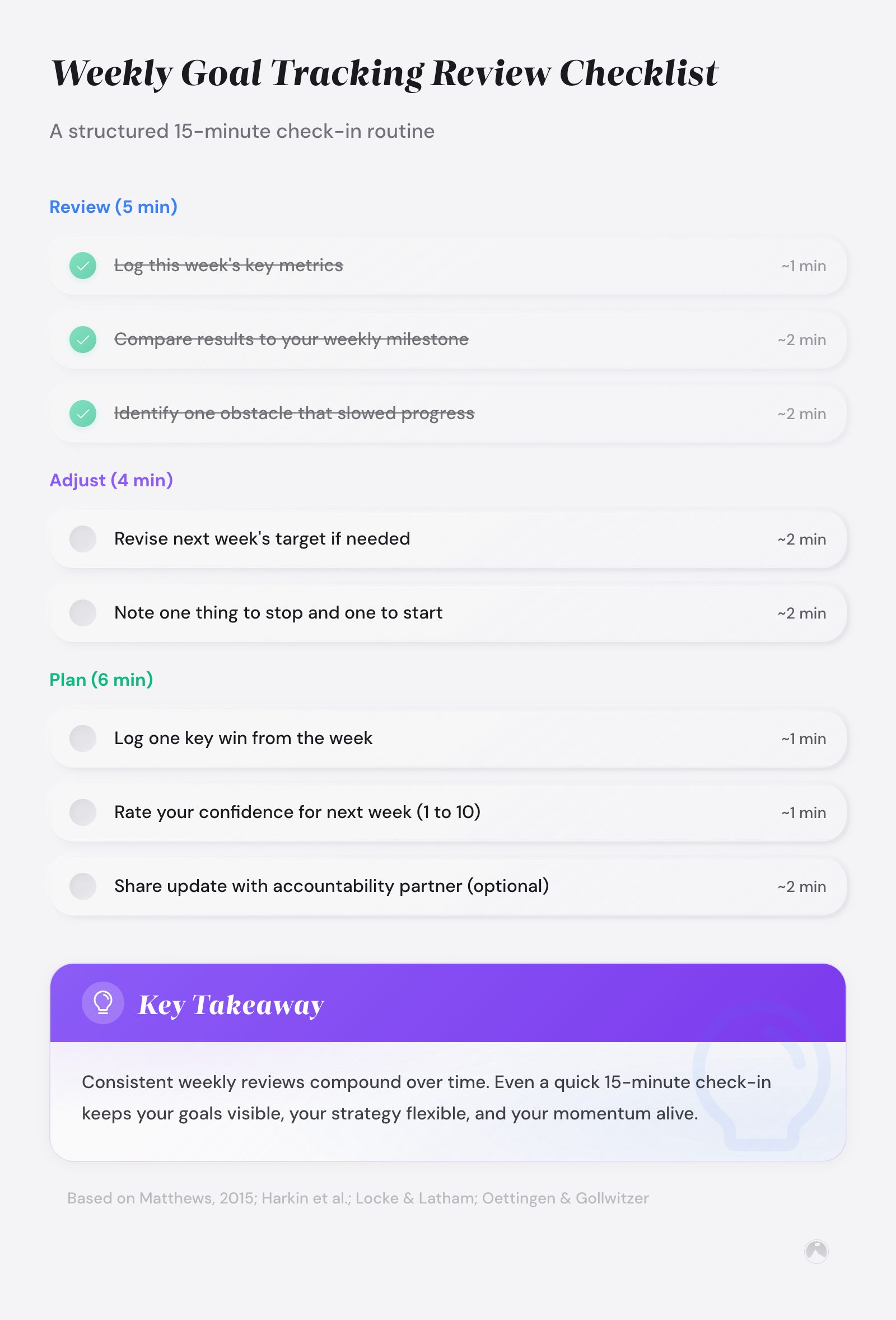
Measurement happens weekly. This is the weekly goal review process where raw data becomes meaningful signal. You compare what happened against what you planned. Are you ahead, behind, or drifting? Progress tracking systems fail not from lack of data but from lack of scheduled moments to interpret that data. A weekly review takes fifteen to thirty minutes and answers three questions: What moved forward? What stalled? What will I do differently next week?
Phase 3: Adjust
Adjustment happens monthly. This is where you make structural changes: revise timelines, redefine metrics, drop goals that no longer matter, or double down on goals that are working. The goal achievement review process provides a structured protocol for these monthly recalibrations. Small weekly tweaks keep you on track. Monthly adjustments keep you on the right track.
| Phase | Question | 0 = No | 1 = Sometimes | 2 = Consistently |
|---|---|---|---|---|
| Track | Do I record goal-related data daily? | ▢ | ▢ | ▢ |
| Measure | Do I compare progress to targets weekly? | ▢ | ▢ | ▢ |
| Adjust | Do I revise goals, methods, or timelines monthly? | ▢ | ▢ | ▢ |
The loop is simple. Making it habitual is the hard part. That’s where follow-through frameworks come in, giving you the structural support to keep the cycle running past the initial enthusiasm.
Goal setting and monitoring: what the research says you should track
Before you can track a goal, you need a goal worth tracking. And not all goals are created equal. Locke and Latham’s research across 35 years of studies found that specific, challenging goals produce performance 90% higher than vague “do your best” goals [4]. The specificity is what makes tracking possible. “Get healthier” can’t be tracked. “Walk 8,000 steps daily” can.
But specificity alone isn’t enough. You need to match the goal setting method to the goal type. Goal setting frameworks like SMART, OKRs, WOOP, and BSQ each handle different situations. A BSQ framework works well for life balance goals. Psychology-based goal setting systems like mental contrasting and if-then planning add layers that pure metric-based methods miss [5].
The connection between setting and monitoring is where most systems break. You set an ambitious goal in a moment of clarity, then return to daily life without building the feedback mechanism. Goal setting and monitoring belong to the same system, not separate activities done at different times of year. When you define a goal, you should simultaneously define what you’ll track, how often you’ll review, and what signal would tell you to adjust.
For goals that span multiple areas of life, multi-goal tracking orchestration becomes the challenge. And when goals collide, a conflicting priorities framework helps you decide what gets your attention first. Dependency mapping reveals which goals need to be sequenced rather than pursued in parallel. These aren’t separate skills. They’re part of the same goal setting and monitoring architecture.
If you’re starting from scratch, setting life goals that stick provides the foundation. If you’ve set goals before and watched them dissolve, the issue is almost always the monitoring layer, not the goal itself.
Accountability frameworks: how much external pressure do you actually need?
Accountability is not one-size-fits-all. Some people thrive with a weekly check-in partner. Others need financial stakes on the line. And some do their best work answering only to themselves. The key is matching the accountability level to the goal’s difficulty, your track record, and your personality.
Research confirms that external monitoring amplifies goal-setting effects. A 2018 meta-analysis found that goals paired with external accountability produced significantly larger improvements than self-monitored goals alone [2]. But “more accountability” isn’t always better. The spectrum runs from light to heavy, and each level serves a different purpose.
Accountability framework is a structured arrangement of external or internal mechanisms designed to maintain commitment to stated goals. Accountability frameworks range from private self-tracking systems to formal arrangements with partners, groups, or professionals, and differ from simple goal reminders by including consequences, reporting obligations, or social visibility.
Level 1: Self-accountability
Journals, trackers, and personal review rituals. This is the baseline. It works for people with strong internal motivation and goals that carry their own reward. The Track-Measure-Adjust Loop operates at this level. For solo entrepreneurs, self-accountability is often the default since no boss is checking your work.
Level 2: Partner accountability
One person who checks in with you regularly. Accountability partner strategies show that the best partnerships involve specific check-in schedules, honest reporting, and mutual investment in each other’s goals. It’s not about having someone nag you. It’s about having someone who sees your data and asks the right questions. Peer productivity support builds on this model with structured daily or weekly exchanges.
Level 3: Group accountability
Community support for goal achievement adds social visibility. Mastermind groups, cohort programs, and online communities create an audience for your progress. The social pressure is moderate but consistent. Group accountability works especially well for long-duration goals where motivation naturally dips.
Level 4: Structural accountability
Commitment devices put something tangible at stake. Money, reputation, or access. Betting on yourself with a financial commitment or making a public declaration raises the cost of quitting. Accountability best practices match the level of external pressure to the difficulty of the goal and the person’s history of follow-through, rather than defaulting to maximum intensity.
| Accountability level | Mechanism | Best for | Risk |
|---|---|---|---|
| Self | Journals, trackers, personal reviews | Intrinsically motivated goals | Easy to rationalize missed targets |
| Partner | Weekly check-ins with one person | Goals needing moderate external push | Partner fatigue or mismatched commitment |
| Group | Community reporting, mastermind circles | Long-duration goals with motivation dips | Social comparison and performance anxiety |
| Structural | Financial stakes, public commitments | High-stakes goals with poor follow-through history | Rigidity when circumstances change |
Special populations need adapted accountability frameworks. Working parents need systems that flex around unpredictable schedules. ADHD creatives need external structure that compensates for inconsistent internal regulation. The accountability framework that works for a solo professional on a stable schedule will fail for a parent managing a toddler and a deadline simultaneously.
Goal tracking tools: apps, spreadsheets, and templates compared
The tool matters less than the system. But the wrong tool adds enough friction to kill the system. Here’s how the main categories compare for different tracking needs.
Goal tracking apps offer convenience and built-in reminders. The best ones handle multiple goal types, provide visual progress displays, and sync across devices. But apps carry a hidden cost: they encourage complexity. The more features available, the more time you spend configuring instead of tracking. A goal tracking system that takes longer to maintain than the goal itself takes to pursue has defeated its own purpose.
Digital spreadsheets remain the most flexible option. You control the structure completely. No subscription fees, no feature bloat, no company pivoting the product out from under you. The tradeoff is setup time. You build it yourself, which means you need to know what to build. The templates and worksheets collection gives you starting points for common goal types.
Paper systems have a permanence that digital tools lack. Writing by hand engages different cognitive processes than typing [6]. A physical tracker on your desk is harder to ignore than an app buried in your phone. But paper can’t calculate, send reminders, or share data with an accountability partner.
The in-depth guide to goal tracking systems evaluates specific tools across these dimensions. The right answer for most people is a hybrid: paper for daily capture, digital for weekly analysis, and a shared tool for accountability reporting.
| Tool type | Strengths | Weaknesses | Best pairing |
|---|---|---|---|
| Mobile apps | Convenience, reminders, portability | Feature creep, subscription costs | Daily habit tracking |
| Spreadsheets | Full flexibility, data analysis, free | Setup effort, no reminders | Quantitative weekly reviews |
| Paper journals | Cognitive engagement, visibility, no distractions | No calculations, hard to share | Narrative and reflection tracking |
| Project management tools | Milestone tracking, collaboration, dependencies | Overkill for simple goals | Multi-goal orchestration |
For those who want to add a motivational layer, gamifying your task list can make daily tracking feel less like a chore. Points, streaks, and progress bars tap into the same reward mechanisms that make video games addictive. Used carefully, gamification keeps the tracking habit alive during the motivation valley between starting a goal and seeing results.
How do goal reviews prevent tracking from becoming busywork?
Tracking without reviewing is just data hoarding. The review is where tracking becomes useful. It’s the moment you look at your numbers and ask: is this working?
The weekly goal review is the minimum viable feedback loop. Fifteen minutes, once a week, looking at what you tracked and deciding what to do next. This single habit separates effective goal tracking from elaborate record-keeping that changes nothing. Locke and Latham’s research is direct on this point: goals plus feedback outperform goals without feedback across nearly every domain studied [4].
Monthly goal achievement reviews go deeper. The weekly review asks “Am I on track?” The monthly review asks “Am I on the right track?” These are different questions. You can faithfully hit weekly targets toward a goal that no longer makes sense. Monthly reviews give you permission to pivot, pause, or drop goals that have outlived their relevance.
Weekly reviews catch execution problems. Monthly reviews catch direction problems. Skipping either one leaves a blind spot in your goal tracking system. The weekly rhythm prevents small misses from compounding into large gaps. The monthly rhythm prevents you from arriving efficiently at the wrong destination.
For goals that span multiple life areas, the personal goal tracking guide covers how to run reviews across different domains without the review itself becoming a half-day project. The trick is structured brevity: a fixed template, a time limit, and a bias toward decisions over documentation.
Why do different goal types need different tracking systems?
A goal to run a marathon and a goal to meditate daily share almost nothing in tracking terms. The marathon has a defined endpoint, measurable sub-targets (weekly mileage, pace times), and a clear finish line. The meditation goal is ongoing, binary in daily measurement (did it or didn’t), and has no finish line at all.
Habit goals and achievement goals need fundamentally different systems. Achievement goals track progress toward a destination. Habit goals track consistency of a behavior. Mixing the two in a single tracking format creates confusion. You end up measuring a habit by achievement standards (100% streak or failure) or measuring an achievement by habit standards (showed up today, good enough).
Achievement goal is a goal defined by reaching a specific, measurable endpoint such as completing a project, earning a certification, or hitting a financial target. Achievement goals have clear completion criteria and a defined finish line.
Habit goal is a goal defined by consistent repetition of a specific behavior over time, such as daily exercise, regular reading, or weekly meal preparation. Habit goals measure frequency and consistency rather than a final endpoint.
For ADHD brains, standard tracking systems often create more friction than they solve. Goal systems designed for ADHD reduce the executive function demands of traditional tracking. Shorter review cycles, visual progress indicators, and novelty rotation keep the system engaging instead of draining. The accountability systems for ADHD creatives guide covers the external scaffolding that compensates when internal regulation fluctuates.
When you’re managing multiple goals across life domains, the tracking challenge compounds. Multi-goal orchestration means running parallel tracking systems that don’t overwhelm your attention budget. The answer isn’t tracking everything with equal intensity. It’s identifying which goals need active tracking this month and which can run on maintenance mode.
How do you rebuild goal tracking systems after a setback?
Every tracking system eventually breaks. Illness, family emergencies, burnout, job changes, or just plain boredom will interrupt even the best-designed system. The question isn’t whether your system will fail. It’s how fast you can restart.
Rebuilding goals after setbacks isn’t about picking up where you left off. It’s about reassessing whether the goal still fits your current reality. A goal set six months ago may no longer match your circumstances, energy, or priorities. The rebuild starts with a fresh assessment, not a guilt trip about lost progress.
The most resilient goal tracking systems are designed to be restarted, not maintained without interruption. No system survives continuous operation for years without occasional breakdowns. Build restart protocols into your system from the beginning: a “minimum restart” version of your tracking habit that takes under two minutes, a predefined re-entry review that takes fifteen minutes, and a compassionate acknowledgment that interruptions are normal.
This is where growth mindset principles become practical rather than theoretical. Viewing a tracking gap as data (“I stopped tracking during a stressful period, which tells me something about my system’s resilience”) rather than failure (“I can’t stick with anything”) changes the restart from a shame event to a design improvement.
For goals where motivation itself is the bottleneck, follow-through frameworks address the structural reasons people abandon goals. And overcoming analysis paralysis helps when the setback triggers overthinking about whether to continue, pivot, or drop the goal entirely.
When does goal tracking hurt instead of help?
Tracking is a tool, and like all tools it can cause damage when misapplied. When goal tracking hurts is not a fringe concern. It’s a predictable failure mode that affects specific personality types and goal categories.
Perfectionists turn tracking into a judgment system. One missed day becomes evidence of personal failure rather than a data point about system design. The streak becomes the goal, and breaking it feels catastrophic rather than informational. If tracking triggers anxiety rather than clarity, the tracking cadence or method needs to change.
Metric fixation is the second failure mode. When the number you’re tracking becomes more important than the outcome it’s supposed to represent, you’ve created what researchers call Goodhart’s Law: “When a measure becomes a target, it ceases to be a good measure” [7]. A writer tracking daily word count might produce 1,000 words of garbage rather than 300 words of quality. The metric was hit. The goal was missed.
Goodhart’s Law states that when a measure becomes a target, it ceases to be a good measure. In goal tracking, Goodhart’s Law describes the common failure where people chase the tracked metric rather than the actual outcome the metric was meant to represent.
The third failure mode is tracking overload. Attempting to monitor too many goals simultaneously fractures attention and turns the tracking system into a second job. Tracking goals effectively means choosing three to five active goals for intensive tracking and letting everything else run on autopilot or light maintenance. Prioritization methods help decide which goals deserve the tracking investment and which ones don’t.
The fix for all three problems is the same: periodic system audits. Every month, ask whether your tracking system is serving the goal or whether the goal is serving the tracking system. If the honest answer is the second one, simplify.
Goal tracking strategies for specific situations
General tracking advice works for general situations. But most lives aren’t general. They’re specific, messy, and constrained. Here are the deep dives for specific contexts.
Solo entrepreneurs face the unique challenge of being both the goal setter and the only person who notices when goals slip. Without a team or manager creating natural checkpoints, every review must be self-initiated. The guide covers how to build external accountability into a solo workflow without hiring a coach.
Working parents deal with time constraints that make elaborate tracking systems impractical. The most effective systems for parents are the ones that take under two minutes daily and survive the chaos of a sick child or a school closure. Simplicity isn’t a compromise for parents. It’s the only realistic option.
ADHD-adapted goal systems and ADHD accountability structures address the executive function challenges that make standard tracking fall apart. These aren’t watered-down versions of regular systems. They’re redesigned from the ground up for brains that process motivation, time, and attention differently.
For those who want to go beyond individual goal tracking, short and long-term planning connects the tracking conversation to the broader question of how daily actions ladder up to multi-year direction. And time management techniques address the execution layer – the best tracking system in the world can’t help if you don’t have time carved out to work on your goals.
Ramon’s Take
I should be better at goal tracking than I am. Here’s what I’ve learned from struggling with it. I’ve tried elaborate spreadsheets, dedicated apps, and paper journals. Every system worked brilliantly for about three weeks, then became another thing on my to-do list that I felt guilty about ignoring. The breakthrough came when I stopped trying to track everything and started tracking only the one metric per goal that would change my behavior next week. For my writing, that’s word count. For fitness, it’s sessions per week. For career goals, it’s hours invested in the one project that matters most this quarter. Everything else is noise I’ve given myself permission to ignore. I use a modified OKR format for quarterly planning and a paper notecard for daily tracking, which costs nothing and takes thirty seconds. The fancy tools are fun to set up but miserable to maintain. My biggest lesson from managing global marketing campaigns and now running this site alongside a demanding job and a small child: the system you’ll actually use beats the system that looks impressive on day one. If your tracking habit breaks – and it will – start again with the minimum viable version. One number, one goal, one weekly review. You can always add complexity later. You almost never need to.
Goal tracking systems conclusion: your action plan
Goal tracking systems aren’t about discipline or willpower. They’re about building a feedback mechanism between your intentions and your reality. The research is consistent: written goals with structured tracking and some form of accountability more than double achievement rates compared to keeping goals in your head [1]. The Track-Measure-Adjust Loop gives that feedback mechanism a repeatable structure. And matching the right tracking method and accountability level to your specific situation prevents the common failure of building a system that looks impressive but feels impossible to maintain.
The system you keep running matters more than the system you build perfectly.
Next 10 minutes
- Write down your three most important current goals with one measurable metric for each.
- Score yourself on the Track-Measure-Adjust Loop self-check above. Identify which phase is weakest.
- Pick one tracking method from the comparison table that fits your primary goal type.
This week
- Set up a tracking tool or template for your top goal using the templates and worksheets collection.
- Schedule a 15-minute weekly review for the same day and time each week.
- Identify your accountability level from the spectrum and take one action to activate it: tell a friend, join a group, or set a commitment device.
There is more to explore
Goal tracking sits at the intersection of several related disciplines within the planning domain. For the broader architecture that connects tracking to direction, explore our guide on short and long-term planning. If your tracking reveals that reflection is the missing piece, the journaling and self-reflection guide covers structured reflection methods. When tracking multiple goals forces difficult decisions about where to focus, prioritization methods provide the decision frameworks. And for the mindset that sustains tracking through setbacks, the growth mindset guide connects psychological resilience to practical goal pursuit.
Take the next step
Ready to put these tracking principles into practice? The Life Goals Workbook provides structured templates for setting trackable goals, built-in weekly review pages, and accountability frameworks you can start using today.
Frequently asked questions
What is the most effective goal tracking method for beginners?
Start with a simple spreadsheet or paper tracker that records one metric per goal daily. Research shows that written tracking with weekly reviews produces significantly higher achievement rates than mental-only tracking [1]. Beginners should avoid complex apps and multi-metric systems that create setup friction. The best starter method is a single page with your top three goals, their metrics, and seven columns for the days of the week.
How often should I review my goal progress?
Weekly reviews are the minimum effective frequency for most personal and professional goals. Locke and Latham’s research identifies feedback as an essential moderator of goal effects [4]. A weekly review takes 15-30 minutes and answers three questions: what moved forward, what stalled, and what changes next week. Monthly reviews add a deeper assessment of whether the goal itself still makes sense.
Can too much goal tracking be counterproductive?
Yes. Excessive tracking triggers three documented problems: perfectionist anxiety from missed targets, Goodhart’s Law where the metric replaces the real goal [7], and attention fragmentation from monitoring too many goals simultaneously. Limit active tracking to three to five goals at most and audit your system monthly to confirm the tracking still serves the goal rather than the reverse.
What is the difference between goal tracking and habit tracking?
Goal tracking measures progress toward a defined endpoint such as completing a project or hitting a financial target. Habit tracking measures consistency of a repeated behavior such as daily exercise or weekly meal prep. Achievement goals need milestone-based tracking with deadline awareness. Habit goals need frequency-based tracking with streak and consistency metrics. Mixing both types in a single system without differentiating them leads to mismatched expectations.
Do accountability partners actually improve goal achievement rates?
Research supports external accountability as a significant amplifier of goal-setting effects [2]. The Matthews study found that weekly accountability reports to a friend raised achievement rates to 76% from 43% for written goals alone [1]. The key factor is structure: scheduled check-ins, honest reporting, and mutual investment. Casual mentions of goals to friends do not produce the same effect as formal accountability arrangements.
How do I track multiple goals without getting overwhelmed?
Designate three to five goals for active intensive tracking and put remaining goals on maintenance mode with minimal monitoring. Use the Track-Measure-Adjust Loop to create a single weekly review that covers all active goals in one session rather than separate reviews for each goal. Multi-goal orchestration requires prioritization: decide which goals get your tracking attention this month and revisit that decision monthly.
What should I do when my goal tracking system breaks down?
Restart with the minimum viable version rather than rebuilding the full system. A tracking breakdown provides useful data about system resilience and life-season fit. Start with one goal, one metric, and one weekly review for two weeks before adding complexity back. Research on goal re-engagement shows that self-compassion during restart periods produces better long-term adherence than self-criticism [8].
Are goal tracking apps better than paper-based tracking?
Neither format is universally superior. Apps offer convenience, automatic reminders, and data visualization. Paper engages different cognitive processes through handwriting and creates a physical reminder that is harder to ignore [6]. Most effective trackers use a hybrid approach: paper for daily quick capture, digital for weekly data analysis, and a shared platform for accountability reporting. Choose based on which format reduces friction for your daily tracking habit.
Glossary of related terms
Goal gradient effect is the psychological phenomenon where motivation and effort increase as a person perceives themselves getting closer to achieving a goal. The effect explains why tracking visible progress accelerates performance near completion milestones.
Feedback loop is a system where output information (progress data) is returned as input to guide future decisions and actions. In goal tracking, feedback loops connect recorded progress to adjustments in strategy, effort, or timeline.
Commitment device is a voluntary arrangement that raises the cost of abandoning a goal through financial stakes, public declarations, or restricted future choices. Commitment devices work by making the pain of quitting exceed the pain of continuing.
OKR (Objectives and Key Results) is a goal-setting framework that pairs a qualitative objective with two to five measurable key results. OKRs differ from traditional goal formats by separating the aspirational direction (objective) from the quantifiable evidence of progress (key results).
Implementation intention is a specific if-then plan that links a situational cue to a goal-directed action (for example, “If it is 7 AM, then I will write for 30 minutes”). Implementation intentions bypass the need for in-the-moment motivation by pre-deciding the response to a given trigger.
Goodhart’s Law states that when a measure becomes a target, it ceases to be a good measure. In goal tracking contexts, Goodhart’s Law warns against chasing the tracked metric instead of the actual outcome the metric was designed to represent.
Goal-setting theory is the motivational theory developed by Edwin Locke and Gary Latham proposing that specific, challenging goals with feedback produce higher performance than vague or easy goals. The theory identifies five key moderators: commitment, feedback, task complexity, goal importance, and self-efficacy.
Track-Measure-Adjust Loop is the goalsandprogress.com framework for goal management consisting of three recurring phases: Track (daily data capture), Measure (weekly comparison against targets), and Adjust (monthly revision of goals, methods, or timelines based on accumulated data).
Multi-goal orchestration is the practice of coordinating tracking, reviews, and resources across multiple simultaneous goals without fragmenting attention or creating competing priorities. Multi-goal orchestration requires prioritization protocols and differentiated tracking intensity across goal categories.
Weekly review is a scheduled session (typically 15-30 minutes) for comparing recorded progress against planned targets, identifying obstacles, and deciding on next-week priorities. The weekly review is the minimum viable feedback loop in most goal tracking systems.
References
[1] Matthews, G. “Goals Research Summary.” Dominican University of California, 2015. Study Summary
[2] Harkin, B., Webb, T. L., Chang, B. P. I., Prestwich, A., Conner, M., Kellar, I., Benn, Y., and Sheeran, P. “Does Monitoring Goal Progress Promote Goal Attainment? A Meta-Analysis of the Experimental Evidence.” Psychological Bulletin, 142(2), 198-229, 2016. DOI
[3] Kivetz, R., Urminsky, O., and Zheng, Y. “The Goal-Gradient Hypothesis Resurrected: Purchase Acceleration, Illusionary Goal Progress, and Customer Retention.” Journal of Marketing Research, 43(1), 39-58, 2006. DOI
[4] Locke, E. A. and Latham, G. P. “Building a Practically Useful Theory of Goal Setting and Task Motivation: A 35-Year Odyssey.” American Psychologist, 57(9), 705-717, 2002. DOI
[5] Oettingen, G. and Gollwitzer, P. M. “Strategies of Setting and Implementing Goals: Mental Contrasting and Implementation Intentions.” Social Psychological Foundations of Clinical Psychology, 114-135, 2010. DOI
[6] Mueller, P. A. and Oppenheimer, D. M. “The Pen Is Mightier Than the Keyboard: Advantages of Longhand Over Laptop Note Taking.” Psychological Science, 25(6), 1159-1168, 2014. DOI
[7] Strathern, M. “‘Improving Ratings’: Audit in the British University System.” European Review, 5(3), 305-321, 1997. DOI
[8] Breines, J. G. and Chen, S. “Self-Compassion Increases Self-Improvement Motivation.” Personality and Social Psychology Bulletin, 38(9), 1133-1143, 2012. DOI