
Why most month-long habit challenges fall apart by day 12
You’ve tried the 30 day habit challenge before. You picked something ambitious, marked Day 1 on your calendar, and felt unstoppable for about a week. Then you missed a Tuesday, felt guilty Wednesday, and quietly abandoned the whole thing by the following Monday.
You’re not alone. A 2025 survey by Drive Research found that 23% quit New Year’s resolutions in the first week, and 43% drop off by the end of January [1]. The structure of the challenge itself is usually the problem, not your discipline.
A 30 day habit challenge framework is a structured behavior-change system that divides a one-month period into progressive phases with escalating difficulty, built-in recovery protocols, and daily tracking mechanisms designed to move a new behavior from conscious effort toward automaticity.
What you will learn
- Why flat-structure 30 day challenges produce a predictable dropout curve
- The 10-20 Ramp: a phased difficulty model designed for real schedules
- A week-by-week blueprint with specific daily actions and milestones
- The best 30 day challenge ideas mapped to the three-phase ramp
- How to recover from missed days without restarting the entire challenge
- What to do after day 30 to reach the 66-day automaticity window
Key takeaways
- A challenge that plans for imperfection is more durable than one that demands perfection and then collapses when life intervenes.
- The 10-20 Ramp matches challenge difficulty to your motivation curve, so the hardest effort arrives after 20 days of practice, not on day 1.
- Missing a day in a 30 day challenge is information about what went wrong, not evidence that you are incapable of change.
- Phased difficulty (the 10-20 Ramp) reduces early overwhelm by starting at 50% target effort.
- Approach-oriented goals (“I will meditate 5 minutes”) outperform avoidance goals by 12 percentage points [3].
- Built-in flex days on days 7, 14, 21, and 28 create planned recovery without breaking streaks.
- A meta-analysis of 138 studies found that self-monitoring your progress accelerates goal attainment [6].
- Real habit automaticity takes a median of 66 days, making day 30 a midpoint rather than a finish line [2].
Why do flat-structure 30 day habit challenges fail
Most 30 day challenges share the same design flaw: they demand peak effort on day 1 and maintain that demand through day 30 with zero adjustment. Run 5K every morning, meditate 20 minutes, write 1,000 words. The assumption is that repetition alone produces habits.
Lally’s team at University College London tracked 96 participants forming new habits over 12 weeks. The median time to automaticity was 66 days, with a range of 18 to 254 days [2]. Automaticity is the point at which a behavior can be performed with minimal conscious attention, requiring little deliberate decision-making to initiate. A 30 day window doesn’t finish the job, and a flat-difficulty structure makes reaching even day 30 unlikely.
The gap between motivation decay and habit formation is where most 30 day challenges die [2]. Motivation peaks in the first few days and declines around week two when novelty wears off.
Oscarsson and colleagues tested this with 1,066 participants. An approach-oriented goal frames the desired behavior as something to add or pursue rather than something to avoid or eliminate. Approach-oriented goals (“I will walk for 15 minutes after lunch”) achieved a 58.9% success rate compared to 47.1% for avoidance goals (“I will stop skipping exercise”) [3]. How you frame the challenge matters as much as which habit you pick.
The problem is not your willpower. The structure of the challenge itself is the real culprit.
How does the 10-20 ramp prevent the week-2 dropout
The 10-20 Ramp is a phased habit challenge structure we developed that starts new behaviors at 50% of target effort for the first 10 days, increases to 75% through day 20, and reaches full effort only after 20 days of consistent practice have built behavioral momentum.
The pattern that separates completed challenges from abandoned ones comes down to phased difficulty paired with scheduled recovery and habit formation science. We designed the 10-20 Ramp based on Lally’s automaticity research [2], dividing the 30 days into three phases. You start at half your target difficulty and reach full effort by day 20, giving your brain 10 days of comfortable repetition first.
The 10-20 Ramp works by matching challenge difficulty to the natural curve of motivation decay, so effort increases as the target habit becomes more automatic rather than as enthusiasm fades [2].
Say your target is a 30-minute morning workout. A flat-structure challenge demands 30 minutes on day 1 when you’re fired up and 30 minutes on day 12 when you’d rather stay in bed. The 10-20 Ramp sets day 1 at 15 minutes, day 12 at 20 minutes, and day 22 at the full 30. By peak difficulty, you’ve already built 20 days of consistency.
| Phase | Days | Effort level | Purpose | Flex days |
|---|---|---|---|---|
| Foundation | 1-10 | 50% of target | Build the repetition pattern without resistance | Day 7 |
| Building | 11-20 | 75% of target | Increase difficulty after the behavior starts becoming familiar | Day 14 |
| Strengthening | 21-30 | 100% of target | Solidify the behavior at full effort | Days 21, 28 |
Flex days (7, 14, 21, 28) are scheduled rest points where you do a minimal version of the habit or skip entirely. Flex days are pressure valves that prevent the all-or-nothing thinking that derails most challenges.
A challenge that plans for imperfection outlasts one that demands perfection every single day [3].
30 day challenge blueprint: week by week
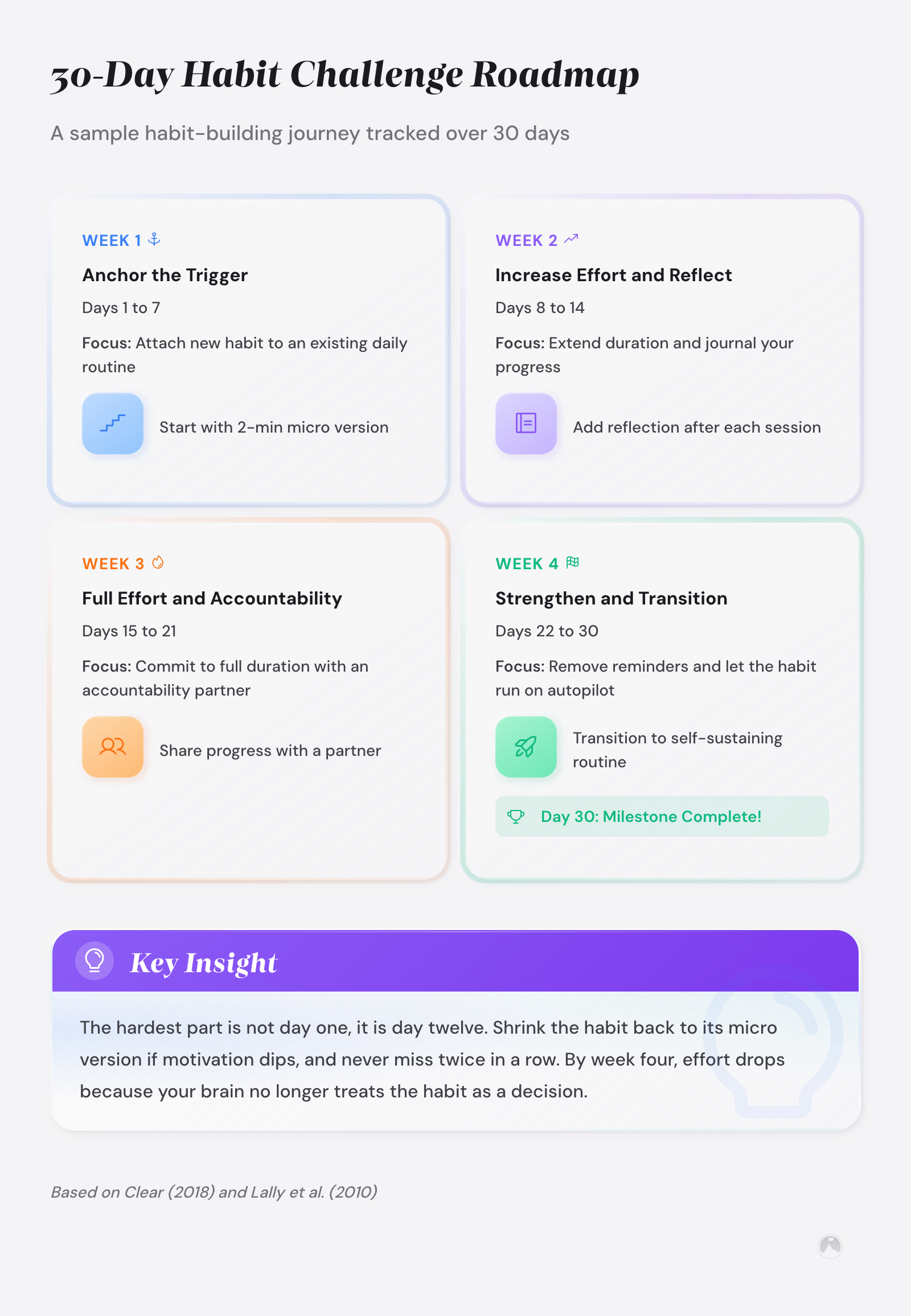
Each week in the 10-20 Ramp has a specific job. The tracking method, accountability structure, and difficulty level shift across the four weeks to match where your brain is in the formation process.
Week 1 (days 1-7): anchor the trigger
Your only job in week one is linking the new behavior to an existing routine. Lally and Gardner found that pairing a new behavior with an established one reduces cognitive load by leveraging existing automatic behaviors [5].
A habit trigger is an existing daily behavior or environmental cue that serves as the prompt for a new habit, reducing the need for conscious remembering. When you attach “meditate” to “morning coffee,” the coffee becomes the trigger, and your conscious attention can shift elsewhere. Keep effort at 50% of your ultimate target.
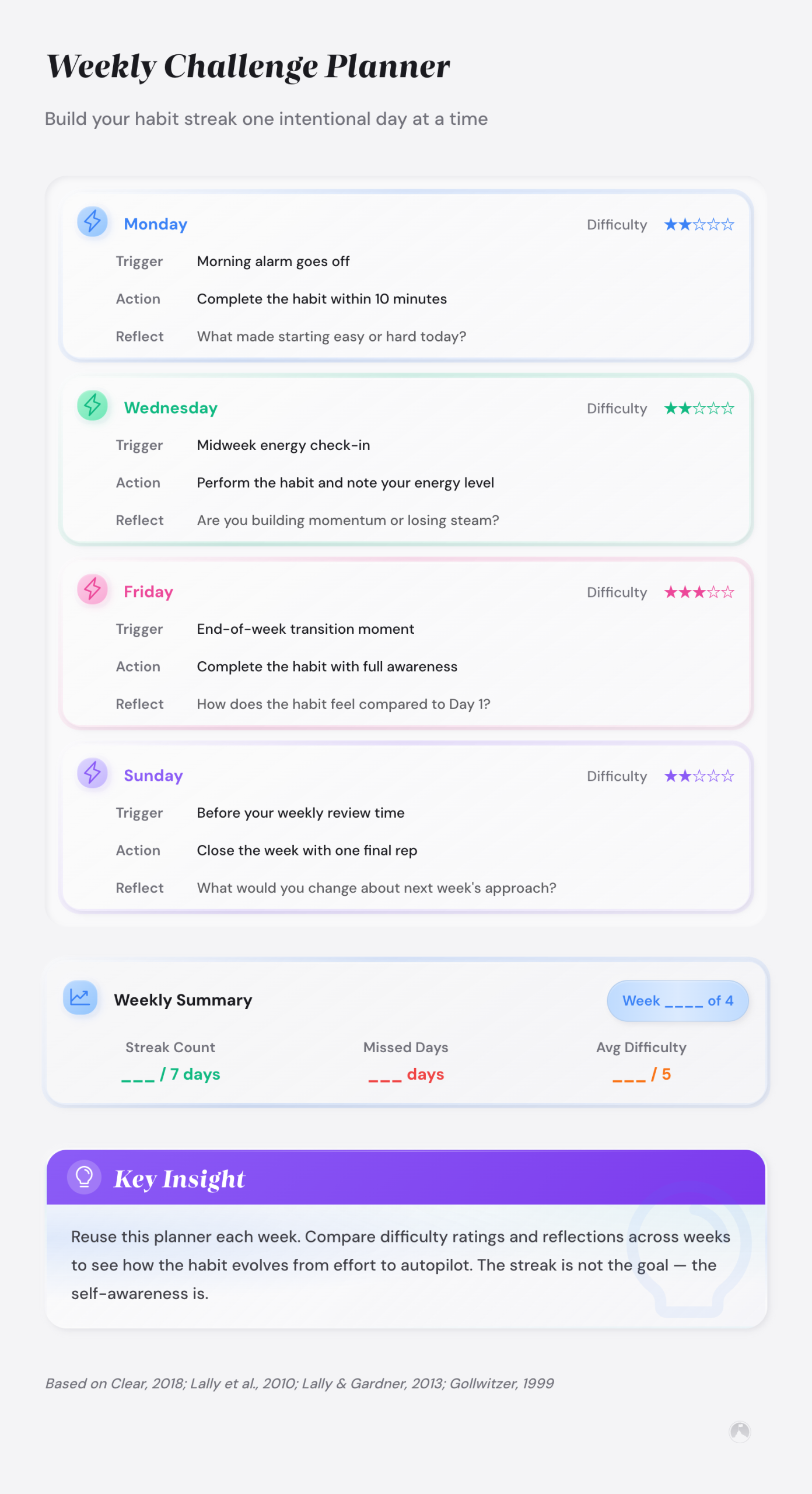
Track with a simple visual streak: X marks on paper taped to your bathroom mirror. The daily habit tracker approach of “don’t break the chain” gives your brain a visual reward for each completed day.
For a more structured approach, create a habit tracking template printable with columns for Day Number, Phase (Foundation / Building / Strengthening), Effort Level (50% / 75% / 100%), Completed, and Reflection. Mark flex days 7, 14, 21, and 28 in a different color. This 30 day challenge calendar layout keeps the three-phase structure visible and prevents tracking from feeling flat.
Day 7 is a flex day – do a 2-minute minimum version or rest.
Week 2 (days 8-14): increase effort, add reflection
This is the danger zone. Novelty has faded, but the behavior isn’t yet automatic. Bump effort to 75% and add a 2-minute end-of-day reflection: “Did I do it? What made it easier or harder?”
A meta-analysis by Harkin and colleagues reviewing 138 studies found that people who tracked their progress were meaningfully more likely to reach their goals [6]. Writing daily reflections using a habit stacking method turns vague feelings into concrete patterns you can adjust.
Day 14 is both a flex day and a checkpoint. Ask: “Is this habit still the right one?” and “Do I need to adjust the difficulty?” Permission to recalibrate prevents the slow drift toward abandonment.
The data you collect about yourself during week two is worth more than the motivation you started with on day one.
Week 3 (days 15-21): full effort, add accountability
Move to 100% of your target effort. You have 14 days of data about what works and which obstacles recur. This is where accountability methods earn their value.
A study by Gail Matthews at Dominican University of California found that participants who wrote down goals and sent weekly progress reports to a friend achieved 76% of their goals, compared to 43% for those who merely thought about them [7]. A daily text to a friend (“Day 17, done”) bridges the fragile middle weeks and the strengthening phase. The goldilocks rule for habits suggests this is where you hit your sweet spot of challenge – hard enough to stay engaged, easy enough to stay consistent.
Week 4 (days 22-30): strengthen and plan the transition
Maintain full effort. Your focus shifts from “can I do this?” to “what happens after day 30?” Start planning your environment for the long term. If your habit is morning exercise, lay out workout clothes the night before. If it is reading, put the book on your pillow. Friction reductions compound over time.
Explore the neuroscience of habit formation to understand why environmental cues matter at a biological level.
Day 30 of a 30 day habit challenge framework is not the finish line – it is roughly the halfway point to the 66-day median where habits start running on autopilot [2].
What are the best 30 day challenge ideas for self improvement
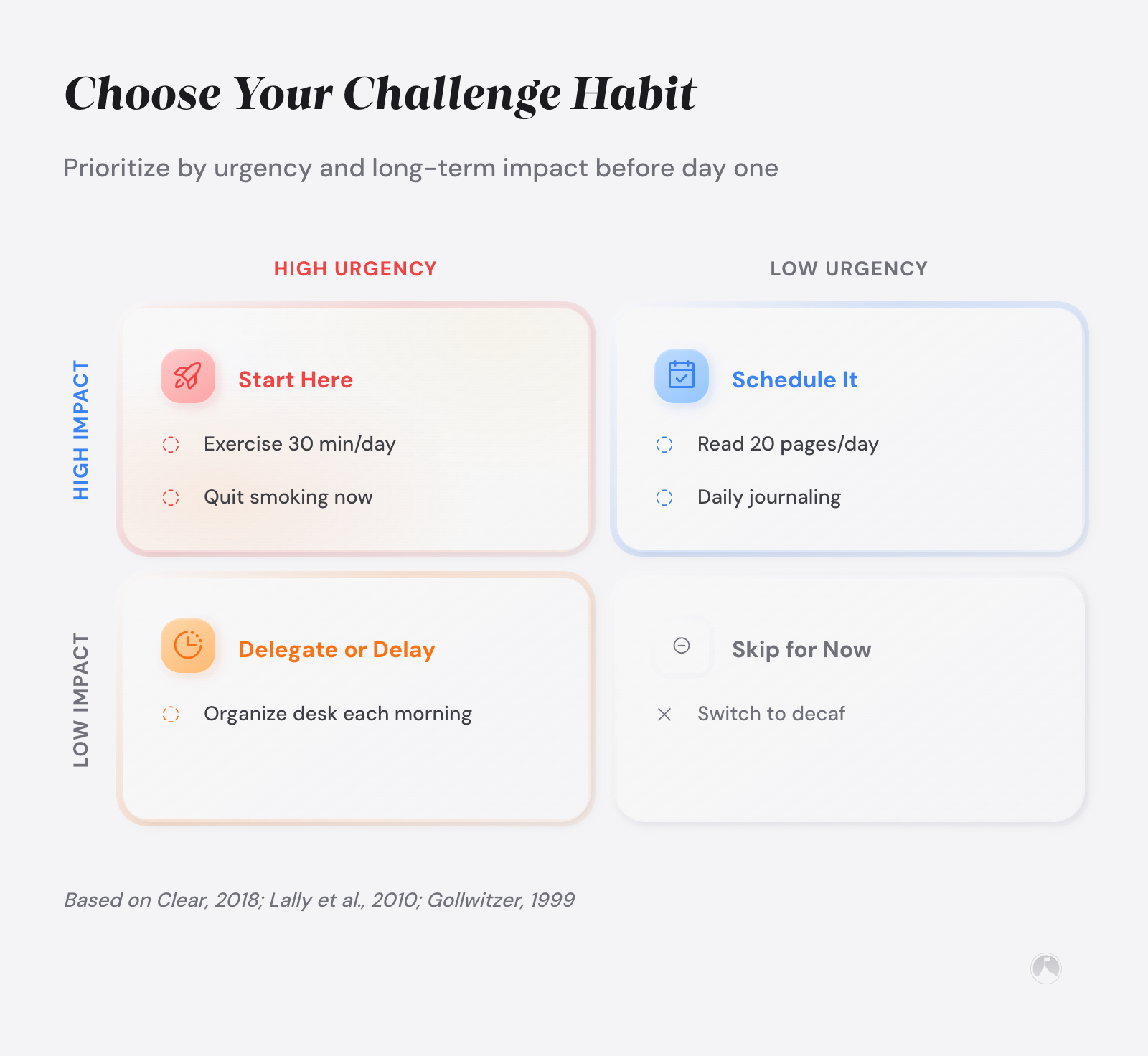
The best 30 day challenges to try are ones where you can clearly define three effort levels for the 10-20 Ramp. Here are self improvement challenge ideas with the phased effort breakdown.
Fitness
- Morning walk: 50% = 10 minutes | 75% = 20 minutes | 100% = 30 minutes
- Bodyweight workout: 50% = 5 minutes of stretching | 75% = 10-minute circuit | 100% = 20-minute routine
Mindfulness
- Meditation: 50% = 3 minutes guided | 75% = 7 minutes | 100% = 15 minutes unguided
- Journaling: 50% = 3 sentences | 75% = half a page | 100% = one full page
Learning
- Reading: 50% = 10 pages | 75% = 15 pages | 100% = 25 pages
- Language study: 50% = 5-minute flashcards | 75% = 15-minute lesson | 100% = 25 minutes with conversation practice
Productivity
- Deep work block: 50% = 15 minutes focused | 75% = 30 minutes | 100% = 60 minutes distraction-free
Relationships
- Daily connection: 50% = one thoughtful text | 75% = 5-minute phone call | 100% = 15-minute intentional conversation
Pick one. Map it to the three phases. Start within 48 hours.
What should you do when you miss a day
Missing a day doesn’t reset your progress. Lally’s research found that missing a single opportunity did not materially affect habit formation [2]. The damage comes from the emotional response, not the missed day itself. Here is the recovery protocol:
- Missed one day: Do the habit the next day at your current effort level. No penalty, no makeup session. Mark the missed day with an “M” on your tracker rather than leaving it blank.
- Missed two consecutive days: Drop back one effort tier (100% to 75%, or 75% to 50%) for three days before returning to your current phase. Two consecutive misses signal something needs adjusting – the time of day, the effort level, or the trigger.
- Missed three or more consecutive days: Return to the beginning of your current phase. If you were in the Building phase, restart at day 11’s effort level. Don’t go back to day 1 – the Foundation phase repetitions still count.
Missing a day in a 30 day challenge is information about what went wrong, not evidence that you need to start over [2].
How do you transition a 30 day challenge into a permanent habit
Day 30 is where most challenge frameworks end and most habits die. The structure disappears, tracking stops, and the behavior erodes. With 66 days as the median for automaticity, day 30 is roughly 45% of the way there [2]. Three steps bridge the gap:
Step 1: Remove the calendar pressure. Switch from daily tracking to weekly check-ins. A key reason habits fail is tracker fatigue, where tracking becomes more burdensome than the habit.
Step 2: Pair the habit with identity language. James Clear argues in Atomic Habits that the strongest habits are tied to identity rather than outcomes [4]. Shift from “I’m doing a 30 day challenge” to “I’m someone who works out in the morning.”
Step 3: Set a 66-day review date. Put a reminder on your calendar for day 66: “Am I still doing this without thinking about it?” If yes, the habit has reached automaticity. If not, run another 30-day Strengthening phase.
Lally’s research at University College London found that new behaviors reach automaticity at a median of 66 days, with individual timelines ranging from 18 to 254 days depending on habit complexity [2].
The 30 day challenge builds the scaffolding. The 66 days after it finish the building.
Ramon’s take
Thirty days of anything is long enough to figure out if you actually hate it. That’s useful information too. I keep thinking the real win isn’t the habit, it’s discovering which challenges were just guilt trips disguised as goals.
Conclusion
A 30 day habit challenge framework that works requires phased difficulty through the 10-20 Ramp, built-in recovery for missed days, and a transition plan that treats day 30 as a checkpoint. Thirty days gets you nearly halfway to the 66-day automaticity median with momentum to carry forward.
Next 10 minutes
- Pick one habit and write it as an approach-oriented goal (“I will…” not “I will stop…”)
- Calculate your 50% starting effort for the Foundation phase (days 1-10)
- Choose your start date and mark flex days (7, 14, 21, 28) on your calendar
This week
- Print or create a 30-day visual streak tracker and place it where you will see it daily
- Identify one existing daily routine as your habit trigger (coffee, commute, lunch)
- Tell one person about your challenge and set up a simple daily check-in format
There is more to explore
Explore our habit formation complete guide for a deeper look at behavior change. Our guide on how long habits take to form breaks down the 21-day myth versus the 66-day reality. If you are building habits with ADHD, see our habit building ADHD guide for adapted strategies.
Related articles in this guide
- atomic-habits-vs-tiny-habits
- behavior-design-hacks-to-form-good-habits
- best-habit-tracking-apps-comparison
Frequently asked questions
How do I choose the right 30 day challenge for me?
Start with a habit you have wanted to build for at least a month, not one you picked on impulse. Approach-oriented behaviors (adding something positive) succeed at higher rates than avoidance behaviors [3]. Pick a habit where you can define 50%, 75%, and 100% effort levels for the three phases.
What should I do if I miss a day during the challenge?
Missing a single day does not reset your progress according to the research behind this framework [2]. The more useful question is what caused the miss. Common culprits include scheduling the habit at your lowest-energy time of day, setting the effort level too high for your current phase, or losing your environmental trigger due to a routine change. Identify the cause before resuming, and adjust accordingly.
Is it better to start on the first of the month or start immediately?
Start within 48 hours of deciding. Waiting for a clean start date introduces a delay where motivation decays. Research on implementation intentions shows that specific start plans including date, time, and location outperform vague future plans [8]. The 10-20 Ramp works on any start date since it counts days, not calendar dates.
How many habits can I realistically build in 30 days?
One. Stacking multiple new habits in a single challenge divides your cognitive resources and increases the probability of abandoning all of them. Once your first habit reaches the Building phase (around day 11-15), you can layer a second micro-habit at 50% effort if the first one feels stable.
What makes a 30 day challenge successful?
Three factors predict completion: phased difficulty that starts below your maximum capacity, a visual tracking system that provides daily feedback, and at least one external accountability mechanism [6][7]. Challenges missing these elements have higher dropout rates in the second and third weeks.
Should I tell others about my 30 day challenge?
Tell one to two people who will check in on you, but avoid large public announcements. Research on goal accountability shows that participants who sent weekly progress reports to a friend achieved significantly more of their goals than those who kept goals private [7]. However, broadcasting to large audiences can create premature satisfaction from the announcement alone.
References
[1] Drive Research. “New Year’s Resolutions Statistics.” Drive Research, 2025. https://www.driveresearch.com/market-research-company-blog/new-years-resolutions-statistics/
[2] Lally, P., van Jaarsveld, C.H.M., Potts, H.W.W., and Wardle, J. “How are habits formed: Modelling habit formation in the real world.” European Journal of Social Psychology, 2010. https://onlinelibrary.wiley.com/doi/abs/10.1002/ejsp.674
[3] Oscarsson, M., Carlbring, P., Andersson, G., and Rozental, A. “A large-scale experiment on New Year’s resolutions: Approach-oriented goals are more successful than avoidance-oriented goals.” PLOS ONE, 2020. https://pmc.ncbi.nlm.nih.gov/articles/PMC7725288/
[4] Clear, J. Atomic Habits: An Easy and Proven Way to Build Good Habits and Break Bad Ones. Avery, 2018.
[5] Lally, P., and Gardner, B. “Promoting habit formation.” Health Psychology Review, 2013. DOI
[6] Harkin, B., Webb, T.L., Chang, B.P., Prestwich, A., Conner, M., Kellar, I., Benn, Y., and Sheeran, P. “Does monitoring goal progress promote goal attainment? A meta-analysis of the experimental evidence.” Psychological Bulletin, 142(2), 198-229, 2016. DOI
[7] Matthews, G. “Goals Research Summary.” Dominican University of California, 2015. https://scholar.dominican.edu/psychology-faculty-conference-presentations/3/
[8] Gollwitzer, P.M. “Implementation Intentions: Strong Effects of Simple Plans.” American Psychologist, 54(7), 493-503, 1999. DOI