
You are not bad at habits. Your habits are fighting the wrong version of you.
Most habit advice gets the problem backwards. It tells you to start smaller, track better, find an accountability partner. None of that is wrong, but it misses why habits fail at a deeper level: the person trying to build the habit hasn’t changed who they believe they are. A 2020 study led by Oscarsson and colleagues, published in PLOS ONE, tracked over 1,000 participants making New Year’s resolutions and found that approach-oriented goals had a 58.9% success rate compared to 47.1% for avoidance-oriented ones [1]. The framing mattered more than the effort.
That finding points to something most habit guides skip entirely: the story you tell yourself about who you are shapes your behavior more than any cue-routine-reward loop. And if you’ve been wondering why your habits keep falling apart, the answer probably isn’t what you think.
Habit failure is the breakdown of repeated behavior before automaticity, caused by misalignment between the behavior, the person’s self-concept, environment, and reward structure.
Key takeaways
- Habits fail most often from what we call the Identity-Behavior Gap – a mismatch between the behavior and your self-concept – not from lack of discipline.
- The two-week motivation cliff happens when novelty fades and automaticity hasn’t kicked in yet.
- Environment design outperforms willpower-based strategies by a wide margin.
- Self sabotage and habit failure are usually identity protection in disguise.
- Matching a new habit to who you are becoming – not who you think you should be – is the strongest predictor of long-term persistence.
- Missing one day does not reset your progress [4] – the streak matters less than the pattern.
Why habits fail at the identity level, not the behavior level
Habits fail at the identity level because the person attempting the new behavior has not updated their self-concept to match it. Here’s the conventional wisdom: habits fail from starting too big, lacking consistency, or not having the right cue. Those are real failure points. But they’re symptoms. The root cause is quieter and harder to spot.
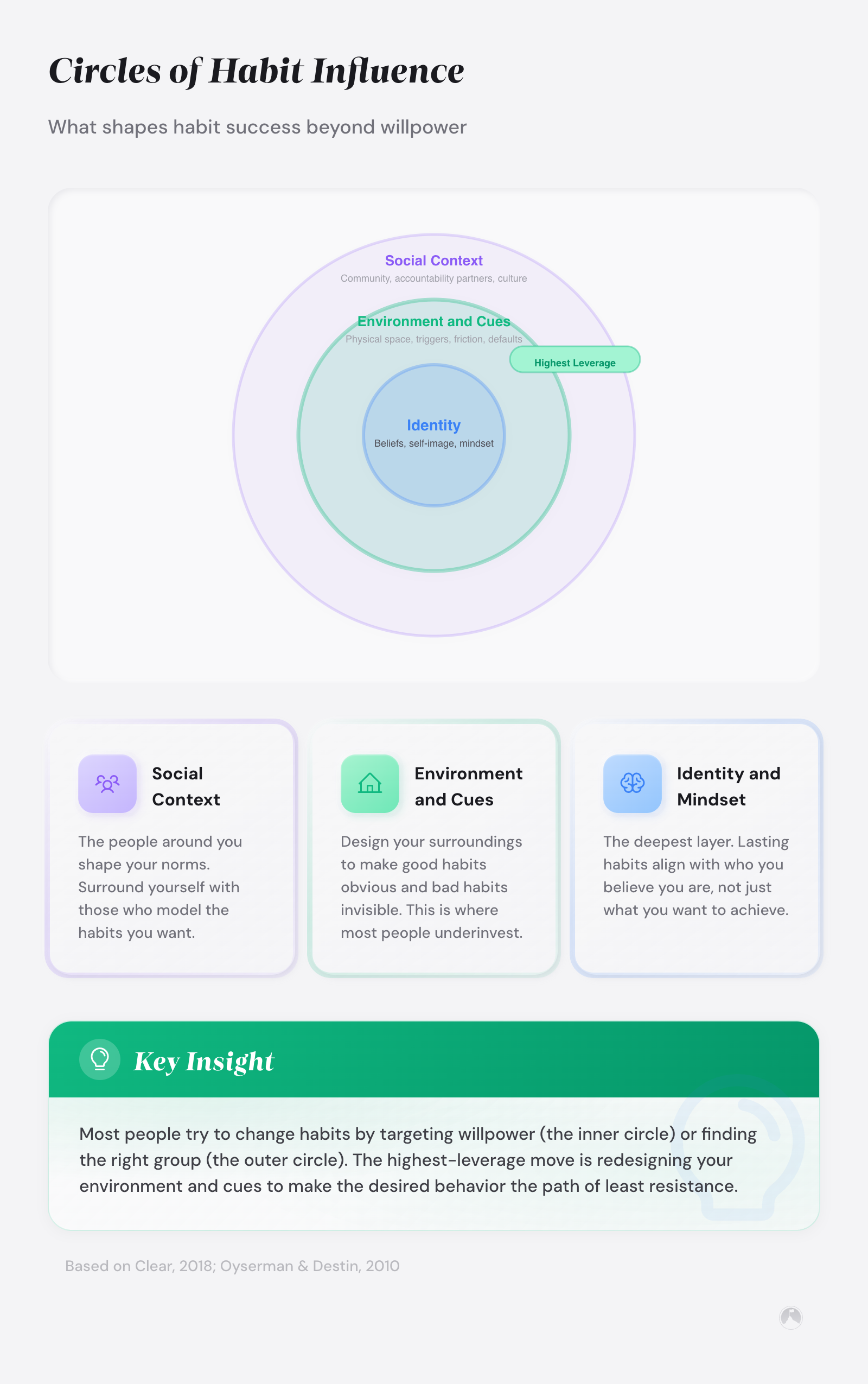
When someone who identifies as “not a morning person” sets a 5:30 AM running habit, they’re fighting something bigger than an alarm clock. They’re fighting a self-concept that has years of evidence behind it. Every late morning, every snoozed alarm, every skipped workout reinforces the belief. Research on identity-based motivation shows that when a behavior aligns with self-concept, it requires less willpower to sustain [6]. When it contradicts self-concept, resistance follows.
The new habit needs more than a good cue and a satisfying reward. It needs the person to stop believing something they’ve believed for a long time. James Clear calls this identity-based habits in Atomic Habits, and the concept is genuinely powerful [2]. But most people read that chapter and think “I should believe I’m a runner.” That’s not how identity shifts work. Identity doesn’t change from declaration. Identity changes from accumulated evidence, one small proof at a time.
You can’t willpower your way into a new identity. You have to build it with receipts. And most habit formation systems skip this step entirely, jumping straight to behavior change without laying the identity groundwork first.
What is the identity-behavior gap?
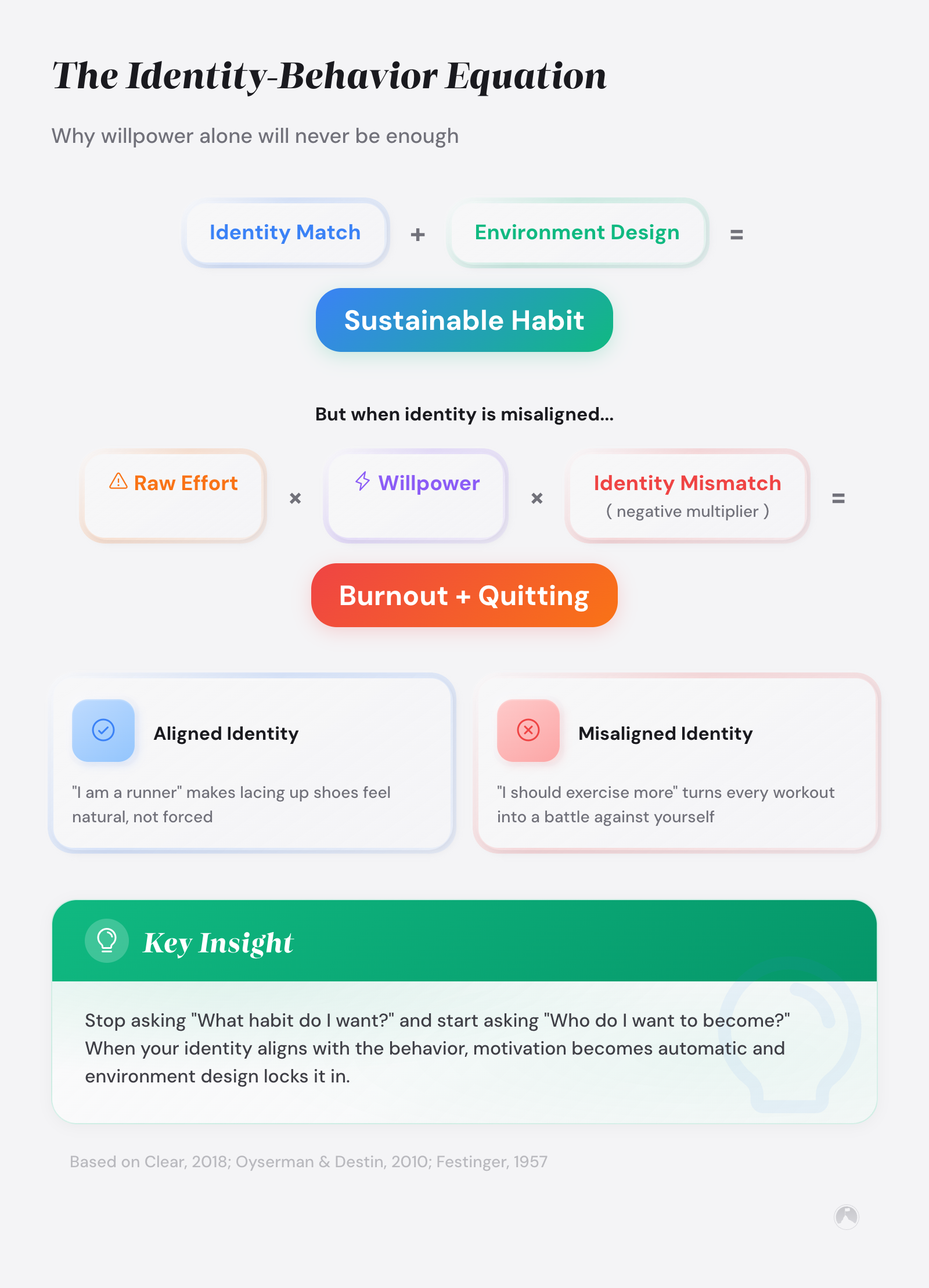
Building on Clear’s identity-based habits framework [2], what we call the Identity-Behavior Gap describes the distance between who a person currently believes they are and who they would need to be for the new habit to feel natural. While Clear focuses on using identity as a lever for habit change, the gap concept zeros in on measuring the misalignment itself. When that gap is wide, the brain treats the new behavior as a foreign object. It generates resistance in the form of procrastination, “forgetting,” rationalization, and self-sabotage.

The Identity-Behavior Gap generates resistance through cognitive consistency – the brain’s preference for maintaining alignment between beliefs and actions. When a new habit contradicts an existing self-concept, the brain treats the behavior as a threat and produces procrastination, rationalization, and self-sabotage as identity-defense responses.
The mechanism works through cognitive consistency. Psychologists have studied this since Leon Festinger’s foundational work on cognitive dissonance in the 1950s [7]. When behavior contradicts belief, something has to give – and for most people, the belief wins. It’s easier to skip the gym than to rewrite your story about who you are.
Why self-sabotage is identity protection, not personal weakness
Research on self-concept threat shows that behavioral resistance to change – forgotten intentions, convenient excuses, procrastination – often operates as unconscious identity protection [8]. Self sabotage in habit failure is usually identity defense disguised as personal weakness. The person who “always forgets” to meditate isn’t forgetful. They haven’t yet built enough evidence to believe they’re someone who meditates.
So the fix isn’t motivation. The fix is shrinking the gap. You close the Identity-Behavior Gap by choosing habits so small that they don’t trigger identity defense – one pushup, two minutes of reading, a single deep breath before opening your laptop. These aren’t “too small to matter.” They’re small enough to slip past the identity guard.
Why does motivation disappear after two weeks?
Motivation disappears after two weeks because the novelty-driven dopamine that powered the first days of a new habit fades before the behavior becomes automatic. There’s a pattern almost everyone recognizes: the first week of a new habit feels exciting, the second week feels manageable, and by week three, you’ve stopped. This isn’t random. It has a neurological explanation.
New behaviors trigger a burst of novelty-driven dopamine. Neuroscience research on habit formation suggests that novel stimuli activate dopamine release in the brain’s reward circuits, and this activation decreases as the stimulus becomes familiar [3]. Your brain responds to the unfamiliar activity with heightened engagement, but that response fades predictably. This neurological pattern is a core reason why new habits don’t last past the initial excitement phase. Phillippa Lally’s 2010 research at University College London found that habits take an average of 66 days to become automatic, with a range of 18 to 254 days depending on the person and the behavior [4]. Based on Lally’s data, there is a significant gap between when initial novelty and enthusiasm typically fade – often within the first few weeks – and when automaticity develops around day 66 [4].
“Missing one opportunity to perform the behavior did not materially affect the habit formation process.” – Lally et al., 2010 [4]
That gap between fading novelty and developing automaticity is where many habits go to die. And this is where the motivation vs discipline for habits debate gets it wrong on both sides. The motivation isn’t coming back, and it’s not supposed to. But discipline alone won’t carry you either. Motivation is the ignition, not the engine. Habits that survive the two-week cliff do so through environment design and identity reinforcement, not through finding more willpower.
How does environment shape habit success more than character does?
Environment shapes habit success more than character because it determines the number of decisions required to perform the behavior each day. The biggest myth in habit formation is that success comes from being a disciplined person. The research tells a different story. A study by Norcross and colleagues tracking 159 New Year’s resolvers over six months found that people who succeeded weren’t more motivated or more disciplined than those who failed [5]. They were better at restructuring their environment and using precommitment strategies to reduce the number of decisions they needed to make each day.
“Successful resolvers reported employing significantly more behavioral strategies, including stimulus control and reinforcement management.” – Norcross et al., 2002 [5]
The environment impact on habit success is more reliable than any amount of personal discipline. If you’re trying to eat better but your kitchen is stocked with chips and your healthy food requires 30 minutes of prep, you’re not fighting a willpower battle. You’re fighting a logistics battle. And logistics problems have logistics solutions.
| Factor | Role in habit success | Reliability over time |
|---|---|---|
| Willpower | Gets you started | Declines after 2-3 weeks |
| Environment design | Removes friction from behavior | Stable once set up |
| Identity alignment | Determines if habit sticks long-term | Grows with accumulated evidence |
Notice the pattern: the factors with the most durability are the ones that don’t depend on how you feel on any given Tuesday. Sustainable habits are designed systems, not feats of personal strength.
Why taking on too many habits at once guarantees failure
Taking on too many habits at once guarantees failure because each new behavior draws from the same limited pool of cognitive resources. There’s an emotional logic to the “new year, new me” approach. You’re inspired – why not start the morning routine AND the gym habit AND the journaling practice AND the meal prep? Research on cognitive resource limits suggests that pursuing multiple behavior changes simultaneously may reduce success rates – though the specific “ego depletion” model underlying this claim has been questioned after large-scale replications found minimal effects (Hagger et al., 2016) [9]. The practical observation remains: spreading effort across too many fronts reduces the attention available for any single habit.
Drive Research’s 2025 market research survey reinforces this: only about 9% of people who set New Year’s resolutions report achieving them, with 23% quitting within the first week [10]. One major factor among the common reasons habits don’t stick: people set multiple resolutions simultaneously, spreading their capacity across too many fronts.
The better approach is sequential, not parallel. Build one habit until it doesn’t require conscious effort anymore, then add the next. This maps directly to the habit stacking approach – you’re building a chain, not throwing everything at the wall. Habit failure isn’t usually caused by choosing the wrong habit. The real cause is choosing too many right habits at the same time.
How to recover from broken habits without starting over
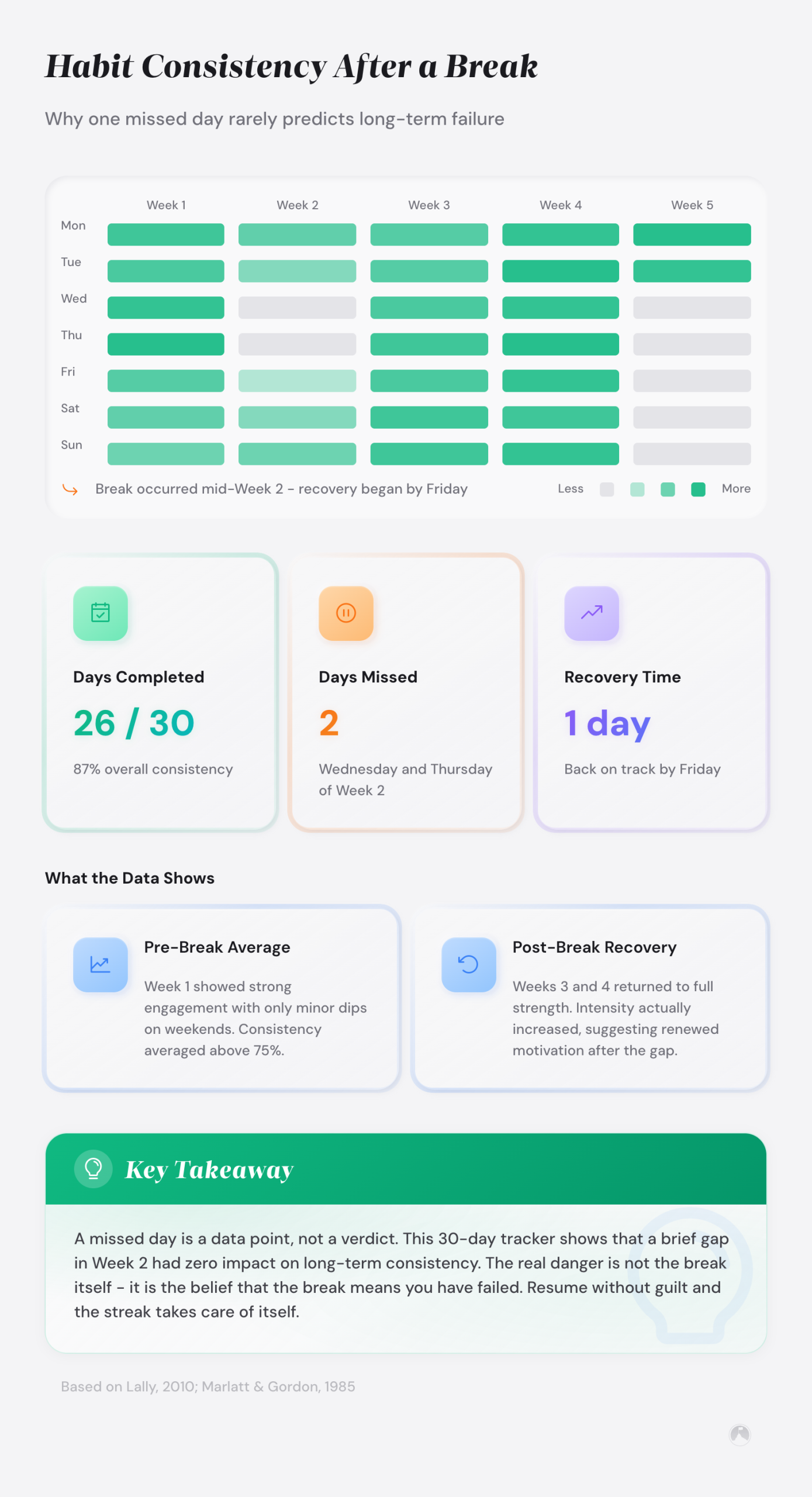
Recovering from a broken habit does not require starting over because a single missed day has no meaningful effect on the habit formation process. Here’s good news that most habit articles bury: Lally’s research found that missing a single day did not meaningfully affect the habit formation process [4]. The streak is less important than the pattern. And yet people treat a missed day like a total reset. They think “I’ve ruined it” and abandon the habit entirely.
This all-or-nothing thinking is one of the common reasons habits don’t stick long-term. Psychologists distinguish between a lapse (a single missed day) and a relapse (return to old pattern). Marlatt and Gordon identified what they call the abstinence violation effect – the tendency to interpret one slip as total failure [11]. This catastrophic thinking, not the slip itself, is what causes actual relapse. One bad day becomes permission to quit.
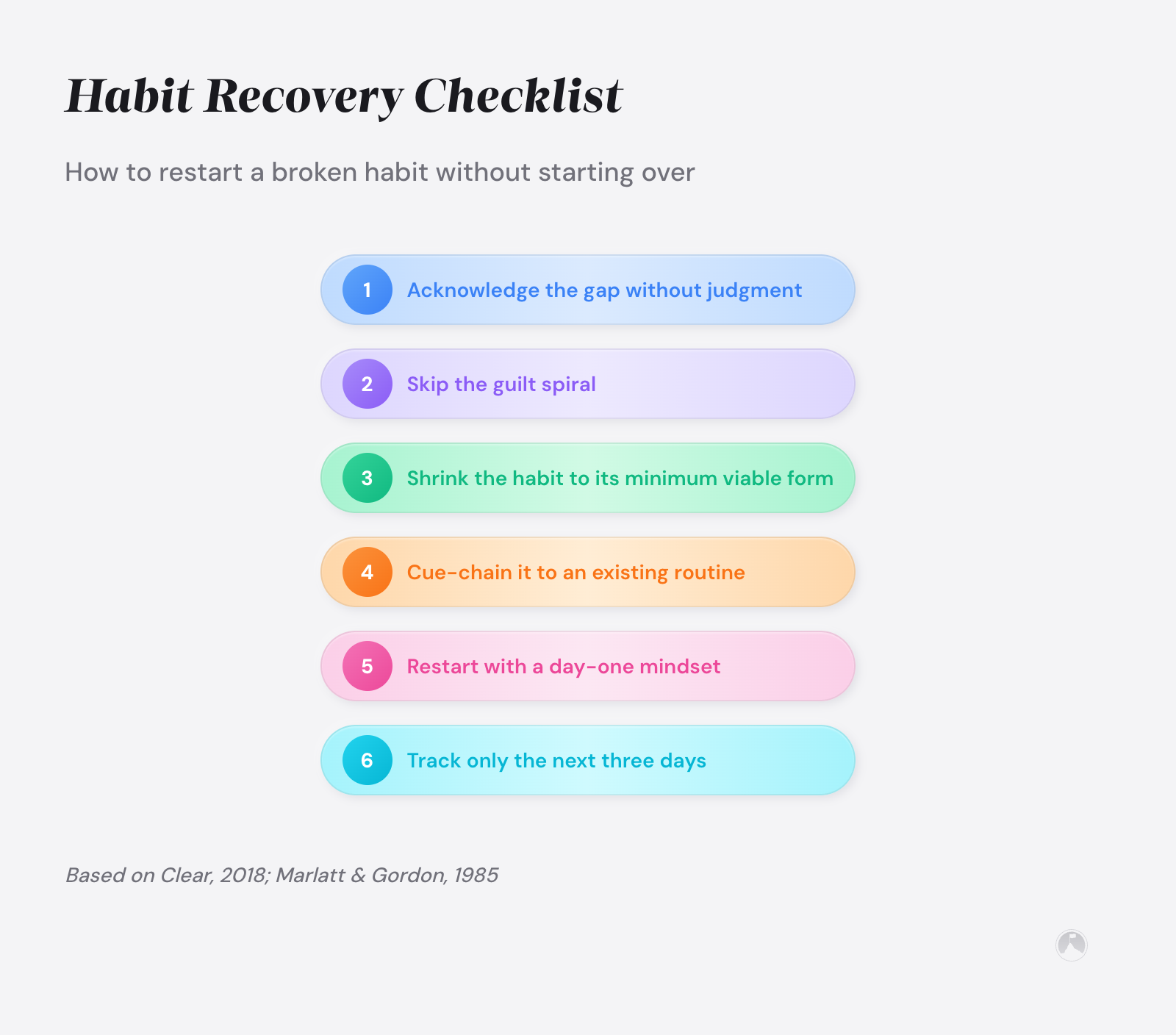
Knowing how to recover from broken habits is simpler than most people expect. Do the habit once, at any scale, as soon as possible after the miss – not to “make up” for the gap but to send your brain a signal that the pattern continues. A runner who missed two days doesn’t need a five-mile “catch-up” run. They need a ten-minute walk. Recovery from a broken habit streak requires one repetition, not a recommitment ceremony.
Each repetition, no matter how small, deposits another piece of evidence into your identity account. Miss a day? One small repetition the next day keeps the growth mindset narrative alive: “I’m still someone who does this.”
Ramon’s take
Two weeks in and motivation’s gone? That’s not failure, that’s just the timeline. I haven’t tested this personally but apparently that’s the exact point where excitement wears off and habit hasn’t kicked in yet. Keep going, just smaller.
Conclusion
Knowing why habits fail changes the entire approach to building them. The answer isn’t more discipline, better apps, or stricter accountability – the answer is alignment: matching the habit to your identity, your environment, and your current capacity. When those three line up, habits don’t need to be forced. When they’re misaligned, no amount of motivation will save them.
The question was never “how do I stick to this habit?” The question is: “Does this habit fit who I’m becoming?”
Next 10 minutes
- Pick one habit that recently failed. Ask yourself: does this match who I believe I am, or who I think I should be?
- Identify one environmental change that would make your target habit easier.
This week
- Shrink your failed habit to the smallest possible version and do it for five days.
- Notice the identity story you tell yourself when you miss a day. Is it true, or is it a pattern?
Related articles in this guide
Frequently asked questions
What is the number one reason habits fail?
Identity misalignment. When a new behavior contradicts your self-concept, your brain generates resistance through procrastination, rationalization, and forgetting. Fixing the identity gap – not adding more willpower – is what makes habits stick.
How long does it really take to form a habit?
Phillippa Lally’s research found an average of 66 days, with a range of 18 to 254 days depending on the person and behavior [4]. The popular 21-day claim has no scientific basis. For more on this, see our guide on how long it really takes to form a habit.
Does missing one day ruin a habit?
No. Research shows that missing a single day does not meaningfully affect the habit formation process [4]. The real danger is all-or-nothing thinking – interpreting one miss as total failure and quitting entirely.
Is willpower or environment more important for habits?
Environment. Research shows that successful habit-builders aren’t more disciplined – they structure their surroundings so the right behavior is the path of least resistance [5]. A practical test: if maintaining your habit requires more than two active decisions each time, the environment needs redesigning before your willpower does.
How do I recover from a broken habit streak?
Do the smallest possible version of the habit within 24 hours of the miss. Research on the abstinence violation effect [11] shows that interpreting one miss as total failure – not the miss itself – is what causes actual relapse. Reframe the day after as a data point (‘I missed one day in thirty’) rather than a verdict (‘I failed’). The scale does not matter; the signal to your brain does.
Why do I keep self-sabotaging my habits?
Self-sabotage in habit formation is usually unconscious identity protection. When a new behavior conflicts with your self-concept, your brain defends the existing identity through procrastination and excuses. Shrink the habit until it doesn’t trigger this defense response.
References
[1] Oscarsson, M., Carlbring, P., Andersson, G., & Rozental, A. “A large-scale experiment on New Year’s resolutions: Approach-oriented goals are more successful than avoidance-oriented goals.” PLOS ONE, 15(12), e0234097, 2020. DOI
[2] Clear, J. Atomic Habits: An Easy & Proven Way to Build Good Habits and Break Bad Ones. Avery, 2018.
[3] Wittmann, B. C., Schott, B. H., Guderian, S., Frey, J. U., Heinze, H. J., & Duzel, E. “Reward-related FMRI activation of dopaminergic midbrain is associated with enhanced hippocampus-dependent long-term memory formation.” Neuron, 45(3), 459-467, 2005. DOI
[4] Lally, P., van Jaarsveld, C. H. M., Potts, H. W. W., & Wardle, J. “How are habits formed: Modelling habit formation in the real world.” European Journal of Social Psychology, 40(6), 998-1009, 2010. DOI
[5] Norcross, J. C., Mrykalo, M. S., & Blagys, M. D. “Auld lang Syne: Success predictors, change processes, and self-reported outcomes of New Year’s resolvers and nonresolvers.” Journal of Clinical Psychology, 58(4), 397-405, 2002. DOI
[6] Oyserman, D., & Destin, M. “Identity-based motivation: Implications for intervention.” The Counseling Psychologist, 38(7), 1001-1043, 2010. DOI
[7] Festinger, L. A Theory of Cognitive Dissonance. Stanford University Press, 1957.
[8] Hoyle, R. H., & Sherrill, M. R. “Future orientation in the self-system: Possible selves, self-regulation, and behavior.” Journal of Personality, 74(6), 1673-1696, 2006. DOI
[9] Hagger, M. S., & Chatzisarantis, N. L. D. “It is premature to regard the ego-depletion effect as ‘too incredible’: Commentary on Carter and McCullough (2013).” Frontiers in Psychology, 5, 298, 2014. DOI
[10] Drive Research. “New Year’s Resolutions Statistics.” Drive Research Market Research Blog, 2025. Link
[11] Marlatt, G. A., & Gordon, J. R. Relapse Prevention: Maintenance Strategies in the Treatment of Addictive Behaviors. Guilford Press, 1985.