
Why the Standard “Find a Buddy” Advice Keeps Failing
Uncommon accountability systems exist because the typical setup fails. You told a friend about your new habit, texted updates for a week, and then both of you quietly stopped mentioning it. A 2015 study by Dr. Gail Matthews found that people who shared weekly progress with a friend achieved their goals 76% of the time, compared to 43% for those who kept goals private [1]. But most people never set up the “weekly progress” part. They just announce a goal and call it accountability.
Uncommon accountability systems work differently. They rely on behavioral economics, loss aversion, and social psychology to create structures that hold up when motivation fades. If you have searched for accountability for habits and found only generic advice, these systems offer something different. Commitment contracts with financial stakes made users far more likely to follow through on goals [9]. Financial commitment contracts, body doubling, and anti-charity stakes are not “tell someone your goal” strategies – they are systems with teeth.
Uncommon accountability systems are structured methods of behavior reinforcement that go beyond traditional accountability partners or groups by incorporating financial stakes, public commitments, automated tracking, or social presence to create external consequences for habit adherence and habit failure.
What You Will Learn
- How financial commitment contracts use loss aversion to keep habits on track
- Why public declarations work – and when they backfire
- How body doubling creates accountability through silent presence
- What reverse accountability is and why coaching others strengthens your own habits
- How anti-charity commitments create stronger motivation than standard rewards
- A comparison framework for choosing the right system for your personality
Key Takeaways
- Financial commitment contracts on StickK increase goal success by 60 percentage points over no-stakes commitments [9].
- Public goal announcements can reduce follow-through by creating a premature sense of identity completion [3].
- Body doubling activates social facilitation and reduces task avoidance, especially for people with ADHD [4].
- Anti-charity commitments outperform standard charity-based stakes by about 6 percentage points [9].
- The Accountability Friction Ladder, a goalsandprogress.com framework, matches system intensity to habit difficulty.
- Losses feel roughly twice as painful as equivalent gains, making loss-framed systems more motivating [5].
- Pre-planned “if-then” rules for when and how to act, paired with accountability, show medium-to-large effects on goal follow-through [6].
How do financial commitment contracts change habit behavior?
Financial commitment contracts are agreements where you put real money on the line – and lose it if you don’t follow through. The idea is rooted in precommitment psychology, where your present self binds your future self to a course of action. Platforms like StickK and Beeminder let you set up these contracts digitally.
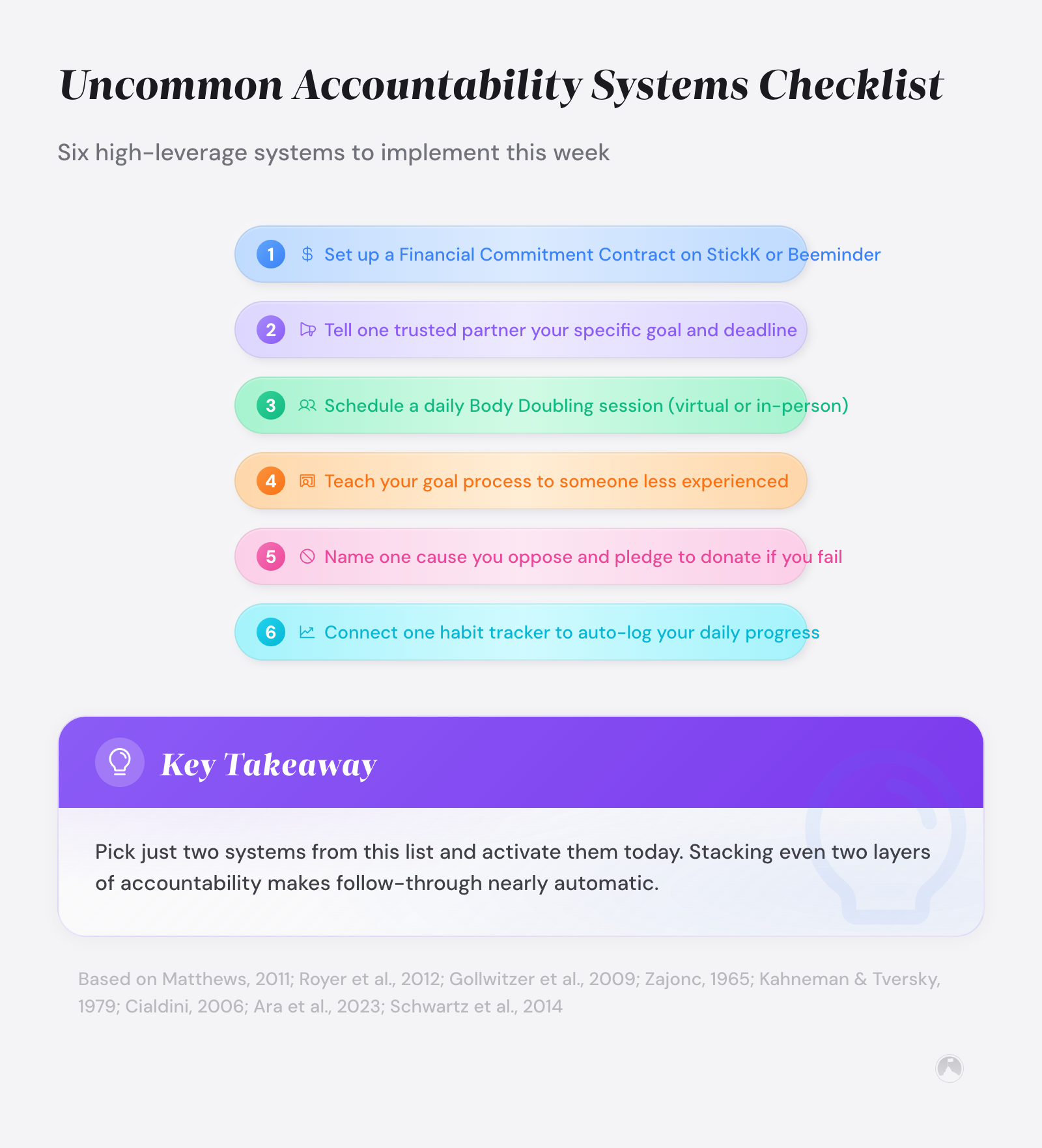
Financial commitment contracts on platforms like StickK increase reported goal success rates by 60 percentage points compared to contracts without monetary stakes [9]. The gap between “I’ll try” and “I’ll lose $50 if I don’t” turns out to be enormous – and Kahneman and Tversky’s prospect theory explains why: losses loom roughly twice as large as equivalent gains [5].
Beeminder tracks your data continuously on what they call a “Bright Red Line” – the first derailment costs $5, the second $10, and it escalates from there. One caveat: less than 33% of StickK users actually set monetary stakes [9]. If you’re going to use a commitment contract, pick an amount that genuinely hurts to lose.
Public declaration accountability – when does sharing goals actually help?
Public declarations seem like they should work perfectly. But psychologist Peter Gollwitzer found something counterintuitive: when people announced identity-relevant goals publicly and received acknowledgment, they actually worked less hard toward those goals [3].
“When identity-relevant behavioral intentions had been noticed by other people, they were translated into action less intensively than those that had been ignored.” [3]
When other people acknowledge a stated intention to change, the brain registers a premature sense of identity completion, making the actual behavior feel less necessary.
So should you keep goals secret? Not exactly. Robert Cialdini’s consistency principle suggests that public commitments do increase follow-through, but the commitment needs to be framed around specific actions, not identity labels [7]. “I will run three times this week” creates a checkable obligation. “I’m becoming a runner” gives you credit just for saying it.
How does body doubling create accountability through silent presence?
Body doubling is the practice of working alongside another person – not collaborating, not talking, just being present in the same space. Robert Zajonc’s 1965 social facilitation research showed that the mere presence of others improves performance on familiar tasks [4]. Building habits with ADHD often requires environmental structure, and body doubling provides exactly that.
Body doubling activates social facilitation – the performance boost people get from another person’s presence – without requiring conversation, collaboration, or direct interaction. Platforms like Focusmate pair users for 50-minute video coworking sessions. A 2025 preprint found that participants completed tasks faster with both human and AI body doubles than when working alone, though this study involved only 12 participants and has not yet undergone peer review [8].
The limits matter too. Social presence improves simple or well-learned tasks but can impair performance on complex or unfamiliar ones [4]. If you’re filing emails or running, a body double helps. But if you’re learning something new and difficult, the added arousal might work against you.
Reverse accountability: why coaching someone else strengthens your own habits
Reverse accountability is a method where a person holds someone else accountable for a habit they are also building, generating internal motivation through the cognitive dissonance of advising behavior they do not yet practice consistently. Most accountability flows in one direction: someone holds you accountable. Reverse accountability flips this. Your brain works to resolve the gap between what you preach and what you practice [7].
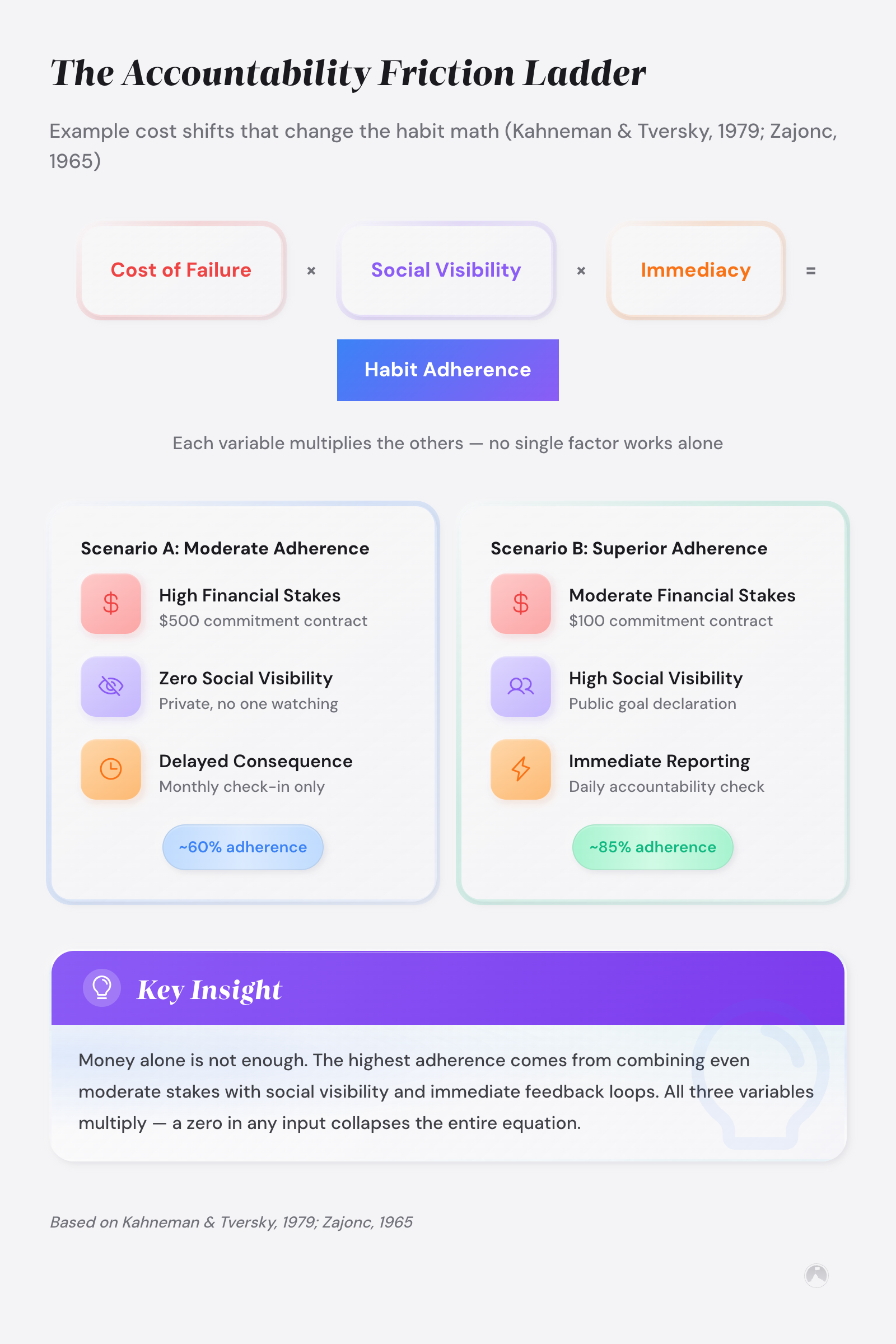
This pairs well with habit stacking, where you attach the coaching check-in to an existing routine. Research on implementation intentions – pre-planned “if-then” rules that specify when, where, and how you will act – shows medium-to-large effects on follow-through [6]. The best pairings involve people at roughly the same difficulty level.
A reverse accountability check-in takes five minutes. Each person shares what they committed to, whether they did it, and what they are committing to next. Asking your partner about their habit forces you to confront whether you followed through on your own. If you skipped but still checked on your partner, the dissonance is immediate – which is the point. Start with three check-ins per week for 14 days.
Why do anti-charity commitments produce stronger habit accountability than standard rewards?
An anti-charity commitment is a habit accountability contract where forfeited money goes to an organization the user actively opposes, combining financial loss with values conflict to produce stronger motivation than standard charity-based penalties. Standard charity commitments have a flaw: part of you doesn’t mind losing the money. Anti-charity commitments remove that comfort entirely.
Users who chose anti-charity destinations on StickK were about 6 percentage points more likely to succeed than those who chose a charity or friend as recipient [9]. Anti-charity commitment contracts outperform standard charity-based stakes for habit accountability, turning the pain of losing money into something personally offensive rather than merely wasteful.
A word of caution: start with $10 or $20 and increase only after you’ve proven the system works at a lower intensity. If the stakes feel so high that you avoid checking your progress, the system has backfired.
How do automated tracking tools remove the weakest link in accountability?
Automated habit accountability tools remove self-reporting bias by connecting directly to data sources, making the system harder to cheat and more reliable than manual check-ins. Habit tracking apps like Beeminder connect to Fitbit, Duolingo, GitHub, and RescueTime, pulling data without your involvement.
Time-locked contracts add another layer: some tools let you set a contract that can’t be canceled for a fixed period. This maps onto the broader habit formation process, where the first two to three weeks are often when enthusiasm fades and new habits are most vulnerable to collapse.
The Accountability Friction Ladder
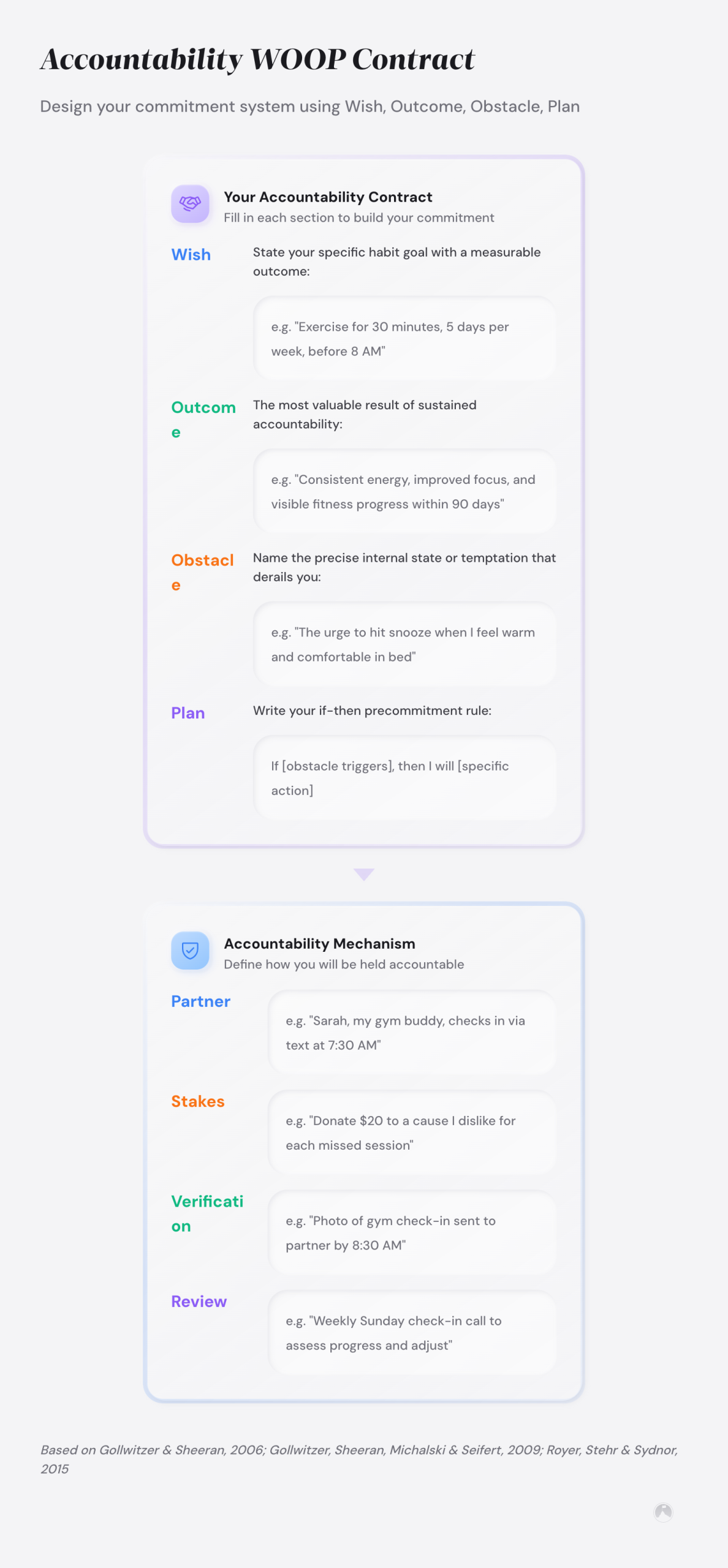
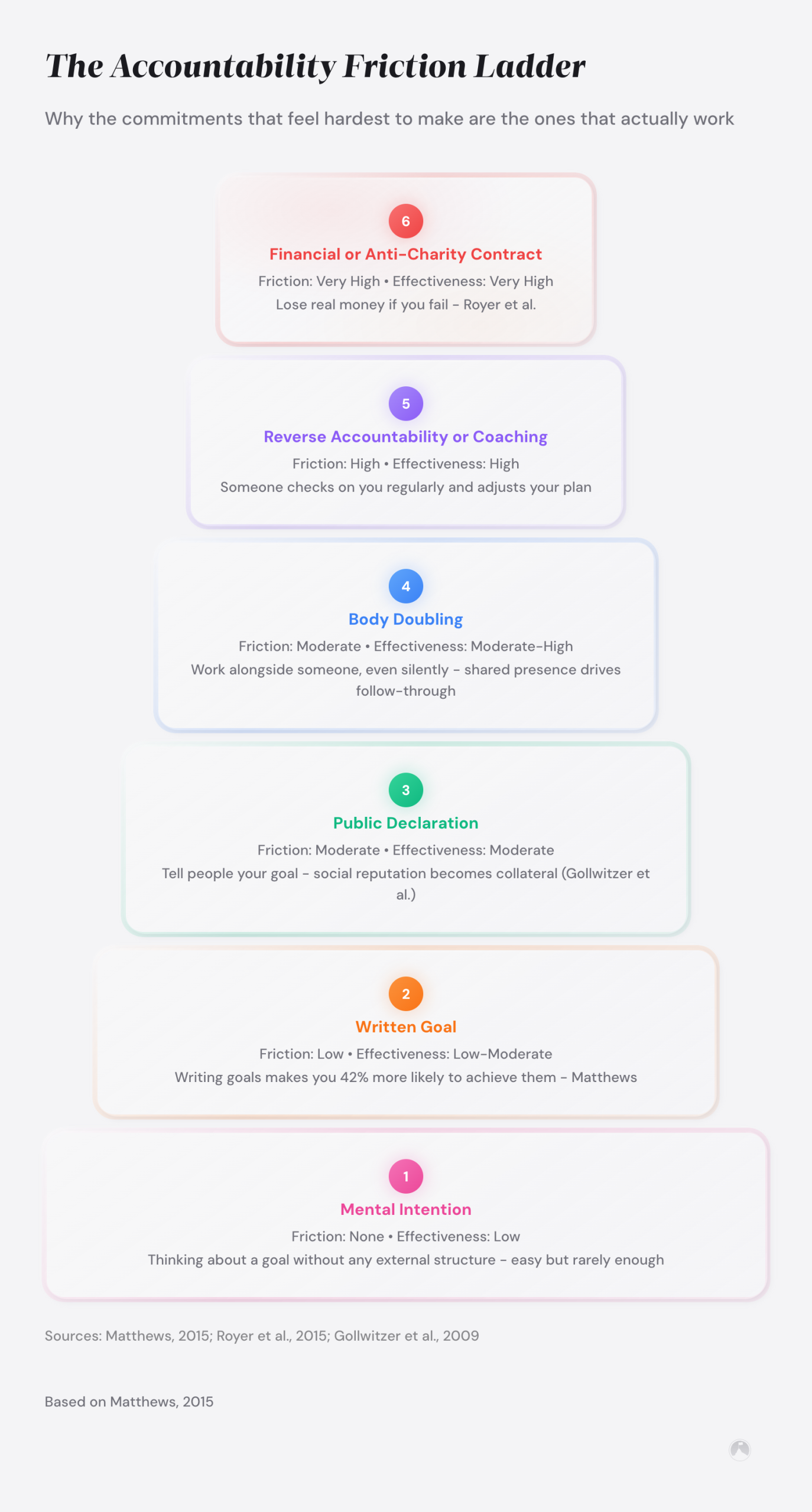
We call this the Accountability Friction Ladder – a goalsandprogress.com framework for matching the right accountability system to your habit’s difficulty. A habit you enjoy needs a gentle nudge. A habit you actively resist needs real consequences.
Friction matching works because under-matched accountability fails to override the existing avoidance pattern – a $5 penalty will not stop you from skipping a habit you genuinely dread. Over-matched accountability triggers “ostrich behavior”: avoiding the tracking system itself because the stakes feel threatening rather than motivating. The right zone creates enough discomfort to act but not enough to flee.
| Friction Level | Accountability Method | When to Use |
|---|---|---|
| Level 1 – Low | Habit tracker app (self-report) | Habits you enjoy but forget (daily reading, stretching) |
| Level 2 – Mild | Body doubling / virtual coworking | Habits that need task initiation help (writing, deep work sessions) |
| Level 3 – Medium | Public declaration to specific person | Habits with moderate resistance (exercise, meal prep) |
| Level 4 – High | Financial commitment contract | Habits you actively avoid (early wake-ups, cold exposure) |
| Level 5 – Maximum | Anti-charity commitment + referee | Habits with strong resistance or past failure (quitting smoking, daily meditation) |
The Accountability Friction Ladder matches system intensity to habit difficulty – low-friction methods for easy habits, high-stakes systems for habits with strong internal resistance. The question is not whether you need accountability – it is which self-accountability method matches your specific resistance pattern. You don’t need a $100 anti-charity contract to remember your vitamins. And you probably won’t sustain a difficult new habit with just a checkbox app. Match the tool to the task.
Uncommon accountability systems: how to choose the right one for you
Not every creative accountability method works for every person. Your personality and past failures both factor into which system will hold.
| System | Cost | Fit & Risk |
|---|---|---|
| Financial contracts (StickK) | $5-$100+ per failure | Loss-averse, competitive – risk: avoidance if stakes too high |
| Public declarations | Free | Extroverted, reputation-conscious – risk: premature identity completion [3] |
| Body doubling | Free to $10/month | ADHD, task-initiation struggles – risk: only works for familiar tasks [4] |
| Reverse accountability | Free | Natural coaches, teachers – risk: partner mismatch |
| Anti-charity contracts | $10-$100+ per failure | Values-driven, stubborn – risk: anxiety if amounts too large |
| Automated tracking | Free to $15/month | Data-oriented, tech-comfortable – risk: over-optimizing metrics |
Accountability System Finder
Answer these three questions to find your starting point:
1. What stopped your habit last time?
- I forgot to do it – Automated tracking (Level 1-2)
- I couldn’t get started – Body doubling (Level 2)
- I lost motivation after week two – Financial contract (Level 4)
- I talked about it but never followed through – Reverse accountability (Level 3)
2. How do you respond to losing money?
- It would genuinely bother me – Financial or anti-charity contracts work well for you
- I’d shrug it off – Skip financial methods, try body doubling or public commitments
3. Do you have someone working on a similar habit?
- Yes – Start with reverse accountability and add financial stakes if needed
- No – Virtual body doubling (Focusmate) or solo financial contracts
The research on accountability psychology is consistent: the best system creates the right amount of friction for your situation. Too little and you ignore it. Too much and you avoid it. Start one level above where you think you need to be. If your habits keep failing, move up.
Ramon’s Take
Reverse accountability is the sleeper hit here. Teaching someone else the habit you want to build? I haven’t tested it yet, but that’s a sneaky workaround. Does it count as cheating if it actually works?
What actually moved the needle was putting $25 on the line through Beeminder for a daily writing habit. That small, annoying penalty kept me going on days when no human being would have checked on me. The first time I paid a $10 derailment fee for missing a day, I felt a specific kind of irritation that no motivational quote has ever produced.
I don’t think financial stakes work for everything – they’re terrible for creative habits where quality matters more than quantity. And I’ve noticed they lose their bite after about three months if you don’t increase the amount. But for habits where the bottleneck is just showing up, money talks in a way that good intentions don’t. The Accountability Friction Ladder came from my own trial-and-error across at least a dozen failed systems before finding the right match for each habit on my list.
Uncommon Accountability Systems Conclusion: Your Next Move
Uncommon accountability systems work not by making habits easier, but by making habit failure more costly. Financial contracts, body doubling, anti-charity commitments, and reverse accountability each create different external pressure. The Accountability Friction Ladder gives you a way to match intensity to need instead of guessing.
The habit that keeps defeating you probably doesn’t need more motivation. It needs more structure around the moments when motivation disappears.
Next 10 Minutes
- Pick one habit that has failed at least twice and identify what stopped you (forgetting, motivation loss, or avoidance)
- Use the Accountability System Finder above to identify your starting friction level
- Create a free account on StickK or Beeminder and browse commitment options
This Week
- Set up one commitment contract with a financial stake you’d genuinely dislike losing
- Try one virtual body doubling session on Focusmate to test if social presence helps your focus
- Find one person working on a similar habit and propose a two-way reverse accountability check-in for 14 days
There is More to Explore
For designing the right incentives after you complete a habit, read our guide on habit reward systems. If your accountability struggles connect to tracking methods that reduce executive function burden, our habit tracking methods guide covers practical options. For goal tracking with a partner, check out accountability partner strategies.
Related articles in this guide
Frequently Asked Questions
Do financial commitment contracts for habits actually work or do people just cheat?
Financial commitment contracts show strong results when the system includes verification mechanisms. On StickK, users can assign a referee – a friend or colleague who confirms whether the commitment was met – which reduces self-reporting bias. Beeminder takes this further by pulling data directly from fitness trackers, GitHub, Duolingo, and productivity apps, making it nearly impossible to cheat without also deceiving the data source.
How much money should I put at stake in a commitment contract for a new habit?
Start with an amount that causes mild discomfort to lose – typically $10 to $25 per week for most people. The stake needs to be large enough that you notice but not so large that you avoid setting up the contract entirely. Research on loss aversion suggests even small financial penalties outperform no penalties at all [5]. Increase the amount only after you have tested the system for at least two weeks.
Can body doubling work virtually or does it require being in the same room?
Virtual body doubling works for many people. Platforms like Focusmate connect users over video for structured 50-minute sessions with a brief check-in at the start and end. The key mechanism is social facilitation through perceived presence, which can function through a screen. In-person proximity tends to produce stronger effects for task initiation, but virtual sessions have the advantage of scheduling flexibility and access to a larger pool of accountability partners across time zones.
Why does telling people about my goals sometimes make me less likely to achieve them?
Publicly announcing identity-relevant goals can create a premature sense of completion, where the social acknowledgment itself partially satisfies the drive to change [3]. The workaround is to share specific action commitments rather than identity statements – say ‘I will run three miles every Tuesday and Thursday at 7 AM’ instead of ‘I am becoming a runner.’ Process-focused sharing gives others a checkable obligation to hold you to, while identity-focused sharing gives your brain credit for something you have not done yet.
What accountability system works best for ADHD habit building?
Body doubling is the most ADHD-friendly accountability method for habit building. It provides external structure without requiring willpower-dependent check-ins or self-reporting. Virtual coworking platforms offer scheduled sessions that help with task initiation, which is often the biggest barrier for people with ADHD [4]. Automated tracking through apps that connect to data sources reduces the executive function burden of manual habit logging.
How is reverse accountability different from having a regular accountability partner?
Reverse accountability puts you in the coaching role rather than the coached role. Instead of someone checking on your progress, you check on theirs for a habit you are building too. This activates Cialdini’s consistency principle – giving advice you do not follow yourself creates cognitive dissonance that motivates your own behavior change [7]. Regular accountability partners track your progress externally. Reverse accountability generates internal pressure through the gap between your advice and your actions.
References
[1] Matthews, G. “Goals Research Summary.” Presented at the 9th Annual International Conference of the Psychology Research Unit, Athens Institute for Education and Research (ATINER), May 2015. Dominican University of California. Link
[2] Royer, H., Stehr, M., and Sydnor, J. “Incentives, Commitments, and Habit Formation in Exercise.” American Economic Journal: Applied Economics, 7(2), 51-84, 2015. DOI
[3] Gollwitzer, P.M., Sheeran, P., Michalski, V., and Seifert, A.E. “When Intentions Go Public: Does Social Reality Widen the Intention-Behavior Gap?” Psychological Science, 20(5), 612-618, 2009. DOI
[4] Zajonc, R.B. “Social Facilitation.” Science, 149(3681), 269-274, 1965. DOI
[5] Kahneman, D. and Tversky, A. “Prospect Theory: An Analysis of Decision under Risk.” Econometrica, 47(2), 263-292, 1979. DOI
[6] Gollwitzer, P.M. and Sheeran, P. “Implementation Intentions and Goal Achievement: A Meta-Analysis of Effects and Processes.” Advances in Experimental Social Psychology, 38, 69-119, 2006. DOI
[7] Cialdini, R.B. Influence: The Psychology of Persuasion. Harper Business, 2006. ISBN: 978-0-06-124189-5.
[8] Ara, Z., Bin Rahim, I., Zhou, P., Yu, L., Esmaeili, B., Yu, L.F., and Hong, S.R. “You Are Not Alone: Designing Body Doubling for ADHD in Virtual Reality.” arXiv:2509.12153, 2025. Link
[9] Schwartz, J., Mochon, D., Wyper, L., Maroba, J., Patel, D., and Ariely, D. “Choosing more aggressive commitment contracts for others than for the self.” Judgment and Decision Making, 18, e18, 2023. DOI