
Why career ladders are dead (and what replaces them)
You’ve probably made good individual career decisions. A smart move to a new team. A project that taught you something valuable. Maybe a course that opened a door. But looking back, do these decisions add up to a coherent trajectory? Or do they feel more like a random walk through your industry?
The disconnect between good individual decisions and a coherent trajectory is the gap strategic career planning frameworks solve. Without intentional planning, individual moves don’t create a coherent career direction. Research published in IntechOpen found that career development opportunities directly correlate with job satisfaction – professionals with structured development paths report stronger satisfaction and lower turnover than those making ad-hoc decisions [1]. And the traditional “climb the ladder” model doesn’t work the way it used to, because as organizational structures have flattened, modern career progression frameworks now follow multiple directions rather than one straight vertical line [2].
The guide below walks you through three career pathing framework models that work together as an integrated system: the dual-track model (for choosing your direction), the 70-20-10 model (for designing development), and competency-based planning (for deciding what to learn). You’ll have a concrete plan by the end.
Strategic career planning frameworks are structured systems for intentionally designing a multi-year career trajectory by choosing a direction between individual contributor and management paths, developing specific capabilities in a disciplined sequence, and regularly assessing progress against a clear definition of success.
Dual-track career framework is an organizational and personal planning model that creates two equally prestigious career paths (individual contributor track and management track) so professionals can advance without being forced into management roles they don’t want.
Individual contributor (IC) track is a career progression path where professionals advance through deepening technical or domain expertise rather than managing teams, typically progressing through titles like Senior, Staff, and Principal.
What you will learn
- How the dual-track career framework removes the false choice between management and expertise
- Why the 70-20-10 career development model works better than heavy investment in courses alone
- The three-step competency mapping process that tells you exactly what to develop next
- How to integrate all three frameworks into a 90-day action plan using the Career Growth Alignment Matrix
- What to do when your planned path becomes irrelevant or blocked
Key takeaways
- Career frameworks replace guessing with structure: you identify your direction, design learning, and target capabilities.
- The dual-track framework lets you choose between deep expertise or broad leadership – both are legitimate paths.
- The 70-20-10 rule (70% on-the-job, 20% mentoring, 10% formal study) prevents wasting money on courses alone [4].
- Competency-based career planning turns abstract goals into concrete, measurable development targets.
- The three frameworks work together through the Career Growth Alignment Matrix: your track choice informs competencies, which shapes learning allocation.
- Strategic planning gives professionals a coherent career narrative that replaces the outdated ladder model [2].
Step 1: make the dual-track choice (direction)
Before you can use any career planning framework effectively, you need to answer one foundational question: are you building toward breadth of impact (management) or depth of expertise?
The dual-track career framework recognizes that organizations need both roles and that they’re genuinely different paths. Academic research on dual career ladders, published in Wiley’s Major Reference Works, confirms that organizations using dual-track systems report higher retention of technical talent and better organizational outcomes when both tracks carry equivalent advancement opportunities [2].
Companies like Buffer have formalized this by publishing career frameworks with two equally prestigious ladders: one for makers (individual contributors) and one for managers [3]. The dual-track model also applies beyond technology. In healthcare, the IC track might progress from Clinical Specialist to Subject Matter Expert, while the management track goes from Team Lead to Department Director. In finance, senior individual contributors often hold titles like Managing Director without managing teams.
The IC track looks like: Software Engineer to Senior Engineer to Staff Engineer to Principal Engineer. You’re deepening technical mastery, solving increasingly difficult problems, and becoming the expert others rely on. The management track looks like: Team Lead to Manager to Senior Manager to Director. You’re building team capability, setting strategy, and multiplying your impact through others. Will Larson’s research into senior IC roles at major technology companies (documented at staffeng.com) shows these IC-track positions include mentoring, influence without authority, and setting technical direction – distinct from people management [3].
The critical insight: the IC track and management track are not interchangeable paths, and your strengths should determine which one fits. Do you light up when solving technical problems or when developing people? Do you want to write code or code reviews? Do you want to be consulted on approach or accountable for outcomes?
The dual-track choice between IC and management shapes everything downstream. If you’re IC-track, your 70-20-10 learning allocates time very differently than if you’re management-track. So spend real time on this choice. It’s not permanent (you can switch tracks) but switching costs credibility and time. Get clear on what energizes you before you commit to developing toward it. For a broader comparison of advancement models, see our guide on comparing career advancement strategies.
The best career decision you can make is choosing which track to commit to – before choosing what to learn.
Step 2: apply the 70-20-10 career development model (development allocation)
Once you know your track, the 70-20-10 model tells you how to structure your development year.
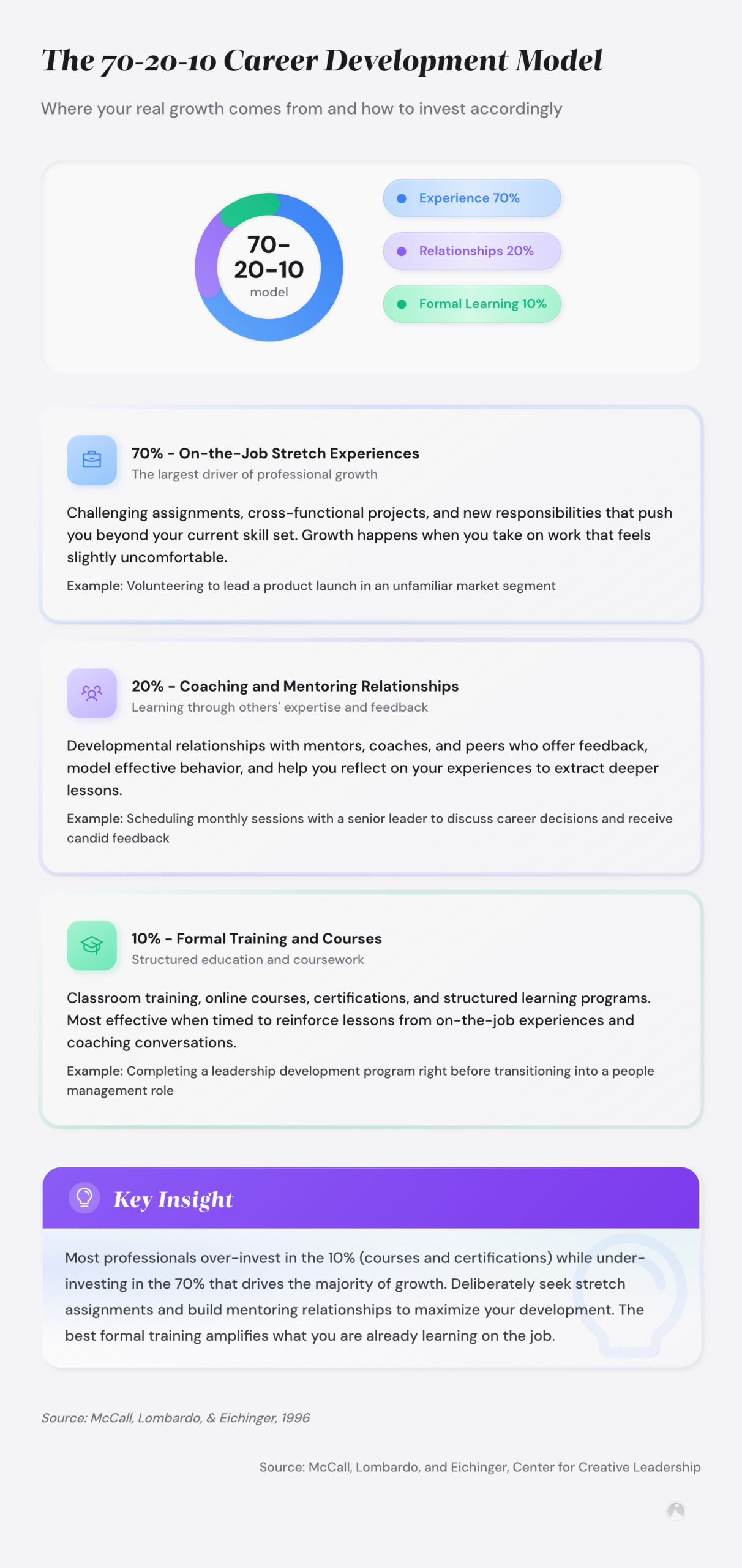
70-20-10 career development model is a learning allocation framework proposing that 70% of professional skill development comes from on-the-job experience, 20% from mentoring and feedback relationships, and 10% from formal education, based on research with executives at the Center for Creative Leadership.
Morgan McCall, Michael Lombardo, and Robert Eichinger at the Center for Creative Leadership discovered through research with 191 executives that professionals develop skills through a 70-20-10 split: 70% from challenging work assignments, 20% from relationships and mentoring, and 10% from formal education [4]. The ratio originates from survey data (not experimental research), and the percentages are meant as architecture, not prescription.
But the principle is what matters: most professionals invert this allocation. They take lots of courses – maybe 40-50% formal study – while the on-the-job learning that actually drives growth never happens because they’re not intentional about it.
According to McCall and colleagues at the Center for Creative Leadership, the 70-20-10 model works as architecture rather than prescription – the principle being that career growth is driven primarily by work experience and mentoring relationships, not coursework alone [4].
The 70-20-10 career development model prevents professionals from over-investing in formal education while neglecting the on-the-job experience that drives 70% of skill growth.
The growth happens at work. Here is how to apply the 70-20-10 model practically.
For the 70% (on-the-job learning): identify one significant stretch assignment aligned with your track. If you’re IC-track seeking Principal Engineer status, maybe it’s owning the architecture for a critical system. If you’re management-track developing executive presence, maybe it’s leading a cross-functional initiative with high political complexity. The assignment should be difficult enough that you’re uncertain you can do it, but achievable with focus.
For the 20% (relationships and coaching): find two mentoring relationships. One inside your organization (ideally someone two levels above where you want to go). One outside (someone who has the role you aspire to). Schedule quarterly 1:1s to discuss your progress, get feedback, and think through obstacles. Quarterly mentoring is not therapy – mentoring provides deliberate access to pattern recognition from someone who’s already done what you’re attempting.
For the 10% (formal education): identify 2-3 specific capability gaps that classes or certifications actually address well. Maybe it’s a language, a technical credential, or a skill your role requires. Don’t take random courses. Take courses that close identified gaps in service of your track.
According to an ATD-reported CYPHER Learning study, 70% of workers feel their organization’s learning and development could be improved, and 44% of workers aged 18-34 are considering leaving their jobs due to insufficient L&D opportunities [5].
You cannot develop deep expertise by taking courses. You develop it by doing hard work while receiving feedback from people who’ve done it before. For deeper exploration of how learning connects to development, see our article on career development psychology research.
Step 3: map your competencies using a skills-based career planning approach
You now know your track (Step 1) and how you’ll learn (Step 2). Step 3 tells you what specifically to develop.
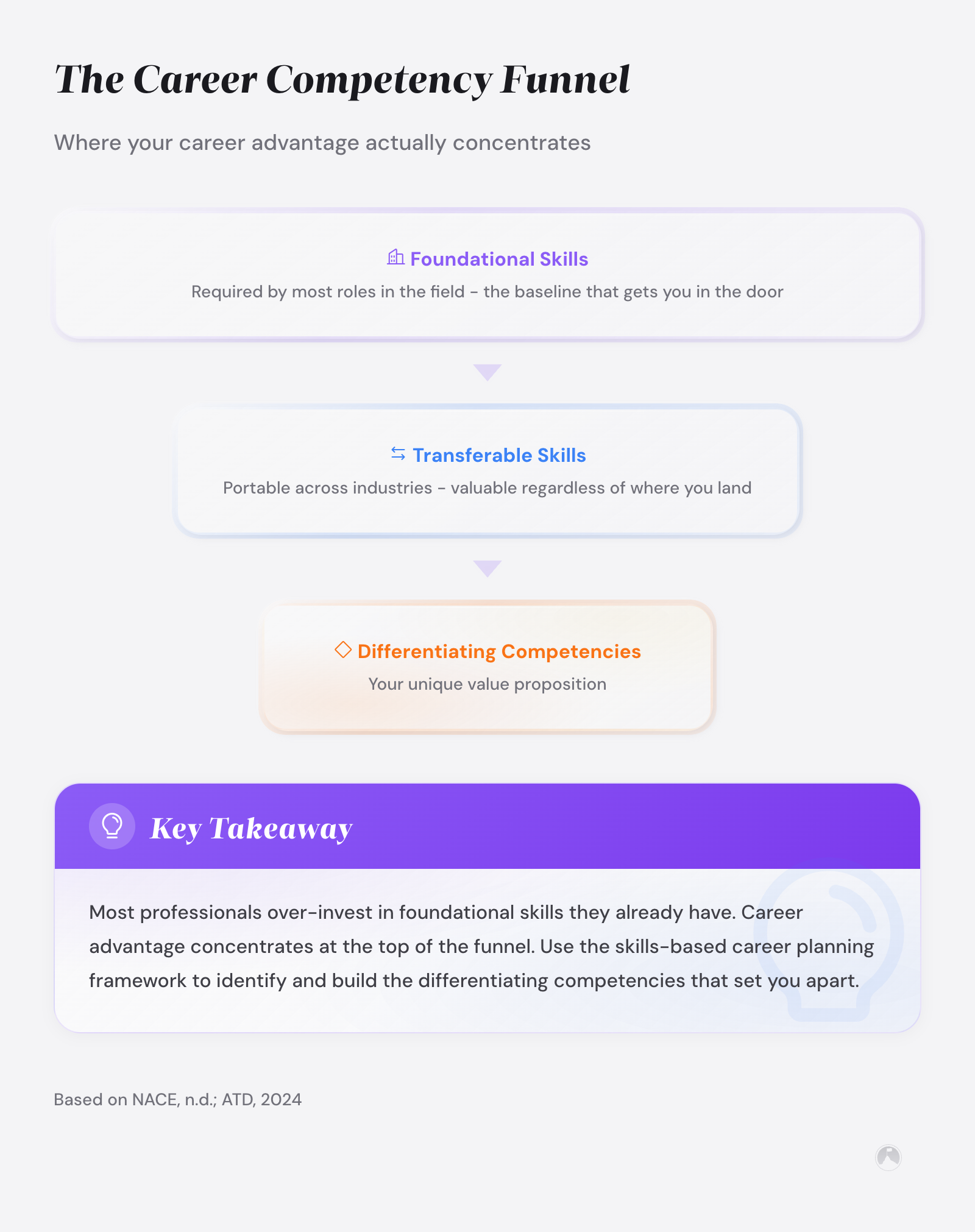
Competency-based career planning is a development approach that replaces job-title-based goals with specific, measurable capability targets, allowing professionals to identify gaps, sequence learning, and track progress against defined skill benchmarks.
Competency-based career planning replaces vague ambitions like ‘become a Senior Manager’ with specific, measurable capability targets that can be assessed and developed sequentially. Research on competency-based frameworks (published in ResearchGate) shows they improve career outcomes by making development specific and measurable – organizations using these approaches show better promotion decisions and higher employee satisfaction [6]. Instead of planning “become a Senior Manager,” you plan “develop strategic influence, executive communication, and team scaling.” Those are competencies. You can assess them, develop them sequentially, and measure progress.
Here’s the three-step competency mapping process:
Identify target role competencies. Look at the role two levels above where you are now. What does someone in that role actually need to do? The National Association of Colleges and Employers identifies eight core career readiness competencies, including critical thinking, communication, teamwork, technology, and leadership [7]. Beyond these universal competencies, IC-track and management-track roles require different emphasis areas. For IC-track: technical breadth, systems thinking, mentoring, and influence without authority. For management-track: hiring excellence, strategic planning, team development, and organizational navigation. List 6-8 core competencies for your target role.
Assess your current level. For each competency, rate yourself (or ask a mentor) on a simple scale: novice (never done this), intermediate (done it a few times, still learning), advanced (done it many times, can teach others). Be honest. The gap between where you are and where you need to be tells you what to develop.
Sequence your development. Don’t try to close all gaps simultaneously. Rank the top 3 competencies that will create the most impact. These become your focus for the next 12-18 months. The 70-20-10 model then becomes your execution plan for those specific competencies.
For example, a software engineer seeking Principal Engineer status might identify these competencies: systems architecture, mentoring, cross-team influence, technical communication. Current assessment: advanced in systems architecture, novice in mentoring, intermediate in influence, intermediate in communication.
Development sequence: mentoring first (activate your 20% relationships), then cross-team influence (70% on-the-job learning through projects), then technical communication (10% formal education in presentation skills).
We call this integrated approach The Career Growth Alignment Matrix – the system where your dual-track choice informs your competency focus, which shapes your 70-20-10 learning allocation. The Career Growth Alignment Matrix is not a new invention. The matrix connects three established frameworks so they reinforce each other instead of floating in isolation. The mechanism is sequential dependency: your track choice constrains which competencies matter, and your competency priorities determine how you split learning time across the 70-20-10 buckets. For example, a manager-track professional who identifies “executive communication” as their top gap would allocate 70% to leading high-stakes presentations, 20% to shadowing a VP-level mentor, and 10% to a negotiation course. For related tools, explore our guide on career planning tools and frameworks.
The problem isn’t that you lack a development plan. It’s that your development plan isn’t connected to a direction.
How the three frameworks compare
| Framework | Best For | Limitation |
|---|---|---|
| Dual-Track Model | Choosing career direction (IC vs. management) | Binary choice; misses hybrid roles |
| 70-20-10 Model | Allocating development time | Based on survey data, not experiment |
| Competency-Based Planning | Targeting specific, measurable skills | Requires honest self-assessment |
Step 4: create your 90-day action plan
Theory is great. Action is what creates a career. You now need a simple quarterly plan.
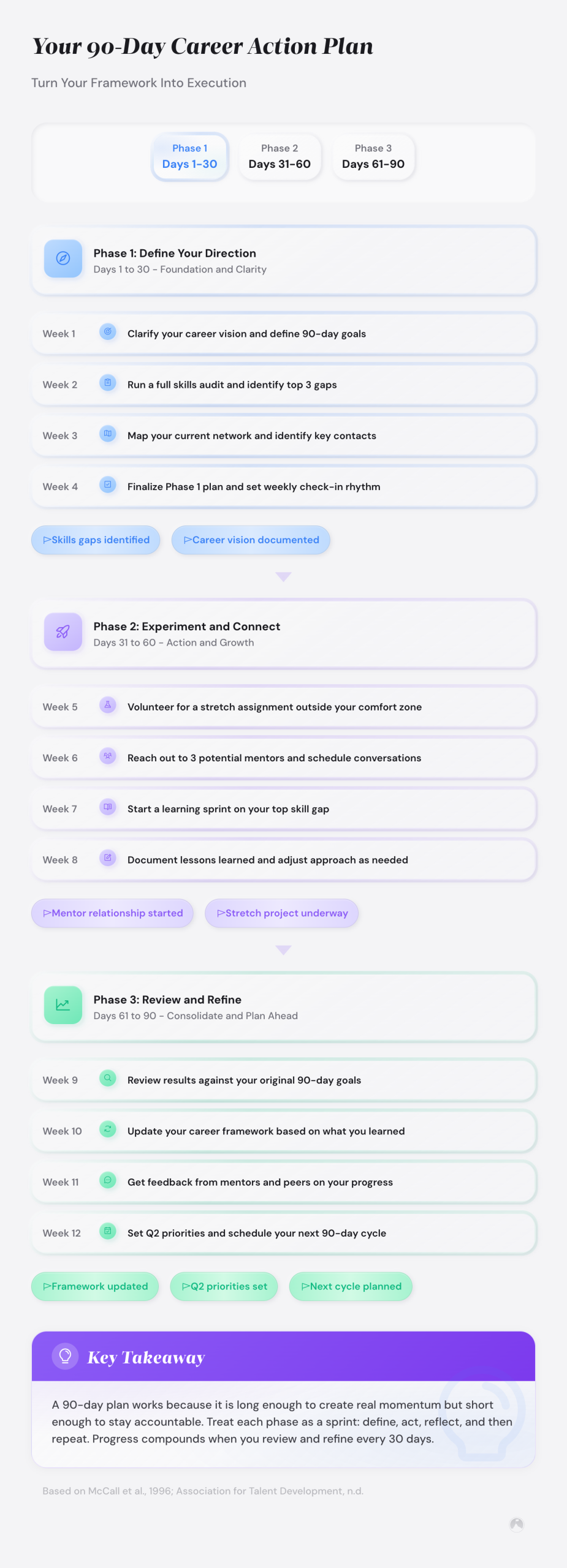
Select your primary stretch assignment (the 70% component). What specific project or responsibility will develop your top-ranked competency? Commit to it with your manager. Make sure they understand this isn’t just work – it’s your intentional development toward a specific goal. Good managers will adjust scope and support once they know what you’re building toward.
Lock in your mentor relationships (the 20% component). Email the two people you’ve identified. Be specific: “I’m focusing on developing [competency]. Would you be willing to do monthly 30-minute calls where I share what I’m working on and get your perspective?” Most people say yes when asked specifically. Don’t ask vaguely.
Identify your formal learning (the 10% component). If it’s a course, register now so it’s non-negotiable. If it’s reading, put the books on your desk. If it’s a credential exam, schedule the test so you have a deadline.
Set a specific success metric. Not “get better at mentoring.” Something like: “Lead mentoring for two junior engineers. Get feedback that I’m unblocking them and teaching them how to think about problems.” Measurable. Specific. Observable by someone else.
This is your 90-day plan. At the end of 90 days, you’ll have clear evidence of whether the 70-20-10 allocation is working for you and whether your competency focus is the right one. For guidance on building a growth-oriented mindset, see our guide on growth mindset development.
A career plan without a deadline is a wish. Give yours 90 days and a success metric.
What happens when plans break (troubleshooting)
Strategic plans work until they don’t. Here are the most common failure modes and what to do.
Strategic career planning frameworks remain useful when plans break because the structure – direction, development allocation, and competency focus – can be redirected without starting over.
Your industry changes and your planned path becomes less relevant. The technology you were building expertise in gets displaced. The management layer you were targeting flattens. When this happens, your framework doesn’t become useless – it becomes more useful. You shift which track or which competencies you’re developing, but you keep the structure. Don’t abandon planning; redirect it. Revisit Step 1 and Step 3. Re-choose your direction given new information. Replan your competencies. See our guide on diagnosing career stagnation for ways to move forward when your path becomes blocked.
Your company doesn’t support your development. You want to stretch, but your manager won’t give you challenging work. Your potential mentor is too busy. This signals your current company isn’t aligned with your growth. You have options: push back with clear asks (“I want to own this project because it develops X competency”), find development elsewhere (changing teams internally), or change companies. Don’t stay somewhere that blocks deliberate development if you have options.
You pick the wrong competency focus and feel stuck after 90 days. This is learning. You now know more about what matters. Replan. Pick a different competency. The framework is flexible – bad quarterly plans are part of the process. Rigidity is the problem, not course-correction.
You realize your dual-track choice was wrong. You thought you wanted management but you miss technical work. Or you wanted IC and you’re bored without team responsibility. Switch tracks. Yes, it costs some credibility. It costs less than 10 years in the wrong track. Companies increasingly accept track-switching for people who’ve proven themselves.
The frameworks work when you use them iteratively. Commit to 90 days. Assess. Adjust. Recommit.
Ramon’s take
Don’t build the whole system first. Just answer the dual-track question this week. IC or manager. That’s it. Everything else flows from there, and if you get that one wrong, no framework saves you anyway.
What I’ve noticed is that people who advance fastest aren’t the ones with the most talent or credentials. They’re the ones who can explain what they’re building toward. Frameworks aren’t about controlling your career. They’re about having something to think through instead of just reacting to what’s available.
Strategic career planning frameworks: your next steps
Strategic career planning frameworks aren’t about predicting your future. They’re about making intentional choices now that increase the probability of reaching a destination that actually matters to you. The dual-track model removes false choices. The 70-20-10 career development model prevents wasteful learning. Competency-based career planning makes development concrete.
Your career is a sequence of deliberate choices or a series of accidents. Strategic career planning frameworks make the difference. For a broader exploration of your entire career arc, explore our guide on career growth strategies overview.
Next 10 minutes
- Spend 10 minutes asking yourself: does the IC track (deep expertise) or management track (broad leadership) feel more energizing? Write one sentence about why. That’s your direction.
This week
- Schedule 30 minutes with a mentor or manager. Tell them which track you’re choosing and ask for their perspective on whether it fits what they see in you.
- Identify one stretch assignment aligned with that track. Talk to your manager about how to get access to it in the next 3-6 months.
- Make a list of six competencies someone two levels above you needs. Rate yourself on each.
There is more to explore
For detailed strategies on how to develop professionally over the long term, explore our guide on networking for career growth. It complements the frameworks in this article with deeper research and implementation guidance.
Related articles in this guide
- career-advancement-strategies-compared
- career-change-anxiety-solutions
- career-development-plan-template
Frequently asked questions
How do I know if I should choose the IC or management track?
The IC track suits people who get energy from problem-solving, technical depth, and direct work. The management track suits people who get energy from developing others, strategic thinking, and multiplying impact through teams. Neither is better. Ask yourself: when was the last time you felt genuinely excited at work? Was it solving a problem, or was it building a team? That points you toward your track.
What if my company doesn’t have a formal dual-track system?
Many organizations haven’t formalized dual-track systems yet, but they’re becoming more common in tech and knowledge work roles. You can still choose and develop toward your preferred track even without formal organizational structure. Specialize deeply, become the expert people rely on, and advance in compensation and influence without moving into management. Name your choice to your manager and align your development accordingly.
Can I switch between tracks mid-career?
Yes, but it costs credibility. You’re asking people to see you as a manager (or IC) when they’ve known you as the other. It works if you have a track record of excellence and people understand your reasoning. Switching in year 2-3 of your career is easier than switching at year 15. If you’re considering a switch, do it deliberately and commit fully to the new track for at least 3-5 years.
Is the 70-20-10 ratio exact or flexible?
The ratio is a guideline, not a rule. What matters most is that you are intentional about all three categories. Some professionals in fast-changing fields may shift toward 80-15-5 because on-the-job learning matters more when the domain evolves quickly. Others in regulated industries like medicine or law may need a higher formal education component, closer to 60-20-20. Adapt the ratio to your field and career stage.
What if I can’t access the stretch assignments I need to develop?
That’s a real constraint. You have several options: (1) Negotiate with your manager for specific projects that develop your target competencies, (2) Develop in a side project or volunteer leadership role, (3) Change teams internally to find better development opportunities, or (4) Change companies if your current organization won’t invest in your growth. Don’t spend years in a role that blocks your development if you have other options.
How often should I revisit my framework?
Quarterly is a natural rhythm. Review your 90-day plan, assess whether your chosen competencies are still the right focus, and decide if your track choice still makes sense. Annual deeper reviews work too, but quarterly keeps you responsive to new information. The goal is iteration, not rigidity.
How does this work for people changing careers or transitioning between industries?
Career transitions complicate the framework because your experience doesn’t transfer 1:1. Start by choosing your dual-track direction in the new field (IC or management). Then identify competencies that transfer (like communication, problem-solving) and new competencies you need to build (technical skills specific to the new field). Weight your 70-20-10 heavily toward the 70% – on-the-job learning through transition roles or lower-level positions where you can learn the new domain.
References
[1] Sarfraz, M., Qun, W., Abdullah, M.I., Alvi, A.K. (2018). “Career Development: An Enabler for Job Satisfaction.” IntechOpen. https://www.intechopen.com/chapters/72489
[2] Weer, B., Greenhaus, J.H., & Linnehan, F. (2016). “Dual Career Ladders in Organizations.” Wiley Online Library, Major Reference Works in Business and Management. DOI: 10.1002/9781118785317.weom130022. https://onlinelibrary.wiley.com/doi/abs/10.1002/9781118785317.weom130022
[3] Buffer Engineering. “How Individuals Advance at Buffer, Without Becoming Managers.” Buffer Resources. https://buffer.com/resources/career-framework/ | Larson, W. (2021). “Staff Engineer: Leadership Beyond the Management Track.” https://staffeng.com/guides/overview-overview/
[4] McCall, M.W., Lombardo, M.M., & Eichinger, R.W. (1996). The Career Architect Development Planner. Minneapolis: Lominger. https://www.ccl.org/articles/leading-effectively-articles/70-20-10-rule/
[5] Association for Talent Development. “New Study Explores Impact of L&D on Career Growth and Workplace Satisfaction.” ATD Blog, 2024. https://www.td.org/content/atd-blog/new-study-explores-impact-of-lampd-on-career-growth-and-workplace-satisfaction
[6] “Competency-Based Framework Development and Implementation: Current and Future Perspectives.” ResearchGate, 2024. https://www.researchgate.net/publication/384250402_Competency-Based_Framework_Development_and_Implementation_Current_and_Future_Perspectives
[7] National Association of Colleges and Employers (NACE). “Career Readiness Competencies.” https://naceweb.org/career-readiness/competencies/career-readiness-defined/