
The patterns you keep repeating
You’ve tried different approaches. You’ve read the books, set the goals, and followed the frameworks. Yet you end up in the same place – frustrated, stuck, wondering what’s different about you. These are signs you need a mindset shift, and the problem might not be your methods. It might be your mindset.
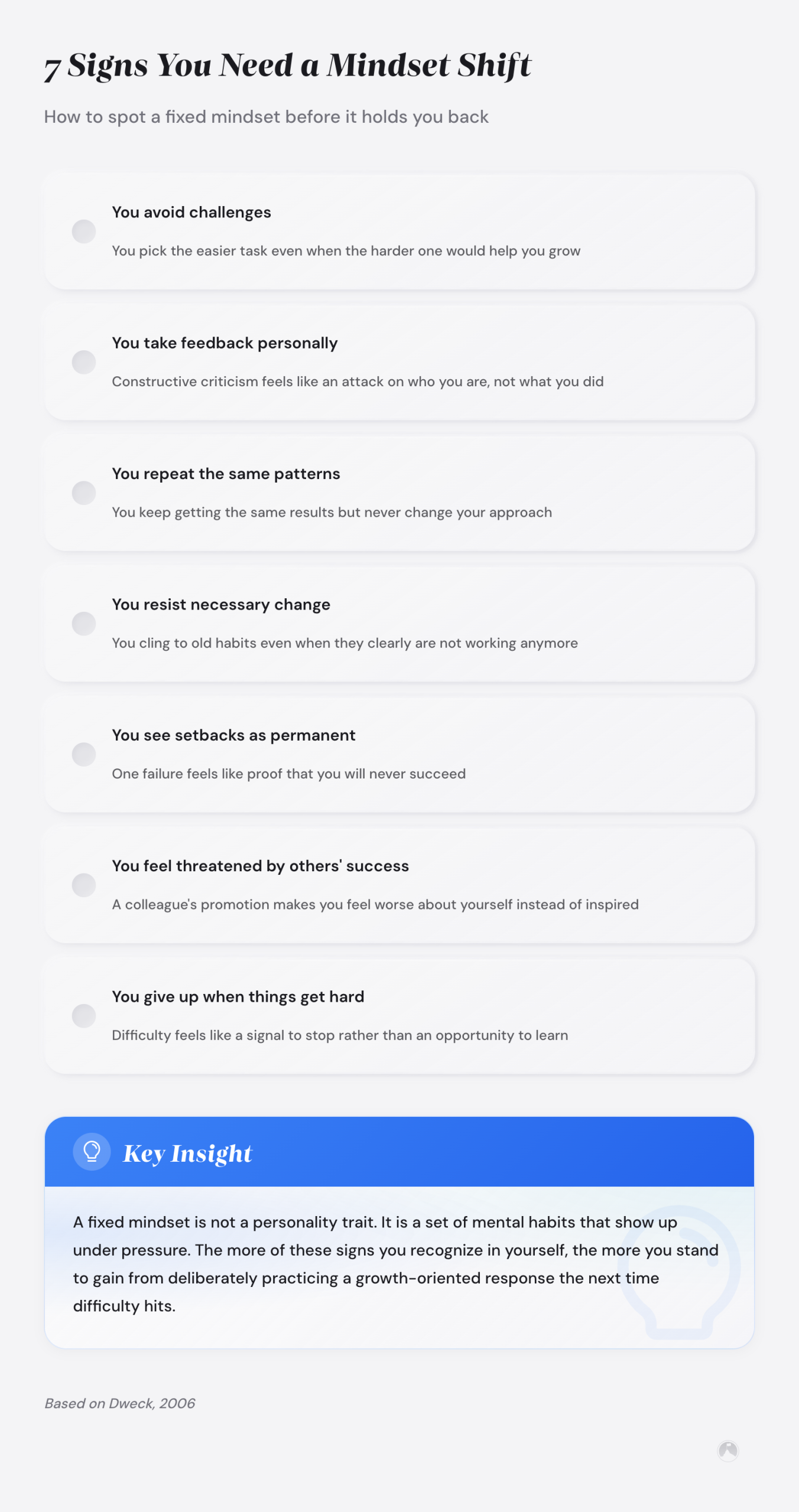
A mindset is the constellation of beliefs you hold about yourself, your abilities, and what’s possible for you. Unlike a bad day or a temporary setback, a limiting mindset is a pattern that repeats across situations and persists over time. Most people don’t realize their mindset is the bottleneck until they stop blaming external circumstances and start recognizing their own patterns. Growth mindset theory has strong intuitive appeal and foundational research support, but recent meta-analyses show the measured effects on achievement are smaller than early studies suggested [11].
Mindset shift is a fundamental change in how you interpret challenges, failures, feedback, and your own potential, moving from fixed beliefs about what you are capable of to growth beliefs about what you can develop.
A person needs a mindset shift when the same self-defeating patterns — avoiding challenges, interpreting feedback as attacks, giving up at difficulty, or attributing success to luck and failure to identity — repeat across multiple environments and relationships rather than appearing in a single context.
The ten most common mindset shift signs include challenge avoidance, feedback defensiveness, pattern repetition, resistance to change, catastrophizing setbacks, feeling threatened by others’ success, quitting when difficulty arrives, believing abilities are fixed, procrastinating on important goals, and attributing success externally while blaming failure on personal inadequacy.
But how do you know if what you are experiencing points to a need for a mindset change? How do you distinguish between a bad stretch and an entrenched belief pattern? The ten signs below are behavioral red flags – fixed versus growth mindset indicators that suggest your thinking might be holding you back.
What you will learn
- How fixed mindset shows up in your daily responses to challenges
- The behavioral signals that you’re interpreting feedback as personal attacks
- Why you keep repeating the same patterns across different situations
- The difference between healthy caution and mindset-driven resistance
- How self-sabotage works as an identity protection mechanism
Key takeaways
- Mindset patterns show up as behavioral red flags across multiple life areas, not just one context.
- Recognizing one or two signs occasionally is normal. A signal you need change is three-plus consistent patterns across situations.
- Sometimes what feels like a mindset problem is actually a structural block – an unsupportive environment, insufficient skills, or unrealistic expectations.
- Feedback defensiveness, challenge avoidance, and pattern repetition are the most common mindset-driven red flags.
- Identifying which specific patterns hold you back tells you exactly which mindset shift to work on first.
- A growth mindset isn’t about being perpetually optimistic. It’s about seeing setbacks as information, not judgment.
1. You avoid challenges rather than embracing them
The sign: You pass on stretch opportunities, even when they align with your long-term goals. A project requires learning a new skill you don’t have? You find a reason it’s not the right timing. A leadership role means stepping into unfamiliar territory? You tell yourself you’re not ready yet.
Challenge avoidance rooted in a fixed mindset turns every new opportunity into a test of worth. If you fail, that failure becomes evidence that you’re not capable – a clear sign of negative thought patterns at work. These are among the most recognizable fixed mindset symptoms.
So you avoid the challenge altogether, not because it’s genuinely a bad opportunity, but because the thought of possibly failing threatens your identity.
Psychologist Carol Dweck and colleagues tracked 373 seventh-graders over two years and found that those who believed abilities were fixed tended to avoid challenging courses and showed declining academic performance [7]. Students who viewed intelligence as developable took on challenges and maintained or improved performance. Your self-talk (“I’m just not ready for that”) is a behavioral expression of an implicit belief about whether abilities are changeable.
In a growth mindset, challenges are opportunities to expand what you’re capable of. Failure is information, not judgment. The presence of a challenge doesn’t feel threatening because growth requires difficulty.
What to notice: Are you consistently choosing the safe option? Do you have a mental list of things you “just can’t do”? When an opportunity appears that excites you but also scares you, does your immediate instinct lean toward decline?
2. You interpret feedback as personal criticism
The sign: Someone offers constructive input on your work and your immediate response is defensiveness. Maybe you argue back, explain away the feedback, or quietly decide the person doesn’t understand. Later, you dismiss what they said rather than considering it seriously. Their words sting not because you worry they might be right, but because you feel attacked.
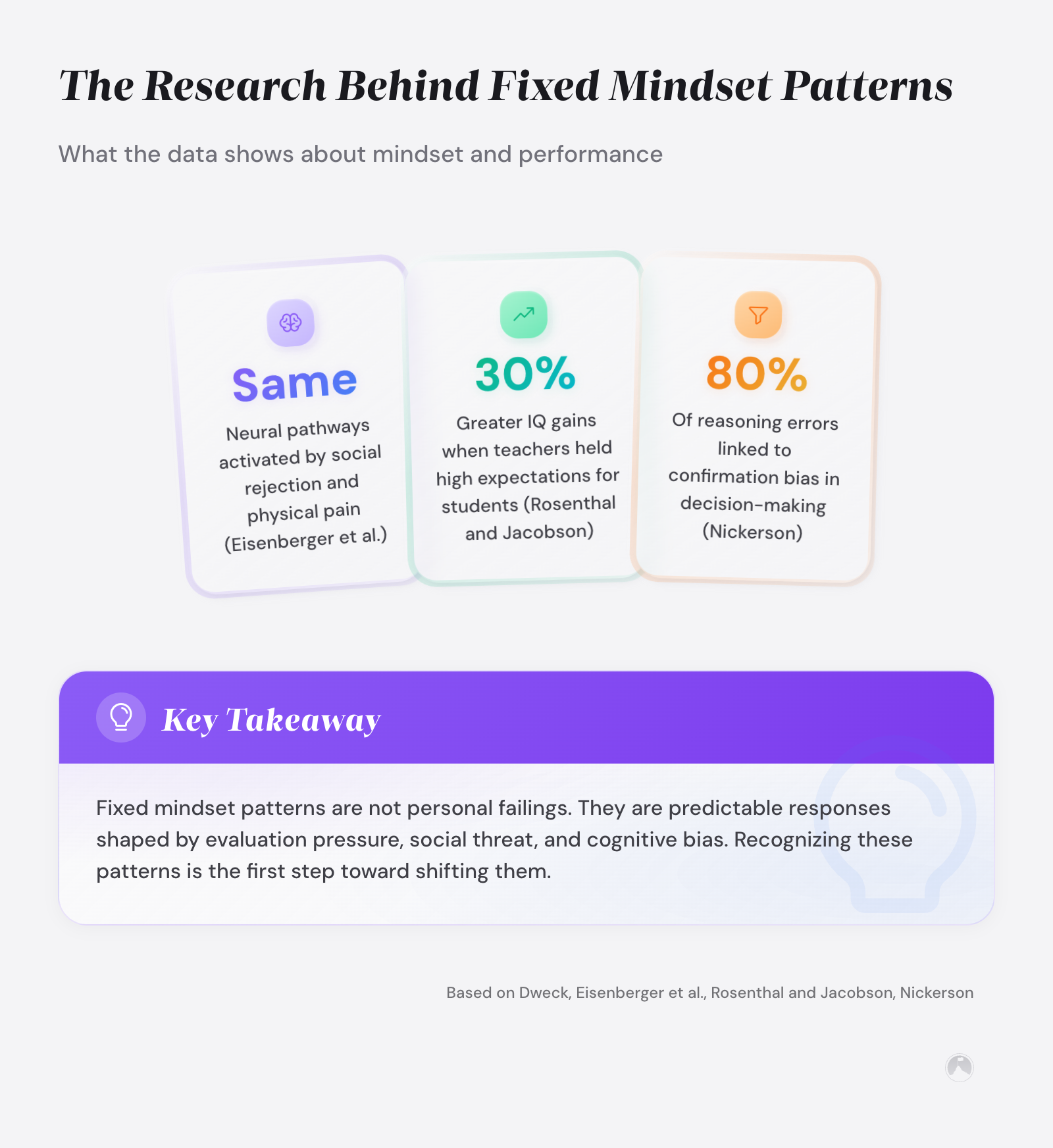
Feedback defensiveness has a neurological basis. Eisenberger, Lieberman, and Williams [2] found that social exclusion activated the same neural pain pathways – particularly the anterior cingulate cortex – as physical pain, suggesting that social threats may be processed similarly to physical ones. When you have a fixed mindset, feedback touches something deeper than “this thing I did could be improved.”
The brain’s threat-detection systems – including the anterior cingulate cortex – appear to interpret social exclusion and criticism as threats [2], triggering defensive responses before conscious evaluation. Your body treats a performance review the way it treats a physical threat.
The growth mindset version: Feedback is data about your work, not a judgment of your value. You might not agree with all of it, but you can receive it without the defensive reaction. You’re curious about the gaps between your intention and the impact. Understanding the neuroscience behind fixed versus growth mindset can help you recognize what’s happening in real time.
Behavioral markers: Do you find yourself explaining away feedback instead of asking clarifying questions? Does your body go into a defensive posture when someone offers criticism? Do you later replay the feedback conversation and focus on what you said in defense rather than what they said?
3. You consistently repeat the same patterns
The sign: You have the same fight in every romantic relationship. You make the same career mistake across different jobs. You start every new goal with enthusiasm and abandon it by week three, every time. The script is different, but the ending is always the same.
Pattern repetition usually signals an unconscious belief creating a self-fulfilling prophecy. In a landmark 1968 study, psychologist Robert Rosenthal found that when teachers were told certain students had high potential, those students actually performed better academically [3]. The mechanism: expectations unconsciously influenced teacher behavior, which shaped student outcomes.
Your internal beliefs work the same way. If you believe you’ll fail, you unconsciously behave in ways that make failure more likely – noticing obstacles more than opportunities, withdrawing effort earlier, interpreting ambiguous signs as confirmation.
Confirmation bias is the tendency to notice and remember evidence that supports existing beliefs while overlooking evidence that contradicts them, distinct from simple favoritism because it operates unconsciously across perception, memory, and interpretation. Psychologist Raymond Nickerson documented this as a universal human tendency [4]. In pattern repetition, you believe relationships fail this way, so you notice confirming signs, overlook differences, and the belief strengthens. Understanding how to overcome limiting beliefs is essential for breaking these cycles.
Sometimes these patterns persist because they serve a hidden function. The familiar pain may feel more comfortable than the unknown territory of change [12]. Or the pattern confirms something you believe about yourself, which paradoxically feels safer than imagining a different identity.
Red flag indicators: Can you trace the same pattern across at least three different situations? Do you say things like “I always end up in this situation” or “This is just what happens to me”? When you catch yourself in the pattern, do you feel resigned rather than curious? Resignation is the fixed mindset’s favorite hiding spot.
4. You resist change, even when you know it’s necessary
The sign: Your company is restructuring and everyone needs to adapt. You know logically that this change is inevitable. But you cling to the old way, move slowly through the transition, maybe even subtly undermine the new approach. Or you’ve recognized your career path isn’t fulfilling, but the thought of exploring a different direction makes you want to stay put. These are resistance to change indicators worth paying attention to.
Not all resistance is mindset-driven. Sometimes caution is wise – a change might genuinely be worse, or you might have legitimate concerns others are ignoring. But mindset-driven resistance usually comes from fear of the unknown, fear of losing competence, or threat to your identity.
In a growth mindset, change is uncomfortable but manageable. You have confidence in your ability to learn new things, so the discomfort of a learning curve doesn’t feel insurmountable. For people going through major transitions, mindset shifts for career changers covers how to work through that specific resistance pattern.
How to distinguish: Ask yourself whether you’re resisting because you have specific, evidence-based concerns about the change, or because the change itself feels threatening. Are you trying to learn the new way, or are you hoping the old way comes back?
5. You interpret setbacks as permanent failures
The sign: You miss a deadline, and your immediate thought is “I’m not cut out for this job.” You have a conflict with a friend, and you decide “I’m bad at relationships.” You fail a test, and you conclude “I’m not intelligent.” One setback becomes total evidence of your permanent inadequacy.
Catastrophizing is a cognitive distortion in which a person interprets a single negative event as evidence of total, permanent failure, distinguished from ordinary disappointment by its absolute, identity-level conclusions. Clark and Beck [5] describe this pattern as central to anxiety and fixed mindset alike: in the context of mindset, catastrophizing reinforces fixed beliefs by turning temporary setbacks into character judgments. When you believe your abilities are fixed, a failure feels like a permanent reflection of who you are. You don’t separate “I failed this time” from “I am a failure.” Learning to reframe setbacks as data rather than verdicts is one of the most important growth mindset red flags to address.
The growth alternative: You miss a deadline – that’s information. What went wrong in your planning or execution? What can you adjust next time? You have a conflict – what did you learn about your needs or communication patterns? Setbacks become data points, not character judgments.
Linguistic markers: Do you use permanent language about setbacks? “I always fail.” “I’ll never be good at this.” “That’s just how I am.” Do you generalize from one specific failure to your overall capability?
6. You feel threatened by others’ success
The sign: When a peer gets promoted or achieves something you wanted, your gut response is more resentment than celebration. You might feel a twinge of “Why them and not me?” Sometimes you diminish their success – they got lucky, the criteria were biased, they networked harder. It’s hard to be genuinely happy for someone when you see their win as evidence of your relative failure.
A fixed mindset frames success as a finite resource, making another person’s achievement feel like a personal loss. Dweck’s research on implicit theories shows that people who view abilities as fixed tend to interpret others’ achievements as threatening rather than inspiring [1]. You might unconsciously sabotage relationships with high-achievers because proximity to their success highlights your perceived inadequacy. A growth-oriented comparison framework can help shift from threat to curiosity.
In a growth mindset, someone else’s success shows what’s possible. You might feel inspired, curious about their path, or motivated. You don’t experience their win as your loss because you’re not comparing from a fixed position.
Warning signs: Do you avoid people you perceive as more successful than you? When you encounter someone’s success, is your first instinct to minimize or explain it away? Do you feel a visceral sting when seeing accomplishments you wanted? If their win feels like your loss, that’s not reality. That’s a fixed mindset doing math.
7. You give up when things get hard
The sign: This differs from sign 1, where you avoid challenges entirely. Here, you start something with enthusiasm – a new skill, a fitness routine, a creative project. The first few weeks feel good. Then it gets hard. The difficulty curve climbs. And instead of climbing with it, you quit. Challenge avoidance means never starting. Giving up means starting with energy and abandoning when difficulty arrives.
You tell yourself it wasn’t really what you wanted anyway, or that you don’t have the talent for it, or that life is too busy.
When struggle appears, it activates a fixed mindset belief: “If I were naturally good at this, it wouldn’t be this hard.” So struggle becomes evidence of lack of talent rather than a normal part of skill development. And instead of pushing through the difficulty – which is where real growth happens – you exit.
The zone of proximal development, identified by developmental psychologist Lev Vygotsky [6], is the optimal learning space where tasks are challenging enough to require effort but achievable enough to prevent total failure, distinct from comfort zones where no growth occurs or panic zones where overwhelm blocks learning. At this zone, struggle is not a sign of inability. It’s a sign you’re at your learning edge. Difficulty is not evidence of lacking talent. Difficulty is evidence that learning is happening.
Growth mindset response: Hard is not the same as impossible. The difficulty means you’re at the edge of your current capability, and that edge is where learning lives. You might need to adjust your approach, but quitting because of difficulty is rarely the right answer. Building an antifragile mindset means treating difficulty as fuel rather than a stop sign.
Pattern check: Do you have a history of unfinished projects? Do you notice a point where things got harder and that’s where you stepped back? When something doesn’t feel natural immediately, do you take that as a sign you’re not cut out for it?
8. You believe your abilities are fixed and unchangeable
The sign: You tell yourself “I’m just not a math person” or “I’ve always been bad at public speaking” or “I’m not creative.” You say this with certainty, as though you’re stating a fact about the physical world. You might even have evidence – you’ve tried and struggled, so obviously this ability is not for you. This belief might extend to character: “I’m just not disciplined” or “I’m too introverted to network.” Recognizing limiting beliefs like these is the first step toward changing them.
A fixed mindset assumes abilities are innate and unchanging. You either have the ability or you don’t. This belief works fine until you encounter something that doesn’t come naturally. Then instead of developing the ability, you write yourself off as lacking it.
Research context: Carol Dweck’s foundational research on growth mindset [1] shows that belief about whether abilities are fixed or developable profoundly affects how people respond to difficulty. In a longitudinal study, Blackwell, Trzesniewski, and Dweck found that students with fixed beliefs about intelligence showed declining grades when challenges appeared, while those with growth beliefs maintained or improved performance [7]. Believing abilities are fixed or developable changes how people respond to difficulty, which in turn changes actual outcomes.
Self-check: Do you use absolute language about your abilities? “I can’t…” “I’m not…” “That’s just not me.” Would you be willing to try if you believed the ability was learnable? That willingness itself is evidence that belief, not actual ability, is the limiting factor. If you want a structured approach to examining your beliefs, self-assessment frameworks can help you map where your fixed mindset assumptions live.
9. You procrastinate on important goals
The sign: You know exactly what you need to do. You’ve made plans. But when it’s time to actually do it, you find reasons not to. You’ll start tomorrow, or next week, or next month. Sometimes the procrastination lasts so long that the opportunity passes.
Procrastination is fundamentally an emotion regulation tool, not a time management failure. Researcher Timothy Pychyl found that people procrastinate to escape anxiety, fear, or self-doubt – not because they’re lazy [8]. You procrastinate because starting the task makes the possibility of failure real. As long as you haven’t started, you can tell yourself you would succeed if you tried. Once you start, you risk finding out that you can’t.
Self-handicapping is the strategic creation of obstacles before a performance situation so that failure can be attributed to the obstacle rather than to lack of ability, distinguished from simple procrastination by its identity-protective function. Psychologist Edward Jones identified this mechanism [9] – by procrastinating, you create a built-in excuse: if you fail, it’s because you ran out of time, not because you lack ability. Procrastination isn’t laziness. It’s your fixed mindset building an escape hatch. Understanding the connection between procrastination and mindset reveals how to break this cycle.
Diagnostic questions: When you procrastinate, what are you actually worried about? Failing? Being judged? Finding out you’re not as capable as you thought? Those worries signal a fixed mindset belief underneath the procrastination.
10. You attribute success to external factors and failure to personal inadequacy
The sign: When something goes well, you credit luck, timing, or help from others: “I got the job because of my connections.” When something fails, you blame yourself: “I’m just not good enough for that role.” This attribution pattern is backwards from reality – your actions played a role in both outcomes – but it feels true to you.
Attribution bias is a systematic pattern in how people explain the causes of success and failure, distinct from general optimism or pessimism because it specifically governs causal explanations rather than expectations about future events. Social psychologist Dale Miller documented these systematic patterns [10]. The typical pattern (self-serving bias) attributes success internally and failure externally.
But in a fixed mindset, the pattern inverts: success feels external (“I got lucky”) and failure feels internal (“I’m not capable”). By telling yourself success is external, you avoid overestimating your abilities. By blaming failure on yourself, you confirm a negative belief about your fundamental nature. Paradoxically, this feels safer than the alternative. Learning to build accurate self-attribution can help correct this inverted pattern.
The reality: Most outcomes result from a mix of internal and external factors. Your skill contributed to that win. Your effort helped, even if luck played a role. And your failure likely involved something you could learn and improve, plus external factors beyond your control.
Recognition pattern: Track your self-talk after wins and losses for one week. What stories do you tell yourself? Are they consistent in direction – always external for wins, always internal for losses? Consistently attributing success to luck and failure to personal inadequacy is not accurate self-assessment. It is attribution bias wearing a mask of humility.
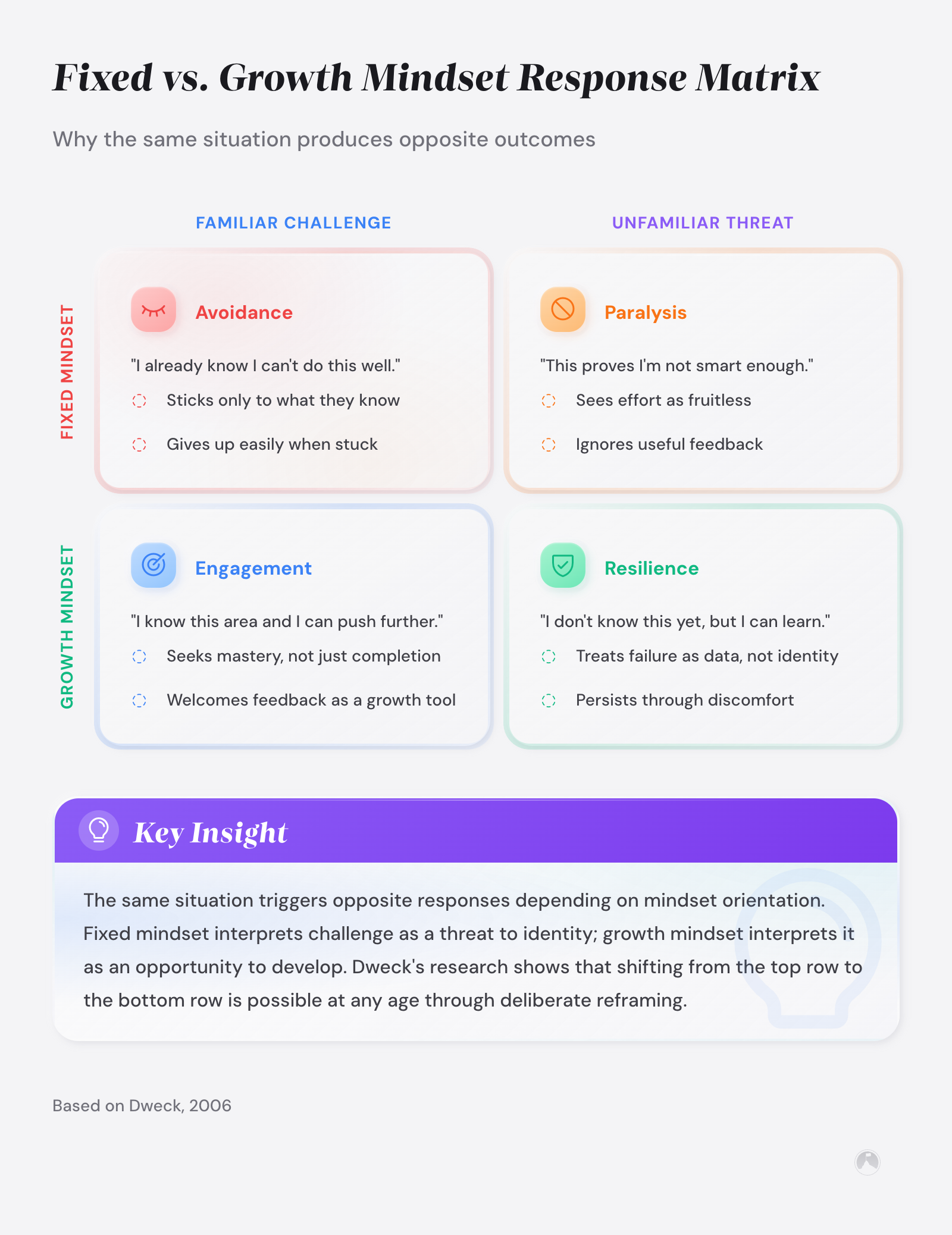
Fixed mindset vs. growth mindset: how each sign shows up
| Sign | Fixed Mindset Response | Growth Mindset Response |
|---|---|---|
| 1. Challenge avoidance | Declines stretch opportunities to avoid failure | Pursues challenges as chances to expand capability |
| 2. Feedback defensiveness | Interprets input as personal attack | Receives feedback as useful data about work |
| 3. Pattern repetition | Repeats same outcomes, feels resigned | Notices patterns with curiosity, adjusts approach |
| 4. Resistance to change | Clings to the familiar despite evidence | Tolerates discomfort of learning curves |
| 5. Catastrophizing setbacks | One failure means permanent inadequacy | One failure means useful information |
| 6. Threatened by others’ success | Their win feels like your loss | Their success shows what is possible |
| 7. Giving up when hard | Quits at difficulty, blames lack of talent | Pushes through, knowing struggle means learning |
| 8. Believing abilities are fixed | “I’m just not a math person” | “I haven’t developed that skill yet” |
| 9. Procrastinating on goals | Delays to avoid risk of proving inability | Starts imperfectly, iterates from there |
| 10. Inverted attribution | Luck caused success, inadequacy caused failure | Effort and skill contributed to both outcomes |
Are these mindset issues or structural problems?
Critical distinction: Not every challenge reflects a mindset problem. Sometimes you struggle because your environment genuinely doesn’t support growth – an unsupportive relationship, a job with no learning opportunities, lack of access to resources. Or your expectations are unrealistic – you’re comparing yourself to people who started years ahead of you.
A true mindset issue persists across environments. You see the same patterns at work and at home, in different relationships, across multiple goal attempts. A structural problem usually improves when the environment changes.
The most likely scenario: You have both. A limiting mindset AND some real structural constraints. The mindset piece is the part you can shift directly. The structural piece might require environmental change, skill development, or seeking support.
Realistic expectations: A mindset shift doesn’t eliminate difficulty. It changes how you relate to it. Growth mindset doesn’t mean everything becomes easy. It means you stop using difficulty as evidence of your inadequacy. A 2018 meta-analysis of 273 studies found that growth mindset interventions produced a very small average effect on academic achievement (d = 0.08), and the relationship between mindset and outcomes was highly context-dependent [11] – with effects concentrated among academically at-risk students and strongest when combined with structural support.
How many signs you need a mindset shift apply to you?
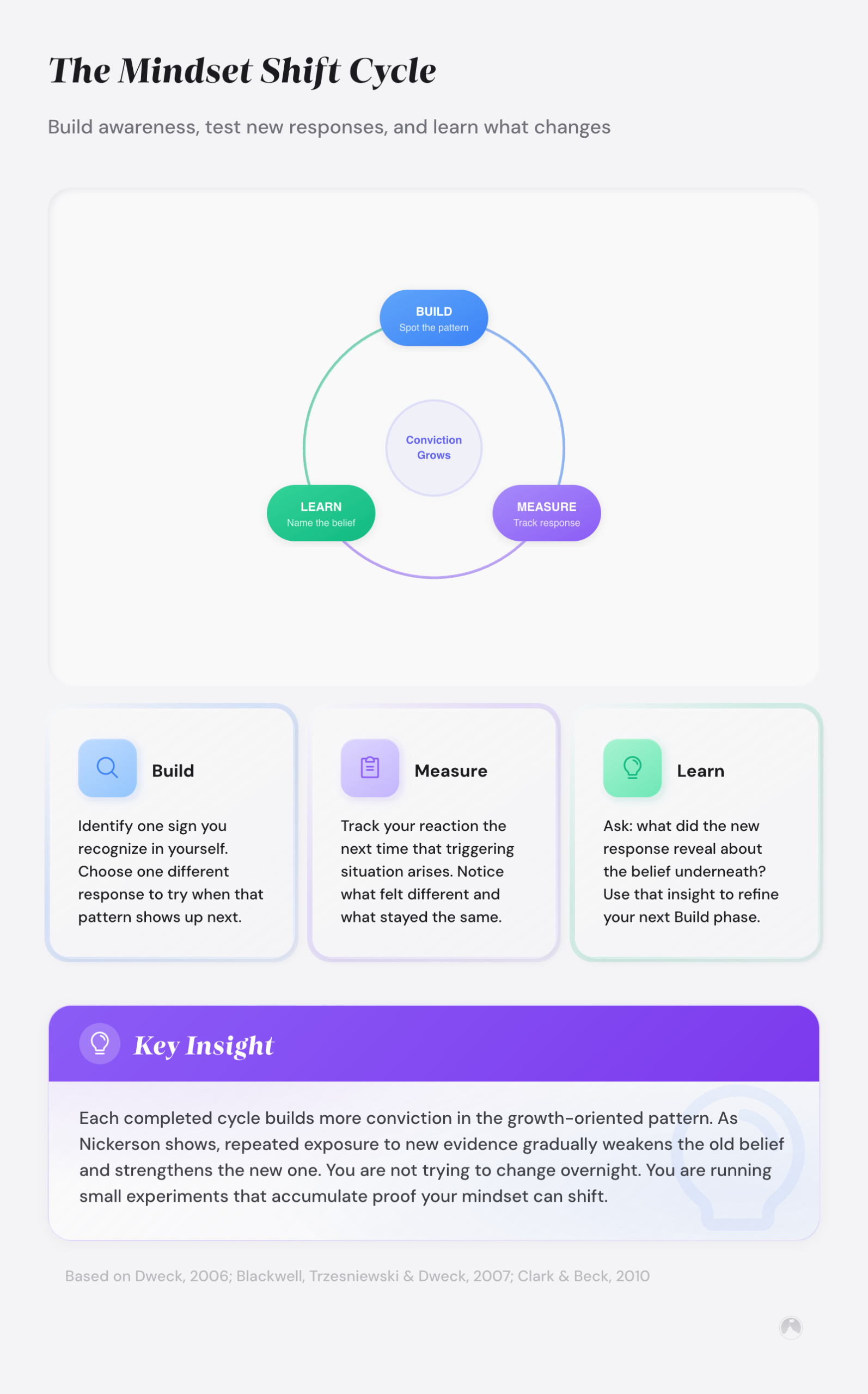
As you review the ten signs, notice: Are you seeing yourself clearly in several of them? Do these patterns show up across multiple life areas, or mostly in one specific context?
Recognizing one or two of these signs occasionally is normal human experience. A signal that you might need a mindset shift is when three or more patterns are consistent across different situations and persistent over time. You’re not just having a bad week or a rough season. You’re looking at a pattern you keep recreating.
If you’re seeing multiple signs, the good news is clear: awareness is the prerequisite for change. You can’t shift what you don’t recognize. For a structured approach to building that awareness into action, our growth mindset development guide walks through the full process from recognition to lasting change.
Ramon’s take
If a few of these signs hit close, don’t start with the biggest one. Pick the most annoying pattern you keep repeating and just watch it for a week before you try to change anything. Noticing it is already doing something.
Conclusion
A mindset shift is not about becoming perpetually optimistic or pretending challenges don’t exist. It’s about changing your relationship to difficulty, failure, and your own potential. Instead of seeing challenges as threats to your worth, you see them as opportunities to expand your capability. Instead of interpreting feedback as judgment, you see it as information. Instead of explaining away other people’s success, you ask yourself what you can learn from their example.
The ten signs above are patterns that show a fixed mindset is active in your thinking. The fact that you recognize them is not a failure. It’s the starting point.
Further reading
For deeper exploration of how mindset develops and how to shift it, see our guides on growth mindset development and building an antifragile mindset.
Next 10 minutes
- Read through the ten signs and mark which ones resonate most strongly with you. Don’t over-identify – just notice which patterns feel most true.
- Pick one pattern that showed up for you across at least two different life areas. That’s your target for deeper work.
This week
- Observe that specific pattern in real time. When does it show up? What triggers it? What’s the automatic response you fall into?
- Choose one small situation where you could respond differently. If you usually avoid feedback, ask one clarifying question. If you usually give up when something gets hard, push through for one more session.
- Explore the relevant deeper guide: Read about overcoming limiting beliefs or the neuroscience behind fixed versus growth mindset if your patterns involve self-imposed constraints.
Related articles in this guide
- building-antifragile-mindset-system
- building-long-term-motivation
- fixed-vs-growth-mindset-neuroscience
Frequently asked questions
What if I recognize these signs but don’t know how to change?
Recognizing the signs is the first step. Once you see a pattern clearly, you can start interrupting it. The next step is understanding the specific belief underneath the pattern. A useful starting point is to write down what you fear would happen if you tried and failed — often the worst-case scenario is far less catastrophic than the fixed mindset assumes. Start with one small change, then explore targeted resources about that specific belief.
How can I tell if it’s my mindset or just external circumstances?
Try the environment swap test: imagine transplanting yourself into a completely different context — new job, new city, new relationship. If you can honestly picture the same pattern showing up there too, it is likely mindset-driven. If the pattern is specific to one environment and you can point to concrete external factors causing it, structural change may help more than mindset work. A therapist or coach can help you distinguish the two when it is unclear.
Can you have a growth mindset in some areas but fixed in others?
Yes. You might have a growth mindset about learning professional skills but a fixed mindset about creativity. You might believe you can improve athletically but not socially. Mindset is domain-specific and context-dependent. As you develop awareness, you can target growth mindset development in the specific areas where it matters most to you.
How quickly can mindset shifts happen once you recognize the need?
Recognizing the need can happen in a moment. Actually shifting the underlying belief takes longer – typically weeks to months of consistent practice interrupting the old pattern and practicing the new response. The shift itself is gradual, though occasionally people report a breakthrough moment where things suddenly click. Most change is incremental.
What happens if I ignore signs that I need a mindset shift?
The patterns continue and compound. You keep recreating the same outcomes — the same conflicts, the same stalled goals, the same frustration. The cost is rarely a dramatic failure. It is a quieter cost: years of untapped potential and goals that stay dreams. The compounding effect means each year of avoidance makes the patterns more entrenched and harder to interrupt. Recognition now is easier than recognition later.
Should I work on mindset alone or get professional help?
This depends on severity and your preference. Self-directed work through articles, books, and structured practice works for many people. Therapy is valuable if the limiting beliefs are deeply rooted in past experiences or trauma. A coach can provide accountability and personalized guidance. Many people benefit from some combination. Start with self-awareness and honest assessment of whether you are making the shifts you want alone.
References
[1] Dweck, C. S. “Mindset: The New Psychology of Success.” Ballantine Books, 2006. https://psycnet.apa.org/record/2006-08575-000
[2] Eisenberger, N. I., Lieberman, M. D., & Williams, K. D. “Does Rejection Hurt? An fMRI Study of Social Exclusion.” Science, 302(5643), 290-292, 2003. https://www.science.org/doi/10.1126/science.1089134
[3] Rosenthal, R., & Jacobson, L. “Pygmalion in the Classroom: Teacher Expectations and Pupils’ Intellectual Development.” Holt, Rinehart and Winston, 1968. https://psycnet.apa.org/record/1968-35054-000
[4] Nickerson, R. S. “Confirmation Bias: A Ubiquitous Phenomenon in Many Guises.” Review of General Psychology, 2(2), 175-220, 1998. https://journals.sagepub.com/doi/abs/10.1037/1089-2680.2.2.175
[5] Clark, D. A., & Beck, A. T. “Cognitive Therapy of Anxiety Disorders: Science and Practice.” Guilford Press, 2010.
[6] Vygotsky, L. S. “Mind in Society: The Development of Higher Psychological Processes.” Harvard University Press, 1978. https://psycnet.apa.org/record/1978-70018-000
[7] Blackwell, L. S., Trzesniewski, K. H., & Dweck, C. S. “Implicit Theories of Intelligence Predict Achievement Across an Adolescent Transition: A Longitudinal Study and an Intervention.” Child Development, 78(1), 246-263, 2007. https://onlinelibrary.wiley.com/doi/10.1111/j.1467-8624.2007.00995.x
[8] Pychyl, T. A., & Sirois, F. M. “Procrastination, Emotion Regulation, and Well-Being.” In F. M. Sirois & T. A. Pychyl (Eds.), Procrastination, Health, and Well-Being (pp. 163-188). Elsevier Academic Press, 2016. https://doi.org/10.1016/B978-0-12-802862-9.00008-6
[9] Jones, E. E., & Berglas, S. “Control of Attributions About the Self Through Self-Handicapping Strategies: The Appeal of Alcohol and the Role of Underachievement.” Personality and Social Psychology Bulletin, 4(2), 200-206, 1978. https://journals.sagepub.com/doi/10.1177/014616727800400205
[10] Miller, D. T., & Ross, M. “Self-Serving Biases in the Attribution of Causality: Fact or Fiction?” Psychological Bulletin, 82(2), 213-225, 1975. https://psycnet.apa.org/record/1975-17996-001
[11] Sisk, V. F., Burgoyne, A. P., Sun, J., Butler, J. L., & Macnamara, B. N. “To What Extent and Under Which Circumstances Are Growth Mind-Sets Important to Academic Achievement? Two Meta-Analyses.” Psychological Science, 29(4), 549-571, 2018. https://journals.sagepub.com/doi/10.1177/0956797617739704
[12] Kahneman, D., & Tversky, A. “Prospect Theory: An Analysis of Decision under Risk.” Econometrica, 47(2), 263-292, 1979. https://doi.org/10.2307/1914185