
Most self-discovery attempts fail because you’re using the wrong process
You’ve tried self-discovery exercises before. Maybe you journaled for a month and found yourself just venting about the day. Maybe you took a personality test online, learned your type, and felt exactly the same way a week later.
The problem isn’t you. The problem is that self-discovery is not one-size-fits-all. As organizational psychologist Tasha Eurich found, most people overestimate how well they know themselves, and the gap between perceived and actual self-knowledge explains why generic approaches feel pointless [1].
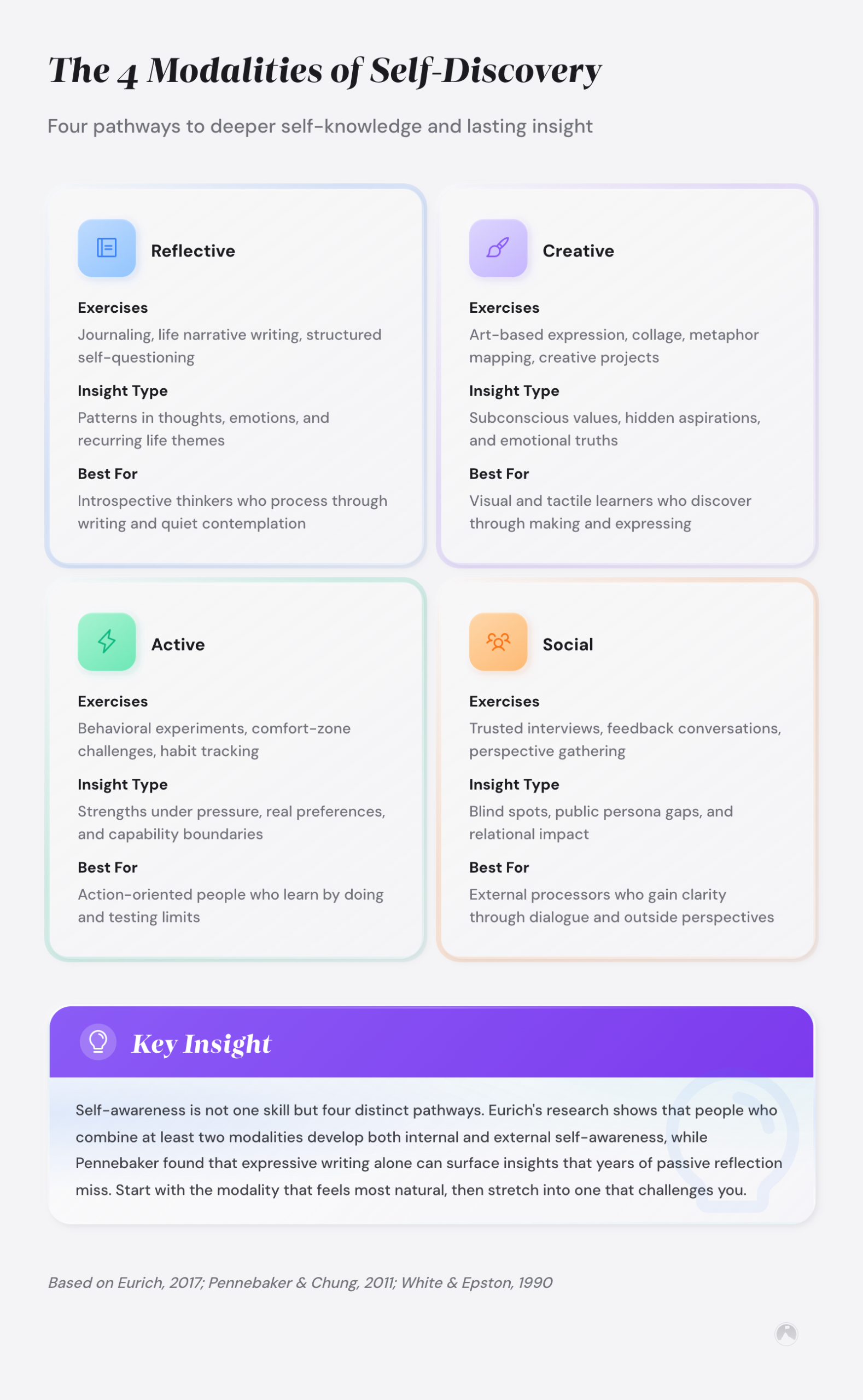
Some people process insight through writing. Others need to move, create, experiment, or talk things through. Self-discovery exercises work when they match how you actually process information – not when they match what a blog post told you to do. This guide maps out which exercise works for which processing style, so you can stop guessing and start discovering.
Self-discovery exercises are structured activities that reveal your values, strengths, preferences, and identity through direct experience and reflection — distinct from personality assessments that categorize and therapy that processes emotional history. The most effective self-discovery exercises match the activity to the individual’s natural processing style.
What you will learn
- The four modalities of self-discovery (reflective, creative, active, social) and how to identify which one works for you
- Ten practical exercises you can start this week, including timing and expected outcomes
- How to match exercises to your specific goal – whether you’re clarifying values, identifying strengths, or discovering your life direction
- How each exercise addresses common sticking points like blank-page paralysis, discomfort with self-reflection, and overthinking
- How to move from self-knowledge to actual life changes
Key takeaways
- In our framework, self-discovery happens through four primary modalities: reflective (writing), creative (making), active (doing), and social (dialogue) – and you likely have a natural preference.
- Effective self-discovery exercises produce specific, actionable insights, not vague self-knowledge.
- Values clarification, strengths identification, and life vision exercises target different aspects of self-knowledge.
- Starting with one modality you naturally prefer makes self-discovery sustainable rather than another abandoned project.
- Insight without action is self-knowledge hoarding; the goal is to use discoveries to make better decisions.
- One exercise done consistently over two weeks beats ten exercises done once each.
- Discomfort during self-discovery often signals you’re getting close to real insight.
- The gap between what you discover and how you live reveals your next step.
1. The reflective journal with insight mining
Journaling gets recommended so often that it has lost credibility. But structured reflective journaling – not daily venting – reveals patterns you’ve never consciously noticed. Psychologist James Pennebaker’s decades of research on expressive writing shows that writing about personal experiences for 15-20 minutes across three or more sessions produces measurable improvements in psychological well-being, reduced anxiety, and clearer self-understanding [2]. The mechanism matters: the writing process itself forces your brain to organize fragmented thoughts into coherent narratives.
Insight mining is the practice of reviewing personal writing to identify recurring themes, emotional patterns, and unstated values that remain invisible during the initial act of writing. Unlike free-form journaling, insight mining treats journal entries as raw data to be analyzed for patterns rather than simply expressed.
How it works: Choose one of these two frameworks for your journal entries.
The Pattern Hunt: Write about a recurring frustration in your life. Write for 10 minutes without filtering. Then read it back and highlight what comes up repeatedly. Pennebaker’s research found that when you write repeatedly about the same frustration, you begin to notice what actually recurs beneath your surface complaints [2]. What seemed like isolated incidents becomes a pattern, which points to a deeper value or need.
The Values-in-Action Journal works differently. At the end of each day, write one decision you made and whether it aligned with what you care about. After two weeks, review and identify which decisions felt good and which felt hollow. Decisions that felt good reveal your operating values versus your aspiring values.
Time needed: 15-20 minutes per entry, once daily or every other day for at least two weeks
Best for: People who think through writing, those with a strong internal monologue, introverts processing their experience
What you’ll discover: Recurring patterns, operating versus aspiring values, internal conflicts, where you’re living on autopilot
Journaling for self-awareness is about making your invisible patterns visible, not producing beautiful prose.
2. The strengths spotting interview
Most people can identify their weaknesses in seconds but stumble when asked about strengths. This exercise flips the process by gathering feedback from people who watch you in action. This is one of the most effective strengths identification activities because it gathers data from multiple perspectives.
How it works: Ask 3-5 people who know you in different contexts (work, personal, family) to answer these three questions: What do you see me doing well without effort? What do you most often ask for my help with? What characteristic of mine has made a difference in your life?
Listen for themes. Strengths are not what you’re good at after effort – they’re what you’re good at that feels almost effortless. Research by Marcus Buckingham and Donald Clifton, drawing on Gallup interviews with over 2 million people, found that peers recognize strengths in action long before you identify them in yourself [3]. This is why asking others what they see you doing effortlessly produces insights you can’t generate alone.
Time needed: 30 minutes of preparation, plus 15-minute conversations with each person
Best for: People who have difficulty recognizing their own gifts, those who benefit from external perspective, anyone in a major transition
What you’ll discover: Strengths you take for granted, how you’re perceived by others, patterns of contribution, where your natural gifts lie
“The key to human development is building on who you already are.” – Marcus Buckingham and Donald Clifton, Now, Discover Your Strengths [3]
Your blind spots about your own strengths are often the most obvious things about you to people who care about you.
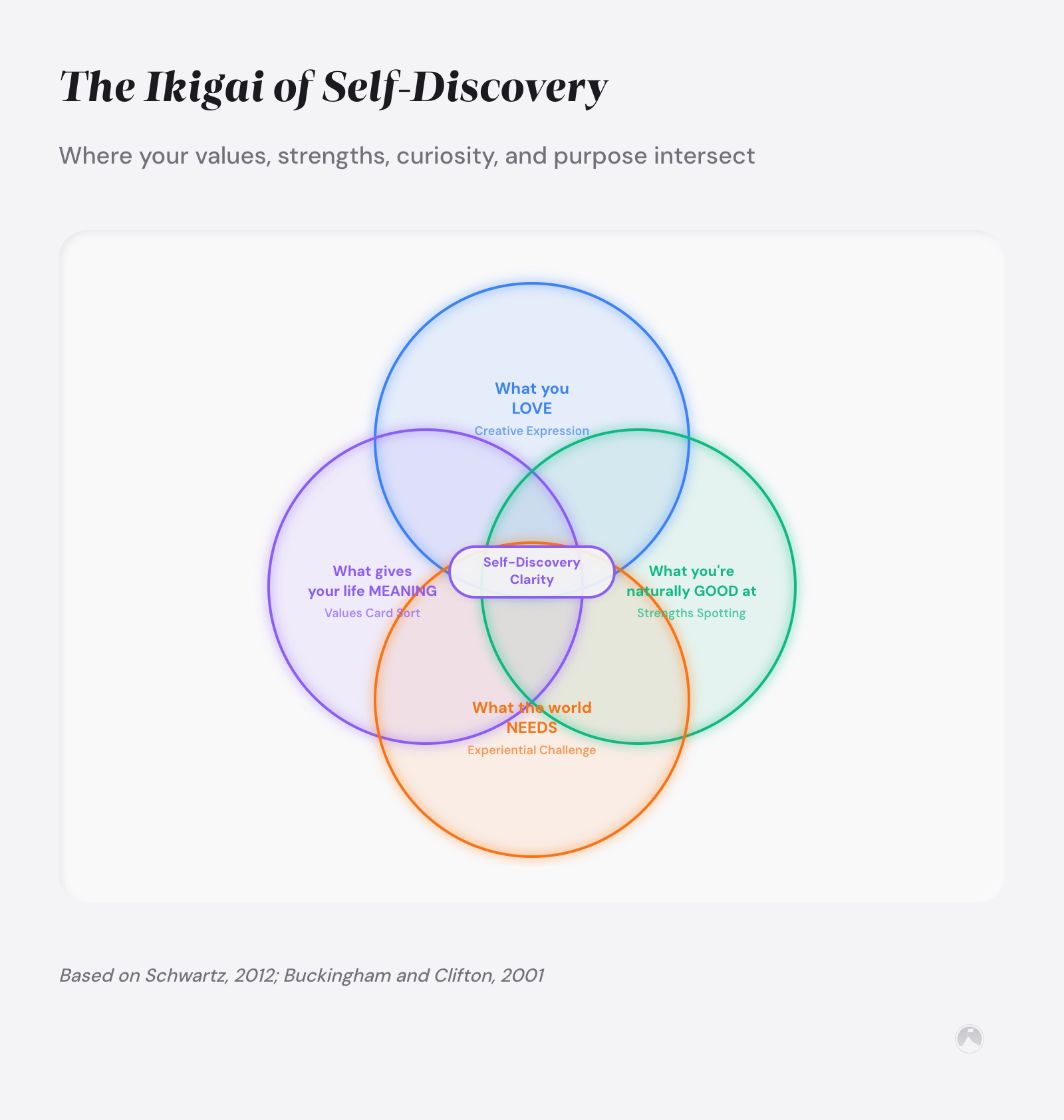
3. The values card sort
This exercise solves the blank-page problem. When someone asks “What are your values?” most people freeze. The card sort removes that paralysis by giving you options to react to rather than create from scratch. This is one of the most practical values clarification exercises because it bypasses abstract thinking entirely.
How it works: Print or write out 15-20 values words (integrity, creativity, security, contribution, adventure, family, independence, growth, humor, impact, autonomy, compassion, excellence). Lay them out and sort them into three piles: essential to who I am, important but not essential, and nice but not core.
Then look at your “essential” pile and rank them. Can’t choose between two? That’s useful information. Social psychologist Shalom Schwartz’s research on values shows that conflicting values create inner tension – what researchers call motivational opposition [4]. When you can’t choose between two values (say, security and adventure), that conflict itself reveals you’re caught between two important motivations. This explains decisions that feel hollow and choices that feel right.
Motivational opposition is the psychological tension that arises when two personally held values pull a person toward incompatible goals. Unlike simple indecision, motivational opposition reflects a structural conflict within a person’s value system where pursuing one value necessarily limits the other.
Time needed: 30-45 minutes
Best for: People who struggle with abstract reflection, visual learners, anyone making a major decision
What you’ll discover: Your true operating values versus ones you think you should have, conflicts between competing values, which decisions will feel aligned
The values you can’t rank against each other are usually the ones running your decisions without permission.
4. The 10-year back narrative
Instead of trying to imagine your future from scratch, this exercise has you imagine your life 10 years from now and then write the story of how you got there. Your brain fills in what matters – and what it fills in reveals more than any abstract planning session. If you want to move from narrative themes to concrete daily planning, exercise 10 provides a complementary next step.
How it works: Close your eyes and imagine yourself 10 years from now in a successful version of your life – not famous or rich necessarily, but successful in a way that feels right to you. Now write the story of what happened in those 10 years. How did you spend your time? What did you create or contribute? What relationships deepened? What did you learn?
Cognitive scientists Annie D’Argembeau and Martial Van der Linden have shown that when you imagine a specific future scenario, the details your brain provides reveal what you truly value [5]. Events aligned with your genuine priorities come alive with sensory detail and emotional weight, while events you think you “should” want appear flat and generic. This is why imagining your ideal day in vivid detail bypasses the shoulds and surfaces what actually matters to you.
Time needed: 30-45 minutes of writing
Best for: People who are stuck in the “I don’t know what I want” phase, visual thinkers who benefit from narrative, anyone in a life transition
What you’ll discover: Authentic desires versus inherited expectations, themes about what brings meaning, direction beneath the vagueness
The futures you imagine in high definition are the ones your brain has already been building toward.
The first four exercises work through reflection and narrative. The next two shift to creation and experimentation – for people who discover by making and doing rather than writing and thinking.
5. The creative expression exploration
Not everyone processes insight through words. Some people need to make something – draw, collage, build, write music, dance – to understand what they truly feel. This is where personality exploration activities move beyond questionnaires and into something your body and intuition can access.
How it works: Choose a medium you don’t usually use. If you’re a writer, try visual collage. If you’re visual, try writing poetry. Spend 20 minutes creating something that represents who you are, what you value, or where you’re heading – without planning it out first. Let your hands lead. Don’t show it to anyone or worry about quality.
When you’re done, look at what you created. What surprised you? What feelings came up while making it? What stands out when you look at it with fresh eyes?
Time needed: 20-30 minutes plus 10 minutes of reflection
Best for: Creatives, people with a strong somatic sense, anyone who feels stuck in their thinking mind
What you’ll discover: Emotions beneath conscious awareness, visual metaphors for your situation, what your intuition knows that your rational mind hasn’t caught up with yet
Sometimes your hands know things your head hasn’t figured out yet.
6. The experiential challenge
This exercise uses small, safe experiments to reveal preferences and patterns you didn’t know you had. It works because what you choose in low-stakes moments tells you more about yourself than what you say you prefer.
How it works: Choose a routine you do on autopilot – your morning, your commute, your lunch hour, your evening wind-down. Change one element intentionally. If you always work in silence, work with music one day. If you always eat lunch alone, eat with someone. If you always go to the same coffee shop, go somewhere new.
Notice what happens. Do you feel more energized or drained? More productive or scattered? More yourself or uncomfortable? Behavioral economics research shows that people’s stated preferences often diverge from their actual behavior – a phenomenon researchers call the stated-revealed preference gap [6]. When you change one element of your routine – eating lunch alone vs. with someone, working in silence vs. with music – you discover which conditions actually energize you versus which you think you are supposed to enjoy.
Revealed preferences are the genuine priorities and values a person demonstrates through actual choices and behavior, as opposed to the preferences that person states or believes they hold. Originally formulated by economist Paul Samuelson, the concept highlights the gap between what people say they want and what their actions show they want.
Time needed: 15-30 minutes per experiment, plus reflection time
Best for: People who learn through doing, those who find sitting still difficult, anyone whose self-knowledge is based on theory rather than experience
What you’ll discover: Your genuine preferences, what energizes versus drains you, which routines you actually value, personality aspects you didn’t know you had
What you do when nobody’s watching reveals more than what you say when everybody’s listening.
If you process best through conversation rather than solo exploration, the next two exercises use other people as mirrors.
7. The feedback reflection conversation
This exercise combines reflection with dialogue – useful for people who think better out loud. If you’ve ever talked through a problem with a friend and suddenly heard yourself say something you didn’t know you believed, you already understand the mechanism.
How it works: Find someone you trust (a friend, mentor, therapist, coach). Tell them you’re doing self-discovery work and ask them to reflect back what they notice about you – not flattering, just honest observation. What do you do that seems to matter to you? What lights you up? What’s the pattern in the choices you make?
Let them talk. Ask follow-up questions. The goal is not agreement. It’s perspective. Research on 360-degree feedback by Nowack and Mashihi found that self-ratings and observer ratings frequently diverge, and that these self-other rating discrepancies reveal blind spots in how people understand their own behavior [7]. This isn’t because they’re right and you’re wrong – it’s because you live inside your own internal experience while they observe your actual behavior. Therapists working in narrative therapy have found that when you tell your story to someone trained to listen for patterns, blind spots become visible that stay hidden in solitary reflection [8].
Time needed: 45 minutes to an hour
Best for: People who think out loud, extroverts who process through conversation, anyone in a major transition who needs outside perspective
What you’ll discover: Blind spots, patterns others notice you missing, how you’re perceived, themes in your choices you haven’t seen
You can’t read the label from inside the jar.
8. The peak performance analysis
Forget your weaknesses for a moment. This exercise focuses on when you’re at your best and what conditions make that possible. It builds on a simple but research-backed idea: the conditions that produce your best work also reveal the architecture of a life that fully engages you.
How it works: Identify three recent times when you were fully engaged, producing good work, and felt energized at the end of the day. For each, answer: What was the task or situation? Who were you with? What was the physical environment? What constraints or structure existed? How much autonomy did you have?
Look for patterns. Psychologist Mihaly Csikszentmihalyi studied thousands of people during peak performance moments and found that the conditions producing flow – the right balance of challenge and skill, clear goals, immediate feedback – reveal what genuinely engages each person at the deepest level [9]. Your peak performance conditions are a blueprint for a life that engages you fully, not just a work tip.
Time needed: 30-45 minutes of reflection and writing
Best for: People who are goal-oriented, those struggling with motivation, anyone trying to design a more fulfilling work or life situation
What you’ll discover: Conditions that bring out your best, what kind of challenges energize you, your operating style, the structure you need to thrive
“The best moments in our lives are not the passive, receptive, relaxing times… The best moments usually occur if a person’s body or mind is stretched to its limits in a voluntary effort to accomplish something difficult and worthwhile.” – Mihaly Csikszentmihalyi, Flow [9]
Your peak moments aren’t random. They share conditions – and those conditions are a map.
9. The conflict archaeology exercise
Your past conflicts and frustrations are data about your values. This exercise uses difficulty to reveal what matters – and it works especially well when combined with a broader growth mindset development approach that treats setbacks as information rather than failures.
How it works: Think of a decision you made in the past that you regret or that didn’t feel good – a job you took, a relationship you stayed in too long, a path you followed because it seemed safe. Write about it without judgment: What did you prioritize in that decision? What did you overlook? What do you know now that you didn’t know then?
The gap between what you prioritized then and what you’d prioritize now reveals your value evolution. Decision psychology research suggests that the pattern in your regrets – what you are no longer willing to compromise on, what you wish you had done differently – maps your value development [10]. This exercise is closely related to the work of overcoming limiting beliefs because many past compromises stem from beliefs about what you deserved or what was possible.
Time needed: 30-45 minutes
Best for: People who learn from reflection on experience, those in mid-life reassessment, anyone recognizing a pattern of misaligned choices
What you’ll discover: Evolved values, non-negotiable needs, where you’ve grown, what you’re no longer willing to compromise on
Regrets are receipts for values you hadn’t named yet.
10. The life vision and reverse engineering exercise
This life vision exercise combines forward imagination with backward planning – for people who need a concrete process, not vagueness.
How it works: While exercise 4 imagines the narrative arc of your next decade and reveals themes in what you value, this exercise zeroes in on one specific day and identifies concrete prerequisites – what needs to be true about your work, relationships, and location. Imagine a specific day in your ideal future – not a fantasy, but something realistically possible. Write it down in sensory detail: What time do you wake up? What’s the first thing you do? Who are you with? What kind of work or contribution are you doing? How does your body feel?
Now work backward. If that’s your ideal day, what needs to be true about your work, relationships, health, and location? What would you need to have learned or developed? What would you need to have said no to? Strategy consultant Peter Schwartz developed the scenario planning method used by major organizations to move from vague aspirations to concrete decisions [11]. The core insight: vividly imagining your ideal future, then working backward to identify prerequisites, transforms abstract “find my purpose” into specific decisions you can make now.
Time needed: 45-60 minutes
Best for: People who need concrete vision before they can move, goal-oriented people, those overwhelmed by open-ended self-discovery
What you’ll discover: What your ideal life actually looks like beneath fantasy, key decisions that would move you toward it, prerequisites for living aligned
A clear picture of one ideal Tuesday tells you more about your purpose than a year of abstract searching.
Self-discovery exercises: which one fits your goal
Not sure which exercise to start with? This table maps your specific self-discovery goal to the exercise most likely to produce useful results.

| Your goal | Best exercises | Why it works |
|---|---|---|
| Clarify your values | Values card sort (3), Conflict archaeology (9) | Sorting forces ranking; regrets reveal evolved priorities |
| Identify your strengths | Strengths interview (2), Peak performance (8) | Others see your gifts; peak conditions reveal your operating style |
| Find your life direction | 10-year narrative (4), Visioning exercise (10) | Imagination surfaces authentic desires; backward planning creates a roadmap |
| Understand your patterns | Reflective journal (1), Feedback conversation (7) | Writing reveals repetition; dialogue reveals blind spots |
| Explore your personality | Creative expression (5), Experiential challenge (6) | Making bypasses thinking; experiments reveal genuine preferences |
Matching self-discovery exercises to your processing style
The grid below shows which modality matches different processing preferences. We organize self-discovery exercises into four processing modalities based on how people naturally absorb, organize, and generate insight about themselves. If you’re unsure where to start, pick the processing style that feels most natural and try the recommended first exercise.
| Processing style | Best modalities | Start with this |
|---|---|---|
| Reflective/thinking-focused | Journaling (1), Back narrative (4), Peak analysis (8), Conflict archaeology (9) | Reflective journal with insight mining |
| Creative/visual | Creative expression (5), Visioning exercise (10), Values card sort (3) | Creative expression exploration |
| Active/experiential | Experiential challenge (6), Peak analysis (8) | Experiential challenge |
| Social/dialogue-focused | Feedback conversation (7), Strengths interview (2) | Strengths spotting interview |
| Balanced/combination | Start with one, then add from other modalities | Try one from each quadrant over 4 weeks |
Processing style refers to the primary way a person absorbs, organizes, and generates insight about themselves – whether through writing (reflective), making things (creative), hands-on experimentation (active), or conversation (social). In our editorial framework, these four modalities organize the self-discovery exercises in this guide. Most people have a natural preference, though it can shift depending on context.
Ramon’s take
Before you try all ten, figure out which of the four processing styles fits you. That one step probably explains why journaling never clicked, or why one honest conversation told you more than a week of solo reflection. Start there, not at exercise one.
For years I was forcing myself into exercises that matched conventional “self-discovery” wisdom instead of matching how I actually process. Once I started with conversation and experimentation, self-discovery stopped feeling like an optional luxury and started feeling like necessary information for making better decisions.
Conclusion: from self-knowledge to self-alignment
Self-discovery is not a luxury or an indulgence. It’s the foundation for making decisions that feel right instead of decisions you’ll second-guess. But it only works when you match the exercise to how you actually think, create, move, and connect.
You don’t need to do all ten exercises. You need to do one that fits how you process best, stick with it long enough to generate real insight, and then use what you discover to make one different choice. The goal of self-discovery is to use self-knowledge to live with more alignment and stop operating on autopilot.
If you’re working on developing a growth mindset or figuring out whether you need a deeper mindset shift, these exercises give you the raw material. Self-discovery tells you who you are right now. What you do with that information determines who you become.
Next 10 minutes
- Identify which processing style resonates with you most (reflective, creative, active, or social)
- Choose one exercise from that column in the matching grid above
- Block 30 minutes this week to do it – not someday, this week
This week
- Complete your first exercise – fully, without editing yourself
- Write down one insight that surprised you or shifted how you see something
- Identify one small decision you can make differently based on what you discovered
- Plan a second exercise from a different modality to try next week
Related articles in this guide
Frequently asked questions
How do I start self-discovery if I don’t know where to begin?
Start with the processing style that feels most natural to you (reflective, creative, active, or social) and choose one exercise from that column. You don’t need to find the perfect exercise or do them all. One matched exercise will produce more insight than ten mismatched ones. The matching grid above helps you identify your starting point.
What if self-discovery exercises make me uncomfortable or bring up difficult emotions?
Discomfort during self-discovery often means you’re getting close to real insight – but only if the discomfort is productive. If an exercise triggers shame, overwhelm, or emotional flooding, stop and try a different one. You can also pair self-discovery with professional support like therapy, which provides safety and guidance. Self-discovery should challenge you, not hurt you.
How long should I spend on self-discovery exercises?
Start with two weeks on one exercise to build momentum. After that, you’ll notice diminishing returns — entries start repeating themes rather than revealing new ones, which signals it’s time to switch exercises or modalities. As self-awareness builds, many people find they need less structured exercise time and more integration time, shifting from daily practice to weekly check-ins.
Can I do self-discovery without journaling or writing?
Writing is only one modality. If journaling feels forced or unproductive, try the creative expression, experiential challenge, strengths interview, or feedback conversation exercises instead. Self-discovery can happen through making, doing, conversation, and experimentation – the grid above shows which exercises match your style.
What are signs that self-discovery work is actually helping?
You’ll notice real progress when you can articulate something specific about yourself you didn’t know before, when you make a decision that feels more aligned than usual, or when you recognize a pattern you’ve been repeating. Progress is not feeling more confident – it’s having clearer information about how you actually operate.
Should self-discovery be done alone or with support?
It depends on the exercise and your processing style. Reflective and creative exercises often work best solo. Social exercises (feedback conversation, strengths interview) require partnership. Professional support like therapy or coaching amplifies any self-discovery exercise by providing safety, perspective, and accountability. Consider combining personal practice with professional guidance.
How do I know which self-discovery exercises are right for me?
If your first exercise feels forced after three or four sessions, that’s a mismatch signal — not a sign you’re bad at self-discovery. Switch modalities rather than pushing through. The difference between productive discomfort and a poor fit is whether you’re learning something new each session. If sessions feel repetitive rather than challenging, try a different processing style.
What do I do with insights from self-discovery exercises?
Use a simple framework: one insight, one change, one week. Pick the single discovery that surprised you most, identify one small decision or behavior you can adjust based on that insight, and give yourself one week to test the change. Not every insight demands a life overhaul — most call for a small shift, like saying no to one obligation that conflicts with a newly identified value.