
One behavior pulls five others in its wake
You’re sitting with your coffee before dawn, looking at your to-do list. Exercise. Better eating. Consistent sleep. Read more. Meditate. Phone-free evenings. Six new habits, all starting Monday. By Thursday, every single one has collapsed.
Keystone habits are single behaviors that trigger cascading positive changes across multiple areas of your life without requiring additional effort. Rather than building six new habits at once, you identify the one habit with the highest ripple potential and let its downstream effects pull adjacent improvements along naturally.
Here’s what research keeps showing: you don’t need more willpower. You need one behavior that makes the other five easier. Charles Duhigg, a Pulitzer Prize-winning reporter, popularized the term in his 2012 book The Power of Habit [1]. Researchers call these keystone habits – single behaviors that trigger a cascade of downstream improvements without requiring additional effort.
Keystone habits
Keystone habits are specific behaviors that produce cascading positive changes across multiple life domains by restructuring daily patterns, shifting self-identity, and reducing cognitive load. Unlike ordinary habits, keystone habits generate disproportionate improvements relative to the effort they require. Sometimes called gateway habits, these high-leverage behaviors act as domino effect routines that pull adjacent improvements along without conscious effort.
What you will learn
- Why certain habits create cascade effect habits and others remain isolated
- The Cascade Audit framework for foundational habit identification tailored to your life
- How to set up your keystone habit for maximum ripple effects
- What to do when a habit looks like a keystone but doesn’t cascade
- How negative keystone habits work and how to replace them
Key takeaways
- Keystone habits create cascading improvements through three mechanisms: small wins that build momentum, identity shifts that reshape self-perception, and cognitive load reduction that frees mental bandwidth.
- Megan Oaten and Ken Cheng’s 2006 study found that participants who adopted a regular exercise routine also improved their eating, reduced stress, cut back on smoking, and studied more often [2].
- The Cascade Audit scores candidate habits on three dimensions – ripple potential, identity shift, and friction reduction. Habits scoring 12+ deserve a four-week trial.
- Your keystone habit depends on your current life constraints, not on a universal list of “best” habits that applies to everyone.
- Cascade effects often emerge within the first month. Full automaticity takes a median of 66 days, though ranges span 18 to 254 days [3].
- In practice, the fastest way to improve multiple areas of your life is often to identify and remove the one behavior that’s degrading all of them.
- Building one keystone habit for 30 days before adding others lets cascade effects develop – an approach that outperforms starting multiple habits simultaneously [3].
- Pairing your keystone habit with environment design and habit stacking anchors accelerates cascade effects [3].
Keystone habits: why they create chain reactions
Keystone habits create chain reactions because a single behavior change restructures daily patterns, generates momentum through small wins, and frees cognitive resources for improvement in adjacent domains. These three mechanisms explain why one habit can produce outsized results across multiple life areas.
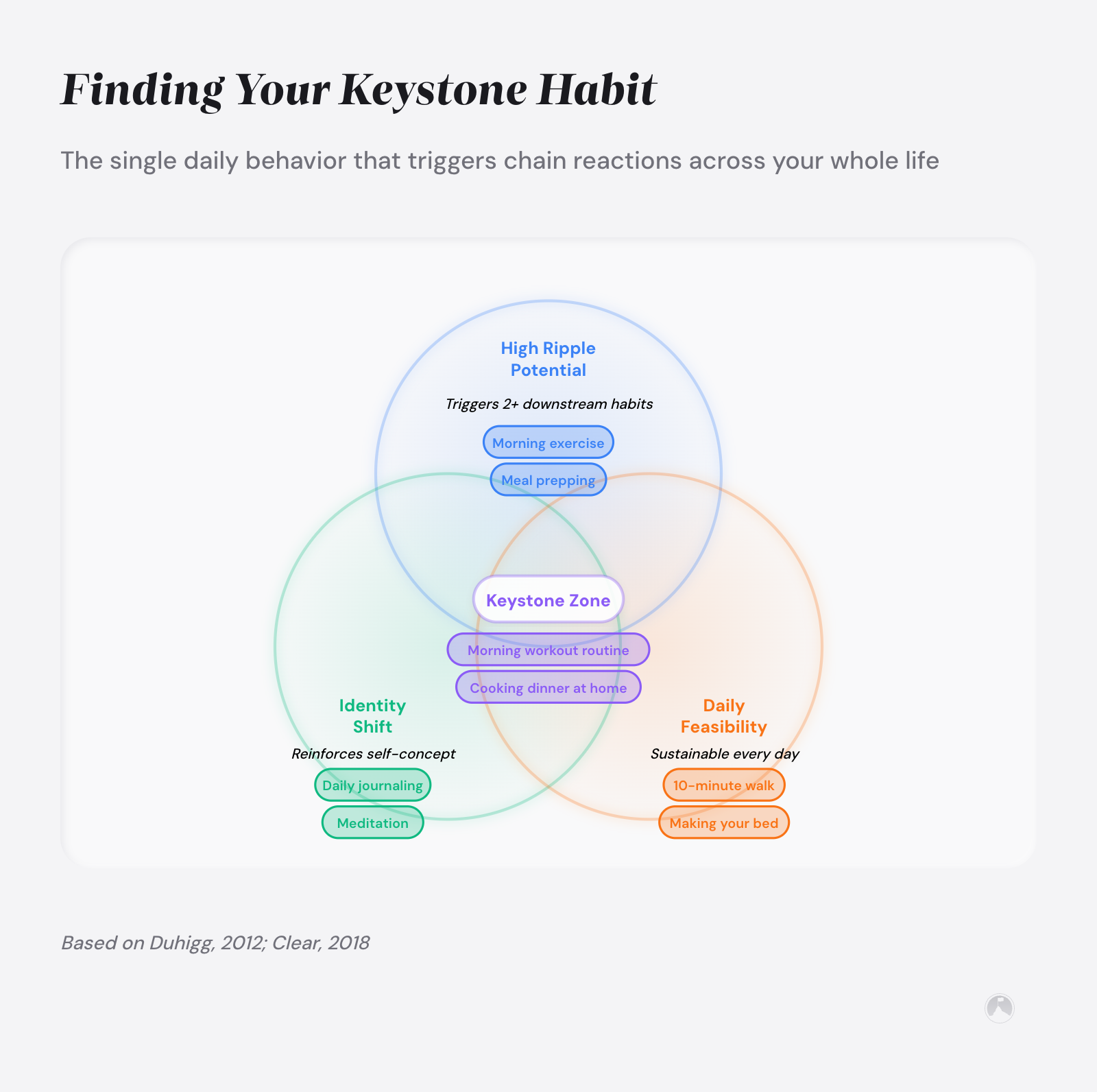
Duhigg’s central example was Paul O’Neill, who became CEO of Alcoa and focused on a single metric: worker safety. That single focus cascaded into improved communication, efficiency gains, and record profits [1]. One behavior. Multiple domains. But how does this domino effect happen?
Three specific processes drive it.
Small wins trigger habit momentum builders
When you succeed at one new behavior, your brain registers the win. Psychologist Karl Weick’s research on small wins shows that completing small tasks builds self-efficacy beliefs that transfer to adjacent behaviors [4]. Duhigg describes this as “a steady application of a small advantage” that compounds over time [1].
Small wins from a keystone habit don’t add up linearly. They multiply by lowering the activation energy for each subsequent change. Small wins habits – behaviors that produce quick, visible success – build the self-efficacy needed to sustain effort. So that morning run doesn’t just improve your fitness – it makes the salad at lunch feel like the obvious choice.
Small wins from keystone habits multiply by creating momentum that makes subsequent changes easier, not just slightly more probable.
Identity-shifting habits reshape self-perception
A keystone habit changes how you see yourself. Someone who exercises three mornings a week starts thinking of themselves as “a person who takes care of their body.” That identity shift creates friction against behaviors that contradict it – like eating fast food every lunch. As James Clear argues in Atomic Habits, identity-based habit formation works because when people internalize a new self-image, they experience natural resistance against contradictory behaviors [6]. Clear calls this identity-based habit formation, and it’s why transformative habit selection matters more than brute-force repetition.
A keystone habit sticks because it changes who you believe you are – not just what you do.
Cognitive load drops
Every habit that becomes automatic frees up mental bandwidth. When your morning exercise routine runs on autopilot, you’re not spending decision-making energy on whether to work out. That freed-up capacity gets redirected toward meal planning, focused work, or evening routines.
Cognitive load reduction
Cognitive load reduction occurs when an automated habit removes conscious decision-making from a recurring behavior, freeing mental bandwidth that can be redirected toward improvement in adjacent life domains.
As psychologists Mark Muraven and Roy Baumeister documented in their influential research on self-regulation resources, automated behaviors reduce the burden of repeated decision-making, creating cognitive surplus for improvement in adjacent domains [7] – though recent large-scale replication studies have questioned the magnitude of the underlying depletion effect. The practical observation remains: when a behavior runs on autopilot, it stops competing for mental bandwidth.
Keystone habits reduce cognitive load in one domain, which creates surplus capacity for improvement in adjacent domains.
These three mechanisms explain why not all habits are keystone habits. A habit that doesn’t generate small wins, shift your identity, or reduce cognitive load for other behaviors is an ordinary habit. Useful, but not a catalyst. So how do you distinguish between them?
How to identify your keystone habit with the Cascade Audit
The Cascade Audit identifies a personal keystone habit by scoring candidate behaviors on three research-backed dimensions – ripple potential, identity shift, and friction reduction – and selecting the highest-scoring habit for a four-week trial. This structured approach to transformative habit selection replaces guesswork with a systematic method.
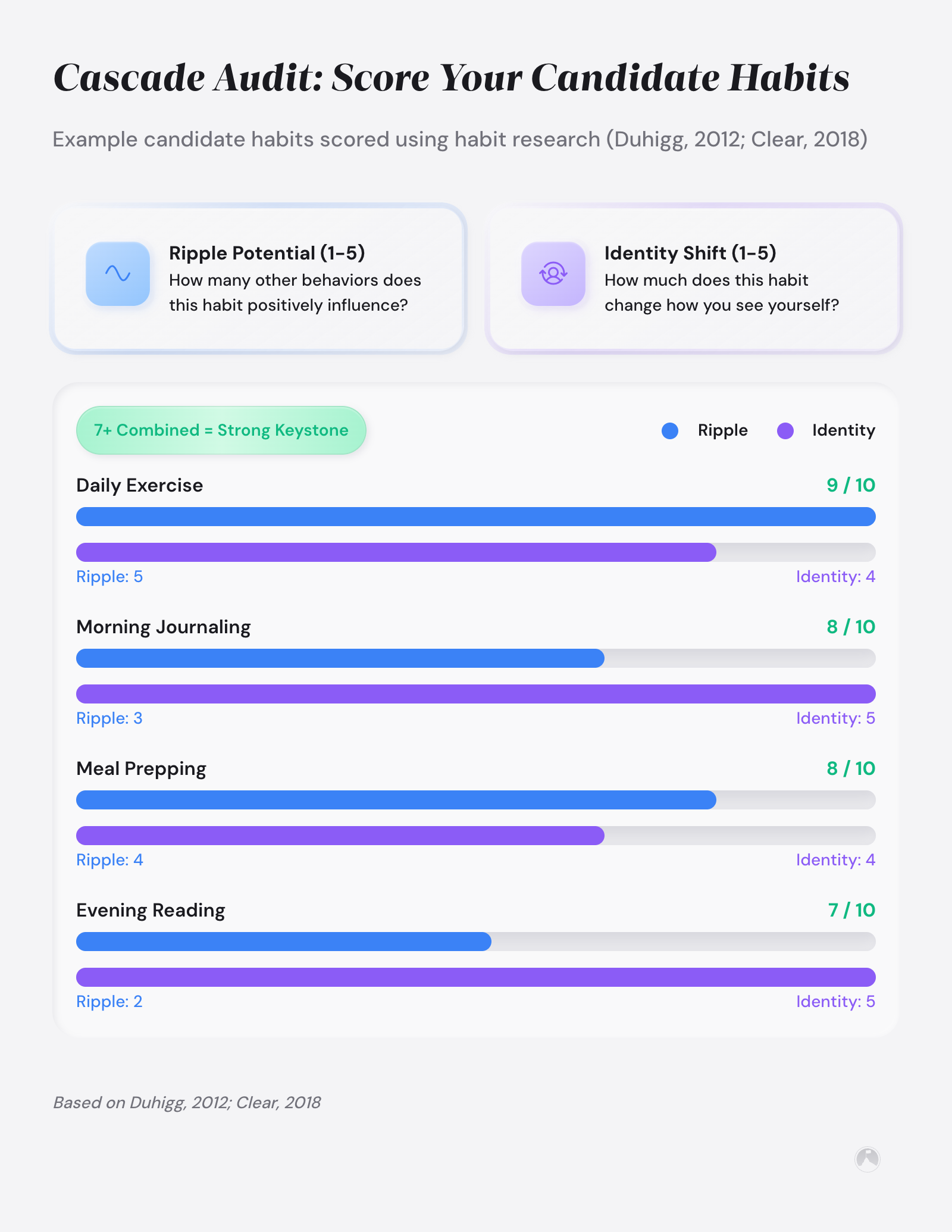
Most articles list exercise, meditation, and sleep, then declare those the “best” keystone habits. But the highest-impact habit for a sleep-deprived new parent looks completely different from the highest-impact habit for a sedentary remote worker. A universal list misses the point.
We developed the Cascade Audit by combining principles from three research areas: Oaten and Cheng’s exercise cascade research on ripple potential [2], Clear’s work on identity-based behavior change [6] and Fogg’s behavior model on motivation and ability [5], and Muraven and Baumeister’s research on cognitive resource management [7]. The criteria aren’t new individually. Combining them into a scoring system produces a clearer signal than gut instinct.
Cascade Audit
The Cascade Audit is a scoring framework for foundational habit identification that rates candidate habits on three dimensions – ripple potential, identity shift, and friction reduction – to determine which single behavior will create the strongest cascade of downstream improvements for a specific person’s circumstances.
Score each candidate habit on three dimensions. The highest total score is your starting point.
Criterion 1: ripple potential (1-5)
Ripple potential
Ripple potential measures how many distinct life areas improve as a downstream consequence of consistently performing a single habit, without requiring additional effort or planning in those areas.
Ask: “If I did this habit consistently for 30 days, how many other areas of my life would improve without extra effort?” Exercise scores high for most people – it improves mood, energy, sleep, and eating decisions. Reading before bed scores moderate – improves sleep and reduces screen time. A skincare routine scores low – contained to one domain.
Criterion 2: identity shift (1-5)
The question: “Would doing this habit change how I describe myself?” The strongest keystone habits reshape self-perception. Running three times a week turns you into “a runner.” Cooking dinner from scratch turns you into “someone who cares about nutrition.” Watching Netflix every evening doesn’t shift identity in a meaningful direction. Rate each candidate on how much it would change your internal narrative.
Criterion 3: friction reduction (1-5)
Does this habit make other positive behaviors easier? Morning exercise reduces friction for healthy eating throughout the day. Meal prepping on Sunday reduces friction for weeknight cooking. A consistent bedtime reduces friction for your morning routine. Add the three scores together. Any habit scoring 12+ deserves a four-week trial.
Here’s a sample Cascade Audit filled out for five common candidate habits:
| Candidate habit | Ripple (1-5) | Identity (1-5) | Friction (1-5) |
|---|---|---|---|
| Morning exercise (30 min) | 5 | 4 | 5 |
| Evening screen cutoff at 9 PM | 4 | 3 | 4 |
| Meal prep on Sundays | 3 | 3 | 4 |
| Reading before bed | 3 | 3 | 3 |
| Daily 15-minute walk | 4 | 2 | 3 |
Total scores and assessments: Morning exercise scores 14 – a strong keystone for most people. Evening screen cutoff scores 11 – underrated, because the sleep cascade is potent. Meal prep scores 10 – solid for parents, less cascade otherwise. Reading before bed scores 9 – a good second habit, not the keystone. Daily 15-minute walk scores 9 – an entry point if exercise feels too big.
Try filling out your own Cascade Audit using this template:
Copy-pasteable Cascade Audit template:
- Candidate habit: ________
- Ripple potential (1-5): “If I did this for 30 days, how many other areas improve?” ____
- Identity shift (1-5): “Would this change how I describe myself?” ____
- Friction reduction (1-5): “Does this make other good behaviors easier?” ____
- Total: ____
The best keystone habit is the one with the highest cascade score for your current life constraints, not the one that appears on every internet list.
How to set up your keystone habit for maximum cascade
Setting up a keystone habit for maximum cascade requires four steps: anchoring to an existing routine, redesigning your environment, running a 30-day trial, and expanding the stack only after automaticity develops. Each step creates conditions for downstream improvements to emerge naturally.
Identifying the right keystone habit is half the work. The other half is setting it up so the cascade effects have room to emerge. Here’s a four-step process.
Step 1: anchor it to an existing routine
Keystone habits survive longer when anchored to existing behaviors – a technique also known as habit stacking. If your keystone is morning exercise, pair it with your first cup of coffee: “After I start the coffee maker, I change into workout clothes.” Phillippa Lally and colleagues at University College London found that context-dependent repetition is the primary driver of automaticity, with new behaviors taking a median of 66 days to become automatic (though the range stretched from 18 to 254 days) [3].
Step 2: redesign your environment
A keystone habit fights an uphill battle in an environment designed for the old behavior. If your keystone is a 9 PM screen cutoff, the phone needs a charging station outside the bedroom. If it’s morning exercise, gym clothes go next to the bed the night before. Environment design removes the decision points that drain willpower before the habit even starts.
A keystone habit survives because it requires zero decisions to begin.
Step 3: run a 30-day keystone trial
Commit to your keystone habit for 30 days before evaluating. During this period, add no other new habits. The point is to let the cascade develop naturally. Keep a simple daily log tracking two data points: whether you did the keystone habit, and any unprompted changes you notice in other areas. Did you eat better without planning to? Did you sleep earlier? Feel more focused at work?
Those unprompted changes are cascade signals. In practice, if you notice two or more cascade signals within the first few weeks, you’ve likely found a genuine keystone habit.
Step 4: expand the stack after the habit feels automatic
Once your keystone habit feels automatic – Lally’s research suggests this takes a median of 66 days, though many people feel comfortable much sooner [3] – you can stack adjacent habits onto it. Add one at a time, spaced two to three weeks apart. The cascade should pull adjacent behaviors in your direction. You’re not forcing them; you’re making space for them. For more on this approach, see our guide on habit stacking for beginners.
Here’s a realistic timeline for building multiple habits through a keystone:
- Weeks 1-4: Keystone habit only. Watch for cascade signals.
- Weeks 5-8: Add first adjacent habit. Keep logging cascade signals.
- Weeks 9-12: Add second adjacent habit. Assess the full system.
Building one habit at a time feels slower than building six. But at week twelve, the person who started with one has three. The person who started with six has zero.
Negative keystone habits: the reverse cascade
Negative keystone habits are single behaviors that degrade multiple life domains through reverse cascade effects – disrupting sleep, reducing energy, undermining exercise, and worsening mood through a single upstream behavior. Identifying and replacing a negative keystone often produces faster results than building a positive one from scratch.
Negative keystone habit
A negative keystone habit is a single behavior that degrades multiple life domains through reverse cascade effects, eroding identity, increasing cognitive load, and eliminating small wins.
Cascade effects run in both directions. Doom scrolling before bed disrupts sleep, which reduces morning energy, which makes exercise less likely, which affects mood and eating for the rest of the day. One behavior. Four downstream consequences.
“Keystone habits work because they change other habits in the process. They transform us by making other patterns possible.” – Charles Duhigg, The Power of Habit [1]
Negative cascades likely operate through the same mechanisms in reverse – eroding identity (“I’m the kind of person who stays up too late”), increasing cognitive load through decision fatigue from poor sleep, and eliminating small wins by starting each day already behind.
To spot your negative keystones, ask: “Which single behavior, if I stopped it, would improve the most other areas of my life?” Common negative keystones include late-night screen use, skipping breakfast, alcohol before bed, and over-committing to obligations. For a deeper diagnostic, see our why habits fail diagnostic.
Replace the negative keystone with a positive alternative rather than simply eliminating it. An empty slot in your routine gets refilled by default.
In practice, the fastest way to improve five areas of your life is often to remove the one behavior that’s degrading all of them.
What if your keystone habit doesn’t cascade?
Sometimes you pick a habit, sustain it for four weeks, and the expected cascade doesn’t materialize. That doesn’t mean keystone habits don’t work for you. One of three patterns is usually at play.
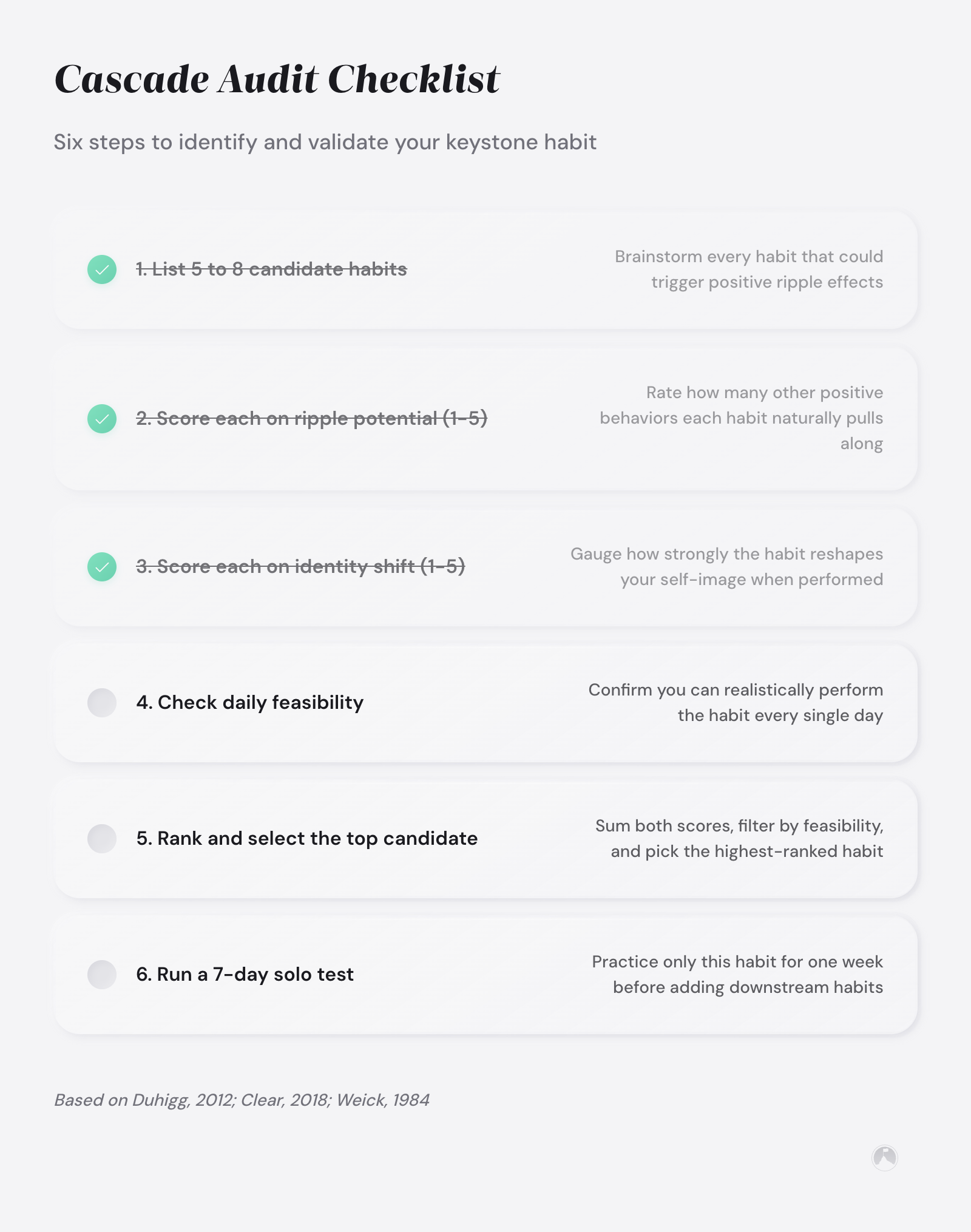
The habit is too small to generate momentum
A five-minute daily walk is a useful entry point, but may not create enough identity shift or friction reduction to cascade. If your keystone habit isn’t generating cascade signals after three weeks, increase its intensity or duration. The habit needs to be big enough that you feel different after doing it, and small enough that you don’t skip it. This is what researchers call the Goldilocks rule for lasting habits – the sweet spot where challenge meets ability.
The environment is fighting the cascade
You exercise every morning, but your kitchen is still stocked with processed snacks and your bedroom still has a TV. The cascade can’t flow into adjacent domains if those domains resist change. Review your environment design and ask whether your physical spaces support or sabotage the cascade.
You chose a solid habit, but not your keystone
Some habits are worth building without being keystone habits. Reading daily is valuable, but for many people it doesn’t produce the same ripple effects as exercise or consistent sleep. If the Cascade Audit score was borderline (8-10), re-evaluate your candidates. The right keystone habit might not be the one you expected. Our guide on why habits fail covers additional reasons habits stall before they reach automaticity.
A regular habit can be worth building without being your keystone. The test for a keystone habit is not whether the behavior is good – it is whether performing it cascades into improvements elsewhere.
Keystone habits for ADHD and working parents
Standard keystone habit advice assumes you control your mornings and evenings. Parents of young children and people managing ADHD often don’t have that luxury.
For parents, the best keystone habit survives interruption. An evening screen cutoff at 9 PM works better than a 5 AM exercise routine when a toddler’s sleep schedule is unpredictable. The cascade still works: better sleep leads to better mood, which leads to more patience, which improves family interactions. See our guide on habits for working parents for more strategies designed for unpredictable schedules.
ADHD changes the selection criteria. Identity shift matters more than ripple potential because ADHD brains respond strongly to self-concept changes but struggle with diffuse benefits. And the habit needs strong external support to survive novelty decay. Body doubling – exercising with a partner or in a class – adds the accountability ADHD brains need. Our habit building for ADHD guide covers this in depth.
Lally and colleagues found that new behaviors took a median of 66 days to become automatic, with a range of 18 to 254 days depending on the individual and the habit’s complexity [3].
The best keystone habit for a chaotic schedule isn’t the one with the highest theoretical score. It’s the one you can still do on your worst day.
Ramon’s take
Find the one thing that, when you skip it, everything else falls apart too. That’s your keystone. Don’t overthink the scoring system, just notice what your bad weeks have in common and start there.
Conclusion
A keystone habits guide that works doesn’t hand you a universal list. It gives you a method for finding the single behavior that creates the biggest cascade in your specific life. The Cascade Audit scores candidates on ripple potential, identity shift, and friction reduction – three dimensions drawn from research on small wins [4], identity-based behavior change [6], and cognitive resource management [7].
Your highest-scoring habit gets a four-week trial. You watch for unprompted improvements in adjacent areas. Then, once the keystone is solid, you expand.
The paradox of building many habits is that the fastest path runs through building one.
In the next 10 minutes
- Write down three candidate keystone habits using the copy-pasteable Cascade Audit template above
- Score each on ripple potential, identity shift, and friction reduction
- Circle the habit with the highest total score
This week
- Anchor your keystone habit to an existing routine and redesign one element of your environment to support it
- Start a simple daily log tracking whether you did the habit and any cascade signals you notice
There is more to explore
For a deeper look at habit formation science, explore our habit formation complete guide. If you want to understand the neuroscience behind why habits form (and break), our guide on neuroscience of habit formation covers the neural pathways involved. And if you’re comparing frameworks, our Atomic Habits vs Tiny Habits comparison breaks down two of the most popular approaches.
Related articles in this guide
Frequently asked questions
What makes a habit a keystone habit?
A keystone habit produces cascading improvements in life areas beyond the habit itself, driven by three mechanisms: small wins that build momentum [4], identity shifts that reshape self-perception [6], and cognitive load reduction that frees mental bandwidth for additional positive behaviors [7]. A regular habit improves one area without generating downstream effects.
What are the three characteristics of keystone habits?
The three characteristics are ripple potential, identity reinforcement, and friction reduction. Research by Oaten and Cheng showed these working together when a single exercise habit led to additional improvements across eating, stress, smoking, and study behaviors [2]. Most habits have one or two of these properties; keystone habits have all three at meaningful strength levels.
How long does it take for keystone habit cascade effects to appear?
Most people notice unprompted improvements in adjacent areas within the first month of consistent practice. Full cascade effects, where multiple life domains show measurable improvement, typically build gradually over several months as the primary habit becomes automatic. Phillippa Lally’s research shows the underlying automaticity takes a median of 66 days, with a range of 18 to 254 days depending on the individual and the habit [3].
Can keystone habits be different for different people?
Based on the Cascade Audit framework, keystone habits vary significantly based on individual circumstances and life stage. Exercise is commonly cited, but for a sleep-deprived person, a consistent bedtime may produce stronger cascade effects [2]. For someone with ADHD, a habit with strong identity-shift potential and built-in accountability may outperform one with high ripple potential but no external structure. The Cascade Audit framework helps identify which habit has the highest cascade potential for a specific situation.
Should I build multiple keystone habits at the same time?
Build one keystone habit at a time. Lally’s research found that more complex behaviors took significantly longer to automate [3], and attempting multiple behavior changes simultaneously splits the cognitive resources needed for habit formation. A sequential approach – building one keystone for four to six weeks before adding the next – lets cascade effects develop without interference.
Is making your bed a keystone habit?
Making your bed can function as a keystone habit for some people, particularly those who respond to visual order and morning momentum. Admiral William McRaven popularized this idea in his book Make Your Bed [8], arguing that completing one task creates a chain of accomplishment. The cascade effect depends on whether bed-making shifts your identity and reduces friction for your specific morning routine – score it with the Cascade Audit to find out.
What is the difference between a keystone habit and habit stacking?
A keystone habit is a single high-leverage behavior that creates natural cascade effects across multiple life domains without deliberate effort. Charles Duhigg described keystone habits as behaviors that ‘change other habits in the process’ [1], while B.J. Fogg and James Clear developed habit stacking as a deliberate sequencing technique [5][6]. The two work well together: once a keystone habit is automatic, habit stacking can deliberately add adjacent habits that the cascade has not pulled in on its own.
References
[1] Duhigg, C. (2012). The Power of Habit: Why We Do What We Do in Life and Business. Random House.
[2] Oaten, M. and Cheng, K. (2006). “Longitudinal gains in self-regulation from regular physical exercise.” British Journal of Health Psychology, 11(4), 717-733. https://doi.org/10.1348/135910706X96481
[3] Lally, P., van Jaarsveld, C.H.M., Potts, H.W.W., and Wardle, J. (2010). “How are habits formed: Modelling habit formation in the real world.” European Journal of Social Psychology, 40(6), 998-1009. https://doi.org/10.1002/ejsp.674
[4] Weick, K.E. (1984). “Small wins: Redefining the scale of social problems.” American Psychologist, 39(1), 40-49. https://doi.org/10.1037/0003-066X.39.1.40
[5] Fogg, B.J. (2009). “A behavior model for persuasive design.” Proceedings of the 4th International Conference on Persuasive Technology. ACM. https://doi.org/10.1145/1541948.1541999
[6] Clear, J. (2018). Atomic Habits: Tiny Changes, Remarkable Results. Avery.
[7] Muraven, M. and Baumeister, R.F. (2000). “Self-regulation and depletion of limited resources: Does self-control resemble a muscle?” Psychological Bulletin, 126(2), 247-259. https://doi.org/10.1037/0033-2909.126.2.247
[8] McRaven, W.H. (2017). Make Your Bed: Little Things That Can Change Your Life…And Maybe the World. Grand Central Publishing.