
Why your best habit pairings keep failing at 3 PM
You built the perfect morning routine. Journaling, exercise, focused reading – all before 8 AM. But by mid-afternoon, that same discipline evaporates. The habits you nailed at dawn collapse after lunch, and no amount of willpower brings them back.
The problem is not your commitment. It’s a mismatch between what a habit demands and what your energy can deliver – a contextual friction that research suggests slows or prevents habit formation [4]. Habit pairing solves the energy mismatch problem by matching each habit to the energy window where it has the best chance of sticking. And this guide shows you exactly how to build that system.
To implement habit pairing, you run a three-day energy audit to find your peak, trough, and recovery windows. Then you categorize each habit by cognitive demand and assign it to the energy window that matches. The result is a flexible daily system where habits get the biological fuel they need to become automatic.
Habit pairing is the practice of matching specific habits to natural energy states throughout the day. You schedule cognitively demanding habits during peak energy windows and pair them with recovery habits during energy dips. Unlike habit stacking, which focuses on sequencing one habit after another, habit pairing focuses on energy alignment between the habit’s cognitive demand and your current biological capacity.
What you will learn
- How habit pairing differs from habit stacking and why energy matters
- The biological case for energy-matched habits
- How to run a three-day personal energy audit
- How to categorize habits by cognitive load
- The Energy-Match Framework for pairing habits to energy states
- How to adjust habit pairs on low-energy days
Key takeaways
- Many habits fail due to energy mismatch, a factor often overlooked in favor of willpower-focused approaches.
- A three-day energy audit reveals your specific peak, trough, and recovery windows.
- Cognitive demand categorization (high, medium, low, restorative) determines optimal habit timing.
- Ultradian cycles create 90-120 minute waves of alertness that add precision to habit placement.
- The Energy-Match Framework assigns habits to peak, trough, and recovery windows based on cognitive demand to accelerate automaticity.
- If-then protocols based on implementation intentions adapt paired habits to variable energy without breaking consistency.
- Your chronotype affects when peak and trough windows occur, making a personal audit more reliable than generic schedules.
How does habit pairing differ from habit stacking?
Habit stacking, popularized by James Clear in Atomic Habits, uses a simple formula: “After I [current habit], I will [new habit]” [1]. It’s a sequencing strategy. You anchor a new behavior to an existing one so the old habit triggers the new one. And it works well for building chains of small behaviors.
But stacking treats all habits as interchangeable, ignoring a variable that determines whether those chains hold or break: your energy state. Habit pairing adds the energy dimension that habit stacking leaves out. Where stacking asks “what comes next?” pairing asks “what does my energy support right now?”
The distinction matters because the same habit stack that runs smoothly at 7 AM can fall apart at 3 PM. Not because you forgot, and not because you lack discipline. But because the cognitive demand of those habits exceeded the energy available at that time. If you’ve already explored habit stacking for productivity and creativity, habit pairing is the next layer: it tells you not just what to pair, but when.
| Dimension | Habit stacking | Habit pairing |
|---|---|---|
| Core question | “After X, I do Y” | “What does my energy support now?” |
| Trigger type | Completion of previous habit | Current energy state |
| Handles energy dips | No | Yes – matches demand to capacity |
| Best for | Small, quick habits in sequence | Any habit, especially demanding ones |
| Failure mode | Chain breaks when one link fails | Adapts – swaps habits based on energy |
Sequence tells you what comes next. Energy tells you what can actually happen.
Why does energy matter more than sequence for habits?
Researchers once thought willpower was a depletable resource, a theory called “ego depletion.” A 2016 multilab replication led by Hagger and colleagues found effect sizes near zero, casting serious doubt on the original model [2]. But the practical observation that people perform worse on effortful tasks later in the day finds stronger support in circadian rhythm research.
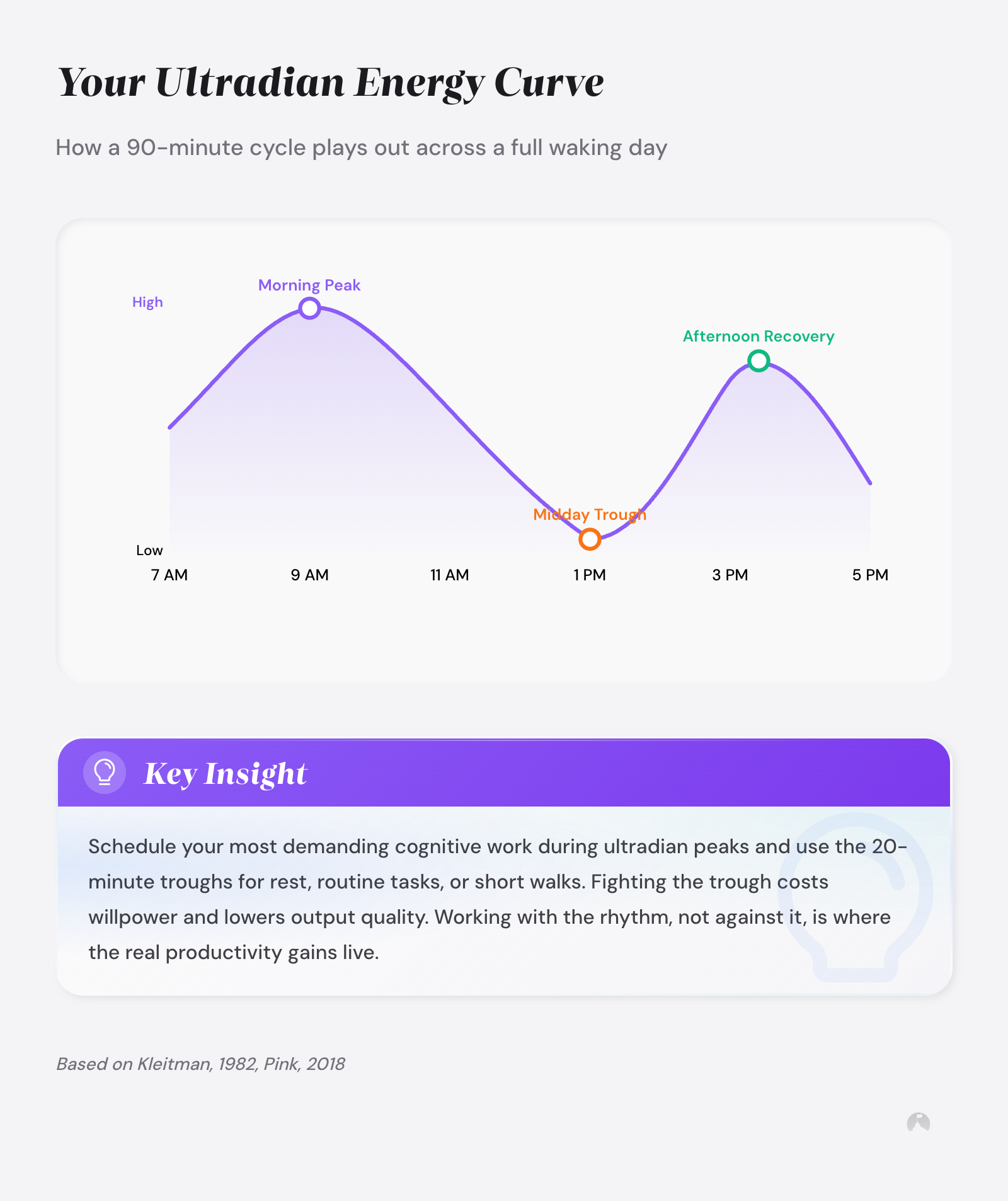
Psychologist Daniel Pink synthesized decades of timing studies in “When” and identified a predictable daily pattern: a peak of cognitive sharpness in the morning, a trough in the early-to-mid afternoon, and a recovery bounce in the late afternoon or evening [3].
As Daniel Pink synthesizes in When, most people experience a predictable daily pattern: peak sharpness after waking, a trough in the early afternoon, and a recovery bounce before evening [3]. This peak-trough-recovery sequence holds across most of the population, though the timing shifts based on individual chronotype.
Habits placed during the wrong energy phase fight biology rather than build automaticity. Psychologists Wendy Wood and David Neal demonstrated in their Psychological Review analysis that contextual cues – locations, preceding actions, and recurring situations – play a direct role in triggering habitual responses [4]. Your energy state is one of those recurring contextual signals. When you try to meditate during a peak alertness window, you’re fighting the urge to act. When you try to do deep analytical work during a trough, you’re fighting the urge to rest.
Both mismatches increase friction and reduce the chance that the behavior becomes automatic.
The basal ganglia – the brain structures responsible for converting repeated behaviors into automatic habit loops – rely on consistent context signals to encode those patterns. Energy state is one of the strongest and most consistent signals your body produces. Pair a habit with the right energy state, and you’re giving your brain a reliable cue. Pair it with the wrong one, and you’re introducing noise. This is why understanding the neuroscience of habit formation matters – it explains why timing beats willpower.
The right habit at the wrong energy level is just friction with good intentions. Research on context-consistent habit formation found that behaviors repeated under matching conditions reach automaticity faster than those performed under variable conditions [6].
How do you run a personal energy audit for habit pairing?
Before you can pair habits to energy states, you need to know your own energy pattern. Most people assume they know when they’re “on” and when they’re not, but informal hunches miss the subtleties. A structured energy audit takes three days and reveals your specific peak, trough, and recovery windows.
This is a simple self-report protocol we recommend – no formal research validates the three-day timeline specifically, but the underlying logic draws on circadian rhythm research that supports individual variation in daily energy patterns [3]. If you want a more rigorous measure, established circadian rhythm assessment tools like the Morningness-Eveningness Questionnaire offer validated alternatives. External factors like caffeine timing, meal composition, and exercise can shift your energy windows – hold these constant during your three-day audit to see your baseline pattern.
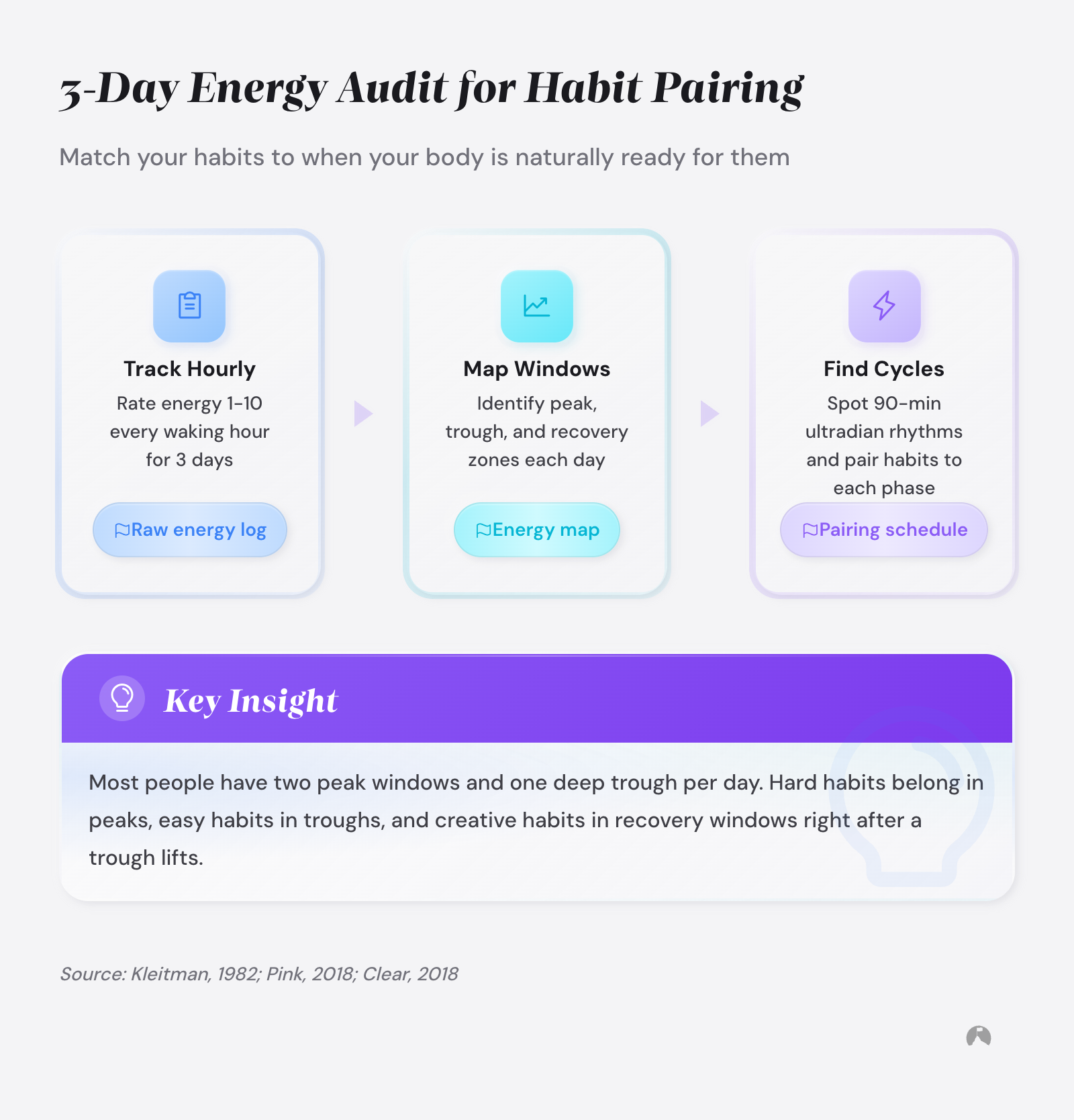
Step 1: Track your energy hourly for three days
Set a recurring alarm for every waking hour. When it goes off, rate your energy on a 1-5 scale (1 = barely functioning, 5 = sharp and focused). Record the time, the rating, and a one-word note about what you were doing. Do not try to control your schedule during these three days. The goal is to see your natural pattern, not an idealized one.
Step 2: Map your peak, trough, and recovery windows
After three days, plot your ratings by time of day. You’ll see a pattern. Most people show a peak in the morning hours after waking, a trough in the early-to-mid afternoon, and a recovery bounce later in the day [3]. But individual variation is real. Your chronotype – whether you’re naturally a morning lark, a night owl, or somewhere in between – shifts when these windows land. This is why chronotype habit pairing requires a personal audit rather than a one-size-fits-all schedule. Your personal map is what matters, not the average. Using habit tracking apps can simplify this process by logging entries automatically.
A night owl whose peak arrives around noon might pair deep writing with their 12-2 PM window and reserve morning hours for low-demand habits like inbox processing – the reverse of a typical morning-lark schedule.
| Chronotype | Approximate peak | Approximate trough | Approximate recovery |
|---|---|---|---|
| Morning lark | 8-11 AM | 1-3 PM | 4-6 PM |
| Intermediate (third bird) | 10 AM-12 PM | 2-4 PM | 5-7 PM |
| Night owl | 12-2 PM (or later) | Morning hours | 6-9 PM |
These are approximate ranges based on general chronobiology research. Individual variation means the personal energy audit is more reliable than any generic table.
Step 3: Identify your ultradian cycles
Sleep researcher Nathaniel Kleitman established that human alertness oscillates in roughly 90-120 minute cycles throughout the day – what he called the Basic Rest-Activity Cycle [5]. Unlike circadian rhythms that span a full 24-hour day, ultradian rhythms repeat multiple times within a single waking period, creating windows of 90-120 minutes that alternate between high and low alertness. Within your peak window, you’ll have one or two of these high-alertness cycles. Within your trough, even these mini-cycles dip lower. Knowing your ultradian rhythm helps you time not just which window a habit falls in, but where inside that window it sits. This is the difference between doing deep work at the start of a 90-minute cycle (when you’re fresh) versus at the end (when you’re fading).
Your energy pattern is as unique as your fingerprint. The audit finds it; the framework uses it.
How do you categorize habits by cognitive load?
Not all habits demand the same cognitive resources. A five-minute meditation requires different mental energy than writing 500 words or solving a math problem. Before you can pair habits to energy states, you need to sort your habits into demand categories.
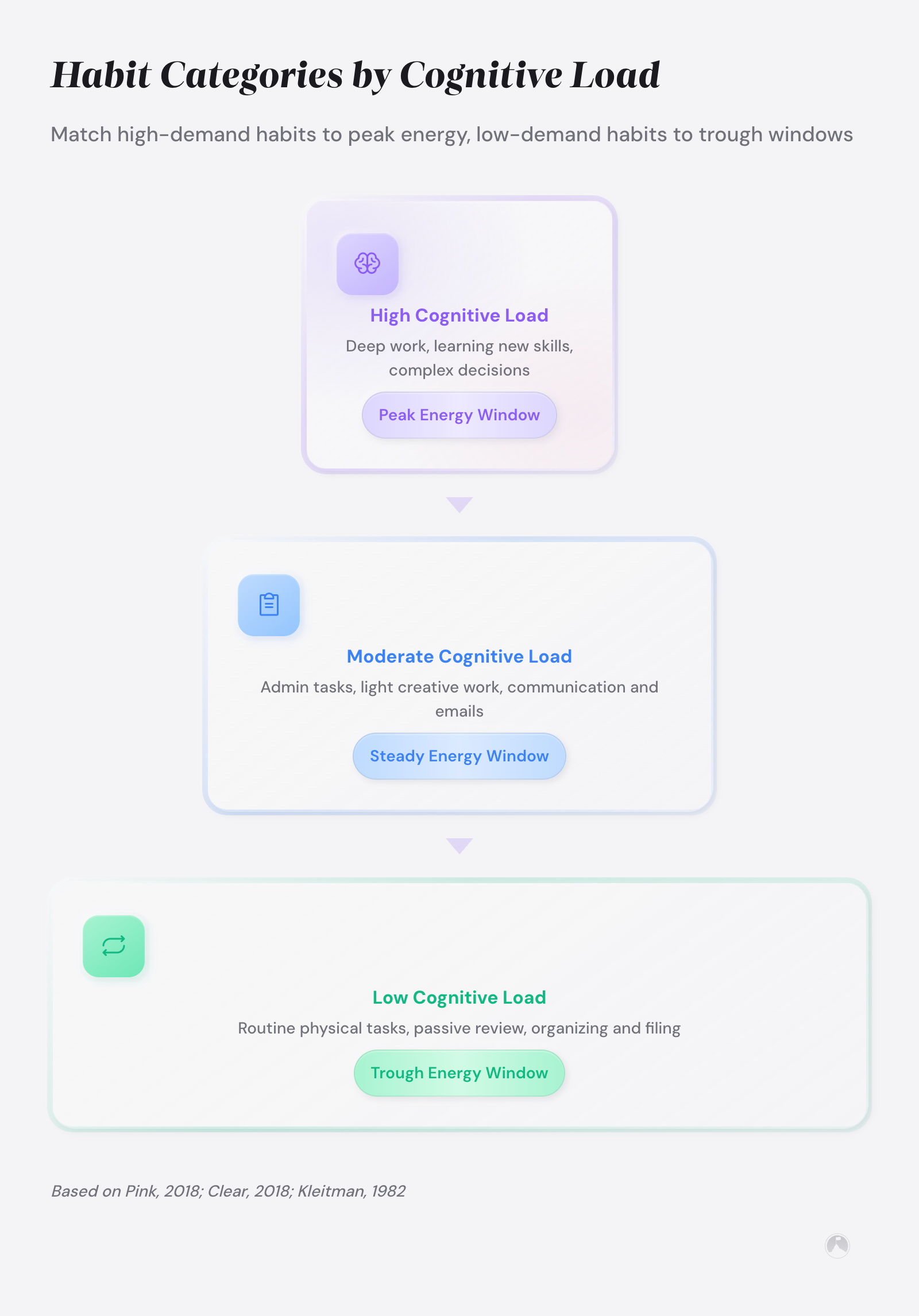
Cognitive demand refers to the mental resources a habit requires for execution. High-demand habits need focus, decision-making, and working memory. Low-demand habits run nearly on autopilot.
| Category | Cognitive demand | Examples | Best window |
|---|---|---|---|
| High-demand | Focus, decision-making, creativity | Writing, studying, strategic planning, learning new skills | Peak |
| Medium-demand | Some attention, not deep focus | Email processing, meal prep, organizing, moderate exercise | Recovery |
| Low-demand | Near-automatic, minimal load | Walking, stretching, tidying, listening to podcasts | Trough |
| Restorative | Actively replenishes energy | Napping, breathing exercises, nature walks, light reading | Trough |
Categorizing habits by cognitive demand transforms the question from “when should I do this?” to “what energy does this need?” Research by Lally et al. on habit formation found that consistency in context, including time of day, accelerates automaticity [6]. Energy alignment is one contextual factor you can control for this effect.
When you consistently match a high-demand habit to your peak window, that recurring energy state reinforces the cue your brain uses to trigger the habit. Lally’s study measured context consistency broadly – not energy state in isolation – but the principle applies: the more consistent the conditions surrounding a habit, the faster it becomes automatic.
The question is not “when do I have time?” It is “when does my brain have the fuel?”
The Energy-Match Framework: how to pair habits with energy levels
Here is a system that keeps showing up when you cross-reference circadian biology with habit formation research. None of these ideas are new individually – Pink’s timing research [3], Kleitman’s ultradian cycles [5], and Lally’s context-consistency findings [6] all point in the same direction. But combining them into a single pairing protocol makes the whole thing actionable.
The Energy-Match Framework is our three-step system for assigning every habit on your list to the energy window where it’s most likely to stick. This energy-based habit scheduling approach applies established principles from circadian biology and habit formation research in a practical structure. While the underlying research is well-established, direct evidence comparing energy-matched vs. fixed-schedule habit adherence remains limited. This framework applies those established principles in a practical structure that has not been isolated in controlled trials.
Step 1: List your current and desired habits
Write down every habit you currently practice and every habit you want to build. Do not filter. Include the easy ones and the hard ones. Then assign each one a cognitive demand category from the table above (high, medium, low, or restorative).
Step 2: Match habits to energy windows
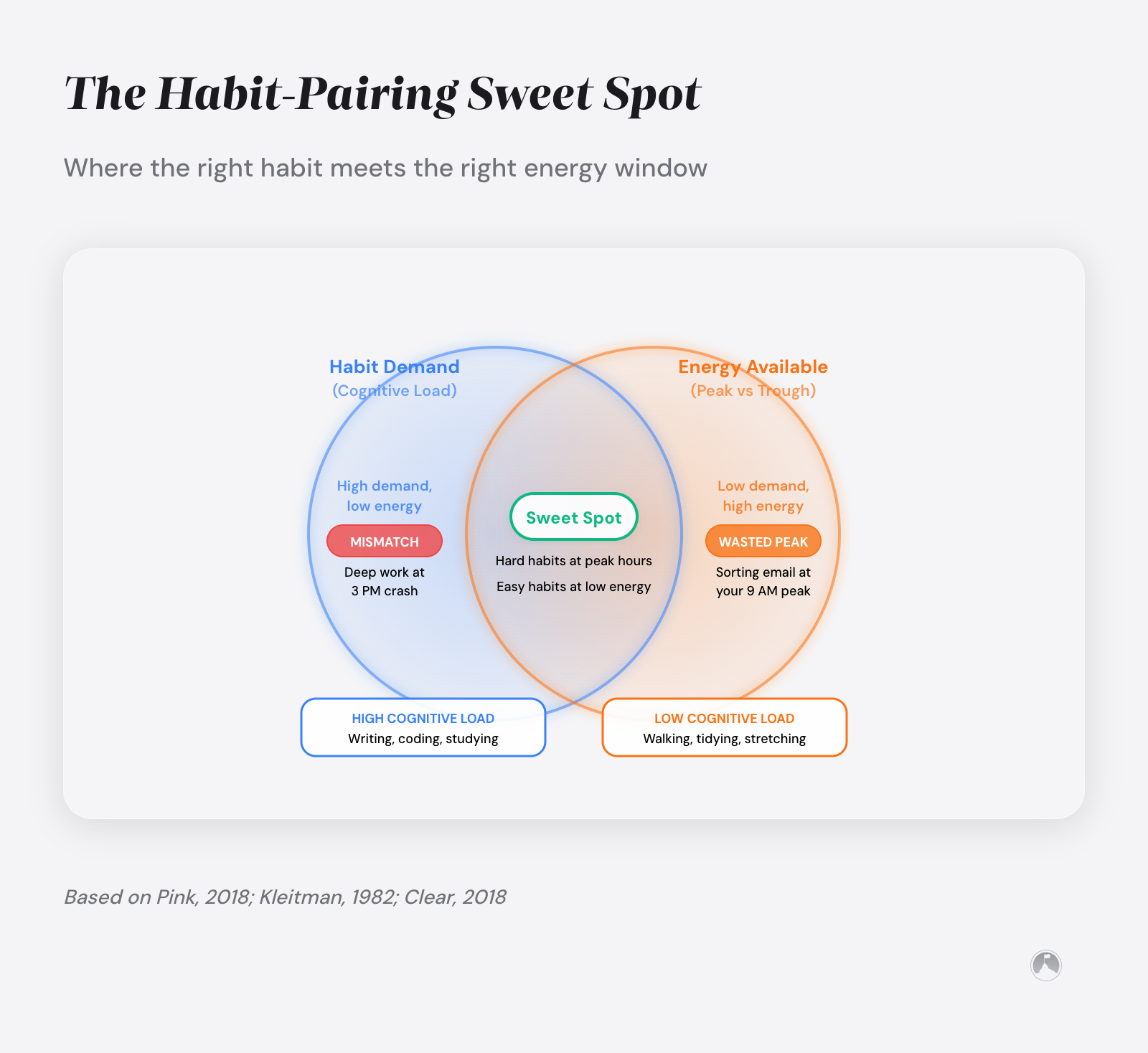
Using your personal energy audit, assign each habit to the energy window that matches its demand level. High-demand habits go to your peak window. Low-demand and restorative habits go to your trough. Medium-demand habits slot into your recovery window. If you’re building a morning routine for habit building, check whether the habits in that stack actually match morning energy. Some might belong elsewhere.
Step 3: Create paired couplets
Here is where pairing gets specific. Within each energy window, create couplets: one habit that uses the energy available, followed by one that either maintains or restores it. A peak-window couplet might be “deep writing session plus short walk.” A trough-window couplet might be “podcast listening plus kitchen tidying.”
Research on workplace recovery found that break activities chosen autonomously between demanding work periods support cognitive recovery and reduce end-of-day fatigue [8]. The couplet structure applies this principle: after a high-demand habit, a restorative or low-demand habit acts as a micro-recovery period. This prevents the rapid depletion you would get from stacking three demanding habits back-to-back during your peak and burning through your best energy in 45 minutes.
Lally et al. found that the median time to automaticity was 66 days, with a range of 18 to 254 days depending on the habit and the person [6]. Context consistency accelerates the path to automaticity, and energy alignment is one of the most reliable contextual factors that speeds up this timeline.
The Energy-Match Framework pairs habit demand with biological capacity so each behavior gets the cognitive fuel it needs to become automatic. A habit system that matches biological energy patterns does not need willpower to run because the energy state itself becomes the cue that triggers the behavior.
Energy-Match pairing builder
Use this template to build your daily habit pairs. Fill in habits by demand category, then slot them into your energy windows. This is our recommended framework – it applies research-backed principles on context consistency and effort management, though the specific couplet structure has not been empirically tested in isolation.
Your time range: e.g. 8-11 AM
Couplet 1: [High-demand] + [Low/Restorative]
Couplet 2: [High-demand] + [Low/Restorative]
Your time range: e.g. 1-3 PM
Couplet 1: [Low-demand] + [Restorative]
Couplet 2: [Low-demand] + [Restorative]
Your time range: e.g. 4-6 PM
Couplet 1: [Medium-demand] + [Low/Restorative]
Couplet 2: [Medium-demand] + [Low/Restorative]
How do you adjust habit pairs for variable energy days?
No system survives contact with a bad night’s sleep. Or a stressful meeting. Or a sick kid. Rigid habit schedules break on variable energy days because they assume yesterday’s energy pattern repeats today. Habit pairing accounts for this with a flexible protocol.
Effective habit pairing uses implementation intentions – pre-planned if-then rules that specify when, where, and how a person will act in a given situation – to adapt habit placement to today’s actual energy, not yesterday’s plan. Unlike general goal-setting, which states what you want to achieve, implementation intentions automate the decision of what to do when specific conditions arise. Psychologists Peter Gollwitzer and Paschal Sheeran found in their meta-analysis of 94 studies that implementation intentions increase goal attainment compared to goal intentions alone [7]. Rather than deciding on the fly what to do on a bad day, you pre-commit to if-then rules: “If my energy is depleted today, then I shift high-demand habits to recovery and do restorative-only in the trough.” This pre-planning removes the decision burden when you’re already running low.
“Implementation intentions had a positive effect of medium-to-large magnitude (d = .65) on goal attainment across 94 independent studies.” – Gollwitzer and Sheeran, Advances in Experimental Social Psychology [7]
On days when your peak window is weaker than normal, shift your high-demand habits one tier down. Move medium-demand habits to peak. Move low-demand and restorative habits to fill the rest. The habits still happen, just in a different arrangement. Knowing how long it actually takes to form a habit makes it clear why flexibility matters more than perfection. Lally et al. found that missing one day does not reset your progress [6]. But forcing a demanding habit during depleted energy can create negative associations that make the habit harder to build, though formal research on this specific mechanism is limited.
| Energy day type | Peak | Trough | Recovery |
|---|---|---|---|
| Normal (good sleep, low stress) | High + Restorative | Low + Restorative | Medium + Low |
| Depleted (poor sleep, high stress) | Medium + Restorative | Restorative only | Low + Restorative |
| High-energy (exceptional rest) | High + High | Medium + Low | Medium + Restorative |
The key rule: never skip all habits on a low-energy day. Always do at least one restorative or low-demand pair. This preserves the continuity signal your brain needs to maintain the habit loops you’ve built, even when the intensity drops. If you want to go deeper into how to master habit stacking, pairing adds the energy layer that makes stacks resilient to bad days. And if you’re wondering why habits fail, energy mismatch is one of the most overlooked reasons.
Flexibility is not the enemy of consistency. It’s the reason consistency survives real life.
Ramon’s take
Before you redesign anything, just notice what time your best habit actually happens right now. That’s it for week one. The audit and the framework can wait. Most people already know their energy windows, they just haven’t named them yet.
Conclusion
Habit pairing does not replace the fundamentals of habit formation. You still need clear cues, manageable difficulty, and consistent repetition. What it adds is a layer that most habit advice ignores: energy alignment. By running a personal energy audit, categorizing your habits by cognitive demand, and matching them to your peak, trough, and recovery windows, you transform habit design from a willpower contest into a system that works with your biology.
For a broader view of how all the pieces of habit building connect, explore our habit formation guide. The habits that last are not the ones you pushed hardest to maintain. They’re the ones you placed where your energy was already waiting for them.
Next 10 minutes
- Write down three habits you want to build or are struggling to maintain
- Assign each one a cognitive demand category (high, medium, low, or restorative)
- Set a recurring hourly alarm on your phone to begin your three-day energy audit
This week
- Complete the three-day energy audit and map your peak, trough, and recovery windows
- Build your first set of habit couplets using the Energy-Match Framework
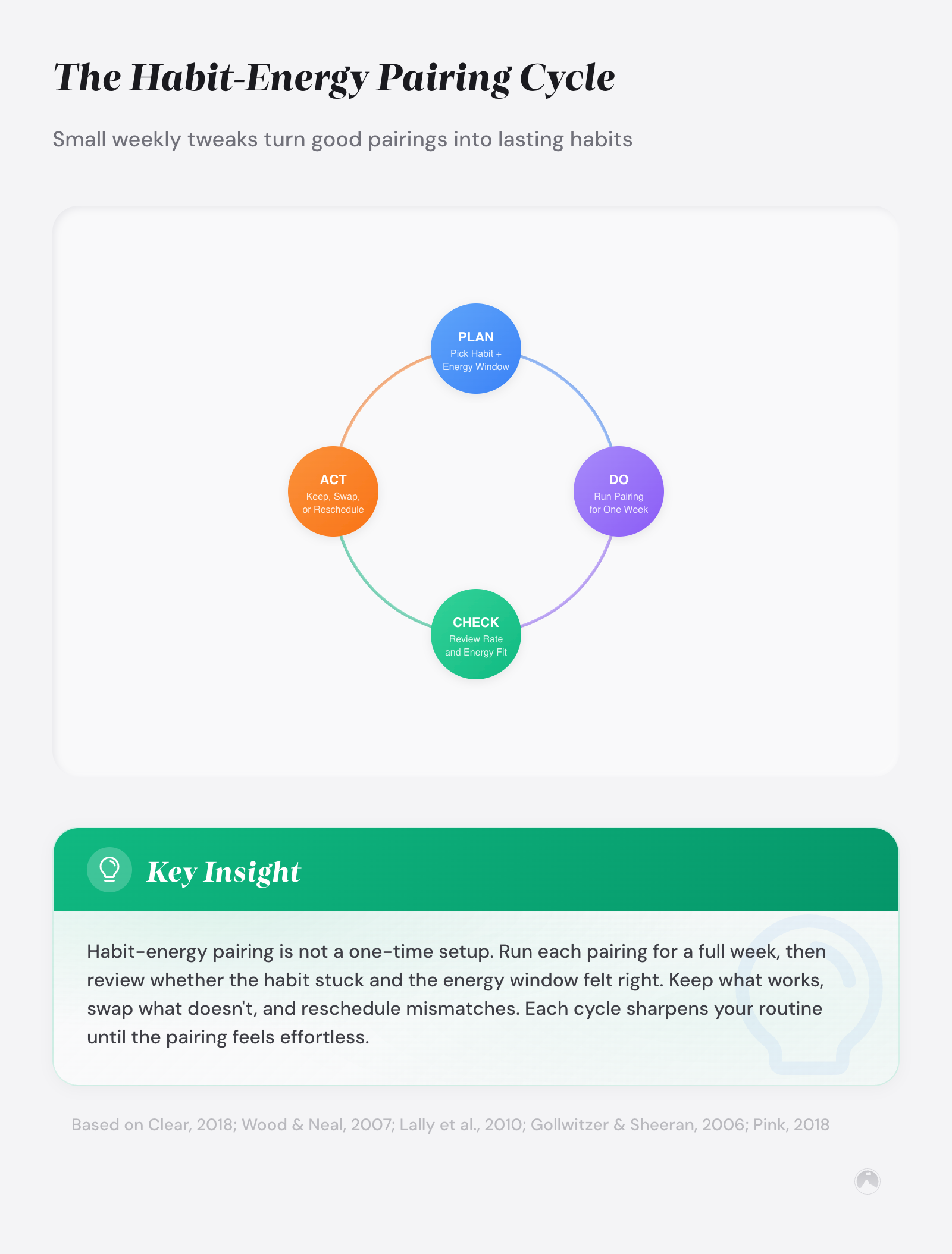
- Test your new habit-energy pairings for five days and note which pairs feel natural versus forced
There is more to explore
For more strategies on building habits that hold up in real life, explore our guides on habit formation and habit stacking for beginners. If you want to understand the brain science behind why energy state matters so much, check out the neuroscience of habit formation. And if ADHD or parenting makes your schedule unpredictable, see our guide on habit building with ADHD.
Related articles in this guide
- habit-stacking-for-beginners
- habit-stacking-productivity-creativity
- habit-system-design-architecture
Frequently asked questions
What is the difference between habit stacking and habit pairing?
Use habit stacking when you have a chain of small, low-demand behaviors that take under two minutes each. Use habit pairing when you need to place demanding habits at specific energy windows. Combine both by building short stacks within energy-matched windows – for example, a peak-window stack might be deep work plus walk plus water, all scheduled during your morning high.
What are the best habits for low energy times of day?
Low-energy windows work best for habits that require minimal decision-making: walking, stretching, podcast listening, light tidying, meal prepping from a pre-made plan, or reviewing a gratitude list. Restorative habits like breathing exercises, napping, or gentle yoga actively rebuild energy during these dips rather than just tolerating them.
How long does it take for an energy-paired habit to become automatic?
Research by Lally et al. found that habit automaticity takes a median of 66 days, with a range of 18 to 254 days depending on the habit and the person [6]. Energy-paired habits may reach automaticity faster because consistent energy-state cues reduce the friction that slows habit formation. No study has isolated this variable directly, but the context-consistency mechanism supports the logic.
Can you do habit pairing if you work shift schedules?
Shift workers can still use habit pairing by anchoring to time-since-waking rather than clock time. For many people, peak energy arrives several hours after waking, though individual chronotypes create variation. Track your energy relative to your wake time for three cycles, then build pairs around those personal windows rather than fixed hours.
What is an ultradian rhythm and how does it affect habits?
Ultradian rhythms are 90-120 minute cycles of high and low alertness that repeat throughout the day, first identified by sleep researcher Nathaniel Kleitman [5]. Unlike circadian rhythms that span a full 24-hour day, ultradian rhythms repeat multiple times within a single waking period. Timing a demanding habit at the start of an ultradian high phase gives it the best cognitive conditions for execution and encoding. Common signs that you are entering a low phase include an urge to check your phone, difficulty maintaining a train of thought, and reaching for snacks – these are signals to take a micro-break or shift to a lower-demand habit.
How do you know your peak energy times for habits without formal testing?
A simple three-day self-rating protocol works for most people. Rate your energy from 1-5 every waking hour, note what you were doing, and average the scores by time slot. Patterns emerge quickly. Or pay attention to when you naturally gravitate toward hard tasks versus easy ones over a week, as your instincts often track your ultradian rhythms.
References
[1] Clear, J. “Atomic Habits: Tiny Changes, Remarkable Results.” Avery, 2018. ISBN: 978-0735211292
[2] Hagger, M. S., Chatzisarantis, N. L. D., et al. “A Multilab Preregistered Replication of the Ego-Depletion Effect.” Perspectives on Psychological Science, 2016. DOI
[3] Pink, D. H. “When: The Scientific Secrets of Perfect Timing.” Riverhead Books, 2018. ISBN: 978-0735210622
[4] Wood, W., & Neal, D. T. “A New Look at Habits and the Habit-Goal Interface.” Psychological Review, 2007. DOI
[5] Kleitman, N. “Basic Rest-Activity Cycle – 22 Years Later.” Sleep, 1982;5(4):311-317. https://pubmed.ncbi.nlm.nih.gov/6819628/
[6] Lally, P., van Jaarsveld, C. H. M., Potts, H. W. W., & Wardle, J. “How Are Habits Formed: Modelling Habit Formation in the Real World.” European Journal of Social Psychology, 2010. DOI
[7] Gollwitzer, P. M., & Sheeran, P. “Implementation Intentions and Goal Achievement: A Meta-Analysis of Effects and Processes.” Advances in Experimental Social Psychology, 2006. DOI
[8] Trougakos, J. P., Hideg, I., Cheng, B. H., & Erdogan, B. “Lunch Breaks Unpacked: The Role of Autonomy as a Moderator of Recovery During Time Away From Work.” Academy of Management Journal, 2014. DOI