Why the wrong difficulty kills more habits than weak willpower
Two people start the same running habit on the same Monday. One is still running six months later. The other quit in week three. The difference was not discipline, motivation, or better shoes.
The difference was how each runner set the difficulty. The goldilocks rule explains why: habits survive when the challenge sits just beyond your current ability, and they die when the gap is too wide or too narrow [1].
Most habit advice focuses on consistency. Show up every day. Do not break the chain. But consistency without adjustment produces either boredom or burnout – one extreme kills your motivation, the other overwhelms your brain.
The real question is not whether you can stick to a habit. What actually matters is whether the habit is set at the just right challenge level where your brain stays engaged.
The goldilocks rule is a behavior design principle stating that peak motivation occurs when a task’s difficulty sits at the boundary of a person’s current ability, roughly where the success rate is 85% and the failure rate is 15%, avoiding both the boredom of tasks that are too easy and the anxiety of tasks that are too hard. For example, a runner completing 8 or 9 out of 10 planned runs – challenged but not crushed – is in the goldilocks zone.
What you will learn
- Why difficulty adjustment matters more than discipline for habit survival
- The neuroscience behind why your brain craves the “just right” challenge
- How to use the Difficulty Dial Method to find your personal optimal challenge point
- How to apply the goldilocks rule across fitness, learning, and creative habits
- What to do when your goldilocks zone shifts from stress, energy, or growth
- How to adapt the goldilocks rule for ADHD brains and parent schedules
Key takeaways
- Habit engagement is a design problem, not a willpower problem, and the goldilocks zone is the design specification.
- The Difficulty Dial Method treats habit adjustment as an ongoing process: rate, check, adjust, repeat every two to four weeks as your ability grows.
- The goldilocks rule is not one adjustment. It is a different adjustment for every domain, revisited as your ability changes.
- The brain’s dopamine system responds most strongly to outcomes that are uncertain but achievable, not to guaranteed success or guaranteed failure [6].
- Boredom may kill established habits more often than difficulty. Too-easy tasks suppress dopamine response [6].
- A goldilocks zone that moves with your energy (adjusting between a difficulty rating of 4 on low-energy days and 7 on high-energy days) is more sustainable than a fixed target that ignores daily fluctuation.
- Scaling back on a hard day is not failure. It is adjustment, and it often produces better long-term outcomes.
- Optimal difficulty without feedback is a guess. Optimal difficulty with feedback is a system.
Why does the goldilocks rule work? Three theories point to one answer
The goldilocks rule is not a motivational platitude. Three independent lines of research point to the same conclusion: your brain is wired to seek challenges at the edge of your current ability.
The first comes from Mihaly Csikszentmihalyi’s flow state research. Csikszentmihalyi’s decades-long study of optimal experience found that people enter flow – the state of complete absorption – when challenge and skill are closely matched [1]. Too little challenge produces apathy. Too much produces anxiety. The sweet spot between them is where engagement peaks, which the neuroscience of flow state and habit formation explains at the neurochemical level.
The second comes from Lev Vygotsky’s zone of proximal development, originally a learning theory. Vygotsky showed that the maximum learning zone is where tasks are slightly beyond current ability but still achievable with effort [3]. A guitarist who can play basic chords is in the zone of proximal development when learning barre chords – beyond current ability but achievable with focused effort. Applied to habits, the growth-producing zone is always slightly past what feels automatic.
The third comes from the Yerkes-Dodson law, which describes an inverted U-curve between arousal and performance for complex tasks [2]. Low arousal produces low performance. High arousal produces low performance too. Peak performance sits in the middle – and since most habits worth building are moderately complex, the inverted-U applies. A language learner studying vocabulary at a comfortable pace remembers less than one practicing conversation with a native speaker, but freezes entirely when asked to give a presentation in the new language. (The original 1908 study found this pattern primarily for difficult tasks; simpler tasks showed a more linear relationship, though the inverted-U has become the dominant framing in modern psychology.)
The 85% rule: where neuroscience meets mathematics
Here is where the research gets specific. In 2019, Wilson and colleagues at the University of Arizona published a study in Nature Communications that mathematically modeled the optimal error rate for learning [4]. The ideal success-to-failure ratio is approximately 85/15. You should succeed about 85% of the time and fail about 15%. That 15% failure rate is what keeps the brain engaged.
“The optimal error rate for training is around 15.87%, or conversely, the optimal training accuracy is about 85%.” – Wilson et al., 2019 [4]
What the research says about the 85% rule: Wilson, Shenhav, Stiso, and Cohen (2019), published in Nature Communications, found that optimal learning occurs at approximately 85% success / 15% failure rate. For every 10 attempts at a habit, aim to succeed 8-9 times and struggle 1-2 times [4].
The neurochemical mechanism behind the goldilocks rule involves dopamine reward prediction errors. Wolfram Schultz’s research shows that expected rewards produce minimal dopamine response, while unexpected rewards produce a spike [6]. Rewards that are uncertain – where the outcome could go either way – produce the strongest sustained dopamine response. Dopamine neurons fire most strongly when reward probability is uncertain, not when rewards are guaranteed or impossible. A habit at the right difficulty keeps the brain’s reward system active. A habit that is too easy becomes invisible to it.
The three zones at a glance
| Zone | Success Rate | What It Feels Like |
|---|---|---|
| Boredom zone | 95-100% | Going through the motions, low attention, disengaging |
| Goldilocks zone | 80-90% | Stretching but not straining, flow-ready, progressively challenging |
| Anxiety zone | Below 60% | Overwhelmed, wanting to quit, cortisol-driven frustration |
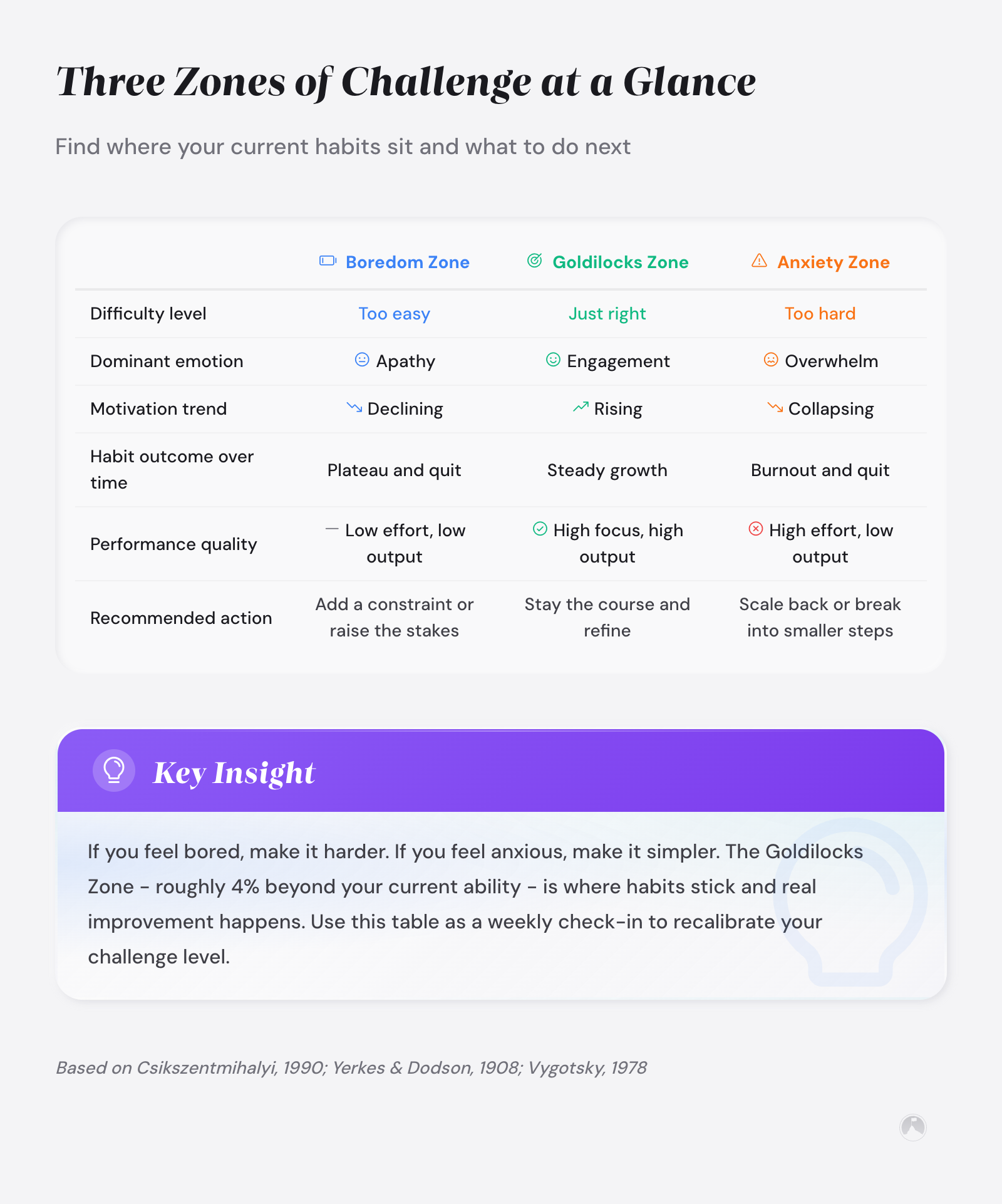
The boredom zone is the difficulty range where success rates exceed 95%, dopamine response drops, and the habit becomes mechanical – you go through the motions without engaging your brain. The anxiety zone is the difficulty range where success rates fall below 60%, cortisol spikes, and the habit triggers frustration or avoidance rather than growth.
Habit engagement is a design problem, not a willpower problem, and the goldilocks zone is the design specification.
How to find your personal goldilocks zone: the Difficulty Dial Method
Knowing the goldilocks zone exists is one thing. Finding it is another, because your optimal challenge point is personal. A five-mile run might be the goldilocks zone for one person and the anxiety zone for another.
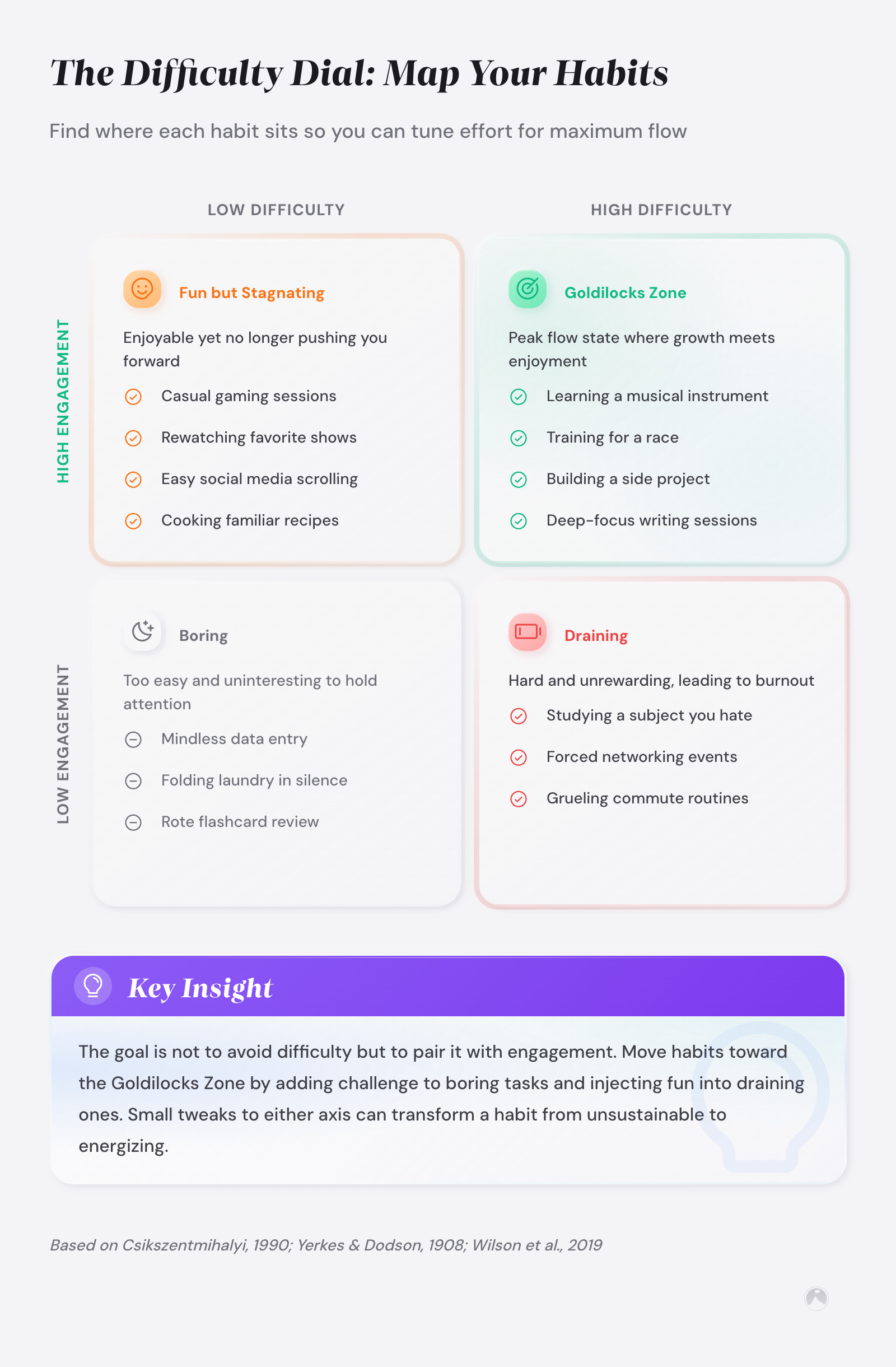
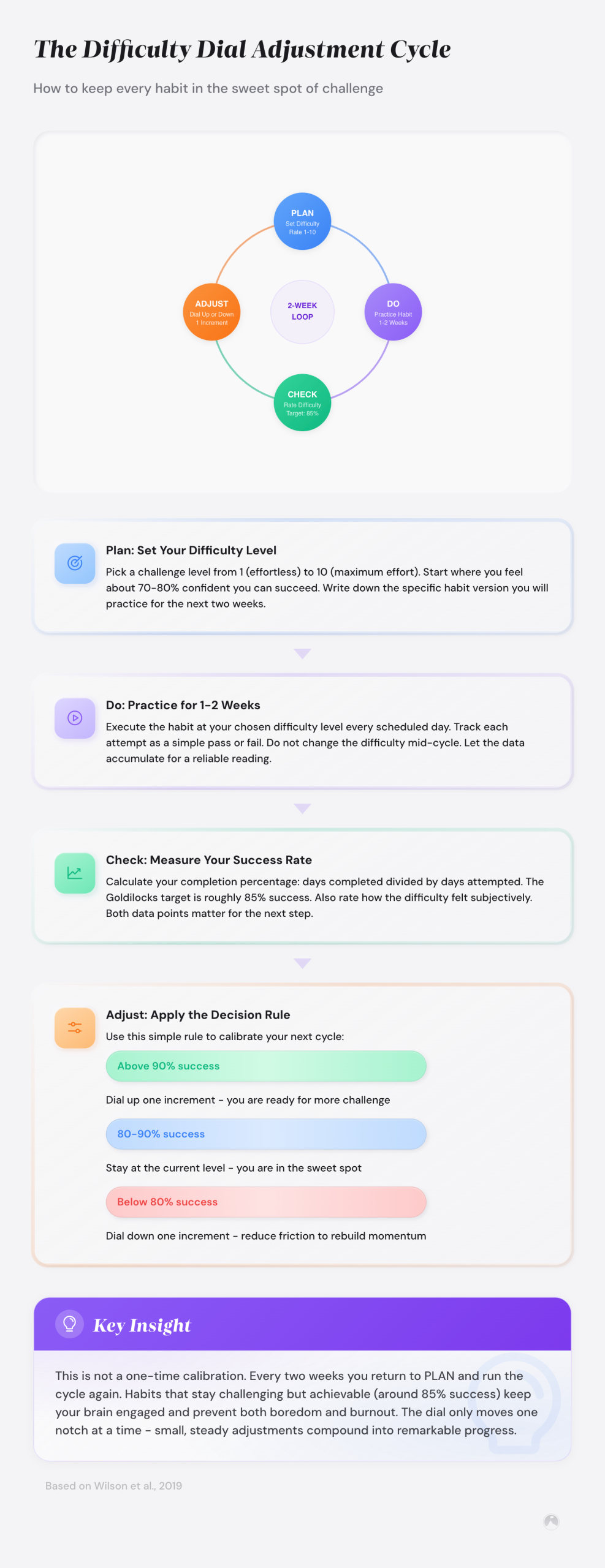
We call this the Difficulty Dial Method, a framework we developed for adjusting habit challenge to your current ability level. It works by treating difficulty as a dial you adjust, not a setting you lock in.
Step 1: rate your current difficulty (1-10 personal scale)
Rate each habit on a 1-10 difficulty scale, where 1 is completely automatic and 10 means you frequently skip it.
For each habit you are building, rate how hard it currently feels on a 1-10 scale. A 1 means completely automatic, zero mental effort. A 10 means you dread it and frequently skip it. Write down the number.
Do not overthink it. Your gut response is usually accurate. Difficulty perception tracks closely with actual cognitive load.
Your goldilocks zone sits between 4 and 7 on this personal scale. Below 4, the habit has become too easy to hold your attention. Above 7, the habit is generating more resistance than engagement. Both extremes predict abandonment, for different reasons.
Step 2: check your success rate
Count how many of the last 10 sessions you completed successfully, targeting 8-9 out of 10.
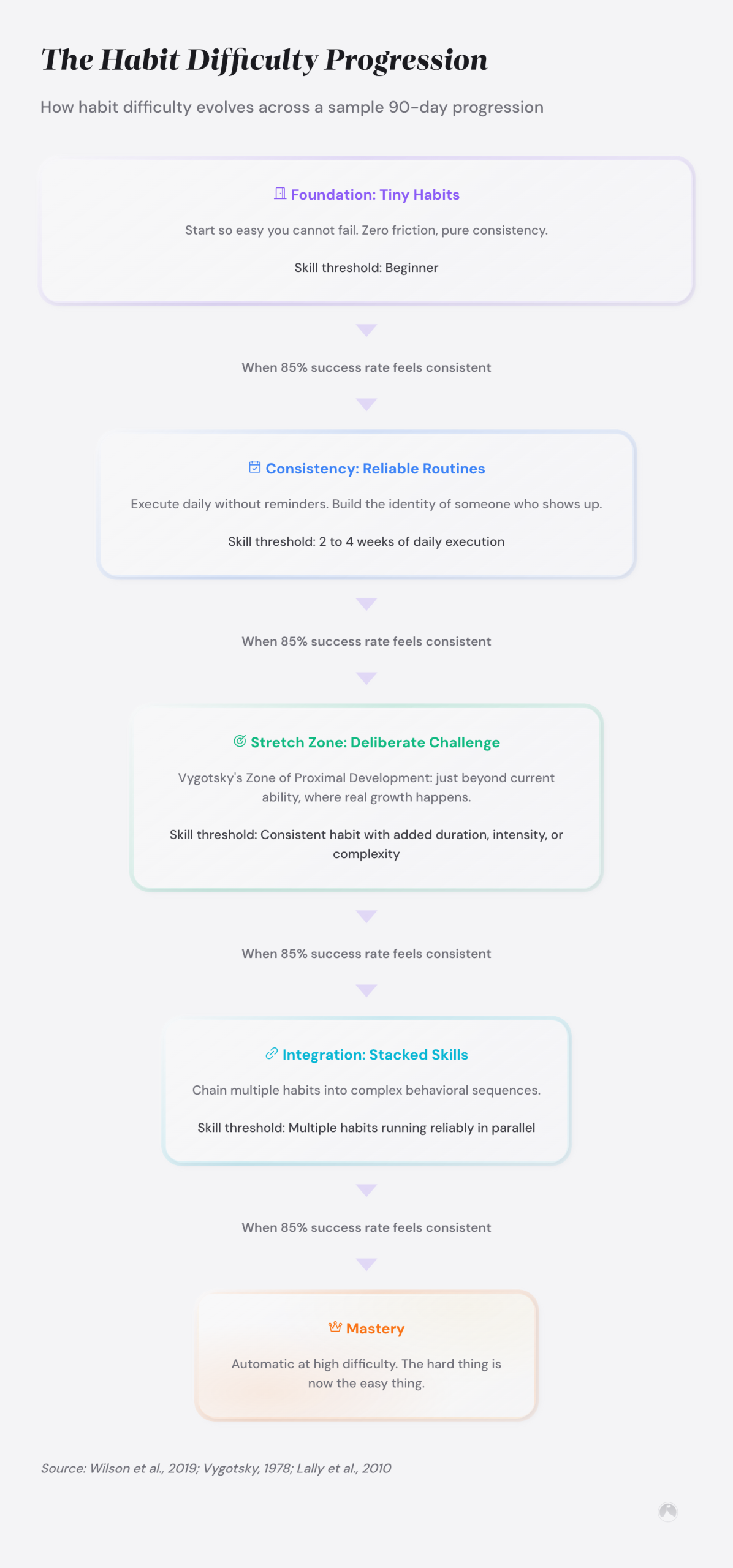
Count how many of the last ten sessions you completed successfully. “Successfully” does not mean perfectly. It means you did the habit and felt challenged but not overwhelmed.
Wilson et al.’s research suggests your target is roughly 8-9 out of 10 [4]. If you are completing 10 out of 10 with ease, the habit has drifted into the boredom zone. If you are completing fewer than 6 out of 10, it is in the anxiety zone.
Step 3: adjust by one increment
Increase or decrease difficulty by roughly 4% – just enough to notice, not enough to overwhelm.
This is the part most people get wrong. They make dramatic changes. A runner goes from three miles to six. A meditator jumps from five minutes to twenty. And they burn out in two weeks.
Research on deliberate practice by K. Anders Ericsson shows that expert performance develops through practice at the edge of current ability, not through dramatic leaps [7]. A practical starting point: increase difficulty by roughly 4% beyond your current comfort level. This is an editorial guideline based on the principle of edge-of-ability practice, not a figure from Ericsson’s research.
What does 4% look like? For a 30-minute run, add about 90 seconds. For meditation, add one minute. For a writing habit, add 50 words to your daily target. Small enough that you barely notice, large enough that your brain stays interested.
The Difficulty Dial Method treats habit adjustment as an ongoing process: rate, check, adjust, repeat every two to four weeks as your ability grows.
How to apply the goldilocks rule across productivity, fitness, and learning
The goldilocks rule applies differently depending on the habit domain. Each has different difficulty dials to turn, and recognizing which dials exist is half the work. Locke and Latham’s 35-year review of goal-setting research confirms that specific, challenging-but-achievable goals consistently outperform vague or easy goals across domains [5]. But what “challenging-but-achievable” looks like changes with the territory.
Physical habits (exercise, stretching, sports)
Physical habits offer the most intuitive difficulty dials: weight, distance, duration, intensity, and rest intervals. The variables are visible and measurable, making goldilocks adjustment straightforward. Layering physical habits through stacking can also help maintain engagement by pairing a tuned habit with complementary routines.
If your current workout feels like a 3/10 effort, increase one variable by a small margin. Add five pounds to a lift. Shorten rest intervals by 15 seconds. Run the same route but 30 seconds faster.
The signal that you have hit the boredom zone is when you can complete the session on autopilot, thinking about something else entirely. The signal for the anxiety zone is dreading the session hours before it starts.
Cognitive habits (reading, studying, language learning)
Cognitive habits are trickier to adjust because the difficulty is less visible. Guadagnoli and Lee’s challenge point framework provides a useful lens: the ideal difficulty for learning increases as the learner’s skill increases [9].
For a reading habit, difficulty dials include material complexity, reading speed targets, and retention requirements. Someone reading pop science books might push into academic papers. Someone comfortable with 20 pages per day might aim for 25.
The boredom signal: you finish a reading session and cannot identify a single new idea from what you read. The signal for the anxiety zone: you are rereading the same paragraph four times without comprehension.
Creative habits (writing, music, art, design)
Creative habits require the most nuanced adjustment. You cannot “add five pounds” to a writing session. Instead, creative difficulty dials include constraint changes (write in a new genre, work in a different medium), quality standards (from first drafts to polished pieces), and audience stakes (from private journal to published work).
The goldilocks zone for creative work often means working on a project where you know roughly how to proceed but are not sure you can pull it off. If you feel zero uncertainty about the outcome, the creative habit has become production, not growth.
Productivity habits (deep work, email management, task batching)
The goldilocks rule for productivity works by adjusting the complexity or duration of focused work sessions. A deep work habit set at 90 minutes might be anxiety-zone for someone who currently manages 30 minutes. Difficulty dials include session length, task complexity, distraction controls, and output targets. If your productivity habit feels mechanical, increase the ambition of what you produce rather than just the time spent.
| Habit Domain | Boredom Signal | Sample 4% Increase |
|---|---|---|
| Physical | Finishing on autopilot | Add 90 seconds to a 30-min run |
| Cognitive | Can’t identify one new idea per session | Switch one pop article for one research abstract per week |
| Creative | Zero uncertainty about outcome | Share one private piece with a trusted reader |
| Productivity | Going through the motions without output gains | Add one high-focus task to a deep work session |
Each domain also has its own anxiety signals worth watching: dreading the session (physical), rereading paragraphs repeatedly (cognitive), paralyzed by the blank page (creative), and avoiding the session entirely (productivity).
Goldilocks rule examples across 5 common habits
Goldilocks rule examples make the principle concrete:
| Habit | Boredom Zone | Goldilocks Zone | Anxiety Zone |
|---|---|---|---|
| Running | Same 2-mile flat route every day | 3-mile route with one hill, aiming for a slightly faster pace | Signing up for a marathon next month with no base |
| Meditation | 5-minute guided breathing you’ve memorized | 12-minute silent sit with open awareness | 45-minute unguided session in a noisy environment |
| Reading | Rereading a favorite novel | One chapter of a challenging nonfiction book per day | A dense academic paper per day in an unfamiliar field |
| Writing | Copying journal prompts from a list | 400 original words on a topic you find engaging but uncertain | Writing and publishing a polished essay every day |
| Language learning | Reviewing flashcards you already know | 15-minute conversation practice with a tutor | Giving a 10-minute presentation to native speakers |
The goldilocks rule is not one adjustment. It is a different adjustment for every domain, revisited as your ability changes.
What happens when your goldilocks zone shifts mid-week?
Here is the part that makes the goldilocks rule harder to apply than most advice suggests: your ability fluctuates daily. Sleep quality, stress levels, nutrition, and life events all shift the goldilocks zone up or down. A workout that felt like a perfect 5/10 on Monday might feel like an 8/10 on Thursday after a rough night with a sick kid.
The daily fluctuation of ability is where most people abandon the adjustment approach entirely. They conclude the goldilocks zone is too imprecise to be useful. But research on habit formation by Phillippa Lally and colleagues at University College London suggests that flexibility within a habit’s execution does not undermine the habit itself [8]. What matters is behavioral consistency, not difficulty consistency.
The practical solution: build a difficulty range, not a single difficulty point. Instead of “run 3.5 miles,” commit to “run between 2 and 4 miles, chosen based on how I feel after the warmup.” On a high-energy day, 4 miles. On a low-energy day, 2 miles. Both sessions keep the habit alive and in the engagement zone.
Scaling back on a hard day is not failure. It is adjustment. And research on goal-setting shows that flexible goal structures produce higher long-term adherence than rigid ones [5].
“Habit formation is the process by which behavior, through regular repetition, becomes automatic or habitual… The time it takes to build a habit depends on the behavior, the person, and the circumstances.” – Lally et al., 2010 [8]
A goldilocks zone that moves with your energy (adjusting between a difficulty rating of 4 on low-energy days and 7 on high-energy days) is more sustainable than a fixed target that ignores daily fluctuation.
How to adapt the goldilocks rule for ADHD brains and unpredictable schedules
Standard goldilocks advice assumes a steady ability baseline and predictable schedule. For people with ADHD or parents of young children, neither assumption holds.
ADHD adaptation
ADHD brains have a different dopamine profile. Research by Volkow and colleagues found that motivation deficits in ADHD are associated with dysfunction in the dopamine reward pathway [10]. Practically, this means the goldilocks zone is narrower – tasks that are slightly too easy become unbearable faster, and tasks that are slightly too hard trigger avoidance more quickly. The window between boredom and overwhelm is smaller, so your brain needs higher feedback frequency to stay engaged.
The adaptation: shorten the feedback loop and increase novelty within the habit. Instead of running the same route daily, rotate three routes. Instead of meditating the same way, alternate between guided, silent, and walking meditation. The underlying habit stays consistent while the execution varies enough to keep dopamine engaged. For more strategies, explore our guide on building habits with ADHD.
Parent adaptation
Parents of young children face a different challenge: the goldilocks zone shifts unpredictably from day to day. You cannot adjust difficulty on a weekly plan when a toddler’s stomach bug eliminated your next three mornings.
The adaptation: define three difficulty tiers for each habit: full version (30-minute workout), reduced version (15-minute workout), and survival version (5-minute stretch). The survival version is not the goldilocks zone. It is the habit-preservation move that keeps the neural pathway active until you can return to proper adjustment.
The goal is to spend most sessions in the goldilocks zone and a few in survival mode, rather than alternating between perfection and zero. If you are juggling kids and habits, our habits for working parents guide covers more adaptations.
The goldilocks rule works for every brain type and every schedule, but only if the adjustment method adapts to the person using it.
Why immediate feedback doubles the goldilocks effect
In Atomic Habits (2018), James Clear’s framing of the goldilocks rule included two components: optimal difficulty and immediate feedback. Most discussions focus on the first and forget the second. Without feedback, you cannot tell whether you are in the goldilocks zone at all.
This goldilocks effect – where engagement peaks at the difficulty-skill boundary – requires immediate feedback to maintain momentum. Feedback means having a signal that tells you, during or right after the habit, whether the difficulty was right. For physical habits, perceived effort during the last set is feedback. For reading, the number of new ideas you recall afterward. For creative work, the ratio of creating versus staring at the screen.
After each session, ask yourself one question: “Was that boring, engaging, or overwhelming?” That three-word check-in, done honestly, is enough data to adjust your next session. If you want to track patterns over time, habit tracking apps can help, but the core feedback loop is that single question.
The reason feedback matters connects back to Schultz’s dopamine research [6]. The brain’s reward prediction system needs information to readjust expectations. Without feedback, the system cannot distinguish between “too easy” and “appropriately challenging.” With feedback, each session becomes a data point that keeps the adjustment accurate.
Optimal difficulty without feedback is a guess. Optimal difficulty with feedback is a system.
Conclusion: your adjustment action plan
The goldilocks rule reframes habit failure as an adjustment problem, not a character flaw. When a habit dies, the first question should not be “why do I not have more discipline?” but “was this set at the right difficulty for my current ability?” The neuroscience is clear: your dopamine system responds to uncertainty and challenge, not to easy repetition or impossible targets [6]. Rate your difficulty, check your success rate, and adjust by small increments every few weeks using the Difficulty Dial Method.
The goldilocks rule for productivity works the same way it works for fitness or learning: the right habit at the wrong difficulty will always feel like the wrong habit. And that is a problem you can fix without needing more willpower. The gap between a habit that lasts and a habit that fades is often less than 4%.
Next 10 minutes
- Pick your most important current habit and rate its difficulty on the 1-10 personal scale (your personal optimal challenge point).
- Count your last 10 sessions: how many did you complete? Compare to the 85% benchmark.
- If the habit scores below 4 or above 7, identify one small adjustment (up or down) for your next session.
This week
- Apply the three-word feedback check (“boring, engaging, or overwhelming?”) after every habit session for seven days.
- If you are building a physical habit, define your three-tier difficulty range (full, reduced, survival) so you have options on low-energy days.
- Read our guide on the neuroscience of habit formation to understand the brain mechanisms behind the goldilocks effect.
There is more to explore
For more strategies on building habits that stick, explore our complete guide to habit formation. If you are looking to layer habits together, our guide on habit stacking for productivity pairs well with difficulty adjustment. And if your habits keep breaking down, our guide on why habits fail offers a diagnostic approach.
Ramon’s take
Somehow the research conclusion is: do the less impressive version of your habit. Every gym bro everywhere just rolled their eyes. But honestly? The people I know who actually stuck with things long-term were the ones who started slow. Is that annoying or is it just true?
Related articles in this guide
Frequently asked questions
What is the goldilocks rule in Atomic Habits?
In Atomic Habits, James Clear introduces the goldilocks rule in Chapter 19 as one of two keys to sustained motivation, alongside immediate feedback. Clear connects the goldilocks rule to his broader 1% improvement philosophy: rather than overhauling a habit, make it slightly harder each session so you stay in the zone where engagement peaks. This framing distinguishes Clear’s approach from the original flow state research by emphasizing gradual, compounding difficulty increases over time [1].
What is the 4% rule for habits and where does it come from?
The 4% rule is a practical guideline suggesting that the optimal increase in habit difficulty is approximately 4% beyond your current comfort level. This figure is a practical guideline inspired by the general principle of edge-of-ability practice documented by Ericsson and colleagues [7], though Ericsson’s research does not specify a particular percentage. The exact amount varies by domain, but the principle holds: small incremental increases in challenge maintain engagement better than dramatic difficulty spikes.
How do you know if a habit is in the goldilocks zone?
The clearest warning signs that a habit has drifted out of the goldilocks zone are behavioral. Boredom-zone drift shows up when you start skipping sessions without guilt or doing the habit while mentally elsewhere. Anxiety-zone drift shows up when you start negotiating with yourself to do less before you even begin, or when you feel relief rather than satisfaction when it is over. If you notice either pattern for three or more sessions in a row, it is time to adjust the difficulty dial [4].
Can the goldilocks rule apply to mental habits like meditation or journaling?
The goldilocks rule applies to mental habits, but the difficulty dials are less obvious than for physical activities. For meditation, difficulty adjustments include session length, technique complexity (breath focus versus open awareness versus loving-kindness), and environmental challenge (quiet room versus public space). For journaling, difficulty dials include prompt complexity, word count targets, and depth of self-reflection required. The key is identifying what makes the practice feel engaging rather than mechanical.
What is the connection between flow state and the goldilocks rule?
Flow state and the goldilocks rule share the same underlying mechanism – both require a match between challenge and skill [1] – but they diverge in important ways. Flow requires uninterrupted time blocks, clear goals, and immediate feedback to sustain the state. The goldilocks zone, by contrast, can operate in fragmented sessions and does not require the deep immersion that characterizes flow. A properly adjusted habit creates the conditions for brief flow-like engagement, but you can benefit from goldilocks-zone difficulty even when a full flow state is not possible.
How often should you readjust the difficulty of a habit?
The ideal frequency depends on the domain. Physical habits benefit from readjustment every 1-2 weeks because strength and endurance gains are relatively fast. Cognitive habits like reading or studying typically need adjustment every 3-4 weeks since skill gains are more gradual. Creative habits often follow no fixed schedule – readjust when engagement noticeably drops rather than on a calendar. Lally et al.’s research suggests habit automaticity develops over a median of 66 days [8], so staying attentive to difficulty during that formation window is especially important.
How does the goldilocks rule differ from other habit formation methods?
Most habit frameworks emphasize consistency, identity, or environmental design. The goldilocks rule uniquely focuses on difficulty adjustment as the driver of engagement. While other methods ask ‘How can I stick to this?’ the goldilocks rule asks ‘Is this adjusted to my current ability?’ The difference matters because the answer changes your entire approach. Instead of forcing yourself through an anxiety-zone habit, you adjust the difficulty. Instead of abandoning a boring-zone habit, you know how to re-engage it. This makes the goldilocks rule particularly useful for people whose habits keep failing despite good intentions.
References
[1] Csikszentmihalyi, M. Flow: The Psychology of Optimal Experience. Harper Perennial, 1990.
[2] Yerkes, R.M. and Dodson, J.D. “The Relation of Strength of Stimulus to Rapidity of Habit-Formation.” Journal of Comparative Neurology and Psychology, 1908. DOI
[3] Vygotsky, L.S. “Mind in Society: The Development of Higher Psychological Processes.” Harvard University Press, 1978. DOI
[4] Wilson, R.C. et al. “The Eighty Five Percent Rule for Optimal Learning.” Nature Communications, 2019. DOI
[5] Locke, E.A. and Latham, G.P. “Building a Practically Useful Theory of Goal Setting and Task Motivation: A 35-Year Odyssey.” American Psychologist, 2002. DOI
[6] Schultz, W. “Dopamine Reward Prediction Error Coding.” Dialogues in Clinical Neuroscience, 2016. DOI
[7] Ericsson, K.A. et al. “The Role of Deliberate Practice in the Acquisition of Expert Performance.” Psychological Review, 1993. DOI
[8] Lally, P. et al. “How Are Habits Formed: Modelling Habit Formation in the Real World.” European Journal of Social Psychology, 2010. DOI
[9] Guadagnoli, M.A. and Lee, T.D. “Challenge Point: A Framework for Conceptualizing the Effects of Various Practice Conditions in Motor Learning.” Journal of Motor Behavior, 2004. DOI
[10] Volkow, N.D. et al. “Motivation Deficit in ADHD Is Associated With Dysfunction of the Dopamine Reward Pathway.” Molecular Psychiatry, 2011. DOI