Your Brain Thinks Your Future Self Is a Stranger
You make plans for your future self all the time – retirement contributions, gym memberships, career goals – and then quietly abandon them. Psychologist Hal Hershfield at UCLA discovered why: brain imaging shows that when people think about themselves in ten years, the neural patterns look more like thinking about a stranger than thinking about themselves today [1]. That gap between present-you and future-you is not a willpower problem. It is a recognition problem.
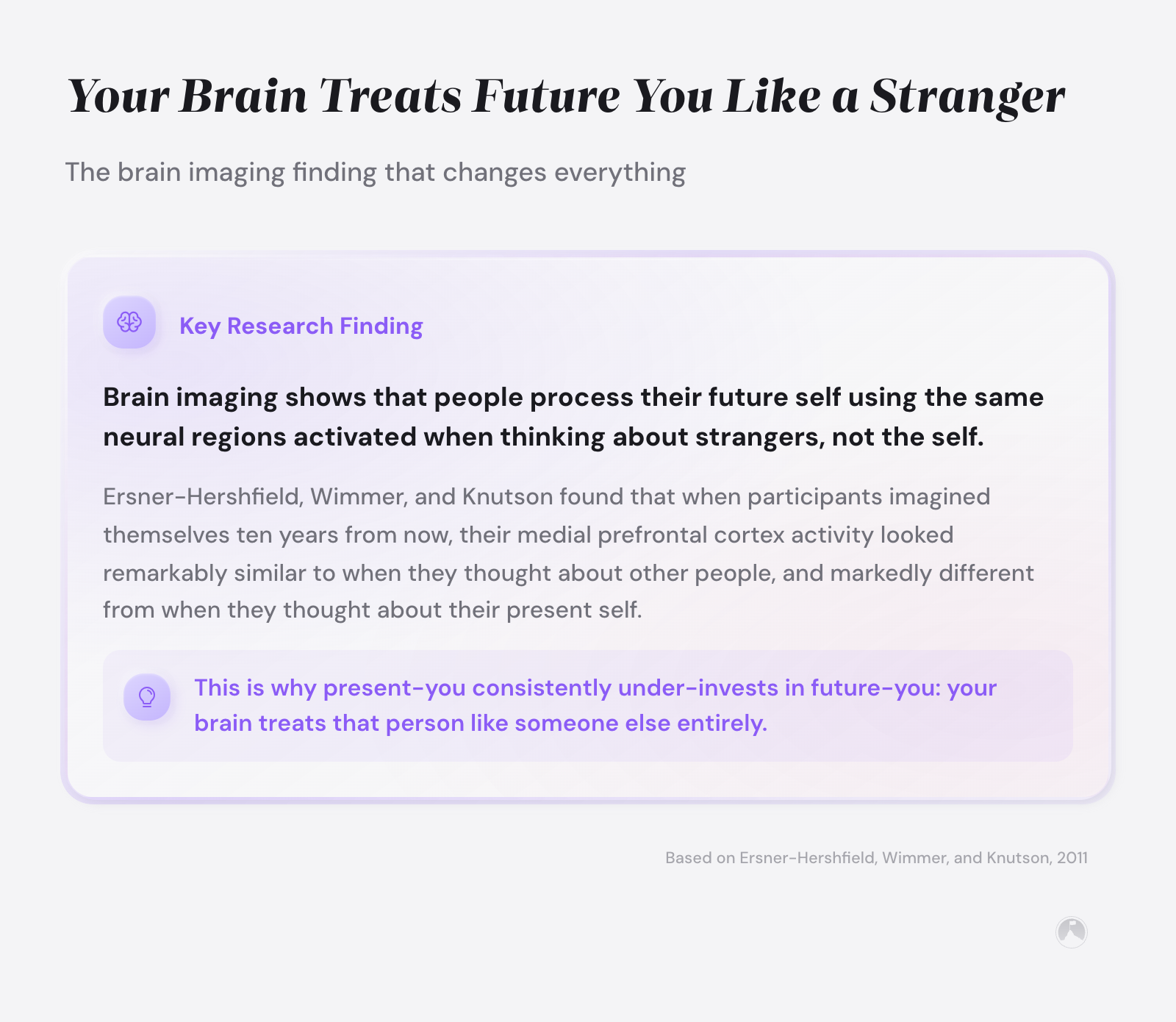
Future self planning bridges that gap by making your future self feel real, specific, and worth protecting. This article walks you through the neuroscience behind the disconnect, a practical framework for strengthening the connection, and exercises you can start today – all grounded in two decades of research on future self continuity and temporal decision-making [2].
Future self planning is a decision-making approach that strengthens the psychological connection between a person’s present identity and anticipated future identity, making long-term choices feel personally relevant rather than abstract. Unlike traditional goal-setting, which focuses on outcomes, future self planning focuses on reducing the felt distance between who a person is now and who that person will become.
What You Will Learn
- Why your brain treats your future self like a stranger (and what the fMRI data shows)
- How future self continuity predicts savings, health, and ethical decisions
- The Temporal Bridge Method – a goalsandprogress.com framework for connecting with your future self
- Three future self visualization exercises backed by research
- How future self planning changes your daily decisions
- Common mistakes that make future self planning backfire
Key Takeaways
- Brain imaging reveals that people process their future self using the same neural regions activated when thinking about strangers [1].
- Higher future self continuity predicts greater retirement savings, better academic performance, and reduced procrastination [2].
- Participants who viewed age-progressed images of themselves allocated more money toward retirement savings [3].
- The Temporal Bridge Method – a goalsandprogress.com framework – uses vividness, similarity, and commitment to connect present and future selves.
- Writing a letter to your future self increases vividness, and pairing it with an immediate decision point strengthens the effect [4].
- Humans think about the future roughly 3.5 times more often than the past, yet rarely think about their future selves in any detail [5].
- Future self visualization works best when combined with pre-commitment devices that lock in choices before present bias takes over [3].
- Identity-based motivation research shows that difficulty feels meaningful when an action fits who a person believes they are becoming [6].
Why does your brain treat your future self like a different person?
In 2009, Hal Hershfield and colleagues at Stanford placed participants in an fMRI scanner and asked them to rate how well certain traits described their current self, their future self, a current stranger, and a future stranger. The results were striking. When people thought about themselves ten years from now, activation in the rostral anterior cingulate cortex – a brain region tied to self-recognition – looked more like thinking about another person than thinking about the present self [1].
Future self continuity is the degree to which a person feels their present and future selves are connected, and individual differences in this neural signature predict real-world financial behavior. The participants whose brains showed the biggest gap between “current me” and “future me” discounted future rewards most steeply in a follow-up behavioral task [1]. They chose smaller immediate payouts over larger delayed ones. Their brains, in a sense, had no reason to save for a stranger.
“When people feel less connected to their future selves, they tend to treat their future selves more like strangers, becoming less willing to sacrifice current pleasures for future rewards.” – Hal Hershfield, UCLA psychologist and future self-continuity researcher [2]
This is not a flaw. It is a feature of how the brain handles identity across time. Thomas Suddendorf and Michael Corballis, who coined the term “mental time travel,” argue that projecting into the future depends on multiple cognitive systems – self-awareness, meta-representation, and the capacity to separate imagined states from current ones [5]. When any of those systems is fuzzy, the future self becomes blurry too.
What does future self continuity predict about your decisions?
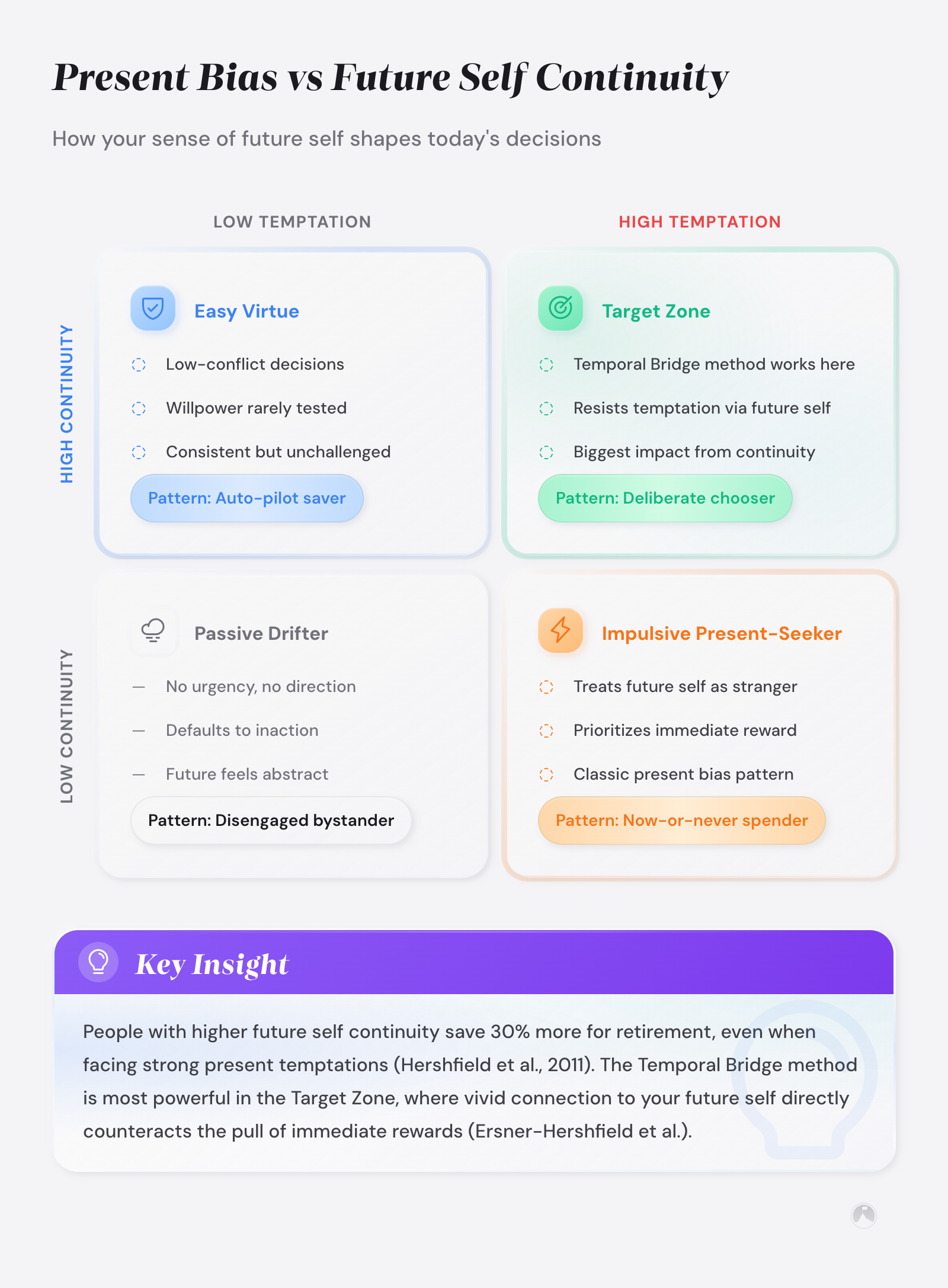
The implications go far beyond brain scans. Hershfield’s research program has shown that the degree of felt connection between present and future selves predicts behavior across multiple life domains [2]. People who score higher on the future self-continuity scale – a visual measure using overlapping circles to represent closeness between current and future identity – consistently make more future-oriented choices.
| Life Domain | High Future Self Continuity | Low Future Self Continuity |
|---|---|---|
| Financial behavior | Higher savings rates, greater retirement contributions | Steep temporal discounting, undersaving |
| Academic outcomes | Better grades, more consistent study habits | Higher procrastination, lower follow-through |
| Health decisions | More exercise, better subjective health ratings | Present-biased health trade-offs |
| Ethical behavior | Stronger moral decision-making under pressure | Greater tolerance for shortcuts and dishonesty |
| General well-being | Higher reported meaning and life satisfaction | Lower sense of purpose over time |
People who feel connected to their future selves save more money, earn better grades, exercise more often, and behave more ethically than those who see their future self as a stranger [2]. This relationship holds even after controlling for general personality traits and trait-level self-control. It is not that disciplined people happen to feel connected to their futures. The connection itself appears to drive better choices.
If you are working on building a growth mindset, knowing about future self continuity adds a missing piece. Growth mindset tells you that abilities can change. Future self planning tells you that the person who will benefit from that change is still you. And connecting with your future self turns abstract improvement into something personal.
The Temporal Bridge Method: a goalsandprogress.com framework for planning with your future self
We call this the Temporal Bridge Method – a goalsandprogress.com framework for turning the research on future self continuity into a practical planning process. The method has three components: Vividness, Similarity, and Commitment. Each one targets a different reason the future self feels distant, and they work best together.
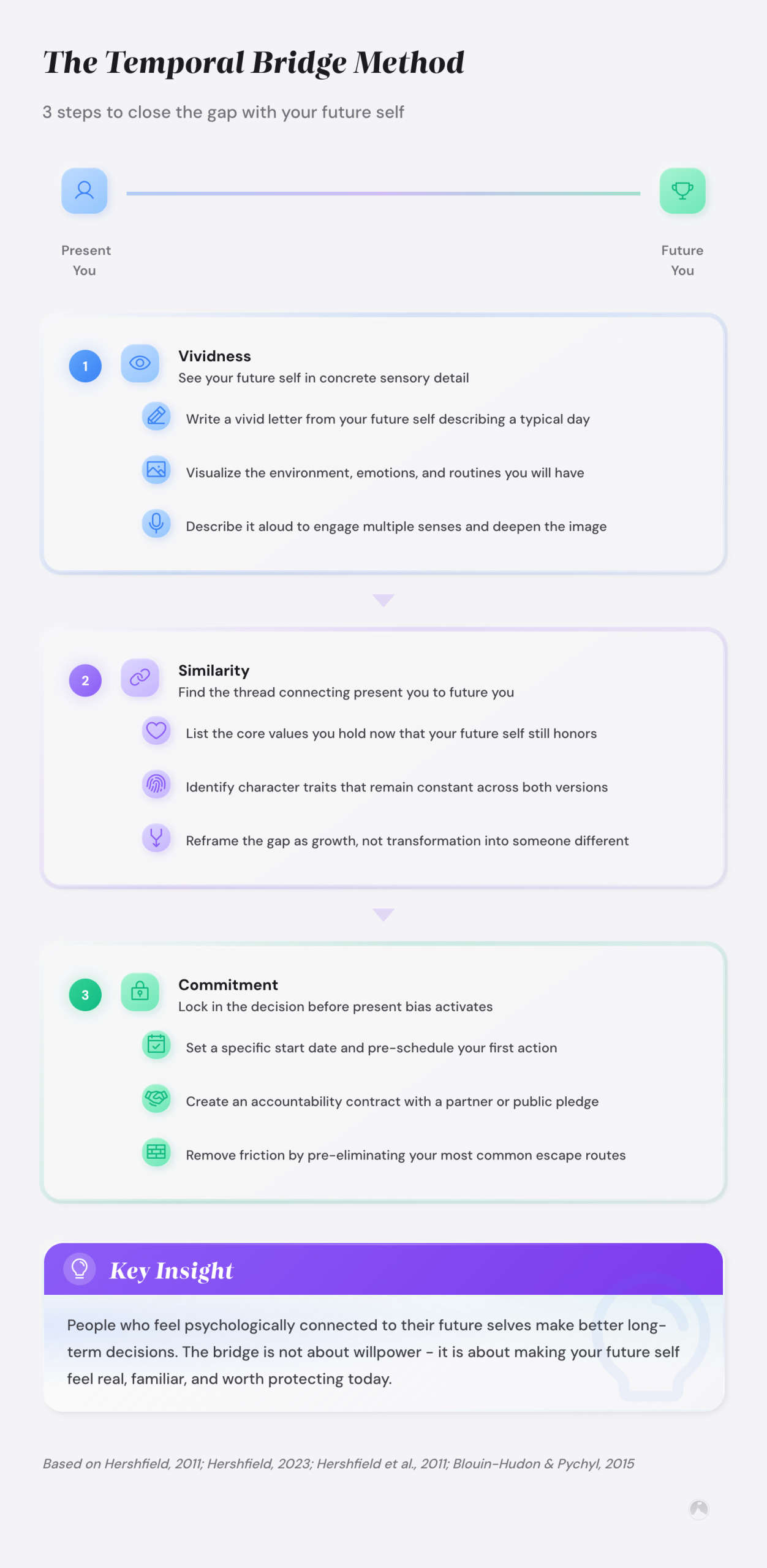
The Temporal Bridge Method addresses all three psychological barriers – vagueness, disconnection, and inaction – that prevent people from planning for their future selves.
| Component | Psychological Barrier It Addresses | Core Action |
|---|---|---|
| Vividness | Future self is abstract and blurry | Create sensory-rich, specific images of future life |
| Similarity | Future self feels like a different person | Identify stable values and traits that carry forward |
| Commitment | Good intentions fade without structure | Pair visualization with pre-commitment decisions |
Vividness: make the future self concrete
Hershfield’s most well-known intervention involved showing participants age-progressed images of themselves using virtual reality. Across four studies, people who interacted with realistic renderings of their older selves allocated more money toward retirement than those who saw their current-age avatar [3]. The effect was driven by a measurable increase in future self-similarity – participants reported feeling 1.1 points closer to their future selves on a 7-point scale, and that shift predicted their savings decisions [3].
You don’t need a VR headset for this. The principle is vividness – any method that makes the future feel specific rather than abstract. Writing a detailed description of a typical Tuesday five years from now activates those same prospection systems that Suddendorf and Corballis identify as core to mental time travel [5].
Similarity: find the thread that connects you
Vividness alone is not enough. Researchers Dan Bartels and Oleg Urminsky found that people need to both know their future selves exist and care about the outcomes those selves will face [4]. This means identifying what stays consistent between present-you and future-you: core values, the relationships you protect, the kind of work that gives you energy.
Lasting behavior change starts with recognizing that a person’s future self shares their values, even if the circumstances look different. This aligns with Daphna Oyserman’s identity-based motivation research, which shows that people act on goals that feel congruent with their sense of self and interpret difficulty as meaningful when the action fits their identity [6]. You can use self-discovery exercises to identify the stable threads worth building on. And self-assessment frameworks can help you clarify which values are genuinely yours versus inherited expectations.
Commitment: lock in the decision before present bias kicks in
Hershfield himself notes a critical caveat in his 2023 book Your Future Self: seeing your aged self or writing letters to your future self may not be enough to change behavior on its own [4]. The visualization needs to be paired with a moment where you can make an actual choice. That is where pre-commitment psychology enters.
Pre-commitment means structuring decisions so your present self can’t easily override what your future self needs. Auto-enrolling in savings increases after a raise. Scheduling workouts with a friend who will notice if you skip. Setting up commitment devices that create a cost for backing out. The combination of vivid future self and locked-in choice is where the real behavioral shift happens.
Three future self visualization exercises that actually work
Not every exercise works equally well. Here are three approaches with research support – ranked by effort required.
1. The future self letter exchange (15 minutes)
Write a letter to your future self five years from now. Then – and this is the part most people skip – write a letter back from that future self to present-you. Hershfield recommends this two-way exchange as it forces you to picture your future self as a real person with perspective on your current decisions [4].
Future Self Letter Template
Letter TO your future self (5 years from now):
- What I am working on right now that I hope pays off for you…
- The trade-off I am making today that I need you to understand…
- The habit or pattern I am trying to change before it reaches you…
- What I hope your typical Tuesday looks like…
Letter FROM your future self (back to present-you):
- The one decision you made that mattered most to me…
- The thing you worried about that turned out fine…
- What I wish you had started sooner…
- What I am grateful you did not give up on…
Pair this letter with one concrete commitment – a savings increase, a scheduled conversation, a calendar block – within 24 hours of writing it.
2. The Tuesday test (5 minutes)
Describe in detail what a regular Tuesday looks like for you in three years. Not the highlight reel. Not the vacation. A boring, good, normal day. Where do you wake up? What is the first thing you do? Where do you work and on what? This exercise taps into prospection – the mental simulation of possible futures that Suddendorf and Corballis identify as a core human capacity [5].
Prospection research shows that humans think about the future roughly three and a half times more often than the past, yet most future thinking is vague and unfocused rather than directed at the self [5]. The Tuesday test forces specificity. And specificity is what converts abstract intention into something your brain treats as real.
3. The values continuity audit (20 minutes)
List your five most important values right now. Then ask: which of these will still matter to me in ten years? The ones that survive that filter are your continuity anchors – the stable threads that connect present-you to future-you across time. Make your current decisions serve those anchors directly.
This exercise draws on the similarity dimension of future self continuity. Research shows that felt similarity to one’s future self operates independently from vividness [2]. You can picture your future self in rich detail and still feel disconnected from that person if you don’t see shared values. Journaling about goal achievement can help you track how your values translate into real decisions over time.
How does future self planning change your daily decisions?
The real test of future self planning is not whether you feel inspired after a visualization exercise. It is whether your choices shift on a Tuesday afternoon when no one is watching.
“Interacting with a vivid representation of one’s future self led to an increased tendency to accept later, larger monetary rewards over smaller, immediate ones.” – Hershfield et al., Journal of Marketing Research [3]
Temporal discounting – the tendency to value immediate rewards over future ones – is not a failure of knowledge or willpower but a failure of identification with the person who will bear the consequences of today’s choices. When you have done the work to make your future self vivid and recognizable, the calculus changes. Skipping the workout feels like shortchanging someone you know. That shift is what Oyserman’s identity-based motivation research predicts: when behavior feels identity-congruent, the effort becomes evidence that the goal matters rather than evidence that it is too hard [6].
If you are building systems for long-term motivation, future self planning gives those systems a “why” that feels personal rather than abstract. For those working on multi-year goal persistence, the future self connection provides the emotional fuel that keeps you going after the initial excitement fades. And if you are thinking about planning long-term career transitions, connecting with your future self helps clarify which career paths genuinely fit the person you are becoming.
What makes future self planning backfire?
Not all future self planning works. Some approaches can actually widen the gap between present and future selves. Here is what to watch for.
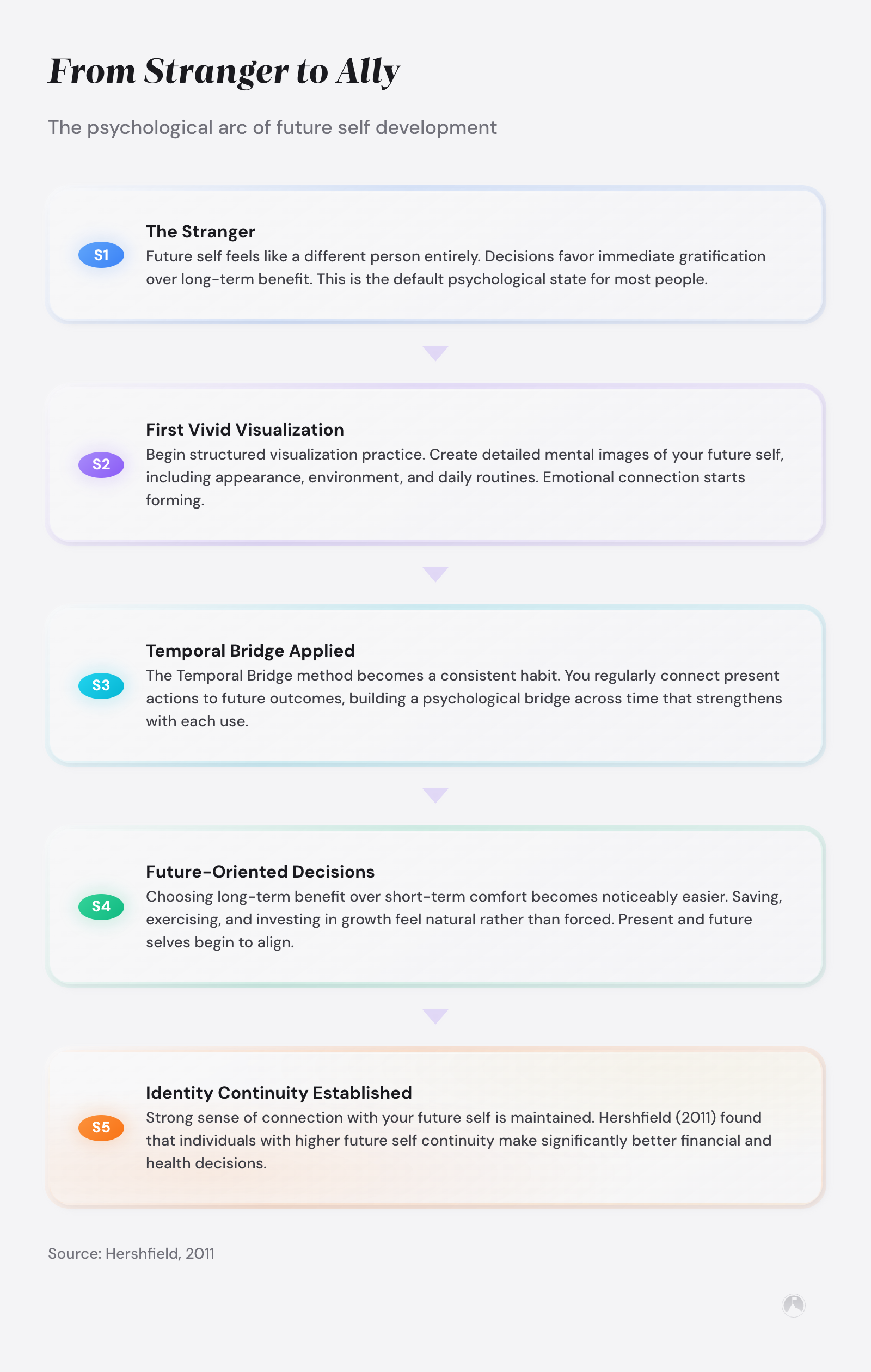
Picturing a future self that is too different from who you are now creates disconnection rather than motivation. If your future self visualization looks like a completely different person – different values, different personality, a life with zero resemblance to your current one – your brain files that person in the “stranger” category and you are back where you started. The research on future self-continuity suggests that the key is felt similarity, not aspiration [2].
A second mistake is visualizing without committing. Hershfield’s work is clear: vividness exercises need to be coupled with actual decision points [4]. Writing a beautiful letter to your future self and then changing nothing creates a “positive fantasy” – it feels good in the moment but can reduce motivation by giving you the emotional reward without the behavior [3].
The third trap is planning for a future self who lives in perfect conditions. Your future self will still be tired. Still be busy. Still face trade-offs. Planning for your future self means building systems that work even when willpower runs low – not picturing a version of yourself who somehow transcends the constraints you face today. This connects to overcoming limiting beliefs – the goal is not to believe your future self is perfect, but to believe that person is still worth investing in.
Ramon’s Take
Before you try the fancy visualization stuff, just write one sentence about what you want your life to look like in five years. Read it every morning for a week. That’s it. See if it changes what you say yes to.
Future Self Planning Conclusion: Your Next Steps
Future self planning is not about predicting your future. It is about closing the psychological gap between who you are and who you will be so that long-term decisions feel personal rather than abstract. The neuroscience is clear: when your future self feels like a stranger, you treat that person like one. When your future self feels familiar, you protect that person’s interests as naturally as you protect your own.
The person you are becoming is already shaped by the decisions you are making today. The only question is whether you will make those decisions for a stranger or for yourself.
Next 10 Minutes
- Take the Tuesday test: write a detailed description of a normal Tuesday three years from now
- Rate your current future self continuity – on a scale of 1-7, how connected do you feel to yourself in ten years?
- Identify one decision you have been putting off since the benefits feel too far away
This Week
- Complete the future self letter exchange – both directions – and pair it with one concrete commitment
- Run the values continuity audit and identify your three strongest continuity anchors
- Set up one pre-commitment device tied to a goal your future self will benefit from
There is More to Explore
For a broader look at the psychological foundations of growth and self-improvement, explore the growth mindset development guide. If you want to pair future self planning with structured reflection, our guide on journaling and goal achievement research covers the evidence on how writing about goals changes outcomes. And if you are ready to turn future self insights into a structured plan, creating a personal development plan provides the step-by-step process.
Related articles in this guide
Frequently Asked Questions
What is the difference between future self planning and regular goal-setting?
Future self planning focuses on strengthening the psychological connection to a person’s future identity, not just defining outcomes and milestones. Research shows that people who feel disconnected from their future selves abandon goals even when the goals themselves are well-defined [2]. Future self planning addresses the identity gap that traditional goal-setting methods miss entirely.
How long does it take for future self continuity exercises to change behavior?
Most research studies show measurable behavioral shifts within a single session when visualization is paired with an immediate decision point [3]. The age-progressed avatar studies found increased savings allocation during the same experimental session. For sustained change, repeating exercises weekly for three to four weeks builds the strongest continuity connection.
Can future self planning help with procrastination?
Yes. Research by Blouin-Hudon and Pychyl found that higher future self continuity predicts lower academic procrastination [7]. When your future self feels real and familiar, the consequences of delay feel personal rather than abstract. Pairing future self visualization with specific deadlines and pre-commitment devices strengthens this anti-procrastination effect.
Does future self visualization work without virtual reality or age-progressed photos?
It does. Hershfield’s original VR studies were compelling, but subsequent research found that written exercises, vivid mental imagery, and letter-writing tasks increased future self continuity as well [4]. The mechanism is vividness and specificity, not the technology. A detailed written description of a future daily routine can activate prospection systems similar to those engaged by visual tools [5].
What is temporal discounting and how does it relate to future self planning?
Temporal discounting is the tendency to value immediate rewards more than future rewards of equal or greater value. Hershfield’s fMRI research showed that temporal discounting rates correlate with how differently the brain processes present versus future self [1]. Future self planning directly targets this by making the future self feel more present, which reduces the discount rate applied to long-term rewards.
How often should you revisit your future self plan?
Quarterly reviews work well for most people. Future self continuity is not a fixed trait – it fluctuates with life circumstances, stress, and major transitions [2]. Revisiting your future self letter, updating your Tuesday test description, and reassessing your values continuity anchors every three months keeps the connection fresh. Major life changes warrant an immediate refresh.
Can connecting with your future self improve financial decision-making?
Hershfield’s VR studies found that participants who viewed age-progressed images of themselves allocated significantly more money toward retirement savings [3]. The mechanism is reduced temporal discounting – when a person’s future self feels real, spending now at the expense of saving later feels like taking from someone familiar. This finding has been replicated across multiple experimental designs.
What role do values play in future self planning exercises?
Values serve as continuity anchors – the stable threads connecting present and future identity. Oyserman and Destin’s identity-based motivation research shows that people act on goals that feel congruent with their sense of self [6]. When future self planning builds on core values that carry forward across time, the exercises produce stronger and more durable behavioral shifts than visualization alone.
References
[1] Ersner-Hershfield, H., Wimmer, G.E., & Knutson, B. “Saving for the future self: Neural measures of future self-continuity predict temporal discounting.” Social Cognitive and Affective Neuroscience, 2009. DOI
[2] Hershfield, H.E. “Future self-continuity: How conceptions of the future self transform intertemporal choice.” Annals of the New York Academy of Sciences, 2011. DOI
[3] Hershfield, H.E., Goldstein, D.G., Sharpe, W.F., Fox, J., Yeykelis, L., Carstensen, L.L., & Bailenson, J.N. “Increasing saving behavior through age-progressed renderings of the future self.” Journal of Marketing Research, 2011. DOI
[4] Hershfield, H.E. Your Future Self: How to Make Tomorrow Better Today. Little, Brown Spark, 2023.
[5] Suddendorf, T., & Corballis, M.C. “The evolution of foresight: What is mental time travel, and is it unique to humans?” Behavioral and Brain Sciences, 2007. DOI
[6] Oyserman, D., & Destin, M. “Identity-based motivation: Implications for intervention.” The Counseling Psychologist, 2010. DOI
[7] Blouin-Hudon, E.M.C., & Pychyl, T.A. “Experiencing the temporally extended self: Initial support for the role of affective states, vivid mental imagery, and future self-continuity in the prediction of academic procrastination.” Personality and Individual Differences, 2015. DOI