
Why building an antifragile mindset beats resilience alone
You survive a setback. You recover. You’re back to baseline. This cycle repeats whether the setback is a failed project, a missed opportunity, or feedback that stung. Resilience strategies teach you to bounce back to where you started. But building an antifragile mindset means doing something different – getting stronger because of the difficulty, not in spite of it.
Most productivity advice focuses on resilience – the capacity to return to your original state after stress. But researchers have identified something more powerful: antifragility. An antifragile mindset doesn’t just survive difficulty. It gains from it. The difference isn’t semantic. It’s the gap between returning to baseline and moving forward enhanced.
Building an antifragile mindset means developing the mental structures and daily practices that convert stress and setbacks into measurable growth. Unlike resilience, which returns you to your previous baseline, antifragility means each difficulty leaves you with stronger capacity, sharper skills, and greater confidence than you had before it arrived.
Antifragility describes systems and people that improve under stress. Unlike resilience (bouncing back to baseline), antifragility means that challenges actually strengthen your capacity and capability. Nassim Nicholas Taleb introduced the concept in his 2012 book, defining it as the opposite of fragility – systems that gain from volatility and disorder [1].
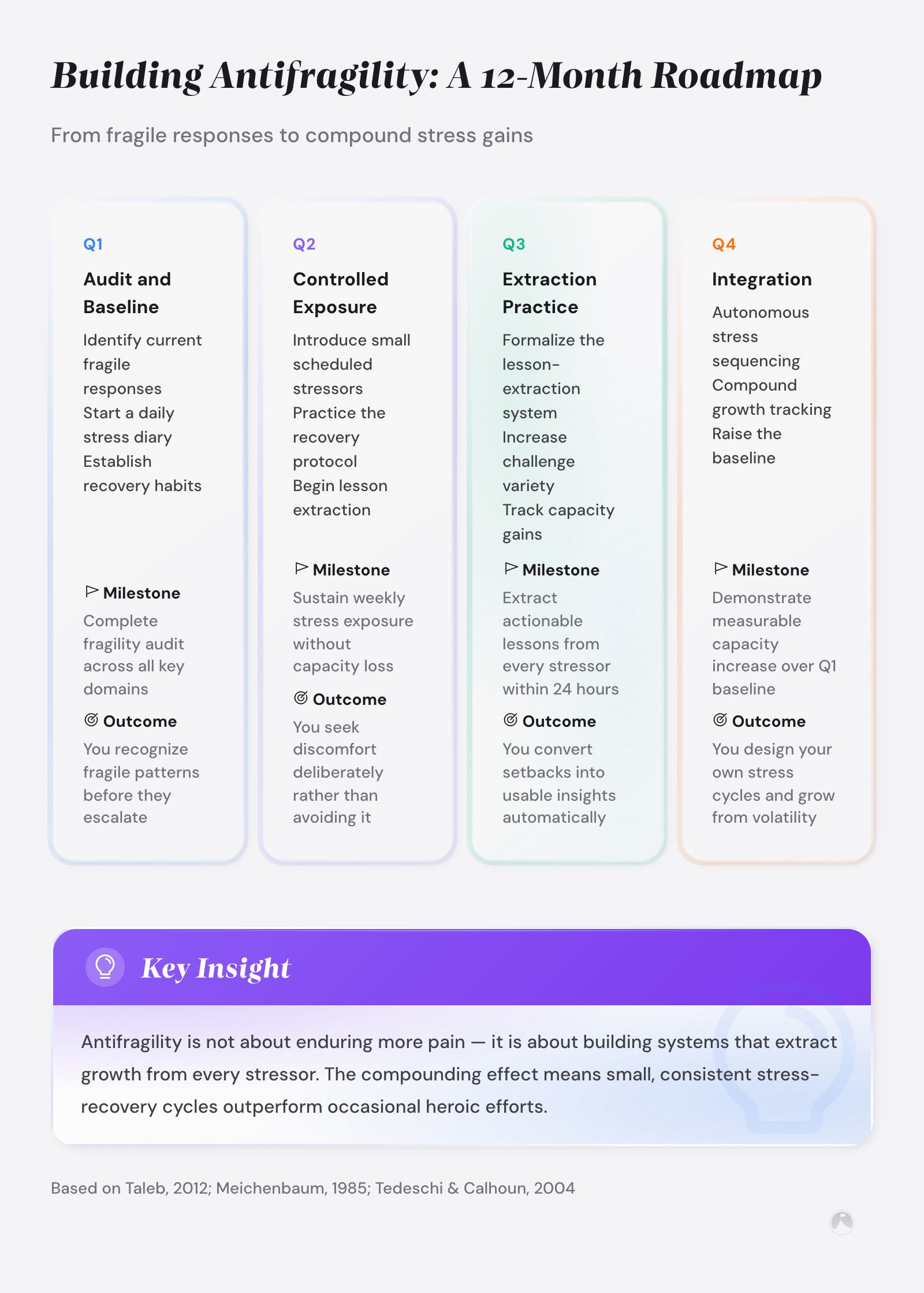
This system shows you how to become antifragile through deliberate practice. You’ll learn to dose stress exposure correctly, extract specific growth from setbacks, and measure whether your antifragility is actually increasing over time. Every step is designed to be actionable today, not theoretical for someday.
Building an antifragile mindset is the practice of intentionally developing mental structures and antifragile behaviors that convert stressors and setbacks into growth inputs, resulting in greater capability and confidence each time you face adversity.
What you will learn
- How antifragility differs from resilience and why the distinction matters for your long-term growth
- The Stress Conversion Framework – a three-phase system for extracting growth from difficulty
- How to find the right amount of stress to challenge yourself without breaking down
- A post-setback analysis protocol for identifying what capacity needs strengthening
- Concrete metrics for measuring whether your antifragility is actually increasing
Key takeaways
- Antifragility is the opposite of fragility, not just a stronger form of resilience – it converts stress into fuel for growth.
- The Stress Conversion Framework has three phases: calibrate exposure, extract lessons, and measure progress.
- Intentional stress exposure – small, manageable challenges – trains your mind to benefit from difficulty rather than be harmed by it.
- Every setback contains data about which capacities need strengthening; extracting that data is the core practice.
- You can measure antifragile growth by tracking recovery speed, learning extraction, and your response to future similar challenges.
- Antifragility is distinct from recklessness; the practice requires wisdom about what stressors to invite and how to recover properly.
Understanding the antifragility spectrum
Most frameworks treat resilience as the gold standard. You’re stressed, you recover, you’re ready for the next challenge. But author Nassim Nicholas Taleb introduced a concept in his 2012 book that shifts this entirely: antifragility, which describes systems and people that actually improve under stress [1]. Recent psychology research has started to formalize this as a measurable capacity distinct from traditional resilience, identifying two factors – recognizing opportunities in challenges and maintaining a positive orientation toward disruption [2]. The difference between resilience and antifragility is more than semantic.
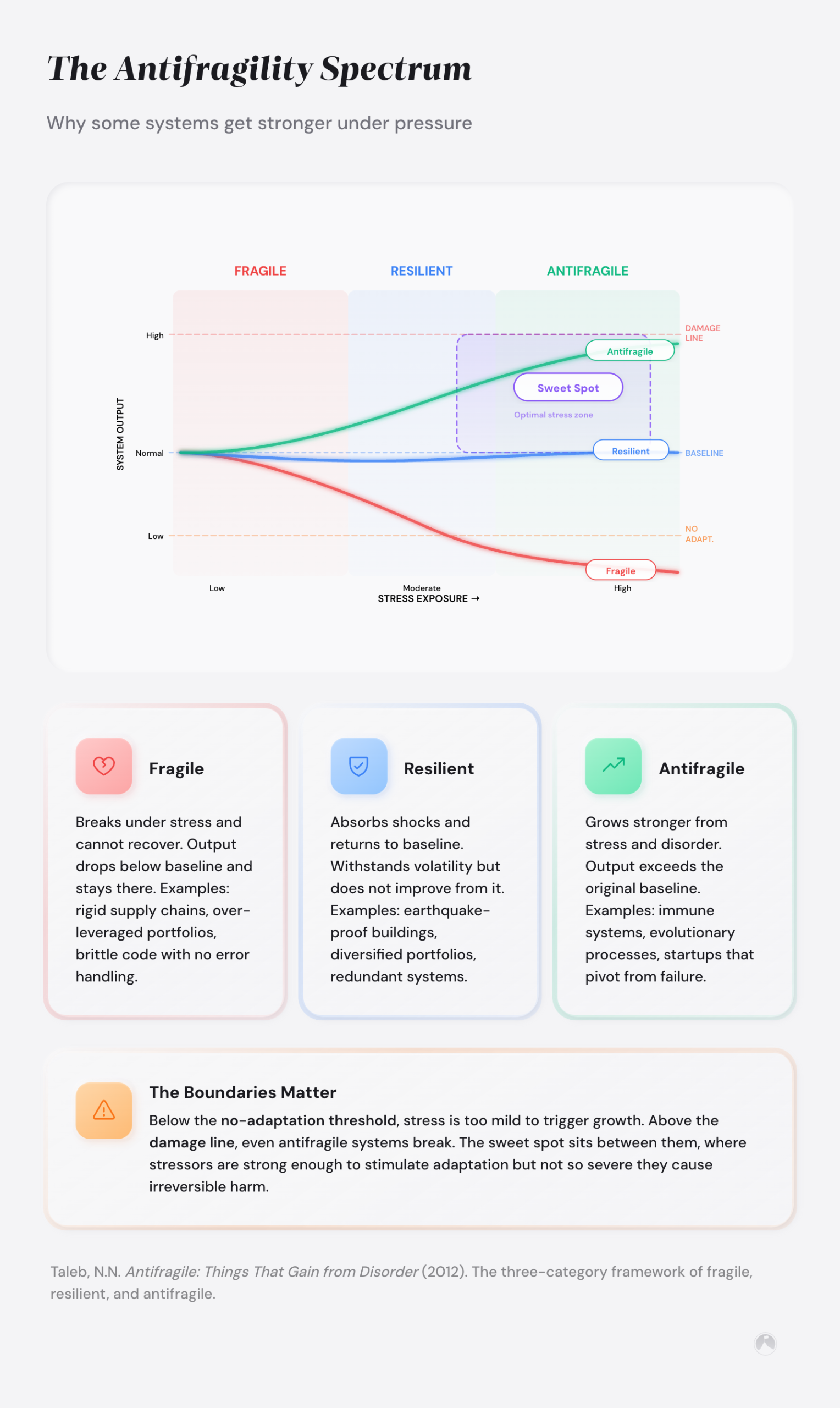
Three people face the same setback – a critical performance review. Each responds differently. A fragile person crumbles and questions their entire ability. A resilient person processes the feedback, adjusts, and returns to their previous functioning. An antifragile person extracts specific insights about their weak areas, builds targeted strength in those areas, and becomes more capable than before the criticism arrived.
Here’s the key: these aren’t fixed personality types. They’re operating modes you can develop. Research into fixed vs. growth mindset neuroscience helps explain why some people shift between these modes faster than others. If you’re not sure where you stand, a structured self-assessment framework can help you map your current patterns. The antifragility spectrum looks like this:
| Dimension | Fragile | Resilient | Antifragile |
|---|---|---|---|
| Definition | Weakened by stress and disorder | Returns to baseline after stress | Gains strength and capability from stress |
| Response to setback | Damage that takes extended recovery; you end up weaker | Temporary disruption followed by full recovery to your previous state | Gaps exposed, adaptation triggered; you recover stronger and more capable |
| Long-term trajectory | Declining capacity over repeated setbacks | Stable capacity — you maintain your baseline | Increasing capacity — each setback builds new strength |
| Example | Critical feedback causes spiraling self-doubt and withdrawal | Critical feedback stings, but you process it and return to normal functioning | Critical feedback reveals a specific skill gap; you build that skill and outperform your previous level |
Where are you on that spectrum right now? Not in general – in your specific weak areas. Maybe you’re resilient about failure but fragile about criticism. Or you bounce back quickly from work setbacks but stay stuck after relationship difficulties. Antifragile capacity is a learnable skill, not a fixed trait – each person can move from fragile to antifragile through deliberate, progressive practice.
The Stress Conversion Framework: how antifragility actually works
Antifragility isn’t about being tough or ignoring pain. It’s about converting stress into information, then using that information to build capability. Psychologist Donald Meichenbaum’s stress inoculation training – a therapeutic approach that builds psychological strength through controlled, graduated exposure to manageable stressors paired with coping skill development – confirms that this process creates psychological and physiological strengthening [3].
Foa and Kozak’s work on emotional processing of fear further supports this principle – exposure followed by recovery produces adaptive change [4]. This is the foundation of the Stress Conversion Framework.
The Stress Conversion Framework is our synthesis of three principles that keep showing up across the stress adaptation research. Three phases, cycled repeatedly. None of these phases are new individually – but working through them together is what makes the difference between accumulating stress and converting it into capacity.
- Phase 1: Calibrate – Invite manageable stress into your practice environment
- Phase 2: Extract – Analyze what the stress revealed and what capacity needs building
- Phase 3: Measure – Track whether you’re actually becoming antifragile or just accumulating stress
Without all three phases, you either pile up unprocessed stress (burnout) or gain experience without learning from it. The Stress Conversion Framework keeps the three-phase cycle complete, and that completeness separates deliberate antifragile development from merely enduring difficulty.
Step 1: Calibrate your stress exposure
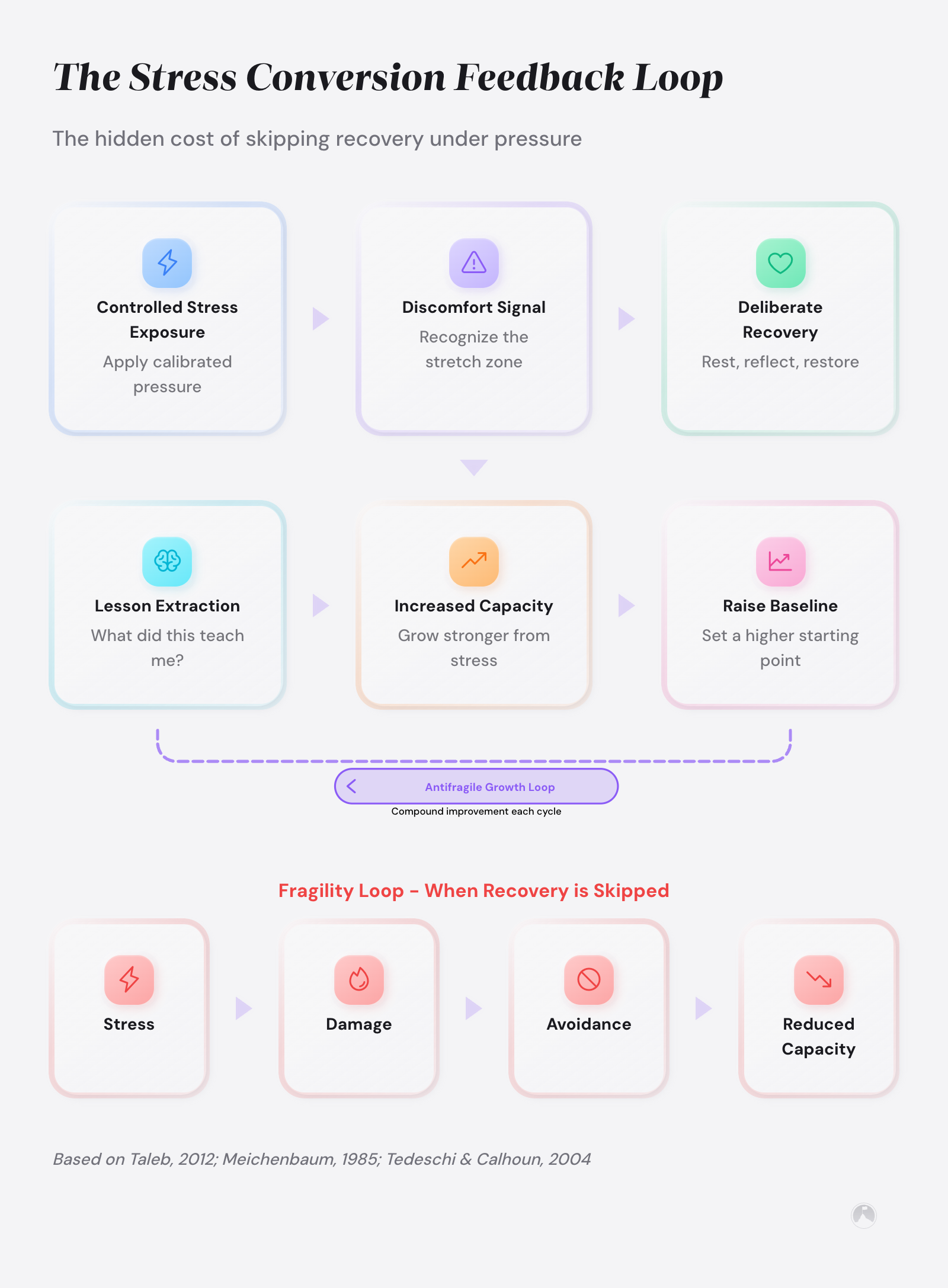
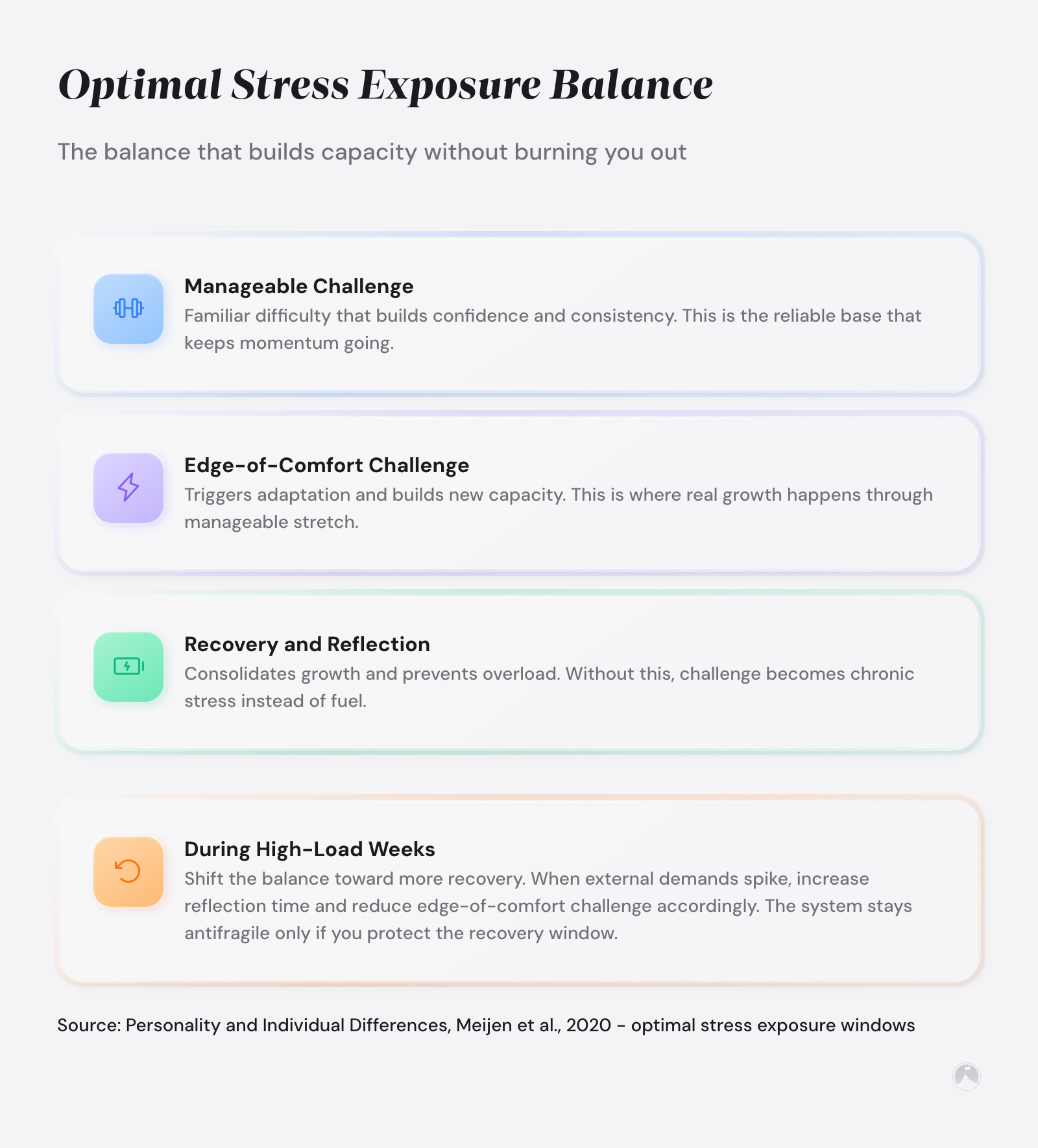
The biggest mistake people make with developing antifragility is confusing it with recklessness. You don’t build antifragility by taking on massive stress all at once. You build it through intentional, well-dosed exposure to manageable difficulty that pushes you to the edge of your current capacity without breaking you.
The sweet spot aligns with what psychologists Robert Yerkes and John Dodson identified over a century ago: performance and adaptation improve with moderate arousal, but decline sharply when stress exceeds capacity [5]. Too little stress, and you don’t adapt. Too much stress too fast, and you break down instead of building strength. The goal is productive discomfort, not productive destruction.
Small, scheduled stressors
These are intentional challenges you add to your practice environment. Examples: having a difficult conversation you’ve been avoiding, publicly sharing work before it feels perfect, taking on a project slightly beyond your current skill level, or setting a deadline earlier than necessary to create productive pressure.
The key: you’re choosing the stressor, the timing, and the scale. This is practice-ground stress, not crisis-triggered stress. Start with one micro-challenge per week. This is more effective than ambitious bursts that lead to overwhelm. If you’re looking for structured ways to identify your starting point, self-discovery exercises and tools can help you pinpoint where to begin.
Response experiments
When real stress appears (unexpected feedback, a setback, a failure), don’t just react automatically. Treat it as an experiment in your antifragile capacity. How do you typically respond to this kind of stress? What would responding antifragilely look like? Commit to one small shift in your response and observe what happens. If you’re working through a broader growth mindset development process, these experiments become data points in your larger trajectory.
Progressive challenge sequencing
Arrange your challenges so each one builds on the last. If you’re working on presenting with confidence, don’t jump from silent meetings to keynote speeches. Go: small team meeting, cross-functional presentation, larger group, recorded session, external audience. Each level of challenge activates and refines the capability the previous level built.
Step 2: Extract lessons from setbacks
Exposure to stress is only half the story. The extraction phase is where antifragility is actually forged. After a difficulty, most people either ruminate on the emotional pain or move on without processing the learning. Antifragile thinking converts raw difficulty into structured growth data. People who practice this do something specific: they analyze what the setback revealed.
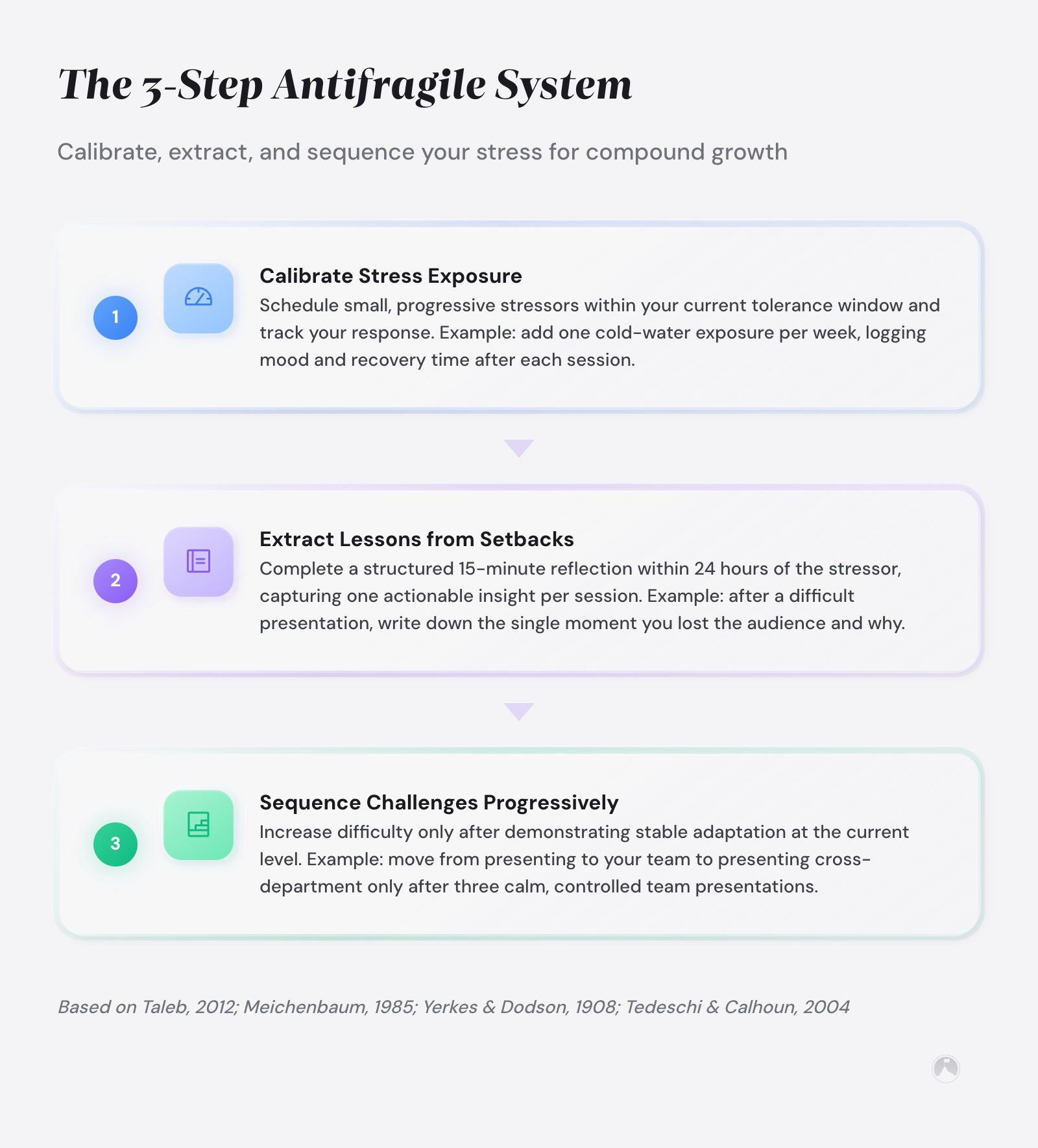
This is a structured post-setback protocol. Timing matters – don’t run this analysis when you’re still emotionally activated. Research on self-distancing by psychologist Ethan Kross shows that analyzing events from emotional distance (rather than raw activation) allows the brain to extract learning instead of ruminating [6].
Wait 24-48 hours, when your brain can access pattern recognition rather than raw emotion. That’s not procrastination. It’s strategy.
The post-setback analysis protocol
Answer these four questions in writing:
- What exactly happened? Describe the setback in factual terms, stripped of interpretation.
- What capacity gap did this reveal? Not “I failed,” but “This showed me I lack X skill” or “I need stronger X ability.”
- What’s the smallest step toward closing that gap? Not a grand overhaul – one specific practice or skill to develop.
- If I encounter this type of challenge again in 90 days, how will my response be different? This question forces you to imagine the upgraded version of yourself.
The act of writing these answers shifts your brain from “I failed” (identity threat) to “This exposed a skill gap I can develop” (capability gap). This cognitive reframing activates what researchers call adaptive coping – problem identification and skill-building that produces stronger psychological outcomes than avoidance or passive endurance [7].
Here’s a quick example of the protocol in action. Say you launched a side project and it got zero traction. Factual description: launched product with no audience research, 3 signups in 2 weeks. Capacity gap: market validation skills. Smallest step: run 5 user interviews before the next launch. In 90 days: I’ll validate demand before building.
Tedeschi and Calhoun’s research on post-traumatic growth demonstrates that growth after difficulty is not automatic – it requires focused reflection and a framework for converting experience into learning [8]. The people who grow through adversity are those who actively ask what the experience is teaching them.
Their research focuses on trauma survivors, but the principle of structured reflection extends to everyday challenges. Roepke and Seligman found that engagement with new possibilities after difficult experiences – actively opening doors rather than just closing old ones – builds psychological well-being and forward momentum in general populations too [9]. The mechanism is the same: writing about and reflecting on setbacks rewires how you process them. For related approaches to cognitive restructuring, see our guide on overcoming limiting beliefs.
Kross and Ayduk’s research on self-distancing shows that stepping outside yourself to view challenging events from a broader perspective increases psychological insight and reduces emotional reactivity [6].
The post-setback analysis questions aren’t therapy. The four-question protocol converts emotional experience into actionable data.
Step 3: Track antifragile progress
You can’t improve what you don’t measure. Most people sense whether they’re becoming more resilient, but they don’t track it with numbers. That’s a missed opportunity. Tracking your antifragility gives you proof the practice is working (which motivates continued effort), clarity about which specific capacities are growing, and early warning signs if you’re slipping back into fragility.
Three metrics to track
Recovery speed
How long does it take you to feel functional after a setback? Track this in days. The pattern to watch for: antifragile individuals show faster functional recovery paired with clear action-oriented thinking during that recovery. Over several months of consistent practice, your recovery time should shorten measurably – and the quality of your post-setback thinking should shift from rumination toward problem-solving.
Lesson extraction rate
Of the difficult experiences you encounter, what percentage yield specific insights you can act on? Track this monthly. When you started, most setbacks probably felt overwhelming. As antifragility builds, the proportion of difficulties you can convert into growth data should climb steadily. The goal isn’t a specific number – it’s the trajectory. Are you extracting more learning from difficulty this month than last month?
Capacity challenge response
Choose one type of challenge you’ve historically struggled with (public speaking, critical feedback, high-pressure decisions). Rate your confidence handling it on a 1-10 scale monthly. Track whether the score increases over time and whether growth accelerates. Many practitioners find that antifragile growth compounds over time – early improvement creates a base for faster adaptation later. If you want a structured approach to tracking this kind of capacity development, the GROW framework pairs well with these metrics.
You don’t need recovery speed, lesson extraction, and capacity challenge response all running perfectly. Start with recovery speed – it’s the easiest to observe and the hardest to fake.
Common mistakes and how to avoid them
The biggest risk with antifragility isn’t that it doesn’t work – it’s that you confuse being reckless with being antifragile. Here are the common breakdowns and how to stay on track.
Mistake 1: Taking on too much stress too fast
You read about antifragility and decide to overhaul your entire life overnight. You sign up for public speaking, take on a major project, and invite conflict everywhere. This isn’t antifragility – it’s uncontrolled stress. The result: burnout, not growth [5]. The fix: one small stressor per week, progressively sequenced. The Yerkes-Dodson principle applies here – moderate challenge builds capacity, but excessive challenge breaks it down.
Mistake 2: Extracting lessons without recovery
You push hard, fail, analyze, and push hard again without ever recovering. Antifragility requires recovery – the adaptation phase that happens during rest. Research shows that post-stress sleep and physical recovery are central to this process, with sleep promoting both physiological restoration and psychological adaptation [10]. If you’re constantly stressed, you’re accumulating fatigue, not building strength. Build recovery into your plan: for every week of intentional challenge, prioritize sleep and physical rest. Without recovery, stress just damages you.
Mistake 3: Confusing acceptance with antifragility
Some advice tells you to “accept difficulty” and “embrace what you can’t change.” That’s wise, but it’s not antifragility. Antifragility is active – you’re seeking challenges, extracting learning, and building capability. Be cautious of acceptance-only approaches that look like growth but function as resignation. Acceptance has its place, but antifragility is dynamic and forward-moving. Know the difference. If you’re noticing patterns of avoidance or stagnation, those may be signs you need a mindset shift.
Mistake 4: Skipping the analysis phase
Life is stressful, so you definitely experience difficulty. But without the post-setback analysis, you’re just accumulating scars, not converting stress into strength. If you’re not writing down the four-question protocol after each setback, you’re not practicing antifragility – you’re just enduring. Written post-setback analysis is non-negotiable. Thinking about lessons is not the same as extracting them.
Ramon’s take
My favorite part of this concept is that it basically gives you permission to chase slightly annoying situations. Cold shower, hard conversation, skipped snooze button. Antifragility is just discomfort with a better PR team.
The antifragility reframe changed the question I ask after setbacks. Instead of “how do I recover from this,” I started asking “what is this failure teaching me, and what would I need to change so this particular failure becomes impossible next time?” That single question (asked honestly, in writing, after the sting fades) has been more useful than any resilience strategy I’ve read about.
Once you experience the shift from resilience to antifragility – from bouncing back to moving forward – you won’t want to go back.
Conclusion
Building an antifragile mindset is learnable. It’s not a trait you’re born with; it’s a practice you build through controlled stress exposure, structured post-setback analysis, and progress measurement. The Stress Conversion Framework gives you the system. Your next step is small – choose one manageable stressor and commit to the four-question analysis when it produces difficulty.
The people who thrive aren’t those who avoid difficulty. They’re those who’ve learned to convert it into fuel. You can start converting difficulty into capability in the next ten minutes.
Next 10 minutes
- Identify one area where you’re fragile (a type of setback that derails you) and one where you’re resilient (you bounce back fine). Write these down.
- Choose one small, manageable stressor to invite this week – something challenging but not overwhelming.
This week
- When your chosen stressor appears, experience it fully. Don’t avoid or minimize it.
- After 24-48 hours, run the four-question post-setback analysis. Write the answers. Observe what you learned.
- Choose one small action to build the capacity the setback revealed.
There is more to explore
For deeper work on mindset development, see our guide on growth mindset development to layer these practices into a broader system. You might explore mindset shifts for career changers to see how antifragility applies to major life transitions.
Related articles in this guide
Frequently asked questions
What is the definition of an antifragile mindset?
An antifragile mindset goes beyond mental toughness or positive thinking. Where toughness resists damage and positivity reframes it, antifragility actively gains capability from difficulty. The distinction matters because most self-help advice targets resilience — getting back to baseline — while antifragility targets a higher baseline after each setback.
How does antifragility differ from resilience and robustness?
A practical test: after your last setback, did you return to your previous capability (resilient) or did you develop a new skill or insight that made you better equipped for the next challenge (antifragile)? Robustness is being unaffected; resilience is recovering; antifragility is upgrading. Psychology researchers have identified antifragility as a distinct construct involving active opportunity-seeking during disruption [2].
What are practical steps to build an antifragile mindset?
Start today with one micro-challenge — volunteer for a task that slightly exceeds your comfort zone. When you feel the friction, note what specific skill gap it reveals. After 24-48 hours, write answers to the four-question post-setback protocol. Track your recovery time in a simple spreadsheet or journal.
How can stress make you stronger instead of weaker?
Stress triggers adaptation when it’s calibrated correctly (challenging but not overwhelming) and followed by proper recovery. Meichenbaum’s stress inoculation research confirms that controlled exposure paired with coping skill development builds psychological strength [3]. The Yerkes-Dodson principle shows performance improves with moderate arousal but declines with excessive stress [5]. Without recovery or analysis, stress just damages you.
What role does uncertainty play in antifragility?
Antifragile systems and people benefit from uncertainty and volatility. Where fragile people fear uncertainty, antifragile people see it as opportunity. Research identifies this as ‘disorder embracement’ – a positive orientation toward disruption that distinguishes antifragile individuals from merely resilient ones [2]. The practice is learning to seek productive uncertainty rather than avoiding it.
Can anyone develop an antifragile mindset?
Yes, though the entry point varies. Someone dealing with chronic stress should focus on recovery fundamentals first before adding intentional stressors. Someone already resilient can begin with the calibration phase immediately. The practice adapts to your starting point — the only prerequisite is willingness to treat setbacks as data rather than verdicts.
What are common mistakes when trying to become antifragile?
The biggest mistakes are: taking on too much stress too fast (leading to burnout instead of adaptation), extracting lessons without recovery (accumulating fatigue instead of strength), confusing acceptance with active antifragility, and skipping the post-setback analysis phase. Avoid these by maintaining calibration and treating recovery as non-negotiable.
How long does it take to develop antifragility?
Early practitioners often report initial shifts in how they respond to setbacks within a few weeks of consistent practice, though timelines vary based on starting point and stressor intensity. Measurable improvement in recovery speed and lesson extraction typically becomes visible within the first month or two. The key variable is consistency with all three framework phases, not elapsed time alone.
References
[1] Taleb, N. N. (2012). Antifragile: Things that gain from disorder. Random House. ISBN: 978-1-4000-6782-4
[2] Personality and Individual Differences (2024). When resilience is not enough: Theoretical development and validation of the antifragility at work scale. https://doi.org/10.1016/j.paid.2024.112782
[3] Meichenbaum, D. H. (1985). Stress inoculation training. Pergamon Press.
[4] Foa, E. B., & Kozak, M. J. (1986). Emotional processing of fear: Exposure to corrective information. Psychological Bulletin, 99(1), 20-35. https://doi.org/10.1037/0033-2909.99.1.20
[5] Yerkes, R. M., & Dodson, J. D. (1908). The relation of strength of stimulus to rapidity of habit-formation. Journal of Comparative Neurology and Psychology, 18(5), 459-482.
[6] Kross, E., & Ayduk, O. (2017). Self-distancing: Theory, research, and current directions. Advances in Experimental Social Psychology, 55, 81-141. https://doi.org/10.1016/bs.aesp.2016.10.002
[7] Compas, B. E., Connor-Smith, J. K., Saltzman, H., Thomsen, A. H., & Wadsworth, M. E. (2001). Coping with stress during childhood and adolescence: Problems, progress, and potential in theory and research. Psychological Bulletin, 127(1), 87-127. https://doi.org/10.1037/0033-2909.127.1.87
[8] Tedeschi, R. G., & Calhoun, L. G. (2004). Posttraumatic growth: Conceptual foundations and empirical evidence. Psychological Inquiry, 15(1), 1-18. https://doi.org/10.1207/s15327965pli1501_01
[9] Roepke, A. M., & Seligman, M. E. P. (2015). Doors opening: A mechanism for growth after adversity. The Journal of Positive Psychology, 10(2), 107-115. https://doi.org/10.1080/17439760.2014.913669
[10] Guida, J. L., Alfini, A., Lee, K. C., Miller, C., Riscuta, G., Rusch, H. L., Wali, A., & Dixit, S. (2023). Integrating sleep health into resilience research. Stress and Health, 39(5). https://doi.org/10.1002/smi.3244