
The two-week wall you keep hitting
You started a meditation habit on January 2nd. By January 16th, you hadn’t sat down once in four days. You told yourself you’d get back to it on Monday. Monday came and went. The cushion gathered dust.
Why habits fail isn’t a mystery of willpower or character. It’s a diagnostic problem. Lally et al.’s landmark research shows that habit formation follows a predictable timeline with specific failure points, and the reasons habits fail at week one differ from the reasons they fail at week six [1]. Most advice lumps all habit failure causes into one generic list. That approach misses the point entirely. The breakdown that kills your habit in the first three days is structurally different from the one that kills it after two months.
Habit failure is not random – it follows predictable patterns tied to specific points in both the habit loop and the formation timeline. The diagnostic framework below maps habit failure patterns so you can identify your own.
What is habit failure?
Habit failure is the breakdown of a behavior’s path to automaticity at one of four stages in the habit loop – cue (trigger missing), craving (no pull), response (behavior too hard), or reward (no satisfaction) – or at a specific window in the formation timeline.
Habits fail for four structural reasons: the cue never fires reliably, leaving the behavior dependent on memory; the craving produces no emotional pull, reducing the habit to a chore; the response demands too much effort or complexity during the formation window; or the reward provides no immediate satisfaction, preventing the brain from encoding the behavior as worth repeating.
Key takeaways
- Why habits fail maps to predictable points in the habit loop: cue, craving, response, or reward breakdown.
- Week 1 failures almost always trace back to missing or unreliable cues in your environment.
- The week 2-3 motivation cliff is a normal part of the habit formation timeline, not a personal flaw.
- Habit formation takes 18 to 254 days depending on complexity, not the commonly cited 21 days [1].
- Context stability is the strongest predictor of whether a habit survives or collapses after disruption.
Where do habits break down in the habit loop?
Every habit runs through four stages: cue, craving, response, and reward. When you’re wondering why you can’t stick to habits, the answer almost always maps to one of these four points. The breakdown location determines the fix.
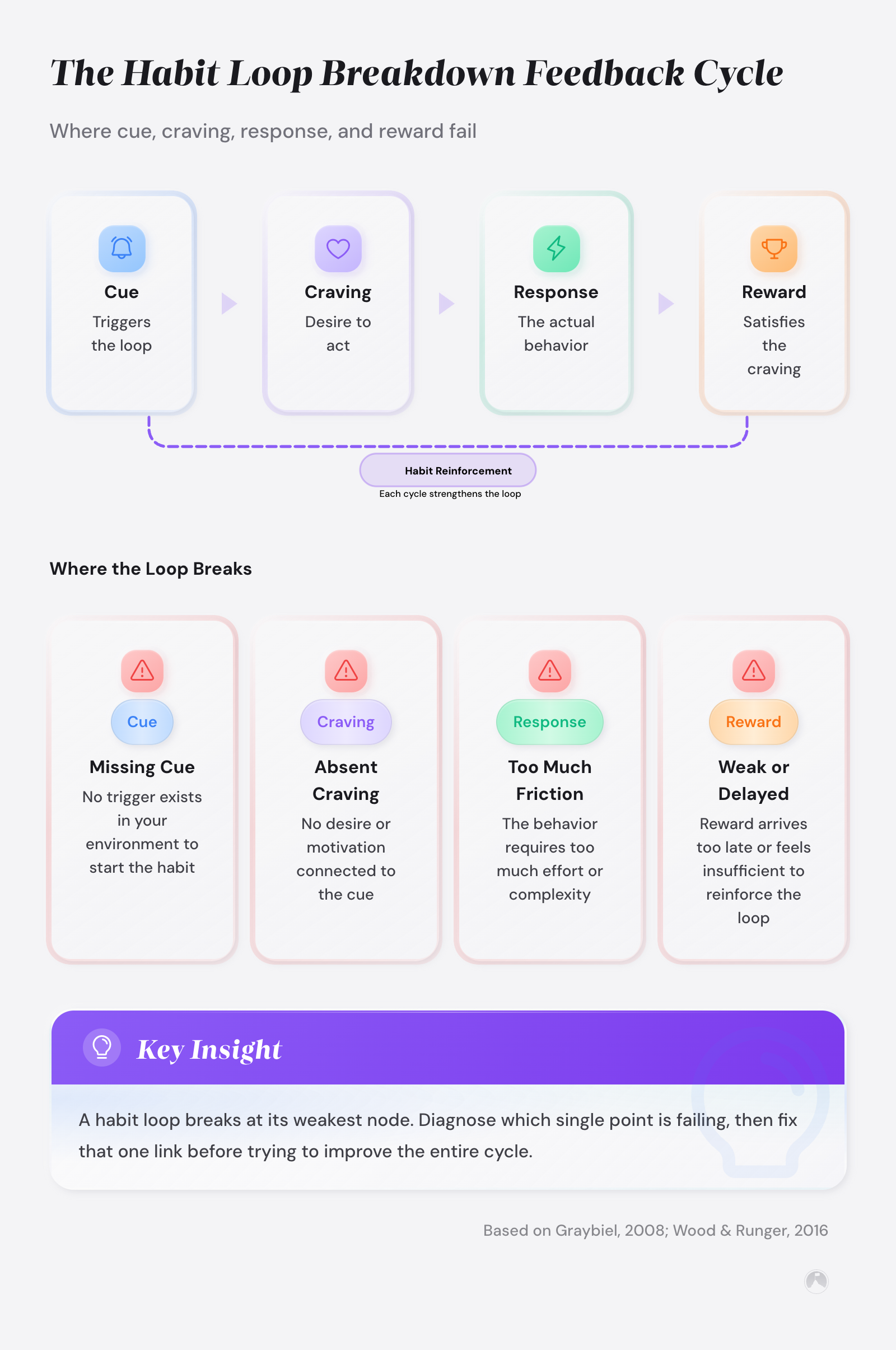
A cue failure means the trigger for your habit never fires. You planned to journal after your morning coffee, but you drink coffee at different times, in different places, and sometimes skip it entirely. The habit has no reliable launch signal. Wendy Wood and Dennis Runger’s research on habit psychology shows that context stability – same time, same place, same preceding action – is what allows cues to trigger automatic behavior [3]. Without a stable cue, the habit depends entirely on conscious memory. And conscious memory fails under stress.
A craving failure means the habit triggers but produces no pull. You see the journal on the counter. You know you planned to write. But you feel nothing – no draw, no desire, no momentum. BJ Fogg’s behavior design framework calls this a motivation gap – the behavior is disconnected from any emotional reward [6]. If journaling feels like a chore with no emotional payoff, the craving stage stays flat and the behavior remains dependent on willpower rather than automaticity.
A habit without emotional pull is a task, not a behavior your brain wants to repeat.
A response failure means you feel the pull but the behavior itself is too hard, too long, or too ambiguous. You want to work out, but “go to the gym” requires driving 20 minutes, changing clothes, and figuring out what exercises to do. The response demands too much activation energy.
Buyalskaya, Ho, Milkman, and colleagues’ machine learning analysis of gym and hygiene habits suggests that simpler behaviors reach automaticity faster [5], because complex behaviors place greater demands on conscious attention during the formation window [3]. If you want to understand why new habits don’t stick, start here – most people make the behavior too big.
A reward failure means you do the behavior but get nothing satisfying back. You meditated for ten minutes and felt… the same. No calm. No insight. No sense of progress. Neuroscientist Ann Graybiel’s research on habit consolidation shows that dopamine-mediated reward feedback is what strengthens cue-response associations in the basal ganglia [7]. Without immediate feedback that the brain recognizes as rewarding, the neural pathways don’t get encoded as automatic patterns. Habit stacking works partly because it borrows the reward from an existing behavior.
| Habit Loop Stage | Failure Mode | Primary Fix |
|---|---|---|
| Cue | Unreliable or missing trigger (Week 1) | Anchor to existing behavior via habit stacking |
| Craving | No emotional connection (Week 1-2) | Link to identity or intrinsic value |
| Response | Behavior too complex (Week 2-3) | Reduce to smallest viable version |
| Reward | No immediate satisfaction (Week 3-6+) | Add visible tracking or sensory reward |
Why habits fail at specific points in the timeline
The reasons habits fail – and the specific habit failure causes behind each breakdown – cluster around three distinct windows in the formation timeline. Knowing which window you’re in changes what you should do about it.
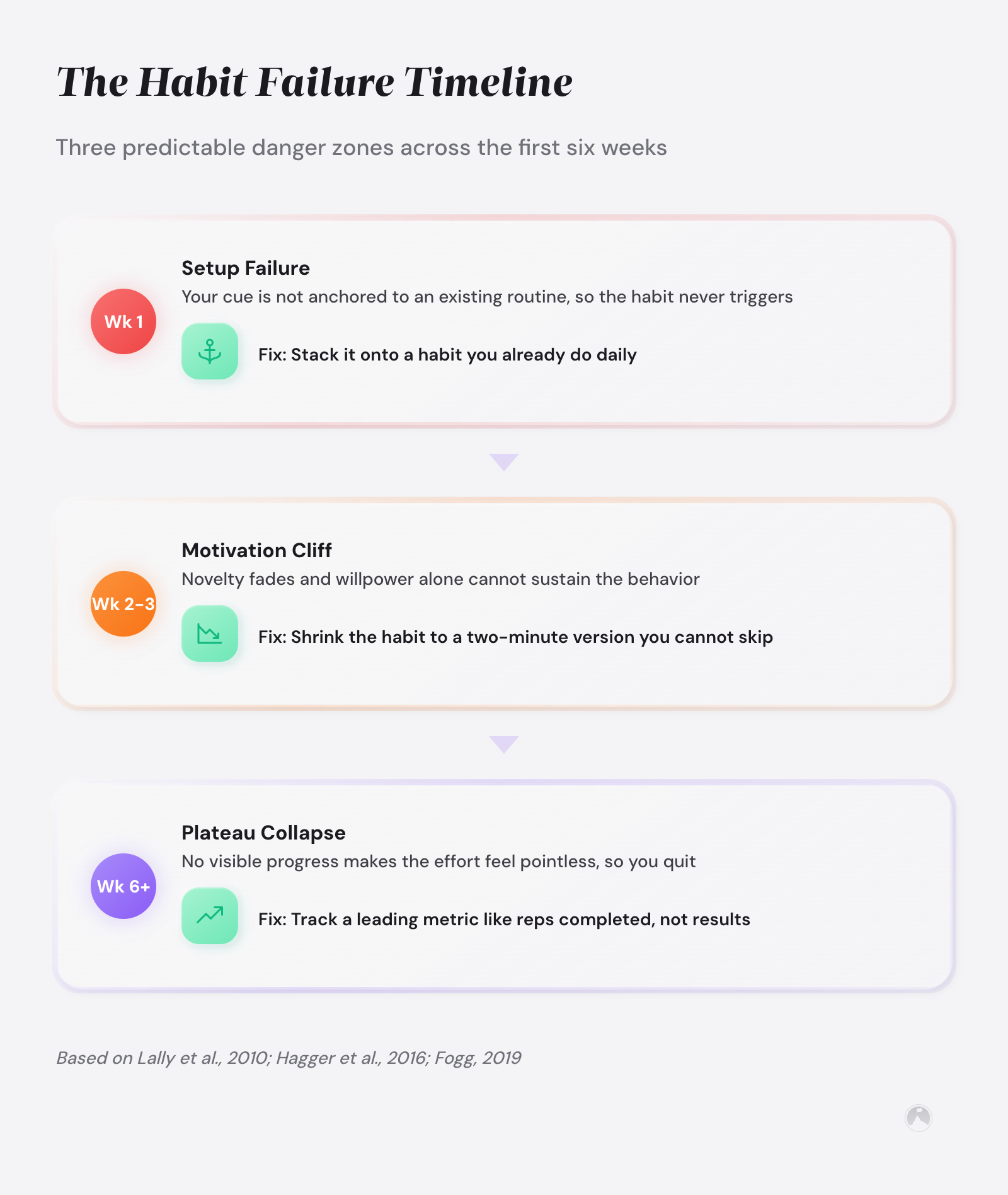
Week 1: the setup failure
Most habits that die in week one were dead on arrival. The cue wasn’t anchored to anything reliable. The behavior was too vague (“eat healthier”) or too ambitious (“run 5 miles every morning”). There was no implementation intention – no specific if-then plan for when and where the behavior would happen.
Gollwitzer and Sheeran’s meta-analysis of 94 studies found that people who create specific “if situation X, then I will do behavior Y” plans follow through at significantly higher rates than those who rely on general motivation, with a medium-to-large effect size across 8,000+ participants [4]. Skipping the implementation intention is one of the most common habit mistakes.
As Gollwitzer’s research demonstrates, the number one reason habits fail in the first week is not lack of motivation – it is lack of a specific trigger anchored to a specific context [4]. If your habit died before day seven, the diagnosis is almost certainly structural. You didn’t fail at the habit. You failed to install it.
Week 2-3: the motivation cliff
This is the window where initial excitement fades but automaticity hasn’t developed yet. Lally et al.’s landmark study found that habit formation takes a median of 66 days, with a range of 18 to 254 days depending on the person and the behavior [1]. At week two, you’re barely past the starting line on that timeline. For more on the science behind how long habits take to form, the 21-day myth is worth examining closely.
The motivation cliff at weeks 2-3 is the most dangerous period in habit formation because initial enthusiasm has faded but automatic behavior has not yet taken hold. You’re in a gap where the behavior requires conscious effort every single time. Research on habit neurophysiology shows that the basal ganglia, which encodes automatic behaviors, hasn’t yet consolidated the pattern [3]. Quitting at week two is like leaving a movie during the setup act and concluding the story had no plot.
Week 6+: the plateau collapse
You made it past the motivation cliff. The habit felt almost automatic for a couple of weeks. Then something disrupted your routine – a vacation, a work deadline, an illness – and the habit vanished as if it never existed. The collapse of habits after a routine disruption is a context-stability failure.
As Wendy Wood writes, “When the context changes, people can’t deploy the learned response that had become their habit” [3]. The behavior was not as automatic as it seemed; it was context-dependent. The environmental cues that sustained the habit no longer existed in the new setting.
Research comparing habit formation in different behaviors shows that complex habits like gym routines take significantly longer to form than simple ones like handwashing [5]. This extended formation window means complex habits remain vulnerable to context disruption for longer, requiring stronger environmental anchoring to survive disruptions [3]. Why good habits don’t last often comes down to one thing: the habit was anchored to a context that changed.
Does willpower explain why habits fail?
For years, the dominant explanation for why habits break down was ego depletion – the idea that willpower is a limited resource that gets used up throughout the day, like a battery draining [2]. Baumeister’s self-regulation research shaped how millions of people think about habit formation failure.
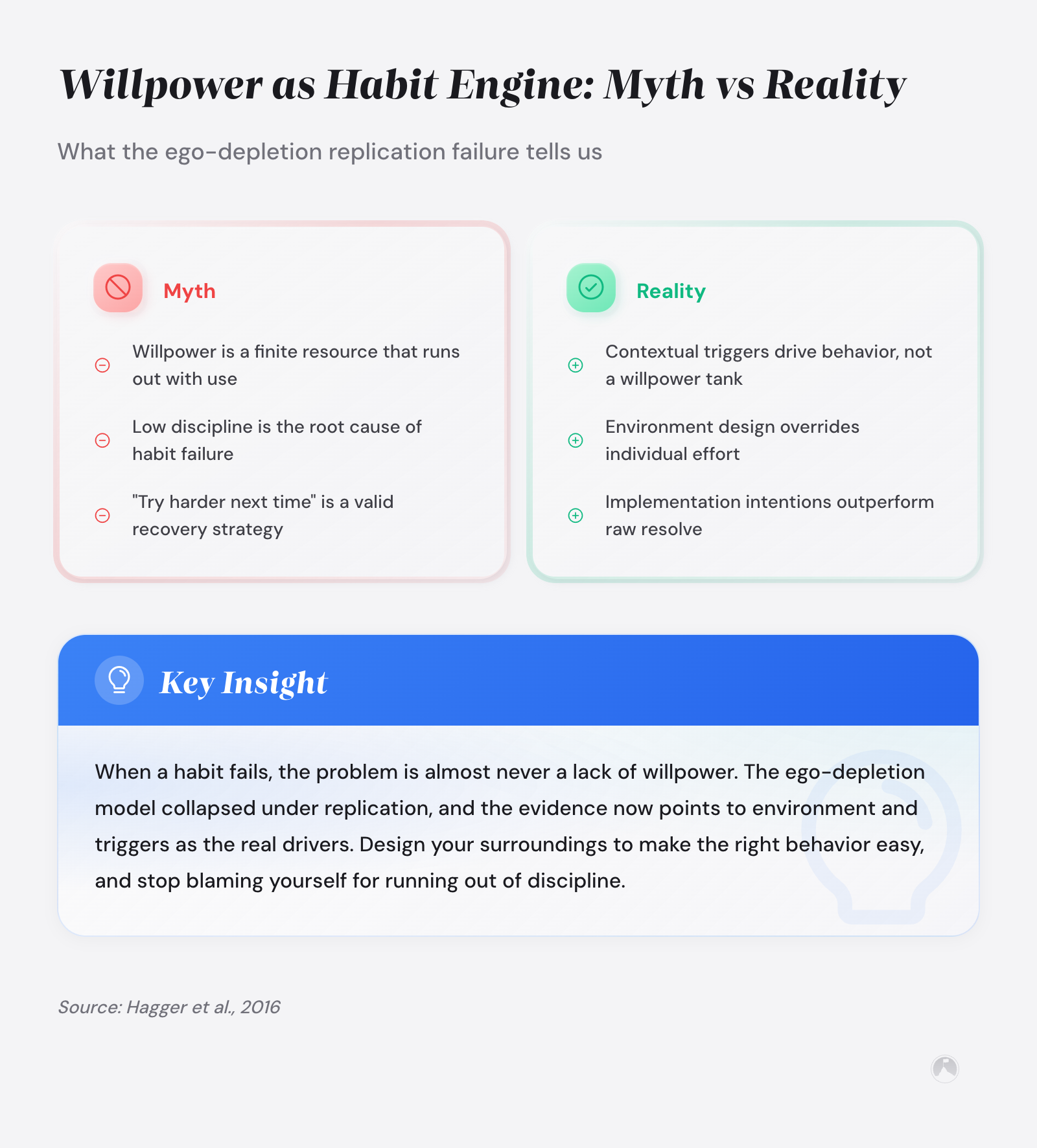
The problem is that Hagger et al.’s 2016 multilab replication across 23 labs with over 2,100 participants found an effect size of d=0.04 – indistinguishable from zero [2]. The ego depletion model of willpower is contested by replication research, which means habit failure is less about running out of willpower and more about poor system design.
The more productive question isn’t “how do I get more willpower?” but “how do I design habits that don’t require willpower at all?” Wood and Runger’s research shows that established habits execute automatically in response to contextual cues, bypassing the need for deliberate self-control [3]. The fix for habit failure isn’t more discipline. It’s better cues, simpler responses, and more reliable rewards. If you’re interested in designing habit systems that work without willpower, that’s a separate (and larger) project.
How do you diagnose your specific habit failure pattern?
Many people cycle through the same one or two failure patterns without recognizing them. You can diagnose yours by asking three questions about your most recent habit failure.

Question 1: When did it die? If it never really started (week 1), you have a setup problem. If it faded after the initial push (week 2-3), you have a motivation-gap problem. If it collapsed after a disruption (week 6+), you have a context-stability problem.
Question 2: Where in the loop did it break? Did you forget to do it (cue failure)? Did you remember but not feel like it (craving failure)? Did you feel like it but the effort was too much (response failure)? Did you do it but stop because it felt pointless (reward failure)?
Question 3: What did you blame? If you blamed yourself (“I’m lazy,” “I lack discipline”), you were probably diagnosing a system problem as a character problem. Habit formation failure is almost always a design failure, not a moral one.
Once you identify your pattern, the fix becomes specific rather than generic. A cue failure needs habit stacking or environment anchoring, not more motivation. A response failure needs the behavior scaled down to something manageable, not a pep talk. A context-stability failure needs a habit that travels with you – one that doesn’t depend on a specific location or schedule. That’s the difference between generic advice and an actual diagnosis.
Ramon’s take
Before your next habit attempt, just answer one question: what will actually remind you to do it? Not ‘I’ll remember.’ Something in your environment that does the reminding for you. If you don’t have an answer, start there.
Conclusion
Why habits fail comes down to where they break and when they break. Cue failures kill habits in week one. Motivation-gap failures kill them in weeks two and three. Context-stability failures kill them after week six. Each failure maps to a specific point in the habit loop, and each one has a different repair.
Stop treating every habit failure the same way. The next time a habit breaks down, ask yourself when it died and where it broke. Then apply the specific fix for that failure mode. The irony of why habits fail is that the failure itself contains the instructions for success – if you know how to read it.
Next 10 minutes
- Think of the last habit you tried and dropped – identify when it died (week 1, 2-3, or 6+)
- Name the loop stage where it broke: cue, craving, response, or reward
- Write down one specific change you’d make to address that exact failure point
This week
- Audit your current habits using the three diagnostic questions from this article
- Pick one habit to restart with a specific implementation intention: “After I [existing behavior], I will [new habit]”
- Reduce the response to the smallest version that still counts – two minutes or less
Related articles in this guide
- 30-day-habit-challenge-framework
- atomic-habits-vs-tiny-habits
- behavior-design-hacks-to-form-good-habits
Frequently asked questions
What are the most common habit mistakes people make?
The most common habit mistakes are structural, not motivational. People set vague goals instead of specific behaviors, skip the implementation intention (the if-then plan), make the behavior too complex, and rely on willpower instead of environmental cues. Research shows that anchoring a behavior to a reliable cue and simplifying the response are the two highest-impact fixes for habit failure.
Why don’t new habits stick even when I’m motivated?
Motivation fades predictably around weeks 2-3, but automaticity (the brain encoding the habit) takes a median of 66 days. During that gap, the behavior requires conscious effort every time you do it. New habits don’t stick because people quit during this normal motivation cliff, thinking something is wrong with them when it’s actually a predictable phase of the formation timeline.
How long does it actually take to form a habit?
The commonly cited 21 days has no scientific basis. The figure traces back to plastic surgeon Maxwell Maltz’s 1960 observations about patients adjusting to new appearances, not to controlled habit research. Lally et al.’s peer-reviewed study found a median of 66 days, with a range of 18 to 254 days depending on the person and behavior complexity [1]. Simple habits form faster; complex routines can take months.
Why do habits break down after a vacation or schedule change?
Habits are deeply tied to environmental context – same time, same place, same preceding action. When your context changes (vacation, new job, illness), the cues that triggered your automatic behavior disappear. The habit wasn’t as automatic as it felt; it was context-dependent. Rebuilding requires re-anchoring the behavior to your new environment.
Is willpower the reason my habits fail?
Probably not. The ego depletion model (willpower as a limited battery) was challenged by a major 2016 replication study across 23 labs that found near-zero effect size. Habit failure is better explained by poor system design – unreliable cues, behaviors that are too complex, or missing rewards – than by running out of willpower. Well-designed habits bypass the need for willpower entirely.
References
[1] Lally, P., van Jaarsveld, C.H.M., Potts, H.W.W., and Wardle, J. “How are habits formed: Modelling habit formation in the real world.” European Journal of Social Psychology, vol. 40, no. 6, 2010, pp. 998-1009. https://doi.org/10.1002/ejsp.674
[2] Hagger, M.S., et al. “A Multilab Preregistered Replication of the Ego-Depletion Effect.” Perspectives on Psychological Science, vol. 11, no. 4, 2016, pp. 546-573. https://doi.org/10.1177/1745691616652873
[3] Wood, W., and Runger, D. “Psychology of Habit.” Annual Review of Psychology, vol. 67, 2016, pp. 289-314. https://dornsife.usc.edu/assets/sites/545/docs/Wendy_Wood_Research_Articles/Habits/wood.runger.2016.habits.pdf
[4] Gollwitzer, P.M., and Sheeran, P. “Implementation Intentions and Goal Achievement: A Meta-Analysis of Effects and Processes.” Advances in Experimental Social Psychology, vol. 38, 2006, pp. 69-119. https://www.sciencedirect.com/science/chapter/bookseries/abs/pii/S0065260106380021
[5] Buyalskaya, A., Ho, H., Milkman, K.L., Li, X., Duckworth, A.L., and Camerer, C.F. “What can machine learning teach us about habit formation? Evidence from exercise and hygiene.” Proceedings of the National Academy of Sciences, vol. 120, no. 17, 2023. https://doi.org/10.1073/pnas.2216115120
[6] Fogg, B.J. Tiny Habits: The Small Changes That Change Everything. Houghton Mifflin Harcourt, 2019.
[7] Graybiel, A.M. “Habits, Rituals, and the Evaluative Brain.” Annual Review of Neuroscience, vol. 31, 2008, pp. 359-387. https://doi.org/10.1146/annurev.neuro.29.051605.112851