
Stop collecting personality data and start using it
You know you need self-awareness to make better decisions. So you search for assessment tools and find an overwhelming menu: Myers-Briggs, DISC, the Enneagram, CliftonStrengths, Big Five, 360-degree feedback, SWOT analysis, VIA Character Strengths, and dozens more. Each one promises insight. How do you know which one is actually worth your time?
Self-assessment frameworks measure different dimensions of who you are: Big Five measures personality traits, CliftonStrengths measures talent themes, SWOT maps context, and 360-degree feedback reveals perception gaps. Choose based on your primary question – career direction, personality, strengths, or blind spots.
Self-assessment frameworks (also called self evaluation methods) are structured tools or methodologies that help individuals evaluate their personality traits, strengths, values, behavioral patterns, or blind spots. Unlike informal self-reflection, frameworks provide standardized approaches with validated questions and interpretation methods designed to reduce personal bias and provide more objective insight into how someone thinks, works, and interacts with others.
What you will learn
- How major frameworks differ by assessment focus (personality, strengths, values, blind spots, career)
- Which personality assessment frameworks have the strongest scientific validation and which work better as thought-starters
- A deliberate sequence for layering multiple frameworks to build genuine self-knowledge
- How to translate assessment insights into concrete behavioral change
- The psychological biases that make self-assessment tricky and how to work around them
Key takeaways
- Different frameworks measure different dimensions: Big Five measures personality; CliftonStrengths measures talents; SWOT measures context; 360-degree feedback measures others’ perception of you.
- Big Five and 360-degree feedback have strong scientific validation [1][4]; MBTI and the Enneagram are popular but lack strong empirical support for their type categories.
- Your choice depends on your primary question: career direction, personality understanding, strengths identification, or blind spot revelation.
- The Assessment Progression Framework guides you through sequential use: strengths first, then personality, then situation, then blind spots.
- Self-assessment results fail to drive change unless translated into specific behavioral experiments.
- Confirmation bias means you’ll unconsciously filter results to match your existing self-image [5]; external feedback counteracts this.
- Most self-assessment frameworks were developed in Western contexts [7]; cultural validation matters when applying them.
- Spending 30 minutes understanding one assessment result beats completing three assessments back to back.
- The gap between insight and action is where most assessment projects stall.
10 major self-assessment frameworks and when to use them
The matrix below organizes personal development assessment tools by what they measure, investment required, and scientific validity. Dozens of tools exist – including newer options like 16Personalities and the Predictive Index – but these 10 were selected for scientific validation, widespread adoption, and distinct measurement focus.
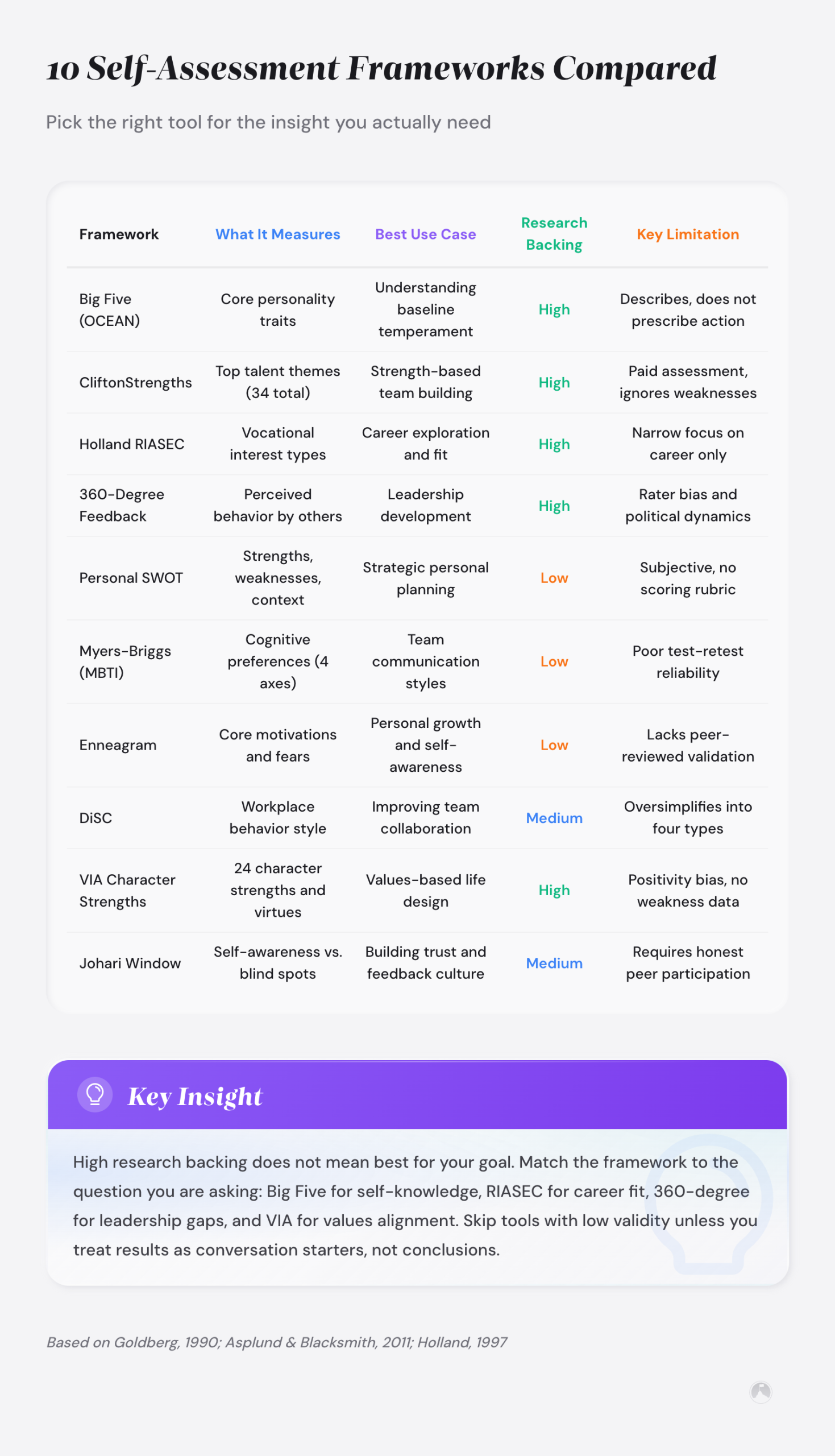
| Framework | Measures | Investment | Best for |
|---|---|---|---|
| Big Five Personality Inventory | Personality traits (openness, conscientiousness, extraversion, agreeableness, neuroticism) | Free-$50, 10-15 min | Understanding personality across contexts; career fit; relationship patterns. Strong scientific validity – Goldberg’s research and decades of cross-cultural validation [1] |
| Myers-Briggs Type Indicator (MBTI) | Personality type and cognitive preferences | $50-$200, 12-15 min | Work style and decision-making preferences; team dynamics. Generally considered moderate in scientific validity – reliable for preferences but type categories lack strong empirical support |
| CliftonStrengths | Top talent themes and strengths | $19-$120, 30-40 min | Identifying where to invest development energy; strengths-based career planning. Strong scientific validity – backed by Gallup research across organizational development [2] |
| DISC Assessment | Behavioral style and communication preferences | Free-$100, 10-15 min | Improving communication with different personality styles; team collaboration. Generally considered moderate in scientific validity – popular in organizational settings but less academic research support than Big Five |
| The Enneagram | Personality type and core motivations | Free-$50, 15-30 min | Deep personal development work; defense mechanisms and growth paths. Generally considered low in scientific validity – primarily rooted in tradition rather than empirical validation |
| VIA Character Strengths | Character strengths and virtues (24 across 6 virtues) | Free or $15-$30, 15-20 min | Positive psychology approach; identifying signature strengths; building resilience. Strong scientific validity – developed through academic research by Peterson and Seligman [9] |
| Holland Career Codes (RIASEC) | Career interests and vocational fit | Free-$75, 15-30 min | Exploring career direction; matching personality to job types; career transitions. Strong scientific validity – Holland’s foundational research with 50+ years of validation [3] |
| 360-Degree Feedback | How others perceive your strengths, weaknesses, and leadership impact | $500-$5000+ or free peer-based, 1-2 hours | Identifying blind spots; validating self-perceptions; leadership development. Strong scientific validity – meta-analytic evidence shows small but positive improvements in leadership effectiveness [4] |
| Personal SWOT Analysis | Strengths, weaknesses, opportunities, threats in a specific context | Free, 30-60 min | Situation-specific assessment; career decisions; life transitions; strategic planning. Generally considered moderate in scientific validity – useful framework but depends entirely on honesty and outside perspective |
| Wheel of Life | Satisfaction and balance across life domains (work, health, relationships, finances, etc.) | Free, 15-20 min | Quick life balance assessment; identifying priority areas for development. Generally considered low in scientific validity but high practically – originates in coaching practice as a simple visualization tool |
Personality assessment frameworks: what they reveal about your work style
If your primary question is “How do I think and interact with the world?” start with Big Five rather than MBTI. Goldberg’s research on Big Five measures personality across five broad dimensions with decades of peer-reviewed research supporting its validity across cultures and job types [1]. MBTI remains popular in corporate settings, but its type categories don’t have the same empirical support.
Here’s the practical difference. If you take Big Five and score high in openness and conscientiousness, you get a nuanced profile showing how those traits shape your approach to new projects, risk tolerance, and collaboration style. MBTI would label you “INTJ” without that granularity. DISC is useful if you specifically want communication style insights for team contexts – it’s quicker and easier to explain to colleagues. But DISC doesn’t replace Big Five’s depth for serious self-development work.
The assessment tool you pick depends on the question you’re asking, not on which test is trendiest.
Strengths-based assessment: identifying your talents
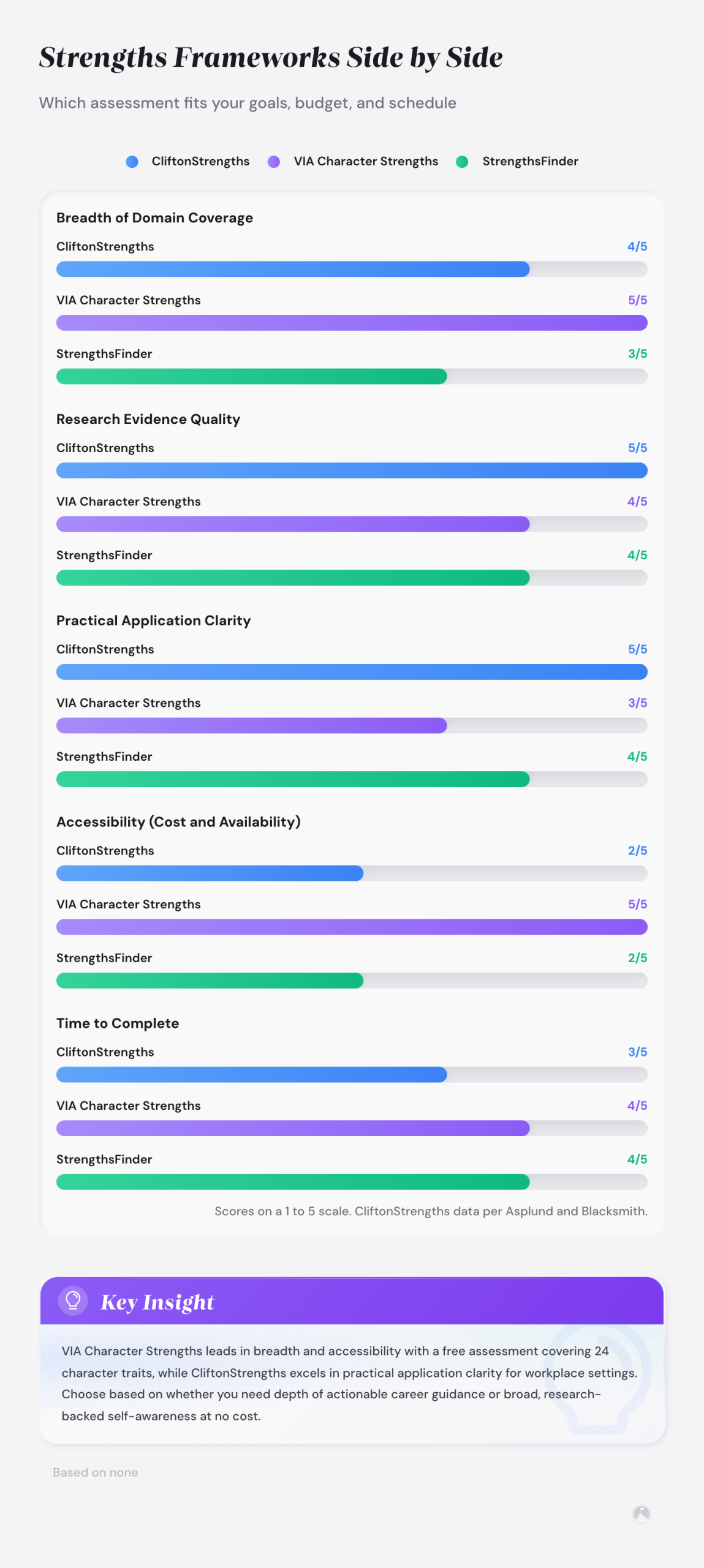
If your question is “What am I genuinely good at?” use CliftonStrengths or VIA Character Strengths. Personality tells you how you think. Strengths tell you where you produce excellence. Asplund and Blacksmith’s Gallup research shows that CliftonStrengths identifies your top talent themes based on decades of data on what distinguishes high performers, making it one of the most actionable career assessment instruments available [2].
If your top 5 themes are Strategic, Learner, Achiever, Intellection, and Input, your profile suggests you create value through deep thinking and continuous learning rather than rapid execution or relationship-building.
VIA Character Strengths takes a more philosophical approach, focusing on virtues from positive psychology. CliftonStrengths is more job-focused; VIA is more life-focused. Don’t use personality assessments as a substitute for strengths assessment – they measure different things.
If you’re working through a broader growth mindset development process, strengths identification is the natural starting point because it builds psychological momentum before you confront harder feedback.
Your personality is how you show up. Your strengths are where you create value.
Choosing a career direction with career assessment instruments
If you’re asking “What career path fits me?” use Holland Career Codes (RIASEC) before any personality assessment. Holland’s framework maps interests to six vocational types and is one of the most thoroughly researched career assessment methodologies, with more than 50 years of validation in career exploration and job satisfaction prediction [3].
If your top codes are Investigative-Artistic (IA), career families like UX research, data visualization, and technical writing would align with your interest pattern – whereas a sales management role (Enterprising-Social) would likely feel misaligned.
Personality alone doesn’t predict career satisfaction – someone introverted can still thrive in client-facing roles if their core interests align. If you’re mid-career, Holland Codes plus a personal SWOT analysis gives you both interest mapping and situational awareness. For people working through mindset shifts during career changes, Holland Codes provide the concrete data that makes abstract career anxiety more manageable.
Personality doesn’t predict career satisfaction. Interest alignment does.
360-degree feedback: identifying blind spots and how others perceive you
If your question is “What don’t I see about myself?” then 360-degree feedback is the tool you need. Self-report assessments have a fundamental limitation: you’re rating yourself. 360-degree feedback bypasses this by asking colleagues, managers, and direct reports to rate you on the same dimensions. The gap between self-rating and others’ ratings is where blind spots live.
“Smither, London, and Reilly’s meta-analysis of 24 longitudinal studies found that multisource feedback leads to small but positive improvements in leadership ratings, with corrected effect sizes (d) of 0.15 from direct reports and 0.15 from supervisors [4].”
Feedback highlighting blind spots can feel threatening – but that’s the point. The meta-analysis also found that follow-up actions like goal-setting and coaching determine whether feedback actually sticks [4].
If feedback feels comfortable, it probably won’t change anything.
Three biases that make self-assessment tricky
Confirmation bias in interpretation
Confirmation bias in self-assessment is the tendency to selectively notice, remember, and weight assessment results that align with an individual’s pre-existing self-image while discounting results that contradict it.
Nickerson’s landmark review of confirmation bias shows that you’ll filter assessment results through your existing beliefs, even when the assessment itself is scientifically sound [5]. The antidote is to have someone unfamiliar with your self-image read the results first and tell you what they notice.
Overcoming limiting beliefs matters before collecting assessment data. If you already believe you’re bad at leadership, your brain will selectively read results through that lens.
The Barnum effect (the astrology problem)
The Barnum effect is a cognitive bias in which individuals accept vague, generalized personality descriptions as uniquely accurate for themselves, making it a key validity threat that separates rigorous assessment frameworks from superficial ones.
Vague personality descriptions feel eerily accurate because they seem tailored to you – but they’re designed to feel universally relatable. In 1949, psychologist Bertram Forer gave 39 students identical personality vignettes from an astrology book and told each the result was individually tailored. Forer’s 39 psychology students rated the accuracy of identical personality vignettes as 4.26 out of 5.0 on average, demonstrating why vague assessment results feel personally accurate even when they are not [6]. The Barnum effect explains why weaker assessment frameworks rely on generalized personality descriptions to feel legitimate, while stronger frameworks provide specific, behavioral data points rather than statements that could apply to anyone.
Cultural and demographic bias
Most popular self-assessment frameworks were developed in Western contexts, often with predominantly white, educated samples. Van de Vijver and Leung’s research on cross-cultural assessment shows that personality traits and what counts as a “strength” varies significantly across cultures – assertiveness is valued in Western individualist contexts but may be perceived differently in collectivist cultures [7]. An assessment validated on American professionals may carry different meaning for someone from a culture emphasizing group harmony. When choosing a framework, check whether it’s been tested across diverse populations.
An assessment only works if it was built for someone like you.
These biases make random assessment-taking risky. The sequence below is designed to build self-knowledge in layers, with each stage correcting for the blind spots of the previous one.
The assessment progression framework: layering multiple personal development assessment tools
The most self-aware people layer multiple frameworks to build depth.
The Assessment Progression Framework — our framing for a deliberate layering sequence — moves from strengths identification through personality understanding to blind spot revelation, with each layer building on previous insights. None of these steps are new, but sequencing them deliberately works better than taking assessments at random.
Layer 1 (Month 1): Strengths identification. Start here because strengths-based assessment is psychologically less threatening and builds momentum. Complete either CliftonStrengths or VIA depending on whether you want job-focused or character-focused insights. Spend a week noticing situations where these strengths showed up naturally.
Layer 2 (Month 2): Personality understanding. Take Big Five or DISC (preferably Big Five for depth). Personality context answers how you deploy your strengths. Does your conscientiousness show up as rigid planning or flexible responsiveness? This layer connects strengths to style. People exploring the neuroscience behind fixed vs. growth mindset often find this layer reveals where their mindset defaults live.
Layer 3 (Month 3-4): SWOT analysis for individuals. Conduct a personal SWOT analysis focused on a specific goal (career transition, relationship improvement, skill development). Now assess the specific situation you’re in. What does a completed personal SWOT look like? A Strengths quadrant might read: “Strong analytical skills (confirmed by CliftonStrengths ‘Analytical’ theme), 8 years domain expertise, trusted by cross-functional peers.” This layer anchors self-knowledge to real context.
Layer 4 (Month 4-6): Blind spot revelation. Request 360-degree feedback from a manager, peer, direct report, or trusted colleagues. After three months of self-assessment, you have a baseline self-image. 360-degree feedback shows where that image diverges from how others experience you – the hardest layer but often the most transformative. If you’re noticing signs you need a mindset shift, 360-degree feedback will confirm exactly where.
Moving from insight to action: the translation problem
Most self-assessment projects stall at the translation step. You complete the assessment, feel a sense of insight, and then nothing changes. The gap between insight and action is where self-assessment stalls – assessment alone doesn’t create change without behavioral translation [8].
Close this gap with behavioral experiments. Take one specific insight and design a two-week experiment testing a different behavior. If CliftonStrengths reveals “Strategic” as a top theme but you spend most of your day in reactive mode, block two hours each Monday for strategic thinking. If Big Five shows high neuroticism, test one new stress management practice for two weeks. If 360-degree feedback reveals you’re perceived as overly critical, run one meeting using only appreciative inquiry questions.
Bennett-Levy and Thwaites describe behavioral experiments as among the most widely recommended methods for translating cognitive insights into sustained behavior change, because they test beliefs against real-world evidence rather than relying on reflection alone [8].
For self-discovery exercises and tools that pair well with assessment results, the two-week experiment format is one of the most practical approaches.
Assessment without translation is just sophisticated data collection.
Ramon’s take
Before you go down the framework rabbit hole, pick one question you actually need answered right now. Career direction needs different tools than blind spots. One question, one framework, then act on it. That’s the whole game.
Conclusion: match the self-assessment frameworks to the question
Choosing among self-assessment frameworks is less about finding the “best” tool and more about matching your question to the right measurement method. Career direction requires different frameworks than personality analysis. Blind spots require different approaches than strengths.
The real work starts after the assessment. Insight only matters if you translate it into behavioral change.
Next 10 minutes
- Identify your primary question about yourself right now (career direction, personality understanding, strengths, or blind spots)
- Choose one framework from the table above that matches that specific question
This week
- Complete the assessment you selected
- Write down one specific insight that surprised you
- Design a two-week behavioral experiment to test whether that insight leads to different action
Related articles in this guide
Frequently asked questions
Which self-assessment framework should I start with if I’m completely new to this?
Start with CliftonStrengths or VIA Character Strengths – widely considered among the best self assessment tools for beginners. Strengths assessment is psychologically less threatening than personality or blind spots, builds momentum, and provides immediately actionable insights. Once you understand your strengths, layer on personality assessment (Big Five) and then situational assessment (SWOT) if you have a specific goal.
Should I pay for professional assessments or use free tools instead?
Free and paid versions vary by framework. Big Five and Holland Codes have excellent free versions – if you want a self assessment test free of charge, those are the strongest starting points. CliftonStrengths justifies the $19-$120 cost through detailed reports and development guides. MBTI’s official version ($50-$200) isn’t significantly better than free versions. 360-degree feedback (usually $500+ professionally facilitated) is worth paying for because facilitator expertise helps interpret challenging feedback. Match investment to how you’ll act on results.
How accurate are personality assessment frameworks like MBTI and Enneagram?
Big Five has strong scientific validation across decades of research. MBTI is reliable for identifying preferences but its type categories (INTJ, ENFP, etc.) lack the same empirical support – treat it as a conversation starter, not a fixed type. The Enneagram is rooted in tradition rather than empirical validation. Use MBTI and Enneagram for self-exploration, but rely on Big Five if accuracy matters for major decisions.
Can I combine different self-assessment frameworks?
Yes – this is actually ideal. Use the Assessment Progression Framework: start with strengths (CliftonStrengths), layer on personality (Big Five), add situational assessment (SWOT), then seek 360-degree feedback. Each layer adds depth. The key is spacing them out (one per month) so you can integrate insights before adding new data, and always translating insights into behavioral experiments.
What should I do with self-assessment results if they surprise or upset me?
Surprising results are usually the most valuable because they challenge your existing self-image. Before dismissing unexpected results, sit with them for a few days. Ask people who know you well whether they see that aspect of you. Conduct a behavioral experiment testing the insight for two weeks. Many people reject accurate feedback because it contradicts their preferred self-image, not because the assessment is wrong.
How often should I reassess my strengths and personality?
Annual reassessment makes sense if you’re actively developing. Major life transitions (job change, relationship shift, new role) warrant reassessment sooner. Personality traits are relatively stable, so dramatic changes would be unusual. Strengths can develop, so annual checks help you notice growth. For blind spots, 360-degree feedback every 18-24 months during active development work creates accountability.
What is the most scientifically valid personality test?
The Big Five Personality Inventory (also called the Five-Factor Model or OCEAN) has the strongest scientific validation of any personality assessment framework. Goldberg’s original research [1] launched decades of cross-cultural replication studies confirming that the five traits – openness, conscientiousness, extraversion, agreeableness, and neuroticism – reliably predict behavior across cultures, age groups, and job types. No other personality framework has this breadth of peer-reviewed support.
What is the difference between MBTI and Big Five?
MBTI sorts people into 16 discrete personality types (e.g., INTJ, ENFP) based on four binary dimensions, while Big Five measures personality across five continuous traits where each person falls on a spectrum. The practical difference: MBTI tells you you’re either introverted or extraverted, while Big Five shows you’re, say, moderately introverted (scoring 35th percentile on extraversion). Research consistently shows trait-based measurement (Big Five) predicts real-world outcomes like job performance and relationship satisfaction more reliably than type-based classification (MBTI) [1].