Why Your Gold Stars Stopped Working in Third Grade
You set up a reward system for productivity, maybe a treat after finishing a report, or a new gadget after 30 days of exercise, and it worked for about two weeks. Then the reward felt hollow, the habit stalled, and you blamed your willpower. Psychologists Edward Deci and Richard Ryan at the University of Rochester spent decades studying why this happens. Their self-determination theory points to a specific mechanism: external rewards can suppress the internal drive that makes habits stick [1]. A meta-analysis of 128 studies confirmed that engagement-contingent tangible rewards undermine intrinsic motivation with a negative effect size of d = -0.40 for interesting tasks [2].
The fix isn’t removing rewards from your habit system. It’s choosing the right type of reward, delivering it at the right time, and shifting the balance from external to internal reinforcement as the habit matures. That’s what this guide covers: a research-backed approach to reward-based habit formation that gets stronger over time instead of weaker.
A reward system for productivity is a structured method of pairing positive reinforcement with target behaviors to increase the frequency and durability of productive habits. Unlike random self-treats, a productivity reward system matches reward type and timing to the stage of habit development, preventing the motivational collapse that occurs when external incentives replace internal drive.
What You Will Learn
- How intrinsic vs extrinsic rewards affect habit durability differently
- Why rewards can backfire and how to avoid the overjustification trap
- How variable reward schedules create persistent, extinction-resistant behaviors
- The Reward Timing Framework, a goalsandprogress method for matching reward type to habit stage
- What dopamine and small wins research reveals about reward timing
- A step-by-step process for building your own habit reward system
Key Takeaways
- Engagement-contingent tangible external rewards undermine intrinsic motivation for interesting tasks by shifting perceived cause from enjoyment to incentive [2].
- Variable ratio reward schedules produce the highest response rates and strongest resistance to extinction of any reinforcement pattern [3].
- Immediate rewards predict habit persistence more strongly than delayed rewards, even when delayed rewards are larger [5].
- Small progress events on meaningful work generate outsized positive effects on motivation and engagement [6].
- The Reward Timing Framework shifts from external-immediate rewards in early habit stages to internal-variable rewards at maturity.
- Dopamine neurons respond most strongly to unexpected rewards, not predictable ones, making surprise reinforcement more effective [4].
- Children promised rewards for drawing spent 50% less free time drawing once rewards stopped, a pattern that applies to adult habits too [7].
Intrinsic vs Extrinsic Rewards: Which Type Builds Lasting Habits?
The split between intrinsic and extrinsic rewards isn’t just academic vocabulary. It’s the single biggest predictor of whether your habit reward system will sustain behavior or sabotage it. Deci and Ryan’s self-determination theory identifies three psychological needs, autonomy, competence, and relatedness, that fuel intrinsic motivation [1]. When a reward satisfies one of those needs, the habit grows roots. When a reward bypasses them, it grows dependent on the reward instead.
Intrinsic rewards come from the activity itself: the satisfaction of completing a hard task, the pride in seeing progress, the enjoyment of the work. Extrinsic rewards come from outside the activity, including money, food, purchases, and social praise. Both have a place in a habit reward system, but they serve different functions at different stages.
The 1999 meta-analysis led by Deci, Koestner, and Ryan reviewed 128 experiments and found that engagement-contingent tangible rewards produced a negative effect size of d = -0.40 on free-choice intrinsic motivation [2]. But here’s what gets missed in the popular retelling: positive verbal feedback actually increased intrinsic motivation with an effect size of d = 0.33. The type of reward matters far more than whether a reward exists.
Reward type comparison
| Reward Type | Examples | Effect on Intrinsic Motivation | Best Used When |
|---|---|---|---|
| Tangible extrinsic | Money, gifts, treats | Negative (d = -0.40) [2] | Starting unpleasant habits you’d never do otherwise |
| Verbal/social extrinsic | Praise, recognition, sharing progress | Positive (d = 0.33) [2] | Anytime: pair with any habit stage |
| Competence-based intrinsic | Skill improvement tracking, personal records | Strongly positive [1] | After initial skill development (week 2+) |
| Autonomy-based intrinsic | Choice over method, self-directed variation | Strongly positive [1] | Once the basic habit is established |
| Progress-based intrinsic | Visible streaks, completed checklists, journal entries | Strongly positive [6] | Throughout all stages |
If you’re building habits through a broader habit formation system, the reward component needs to work alongside cue design and routine structure. Rewards don’t exist in isolation. They’re the third piece of the habit loop, and they need to match the other two.
How Does the Overjustification Trap Destroy Habits?
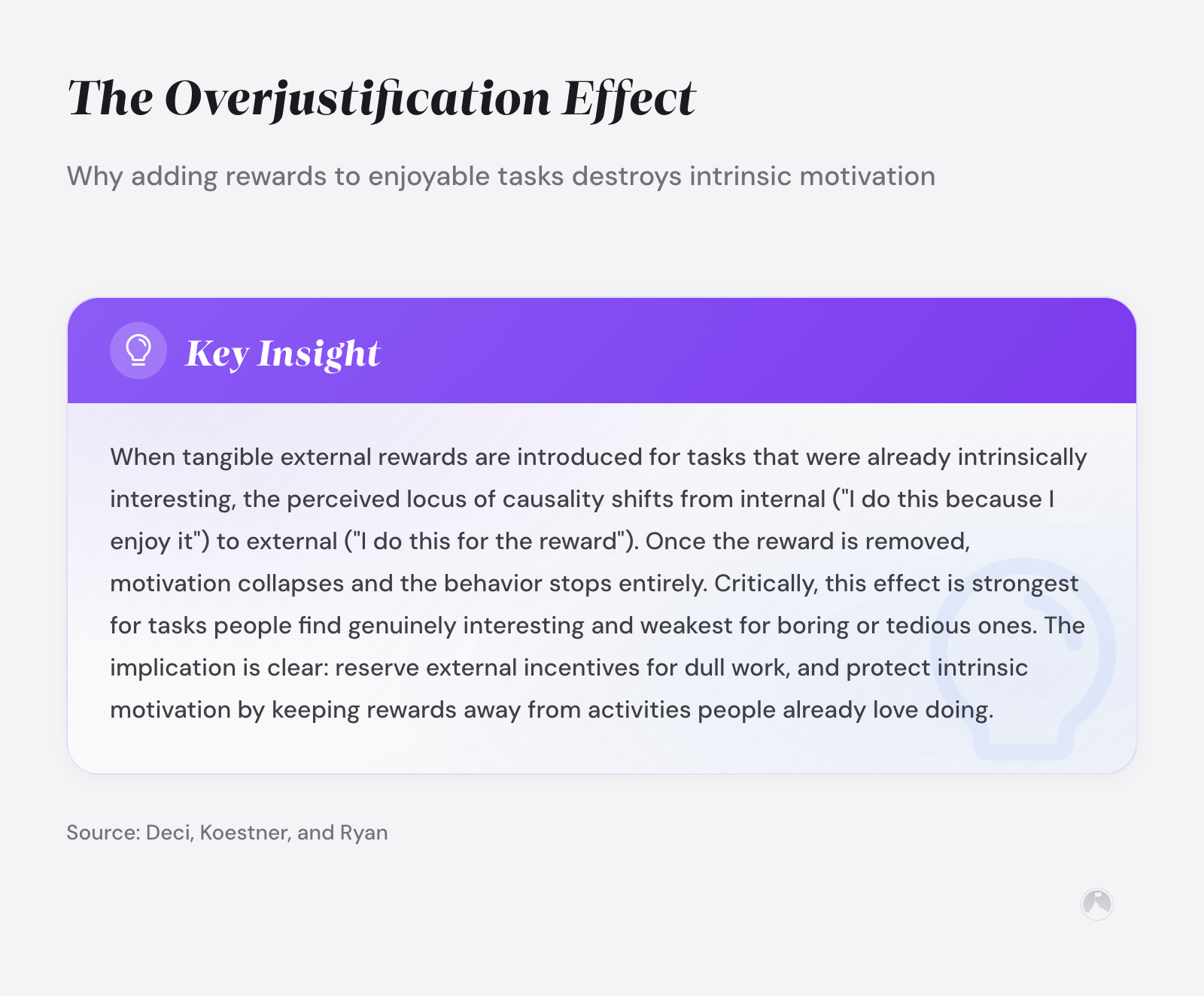
In 1973, psychologist Mark Lepper and colleagues David Greene and Richard Nisbett ran an experiment at Stanford with preschool children who loved to draw [7]. They split the kids into three groups: one group was promised a “Good Player” certificate for drawing, another received the same certificate unexpectedly after drawing, and the third group got nothing.
Children who expected a reward before drawing spent 50% less time drawing during free play compared to children who received no reward at all [7]. The unexpected-reward group showed no decline. The promised reward had converted play into work, and when the reward disappeared, so did the behavior.
The overjustification effect is the psychological phenomenon in which expected external rewards reduce a person’s intrinsic motivation for an activity by shifting the perceived cause of the behavior from internal enjoyment to external incentive.
The observed decline in drawing behavior after rewards were removed is the overjustification effect, and the pattern applies directly to adult productivity habits. When you promise yourself a treat for finishing a workout, you shift your brain’s explanation for why you exercise. Instead of “I exercise for the feeling it gives me,” the narrative becomes “I exercise for the reward.” Remove the reward, and the behavior has no remaining justification.
The practical rule: use tangible extrinsic rewards only for behaviors you genuinely find unpleasant, and only as a bridge to get the behavior started. For activities that have any natural enjoyment, rely on verbal feedback, progress tracking, and competence-building rewards that strengthen rather than replace internal motivation. This principle connects directly to how neuroscience explains habit formation: the basal ganglia automates behaviors based on the reward signal, and the type of signal determines what gets automated.
Why Do Variable Reward Schedules Create Unbreakable Habits?
B.F. Skinner’s research on operant conditioning revealed something counterintuitive: behaviors reinforced every single time are the easiest to extinguish [3]. The most persistent behaviors, the ones that keep going even when rewards stop, come from variable reinforcement schedules. This is the mechanism behind slot machines, social media feeds, and every app that keeps you checking one more time.
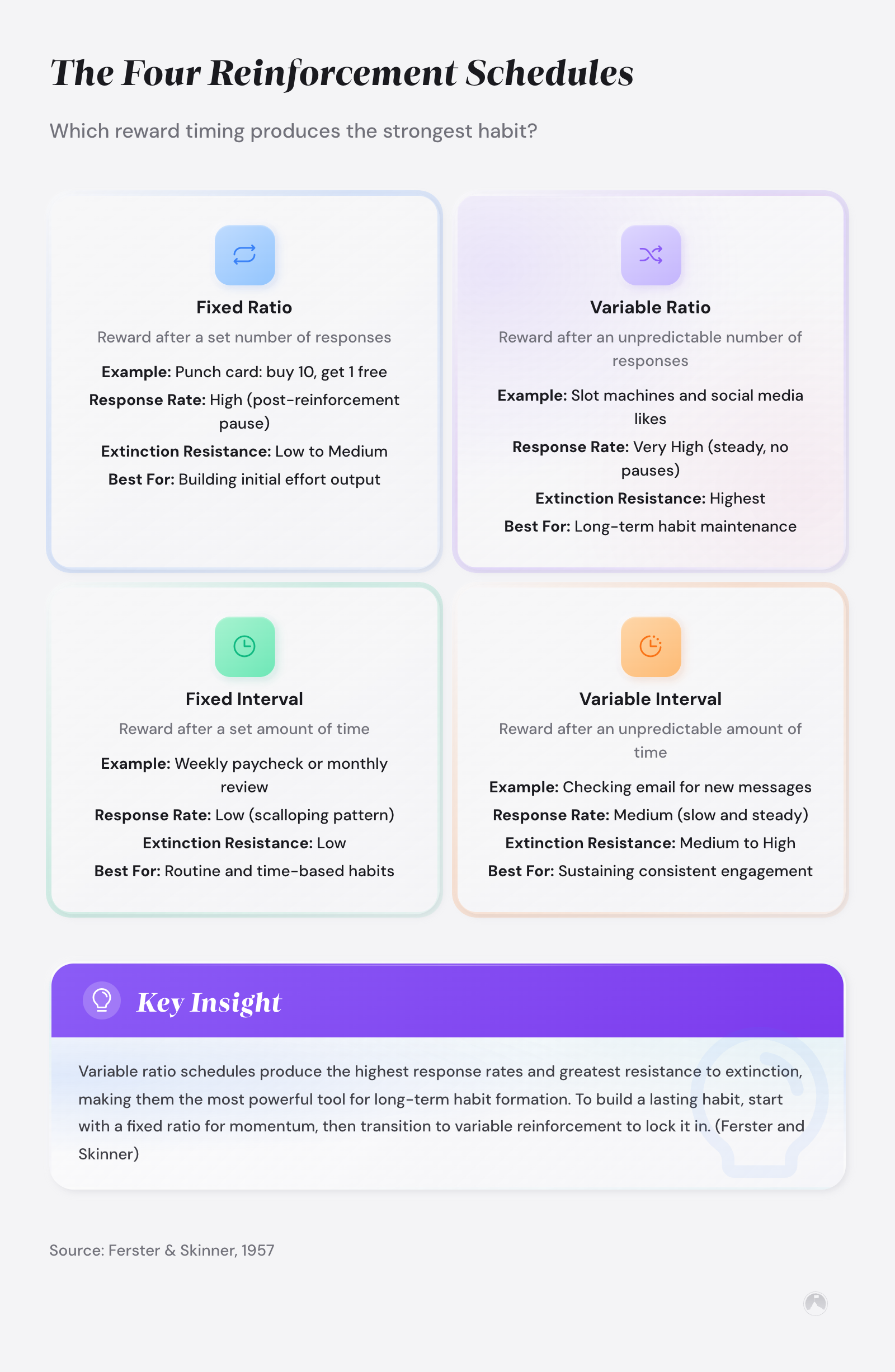
Variable ratio reinforcement is a schedule of reward delivery in which a reward is given after an unpredictable number of target behaviors, producing high and steady response rates with strong resistance to behavioral extinction [3].
You can use this same principle ethically to build productive habits that resist fading. Variable ratio reinforcement, where rewards arrive after an unpredictable number of responses, produces the highest sustained response rates of any reinforcement pattern [3].
The four reinforcement schedules compared
| Schedule Type | How It Works | Behavior Pattern | Habit Example |
|---|---|---|---|
| Fixed Ratio | Reward after every N completions | High, with pauses after reward; Low extinction resistance | Coffee after every 3 workouts |
| Variable Ratio | Reward after unpredictable number of completions | High and steady; Very high extinction resistance | Random bonus reward from a jar after workouts |
| Fixed Interval | Reward after set time period | Increases near reward time; Low extinction resistance | Weekly treat for daily journaling |
| Variable Interval | Reward after unpredictable time | Low but steady; Moderate extinction resistance | Occasional surprise day off after consistent work |
Here’s how to apply variable ratio schedules to productivity habits. Write 10 possible rewards on slips of paper, some small (a 10-minute break), some medium (a favorite snack), one or two larger ones (a movie night, buying something you’ve been wanting). After completing your target habit, roll a die, and on a 6, you pull a reward from the jar. The unpredictability is the point.
Pairing variable reward schedules with gamification approaches multiplies the effect because game mechanics already rely on variable reinforcement to sustain engagement. Points, levels, and random drops are all variable ratio systems dressed up in game clothing. If you track habits with an app, look for features that introduce randomized rewards rather than fixed milestone prizes.
The Reward Timing Framework: Match Reward Type to Habit Stage
We call this the Reward Timing Framework, a goalsandprogress method for systematically shifting your reward approach as a habit matures through three stages. The framework builds on two findings: Woolley and Fishbach’s 2018 research showing that immediate rewards predict habit persistence more strongly than delayed rewards [5], and Amabile and Kramer’s progress principle showing that small forward steps on meaningful work generate outsized motivational effects [6].
The Reward Timing Framework maps three habit stages, initiation, strengthening, and autonomy, to specific reward types that prevent overjustification at each transition.
Stage 1: Initiation (Days 1-14)
Goal: Get the behavior happening at all, using immediate tangible rewards delivered right after the behavior. A small treat after your first week of morning pages, or a favorite podcast episode only during your walk. The reward should be instant. Research by Woolley and Fishbach at Cornell and the University of Chicago found that an immediate bonus increased continuance by 35%, while a larger bonus only increased it by 19%, suggesting reward timing outweighs reward magnitude [5]. Delayed rewards of the same size didn’t produce the same effect.
Stage 2: Strengthening (Days 15-45)
Goal: Shift from external to internal reinforcement by replacing tangible rewards with progress-based ones. Start tracking your habit streak visually and noting skill improvements. Move from “I get a treat after writing” to “I can see myself getting better at writing.” This is where the variable schedule enters. Stop rewarding every instance and switch to unpredictable reinforcement.
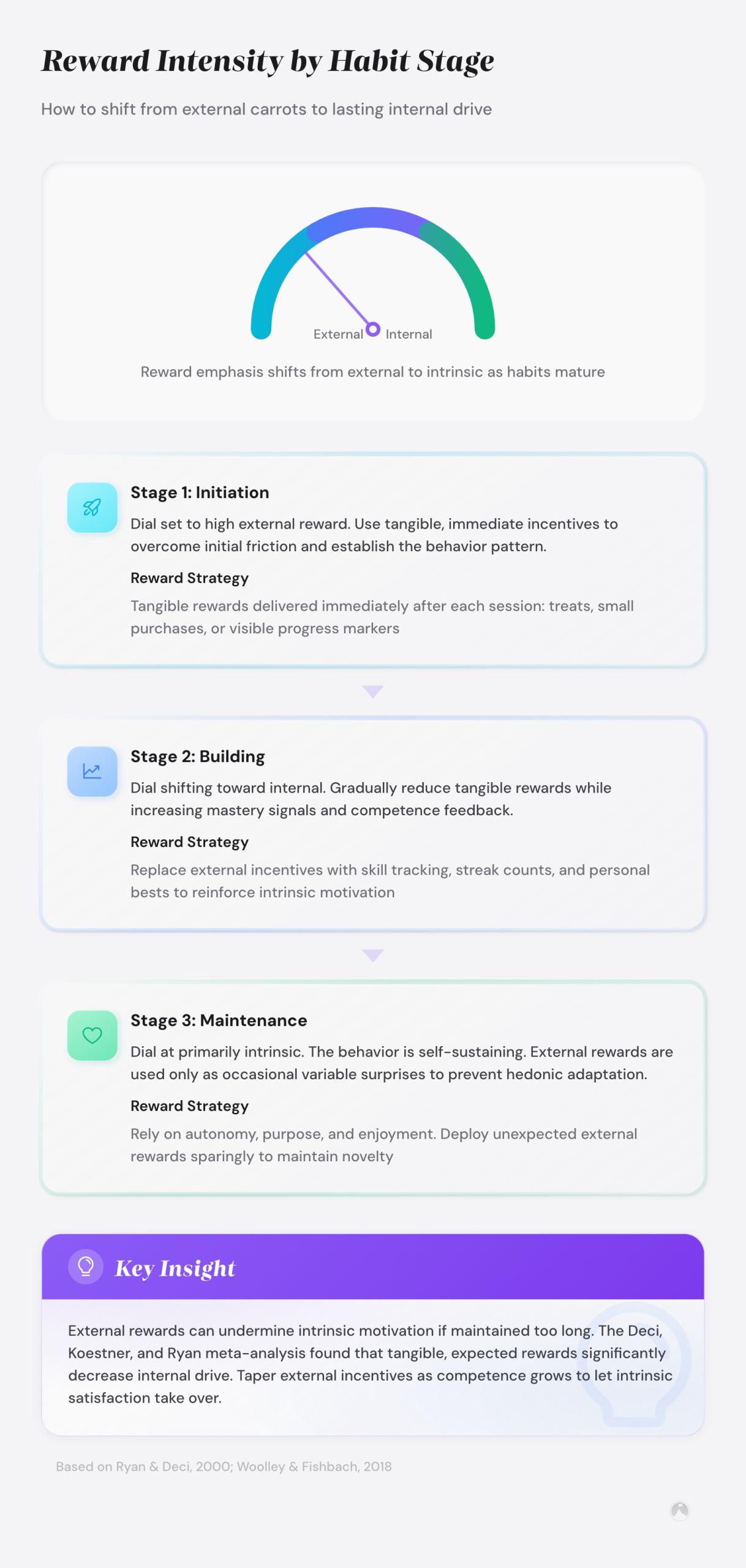
Stage 3: Autonomy (Day 46+)
Goal: The behavior is its own reward. External rewards should now be rare surprises, not expectations. The primary reinforcement comes from competence satisfaction (“I’m good at this”), autonomy satisfaction (“I chose to do this my way”), and the visible progress of your outputs. If you still need a tangible reward at this stage, the habit may not be the right fit. Consider whether you need to diagnose why the habit isn’t taking hold.
Reward Timing Planner
Map your habit to the framework. Write your habit name, current stage, and planned reward shift.
Stage 1: Initiation (Days 1-14)
Reward type: Immediate + tangible
Schedule: Every time (continuous reinforcement)
Example: ____________________
Stage 2: Strengthening (Days 15-45)
Reward type: Progress-based + variable tangible
Schedule: Variable ratio (random reinforcement)
Example: ____________________
Stage 3: Autonomy (Day 46+)
Reward type: Intrinsic + rare surprise
Schedule: Internal reinforcement with occasional variable reward
Example: ____________________
What Does Dopamine Research Reveal About Reward Timing?
Neuroscientist Wolfram Schultz and colleagues published a landmark 1997 paper in Science that changed how we understand reward processing in the brain [4]. They found that dopamine neurons don’t simply fire when you receive a reward. Dopamine neurons fire when you receive an unexpected reward, a signal called reward prediction error. A fully predicted reward produces no dopamine spike at all. And a predicted reward that fails to arrive actually causes a dip below baseline.
Dopamine neurons respond to the gap between expected and received rewards, not to reward magnitude alone, making unpredictable reinforcement neurologically more potent than guaranteed prizes [4].
Reward prediction error is the difference between the reward the brain expects and the reward it actually receives, serving as the primary signal that drives dopamine neuron firing and makes unexpected rewards neurologically more potent than predictable ones [4].
“Of all the things that can boost emotions, motivation, and perceptions during a workday, the single most important is making progress in meaningful work.” [6]
That finding from Amabile and Kramer aligns with what Schultz’s work predicts at the neural level. This is why the variable reward schedule works at the neurological level. A guaranteed treat after every workout becomes invisible to your dopamine system within a few weeks. A surprise reward after a random workout keeps generating a signal.
Teresa Amabile and Steven Kramer’s research at Harvard analyzed nearly 12,000 daily diary entries from 238 workers and found what they called the progress principle: small wins on meaningful work were the strongest predictor of positive inner work life, more influential than recognition, incentives, or interpersonal support [6]. On days when employees made even minor progress, they reported more positive emotions and higher intrinsic motivation. On setback days, the reverse was true.
Small progress events on meaningful projects produce a motivational effect that outweighs formal recognition programs and financial bonuses combined [6]. This means the best habit reward system might be nothing fancier than a visible record of your progress. A filled-in habit tracker, a growing word count, a declining mile time: these small wins generate their own reward signal. And unlike external rewards, they don’t trigger the overjustification effect.
How to Build a Reward-Based Habit System That Strengthens Over Time
Here’s the step-by-step process for building a habit reward system using everything covered above. This works for any productive habit, whether exercise, writing, studying, meditation, deep work, or anything else you’re trying to make automatic.
Step 1: Classify your habit’s natural reward potential
Ask yourself: does this activity have any built-in enjoyment? Filing taxes probably not, writing maybe, running depends on the person. If the activity is inherently unpleasant, external rewards are fine as a permanent feature. If the activity has any enjoyment potential, plan to transition away from external rewards using the Reward Timing Framework.
Step 2: Set up your initiation rewards
Choose an immediate reward that happens right after the behavior, not hours later, not at the end of the week. Woolley and Fishbach’s research showed that immediacy, not size, predicts persistence [5]. A small piece of chocolate right after a workout beats a shopping spree at month’s end. Pair this with a habit stacking approach so the reward slots naturally into your routine.
Step 3: Build your variable reward jar
Write 10-15 rewards on slips of paper with a mix of sizes, and include a few blanks (“nice try, keep going”). After your habit behavior, use a random method to determine if you get a reward this time: a die roll, a coin flip, an app-based randomizer. Over weeks, reduce the frequency of wins. Your brain, trained by variable reinforcement, will keep the behavior going.
Step 4: Make progress visible
Set up a tracking system that shows your accumulating effort. This is where Amabile and Kramer’s progress principle does the heavy lifting [6]. A wall calendar with X marks, a spreadsheet tracking your metrics, a journal with daily reflections. The Seinfeld Strategy’s “don’t break the chain” method is one of the simplest and most effective progress visualization tools available. Behavior design research emphasizes that celebration and visible progress are the fastest path to automaticity.
Step 5: Plan your reward transition
At the two-week mark, consciously reduce tangible rewards and increase attention to internal signals. Notice when the habit starts feeling good on its own. When you catch yourself doing the behavior without thinking about the reward, you’ve crossed into the strengthening stage. Celebrate that: it’s a sign the habit is becoming self-reinforcing.
Ramon’s Take
Gold stars stopped working in third grade and somehow we’re all still designing systems based on gold stars. At least make it a mystery box. Unpredictability actually works, which feels ridiculous but also kind of tracks.
The turning point came when I stopped tracking my writing streak for the reward and started tracking it purely for the data: which days I wrote more, what my average looked like over 90 days, whether mornings or evenings produced better output.
That shift from “reward for doing” to “information about doing” made my consistency jump in a way no treat ever had. I use a plain spreadsheet for this, nothing fancy, because the simpler the tracking tool the less friction it adds.
The best reward I’ve found for any habit is a simple, visible record that shows the gap between where I started and where I am now. It sounds boring compared to buying yourself a new gadget, but boring works when flashy stops working. And the data itself becomes addictive in the best possible way: you start protecting the streak not because someone promised you a prize, but because you can see the proof that you’re someone who does this thing.
Reward System for Productivity: Conclusion
A reward system for productivity isn’t about finding the perfect prize for good behavior. It’s about understanding why your brain responds to different reward types at different stages and designing a system that shifts from external to internal reinforcement over time. The research from Deci and Ryan, Schultz, Amabile and Kramer, and Woolley and Fishbach all point to the same conclusion: the best rewards are immediate, often unexpected, and gradually become unnecessary as the habit builds its own momentum.
The habit that needs a reward every time is a habit that hasn’t finished forming. The one that rewards itself is the one that lasts.
Next 10 Minutes
- Pick one habit you’re trying to build and classify it: inherently enjoyable, neutral, or unpleasant
- Choose one immediate reward you can pair with your next session of that habit
- Set up a simple visible tracker: a calendar on the wall, a note on your phone, a tally in a notebook
This Week
- Create your variable reward jar with 10-15 rewards of different sizes and a few blank slips
- Run your habit for 7 consecutive days using immediate rewards after each session
- At the end of the week, review your tracker and note any moments the habit felt good on its own
There is More to Explore
For connecting reward design to flow state productivity, the key insight is that flow itself is an intrinsic reward. Once you can reliably enter flow during a habit, external reinforcement becomes redundant.
And if your habits keep stalling even with good reward design, the issue might be in your habit system architecture. Rewards can’t fix a poorly designed cue or an overcomplicated routine.
Related articles in this guide
Frequently Asked Questions
Can extrinsic rewards ever help build long-term habits?
Extrinsic rewards are effective for starting habits with zero natural enjoyment, such as expense reports, data entry, or household cleaning. To phase them out, use a gradual reduction schedule: full reward for weeks 1-2, reward every other session in week 3, then one random reward per week by week 4. Activities with any enjoyment potential should transition to progress-based tracking within the first month to avoid the overjustification effect [2].
What is the best reward schedule for habit building?
Variable ratio reinforcement produces the strongest, most persistent behavior [3]. To start today, use a 6-sided die after each habit session and reward yourself only on a roll of 5 or 6. After two weeks, reward only on a 6. After four weeks, switch to a coin flip done once per week. The decreasing frequency mirrors how dopamine neurons respond to prediction errors rather than expected outcomes [4].
How do I know when to stop using external rewards for a habit?
Watch for two signals: you start doing the habit without thinking about the reward, and you feel genuine satisfaction from the activity itself. For most people, this transition begins around days 15-30, which aligns with the strengthening stage in the Reward Timing Framework. If you still rely on external rewards after 60 days, the habit may be a poor fit for your lifestyle, or the routine itself may need redesigning rather than more incentive.
Why do rewards stop working after a few weeks?
Reward adaptation occurs when a predictable reward no longer triggers a dopamine response [4]. Beyond switching to variable schedules, combat adaptation by rotating reward categories every two weeks: experiential rewards (a favorite walk), social rewards (calling a friend), and tangible rewards (a small purchase). A mystery box approach, where you write rewards on folded slips and draw one at random, adds novelty that keeps the dopamine signal active.
How do I build a reward system for productivity habits with ADHD?
ADHD brains often need stronger and more immediate reinforcement to maintain habit behavior because of differences in dopamine regulation. Use immediate micro-rewards after each session rather than delayed weekly rewards. Variable ratio schedules work especially well for ADHD because novelty triggers stronger dopamine responses [4]. Pair tangible rewards with visual progress tracking to engage both reward pathways, and consider apps that gamify habit streaks with random bonus features.
Do small wins really matter more than big milestone rewards?
Small progress signals activate the brain’s reward circuitry independent of any external reward delivery, which is why daily wins compound more effectively than distant milestones [6]. To capture this effect, keep a two-line daily log: what you completed, and one metric that moved forward. Big milestone rewards create long gaps with no reinforcement where the habit is most vulnerable to fading, while daily logging generates continuous reward signal from your own progress data.
References
[1] Ryan, R. M., & Deci, E. L. “Self-Determination Theory and the Facilitation of Intrinsic Motivation, Social Development, and Well-Being.” American Psychologist, 2000, 55(1), 68-78. DOI
[2] Deci, E. L., Koestner, R., & Ryan, R. M. “A Meta-Analytic Review of Experiments Examining the Effects of Extrinsic Rewards on Intrinsic Motivation.” Psychological Bulletin, 1999, 125(6), 627-668. DOI
[3] Ferster, C. B., & Skinner, B. F. Schedules of Reinforcement. Appleton-Century-Crofts, 1957. Reprinted by B.F. Skinner Foundation, 2015.
[4] Schultz, W., Dayan, P., & Montague, P. R. “A Neural Substrate of Prediction and Reward.” Science, 1997, 275(5306), 1593-1599. DOI
[5] Woolley, K., & Fishbach, A. “It’s About Time: Earlier Rewards Increase Intrinsic Motivation.” Journal of Personality and Social Psychology, 2018, 114(6), 877-890. DOI
[6] Amabile, T. M., & Kramer, S. J. The Progress Principle: Using Small Wins to Ignite Joy, Engagement, and Creativity at Work. Harvard Business Review Press, 2011. ISBN: 978-1422198575.
[7] Lepper, M. R., Greene, D., & Nisbett, R. E. “Undermining Children’s Intrinsic Interest with Extrinsic Reward: A Test of the ‘Overjustification’ Hypothesis.” Journal of Personality and Social Psychology, 1973, 28(1), 129-137. DOI