
Most People Track Habits but Never Learn from the Data
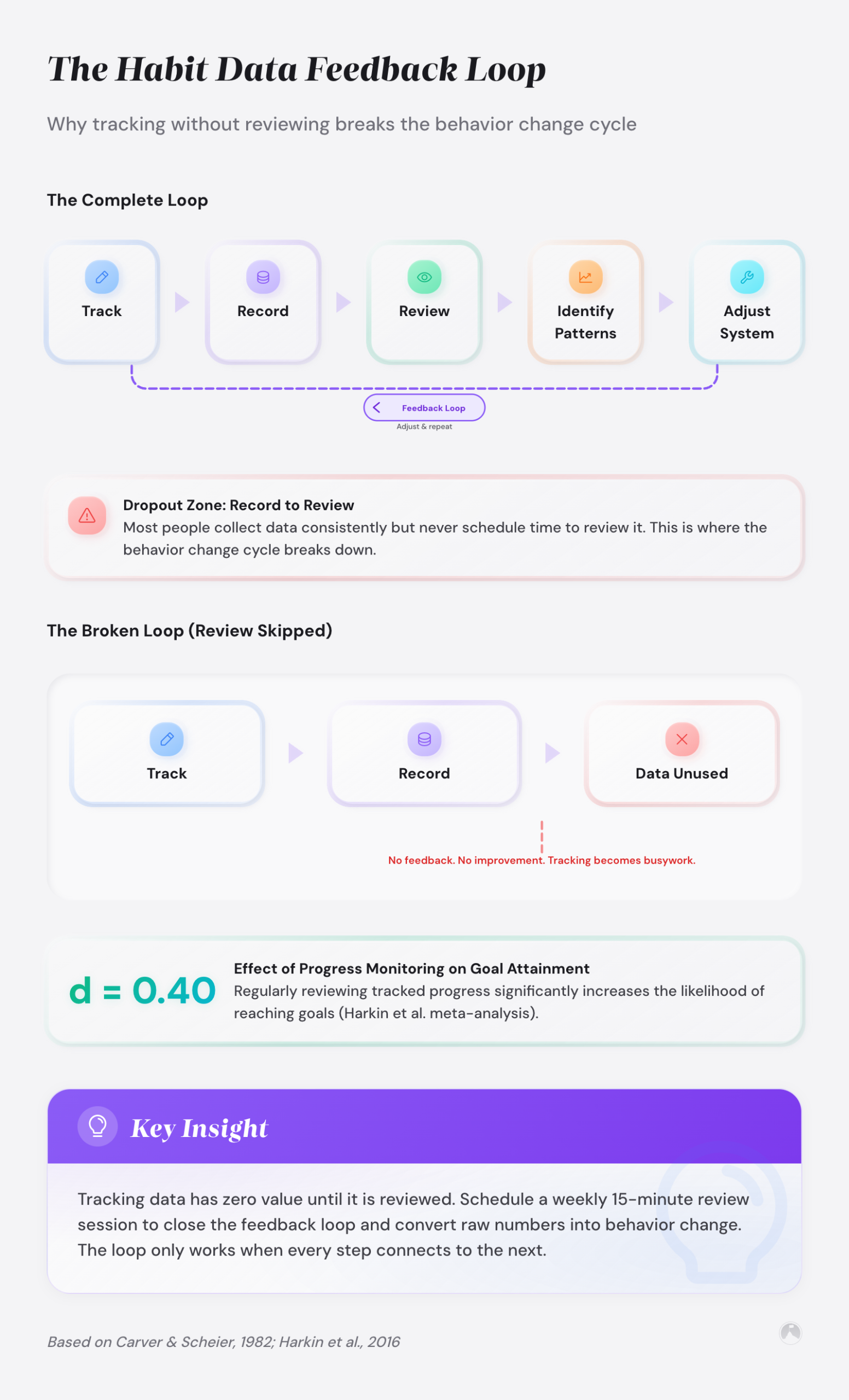
You check the boxes, fill in the streaks, and three months later you’re doing the same habits with the same problems – or you’ve quietly dropped them altogether. A review cadence framework changes this by building structured review points into your habit system at daily, weekly, monthly, and quarterly intervals. A 2016 meta-analysis led by Benjamin Harkin at the University of Sheffield found that monitoring goal progress significantly promoted goal attainment across 138 studies, but only when the monitoring information was physically recorded and reviewed [1]. The tracking alone isn’t doing the work – the review is.
Behavioral scientist Dominika Kwasnicka and her colleagues at Newcastle University identified five overarching themes that explain why behavior change sticks over time – and self-regulation through structured feedback was one of the most consistent [2]. Your habit tracker is a data collection tool. What turns that data into behavior change is a layered review system with different questions at different time horizons. That’s what this guide builds.
A review cadence framework is a structured schedule of recurring self-assessments – daily, weekly, monthly, and quarterly – designed to turn raw habit tracking data into specific adjustments. Unlike single-frequency reviews, a review cadence framework operates at multiple time horizons, giving short-term execution, medium-term patterns, and long-term direction each their own dedicated review layer.
What You Will Learn
- Why reviewing habits at multiple frequencies produces better results than tracking alone
- How to structure daily, weekly, monthly, and quarterly habit reviews
- The Cascade Review Method – a named framework for layered habit feedback
- What specific questions to ask at each review layer
- Why most habit review systems fail and how to fix them
- A ready-to-use review cadence planner for your own habit system
Key Takeaways
- Progress monitoring raises goal attainment (d = 0.40), but only when data is recorded and reviewed [1].
- A review cadence framework uses four time horizons – daily, weekly, monthly, quarterly – each asking different questions about habit performance.
- Daily reviews take 60 seconds and focus on execution. Weekly reviews take 15 minutes and focus on patterns.
- The Cascade Review Method funnels observations upward from daily data to quarterly direction checks.
- Habit maintenance relies on different psychological processes than habit formation – reviews must shift focus over time [2].
- After-action reviews improve performance by roughly 25% on average, with aligned goals and structured facilitation strengthening the effect [3].
- Implementation intentions (if-then plans) formed during reviews produce a medium-to-large effect on goal attainment [4].
- Habit automaticity takes a median of 66 days, so review focus should shift after roughly two months [5].
Why does a review cadence framework produce better habit results than tracking alone?
Tracking a habit tells you whether it happened. Reviewing a habit tells you whether it’s working. That gap is bigger than most people realize. Harkin’s meta-analysis of 138 studies with nearly 20,000 participants found that progress monitoring interventions had a medium effect on goal attainment (d = 0.40) – but the effect size jumped when participants physically recorded their observations and when results were reported or made public [1].
The mechanism behind this comes from control theory, first applied to self-regulation by Charles Carver and Michael Scheier in 1982 [6]. Their model describes behavior as a feedback loop: you set a reference value (the goal), compare your current state against it, and adjust your output (behavior) to close the gap. Without regular comparison points, the loop breaks. You drift without noticing.
A habit review cadence provides the comparison function that raw tracking data cannot supply on its own. Think about the review cadence this way: your habit tracker is the speedometer, and your review cadence is the driver who actually reads the speedometer and turns the wheel. One collects data. The other acts on it.
And the type of review matters just as much as the frequency. Harkin’s research showed that prompting people to monitor their behavior had larger effects on changing that behavior than simply monitoring outcomes, and these effects were strongest when participants physically recorded and reviewed their data [1]. So a weekly review that only asks “did I hit my targets?” misses the behavioral patterns underneath the numbers because monitoring outcomes without also tracking the underlying behaviors produced weaker effects on behavior change [1]. A well-designed habit formation system includes both behavior-level and outcome-level review questions at different cadences.
How do you structure daily, weekly, monthly, and quarterly habit reviews?
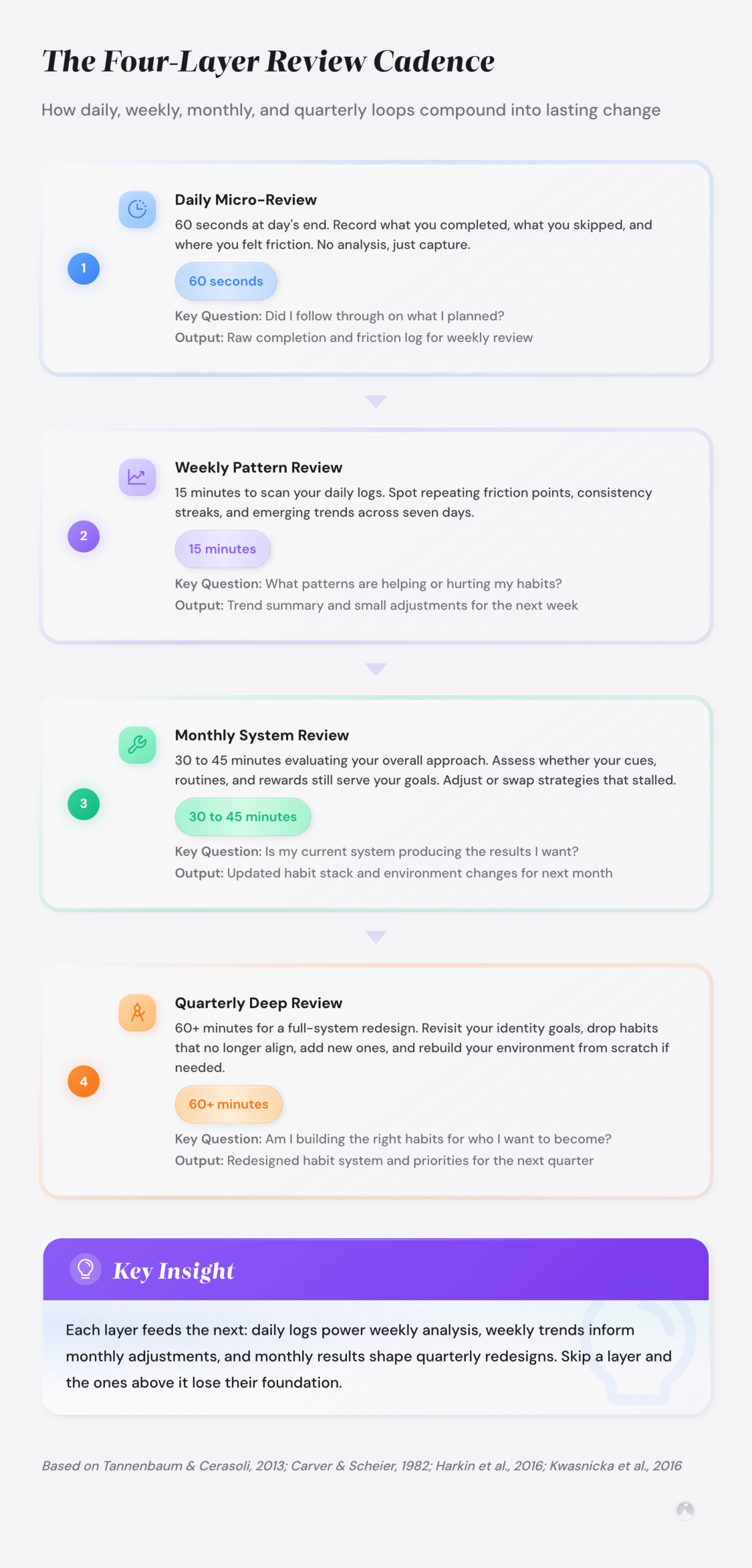
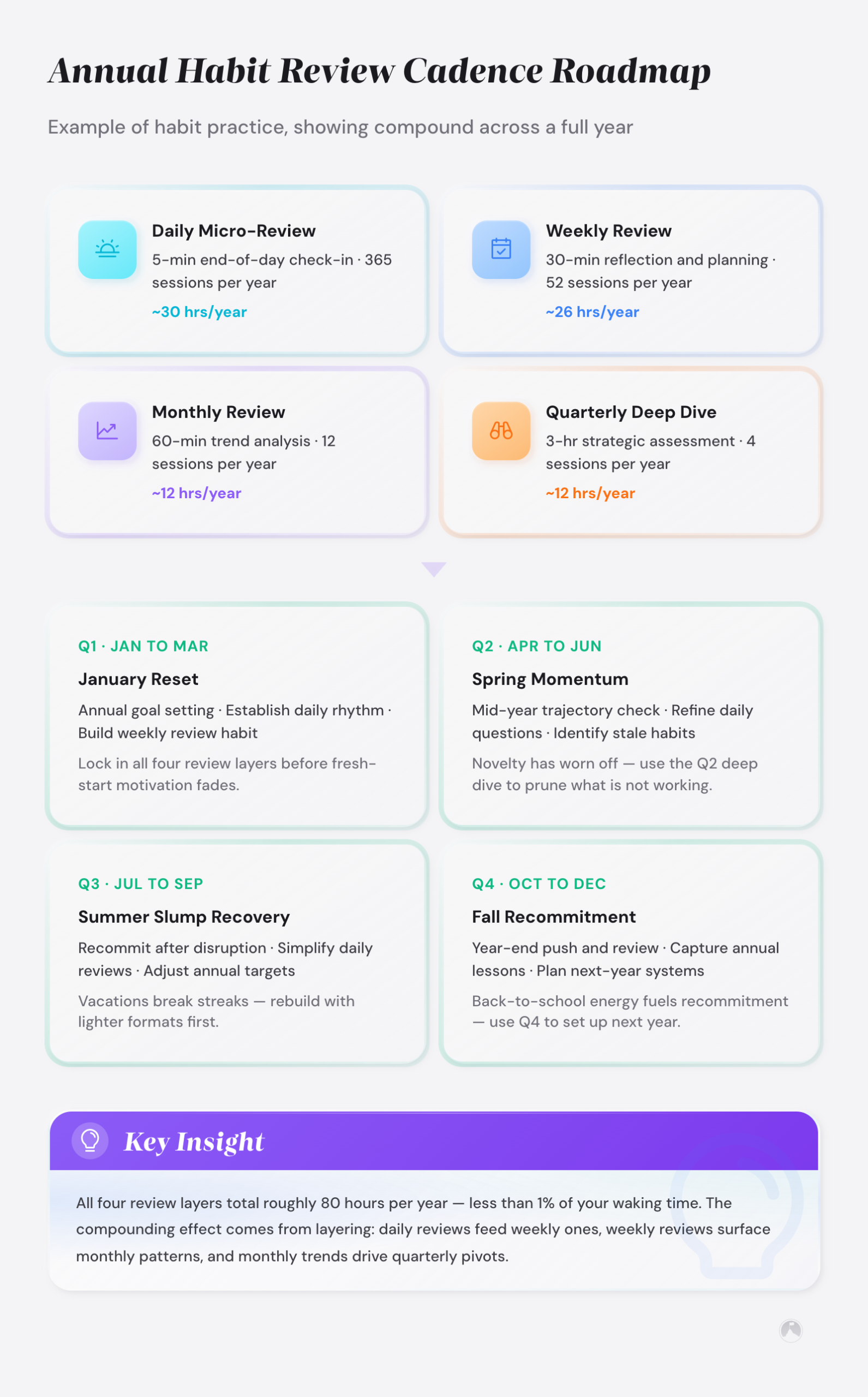
Each review frequency serves a distinct purpose in a productivity feedback loop. Mixing them up – running quarterly-style reflection during a daily check-in – wastes time and produces poor signals. The table below shows what each layer handles and how long it should take.
| Review Layer | Duration | Focus | Key Output |
|---|---|---|---|
| Daily Micro Review | 60 seconds | Did I do the habit? What got in the way? | Same-day adjustment or next-day intention |
| Weekly Pattern Review | 15 minutes | Which habits hit rate is dropping? What context patterns emerge? | One adjustment to cue, routine, or environment |
| Monthly System Review | 30-45 minutes | Are these habits still the right ones? Which should be added, paused, or retired? | Updated habit roster and priorities |
| Quarterly Direction Review | 60-90 minutes | Are my habits connected to my bigger goals? What identity shifts have occurred? | Revised habit strategy for next quarter |
The daily micro review is the foundation of any habit tracking review system and should never take more than 90 seconds. You’re not analyzing – you’re recording. Mark whether you completed each habit, note any obstacle in one phrase (“meeting ran late,” “didn’t sleep well”), and move on. The analysis happens later.
The weekly pattern review is where real learning starts. Sit down with your week’s data and look for recurring signals – did your evening habits fail every Tuesday, or did your reading habit succeed only when you did it before checking email? These are the patterns your daily check-ins collected but couldn’t make sense of alone. Each weekly review should produce exactly one concrete adjustment – not five.
Monthly and quarterly reviews zoom out further. Your monthly system review asks whether the selection of habits still makes sense. Your quarterly direction review connects habits back to goal tracking systems and life priorities. Both are less frequent for a reason – direction changes need enough data to avoid false signals from a bad week.
The Cascade Review Method: a layered productivity feedback loop for habits
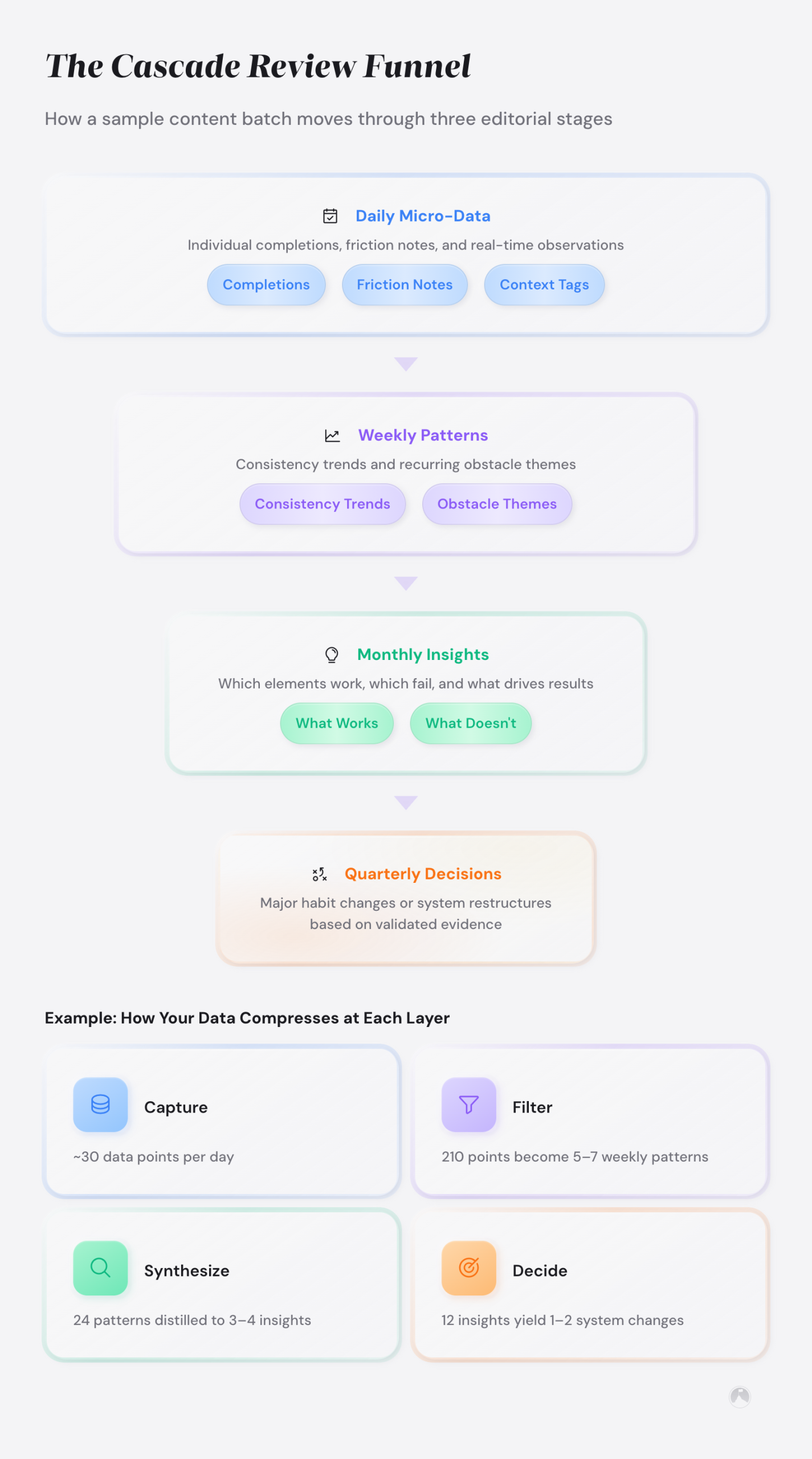
The Cascade Review Method is a habit review framework where observations flow upward from daily data to quarterly direction checks, and decisions flow downward from quarterly strategy into daily execution. We developed this approach at goalsandprogress.com to give each review layer a clear input and output. Each review layer feeds the next.
Here’s how the cascade works in practice. Your daily micro reviews generate raw observations (“skipped gym Wednesday and Thursday”), and your weekly pattern review spots the recurring signal (“gym fails when I schedule it after 5 PM”). Your monthly system review decides the structural response (“move gym to morning slot, pair with existing morning coffee habit”). And your quarterly direction review confirms the strategic fit (“physical fitness is still a top-3 priority for this season”).
The Cascade Review Method prevents the common trap where daily frustrations trigger strategic overhauls and quarterly reflections produce no operational changes. Each layer has a decision boundary: daily reviews can adjust today’s plan, weekly reviews can modify cues and contexts, and monthly reviews can add or remove habits from your active roster. Only quarterly reviews can change your priority structure or retire an entire habit category.
This layered approach mirrors what Kwasnicka et al. found in their review of 100 behavior change theories: maintenance requires a shift from motivational factors (which drive initiation) to self-regulatory and habitual factors (which sustain behavior over months and years) [2]. A single review frequency can’t handle both. The cascade gives each stage the right tool.
What questions should you ask at each review layer?
Vague review sessions produce vague results. The difference between a productive 15-minute weekly review and a wasted one is having specific questions prepared before you sit down. Below is the question set for each layer of the review cadence framework.
Daily micro review questions (60 seconds)
- Did I complete each habit today? (Yes/No/Partial)
- If I missed one, what specific barrier appeared?
- What’s my one if-then plan for tomorrow? (“If [barrier reappears], then I will [specific action].”)
The daily if-then planning question draws directly from Peter Gollwitzer’s research on implementation intentions. Implementation intentions are pre-formed if-then plans that specify when, where, and how a person will act toward a goal – distinct from general goal-setting because they link a specific situational cue to a specific behavioral response [4]. His meta-analysis with Paschal Sheeran found that if-then plans produce a medium-to-large effect on goal attainment (d = 0.65) across 94 studies [4]. Forming one implementation intention during a daily review converts passive reflection into a concrete behavioral plan for the next 24 hours.
Weekly pattern review questions (15 minutes)
- What was my completion rate for each habit this week?
- Which day or context produced the most misses?
- Did my if-then plans from daily reviews actually work?
- What one cue, timing, or environment change would improve next week?
- Am I experiencing friction with any habit that was easy last week?
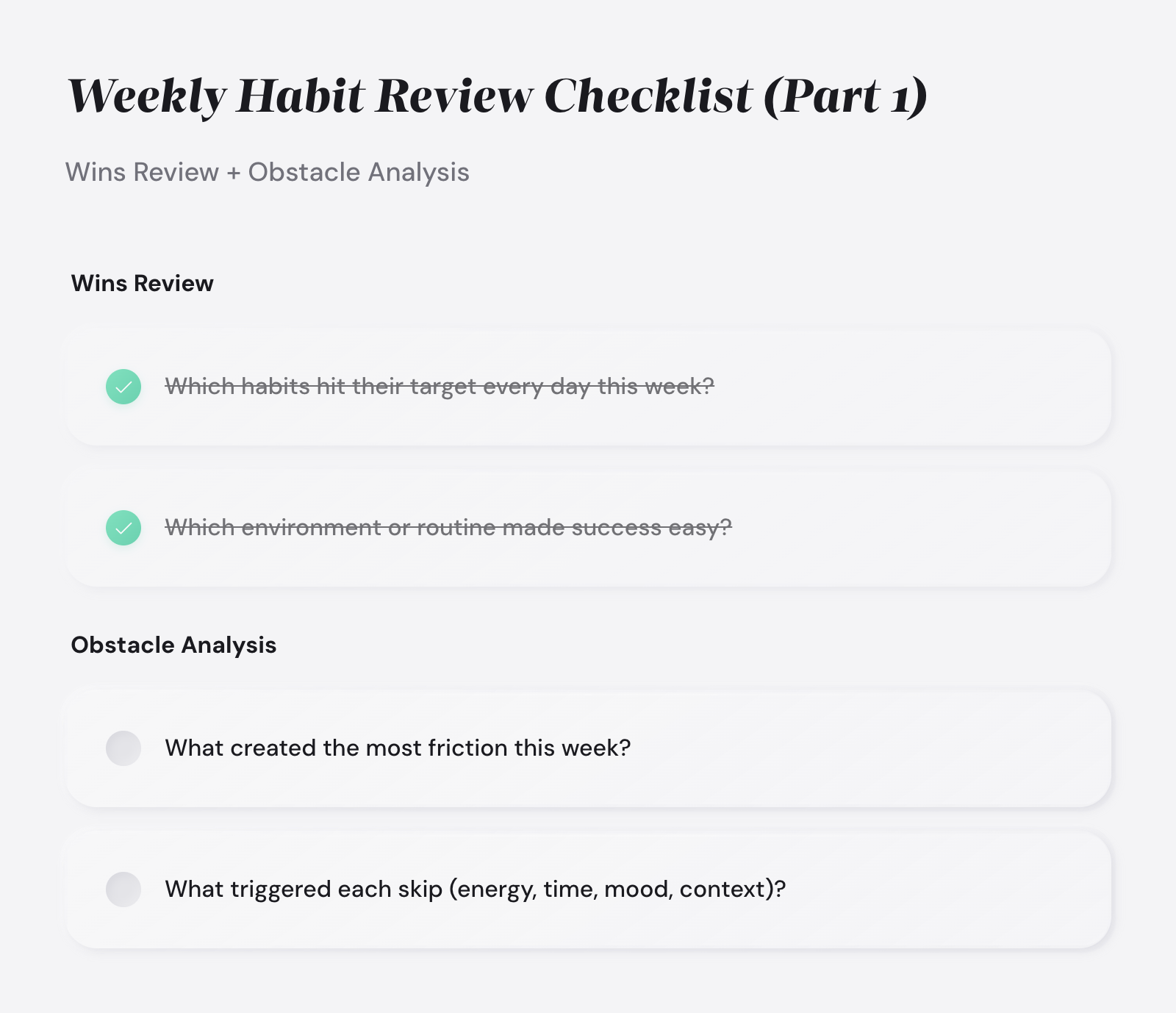
The weekly review is where you start seeing the patterns that daily data alone can’t show. If you’re using a habit tracking app, this is when you look at the weekly charts rather than the daily checkboxes. One adjustment per week – not three, since changing too many variables at once destroys your ability to tell what worked.
Monthly system review questions (30-45 minutes)
- Which habits have a completion rate above 80%? Are they becoming automatic?
- Which habits have been below 50% for two or more weeks? Should they be simplified, rescheduled, or paused?
- Am I tracking too many habits at once? (Research supports starting with fewer for higher success rates [5].)
- What new habit should I consider adding based on this month’s progress?
- Did any life circumstances change that make a current habit impractical?
Phillippa Lally’s research at University College London showed that habit automaticity takes a median of 66 days, with a range from 18 to 254 days depending on behavior complexity [5]. Your monthly review at the 30-day mark should check whether a habit feels more automatic than it did on day one – if it doesn’t feel any different after four weeks of consistent execution, the cue-routine pair probably needs restructuring rather than more willpower. This is a good time to revisit your habit stacking to see if the sequence still holds.
Quarterly direction review questions (60-90 minutes)
- Which habits directly served my top three priorities this quarter?
- Which habits ran on autopilot without contributing to anything I care about?
- What new skill, role, or life change should my habits support next quarter?
- Am I maintaining habits out of obligation rather than value?
- What would I tell a friend to start or stop doing based on what I’ve learned?
Quarterly habit direction reviews should compare current habits against current goals, not the goals that existed when the habits were first created. Priorities drift. A habit that served you in January might be irrelevant by April. The quarterly review is the only layer in the cascade with permission to make that call.
Why do most habit review schedules fail – and how do you fix them?
There are three common failure modes in habit review systems. Each one looks different, but they all produce the same result: reviews that happen without producing change.
Failure 1: Review without action
You sit down, look at your data, feel bad (or good), and close the notebook. Nothing changes. Scott Tannenbaum and Christopher Cerasoli’s 2013 meta-analysis of after-action reviews found that structured debriefs improve performance by roughly 25% on average [3]. The strongest effects appeared when the debrief focus was aligned with performance goals and when reviews followed a structured format. A review session that ends without at least one written commitment (“Next week I will…”) is just rumination with a calendar invite.
Failure 2: Wrong frequency for the question
Asking “are these the right habits for my life?” every day creates decision fatigue and anxiety. Asking “did I do the habit today?” once a month gives you nothing useful. Matching review questions to the right time horizon is half the design work in a review cadence framework. The table in the previous section maps this precisely.
Failure 3: Never shifting from formation to maintenance
Kwasnicka’s review of behavior change theories found that maintenance depends on different psychological factors than initiation [2]. Early on, you need motivation, self-efficacy, and conscious effort – but after a habit becomes partially automatic, the review focus should shift toward satisfaction with outcomes, identity reinforcement, and environmental support. People who keep running “am I motivated enough?” reviews on an 8-month-old habit are asking the wrong question entirely; by that point, the real question is “is this habit still serving my goals?”
| Failure Mode | Symptom | Fix |
|---|---|---|
| Review without action | You review weekly but nothing changes month to month | End every review with one written if-then commitment |
| Wrong frequency for question | You feel overwhelmed by daily reviews or directionless with monthly ones | Match question type to review layer (see cascade framework) |
| No formation-to-maintenance shift | You keep troubleshooting habits that are already automatic | After 60-90 days of 80%+ completion, shift review to outcomes and direction |
How do you build your own review cadence framework from scratch?
The template below gives you a starting structure you can adapt. It’s based on the Cascade Review Method and the research-backed principles covered above. Print it, copy it into your planner, or adapt it for your habit system design.
Review Cadence Planner
Daily Micro Review (60 seconds – every evening)
☐ Mark each habit: Done / Missed / Partial
☐ Note one barrier (if any): _________________
☐ Tomorrow’s if-then plan: “If _________, then I will _________.”
Weekly Pattern Review (15 min – Sunday evening)
☐ Calculate completion rate per habit: ___% ___% ___%
☐ Worst day/context: _________________
☐ Which if-then plans from this week worked? _________________
☐ ONE adjustment for next week: _________________
Monthly System Review (30-45 min – last Sunday of month)
☐ Habits above 80% (graduating to maintenance?): _________________
☐ Habits below 50% for 2+ weeks (simplify or pause?): _________________
☐ Total active habits (aim for 3-5): _________________
☐ Add / Pause / Retire decision: _________________
Quarterly Direction Review (60-90 min – first weekend of quarter)
☐ Top 3 priorities this quarter: _________________
☐ Which habits directly serve those priorities? _________________
☐ Which habits are running on autopilot without contributing value? _________________
☐ Habit strategy for next quarter: _________________
If you use a digital habit tracker, set your daily review as a recurring evening reminder in the app. Most trackers with weekly summary features – like the ones compared in our habit tracking apps comparison – can automate the data collection your weekly pattern review needs. For a paper-based habit tracking review system, a simple notebook with one row per habit and one column per day gives you everything the daily and weekly reviews require.
Start with just the daily and weekly layers. Add monthly after your first full month. Add quarterly after your first full quarter. Building the review habit itself follows the same neuroscience of habit formation as any other behavior – context consistency and repetition matter more than ambition.
How should your habit review schedule change as habits mature?
A new habit and a six-month-old habit need different kinds of attention. Lally’s research showed that automaticity – the state in which a behavior is performed with minimal conscious effort, measured through self-reported habit strength – follows an asymptotic curve: fast gains early, then a plateau [5]. Your review cadence framework should mirror that curve.
| Habit Stage | Review Focus | Primary Questions |
|---|---|---|
| Initiation (Weeks 1-3) | Consistency and cue reliability | Am I doing this every day? Is the cue working? |
| Strengthening (Weeks 4-10) | Friction reduction and pattern recognition | Where am I losing momentum? What context helps? |
| Automaticity (Weeks 10-16) | Outcome evaluation and quality | Is this habit producing the results I expected? |
| Maintenance (Month 4+) | Direction and evolution | Does this habit still serve my current goals? |
Habit review focus should shift from ‘am I performing this habit?’ to ‘is this habit producing results?’ to ‘is this habit still worth maintaining?’ as a behavior moves from initiation through automaticity to long-term maintenance. The shift from execution-focused to outcome-focused reviews matches what the research tells us about the different psychological demands at each stage. Early habits need motivational scaffolding and conscious self-regulation. Established habits need outcome feedback and strategic direction checks [2].
Here’s a concrete example with a morning journaling habit. In week two, your daily review asks “did I journal today and what got in the way?” – but by week eight, that question should shift to “is the journaling prompt still generating useful reflection, or am I going through the motions?” By month four, the quarterly review asks “is journaling still the best use of this morning slot, or would a different habit serve me better?” Same habit, different review questions – that’s the cascade at work.
For more on how habits and goals intersect over longer time horizons, the weekly goal review process covers the goal side of the equation. The habit review cadence in this article covers the behavioral side. They’re complementary, not competing systems.
Ramon’s Take
Calling it a ‘cascade review method’ makes it sound more complicated than it is. You’re just asking different questions on different days. That’s it. The fancy name is doing a lot of heavy lifting here.
The shift from “big weekly reflection” to “tiny daily record, focused weekly adjustment” was the thing that actually made my habit system self-correcting. I think the temptation for productivity-minded people is to turn every review into a strategic planning session, and that’s the exact trap that makes reviews feel like a chore instead of a tool.
Review Cadence Framework Conclusion
A review cadence framework turns your habit tracking data into a genuine productivity feedback loop. The structure isn’t complicated – daily recording, weekly pattern-spotting, monthly system checks, and quarterly direction checks. What makes it work is matching the right questions to the right time horizon, and shifting those questions as habits mature from conscious effort into automatic behavior.
The best review system is the one that runs without you needing to decide whether to do it. Build the cadence, keep each layer short, and let the data tell you what to change.
Next 10 Minutes
- Pick one current habit and answer the three daily micro review questions for today.
- Set a recurring 15-minute calendar block for your first weekly pattern review this Sunday.
- Write one if-then plan for tomorrow’s biggest habit challenge.
This Week
- Run daily micro reviews every evening for seven straight days.
- Complete your first weekly pattern review using the five questions in this guide.
- Decide whether to add a monthly review block to your calendar based on how the weekly review felt.
There is More to Explore
If you’re building a complete habit system, our habit formation complete guide covers everything from cue design to long-term maintenance. For understanding the science behind why some habits stick and others don’t, the neuroscience of habit formation explains the brain mechanisms that your review cadence is designed to support.
And if you’re finding that habits keep failing before they get to the review stage, our guide on why habits fail covers the 12 most common breakdown points and how to fix each one.
Related articles in this guide
Frequently Asked Questions
How often should I review my habits for the best results?
A four-layer system works best: daily (60 seconds for recording), weekly (15 minutes for pattern analysis), monthly (30-45 minutes for system evaluation), and quarterly (60-90 minutes for direction setting). Research shows that more frequent monitoring correlates with higher goal attainment, but only when observations are recorded and acted upon [1]. Start with daily and weekly reviews, then add monthly and quarterly once the habit of reviewing itself feels natural. A common mistake is launching all four layers in the first week — this creates review fatigue before any layer becomes habitual, so build your review cadence the same way you build any habit: one layer at a time.
What is the difference between a habit review and a goal review?
A habit review examines the behavioral patterns underneath your goals – whether you did the habit, what blocked it, and how to adjust the cue or context. A goal review examines progress toward outcomes like weight loss, revenue, or skill acquisition. The key distinction is time horizon: habit reviews happen more frequently (daily and weekly) and focus on process mechanics, while goal reviews happen less frequently (monthly and quarterly) and focus on whether outcomes are tracking toward targets.
How long should a weekly habit review take?
Fifteen minutes is the target for a weekly habit review. If your reviews consistently run longer, use the five weekly review questions from the Cascade Review Method as a forcing function — answer only those five questions and stop. When even that takes more than 15 minutes, the issue is usually too many active habits rather than too little review time, so reduce your active roster to three to five habits before adding review depth.
Should I change my review approach as a habit becomes automatic?
Yes. Habit automaticity develops along an asymptotic curve, reaching a plateau after a median of 66 days [5]. Early reviews should focus on consistency and cue reliability. After 8-10 weeks of 80%+ completion, shift your review focus from execution questions to outcome and direction questions. A useful test: if you no longer need to think about whether to do the habit, your reviews should stop asking whether you did it and start asking whether it’s producing the results you want.
Can I do habit reviews in a journaling app or do I need a separate system?
Any tool that lets you record daily data and review it weekly will work. Dedicated habit tracking apps automate the data collection, but a simple notebook or journal works if you are consistent. The medium matters less than the cadence – research shows that physically recording observations is the key moderator of monitoring effectiveness [1]. Digital or analog, pick whichever format you will actually use every day.
How many habits should I track and review at once?
Three to five active habits is a practical maximum for most people. Each additional habit adds review overhead and splits your attention during weekly analysis. Lally’s research found that more complex behaviors take longer to become automatic [5], so fewer habits with consistent review will outperform a long list with sporadic attention. Add new habits only when existing ones have reached the automaticity stage, typically after two to three months of consistent execution.
References
[1] Harkin, B., Webb, T.L., Chang, B.P.I., Prestwich, A., Conner, M., Kellar, I., Benn, Y., and Sheeran, P. “Does Monitoring Goal Progress Promote Goal Attainment? A Meta-Analysis of the Experimental Evidence.” Psychological Bulletin, 2016, 142(2), 198-229. https://doi.org/10.1037/bul0000025
[2] Kwasnicka, D., Dombrowski, S.U., White, M., and Sniehotta, F. “Theoretical Explanations for Maintenance of Behaviour Change: A Systematic Review of Behaviour Theories.” Health Psychology Review, 2016, 10(3), 277-296. https://doi.org/10.1080/17437199.2016.1151372
[3] Tannenbaum, S.I. and Cerasoli, C.P. “Do Team and Individual Debriefs Enhance Performance? A Meta-Analysis.” Human Factors, 2013, 55(1), 231-245. https://doi.org/10.1177/0018720812448394
[4] Gollwitzer, P.M. and Sheeran, P. “Implementation Intentions and Goal Achievement: A Meta-Analysis of Effects and Processes.” Advances in Experimental Social Psychology, 2006, 38, 69-119. https://doi.org/10.1016/S0065-2601(06)38002-1
[5] Lally, P., van Jaarsveld, C.H.M., Potts, H.W.W., and Wardle, J. “How Are Habits Formed: Modelling Habit Formation in the Real World.” European Journal of Social Psychology, 2010, 40(6), 998-1009. https://doi.org/10.1002/ejsp.674
[6] Carver, C.S. and Scheier, M.F. “Control Theory: A Useful Conceptual Framework for Personality-Social, Clinical, and Health Psychology.” Psychological Bulletin, 1982, 92(1), 111-135. https://doi.org/10.1037/0033-2909.92.1.111