
Why the voice in your head might be telling you something untrue
You’re about to apply for a promotion but something inside says you’re not ready. You want to start a creative project but a voice whispers you’re not the artistic type. Here’s the frustrating part: you don’t actually believe these thoughts are true. Yet they still shape what you do and what you won’t even attempt.
Limiting beliefs are deeply held convictions about what’s impossible for you that restrict your actions – usually when the limitation isn’t real. They form through past experiences, social conditioning, even trauma. And they operate beneath conscious awareness, quietly shaping choices.
Overcoming limiting beliefs requires a 4-step evidence-based process: (1) identify the belief beneath your avoidance pattern, (2) gather evidence that contradicts the belief, (3) construct a realistic reframe grounded in that evidence, and (4) test the new belief through small behavioral experiments that build real conviction.
Limiting belief – A deeply held conviction that something is impossible about you or your abilities, formed through past experiences, that restricts your actions and potential. The belief feels true but often doesn’t match reality.
The good news: these beliefs aren’t character flaws. They’re protective strategies your brain developed to keep you safe – avoidance patterns that once reduced exposure to pain or failure but now prevent growth [9]. They’ve outlived their usefulness, but they’re not permanent. This article walks you through a 4-step process grounded in the same growth mindset principles that underpin lasting personal change.
What you will learn
- How to uncover the limiting beliefs hiding beneath your avoidance patterns
- Why evidence-based reframing works where affirmations fail
- How to test new beliefs through small experiments that build real conviction
- Why old beliefs resurface during stress and what actually stops the cycle
Key takeaways
- Limiting beliefs are learned protective strategies, not truths about you. Recognizing this reduces shame and opens curiosity about where they came from.
- As Robert Merton’s foundational self-fulfilling prophecy research shows [1], your behavior aligns with your belief, generating evidence that seems to confirm it.
- Identification happens through tracking what you consistently avoid, postpone, or sabotage. These patterns are signals of limiting beliefs operating beneath awareness.
- Evidence-based reframing works better than affirmations because your brain accepts it as credible, grounded in your actual experience, not wishful thinking [4].
- New beliefs stick through behavioral experiments – small actions that generate new evidence your brain treats as credible [5]. Conviction changes through experience, not willpower.
- Belief echoes are temporary stress reactions, not relapse. During high-stress periods, old beliefs seem true again because your prefrontal cortex shifts resources to threat detection [6].
- Deep belief transformation takes sustained practice over several months of consistent behavioral experiments. Lally’s habit formation research found a median 66 days for behavioral automaticity [2].
How limiting beliefs form and why they persist
A limiting belief starts small. You fail at something. You face criticism. Someone tells you that people like you can’t do X. A single painful experience gets overgeneralized into a broad belief about your identity. One bad presentation becomes “I’m not a public speaker.” One rejection becomes “People don’t like me.”
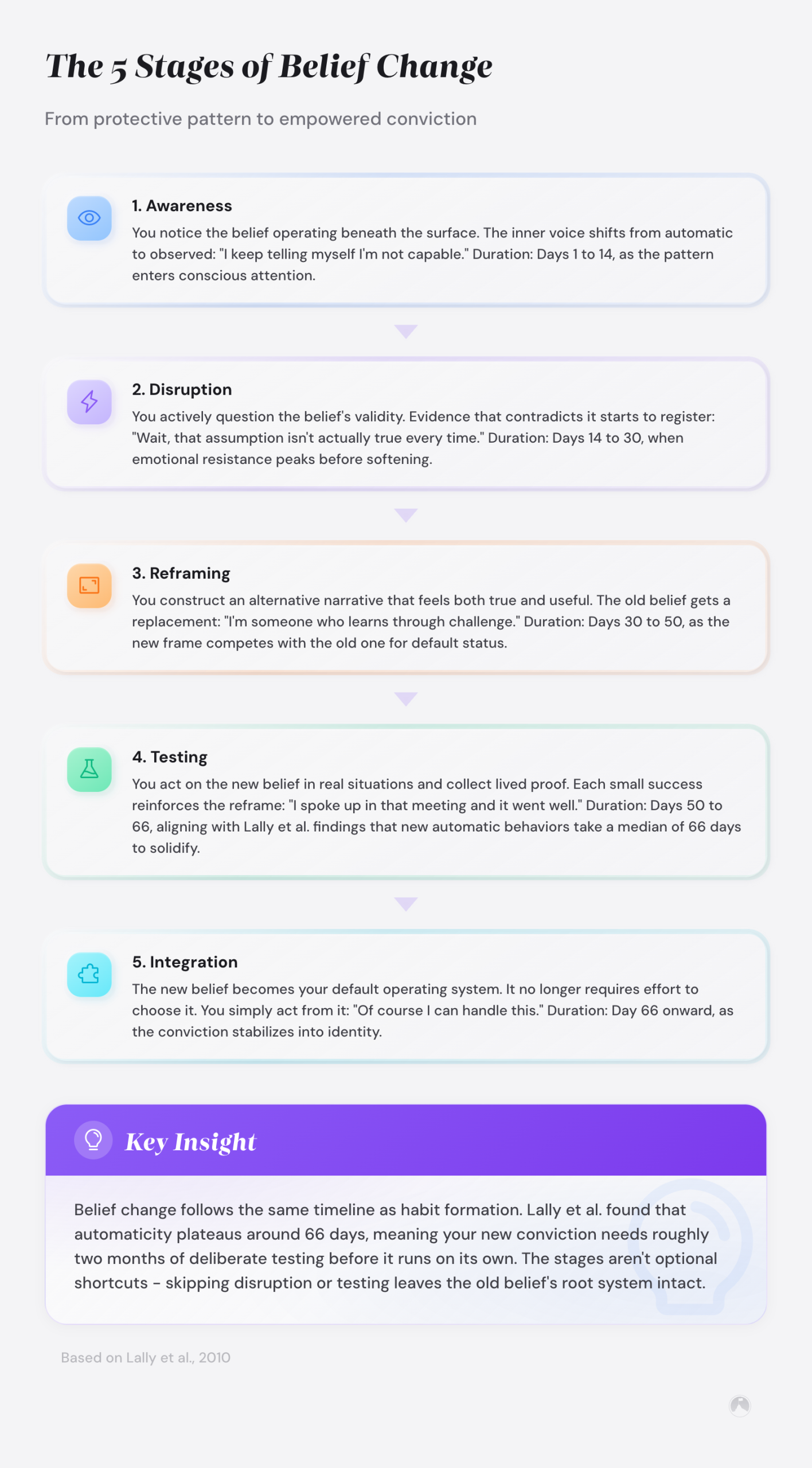
The belief persists because of what Robert Merton called a self-fulfilling prophecy [1] – a prediction that causes itself to become true because the person’s behavior aligns with the prediction, generating confirming evidence. If you believe you’re not a public speaker, you avoid speaking opportunities. That avoidance prevents skill development. Because you don’t practice, you remain uncomfortable speaking. The belief seems confirmed.
A limiting belief that feels like a character flaw is actually a protective loop the brain created to keep you safe. The belief served a function once – it kept you from risking failure. Now it keeps you from risking anything.
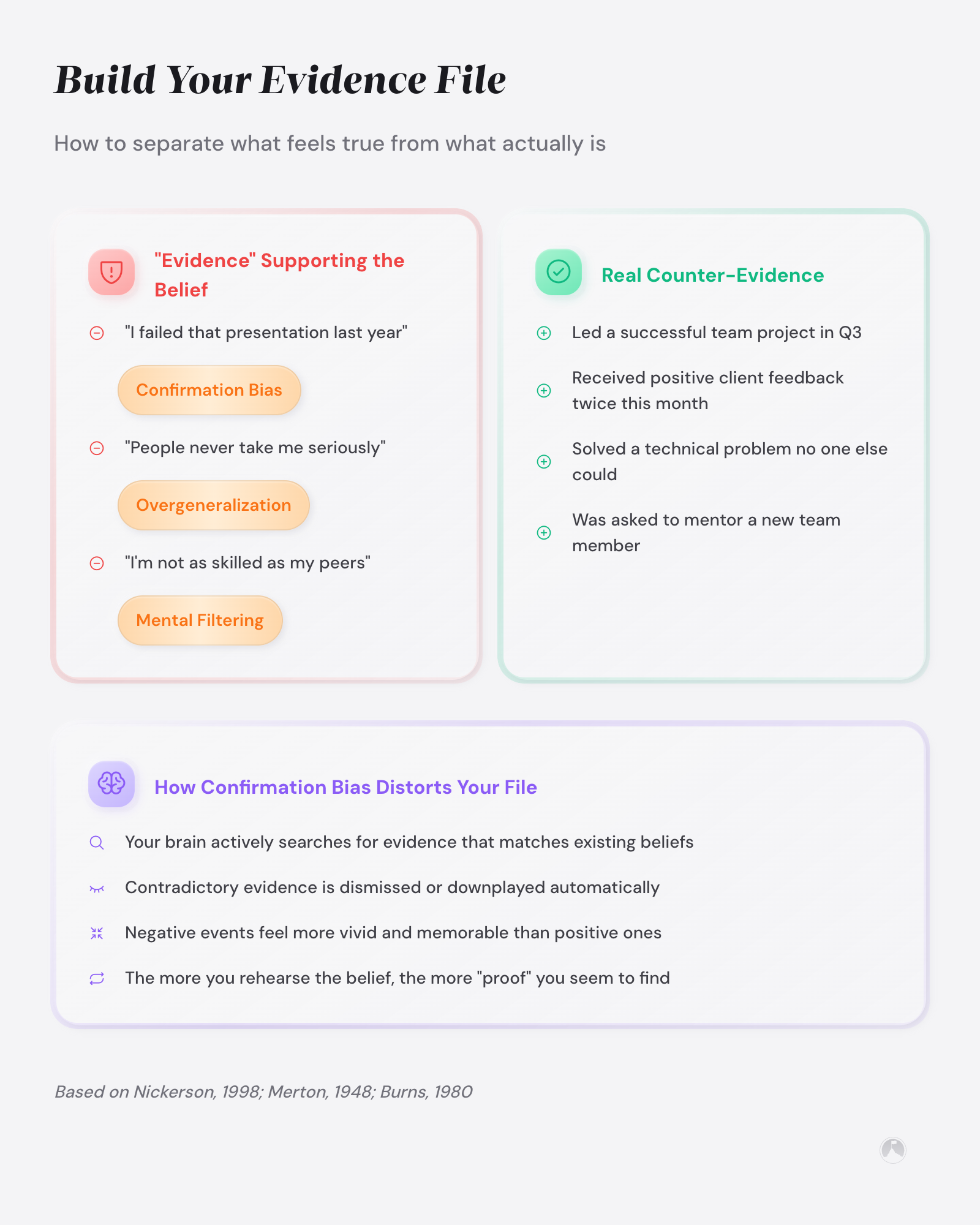
Here’s what makes this sticky: Nickerson’s confirmation bias research [3] shows that people systematically seek, interpret, and remember information that confirms existing beliefs while overlooking contradicting evidence. You complete a presentation and it goes fine, but your brain categorizes it as “exception” not “evidence.”
You get positive feedback and attribute it to luck – a pattern attribution researchers call self-serving bias, where people claim credit for successes but blame failures on external circumstances [7]. Paradoxically, people operating under limiting beliefs show the reverse: they dismiss successes as luck while treating failures as confirmation of their inadequacy. Confirmation bias [3] fuels this selective filtering, and every failure gets filed as proof the belief is correct.
The evidence on both sides is there. Your brain is just selectively seeing it. The first step toward overcoming limiting beliefs isn’t arguing with yourself – it’s noticing the evidence you’ve been trained to ignore.
The first step: identify the belief hiding beneath your avoidance
Limiting beliefs operate below conscious awareness. You don’t walk around thinking “I’m not intelligent” – you just avoid intellectual challenges. The belief shapes decisions, but you can’t articulate it unless you know where to look.
Start by noticing patterns of avoidance. What goals do you repeatedly abandon? What opportunities do you decline? What conversations do you postpone? These avoidance patterns signal limiting beliefs operating beneath the surface. If the stalling feels bigger than simple procrastination, you might be seeing signs you need a mindset shift.
Common avoidance patterns and the beliefs they signal:
- “I always abandon projects before finishing” – belief: “I can’t follow through” or “I’m not disciplined”
- “I never apply for promotions or leadership roles” – belief: “I’m not qualified” or “I’m not leadership material”
- “I don’t network because people wouldn’t find me interesting” – belief: “I’m boring” or “People won’t like me”
- “I procrastinate on anything creative” – belief: “I’m not creative” or “Whatever I make will be bad”
- “I never speak up in meetings” – belief: “My ideas aren’t good” or “I’ll say something stupid”
Domain-specific limiting beliefs:
Limiting beliefs also cluster around specific life domains. In careers: “I’m not leadership material” or “I don’t deserve a higher salary.” Around money: “People like me don’t build wealth.” In relationships: “I’m too much for anyone” or “I’ll always end up alone.” Around health: “I’m just not an athletic person.” Recognizing the domain helps trace the belief’s origin – career beliefs often come from early workplace experiences, financial beliefs from family messaging, relationship beliefs from attachment patterns, and body beliefs from childhood experiences.
Once you notice an avoidance pattern, use the downward arrow technique to surface the core belief. The downward arrow technique is a cognitive therapy method that surfaces core beliefs by repeatedly asking “why?” and “what does that mean about me?” until reaching an identity-level statement [8].
Example flow:
Avoidance pattern: “I never apply for promotions.”
Q: If you applied, what would happen? A: “People would see that I’m not qualified.”
Q: What would that mean? A: “I’d be exposed as a fraud.”
Q: What does being exposed as a fraud say about you? A: “It means I’m not actually competent. I just got lucky so far.”
Core belief: “I’m not competent. I’m a fraud.”
The limiting belief driving avoidance isn’t about the promotion itself – limiting beliefs operate at the identity level, shaping who you think you are.
Challenge the belief: build your evidence file
Once you’ve named the limiting belief, the next step isn’t to argue with it or force yourself to think something different. It’s to become a scientist examining your actual evidence.
Create two lists. On one side, write evidence that supports the limiting belief. On the other, write evidence that contradicts it. Here’s the part most people skip: actually find the disconfirming evidence. Not what you hope is true, but what you’ve actually experienced.
The evidence-gathering step is where most people discover something startling: the evidence contradicting their limiting belief is often just as extensive as the evidence supporting it. People have just been overlooking it because confirmation bias was protecting them [3]. Evidence-based reframing is the process of constructing an alternative belief grounded in documented personal experiences rather than aspirational thinking, making the new belief credible enough for the brain to accept.
If the limiting belief is “I’m not competent,” your evidence-against list might include: projects you’ve completed successfully, positive feedback you’ve received, skills you’ve developed, problems you’ve solved. These moments felt like exceptions. They’re actually evidence.
Nickerson’s research demonstrates that this selective filtering operates across hypothesis testing, decision-making, and belief maintenance [3]. The evidence-gathering step directly interrupts this filtering by forcing attention to disconfirming experiences.
Why evidence-based reframing works where affirmations fail:
Affirmations like “I am competent” don’t work because your brain immediately notices the gap between the affirmation and your actual belief. Research by Wood, Perunovic and Lee found that people with low self-esteem who repeated positive self-statements actually felt worse – the affirmation provoked contradictory thoughts that overwhelmed the positive statement [4]. For people whose current self-belief is far from the affirmation, the positive statement backfires.
But a reframed belief grounded in actual evidence feels credible. If your limiting belief is “I’m not intelligent,” an evidence-based reframe might be: “I’m intelligent in certain domains and capable of learning in areas where I’m currently weaker.” Your brain already has evidence for this. It feels accurate, not wishful. This is one of several cognitive reframing techniques drawn from CBT research, connecting to the neuroscience of shifting from a fixed to a growth mindset.
Construct the reframed belief grounded in reality
The reframed belief shouldn’t swing to the opposite extreme. “I’m not intelligent” to “I’m a genius” gets rejected – Wood et al.’s research [4] shows that statements too far from current self-belief provoke resistance. Instead, aim for the middle ground supported by your actual evidence.
The reframe should address the specific fear underlying the original belief. If the belief was “I’m not intelligent enough, so I’ll be exposed,” the reframe needs to address both: “I have legitimate competence in my field, and I’m still learning – that’s normal, not fraudulent.”
Consider a career example: someone holds the belief “I’m not a real leader – I just manage tasks.” A forced positive reframe like “I’m an incredible leader” triggers instant rejection. An evidence-based reframe sounds different: “My team has hit every deadline this quarter, and two people have said they appreciate how I handle conflict. I lead differently than the loudest person in the room, and that’s legitimate.” The reframe is specific, grounded in documented evidence, and addresses the fear that leadership requires a single personality type.
Common reframing mistakes: Swinging too positive (“I’m an amazing leader”) gives your brain something to argue with. Being too vague (“I’m good enough”) doesn’t address the specific fear. Reframing the situation instead of the identity (“That project went well”) misses the point – the belief lives at the identity level, so the reframe must too.
The table below shows the difference between a limiting belief, a forced positive affirmation your brain will reject, and a grounded evidence-based reframe:
| Limiting Belief | Forced Positive Affirmation | Evidence-Based Reframe |
|---|---|---|
| “I’m not intelligent” | “I’m a genius” | “I’m intelligent in certain domains and capable of learning in areas where I’m currently weaker” |
| “I’m not a public speaker” | “I’m an amazing speaker” | “I can speak effectively to small groups and I’m developing comfort with larger audiences” |
| “I’m not a real leader” | “I’m a born leader” | “I lead effectively in my own style – my team’s results and feedback confirm this” |
Write the reframed belief down. Make it specific and grounded in evidence you’ve actually collected. The reframed belief becomes your new belief statement – the more accurate version of reality you’re asking your brain to accept. A good reframe doesn’t feel inspiring. It feels honest.
Test the belief: behavioral experiments that build conviction
Here’s what most people miss: your brain updates beliefs through experience far more readily than through logic [5]. You can gather evidence and construct a reasonable reframe, but until you live differently, the old belief maintains its grip.
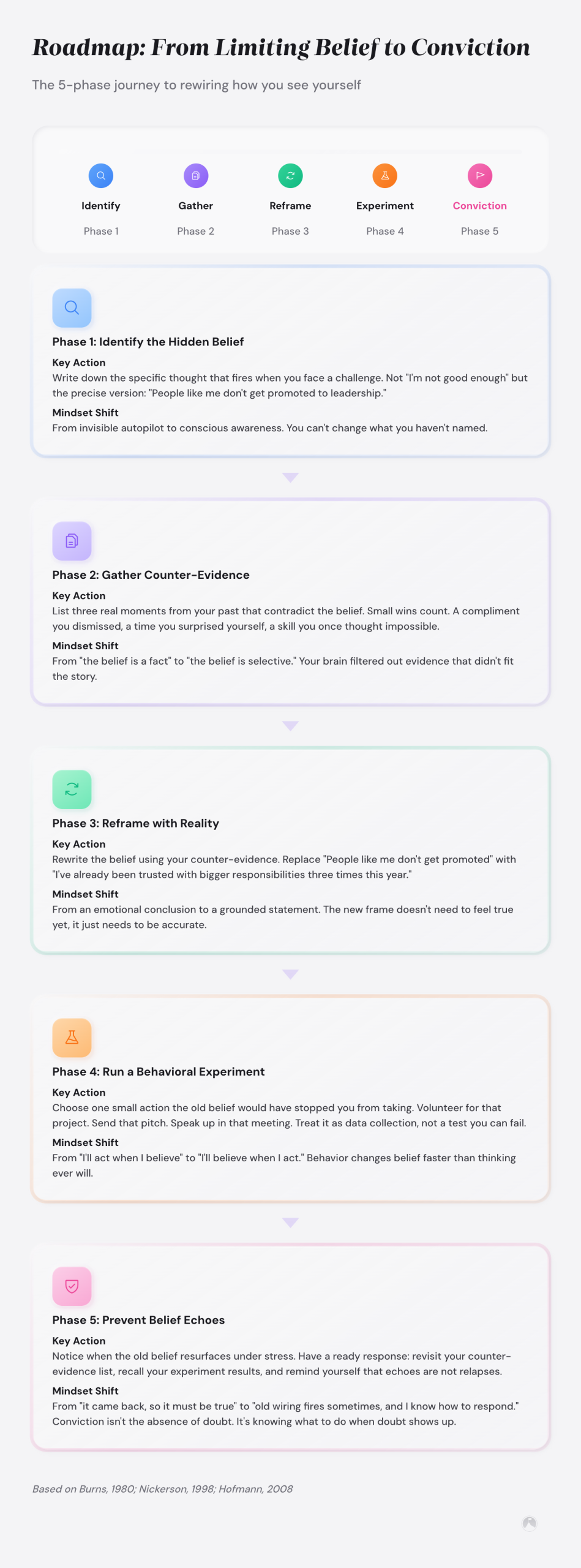
A behavioral experiment is a planned, small-scale action designed to test whether a limiting belief holds up against real-world evidence – distinguished from general exposure by requiring a specific prediction to be tested. Hofmann’s research found that experiential evidence from testing beliefs carries more weight than intellectual understanding alone [5]. If the belief was “I’m not a public speaker,” experiments might include:
- Speaking up once in a team meeting
- Sharing one idea during a presentation
- Giving a 5-minute lightning talk
- Presenting one idea to a small group
Behavioral experiments aren’t meant to be perfect. They’re meant to generate data your brain can work with. “I spoke. I wasn’t flawless. The world didn’t end. People actually listened.” That’s the kind of evidence that shifts conviction. Structured self-discovery exercises can help you design experiments matched to your specific belief patterns.
The experiments work best when they’re small enough that you’ll actually do them and frequent enough that evidence accumulates. Weekly small experiments compound faster than waiting for one big opportunity.
After each experiment, record what happened. This becomes your new evidence file – documented proof that the limiting belief is less accurate than it felt. Phillippa Lally’s habit formation research found a median of 66 days for simple behavioral habits to become automatic [2], but no equivalent research has established a precise timeline for belief restructuring. Clinical CBT programs typically span 12-20 sessions over 3-5 months, suggesting deep belief work requires sustained commitment.
When old beliefs resurface: belief echoes and prevention
At some point – during stress, after a setback, or in unfamiliar situations – the old limiting belief will feel true again. You’ll think: “I guess I really am not qualified / not capable of change.” This isn’t failure. It’s normal. Understanding why it happens prevents these moments from derailing your progress.
Belief echoes vs. true relapse:
What we call a “belief echo” is a temporary stress reaction where an old limiting belief feels suddenly true again. You’ve spent eight weeks building evidence that you’re a capable public speaker. Then a high-pressure board meeting goes poorly and suddenly “I’m not a public speaker” feels completely true again. That’s a belief echo – temporary and stress-driven, not a sign your progress was fake. After reviewing your evidence file, the new belief returns – but in that moment, the old pattern felt completely real.
Neuroscience research by Amy Arnsten shows why: under acute stress, the brain’s threat-detection systems become hyperactive while the prefrontal cortex (responsible for belief updating) becomes less active [6]. Your brain defaults to the most familiar pattern available. If you held “I’m not intelligent” for 30 years, it takes more than a few weeks of evidence to rewire that pattern.
The key difference: after a belief echo, you still have access to the experiments and evidence that contradicted the old belief. You can remind yourself: “I’m noticing the old thought, but my recent evidence contradicts it.” Meta-awareness – the ability to notice a returning old thought without accepting it as fact – is what transforms belief echoes from scary relapses into manageable bumps.
This neurological mechanism – the prefrontal cortex going temporarily offline under stress [6] – explains why belief echoes feel so convincing in the moment.
Belief maintenance system:
Once you’ve built evidence for your new belief, protect it. Continue small behavioral experiments even after conviction feels solid. Schedule a weekly 5-minute review: What evidence did I generate this week? Where did the old belief show up? How did I respond? This practice of building a mindset system that strengthens under pressure turns setbacks into data rather than proof of failure.
The most common reason limiting beliefs return is that people stop building evidence once the belief feels established. Deep change requires ongoing reinforcement. This ties directly to recognizing when your mindset needs recalibration – both require consistent practice. Believing something new isn’t a moment. It’s a maintenance project.
Ramon’s take
My suggestion: skip straight to the behavioral experiment part. Reading about beliefs doesn’t change them, doing something small that contradicts the belief does. Pick one tiny action your old story says you can’t do, and do it this week. That’s genuinely the whole thing.
Overcoming limiting beliefs: the full process
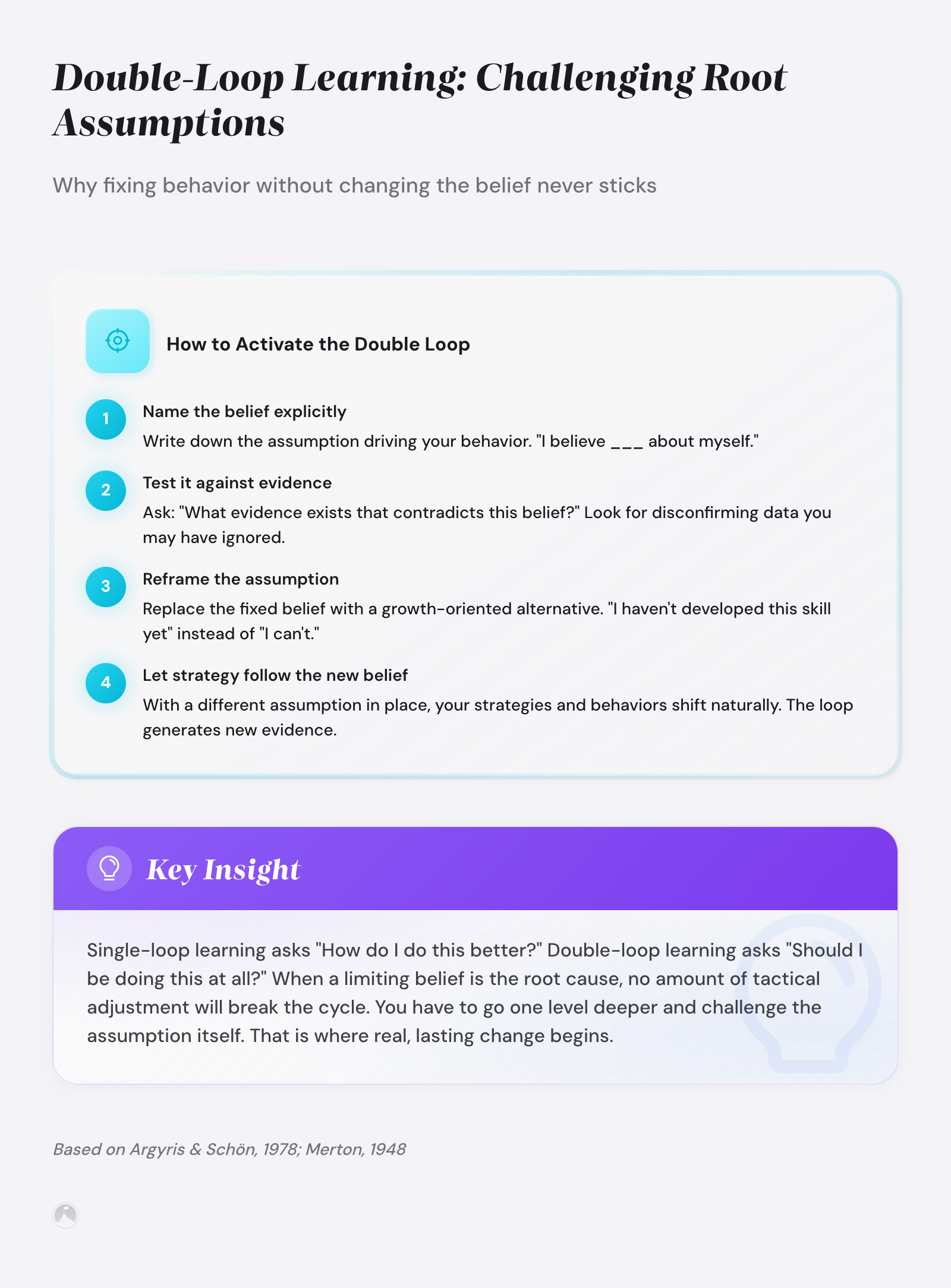
Overcoming limiting beliefs isn’t about destroying unhelpful thoughts or replacing them with forced positivity. It’s about becoming a scientist of your own mind: identifying the beliefs running your behavior, examining them against actual evidence, constructing alternatives grounded in reality, and testing those alternatives through behavioral experiments. Your brain updates beliefs through experience far more readily than through logic [5]. Start with one belief, one evidence file, one small experiment – and let the data do the convincing.
Next 10 minutes
- Identify one consistent avoidance pattern or goal you haven’t pursued. Write it down.
- Use the downward arrow technique (ask “why” repeatedly) to surface the limiting belief underneath.
This week
- Rate your conviction in the limiting belief (0-100%). Create a clear belief statement.
- Build your evidence file: evidence supporting the belief on one side, contradicting evidence on the other.
- Plan one small behavioral experiment this week that would generate evidence against the limiting belief. Do it.
There is more to explore
For deeper work on belief change and mindset transformation:
- Growth mindset development guide – How beliefs about learning shape your approach to difficulty and failure
- Self-assessment frameworks compared – Tools for measuring where limiting beliefs show up in your life
- Self-discovery exercises and tools – Hands-on practices for building awareness of beliefs and behaviors
- The GROW framework guide – A structure for translating new beliefs into concrete goal progress
- Building an antifragile mindset system – How to build resilience that gets stronger under pressure
Related articles in this guide
- self-affirmation-techniques-for-focus
- self-assessment-frameworks-compared
- self-discovery-exercises-tools
Frequently asked questions
What are limiting beliefs and how do they form?
Limiting beliefs often develop through cultural and generational transmission – family messages like ‘people like us don’t start businesses’ or ‘money is the root of all evil’ create convictions that feel like absolute truths because they were absorbed before critical thinking developed. These inherited beliefs are particularly persistent because they carry the weight of family identity rather than personal experience, making them harder to recognize as beliefs rather than facts.
How do I identify my limiting beliefs if they’re beneath awareness?
Beyond tracking avoidance patterns, the body often signals limiting beliefs before the mind recognizes them: tightness in the chest before networking events, procrastination that feels physically heavy, or a knot in the stomach when considering a promotion application. Journaling with sentence completion prompts like ‘I could never…’ or ‘People like me don’t…’ can surface beliefs the conscious mind has learned to work around. These somatic and written approaches complement the downward arrow technique by accessing beliefs through different channels.
Why don’t affirmations work for changing limiting beliefs?
Affirmations fail because the brain detects the gap between the positive statement and the person’s actual belief. Research by Wood, Perunovic and Lee (2009) found that people with low self-esteem who repeated statements like ‘I am a lovable person’ actually felt worse – the affirmation provoked contradictory thoughts that overwhelmed the positive statement [4]. Evidence-based reframing works better because the reframed belief is grounded in evidence the brain already partly accepts, making it feel credible rather than wishful.
How does evidence-based reframing work?
List evidence that supports your limiting belief on one side and evidence that contradicts it on the other. Most people discover the contradicting evidence is just as extensive – their brain was just overlooking it due to confirmation bias [3]. Then construct a reframed belief grounded in that evidence. For example, ‘I’m not intelligent’ becomes ‘I’m intelligent in certain domains and capable of learning where I’m weaker.’ Your brain accepts this as credible because it’s supported by your actual experience.
Can limiting beliefs really be changed permanently?
Self-guided belief work using the evidence-and-experiment approach is effective for many common limiting beliefs about career, creativity, or social confidence. However, beliefs rooted in trauma, beliefs causing clinical anxiety or depression, or beliefs that have resisted two or more months of consistent self-directed work typically benefit from working with a therapist trained in cognitive behavioral therapy (CBT). CBT programs typically span 12-20 sessions and directly target the belief structures underlying persistent patterns.
What do I do if the old belief comes back when I’m stressed?
Use a 3-step in-the-moment protocol: (1) label the thought explicitly by saying ‘I’m noticing the old belief resurfacing,’ which creates distance between you and the thought; (2) check your evidence file and read at least three documented entries that contradict the old belief; (3) do the smallest possible behavioral experiment within 24 hours to generate fresh evidence. This sequence interrupts the stress-driven reversion cycle before it gains momentum.
How long does it take to change a deeply held limiting belief?
No research has established a precise timeline for cognitive belief restructuring. Phillippa Lally’s habit formation research found a median of 66 days for simple behavioral habits to become automatic [2], but belief change involves more complex cognitive processes. Clinical CBT programs typically span 12-20 sessions over 3-5 months. The more deeply rooted the original belief, the more time and evidence you’ll need. Belief change isn’t magic – it’s the time required for your brain to update its prediction model based on new evidence.
What’s the difference between a belief echo and actual relapse?
A belief echo lasts hours to a few days – the old belief feels true under stress, but you can still access your evidence file and return to the new belief without external intervention. Concrete markers of a belief echo include recognizing the old thought as familiar rather than new, remembering your experiments even while feeling the old conviction, and bouncing back within days. Relapse means you’ve stopped the evidence-gathering and experiment process entirely for two or more weeks and the old belief is consistently driving your behavior again without awareness.
References
[1] Merton, R.K. (1948). “The self-fulfilling prophecy.” Antioch Review, 8(2), 193-210. Foundational work on how beliefs shape behavior and generate evidence confirming the belief.
[2] Lally, P., Van Jaarsveld, C.H.M., Potts, H.W.W., & Wardle, J. (2010). “How are habits formed: Modelling habit formation in the real world.” European Journal of Social Psychology, 40(6), 998-1009. https://doi.org/10.1002/ejsp.674
[3] Nickerson, R.S. (1998). “Confirmation bias: A ubiquitous phenomenon in many guises.” Review of General Psychology, 2(2), 175-220. https://doi.org/10.1037/1089-2680.2.2.175
[4] Wood, J.V., Perunovic, W.Q.E., & Lee, J.W. (2009). “Positive Self-Statements: Power for Some, Peril for Others.” Psychological Science, 20(7), 860-866. https://doi.org/10.1111/j.1467-9280.2009.02370.x
[5] Hofmann, S.G. (2008). “Cognitive processes during fear acquisition and extinction in animals and humans: Implications for exposure therapy of anxiety disorders.” Clinical Psychology Review, 28(2), 199-210. https://doi.org/10.1016/j.cpr.2007.04.009
[6] Arnsten, A.F. (2009). “Stress signalling pathways that impair prefrontal cortex function.” Nature Reviews Neuroscience, 10(6), 410-422. https://doi.org/10.1038/nrn2648
[7] Miller, D.T., & Ross, M. (1975). “Self-serving biases in the attribution of causality: Fact or fiction?” Psychological Bulletin, 82(2), 213-225. https://doi.org/10.1037/h0076486
[8] Burns, D.D. (1980). Feeling Good: The New Mood Therapy. New York: William Morrow. Origin of the downward arrow technique in accessible CBT literature.
[9] Salkovskis, P.M. (1991). “The importance of behaviour in the maintenance of anxiety and panic: A cognitive account.” Behavioural and Cognitive Psychotherapy, 19(1), 6-19. Research on safety behaviors and avoidance learning as protective strategies.