The morning coffee you don’t remember making
You reach for your coffee mug without thinking. Your hand knows exactly where it sits on the counter. The motion feels automatic – muscle memory taking over while your mind wanders to the day ahead. This simple act reveals one of the brain’s most powerful capabilities: transforming deliberate actions into unconscious routines.
The neuroscience of habit formation explains why some behaviors become so deeply encoded that you can perform them while barely paying attention. Your brain wasn’t designed to consciously process every decision. Neuroscientist Ann Graybiel’s research at MIT demonstrates that habit formation in the brain works as an energy-saving mechanism, allowing neural circuits to automate repetitive behaviors so cognitive resources remain available for novel challenges [1].
When habits take over, activity shifts from executive control regions to deeper structures specialized for automatic processing. Understanding why your morning routine runs on autopilot requires looking at the brain regions, neurotransmitters, and neural pathways that make this transformation possible. The habit formation guide covers practical applications, but the underlying brain science of habits reveals why certain strategies work while others fail.
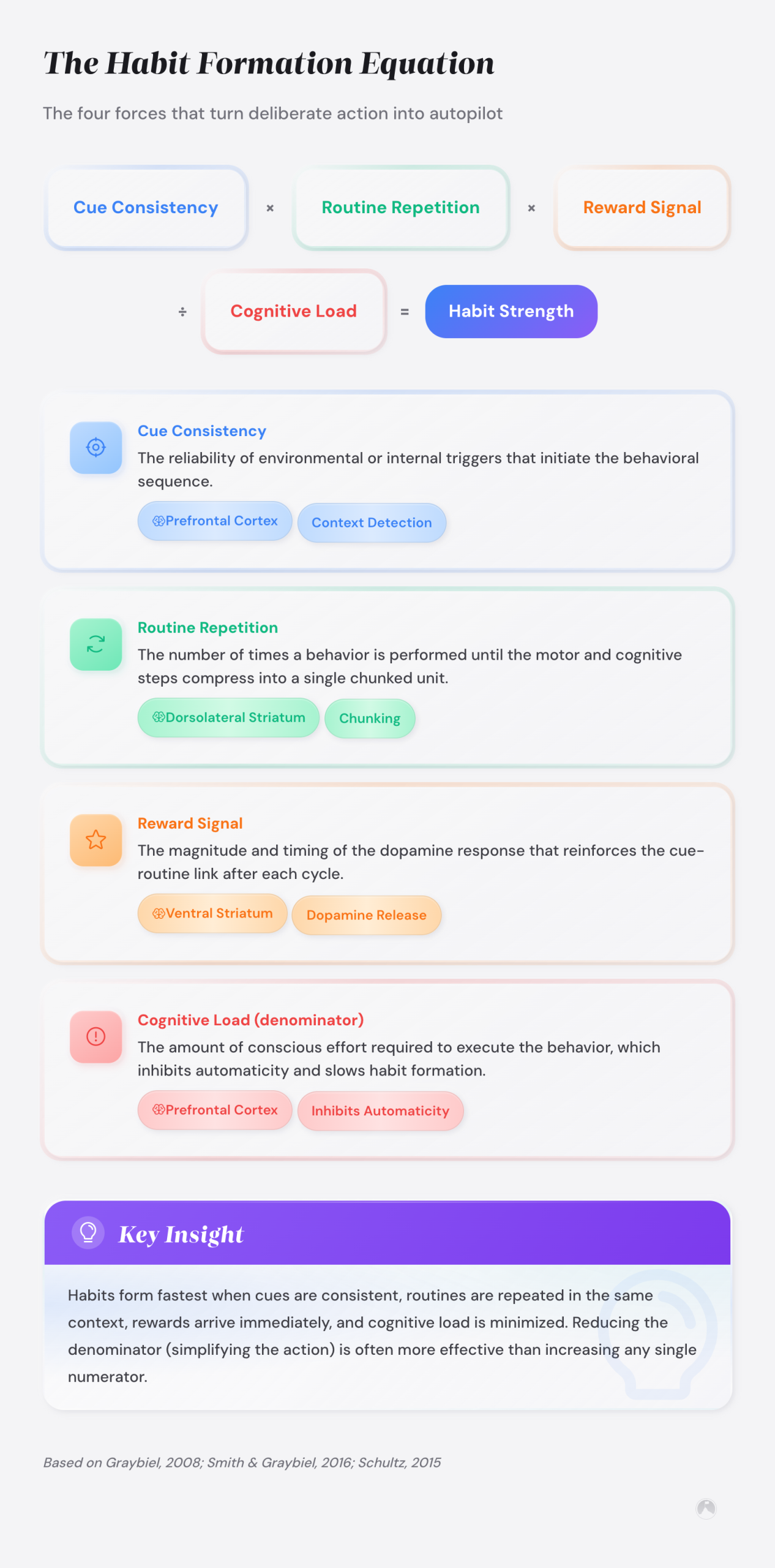
Habit formation is the neurobiological process through which repeated behaviors transition from goal-directed actions controlled by prefrontal cortex circuits to automatic responses encoded in dorsolateral striatum pathways, resulting in stimulus-triggered behaviors that require minimal conscious attention or decision-making effort.
Key takeaways
- The brain shifts habit control from prefrontal cortex to dorsolateral striatum during formation.
- Habit formation timelines vary from 18 to 254 days, with a median of 66 days [6].
- Dopamine functions as a prediction signal, not a reward chemical, in habit development [3].
- The corticostriatal shift explains why habits feel effortless once neural pathways migrate.
- Basal ganglia habit formation depends on both dopamine learning signals and glutamate consolidation [5].
- Stress accelerates habitual behavior by suppressing prefrontal cortex goal-directed activity [4].
- Breaking habits means building competing neural pathways, not deleting existing ones.
- Neuroplasticity and habits interact bidirectionally – repetition shapes brain structure over time.
What happens in your brain when habits form?
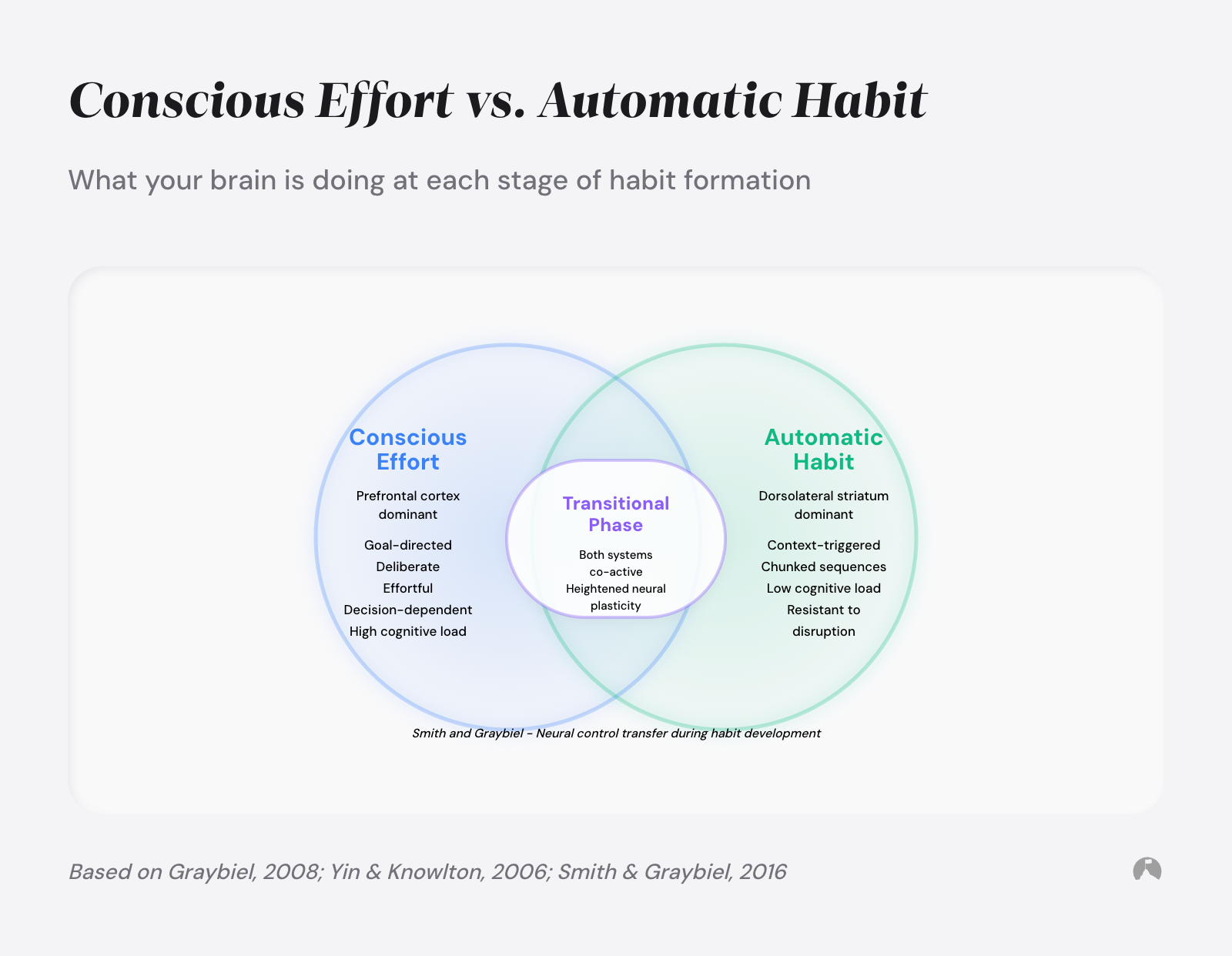
When habits form, your brain transfers behavioral control from the prefrontal cortex (which handles conscious decisions) to the dorsolateral striatum (which stores automatic responses). This corticostriatal shift occurs through repeated practice as neural pathways strengthen, allowing previously deliberate actions to execute without conscious effort.
Your brain operates two distinct control systems for behavior. The goal-directed system, centered in the prefrontal cortex and dorsomedial striatum, handles novel tasks requiring conscious planning. The habitual system, rooted in the dorsolateral striatum and sensorimotor cortex, executes well-practiced behaviors with minimal cognitive effort.
When you first learn a new behavior, your prefrontal cortex drives every decision. You consciously think through each step, weigh outcomes, and adjust your approach. And this deliberate processing consumes significant mental energy.
But with repetition, control gradually transfers to deeper brain structures designed for automatic execution. Neuroscientists call this the corticostriatal shift – the migration of behavioral control from associative cortical regions to sensorimotor circuits. Smith and Graybiel’s research documented how this shift coincides with changes in reinforcement representations within the sensorimotor striatum [2].
“Habit formation coincides with shifts in reinforcement representations in the sensorimotor striatum.”
– Smith, K. S., & Graybiel, A. M., Journal of Neurophysiology (2016) [2]
How basal ganglia coordinate habit formation
The dorsolateral striatum acts as the brain’s habit storage center. Neural patterns encoding specific stimulus-response associations accumulate here through repeated practice. And when environmental cues trigger these stored patterns, the behavior executes automatically – without requiring conscious deliberation from higher brain regions.
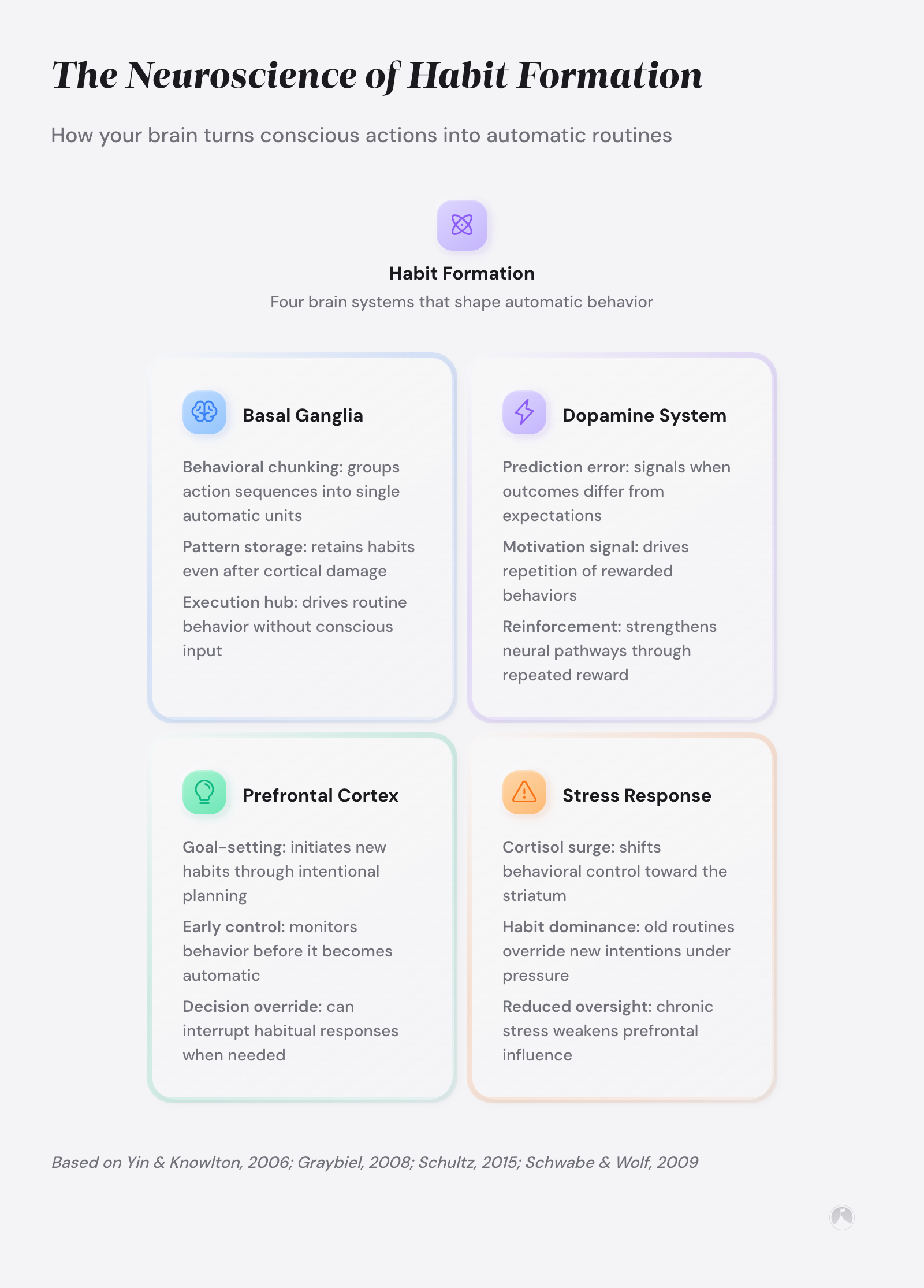
The basal ganglia, the larger structure housing the striatum, coordinate this entire process of basal ganglia habit formation from initial learning through full automaticity [5].
How do neurotransmitters drive the dopamine and habit loops?
Neurotransmitters drive habit loops through two complementary mechanisms: dopamine acts as a teaching signal that strengthens cue-response connections during learning, while glutamate consolidates those connections into lasting structural changes in the dorsolateral striatum. Together, these neurotransmitters transform temporary behavioral patterns into permanent automatic responses.
Dopamine’s role in habit formation contradicts popular understanding. The common belief frames dopamine as a “reward chemical” that makes behaviors feel good. But Wolfram Schultz’s research on reward prediction errors reveals that dopamine functions primarily as a teaching signal that strengthens neural connections between cues and responses [3].
When you perform a behavior and experience an unexpected positive outcome, dopamine neurons fire rapidly. This burst strengthens synaptic connections between the preceding cue and the motor pattern that executed the action [3]. Over time, the cue alone becomes sufficient to trigger the behavior automatically.
Dopamine doesn’t make habits feel rewarding – dopamine makes habits predictable and automatic. Once a behavior becomes fully habitual, dopamine activity actually decreases because the outcome is no longer unexpected. The habit runs on autopilot, requiring no learning signal or conscious motivation to execute. So the popular framing of dopamine and habit loops as reward-driven cycles misses the deeper mechanism entirely.
Glutamate plays an equally important but less publicized role. As Yin and Knowlton described in their review of the basal ganglia’s role in habit formation, this excitatory neurotransmitter consolidates habit memories in the dorsolateral striatum through long-term potentiation [5]. Repeated glutamate signaling between neurons strengthens their connections, cementing the stimulus-response association until it becomes resistant to change.
The brain doesn’t form habits through rewards alone – it cements them through structural neural changes. Dopamine initiates learning and glutamate solidifies the learned pattern into lasting corticostriatal pathways. This two-stage process explains why habits persist long after the original motivation fades.
Research suggests that endocannabinoids may also modulate both systems by regulating synaptic connection strength [5]. These signaling molecules could influence how easily new habits form and how resistant established habits become. For practical approaches to building new behavioral patterns, explore strategies in habit stacking for beginners.
How long does it take for neural pathways to automate habits?
Habit formation timelines range from 18 to 254 days depending on behavior complexity, with a median of 66 days according to Lally et al. (2010). Simple single-step motor habits automate fastest, while complex multi-step behavioral chains require months of consistent repetition before neural pathways consolidate enough for automatic execution.
The widely repeated claim that habits form in 21 days comes from a misinterpretation of 1960s research on cosmetic surgery patients. Modern neuroscience provides more accurate timelines based on actual neural changes.
Phillippa Lally and colleagues tracked 96 participants as they attempted to establish new daily behaviors. The research found habit automaticity timelines ranging from 18 days to 254 days, with a median of 66 days [6]. This massive variability reflects fundamental differences in both the behaviors being learned and individual brain characteristics (the 66-day median masks enormous individual variation).
“It took on average 66 days for participants to reach their asymptote of automaticity, with a range of 18 to 254 days.”
– Lally, P. et al., European Journal of Social Psychology (2010) [6]
| Behavior Type | Example | Approximate Timeline |
|---|---|---|
| Simple motor habit | Drinking water after waking | 18-40 days |
| Moderate behavioral habit | Eating fruit with lunch | 40-80 days |
| Complex behavioral chain | 50 pushups before breakfast | 80-254 days |
Source: Lally et al. (2010) [6]
Simple motor habits like drinking water after waking showed faster automaticity than complex behavioral chains like doing 50 pushups before breakfast. The number of sequential decisions involved in a behavior directly correlates with formation time. Single-step actions automate faster than multi-step routines requiring prefrontal coordination (which explains why drinking water sticks but gym routines don’t).
The formation timeline follows a characteristic curve. Progress accelerates rapidly during the first few weeks as basic neural pathways strengthen through initial repetition. Then progress plateaus as the behavior reaches “good enough” automaticity. Final consolidation into unconscious execution requires additional weeks or months of consistent practice [1].
The brain optimizes for efficiency, not perfection. A behavior becomes “habitual” when it requires significantly less conscious effort than it did initially, even if some attention remains necessary. Habit automaticity represents the endpoint of a continuum rather than a binary threshold you cross at a specific moment.
Missing occasional repetitions during formation doesn’t reset progress to zero. Lally’s research indicates that skipping a single day has minimal impact on trajectory, but missing multiple consecutive days weakens the emerging neural pattern [6]. For practical guidance on maintaining consistency, explore strategies in habit stacking for productivity.
Why do some people form habits faster than others?
Individual variation in habit formation speed stems from structural and neurochemical differences in brain architecture, including striatal volume, dopamine receptor density, and baseline stress levels. These neurological differences explain why identical behaviors can take weeks for one person and months for another to reach automaticity.
Neuroimaging research suggests that individual differences in striatal structure may influence habit formation speed, with people showing larger striatal volume tending to form habits more quickly. Baseline dopamine receptor density also predicts formation speed. Research suggests that individuals with higher D2 receptor concentrations in striatal regions may show accelerated habit learning compared to those with lower receptor availability [3].
Stress dramatically alters the balance between behavioral control systems. Schwabe and Wolf’s research demonstrates that when you experience stress, cortisol suppresses prefrontal cortex activity and amplifies dorsolateral striatum signaling [4]. And this shift makes you more likely to fall back on habitual responses rather than thoughtfully evaluating your actions.
The stress-habit connection explains why established patterns resurface during difficult periods even after months of conscious effort to change them. Your brain defaults to automatic behaviors when cognitive resources for deliberate decision-making become depleted. Recognizing this mechanism helps explain why habits fail under pressure.
Neuroplasticity and habits share a bidirectional relationship – repeated behaviors reshape neural architecture, and existing neural architecture influences how easily new habits form. Research on neuroplasticity suggests that younger brains may have structural advantages for forming new pathways, though the relationship between age and habit formation speed has not been extensively studied in humans. The key factor remains consistency of repetition rather than raw neuroplasticity capacity.
ADHD introduces additional complexity. Dopamine dysregulation in ADHD brains affects both the initial learning signal and the maintenance of established habits.
Castellanos and Proal’s review of large-scale brain systems in ADHD suggests that people with ADHD may require longer formation periods for complex habits given broader striatal-prefrontal network differences, but show similar timelines for simple motor routines [7]. Specialized approaches detailed in habit building for ADHD address these neurological differences.
Can you rewire your brain to break bad habits?
Breaking an established habit requires building new competing neural pathways that override the original response, because the brain cannot delete existing habit circuits stored in the dorsolateral striatum. Successful habit change uses the same neuroplasticity mechanisms that created the original habit – redirecting them to strengthen alternative cue-response associations.
The neural pathways encoding the behavior remain intact in the dorsolateral striatum even after months of disuse. Environmental cues can reactivate these dormant patterns instantly, triggering the automatic response before conscious awareness catches up.
Wood and Neal’s research on habit persistence shows you can’t actually delete habit pathways [8]. Instead, successful habit change involves building new competing pathways that suppress or override the original response.
What researchers call the context disruption effect – a principle drawn from Wood and Neal’s work on habit persistence [8] – explains why changing your environment helps break unwanted habits. The context disruption effect is the phenomenon in which changes to environmental cues weaken existing habit triggers by removing the contextual stimuli that the dorsolateral striatum requires to activate automatic behavioral responses. When environmental cues change, the automatic trigger loses its grip because the brain fails to recognize the situation requiring the habitual response [8]. Moving to a new home, starting a new job, or even rearranging your furniture disrupts cue-behavior associations encoded in existing neural pathways.
Replacement strategies work by building new cue-response associations that compete with existing ones. When you encounter a habit trigger, executing an alternative behavior strengthens the new pathway as the old one weakens from disuse. This approach uses the brain’s competitive plasticity – neural connections that receive consistent use strengthen while unused connections gradually fade.
You can’t fight automatic behaviors with willpower alone – building better automatic behaviors is the only effective override. The neuroplasticity that created the original habit is the same mechanism you use to override it. For systematic approaches to habit modification, how to master habit stacking provides frameworks built on these neurological principles.
How does stress affect the neuroscience of habit formation?
Stress doesn’t just make habit change harder – it fundamentally alters which brain systems control your behavior. Under acute stress, the brain shifts decisively from goal-directed prefrontal cortex control to habitual dorsolateral striatum control [4].
This shift happens through glucocorticoid stress hormones that suppress prefrontal cortex activity and amplify striatal signaling. Your brain deprioritizes flexible decision-making in favor of fast, automatic responses based on past experience. From an evolutionary perspective, this makes sense – survival situations demand immediate action, not careful deliberation.
But this ancient survival mechanism creates problems in modern contexts. When work stress triggers the same neurobiological response as a physical threat, you lose access to the executive functions needed for breaking unwanted habits or establishing new ones. Your brain defaults to whatever automatic patterns exist, regardless of whether they serve your long-term goals.
Chronic stress compounds the problem by keeping the prefrontal cortex perpetually suppressed and maintaining heightened dorsolateral striatum activity. Habitual behaviors become increasingly dominant and goal-directed actions require extraordinary effort – which explains why stressed individuals often report feeling “stuck” in patterns they consciously want to change.
Schwabe and Wolf’s research demonstrates that stress-induced habit dominance can be reversed through targeted interventions that restore prefrontal cortex function [4]. Techniques that reduce stress perception – including exercise, adequate sleep, and habit pairing strategies that minimize decision fatigue – help reestablish the balance between deliberate and automatic behavioral control.
Ramon’s take
Two months of ‘is this even working?’ before anything clicks. That’s the part worth knowing upfront. If you’re on week six and it still feels forced, you’re probably right on schedule, not failing.
When I tried building a morning exercise habit, the neural pathway took forever because it involved multiple decisions: changing clothes, choosing a workout, finding equipment. Compare that to drinking water after waking – one simple action that encoded fast. The research on sequential decisions versus single actions matches my lived experience perfectly.
The stress-habit connection hits home for anyone who has relapsed during difficult periods. Your prefrontal cortex literally goes offline when cortisol floods your system. But knowing this changed how I approach habit formation during busy work periods – I now design habits with the assumption that my executive function will periodically disappear and the behavior needs to survive on autopilot alone.
The biggest insight from the brain science of habits: automatic behaviors encoded in the dorsolateral striatum tend to overpower prefrontal cortex willpower in most situations. You need environmental design and cue manipulation instead of discipline. That’s not weakness – that’s respecting how the brain actually works.
Conclusion
The neuroscience of habit formation reveals why behavior change feels difficult – you’re literally rewiring neural pathways that evolved to resist modification. The corticostriatal shift from prefrontal cortex control to dorsolateral striatum automaticity explains both the power and persistence of habits. Understanding this process removes the moral judgment from habit formation and replaces it with actionable knowledge about dopamine signaling, glutamate consolidation, and the timeline required for neural changes.
Your brain optimizes for energy efficiency through automation. Habits represent that optimization taken to its logical conclusion – behaviors so deeply encoded they execute without conscious involvement. Your brain was never designed to change through force. It was designed to change through repetition.
For strategies that build on these neurological principles, explore the habit formation guide to translate brain science into practical systems.
Next 10 minutes
- Identify one habit you want to build and break it into the smallest possible single action
- Choose an existing environmental cue that already occurs consistently in your daily routine
- Write down the specific context where the new behavior will occur to strengthen the cue-response association
This week
- Track daily execution of your target behavior to monitor consistency without judging missed days
- Notice which contexts make the behavior easier or harder to execute automatically
- Adjust environmental cues to reduce decision points and support autopilot execution
Related articles in this guide
Frequently asked questions
What part of the brain controls habit formation?
The dorsolateral striatum stores fully formed habits, but habit formation involves a distributed network including the infralimbic cortex (which is critical for habit expression) and the cerebellum (which contributes to motor habit timing). The amygdala also plays a role in emotion-driven habits, linking emotional states to automatic behavioral responses. Control transfers through the corticostriatal shift as behaviors move from conscious prefrontal management to automatic striatal execution [2].
How long does it actually take to form a habit according to neuroscience?
Habit formation speed depends on the distinction between habit initiation (when the behavior first becomes easier) and habit strength (when the behavior resists disruption). Lally et al. (2010) found a median of 66 days to reach peak automaticity, but emotional habits tied to strong affective states may form faster than purely behavioral ones [6]. Practical habit tracking during the first 30 days helps identify whether a behavior is on a fast or slow formation trajectory.
What role does dopamine play in habit formation?
Dopamine operates through two distinct receptor pathways during habit learning: D1 receptors in the direct pathway facilitate go signals that reinforce rewarded actions, while D2 receptors in the indirect pathway suppress competing behaviors [3]. This explains why medications affecting dopamine (such as L-DOPA for Parkinson’s) can inadvertently alter habit formation. The distinction between dopamine-driven wanting and opioid-driven liking further clarifies why habits persist even when the behavior is no longer enjoyed.
Can you completely erase a bad habit from your brain?
Neural pathways encoding established habits remain intact in the dorsolateral striatum even after long periods of disuse [8]. You cannot delete habit pathways, but you can build competing pathways that suppress the original response. This requires sustained prefrontal cortex activation to override automatic striatal responses. Environmental changes disrupt cue-behavior associations, making old habits less likely to trigger.
Why do habits resurface during stressful periods?
Stress hormones suppress prefrontal cortex activity and amplify dorsolateral striatum signaling, shifting behavioral control from goal-directed to habitual systems [4]. The shift from goal-directed to habitual control happens rapidly after encountering stressors. Chronic stress maintains this imbalance, making habitual responses dominant and goal-directed actions requiring extraordinary effort. The brain defaults to automatic patterns when cognitive resources for deliberate decision-making become depleted.
Does neuroplasticity affect habit formation speed?
Yes, neuroplasticity directly influences habit formation speed by determining how quickly synaptic connections strengthen between cue and response neurons. Factors including age, sleep quality, and baseline dopamine receptor density all modulate this process. Higher striatal volume correlates with faster habit formation [2]. Consistent repetition can compensate for lower baseline neuroplasticity through persistent synaptic strengthening over extended periods.
What is the corticostriatal shift in habit formation?
The corticostriatal shift is the migration of behavioral control from associative cortical regions to sensorimotor circuits during habit formation, and fMRI neuroimaging has made this shift observable in real time by tracking changes in blood-oxygen-level-dependent signals across brain regions [2]. The shift’s timeline does not perfectly align with behavioral automaticity – neural control can transfer before or after the behavior feels automatic. Notably, the corticostriatal shift can partially reverse when a person deliberately re-engages prefrontal cortex control through intentional focus.
How does habit formation differ in ADHD brains?
ADHD brains show altered habit formation primarily because dopamine signaling irregularities disrupt both the initial learning phase and long-term maintenance of automatic behaviors [7]. People with ADHD may require longer formation periods for complex habits but show comparable timelines for simple motor routines. The prefrontal cortex challenges characteristic of ADHD can paradoxically accelerate the shift to habit-based control for frequently repeated actions, as the brain compensates for executive function demands by automating behaviors sooner.
References
[1] Graybiel, A. M. “Habits, Rituals, and the Evaluative Brain.” Annual Review of Neuroscience, 31, 359-387, 2008. https://doi.org/10.1146/annurev.neuro.29.051605.112851
[2] Smith, K. S., & Graybiel, A. M. “Habit Formation Coincides with Shifts in Reinforcement Representations in the Sensorimotor Striatum.” Journal of Neurophysiology, 115(3), 1487-1498, 2016. https://doi.org/10.1152/jn.00925.2015
[3] Schultz, W. “Neuronal Reward and Decision Signals: From Theories to Data.” Physiological Reviews, 95(3), 853-951, 2015. https://doi.org/10.1152/physrev.00023.2014
[4] Schwabe, L., & Wolf, O. T. “Stress Prompts Habit Behavior in Humans.” Journal of Neuroscience, 29(22), 7191-7198, 2009. https://doi.org/10.1523/JNEUROSCI.0979-09.2009
[5] Yin, H. H., & Knowlton, B. J. “The Role of the Basal Ganglia in Habit Formation.” Nature Reviews Neuroscience, 7(6), 464-476, 2006. https://doi.org/10.1038/nrn1919
[6] Lally, P., van Jaarsveld, C. H. M., Potts, H. W. W., & Wardle, J. “How Are Habits Formed: Modelling Habit Formation in the Real World.” European Journal of Social Psychology, 40(6), 998-1009, 2010. https://doi.org/10.1002/ejsp.674
[7] Castellanos, F. X., & Proal, E. “Large-Scale Brain Systems in ADHD: Beyond the Prefrontal-Striatal Model.” Trends in Cognitive Sciences, 16(1), 17-26, 2012. https://doi.org/10.1016/j.tics.2011.11.007
[8] Wood, W., & Neal, D. T. “A New Look at Habits and the Habit-Goal Interface.” Psychological Review, 114(4), 843-863, 2007. https://doi.org/10.1037/0033-295X.114.4.843