
Your network is silently making or breaking your career
Here’s the thing about career success: it depends less on what you can do than on who knows what you can do. According to Aptitude Research, 84% of companies use employee referral programs as part of their hiring strategy [6]. Yet a relatively small fraction of positions are ultimately filled through public job boards.
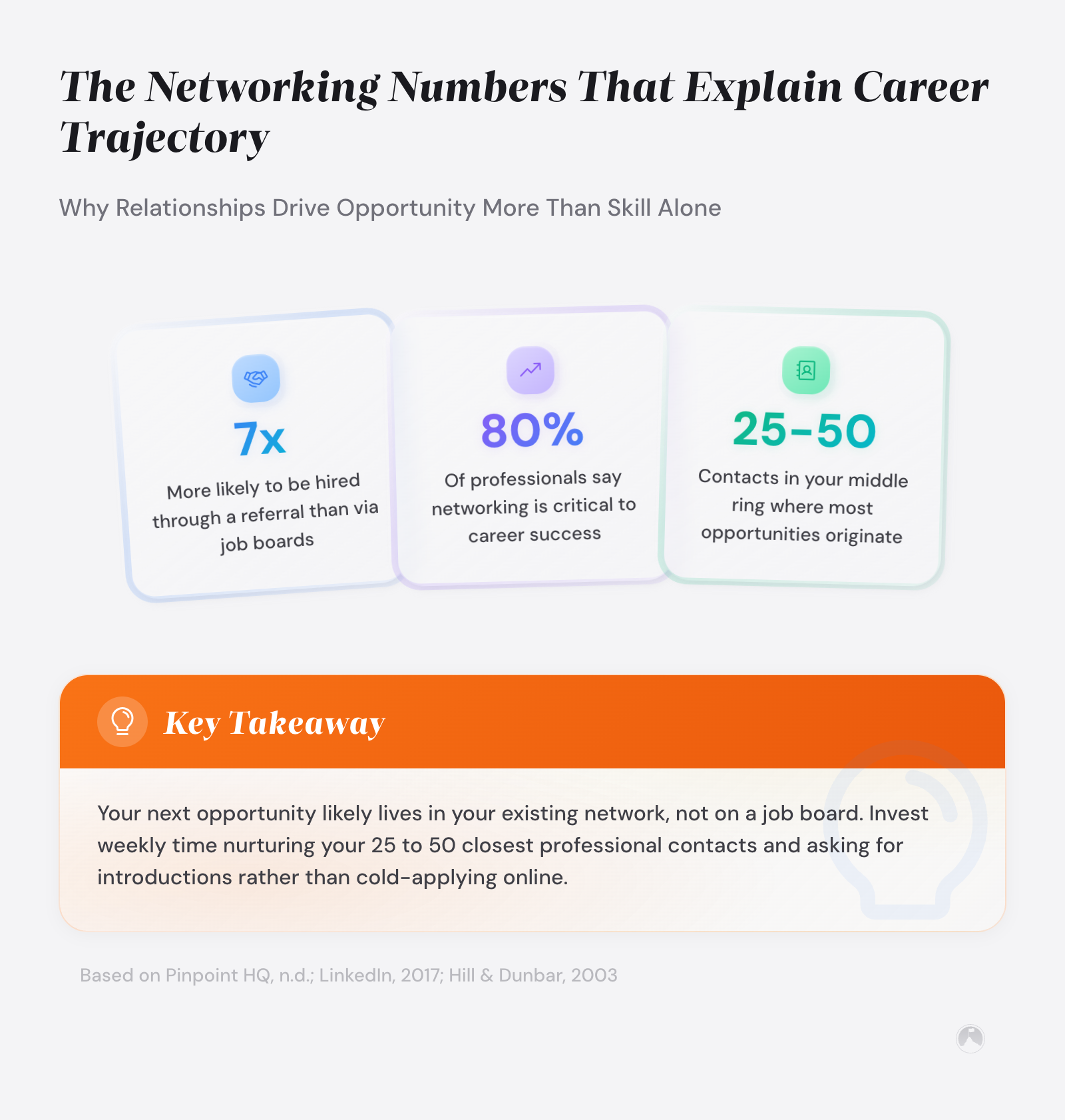
A Pinpoint HQ analysis of 4.5 million applications found that referral candidates are seven times more likely to be hired than applicants competing on a public board [1]. If that statistic made you anxious, this article is for you. Effective networking for career growth doesn’t require being the life of the party or using manipulative tactics. It requires a system.
Networking for career growth means building and maintaining mutually beneficial professional relationships that create opportunities for advancement, mentorship, referrals, and visibility in your industry without requiring constant effort or self-promotion.
What you will learn
- The three-tier network model that matches how career opportunities actually flow
- How to identify and nurture your inner circle of five to ten close professional allies
- Specific professional networking strategies for building your middle ring where most opportunities appear
- Why weak ties open doors your strong relationships never will
- How to network effectively as an introvert, remote worker, or recent career changer
Key takeaways
- Most opportunities flow through your middle tier (25-50 people), not deep friendships or random connections.
- The three-tier network model separates maintenance into sustainable, role-specific practices for each tier.
- Referral candidates are 7x more likely to be hired than job board applicants, per Pinpoint HQ data [1].
- The three-tier model replaces vague “networking” with depth-matched relationships: listen first and offer value before asking anything of inner circle or middle ring contacts.
- LinkedIn serves three distinct roles by tier: congratulating inner circle wins, staying visible to middle ring contacts, and low-effort maintenance for weak ties.
- Maintaining professional relationships requires consistent touchpoints matched to depth, not one-time effort.
- Networking for introverts works best through one-on-one conversations and digital relationship maintenance.
Networking for career growth starts with the three-tier model
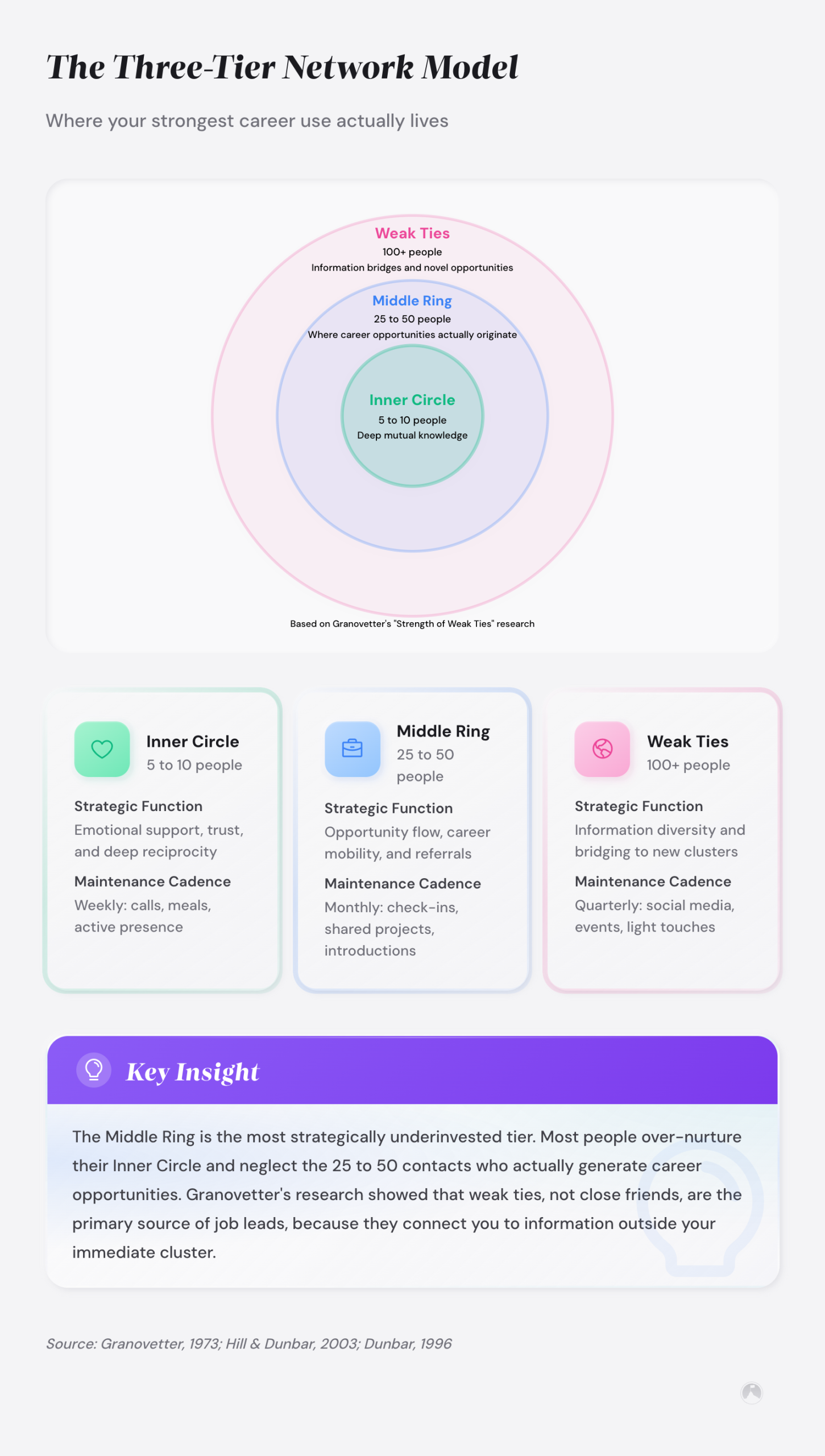
Your professional network isn’t one thing. Each network tier serves different functions and requires different maintenance strategies. Most professionals have a decent inner circle but an almost empty middle ring — exactly where career opportunities actually flow.
What we call the three-tier network divides your relationships into inner circle (roughly 5-10 people), middle ring (approximately 25-50 people), and outer ring (weak ties and newer contacts).
Inner circle relationships are maintained through regular substantial contact. Middle ring relationships get quarterly check-ins and event-based interaction. And outer ring relationships survive on occasional LinkedIn activity and strategic outreach when opportunities match.
The three-tier network model is our synthesis of Robin Dunbar’s relationship layers [4] and Mark Granovetter’s weak ties research [2], organized into a practical career networking framework.
The three-tier network model (our framing) organizes professional relationships into three maintenance layers — inner circle (5-10 close allies contacted monthly), middle ring (25-50 professional contacts reached quarterly), and weak ties (acquaintances maintained through occasional touchpoints) — drawing on Dunbar’s relationship layers [4] and Granovetter’s weak ties research [2] to match networking effort to natural relationship limits.
| Tier | Size | Contact Frequency | Opportunity Type |
|---|---|---|---|
| Inner Circle | 5-10 people | Monthly (30 min) | Deep referrals, mentorship, sponsorship |
| Middle Ring | 25-50 people | Quarterly | Job leads, introductions, project opportunities |
| Weak Ties | 100+ people | Occasional | Novel information, cross-industry opportunities |
As sociologist Mark Granovetter argued in his foundational 1973 research, strong ties provide emotional support and validation, but weak ties provide novel information and opportunity access [2]. Your close friends probably know the same people. Your acquaintances in adjacent fields encounter opportunities outside your immediate circle and think to recommend you.
A 2017 LinkedIn survey found that 80% of professionals consider networking important to career success, yet only 48% actually maintain their network when things are going well [3]. The networking maintenance gap exists since professionals try to maintain hundreds of connections at the wrong depth, burning out after a few months.
Networking is just one piece of a broader career growth strategy, and the three-tier model keeps it from becoming the piece that burns you out.
The problem isn’t that people don’t network. It’s that they network at the wrong depth with the wrong people.
Building your inner circle: the five to ten people who know your work
Your inner circle consists of people who deeply understand your capabilities, values, and career direction — the people who would recommend you without hesitation and know enough detail to do it credibly.
Inner circle consists of five to ten professionals who understand your capabilities, values, and career direction well enough to recommend you without hesitation or briefing — distinct from personal friends or casual work acquaintances.
Anthropologist Robin Dunbar’s research suggests most people can sustain deep, regular contact with approximately five to ten close relationships [4]. Your inner circle typically includes current colleagues you trust, mentors, previous managers who saw your work firsthand, or peers who respect your expertise.
Inner circle relationships require substantial, consistent contact — they’re the foundation of your professional credibility. These relationships survive on regular conversation (monthly or more frequent), genuine mutual support, and willingness to ask for help.
When you need something from your inner circle — a referral, mentorship, or introduction — you shouldn’t need to explain your background. A solid career development plan can help you identify which relationships to prioritize.
To build your inner circle, start by identifying people in your current and past roles who observed your work directly. Then add one or two mentors outside your organization who see your broader trajectory. The key criterion: would they feel comfortable vouching for you in a specific way (not just a vague “great person to work with”).
Dunbar’s research on relationship tiers shows humans naturally organize social connections into nested layers — roughly 5 intimates, 15 close friends, 50 good friends, and 150 general contacts [4]. Your networking strategy should work with these natural limits, not against them.
For instance, a monthly check-in with a former manager might look like: January, you ask about a reorganization at their company. February, you share a relevant article and ask for their take. March, they mention a VP opening and offer to introduce you to the hiring director. Three conversations, thirty minutes each, and you have a warm introduction you would never have found on a job board.
Maintenance for inner circle relationships requires roughly 30 minutes monthly per person — enough time for one substantial conversation about work, a project they’re struggling with, or progress toward a goal.
Thirty minutes of substantial monthly conversation beats surface-level contact with dozens of people — these relationships compound. The person who knows your work deeply becomes a mentor, then a sponsor (someone who advocates for you in rooms you’re not in), then a collaborator on future projects.
Five deep relationships will do more for your career than 500 shallow ones.
Developing your middle ring: where career opportunities actually live
Most career growth happens through people you don’t know intimately. Your middle ring consists of approximately 25-50 people you know through work, industry events, or online communities [5]. You have had substantive conversations with middle-ring contacts but don’t maintain frequent contact.
Middle ring includes approximately 25-50 professional contacts you know through work, industry events, or communities — people you have had substantive conversations with but do not maintain frequent contact with, and where most career opportunities originate.
Middle-ring contacts work at different companies and encounter needs outside your direct circle. When a project opens up or someone in their network mentions a need your skills address, they think of you — but only if you’ve stayed visible. Seeing how networking fits into broader career advancement strategies helps you see why the middle ring deserves attention.
Build your middle ring through three professional networking strategies: professional associations, LinkedIn strategic connection, and informational interviews. Professional associations put you in repeated contact with people pursuing similar career paths. LinkedIn allows you to identify people at target companies or in adjacent specialties.
And informational interviews let you deepen relationships beyond surface connection.
Maintaining professional relationships in your middle ring typically requires quarterly contact — a lunch or coffee meeting, a video call, or a thoughtful LinkedIn message commenting on something they’ve shared. The contact doesn’t need to be long, but it should be specific.
Generic “let’s grab coffee sometime” messages don’t create memory. A specific comment on a recent article they shared or a question about a project they’re working on — that’s what keeps the relationship alive.
A quarterly middle-ring message works when it is specific: “I noticed your team launched the new product dashboard — the data visualization choices were really sharp. How has adoption been going?” That message takes two minutes to write but keeps you visible in a way that “Let’s catch up sometime” never will.
Your middle ring is your career’s hidden engine. Feed it or watch it stall.
Expanding your weak ties: why acquaintances matter more than you think
Weak-tie relationships might feel less valuable than deep friendships, but Granovetter’s research shows weak ties are where novel opportunities appear [2]. Strong ties know what you know. Weak ties know things your strong circle has never encountered.
Weak ties are professional acquaintances you know superficially — former classmates, one-time conference contacts, or online community members — who provide access to novel information and opportunities outside your immediate network, as described in Granovetter’s 1973 research [2].
Weak ties feel less transactional — they come with no expectation of frequent contact. You can maintain hundreds of weak-tie relationships with minimal effort: occasional LinkedIn networking through post interaction, a message when something relevant appears, or a reconnection conversation when a real opportunity shows up.
The person who’s been your acquaintance for five years doesn’t feel offended if you reach out about a specific opportunity. Low-expectation contact is the strength of weak ties (and one reason introverts tend to underestimate them).
Expand weak ties through online communities, alumni networks, industry conferences, and reconnection outreach. Online communities — Slack groups, Reddit communities, Discord servers — let you meet dozens of people casually without geographic constraints.
Alumni networks maintain dormant connections automatically. Reconnection outreach (reaching out to former colleagues or classmates you’ve lost touch with) activates weak ties that already exist.
Consider a former classmate you have not spoken to in three years. They post about a challenge in supply chain analytics, and you comment with a question about their approach. Six months later, they remember you when a recruiter asks if they know anyone with your skill set. The entire “maintenance” cost was one thoughtful comment.
Maintenance for weak ties is minimal: reply to their LinkedIn posts occasionally, send a message when something relevant appears, or reach out when a real opportunity comes up. You need strategic touchpoints and willingness to invest when a genuine connection emerges.
The person who changes your career trajectory is probably your best acquaintance, not your best friend.
Overcoming the specific barriers to networking success
The most common obstacles to networking are specific psychological barriers that show up as procrastination or avoidance. Knowing your barrier helps you choose the right tactic.
For the introvert: shift from events to one-on-one
The introvert networking myth says you need to “work the room” at events. Most career networking doesn’t happen at large events — it happens through one-on-one conversations.
Many introverts find that one-on-one conversations play to their strengths — deeper listening and genuine curiosity come more naturally in focused settings.
Networking for introverts means skipping most large networking events and attending industry conferences with structured sessions, where you can connect with people around a shared topic. Initiate one-on-one coffee meetings instead of trying to work a room. Ask other people questions about their work and listen more than you talk.
For the remote worker: use async communication and video calls
Remote work creates a distinct networking challenge: less accidental contact with colleagues and no geographic proximity to industry events. But remote work creates an advantage if you’re intentional — you can build relationships across regions and connect through online communities instead of only local groups.
Use LinkedIn strategically as your primary connection channel. Participate in online communities and Slack groups relevant to your field. Suggest video calls instead of coffee meetings (often easier to schedule).
When you attend in-person events, prioritize them — the effort is worth the deeper connections. For more targeted guidance, our piece on career growth for remote workers covers this in depth.
For the recent career changer: use informational interviews
Changing careers means rebuilding your middle ring in a new field with fewer established relationships. If you’re working through this shift, our guide on career change anxiety solutions covers the emotional side. Relationship building for career success starts with authentic interest in what other people are doing, and career changers already have that baked in.
Informational interview is a structured conversation where you ask someone established in a career path you are considering about their experience, the skills that matter, and how they navigated their trajectory — a relationship-building tool, not a job request.
An informational interview means asking someone five to ten years into a career you’re considering: “Can I buy you coffee and ask you a few questions about how you got to where you are?” Most people say yes. In that conversation, you learn about the transition and the skills that matter most, and you let them see your genuine preparation.
The best networkers aren’t the most outgoing. They’re the most curious.
Ramon’s take
Reading this made me realize I’ve been ghost-maintaining most of my middle tier for years. A quick reply here, a like there. I don’t actually know if that counts. Does staying loosely visible even work, or does it just feel like effort?
Now I keep a short list of ten people I check in with every month, not because I need something, but because I want to know what they are building. When opportunities come up, they come from people who already know my work.
Conclusion
Networking for career growth works best as a three-tiered system — inner circle contacts who know your work deeply, a middle ring where opportunities emerge, and weak ties that expose you to possibilities outside your immediate world. Each tier requires different maintenance strategies, all less demanding than the constant “networking” people imagine.
You already have relationships that could form your network. Your job is to be intentional about deepening the right ones through consistent, genuine contact. The real question is whether you’re willing to do it the way that actually works.
Next 10 minutes
- Write down the five to ten people who understand your work and career direction well enough to recommend you without hesitation. That’s your inner circle.
- Pick one person from that list and schedule a 30-minute conversation in the next two weeks.
This week
- Send one middle-ring contact a specific, personal message about something they recently shared or accomplished.
- Join or more actively participate in one professional community or industry group relevant to your field.
There is more to explore
For deeper strategies on building your professional foundation, explore our guides on career planning tools and frameworks, skill development strategies, salary negotiation strategies, and personal growth.
Related articles in this guide
- planning-for-long-term-career-transitions
- strategic-career-planning-frameworks
- career-advancement-strategies-compared
Frequently asked questions
Why is networking so important for career growth?
Referral hires tend to stay at companies longer and ramp up faster than candidates sourced through job boards, which means networking creates compounding career value beyond the initial hire [1]. Over a 10-year career span, a well-maintained professional network surfaces opportunities from the hidden job market — roles filled before they are ever publicly posted. Most career progress comes through relationships, not applications.
How do I build professional relationships without feeling transactional?
Focus on genuine curiosity about other people’s work and progress before asking for anything. Ask thoughtful questions, remember details they share, and look for ways to offer value first – an introduction to someone useful to them, sharing relevant information about their industry, or congratulating them on visible wins. Transactional feelings disappear when relationships are built on consistent genuine contact rather than sudden requests from someone who hasn’t checked in for two years.
Can introverts be effective networkers?
Yes, and introverts often have a built-in advantage. The pre-event research tactic works well: before attending any conference or meetup, identify two or three specific people to connect with and prepare a question for each. Platforms like Lunchclub or industry-specific Slack communities allow introverts to build relationships asynchronously, without the energy drain of large-group events.
How often should I reach out to people in my professional network?
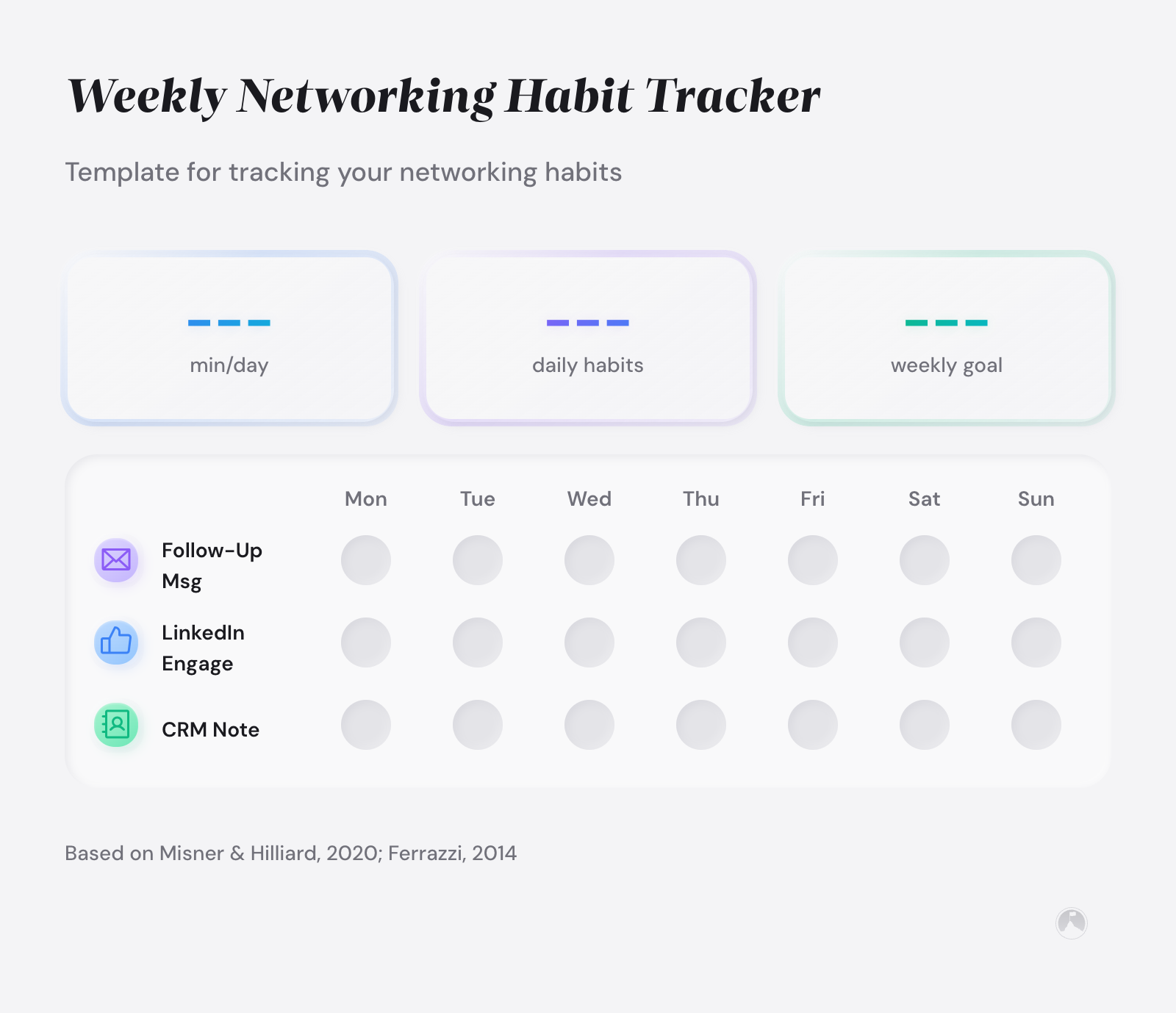
Watch for red flags at either extreme. Over-contacting looks like every message requiring a response or feeling like an obligation. Under-contacting looks like learning about a contact’s major career change from their LinkedIn feed rather than a direct conversation. A simple tracking approach — a spreadsheet or CRM noting last contact date by tier — keeps frequency aligned without guesswork.
What should I say when reaching out to someone new?
Lead with genuine curiosity about their work. Ask what they’re building, what problems they’re solving, or how they got into their current role. Listen more than you talk. Mention a specific reason you wanted to connect (you read something they wrote, someone recommended you talk, or you share an interest in a topic). Follow up within a week with something specific from the conversation.
How do I maintain my network when I am busy?
Batch processing is the most effective efficiency tactic: block 15 minutes each week for a LinkedIn comment session where you engage with posts from middle-ring and weak-tie contacts. Apply the two-minute rule — if a relationship touchpoint takes less than two minutes (a congratulations message, a shared article), do it immediately rather than adding it to a list you will never revisit.
How does LinkedIn fit into a networking strategy?
LinkedIn serves different purposes for different network tiers. For inner circle, use it as a way to see career updates and congratulate wins. For middle ring, use it to stay visible through thoughtful comments on their posts and to find reasons to reconnect. For weak ties, LinkedIn is your primary maintenance tool – commenting on their content occasionally keeps you present in their awareness without requiring direct contact. For all tiers, use LinkedIn to identify and connect with new people in roles or companies you’re interested in.
What is the difference between networking and relationship building?
Networking often implies collecting connections and calling in favors. Relationship building implies genuine mutual interest, consistent contact, and willingness to help without immediate expectation of return. The three-tier network model is actually a relationship-building approach that happens to create networking opportunities as a byproduct of authentic relationships.
References
[1] Pinpoint HQ. “Referrals are 7x more likely to be hired than job board candidates.” Pinpoint HQ Insights, https://www.pinpointhq.com/insights/referrals-are-7x-more-likely-to-be-hired-than-job-board-candidates/
[2] Granovetter, Mark S. “The Strength of Weak Ties.” American Journal of Sociology, vol. 78, no. 6, May 1973, pp. 1360-1380. https://doi.org/10.1086/225469
[3] LinkedIn. “Eighty Percent of Professionals Consider Networking Important to Career Success.” LinkedIn News, June 2017, https://news.linkedin.com/2017/6/eighty-percent-of-professionals-consider-networking-important-to-career-success
[4] Dunbar, Robin. Grooming, Gossip, and the Evolution of Language. Harvard University Press, 1996. ISBN: 978-0-674-36336-6.
[5] Hill, Russell, and Robin Dunbar. “Social Network Size in Humans.” Human Nature, vol. 14, no. 1, 2003, pp. 53-72. https://doi.org/10.1007/s12110-003-1016-y
[6] Laurano, Madeline. “Solving the Sourcing Challenge: Leaning into Referrals to Drive Improved Hiring Outcomes.” Aptitude Research, 2022.