
Why your progress in one area always seems to cost you another
You pour energy into your career for three months. Your fitness drops. Your relationships thin out.
So you pivot – hit the gym, reconnect with friends – and your professional momentum stalls. The cycle repeats.
Multi-domain personal development is the practice of coordinating life domains – career, health, relationships, learning, creativity – so that progress in one area doesn’t come at the cost of another. Research on psychological wellbeing by Carol Ryff found that balanced functioning across multiple dimensions – including personal growth, purpose, and positive relationships – predicts overall flourishing more reliably than excelling in any single dimension [1]. The question isn’t whether to pursue growth in more than one area. It’s how to do it without the exhausting whiplash of constant pivoting.
Multi-domain personal development is the planned coordination of growth activities across multiple life areas – career, health, relationships, learning, creativity – using a structured rotation system that prevents any single domain from monopolizing attention and energy.
What you will learn
- Why single-domain focus backfires even when it feels productive
- The Domain Rotation Protocol – a weekly system for balanced personal development
- How to map your personal development domains and spot hidden conflicts
- What breaks most multi-domain plans and how to prevent it
Key takeaways
- Balanced functioning across multiple life dimensions predicts wellbeing more reliably than depth in any single area [1].
- Goals in different domains can reinforce each other or create conflicts – coordinating life domains prevents depletion [2].
- The Domain Rotation Protocol assigns one active and two maintenance domains per week to prevent whiplash.
- Domain mapping reveals reinforcements (exercise boosts work focus) and conflicts (overtime erodes relationships).
Why does single-domain focus backfire?
Most personal development advice tells you to focus on one thing at a time. Pick your biggest goal, pour yourself into it, then move to the next. The advice sounds reasonable. But real life doesn’t pause the domains you’re ignoring.
Goal systems theory, developed by Arie Kruglanski and colleagues, shows that goals in different life areas form a dynamic system [2]. Some goals complement each other – health supports career energy. Others conflict directly, where work time competes with family time.
Leaving these interactions unmanaged leads to resource depletion. So you don’t get the benefit of reinforcement, and you pay the full cost of conflict.
Single-domain focus creates the illusion of progress by hiding the costs accumulating in every other area of life. Your quarterly performance review looks great. But your back hurts, your friendships have gone quiet, and you haven’t read a book in months.
Research on self-regulation suggests that pursuing multiple goals simultaneously draws from limited cognitive and motivational resources [3], though the exact mechanism remains debated following large-scale replication studies. When you try to push hard on everything at once, performance deteriorates across the board.
And this is exactly why balanced personal development matters. Research on psychological wellbeing confirms that breadth of engagement across life dimensions predicts flourishing more strongly than depth in any single dimension [1]. So “go all in on one thing” works for short sprints. As a long-term personal development strategy, it’s a recipe for lopsided living.
How do you map your development domains?
Before coordinating growth, you need to know what you’re coordinating. Most people operate with vague intentions to “work on health” or “get better at networking.” That vagueness is where multi-domain plans die before they start.
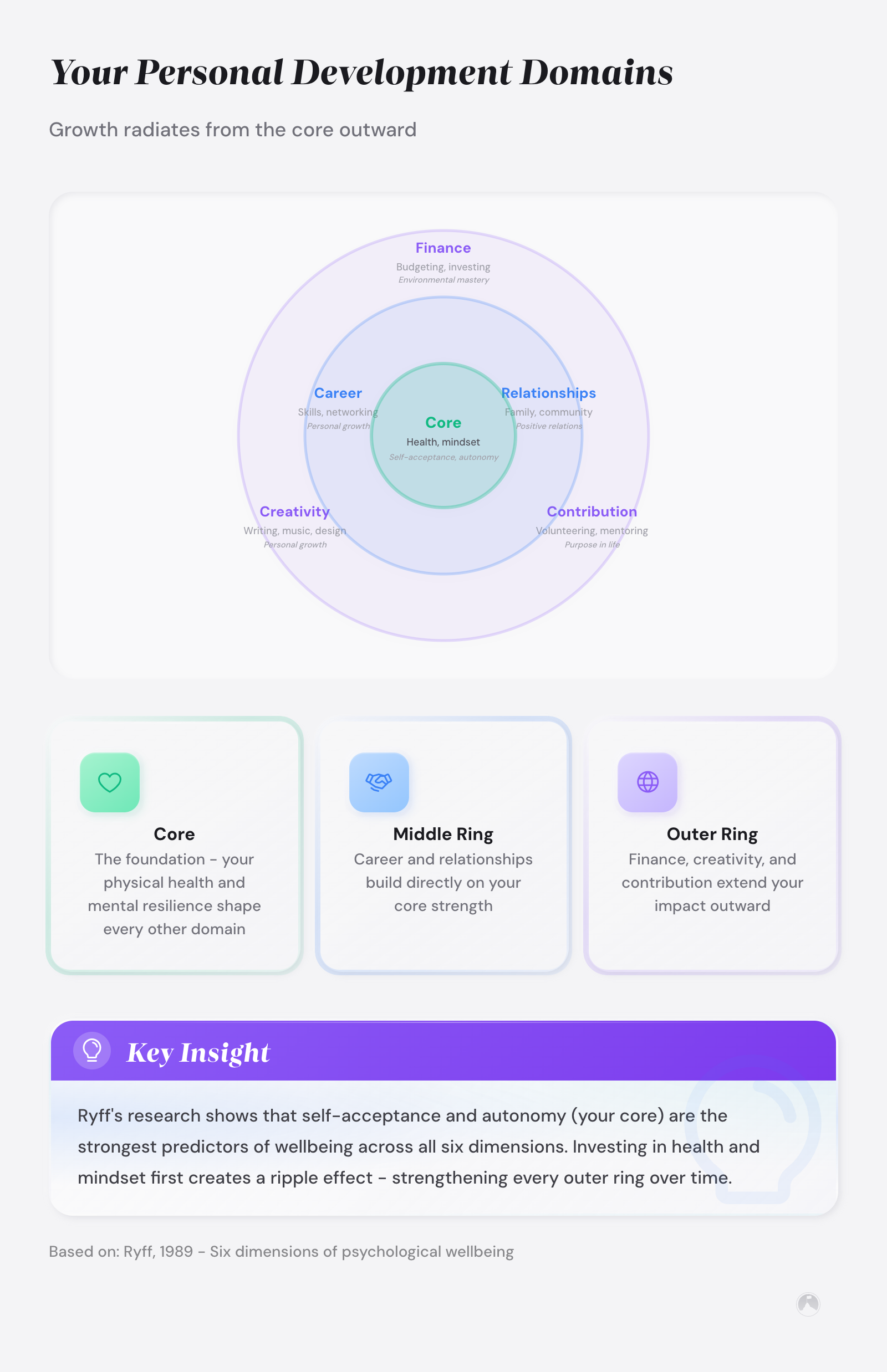
Start by listing your active development domains. We recommend keeping your list to five domains maximum. Research on wellbeing assessment scales has tested systems ranging from three to ten life domains, and consistently finds that fewer than three categories misses important areas and more than five or six creates cognitive overload that makes tracking impractical [4]. Three to five primary domains works for most people developing across multiple areas.
Once you have your domains listed, map the relationships between them using what we call the Reinforcement-Conflict Matrix. This is where the real value shows up.
| Domain pair | Relationship | Example |
|---|---|---|
| Health + Career | Reinforcing | Regular exercise improves cognitive performance and work output |
| Career + Relationships | Conflict | Overtime hours directly reduce time with family and friends |
| Learning + Career | Reinforcing | New skills feed back into professional capability |
| Creativity + Health | Neutral | These domains rarely compete for the same resources |
| Relationships + Learning | Mixed | Study groups reinforce; solo study competes with social time |
The value of domain mapping isn’t the map itself – it’s seeing the conflicts you’ve been pretending don’t exist.
Research on simultaneous goal pursuit by Maria Louro and colleagues found that understanding which goals reinforce versus compete improved effort allocation across multiple objectives [5]. Domain mapping turns vague good intentions into a coordination plan with actual structure. Reinforcing domains can be developed in parallel. But conflicting domains need explicit time boundaries.
Greenhaus and Beutell’s foundational research on work-family conflict identifies three conflict mechanisms: time competition (hours spent at work reduce hours with family), psychological strain (work stress reduces emotional availability), and behavioral incompatibility (work mode and family mode activate different social skills) [6]. Some conflicts are time-based and can be resolved through combined activities. But others are strain-based and need explicit recovery boundaries.
According to Kruglanski and colleagues, goal systems theory describes how multiple goals form a dynamic system where some support each other while others compete for the same limited resources [2].
If you want a structured way to think through your domains, building a personal development plan gives you a framework for turning this map into weekly actions.
The Domain Rotation Protocol for multi-domain personal development
Knowing your domains and their relationships gives you the map. We call the next step the Domain Rotation Protocol – a weekly rotation structure built on goal systems research that turns domain awareness into action. The core insight comes from research by Brodscholl, Kober, and Higgins on self-regulation strategies, which found that attainment goals (moving toward a desired state) and maintenance goals (keeping a valued state stable) require fundamentally different psychological strategies [7]. Attempting both simultaneously reduces the effectiveness of each.
So here’s how it works in three steps.
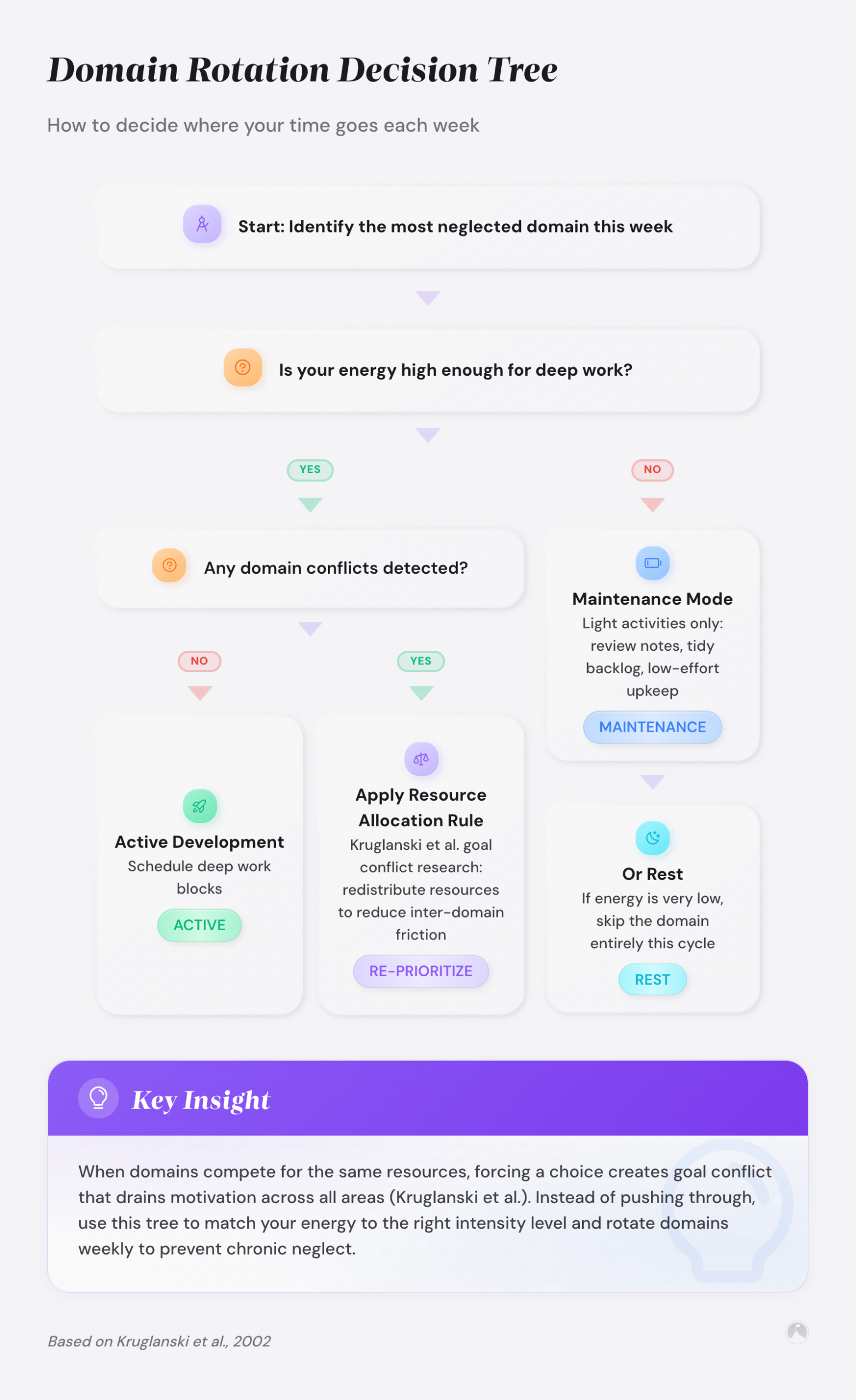
Step 1: assign intensity levels each week
Every week, assign each domain one of three levels:
| Level | Weekly time | Goal |
|---|---|---|
| Active | 4-6 hours | Push for measurable progress |
| Maintenance | 1-2 hours | Hold current level, prevent decay |
| Rest | 0 hours | Intentional pause |
You get one active domain per week. Two domains at maintenance. The remaining domains rest. The constraint is the system – not a limitation of it.
This structure applies the attainment-versus-maintenance research directly: one domain gets promotion-focused effort and others receive prevention-focused upkeep [7].
Step 2: rotate the active domain
Every one to two weeks, shift which domain is active. A five-domain rotation might look like: Career (active) week 1, Health (active) week 2, Relationships (active) week 3, Learning (active) week 4, Creativity (active) week 5. Then repeat.
The rotation prevents any single domain from going more than four weeks without active attention. And that timing matters. Research on domain satisfaction changes shows that neglected domains don’t freeze in place – satisfaction tends to decline over time when domains receive zero attention [8]. The rotation cycle is calibrated to prevent that drift.
If you’re working toward a personal growth goal with a deadline, you can double up – keep one domain active for two consecutive weeks. But don’t stretch to three. That’s when other domains start decaying.
Step 3: match activities to energy patterns
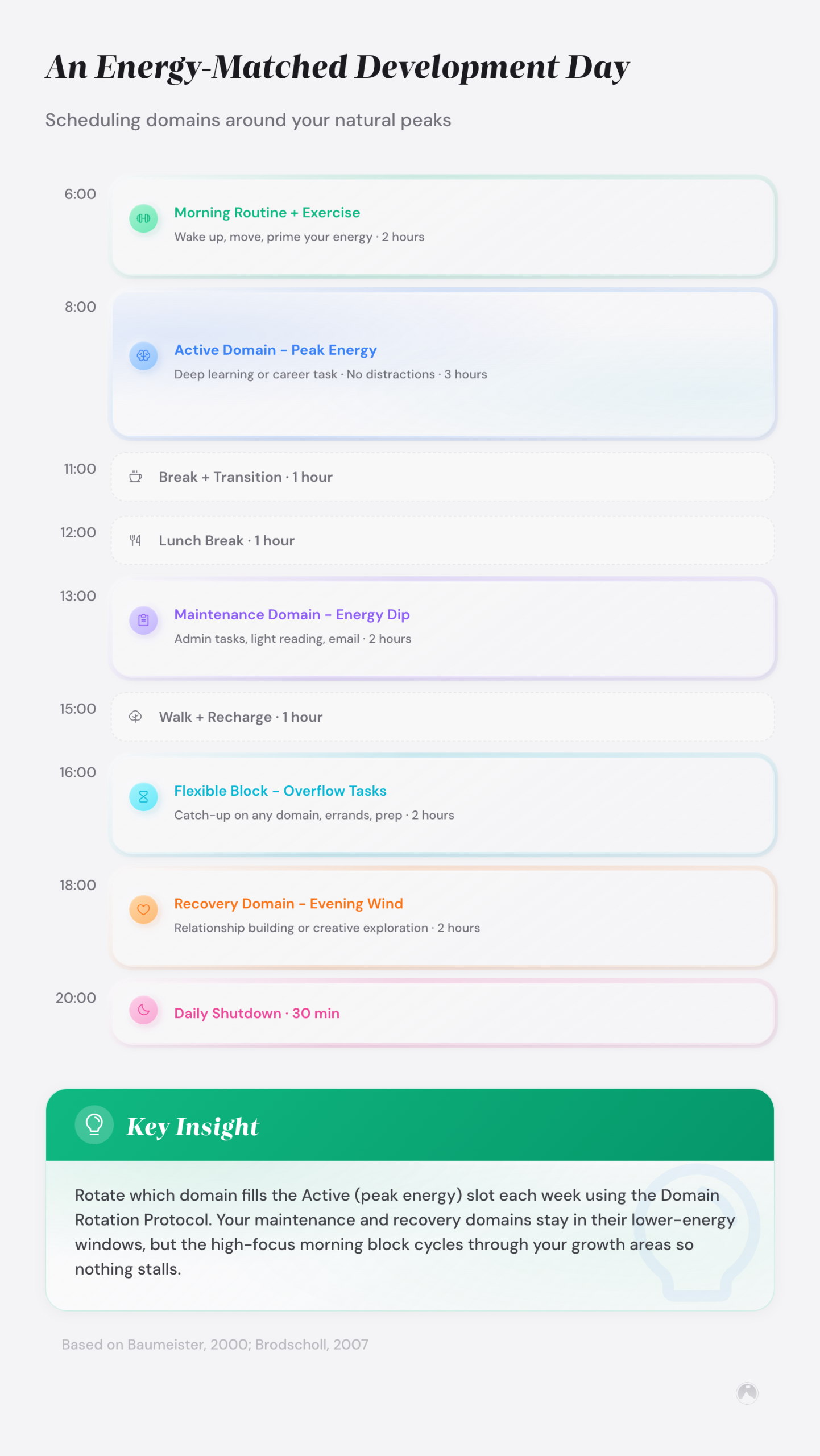
A common mistake is treating all development activities as equal. Reading a book for 30 minutes doesn’t cost the same energy as attending a networking event for 30 minutes. The Domain Rotation Protocol works best when you match activity intensity to your energy patterns throughout the day.
Personal growth without burnout depends on scheduling high-demand activities during high-energy windows, not cramming them into whatever time is left. Schedule learning activities during quiet focus hours. Schedule relationship maintenance – phone calls, lunch – during mid-day when social energy peaks. Leave evenings for recovery and low-demand domains like creative work or reading.
Brodscholl, Kober, and Higgins found that goal attainment calls for eager approach strategies, whereas goal maintenance calls for vigilant avoidance strategies [7]. Matching your energy to the type of goal you’re pursuing in each domain amplifies the effectiveness of the rotation.
What breaks most multi-domain plans?
The Domain Rotation Protocol is clean on paper. In practice, three failure modes account for most breakdowns when developing across multiple areas.
Failure 1: overloading the active domain
When career is your active domain, you’re tempted to cram in everything – courses, networking, side projects, extra hours. But 4-6 hours of active development per week is the ceiling. And going beyond it steals energy from maintenance domains – maintenance is what keeps the system intact.
The fix: define your active domain’s weekly deliverable before the week starts. One measurable outcome. Not a list of activities.
Failure 2: treating maintenance as optional
Maintenance looks small – one workout, one phone call, twenty minutes of reading. But those small actions prevent decay. Skip maintenance for two rotation cycles and you’ll find yourself starting over in that domain instead of picking up where you left off. Research on domain satisfaction supports this: domains receiving zero attention tend to decline over time [8].
Maintenance is what separates a rotation system from a neglect system. The fix: schedule maintenance activities first. They’re non-negotiable. Active domain activities fill whatever time remains.
Failure 3: ignoring domain conflicts
If your career demands networking events three evenings a week, your relationship domain will suffer no matter how carefully you’ve planned. Domain conflicts need direct resolution – not wishful thinking that you’ll “make it work.”
The fix: when two domains conflict, use your Reinforcement-Conflict Matrix to find a combined activity. Exercise with a friend covers health and relationships. Learning to set boundaries for personal time protects space for other domains. And a personal mission statement clarifies which domains deserve priority when conflicts can’t be resolved through combination.
Ramon’s take
My maintenance domains have historically been a graveyard with a nice label on it. Reading this made me realize I’ve been calling ‘not actively quitting’ a strategy. Is that what everyone else is doing too?
Coordination beats intensity
Multi-domain personal development isn’t about doing more. It’s about coordinating what you’re already trying to do so the pieces stop competing with each other. The Domain Rotation Protocol gives you the structure for career and health development alongside relationships and learning: one active domain, two on maintenance, the rest at rest. That’s personal growth without burnout built into the system itself.
Map reinforcements and conflicts between your domains. Schedule around energy, not around available time. Protect maintenance like it matters – that’s what keeps your progress from evaporating the moment you shift attention.
Next 10 minutes
- List your 3-5 active development domains on paper or in a note.
- For each pair of domains, write R (reinforcing), C (conflict), or N (neutral) next to them.
This week
- Choose one domain as your active domain for this week and define a single measurable deliverable.
- Schedule one maintenance activity for each of your two maintenance domains.
There is more to explore
- Personal development strategies – The full framework for choosing and executing your growth approach
- GROW framework guide – A step-by-step method for setting goals within individual domains
- Personal development burnout – How to recognize when rotation isn’t enough and you need to stop entirely
Related articles in this guide
- personal-development-books-that-changed-lives
- personal-development-burnout
- personal-development-for-remote-professionals
Frequently asked questions
How many development domains should you pursue at once?
Start by listing every area where you feel a pull to improve, then group overlapping areas – networking and career advancement are often one domain, not two. Test whether a domain has its own distinct activities, metrics, and energy cost. If yes, it’s a separate domain. Most people end up with three to five after this consolidation process [4]. Keeping fewer domains active makes rotation practical without creating the cognitive overload that self-regulation research warns against [3].
Can domain conflicts be resolved through combined activities?
Yes, but only for time-based conflicts. Greenhaus and Beutell’s research identifies three types of domain conflict: time competition, psychological strain, and behavioral incompatibility [6]. If career and relationship domains compete for time, exercise with a friend covers both. If health and learning conflict, take a walking podcast session. But strain-based conflicts (work stress reducing emotional availability at home) need actual recovery time, not combination.
What counts as maintenance-level effort in a domain?
We recommend one meaningful activity per week that prevents skill decay: one workout for health, one coffee or call for relationships, twenty minutes of reading for learning, or one creative practice session for creativity. Research on attainment versus maintenance goals shows these require fundamentally different psychological strategies [7]. Maintenance preserves your position but doesn’t push progress.
How long should you keep the same domain as active?
Rotate when you’ve hit your weekly deliverable and momentum is naturally tapering, or when you notice maintenance domains starting to feel urgent. If you’re still gaining clear ground after one week, stay for two – but watch for signs of neglect in other domains, such as skipped maintenance activities or growing dissatisfaction. Your full rotation should cycle through all domains before any single one sits untouched long enough to noticeably decline [8].
What happens to rest-level domains?
Rest-level domains receive zero scheduled development time. This is intentional. Domains with a solid baseline can coast for several weeks with zero attention, but decline tends to accelerate the longer they sit idle [8]. The Domain Rotation Protocol assumes you’re cycling back to rest domains within four to five weeks to prevent meaningful erosion.
Does the Domain Rotation Protocol work for working parents?
Yes, and it’s especially useful for parents. The protocol replaces the impossible expectation of simultaneous peak effort with a realistic rotation. Parents can keep family at permanent maintenance level (non-negotiable daily time) and rotate the active designation among career, health, learning, and personal interests. The constraint is the feature.
How do you balance career development with personal health goals?
Career and health are typically reinforcing domains – regular exercise improves cognitive performance and work output, while career progress funds better health resources. Schedule health activities during transitions between work blocks rather than competing for the same time slots. When these domains conflict (deadline weeks that eliminate gym time), temporarily shift health to maintenance level with one short workout and plan to return it to active status the following week [7].
References
[1] Ryff, C.D. “Happiness Is Everything, or Is It? Explorations on the Meaning of Psychological Well-Being.” Journal of Personality and Social Psychology, Vol. 57, No. 6, 1989, pp. 1069-1081. DOI
[2] Kruglanski, A.W., Shah, J.Y., Fishbach, A., Friedman, R., Chun, W.Y., and Sleeth-Keppler, D. “A Theory of Goal Systems.” Advances in Experimental Social Psychology, Vol. 34, 2002, pp. 331-378. DOI
[3] Baumeister, R.F., Muraven, M., and Tice, D.M. “Ego Depletion: A Resource Model of Volition, Self-Regulation, and Controlled Processing.” Social Cognition, Vol. 18, No. 2, 2000, pp. 130-150. DOI
[4] Cummins, R.A., Eckersley, R., Pallant, J., Van Vugt, J., and Misajon, R. “Developing a National Index of Subjective Wellbeing: The Australian Unity Wellbeing Index.” Social Indicators Research, Vol. 64, 2003, pp. 159-190. DOI
[5] Louro, M.J., Pieters, R., and Zeelenberg, M. “Dynamics of Multiple-Goal Pursuit.” Journal of Personality and Social Psychology, Vol. 93, No. 2, 2007, pp. 174-193. DOI
[6] Greenhaus, J.H., and Beutell, N.J. “Sources of Conflict Between Work and Family Roles.” Academy of Management Review, Vol. 10, No. 1, 1985, pp. 76-88. DOI
[7] Brodscholl, J.C., Kober, H., and Higgins, E.T. “Strategies of Self-Regulation in Goal Attainment versus Goal Maintenance.” European Journal of Social Psychology, Vol. 37, No. 4, 2007, pp. 628-648. DOI
[8] Montero-Marin, J., et al. “Burnout Subtypes and Absence of Self-Compassion in Primary Healthcare Professionals.” PLOS One, Vol. 11, No. 6, 2016, e0157499. DOI