
The Pinterest routine that lasted eleven days
You found a morning routine on a productivity blog, set your alarm for 5:15 AM, and powered through meditation, journaling, exercise, cold shower, reading, and smoothie-making for eleven glorious days.
Then you overslept on a Tuesday. The whole stack collapsed, and you haven’t tried again since.
Clow and colleagues’ 2010 systematic review on the cortisol awakening response found that the first 30 to 45 minutes after waking represent a unique neurobiological window where the brain is primed for alertness and new behavioral patterns [1]. The problem wasn’t your discipline. The problem was building a 90-minute performance instead of a habit-forming engine sized for your actual life.
A morning routine for habit building works differently from a morning productivity checklist. Instead of cramming in activities, you select one keystone habit, attach it to your existing wake-up sequence, and expand only after automaticity takes hold. That approach turns mornings from a willpower drain into the single most reliable habit incubator in your day.
Morning routine for habit building
A structured sequence of chosen behaviors performed after waking, designed to use the cortisol awakening response and pre-existing morning anchors to form lasting habits through graduated stacking rather than rigid checklists.
What you will learn
- Why most morning routines collapse within three weeks and how to prevent it
- How the cortisol awakening response creates a biological window for habit formation
- The Morning Launch Sequence: a framework for building routines that survive disruption
- Which keystone morning habits produce the strongest cascading effects on your day
- How to build a morning routine if you’re genuinely not a morning person
- How to handle weekends, travel, and disrupted mornings without losing progress
Key takeaways
- Start with one five-minute keystone habit rather than a 90-minute routine that collapses within weeks.
- The cortisol awakening response creates a 30-to-45-minute biological window favoring new habit anchoring [1].
- The Morning Launch Sequence uses three tiers (full, reduced, minimum) to survive bad mornings.
- Phillippa Lally’s research shows habit formation averages 66 days, ranging from 18 to 254 days [2].
- Keystone morning habits like hydration and light exposure create cascading benefits for focus and mood [5].
- Night owls can build morning habits by adjusting timing rather than fighting their chronotype [3].
- Weekend routines need a separate minimum version to maintain consistency without rigidity [12].
- Stacking a second habit before the first reaches automaticity is the most common morning routine mistake [2].
Why do most morning routines for habit building fail within three weeks?
Most morning routines for habit building fail within three weeks because they are designed as all-or-nothing performance routines rather than graduated habit formation systems. The structural flaw in standard morning routine advice is telling you to build a complete routine on day one: wake early, meditate, journal, exercise, eat clean, review goals.
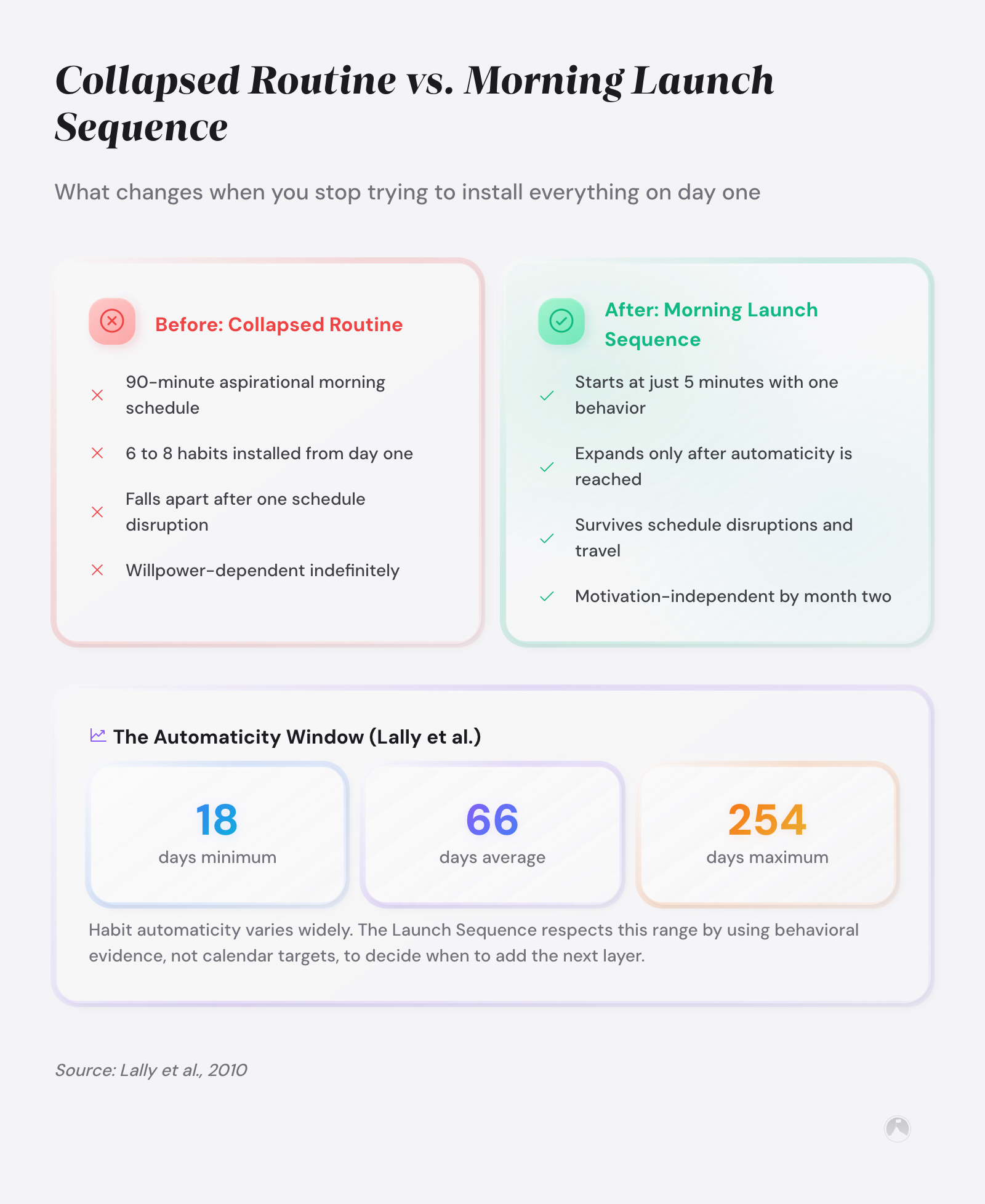
Phillippa Lally’s landmark 2010 study at University College London tracked 96 volunteers developing new habits over 12 weeks [2]. The average time to reach automaticity was 66 days, but the range was massive: 18 to 254 days depending on behavior complexity. So piling ten habits into a single morning guarantees that none of them reach automaticity before your motivation runs out.
Morning routines fail when designed for performance rather than formation. You can white-knuckle a 90-minute routine for two weeks. But willpower is depletable, and the moment life disrupts your perfect sequence, the whole thing falls apart. The missing piece is progression: starting absurdly small and adding complexity only after each layer becomes automatic.
Three patterns directly damage morning routines. First, the routine is too long for the available time before work or family obligations. Second, it has no fallback for mornings when sleep was poor or time is short. Third, you add new habits before existing ones feel effortless. See our guide on why habits fail for a deeper analysis of these patterns.
So what makes mornings biologically different from any other time of day?
How does the cortisol awakening response support morning habit formation?
The cortisol awakening response supports morning habit formation by creating a 38-to-75-percent cortisol spike within 30 to 45 minutes of waking, priming the brain for alertness and new behavioral patterns [1]. Your body gives you this built-in advantage for morning habits. Bowles and colleagues’ 2022 research in Frontiers in Neuroscience confirmed that this cortisol surge is regulated by the circadian system and enhances the brain’s receptivity to new learning [8].
Cortisol awakening response (CAR)
A natural 38-to-75-percent spike in cortisol that occurs within the first 30 to 45 minutes after waking, regulated by the circadian system, which increases alertness and brain receptivity to new behavioral patterns.
Here’s what that means for your morning routine: habits practiced during the CAR window have biological momentum. Your brain is already in a state of heightened alertness and openness to new patterns. And according to Angela Clow’s systematic review of CAR research, the magnitude of the cortisol spike actually predicts your cognitive performance and stress resilience for the entire day ahead [1]. Understanding the neuroscience behind automatic behavior helps explain why this window is so powerful.
The catch? This window is finite. Spending your first 20 minutes scrolling in bed can consume a significant portion of it before you do anything purposeful.
The cortisol awakening response gives morning habits a biological head start, but only if the first behavior after waking is the habit you’re building. That’s why sequence matters more than content. But knowing the biology is only half the equation – you need a structure that puts it to work.
How do you build a morning routine that scales? The Morning Launch Sequence
When you combine habit formation research with cortisol timing data, a simple framework emerges. We call it the Morning Launch Sequence. It works by treating your morning routine as a three-tier system rather than a single fixed block. These ideas aren’t new individually. They draw from habit stacking for morning rituals and Peter Gollwitzer’s foundational 1999 research on implementation intentions, which showed that pre-planning “if-then” behavioral responses produces a medium-to-large effect on goal attainment (d = 0.65 across 94 studies) [4]. But combining them into a tiered morning structure solves the all-or-nothing problem that kills most routines.
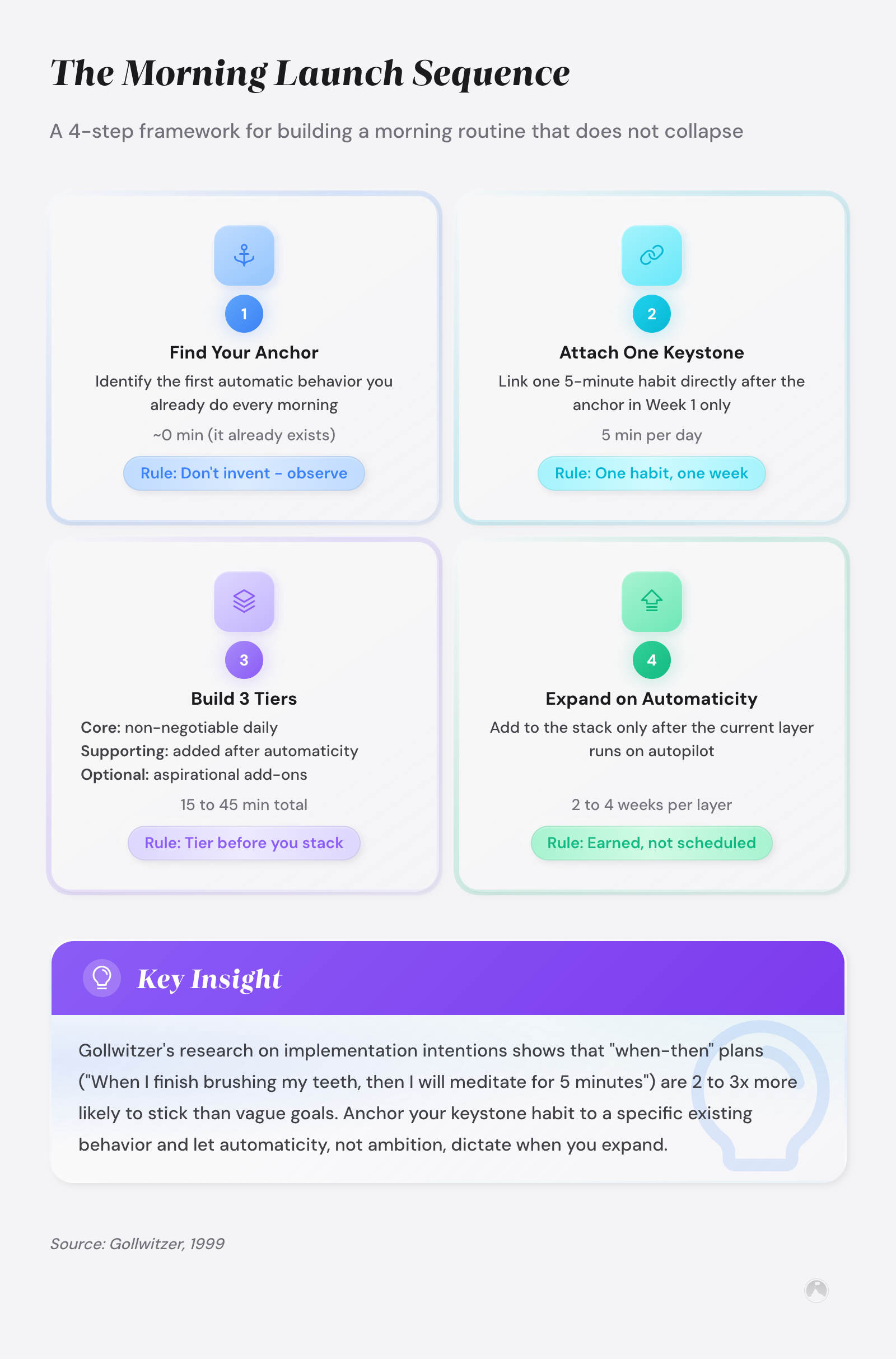
The Morning Launch Sequence
A framework that organizes a morning routine into three tiers (minimum, reduced, and full) so the core habit survives even on the worst mornings, preventing the all-or-nothing collapse that derails most morning routines within three weeks.
The Morning Launch Sequence works because the minimum tier preserves habit identity on disrupted mornings, eliminating the all-or-nothing decision that triggers routine abandonment. When you pre-decide three response levels for any morning condition, you convert a willpower challenge into an automatic if-then response, which Gollwitzer’s research shows substantially increases goal follow-through [4].
Step 1: identify your wake-up anchor
Your wake-up anchor is the first thing you do every morning without thinking. For most people, that’s using the bathroom, turning off the alarm, or starting the coffee maker. This behavior is already automatic, and it becomes the trigger for your first new habit. BJ Fogg, Director of Stanford’s Behavior Design Lab, calls this pairing an “anchor moment” and recommends the structure “After I [existing behavior], I will [new behavior]” [6]. This simple if-then format creates the automatic triggering pattern that habits depend on.
Step 2: add one keystone habit for week one
Choose one habit that takes two to five minutes and attach it directly after your wake-up anchor. This is your minimum tier: the version of your simple morning routine for beginners that happens no matter what. Whether you overslept by 40 minutes or the morning is chaos, this single behavior still happens. Good candidates include drinking a full glass of water, doing five minutes of stretching or movement, or writing three lines in a journal (yes, three lines counts).
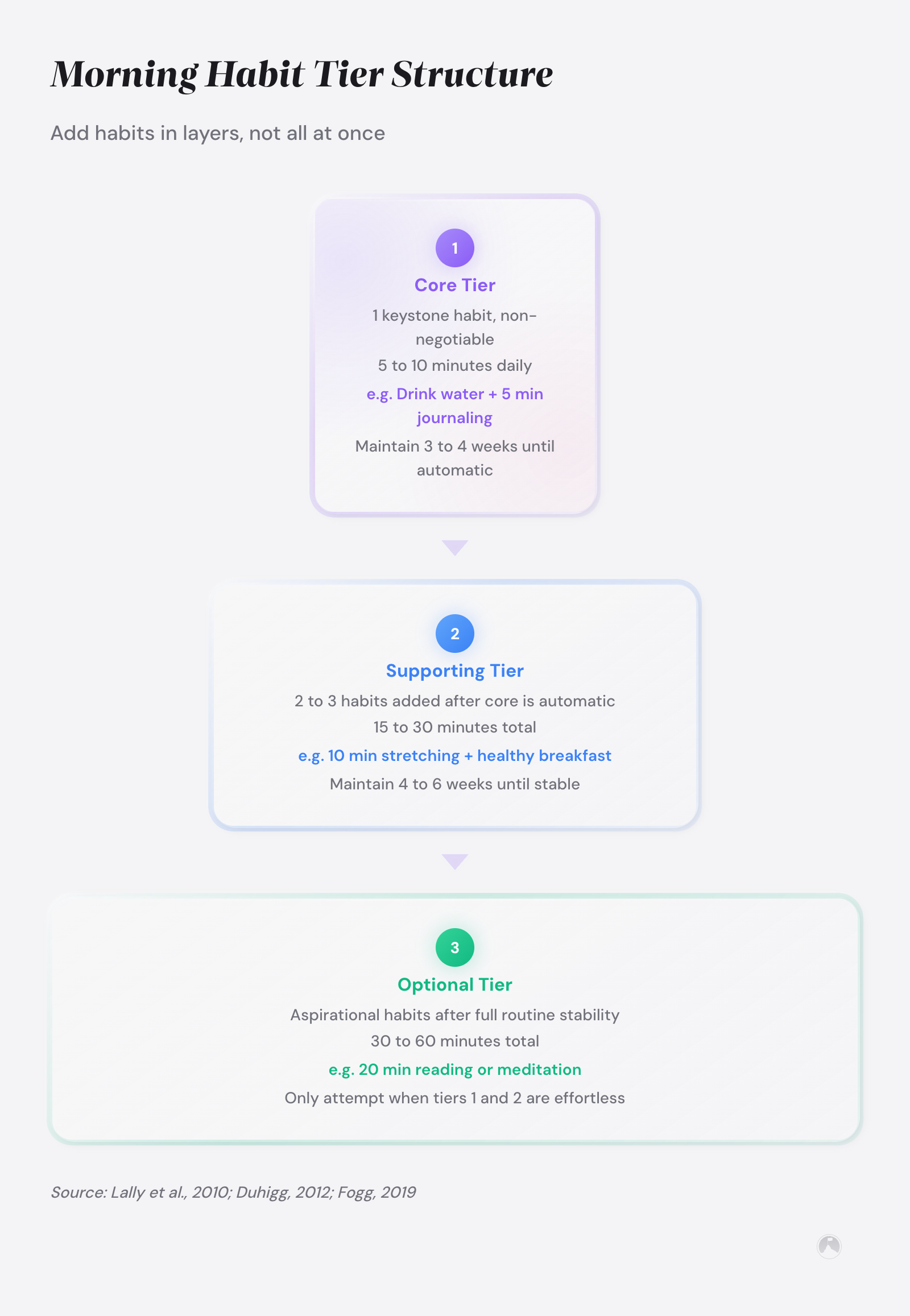
Step 3: build three tiers
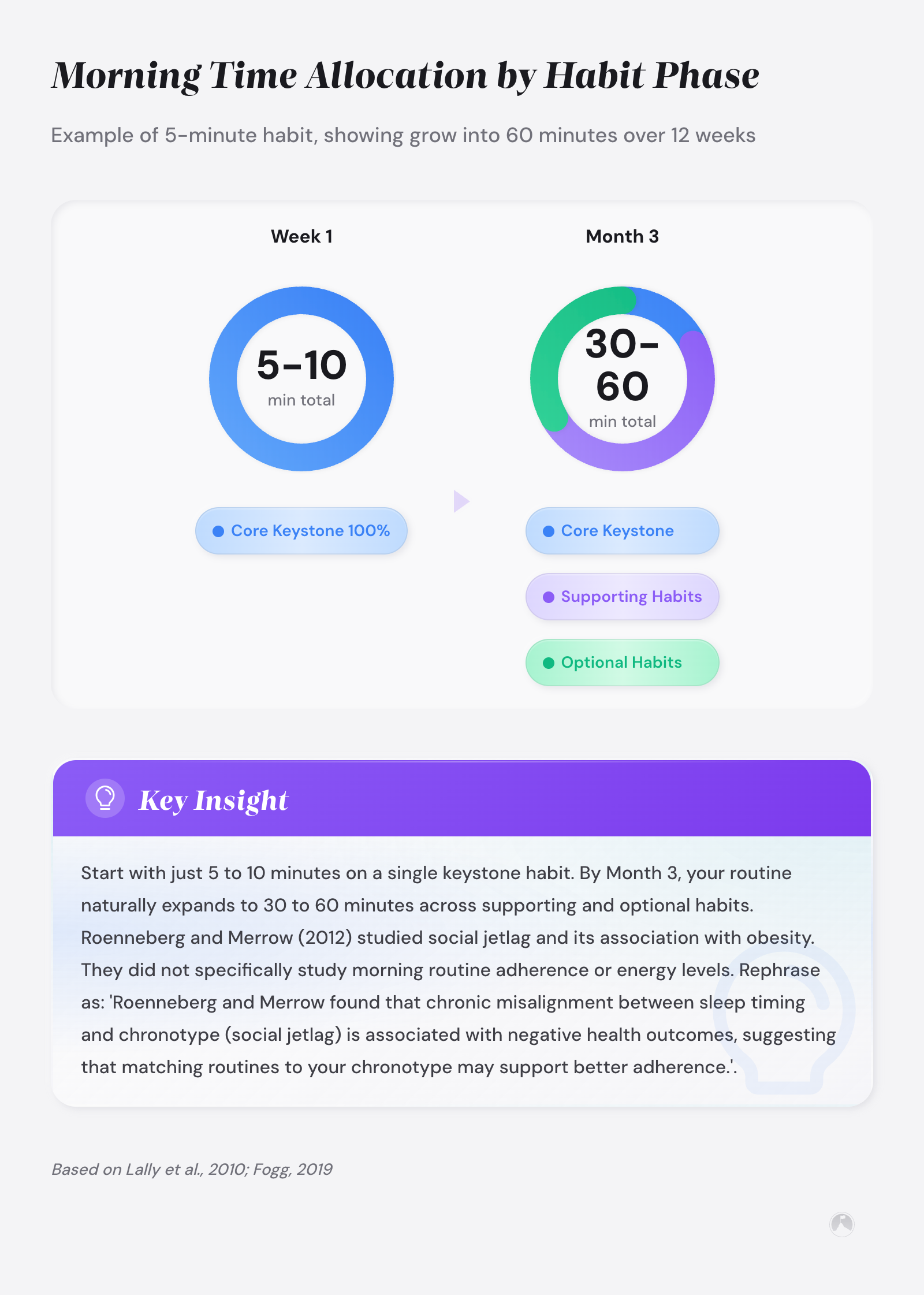
Once your first habit feels effortless (typically two to four weeks for a simple behavior, according to Lally’s findings [2]), design three versions of your morning:
| Tier | Time required | When to use | Example |
|---|---|---|---|
| Minimum | 2-5 minutes | Overslept, sick, travel, crisis mornings | Glass of water + 5 deep breaths |
| Reduced | 10-20 minutes | Busy weekdays, poor sleep, shortened schedule | Water + 10-minute walk + 3 journal lines |
| Full | 30-60 minutes | Spacious mornings, weekends, energy surplus | Water + walk + journal + reading + stretching |
The minimum tier is sacred. You never negotiate below it. A morning routine with three tiers survives disruption. A morning routine with one tier either happens or it doesn’t.
Here is a copy-pasteable morning routine checklist template you can adapt to your own schedule:
My Morning Launch Sequence
- Wake-up anchor: After I _______ (e.g., turn off alarm, use the bathroom)
- Minimum tier (2-5 min): I will _______ (e.g., drink water + 5 deep breaths)
- Reduced tier (10-20 min): I will _______ + _______ (e.g., water + 10-minute walk)
- Full tier (30-60 min): I will _______ + _______ + _______ (e.g., water + walk + journal + reading)
- Automaticity check: Does my minimum tier feel incomplete if I skip it? Yes / Not yet
Step 4: expand only after automaticity
Add a second habit only when the first one requires no willpower to execute. Wendy Wood’s research on habit disruption found that automaticity is indicated by the difficulty of suppressing the behavior and a sense of incompleteness when the behavior is skipped [7] – the same sensation you get when you realize you forgot to brush your teeth. But if you still need to remind yourself, give it more time.
For deeper context on habit formation stages, see our habit formation complete guide.
Which keystone morning habits produce the strongest all-day effects?
Not all morning habits carry equal weight. Some are isolated activities that feel good in the moment. But others are keystone habits – habits that create a ripple effect influencing behavior for the remaining hours of the day.
Charles Duhigg’s analysis of habit research found that people who exercised regularly (three or more times weekly) also reported improvements in eating habits, sleep quality, emotional control, and productivity [5]. That cascading pattern (one habit pulling others along for the ride) is what makes certain morning behaviors function as keystones.
Keystone morning habits
Specific morning behaviors that produce cascading positive effects on energy, focus, and decision-making throughout the rest of the day, functioning as triggers for a chain of downstream behavioral improvements.
| Keystone habit | Time | Primary cascade effect | Best for |
|---|---|---|---|
| Morning hydration (16 oz water) | 1 min | Improved alertness, reduced brain fog (strong evidence [1]) | Everyone, especially beginners |
| Morning light exposure (10-15 min) | 10-15 min | Circadian alignment, better sleep that night (strong evidence [9][10]) | Night owls, poor sleepers |
| Brief movement (walk, stretching) | 5-15 min | Mood elevation, sustained energy (strong evidence [5]) | Desk workers, low-energy starters |
| Writing (journal, gratitude, planning) | 5-10 min | Mental clarity, reduced anxiety (moderate evidence) | Overthinkers, stressed professionals |
| Single priority identification | 2 min | Focused task execution all day (moderate evidence) | People who feel scattered |
Morning hydration and light exposure carry the strongest research backing as keystone habits. But here’s the thing: “strongest evidence” doesn’t mean “best for you.” If anxiety is your biggest barrier to a good day, a five-minute journal entry might outperform any physical habit. So choose the keystone habit that addresses your primary daily bottleneck.
The best morning routine for productivity is not the most impressive routine. The best morning routine for productivity targets your specific bottleneck.
Morning routine for habit building if you’re not a morning person
If the phrase “5 AM wake-up” fills you with dread, here’s the good news: you don’t need one. Chronotype research from Till Roenneberg’s group shows that roughly 15 percent of the population are genuine night owls, 15 percent are natural early risers, and approximately 70 percent fall somewhere in the middle [3]. And fighting your chronotype doesn’t build better habits. It builds resentment and exhaustion.
How to wake up early for habit formation without fighting your chronotype
Redefine “morning” as the first 30 to 45 minutes after you wake, regardless of clock time. If you wake at 8:30 AM, your cortisol awakening response still fires, your wake-up anchor still exists, and the Morning Launch Sequence still works. Only the timestamp changes. Randler’s chronotype research supports the principle that performance outcomes improve when behavioral timing aligns with individual circadian rhythm rather than fighting it [11].
Two adjustments help night owls most. First, use morning light exposure as your keystone habit. A 30-minute exposure to bright light (from a 10,000-lux therapy lamp or natural sunlight) within 30 minutes of waking can gradually shift your circadian rhythm earlier over two to four weeks [9]. In a 2023 study, He and colleagues found in the Journal of Sleep Research that morning bright light exposure improved sleep efficiency by approximately 3.5 percent, reduced sleep fragmentation, and enhanced next-morning alertness [10]. Second, keep your minimum tier absurdly small. Night owls typically experience lower cortisol levels at early clock times, which can make larger morning commitments feel cognitively harder. A two-to-five-minute habit accounts for that difference.
Does the Miracle Morning SAVERS method work for habit building?
Hal Elrod’s Miracle Morning SAVERS method promotes six components: Silence (meditation), Affirmations, Visualization, Exercise, Reading, and Scribing (journaling). The framework touches multiple dimensions of personal development in a single session. But from a habit-building perspective, it has a structural flaw: it asks you to install six new habits simultaneously. And that’s where the science says it breaks down.
Lally’s research shows that habit formation works best when new behaviors are introduced one at a time [2]. So stacking six unfamiliar activities into a single morning block means none of them are likely to reach automaticity before your motivation to wake up early enough for all six fades.
A smarter approach takes the SAVERS menu and applies the Morning Launch Sequence: pick one SAVERS component as your keystone, practice it until automatic, then add the next. Over six months (which is faster than you think when the habit is actually sticking), you might build a full SAVERS routine where each component is genuinely habitual rather than performed through daily willpower. The best morning routine framework is the one where each habit has time to become automatic before the next one arrives.
How do you maintain a morning routine on weekends and during disruptions?
Weekend mornings kill most routines. Without the external pressure of a work commute, the rigid weekday routine loses its scaffolding. You sleep in, skip everything, feel guilty, and spend Monday rebuilding momentum from scratch. So what’s the fix? It’s not forcing yourself to keep the same schedule seven days a week.
Lally’s research suggests that consistency of behavior matters more than consistency of timing [2]. And Stothard and colleagues at the University of Colorado found through their circadian entrainment research that weekend timing shifts of two to three hours produce minimal circadian phase drift provided the behavior stays consistent relative to wake time [12]. So doing your keystone habit at 9 AM on Saturday preserves the neural pathway you built at 6:30 AM on Tuesday. The important thing is that the behavior happens, attached to the same wake-up anchor.
The Morning Launch Sequence handles this naturally. Weekends default to your minimum or reduced tier. Your sacred two-to-five-minute habit still happens every morning, regardless of when you wake. The full tier is a bonus for mornings with time and energy, not an obligation.
For travel and major disruptions, protect the minimum tier: if your keystone habit is drinking water first thing, you can do that in a hotel room, at your parents’ house, or after a red-eye flight (and that still counts as maintaining the routine). See our guide on habit pairing and energy management for how context changes don’t have to derail habit persistence.
Building consistency in morning routine depends on protecting the minimum behavior, not perfecting the maximum one.
But what about mornings where unpredictability is not occasional – where it is the baseline?
How do morning routines for habit building work with ADHD and young children?
Parents with young children and adults with ADHD share a common challenge: unpredictability. A toddler’s meltdown or an ADHD brain’s inability to sequence tasks can obliterate a planned morning routine in seconds. And standard advice assumes you control your first hour. Many people don’t.
The parent scenario
For parents, the minimum tier becomes non-negotiable. Consider Sarah, a working mom of a two-year-old who sets her alarm ten minutes before her daughter typically wakes. Her minimum tier: a glass of water while the coffee brews and writing one sentence about her top priority for the day. That’s it. That counts. On mornings when the toddler is up early (which happens at least twice a week), the glass of water still happens because it’s attached to the coffee-making anchor.
The ADHD scenario
For adults with ADHD, external cues replace internal motivation. Consider Marcus, who has ADHD and works from home. He sets out his water glass the night before, puts his journal on top of his phone (so he has to physically move it), and uses a visual timer set to five minutes to contain the habit to its planned duration. The environmental setup does the work that executive function sometimes can’t. And on mornings when his brain is scattered, the physical cues still trigger the minimum behavior because the cue is visual, not cognitive.
The most resilient morning routines are designed for the hardest mornings, not the easiest ones. If your routine works when the baby woke up three times, when you got four hours of sleep, and when you have a 7 AM meeting, it will work on the good mornings too. Design downward. See our habit building for ADHD guide for additional adaptations specific to neurodivergent mornings.
Ramon’s take
Just pick the one habit you already almost do every morning and attach something tiny to it. That’s literally the whole system. Don’t build tiers until the first thing feels boring.
Conclusion
A morning routine for habit building doesn’t require waking at 5 AM, meditating for 20 minutes, or overhauling your entire morning. It requires one keystone habit attached to one existing anchor, practiced consistently until it becomes automatic, then gradually expanded using the three-tier Morning Launch Sequence.
The cortisol awakening response gives you a biological window [1]. The tiered structure gives you resilience against bad mornings. And the graduated approach (one habit at a time, expanded only after automaticity) gives each habit enough time to become permanent before you add the next one.
The most productive mornings are not defined by completing a 90-minute checklist. The most productive mornings are defined by building something that will still be there six months from now.
In the next 10 minutes
- Identify your wake-up anchor: what’s the first thing you do every morning without thinking?
- Choose one keystone habit from the table above that addresses your biggest daily bottleneck.
- Write the implementation intention: “After I [anchor], I will [habit] for [duration].”
This week
- Practice your one keystone habit every morning for seven days, using only the minimum tier.
- Set your water glass or journal on your nightstand tonight so the cue is visible tomorrow morning.
- Track your streak with a simple tally on a sticky note – no app needed, no complex tracking.
There is more to explore
If you’re interested in the neuroscience behind habit loops, our neuroscience of habit formation guide breaks down the brain mechanisms driving automatic behavior. And for a deeper look at how to structure habits across your entire day (not just mornings), see our guide on habit stacking for productivity.
Related articles in this guide
Frequently asked questions
How do I start a morning routine if I’m not a morning person?
Begin by identifying the first automatic behavior after you wake, regardless of clock time. Attach one two-minute habit to that anchor. Because the cortisol awakening response fires at any natural wake time [1], your biological habit-forming window works whether you rise at 6 AM or 9 AM. If you want to gradually shift earlier, use a 10,000-lux light therapy lamp within 30 minutes of waking for two to four weeks [9].
How do I know when a morning habit has become automatic?
Wendy Wood’s research identifies two reliable signals of automaticity: the behavior becomes difficult to suppress, and you feel a sense of incompleteness when you skip it [7]. If forgetting your morning habit feels like forgetting to brush your teeth, automaticity has taken hold. Phillippa Lally’s data shows this process averages 66 days but ranges from 18 to 254 days depending on complexity [2].
Should I track my morning routine, and if so how?
Tracking helps during the formation phase but should stay simple. A tally mark on a sticky note or a single checkmark in a notebook provides enough visual feedback to reinforce consistency without adding friction. Research on implementation intentions suggests that the act of planning and monitoring increases follow-through [4]. Drop the tracking once the habit feels automatic, since the behavior itself becomes the evidence.
Can I combine the Morning Launch Sequence with other frameworks like time blocking or GTD?
The Morning Launch Sequence is compatible with other productivity systems because it occupies the pre-work window before structured planning begins. Use your minimum tier as a non-negotiable pre-work ritual, then transition into time blocking or GTD processing once the morning habit sequence is complete. The key constraint is keeping the Morning Launch Sequence first, during the cortisol awakening response window [1], before cognitive load increases.
How do I build a morning routine with young children?
Design your minimum tier to happen before the children wake up or in the 60 seconds between your alarm and entering their room. A glass of water while the coffee brews or three deep breaths before opening the nursery door both count. Parents need the smallest possible habit that requires zero setup, zero equipment, and zero uninterrupted time. Expand only during seasons when sleep improves or morning schedules become more predictable.
What is habit stacking and how does it apply to morning routines?
Habit stacking is the practice of attaching a new behavior to an existing automatic behavior. BJ Fogg, Director of Stanford’s Behavior Design Lab, developed the formula ‘After I [anchor moment], I will [tiny behavior]’ to create reliable triggers for new habits [6]. In the context of morning routines, your wake-up anchor (turning off the alarm, using the bathroom, starting the coffee maker) becomes the trigger for your first new habit, creating habit stacking for morning rituals that require no willpower to initiate.
Does waking up early actually help with building habits?
Waking up early is not required for morning habit building. Roenneberg’s chronotype research shows that approximately 15 percent of the population are genuine night owls with genetic predispositions toward later sleep and wake times [3]. The cortisol awakening response fires regardless of clock time, so wake up early habit formation is less about the clock and more about using the first 30 to 45 minutes after you naturally wake. Matching your routine to your chronotype produces better outcomes than forcing an unnaturally early alarm [11].
References
[1] Clow, A., Hucklebridge, F., Stalder, T., Evans, P., & Thorn, L. (2010). “The cortisol awakening response: More than a measure of HPA axis function.” Neuroscience & Biobehavioral Reviews, 35(1), 97-103. https://doi.org/10.1016/j.neubiorev.2009.12.011
[2] Lally, P., van Jaarsveld, C. H. M., Potts, H. W. W., & Wardle, J. (2010). “How are habits formed: Modelling habit formation in the real world.” European Journal of Social Psychology, 40(6), 998-1009. https://doi.org/10.1002/ejsp.674
[3] Roenneberg, T., & Merrow, M. (2012). “Social jetlag and obesity.” Current Biology, 22(11), 939-943. https://doi.org/10.1016/j.cub.2012.03.038
[4] Gollwitzer, P. M. (1999). “Implementation intentions: Strong effects of simple plans.” American Psychologist, 54(7), 493-503. https://doi.org/10.1037/0003-066X.54.7.493
[5] Duhigg, C. (2012). The Power of Habit: Why We Do What We Do in Life and Business. Random House.
[6] Fogg, B. J. (2019). Tiny Habits: The Small Changes That Change Everything. Houghton Mifflin Harcourt.
[7] Wood, W., Tam, L., & Witt, M. G. (2005). “Changing circumstances, disrupting habits.” Journal of Personality and Social Psychology, 88(6), 918-933. https://doi.org/10.1037/0022-3514.88.6.918
[8] Bowles, N. P., Thosar, S. S., Butler, M. P., et al. (2022). “The circadian system modulates the cortisol awakening response in humans.” Frontiers in Neuroscience, 16, 995452. https://doi.org/10.3389/fnins.2022.995452
[9] Terman, M., & Terman, J. S. (2005). “Light therapy for seasonal and nonseasonal depression: efficacy, protocol, safety, and side effects.” CNS Spectrums, 10(8), 647-663. https://doi.org/10.1017/S1092852900019611
[10] He, M., et al. (2023). “Shine light on sleep: Morning bright light improves nocturnal sleep and next morning alertness among college students.” Journal of Sleep Research, 32(2). https://doi.org/10.1111/jsr.13724
[11] Randler, C., & Schaal, S. (2010). “Correlation between morningness-eveningness and final school leaving certificate grades depends on seasons of exam.” Chronobiology International, 27(9-10), 1813-1820. https://doi.org/10.3109/07420528.2010.515770
[12] Stothard, E. R., McHill, A. W., Depner, C. M., et al. (2017). “Circadian entrainment to the natural light-dark cycle across seasons and the weekend.” Current Biology, 27(1), 49-59. https://doi.org/10.1016/j.cub.2016.12.041