
Why your new skills aren’t enough
You’ve done the hard work. Maybe you’ve completed a bootcamp, earned a new certification, or spent months building a portfolio in your new field. The practical skills are there. Yet something still feels off. When you sit at your desk in your new role, your mind whispers: “You don’t belong here” or “People who actually studied this knew this already.”
The gap between what you can do and what you believe you can do is the real career transition challenge. And it’s more common than you think.
Career change isn’t primarily a skills problem – it’s a mindset problem. William Bridges’ work on career transitions argues that professionals who successfully shift careers do so not because they become instantly competent in their new field, but because they develop specific ways of thinking that allow them to rebuild their professional identity from scratch [1]. Your brain is still operating on old patterns from your previous career, and that’s precisely what holds most career changers back.
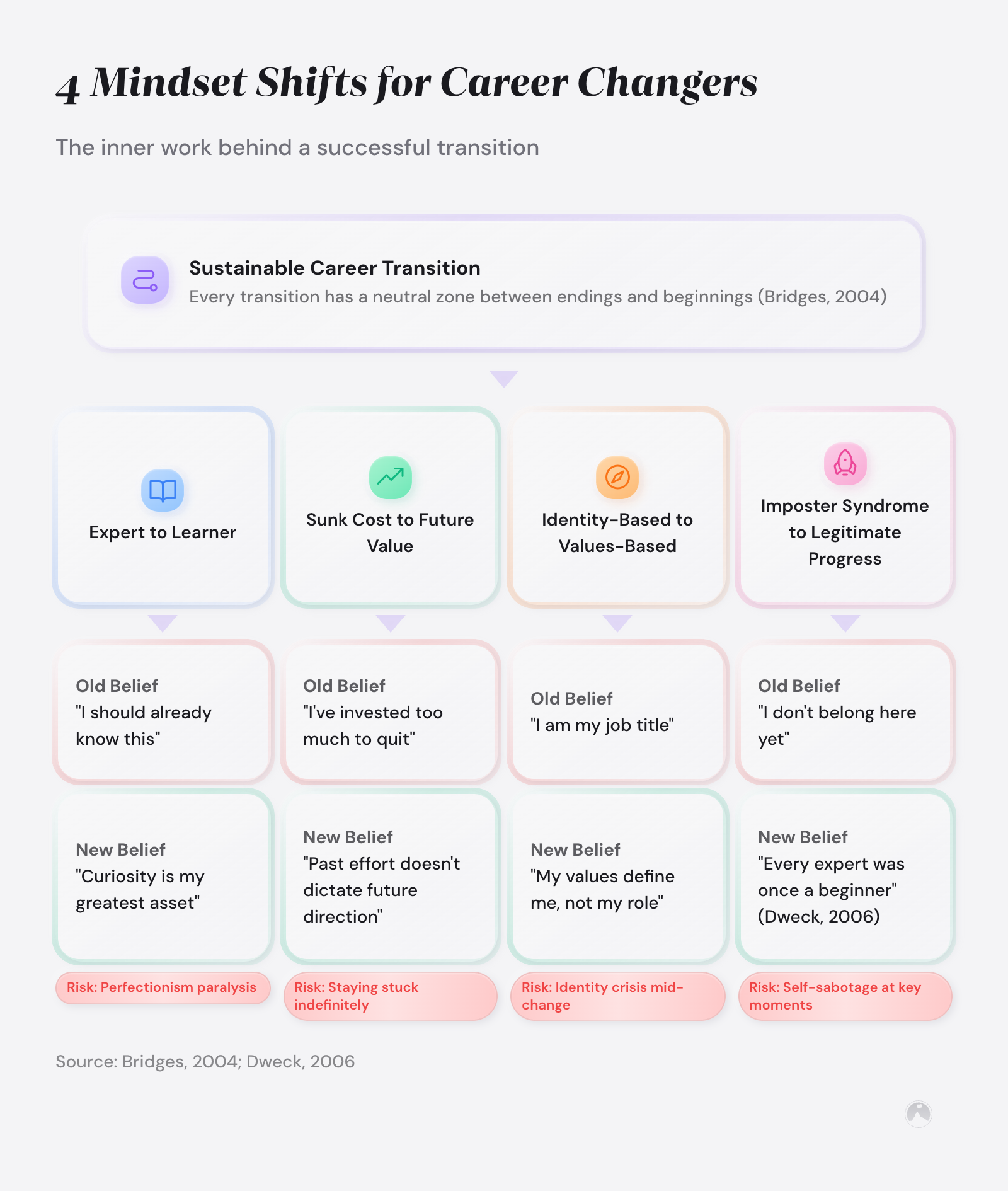
The five mindset shifts for career changers are: moving from expert to learner, reframing sunk costs as future value, shifting from identity-based to values-based thinking, converting imposter syndrome into legitimate progress, and building antifragility. Each addresses a specific psychological barrier that surfaces during professional transitions and determines whether you persist or retreat.
Mindset shifts for career changers are deliberate reorientations of how you think about ability, learning, failure, identity, and value during a professional transition. Rather than remaining anchored to old expertise, you intentionally reorganize thinking across five dimensions that determine whether you persist or retreat.
The difference between career changers who thrive and those who return to their old field usually comes down to these five personal growth mindset changes. They’re not about being more optimistic or trying harder. Mindset shifts for career changers are about rewiring how you interpret your experiences, process setbacks, and define your professional worth.
What mindset shifts career changers need to learn
- How to move from “expert” thinking to “learner” thinking without losing your professional confidence
- Why sunk costs keep you trapped and how to reframe your career transition as pure forward value
- The identity shift that separates successful career changers from those who retreat to safety
- Why imposter syndrome intensifies during career changes and the precise mindset that neutralizes it
- How to build an antifragile mindset that treats obstacles as information rather than indictment
Key takeaways
- The expert-to-learner shift: Moving from defending your expertise to actively seeking blind spots separates sustainable career transitions from surface-level job switches.
- The sunk-cost reframe: Stop calculating what you’re leaving behind and start calculating the difference between your current trajectory and your desired future.
- From identity to values: Your old career was part of your identity, but career sustainability requires shifting to values-based thinking about what you contribute.
- Imposter feelings are data: Imposter feelings are widespread among professionals across demographics [8] – the mindset shift is interpreting them as growth signals, not fraud evidence.
- The identity-confidence collision point: Most career changers hit a predictable collision point in the early months where old mindsets reassert themselves under stress.
- Track behaviors, not confidence: You cannot measure mindset changes directly – track behavioral proxies instead like asking questions, seeking feedback, and staying uncomfortable.
- Carol Dweck’s growth mindset as foundation: People who see ability as malleable rather than fixed may recover faster from mistakes and persist longer learning new domains [3], though effect sizes are debated [13].
- Integration, not replacement: Successful career shifts don’t erase your old expertise – the strongest career changers integrate previous skills into their new field.
| Mindset Shift | Old Pattern | New Pattern |
|---|---|---|
| Expert-to-Learner | Defending what you already know | Actively seeking blind spots and asking questions |
| Sunk-Cost-to-Future-Value | Protecting past investment in old career | Maximizing value of remaining working years |
| Identity-to-Values | Self-worth tied to job title and role | Self-worth tied to values applied to problems |
| Imposter-to-Progress | Interpreting doubt as evidence of fraud | Interpreting doubt as a growth signal |
| Antifragility | Avoiding difficulty and seeking comfort | Being drawn to difficulty as learning fuel |
The expert-to-learner shift: rewiring your relationship with not knowing
Your previous career granted you something valuable: expertise. You knew the answers. People came to you. You could walk into a room and know what to do. This identity as a knowledgeable professional shaped not just your work but your self-respect and internal sense of competence.
Leaving that behind is harder than learning new technical skills.
Growth mindset is the belief that abilities and intelligence can be developed through effort, strategy, and learning from feedback. Dweck contrasts this with a fixed mindset – the belief that abilities are innate and unchangeable – showing that the growth orientation leads to greater persistence and faster recovery from setbacks [3].
In your new field, you don’t know the unwritten rules, the jargon, or which approaches are considered outdated versus cutting-edge. A 2023 systematic review of career transition research found that most professionals reach working competence within one to two years, though timelines vary significantly by field complexity and individual circumstances [2]. That’s a long stretch of not knowing. The mindset shift required is to stop experiencing not knowing as a personal deficit and start experiencing it as useful information about where your learning needs to happen. This beginner mindset – deliberately embracing what you don’t yet know – is the foundation of the expert-to-learner shift.
The Carol Dweck growth mindset framework on fixed versus growth mindset demonstrates this directly. The fixed mindset about learning says: “If I have to learn this, it means I’m not naturally suited for it.” The growth mindset says: “If I have to learn this, it means I’ve found the edge of my current capability – exactly where growth happens.” Dweck’s work suggests that people who adopt growth thinking about their abilities may recover faster from failure and persist longer in learning new skills [3], though the magnitude of these effects is debated [13].
“People who believe that their abilities are not fixed, but can be developed, are more likely to engage in deliberate practice and persist through difficulty.” – Carol Dweck [3]
It is worth noting that growth mindset research has generated scientific debate. A meta-analysis by Sisk et al. (2018) found that the overall effect of mindset interventions on academic outcomes is small, though some evidence suggests effects may be larger for individuals navigating adversity or major transitions – precisely the situation career changers face [13]. The takeaway for career changers is pragmatic: thinking of your abilities as developable is a useful reframe during a transition, even if the broader research picture is more nuanced than early enthusiasm suggested.
Here’s the concrete difference: When you make a mistake in your new field from a fixed mindset, you interpret it as evidence that you chose the wrong career. When you make the same mistake from a growth mindset, you interpret it as data about the next step in your learning process. The mistake is identical. Your interpretation of it – the mindset – determines whether you stay or leave.
The implementation practice for this shift is simple but uncomfortable: Ask questions without apologizing for asking them. But your brain (trained in your previous field where you were expected to have answers) will want to hide what you don’t know. The shift requires deliberately doing the opposite.
Track it: How many questions did I ask today? Did I ask a question I would have hidden before? This behavioral tracker – not your confidence level, not your internal belief, but the actual asking of questions – is how you know the shift is taking hold.
The person who asks the most questions in month one becomes the most competent person in month twelve.
The sunk-cost-to-future-value shift: freeing yourself from yesterday
The sunk cost fallacy traps most career changers in the early months. You think about the years you spent building expertise in your old field. You think about the salary you left behind. You think about the reputation you had and the respect you’ve temporarily lost.
The emotional weight of these sunk costs can be paralyzing: “I’ve wasted ten years of my career. What if I waste another ten in this new field?”
Sunk costs are past investments – including years of expertise, salary history, credentials, and professional reputation – that cannot be recovered. The mental trap is that these past costs feel like they should inform future decisions when they should not.
Psychologists Hal Arkes and Catherine Blumer demonstrated in their foundational research that humans systematically make irrational decisions based on past costs rather than future outcomes [4]. This explains why career changers often feel trapped by years of prior expertise – the sunk cost fallacy makes the emotional weight of past investment feel like a rational argument against change.
The mindset shift required is from looking backward (protecting what you’ve already built) to looking forward (maximizing the value of the remaining decades of your working life). This is one of the most critical shifts within any growth mindset development journey. Here’s the cognitive reframe: Instead of calculating “I’ve spent 15 years becoming expert in X,” calculate “I have 25-30 working years remaining. Does my old career or my new career better serve the next 25-30 years?” When you frame the question this way, sunk costs disappear from the equation. They become irrelevant.
In a career transition, the only relevant calculation is future value – not what you invested in your old career.
The behavioral practice: Create a simple comparison document. On one side, project your trajectory if you stayed in your old career – income, growth, job satisfaction. On the other side, project your trajectory in your new career assuming normal progression. Look at the 10-year and 20-year projections, not the next 12 months. Review this document when doubt hits – not as an inspirational exercise, but as rational accounting of where the actual value is.
The identity-based-to-values-based shift: untethering your worth from your title
Your old career was probably part of your identity. When someone asked “What do you do?”, your answer was tied to who you were: “I’m a lawyer,” or “I’m an engineer,” or “I’m a financial analyst.” This identity provided structure and stability. It also made leaving feel like identity loss.
Professional identity is the internalization of a career role as part of your sense of self. Research on occupational identity shows that career roles become internalized as part of self-concept over years of practice [5]. In contrast, values-based career thinking focuses on the principles and impact that matter to you, independent of title or field.
When you remain in identity-based thinking during a career change, your self-worth crashes in your new field. You were an expert in one context, and now you’re a beginner in another. If your identity is tied to being an expert, being a beginner feels like being worthless.
This is why career changers often experience an identity crisis in the early months: they’ve lost their old identity and haven’t yet built a new one.
Research on career calling from Duffy, Dik, and Steger found that career satisfaction increases when people align their work with core values rather than deriving identity from a single role [6]. This is the foundation for the mindset shift. Instead of thinking “I am an X” (identity-based), you think “I solve problems using Y values in Z contexts” (values-based). A lawyer who values careful analysis, protection of vulnerable people, and structured thinking might transition to social work or policy work or product management – different titles, different fields, same values being expressed.
The behavioral practice for tracking this shift is to reframe how you answer “What do you do?” When you catch yourself describing your new role by title alone (“I’m a junior UX designer”), pause and add the values layer: “I design for how people actually work, not how I think they should work.”
Notice that this answer works whether you’re a lawyer, a teacher, a programmer, or a product manager. That answer – rooted in how you solve problems, not what title you hold – reflects the values layer of professional identity. If you’re working through a broader personal growth mindset change, this shift from title-dependent to values-dependent professional worth is often the psychological turning point – and exploring signs you need a mindset shift can help you recognize when it’s time.
Your professional worth is how effectively you apply your values to the problems you’re solving, not the title on your business card.
The imposter-syndrome-to-legitimate-progress shift: reinterpreting the discomfort
Imposter syndrome is not a personal flaw. It’s a predictable cognitive response to being genuinely new in a domain. When you’re in your first months in a new career, you literally don’t know what you don’t know. Your brain detects this genuine knowledge gap and generates anxiety: “I don’t belong here.” This is accurate data. The problem is the interpretation.
Psychologists Pauline Clance and Suzanne Imes first identified the impostor phenomenon in 1978, defining it as “an internal experience of intellectual phoniness” [7]. Later research found it affects not just high-achieving women (Clance and Imes’ original sample) but professionals across demographics. Prevalence estimates of imposter feelings vary widely – from 9 to 82 percent of professionals depending on the population studied and the measurement tool used [8].
In career transitions, imposter feelings are actually a signal that you’re in the right difficulty zone – not so easy that you’re not learning, and not so hard that you’ve given up. The mindset shift required is reframing imposter feelings from “I’m not qualified for this role” to “I’m in a learning phase where qualification gaps are normal and closing predictably.”
Dweck’s research demonstrates that the path from novice to expert reflects deliberate practice and accumulated experience rather than innate ability [3].
Your feeling of not belonging is real. The people around you who do belong have simply accumulated context and pattern recognition that you haven’t yet. There’s no dishonesty in being a beginner – there’s only the hard work of moving from beginner to competent to expert. If you’re wrestling with limiting beliefs about whether you’re “smart enough” for your new field, know that those beliefs are the fixed mindset talking.
The behavioral practice: Track the moments when you don’t know something and explicitly decide to learn it. This is not evidence of fraud. This is evidence of professional growth. Create a simple log: “Tuesday: discovered I don’t know how to structure a component. Learned X from Y source. Wednesday: applied learning to Z project. The gap closed.” Over 12 months, even 10 minutes a day of this practice creates a behavioral record of competence building that your brain cannot argue with.
Every imposter feeling, when you don’t hide from it, becomes a closed skill gap.
That reframe works day-to-day – but there is a predictable moment when it gets tested at a deeper level.
When old mindsets reassert: the collision point
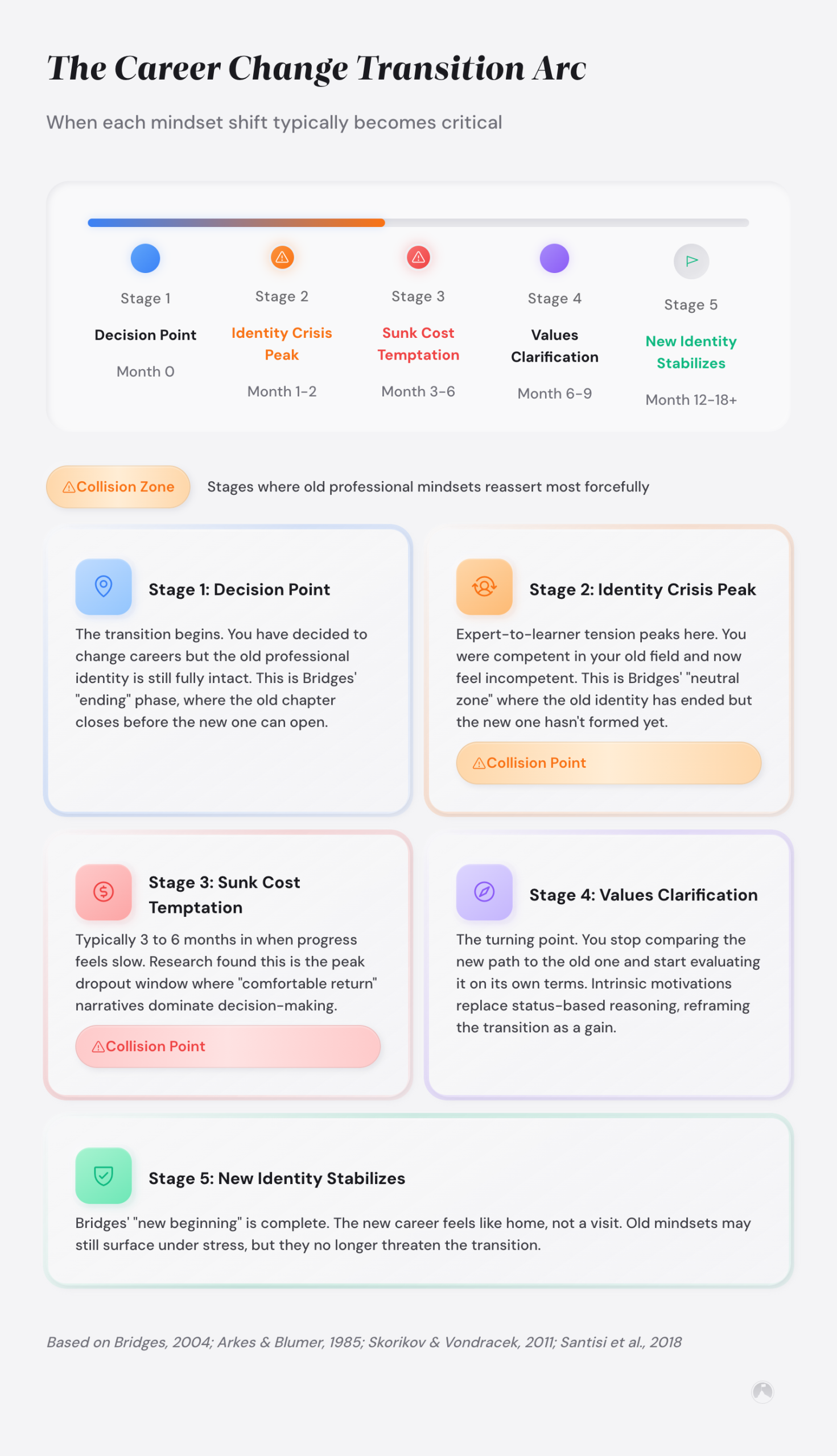
The dangerous moment in a career transition typically arrives around month three to six. You’ve survived the initial shock, learned basic competencies, and started to feel slightly more oriented. Then something happens. Maybe you make a significant mistake, maybe someone in your old field achieves something notable, maybe you have a genuinely tough week. And your old mindsets come roaring back.
You think: “I should have stayed in my old field. I’d be better at that. I’d be respected.”
This is what we call the identity-confidence collision point – the predictable moment, typically around month three to six, when your well-rehearsed old professional identity clashes with your fragile new one under stress. It is not a sign that you should have chosen differently. It is a sign that you’ve hit the normal collision between your old identity and your emerging one. Research on career transitions suggests that psychological resources like confidence and satisfaction develop as professionals settle into new roles, though individual timelines vary significantly [9].
The specific techniques that work at this collision point:
Technique 1: Reality-testing the “better off” narrative
When you think “I should have stayed,” be specific. Better at what? Respected by whom? The narrative usually isn’t specific. You’re comparing your beginner self in your new field to an imagined version of your expert self in your old field – not your actual current self in your old field. The reality-test: would you actually be happy returning? For most career changers, the answer is no. The pull back is nostalgia for knowing how to do the work, not missing the work itself.
Technique 2: The confidence-timeline reframe
If you’re at month four feeling shaken, you’re likely approaching the point where confidence begins to stabilize as you build familiarity with your new role [9]. This is when the mindset matters most. Knowing that confidence dips are temporary, predictable phases (not indications of poor choice) changes how you interpret your current struggle. A structured goal-setting framework can help you map specific milestones during this period so progress becomes visible even when confidence lags.
Technique 3: Behavioral continuity tracking
Don’t track your confidence (which will fluctuate). Track behaviors that indicate growth: Did I ask more questions this week than last week? Did I seek feedback on work where I’m still learning? Did I stay in a difficult situation longer than my old self would have? These behavioral indicators tell you whether you’re moving forward even when your emotions are telling you to retreat.
The pull back to your old career is nostalgia for competence, not a signal to return.
Building antifragility: the mindset that survives uncertainty
The strongest career changers don’t aim for confidence. They aim for antifragility – a mindset where setbacks strengthen your resolve and challenges deepen your capability. Antifragility – a term coined by Nassim Nicholas Taleb – describes systems that gain from disorder and improve under stress [10]. The obstacles themselves make you stronger.
Tedeschi and Calhoun’s research on posttraumatic growth demonstrates that professionals who work through significant challenges often develop enhanced capabilities, new possibilities, and a stronger sense of purpose [11]. While Tedeschi and Calhoun’s research focuses on growth after traumatic experiences rather than career transitions specifically, the underlying mechanism – that challenge can catalyze growth – applies to demanding professional transitions as well. This is the psychological mechanism behind what Taleb calls antifragility.
In a career transition, antifragility looks like this: You discover you don’t know something. Rather than feeling defeated, you become more motivated because you’ve identified the exact edge of your learning. You make a mistake. Rather than seeing it as evidence that you’re wrong for this field, you extract the lesson and move forward more informed. Mihaly Csikszentmihalyi’s flow research shows that optimal learning and satisfaction occur when challenges slightly exceed current skills [12] – which is exactly the state a career transition puts you in.
The practice for building an antifragile mindset is to deliberately seek out the hardest part of your work and spend 20 percent of your weekly time there. Not to prove something, but because the hardest parts contain the most valuable learning.
The behavioral indicator that antifragility is building: You stop talking about your career change as “scary” and start talking about it as “interesting.” This shift in language reflects a deeper shift in how your nervous system interprets the career change – from threat to challenge.
When you develop the habit of being drawn to difficulty rather than avoiding it, you’ve built antifragility.
Ramon’s take
Forget mapping out every mindset shift right now. Just pick the one that made you a little uncomfortable when you read it. That’s the one. Start there this week.
Making mindset shifts stick through your career change
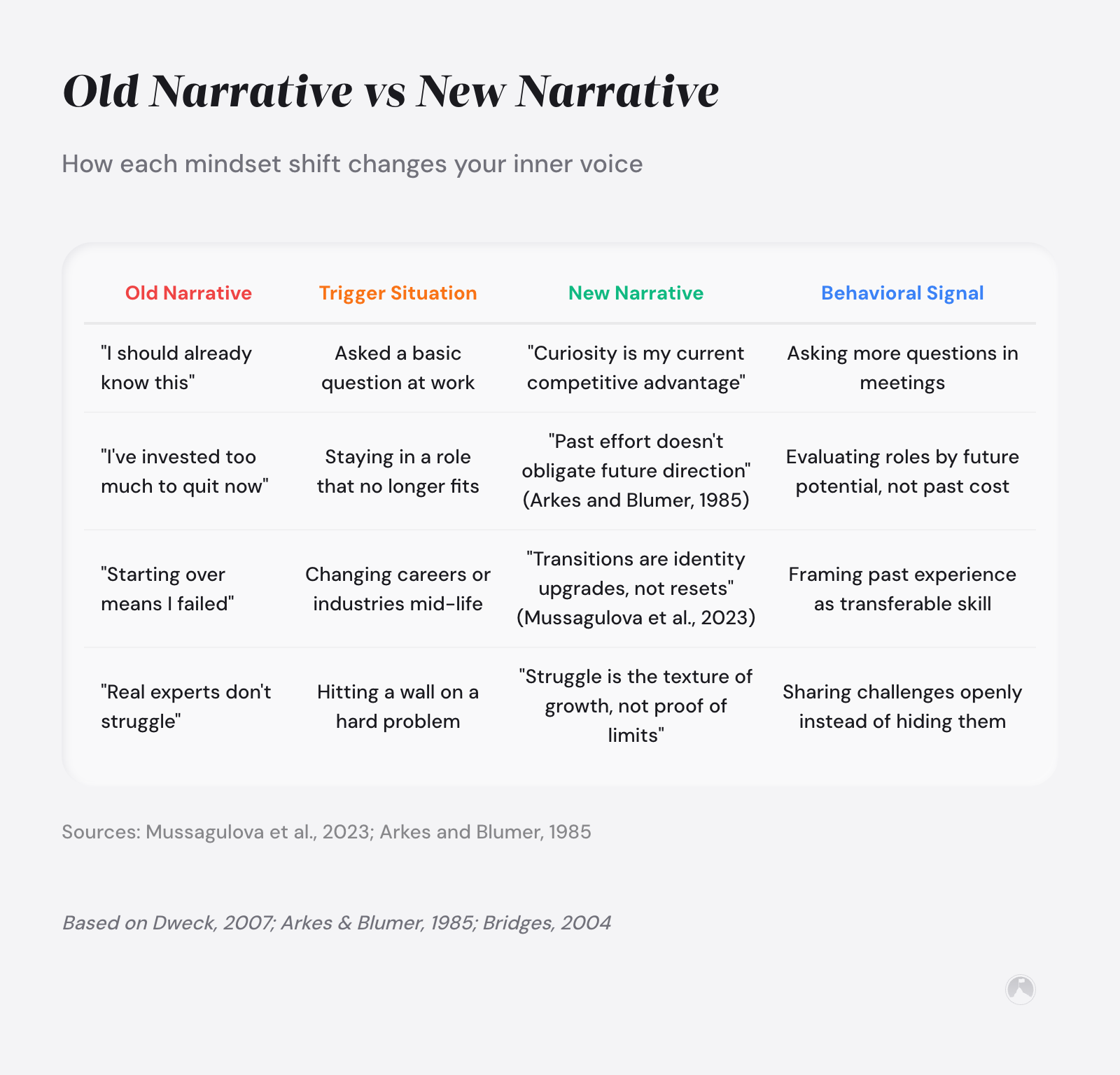
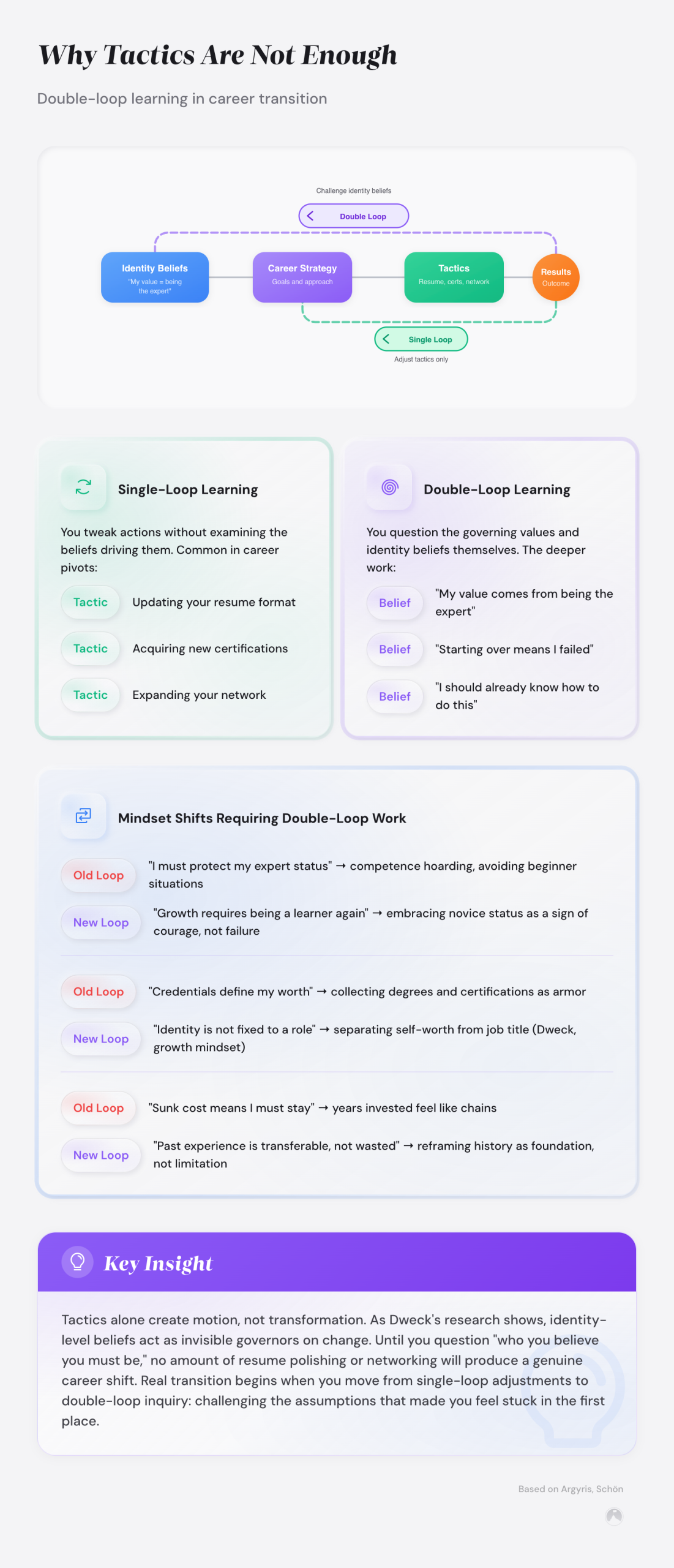
Mindset shifts for career changers aren’t about psychology for its own sake. They’re about the practical realization that how you interpret your experiences during a transition determines whether you persist or retreat. The five shifts – from expert to learner, from sunk-cost to future-value thinking, from identity to values, from imposter-syndrome to legitimate-progress, and toward antifragility – are not destinations. They’re directions. You don’t arrive at them and stay there. You practice them repeatedly, especially when old patterns reassert.
These transformational mindset shifts are learnable, measurable through behavior, and they predictably lead to successful career transitions. The stronger version of yourself on the other side of your career change isn’t built through more skill acquisition. It’s built through the mental rewiring that happens when you deliberately practice these mindset transformation strategies until they become your new default. Every time you catch yourself thinking “I don’t belong here” and reframe it as “I’m in the learning zone where growth happens” – that’s the work.
Do that enough times and you won’t just change careers. You’ll change how you approach change itself.
Next 10 minutes
- Identify which single mindset shift (expert-to-learner, sunk-cost, identity-to-values, imposter-syndrome, or antifragility) is your biggest current bottleneck. Write one sentence describing how it’s showing up in your daily experience.
- Pick one behavioral tracking practice from this article for this week. Choose the one you’re most resistant to – that’s usually the highest-impact shift.
This week
- Review your career transition so far and identify one moment where your old career’s expertise actually helped your new field. Write it down – this is the bridge between your old identity and new identity, not a gap but an integration.
- Have a conversation with someone who’s 6-12 months further along in the new career than you are. Ask them specifically: “What mindset shift was hardest for you?” Listen for patterns.
- Set a calendar reminder for 90 days from today labeled “Confidence check.” Plan to revisit this article at that milestone and track whether your confidence has shifted despite ongoing challenges.
There is more to explore
For a deeper understanding of how mindset shapes learning and growth, explore our growth mindset development guide – it covers the full framework behind the shifts described here. If your career change involves learning new technical or creative skills, our guide on fixed versus growth mindset neuroscience explains why your brain resists new learning and what to do about it. You might also find value in exploring self-discovery exercises and tools to clarify your values during the transition, or the GROW framework guide for a structured approach to setting goals in your new career.
Related articles in this guide
- multi-year-goal-persistence-system
- overcoming-limiting-beliefs
- self-affirmation-techniques-for-focus
Frequently asked questions
Is it ever too late to make a mindset shift during a career change?
No. Mindset shifts are not a one-time event but an ongoing practice, which means career changers who are months or even years into a transition can still benefit from deliberately adopting these frameworks. Even professionals who initially white-knuckled through their career change without intentional mindset work can retroactively apply the expert-to-learner, values-based, and antifragility shifts. Bridges’ research on transitions emphasizes that identity reconstruction is iterative and can begin at any stage of a career change [1].
How long does it take to actually shift your mindset during a career change?
Mindset shifts develop through repeated practice, not a single realization. You can start behavioral changes right away (asking more questions, seeking feedback, tracking learning). A 2023 systematic review of career transition research found that most professionals reach working competence within one to two years, though timelines vary significantly by field complexity and individual circumstances [2]. You’ll likely notice behavioral shifts within weeks, internal conviction shifts within a few months, and fuller integration over the following year.
What should I do when old mindsets come back during my career transition?
Old mindsets reassert themselves predictably in the early months of a transition, especially after setbacks. Use reality-testing (compare your beginner self to your actual current situation, not an imagined expert self), the confidence-timeline reframe (research suggests confidence and satisfaction develop as professionals settle into new roles [9]), and track behavioral continuity rather than emotional confidence. One journaling prompt that helps: write down the three specific things you would miss about your new career if you went back to your old one. The reassertion of old mindsets is not a sign you chose wrong – it’s a sign you’ve hit the normal identity-confidence collision point.
Can you work on multiple mindset shifts at the same time?
You can, but starting with whichever shift represents your biggest current bottleneck is more effective than trying all five simultaneously. The shifts naturally reinforce each other once one takes hold – for example, adopting the expert-to-learner shift often reduces imposter feelings as you reframe not-knowing as normal. Begin with the shift you feel most resistance toward, practice it for a few weeks, and then layer in additional shifts as the first one becomes more automatic.
Can mindset shifts really transform your experience of a career change or is that oversimplified?
Mindset shifts are not magic, but they’re also not oversimplified. Research on career transitions shows that professionals’ interpretation of their experiences predicts whether they persist more reliably than external factors like industry conditions or starting salary [1]. You cannot think your way into competence, but you can think your way into giving yourself the time and patience needed to build competence. The shift is real and measurable through behavioral indicators.
What is the difference between resilience and antifragility in the context of career changes?
Resilience means bouncing back from difficulty and returning to your previous state. Antifragility, a concept coined by Nassim Nicholas Taleb [10], means that difficulties actually make you stronger and more capable than before. Psychological research on post-traumatic growth supports this – professionals who work through significant challenges often emerge with enhanced capabilities [11]. Building antifragility means deliberately seeking out the hardest parts of your work and treating challenges as evidence that you’re learning.
How do I know if my mindset shifts are actually working?
Track behavioral indicators, not confidence levels. Research on growth mindset and deliberate practice shows that behavioral change precedes internal conviction [3]. Behavioral indicators include asking more questions without apology, seeking feedback in areas where you’re still learning, staying in uncomfortable situations longer than you previously would have, and identifying skill gaps then intentionally closing them. If these behaviors are increasing week over week, your mindset is shifting even if your confidence feels unstable. Confidence lags behind capability development – it’s not a reliable indicator of progress.
Should I integrate my old career expertise into my new field or try to start completely fresh?
Integration is stronger than starting from scratch. The strongest career changers leverage their old expertise as a differentiator in their new field. A lawyer moving into product management brings rigor and risk-thinking that pure tech backgrounds may lack. A teacher moving into user research brings attention to how people learn. Research on values-aligned career development shows that satisfaction increases when you align work with your core values rather than a single role identity [6]. The mindset shift is from seeing your old career as baggage to seeing it as unique perspective.
References
[1] William Bridges. “Transitions: Making Sense of Life’s Changes.” 2nd ed. Cambridge, MA: Da Capo Press, 2004. ISBN: 9780738209043.
[2] Mussagulova, A., Chng, S., Goh, Z. A. G., Tang, C. J., and Jayasekara, D. N. “When is a career transition successful? A systematic literature review and outlook (1980-2022).” Frontiers in Psychology, 14, 1141202. 2023. DOI
[3] Carol S. Dweck. “Mindset: The New Psychology of Success.” New York: Random House, 2007. ISBN: 9780345472328. PsycNET
[4] Arkes, H. R., and Blumer, C. “The psychology of sunk cost.” Organizational Behavior and Human Decision Processes, 35(1), 124-140. 1985. DOI
[5] Skorikov, V. B., and Vondracek, F. W. “Occupational identity.” In S. J. Schwartz, K. Luyckx, and V. L. Vignoles (Eds.), Handbook of Identity Theory and Research (pp. 693-714). Springer, 2011. DOI
[6] Duffy, R. D., Dik, B. J., and Steger, M. F. “Calling and work: Definitions and prospects for research and practice.” The Counseling Psychologist, 39(3), 424-450. 2011. DOI
[7] Clance, P. R., and Imes, S. A. “The impostor phenomenon in high achieving women: Dynamics and therapeutic intervention.” Psychotherapy: Theory, Research and Practice, 15(3), 241-247. 1978. PsycNET
[8] Bravata, D. M., Watts, S. A., Keefer, A. L., et al. “Prevalence, predictors, and treatment of impostor syndrome: A systematic review.” Journal of General Internal Medicine, 35(4), 1252-1275. 2020. DOI
[9] Santisi, G., Magnano, P., Platania, S., and Ramaci, T. “Psychological resources, satisfaction, and career identity in the work transition.” Psychology Research and Behavior Management, 11, 187-195. 2018. DOI
[10] Nassim Nicholas Taleb. “Antifragile: Things That Gain From Disorder.” New York: Random House, 2012. ISBN: 9780812979688.
[11] Tedeschi, R. G., and Calhoun, L. G. “Posttraumatic growth: Conceptual foundations and empirical evidence.” Psychological Inquiry, 15(1), 1-18. 2004. DOI
[12] Csikszentmihalyi, M. “Flow: The Psychology of Optimal Experience.” New York: Harper and Row, 1990. ISBN: 9780061339202.
[13] Sisk, V. F., Burgoyne, A. P., Sun, J., Butler, J. L., and Macnamara, B. N. “To what extent and under what circumstances are growth mind-sets important to academic achievement? Two meta-analyses.” Psychological Science, 29(4), 549-571. 2018. DOI