Goals & Progress


The myth of “having it all” without telling anyone
Managing side hustle and family expectations is harder than it should be – mostly because most people treat it like a product launch problem rather than a communication problem. You build something on the side, sneak hours in early mornings or late evenings, and hope your family won’t notice the shift in your attention. The problem is obvious in retrospect: families notice. And when they do, resentment builds faster than your business.
The real issue is almost never the hours. The core tension happens because expectations haven’t been set, communicated, or renegotiated as your business grows. The fix is about architecture, not willpower.
Work-family conflict research consistently shows that conflict flows in both directions: time and energy spent at work spills into family life, and family demands spill back into work [1]. Your family doesn’t resent the work – they resent the surprise, the silence, and the sense that they’re secondary to something you won’t even explain.
Ahmed and colleagues’ review of entrepreneurial stress confirms this pattern. The strain comes from what they describe as the “intertwined nature of work with personal life” – especially when side hustlers fail to set clear boundaries [2]. So the problem isn’t ambition. It’s architecture.
Key takeaways
- Work-family conflict flows in both directions – unclear communication about your side hustle feeds back into family tension regardless of hours worked [1]
- The “Transparent Trade-Off Negotiation” framework separates productive conversations from guilt-driven apologies
- Your family’s buy-in depends less on them understanding your dream and more on them seeing themselves in its benefits [4]
- Managing guilt about side hustle time is often a signal that you haven’t assigned realistic time blocks or communicated them clearly
- Children benefit from age-appropriate involvement in your side business rather than simple explanations of why you’re unavailable
- Partner communication is the most impactful conversation – prioritize this before involving extended family
The hidden cost of secrecy and vagueness
Let’s start with what doesn’t work: approaching your side hustle as a personal project that happens to exist in shared physical and emotional space. When your family experiences you being mentally elsewhere – attending an email during dinner, taking a call after the kids are asleep, disappearing into the office on a Saturday – they don’t see a productive side business. They see priorities that don’t include them.

Perceived time adequacy is the subjective sense that you have enough time to meet both work and family demands. Research shows it predicts daily well-being better than actual hours worked, which means how your family feels about your availability matters more than the raw count of hours you spend with them [3].
Lee and colleagues studied 90 employed parents using an 8-day daily diary protocol and found that perceived time adequacy – the feeling of having enough time for both work and family – predicts daily well-being better than actual hours worked, above and beyond the raw amount of time logged [3]. It’s not that your family is counting the hours. It’s that they’re noticing the ruptures in attention. You’re present but not really there. A side hustle partner’s complaint is usually a presence complaint disguised as a time complaint.
This is where vague communication becomes corrosive. If you haven’t told your family what you’re building, why it matters, and when they can expect your full attention back, their brain fills the gap with its own story. That story is usually worse than reality.
They imagine unlimited future sacrifice. They wonder if the side hustle will eventually replace the family. They feel unvalued because you haven’t valued them enough to explain what’s happening.
The fix isn’t more quality time or guilt-driven apologies. Honest communication about what’s actually happening beats every other strategy for running a side hustle without neglecting family. And the research backs this up: families experience more strain from interrupted attention than from the actual time commitments themselves [3].
Managing side hustle and family expectations with the Transparent Trade-Off Negotiation framework
Most family conversations about side hustles fail because they’re framed as apologies. You’re defending the time, explaining why the work matters, trying to convince them it’s temporary. That defensive posture signals that you’re asking their permission for something you’ve already decided to do. It creates the wrong dynamic – you’re the guilty party, they’re the judges.
Flip the frame.
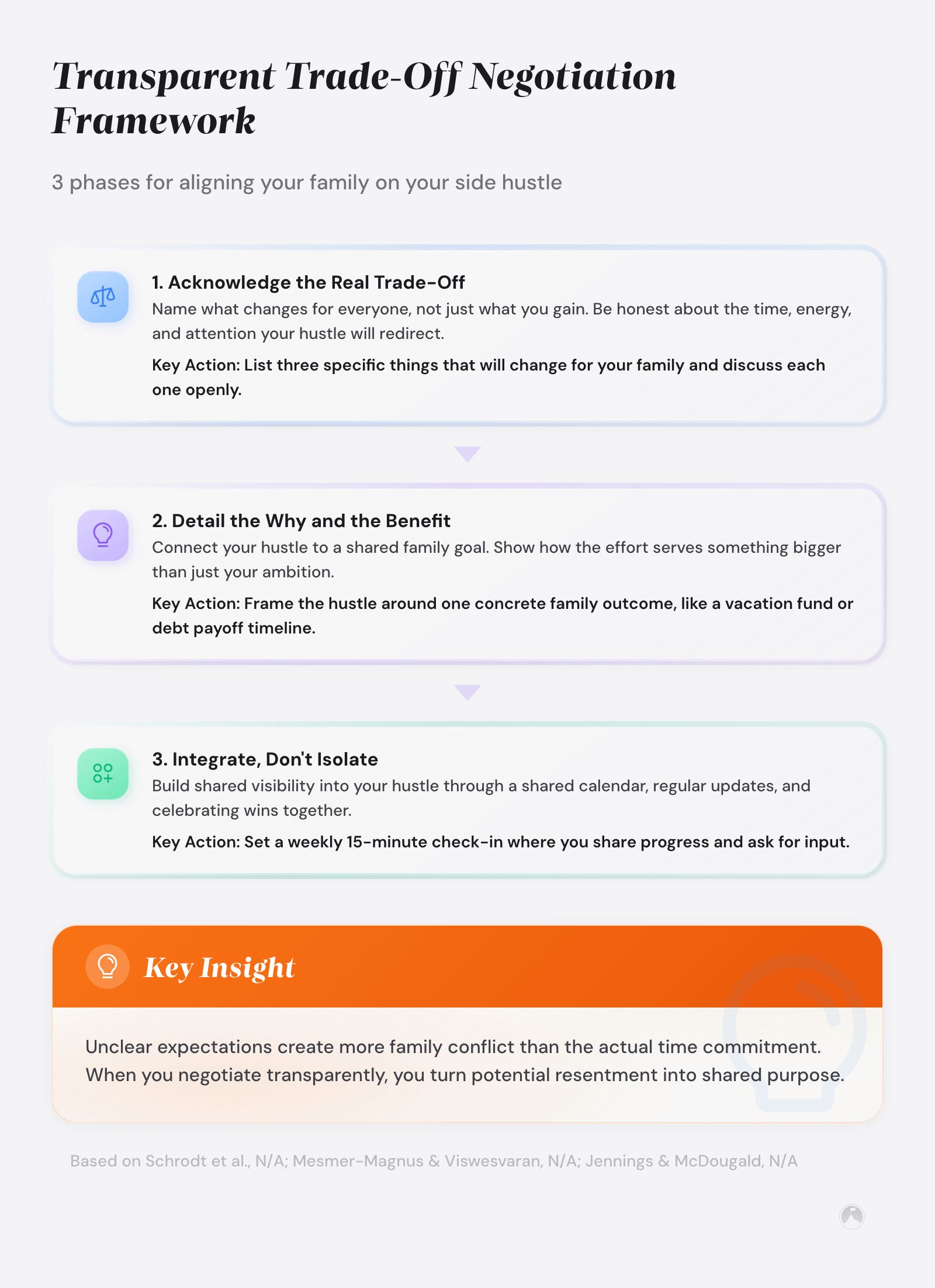
The Transparent Trade-Off Negotiation is a structured conversation approach that replaces apologies with joint problem-solving. The approach requires naming the cost honestly, explaining the benefit to everyone involved, and integrating the commitment into family life rather than concealing it. The goal is converting potential conflict into shared planning through communicating side hustle boundaries to family.
This framework has three phases: Acknowledge, Detail, and Integrate.
Phase 1: Acknowledge the real trade-off
Start by naming what’s actually being traded off. Not “I’m spending a few extra hours on my side hustle” – that’s vague and defensive.
Instead: “For the next six months, I’ll be working on this project from 5:30 to 7:00 PM on weeknights and 3-4 hours on Saturday mornings. That’s time I currently spend on [specific activity: watching shows after the kids sleep, side projects around the house, morning runs]. Here’s what that means for you.”
This honesty serves two purposes. First, it shows respect – you’re not hiding the actual cost. Second, it forces you to be realistic about the actual commitment, because when you say it out loud, you often realize the time estimate was inflated.
Setting expectations with family about side business starts here – with specifics, not hand-waving. (If you haven’t written your formal side hustle business plan yet, doing that first gives you concrete numbers to bring into this conversation.)
Phase 2: Detail the why and the benefit
Now explain why this matters to you and – even more so – what the family gets. Don’t lead with passion or dreams. That’s nice, but it doesn’t address your family’s real question: “Are you leaving us for this?”
Instead, lead with outcomes: “If I get this client, our savings margin for that college fund grows meaningfully. If I fail, we lose nothing but the time I’ve allocated. If I succeed, we have more flexibility in [specific life outcome: whether you work, saving for that trip, paying for the kids’ activities without stress].”
Conversation orientation is a family communication pattern in which members openly discuss goals, opinions, and decisions together rather than relying on one-way explanation or authority. High conversation orientation is associated with better psychosocial outcomes across measures of relationship satisfaction, conflict resolution, and resilience [4].
Schrodt and colleagues’ meta-analysis of 56 studies on family communication patterns found that families with high conversation orientation – where members openly discuss goals and decisions together – report significantly better psychosocial outcomes than families relying on conformity and one-way explanation [4]. When families see themselves in the benefit – not just tolerating your ambition but gaining from it – relationship cohesion increases.
Schrodt, Witt, and Messersmith found that open conversation orientation predicted psychosocial outcomes with a correlation of r=.460 across nearly 20,000 family members – a signal that how families talk about decisions matters far more than whether they avoid conflict. [4]
But the research goes deeper than that. Jennings and McDougald’s review of work-family interface experiences argues that spousal support increases significantly when partners perceive direct benefits to family outcomes [5]. Spouses who see themselves in the business outcomes report dramatically higher satisfaction than those who view it as the entrepreneur’s personal project.
Your family’s buy-in isn’t about convincing them to believe in your dream. It’s about showing them where they fit inside it.
The honesty about “if I fail” also matters. It signals that this isn’t a certainty and you’re not betting the house on it. That reduces anxiety.
One distinction worth making: the first conversation about starting a side hustle is different from ongoing renegotiation as the hustle scales. Early disclosure is about establishing buy-in – the framework above applies fully. Renegotiation happens when the reality drifts from the original agreement: the hours grew, the income didn’t materialize as expected, or your partner’s workload changed. Treat these as separate conversations with the same structure – but in renegotiation, lead by acknowledging what changed rather than defending the original plan.
Phase 3: Integrate, don’t isolate
This is where most side hustlers fail. They set up their schedule, communicate it once, and then wonder why family members still feel abandoned. The reality is that your side hustle needs to be integrated into family life, not segregated from it.
What does this look like? One option: your partner watches the kids during side hustle time, but you handle bedtime together after. Another: the kids know Monday and Wednesday evenings are “Dad’s project time” and they have a specific activity during that window.
Extended family gets a brief, honest summary at reunions: “I’m working on launching a consulting practice. You’ll see less of me Tuesday and Thursday evenings, but we’ll definitely still make Sunday dinners.” If your primary tension is with parents or in-laws rather than a partner – especially if they help with childcare – apply the same framework directly with them. Name the change, explain the benefit to the family unit, and give them a concrete picture of what stays the same.
If you’re a single parent or co-parenting without a live-in partner, the integration challenge shifts. You’re managing childcare logistics alongside side hustle time rather than negotiating with a spouse. Here the practical move is to be explicit with your kids about what’s different on side hustle days, and to use a shared digital calendar (Google Calendar, Cozi, or even a paper schedule on the fridge) so everyone knows when your work blocks are and when you’re fully available. Predictability does most of the emotional work that conversation can’t.
The integration reduces the sense of secrecy that triggers resentment. Your side hustle isn’t happening to your family – it’s happening in your family, with clear boundaries they understand. Balancing side hustle with family time isn’t about splitting your attention equally. It’s about making the boundaries visible and predictable.
The role of guilt and why it’s usually a system problem
Side hustle guilt is almost always a system signal, not a character flaw. When you feel guilty about time away from family, the productive question is not “should I quit?” but “which of the three patterns below applies?” Each has a different fix.
Many side hustlers report feeling guilty about the time away from family. That guilt is real and valid. But it’s also often a signal that your system isn’t working – either the time commitment is unrealistic, or the communication has broken down.
Consider a common version of this: you told your partner you’d wrap up the side project by 9 PM. It’s now 10:30 PM and you’re still at your laptop. Nobody said anything, but the silence at breakfast feels different. That guilt isn’t about ambition. It’s about a broken agreement – and the agreement is what needs to change, not the feeling.
Aarntzen and colleagues found that internalized gender stereotypes predict higher guilt in working mothers on days they work longer hours – pointing to a systematic gap between social expectations and actual time allocation rather than a character flaw [6].
Managing guilt about side hustle time typically means identifying which of three patterns applies:
Pattern 1: You’re working more hours than you said you would. You promised “two evenings and Saturday morning” but you’re also checking email during family dinner and working on Sundays. The guilt isn’t about the decision – it’s about the creeping expansion.
The solution: strict time boundaries. Calendar-block your side hustle hours just like client meetings. When the block ends, stop.
If you can’t stop, your time estimate was too optimistic – revise it downward and renegotiate with your family.
Pattern 2: You haven’t told anyone what you’re doing. You’re stealing time, justifying it privately as “necessary,” and feeling guilty because you know your family would have concerns if they knew. This guilt is the correct signal – you need to have the conversation you’ve been avoiding. It’ll feel uncomfortable, but delayed honesty is always worse.
Pattern 3: Your family has other demands that are incompatible with your timeline. Your partner is also running a side project, your kids are in a season with more activities, or one parent’s health needs attention. The guilt here is appropriate, and the solution is renegotiation. You might need to pause the side hustle for a season or cut your commitment in half – that’s not failure, it’s adaptation.
Guilt without corresponding action is just shame wearing a productive mask. If you feel bad but keep the same schedule, you’re not solving anything. You’re adding emotional pain on top of relationship strain. Identify which pattern applies, then change the system.
When family resistance isn’t unreasonable
Family resistance to a side hustle is often valid feedback about workload distribution, not irrational overprotectiveness. Before reframing it as a communication problem, check whether the household burden has shifted in ways you haven’t acknowledged.
Here’s the honest part: sometimes your family’s concern isn’t irrational overprotectiveness. Sometimes they’re seeing a problem you’re missing.
If your partner explicitly says, “I can’t do this alone,” they’re telling you that your side hustle is creating unsustainable burden on them. Maybe you’re relying on them to manage the kids, household, and their own work while you build your business. Ahmed and colleagues found that partners of entrepreneurs experience significantly higher stress when entrepreneurs don’t set clear boundaries [2].
That’s not a communication problem. That’s a system problem, and no amount of better conversation fixes an unfair distribution of labor.
The solution isn’t better guilt management. It’s honest evaluation: Is this worth the actual cost? Can you reduce your commitment? Can you hire help or renegotiate household tasks? Can you wait until life circumstances change?
Role overload is the experience of having too many competing demands across roles, parent, partner, employee, entrepreneur, such that meeting each role’s requirements fully is impossible. Research distinguishes role overload from simply working long hours: overload degrades relationship quality in ways that extra hours alone do not [7].
Similarly, if your kids are showing signs of behavioral change – acting out when you announce side hustle time, expressing that they miss you more often – those are data points you shouldn’t ignore. Crouter and colleagues’ study of 190 dual-earner families found that role overload – not just long hours – was associated with worse relationship outcomes for fathers with both wives and adolescent children [7]. Long hours reduced time together, but it was the overload of competing demands that degraded relationship quality. These reactions are telling you something real about the pressure on your family system.
You can’t usually ask children to suppress their feelings so you can pursue ambition. And you shouldn’t. The goal isn’t for family to accept your side hustle unconditionally – it’s for your side hustle to fit into a life where family relationships remain solid.
This sometimes means saying “not now.” That’s not failure. That’s the hardest form of strategic patience. When you do scale back, the skills you built won’t disappear: review scaling your side hustle while employed when the timing is right.
Ramon’s take
Before anything else, just write down what your side hustle actually costs per week in time. Not what you hope it costs. What it really costs. Show your partner that number first, before you pitch the dream. It changes the whole conversation.
Conclusion
Managing side hustle and family expectations isn’t about finding more time or getting better at balance. It’s about designing the conversation so expectations stay aligned as your business grows.
Most side hustlers treat family expectations as a problem to work around. That’s backward. Your family’s realistic expectations are the constraint that prevents you from overcommitting, burning out, and destroying the relationships the side hustle is supposed to serve in the first place.
A partner who knows the actual time cost, the realistic upside, and their own role in the plan will show up differently than one who’s simply tolerating your absence. That difference is not small. Research shows that families with open conversation orientation report significantly better outcomes across psychosocial measures than those relying on one-way explanations alone [4].
The Transparent Trade-Off Negotiation framework is not magic. It’s just honest conversation structured around specifics instead of vague optimism. When you run it well, your family stops being an audience for your ambitions and becomes a participant in the plan. That’s the version of this that actually holds up over time.
Next 10 minutes
- Write down the actual weekly hours your side hustle takes – not your optimistic estimate, the real number including emails, research, and admin. Compare it to what you’ve communicated. The gap between those two numbers is your most important data point.
- Block a 20-minute conversation with your partner this week – not tonight when you’re both tired, but at a time you’d both show up fully. Put it in the calendar now.
This week
- Have the Transparent Trade-Off Negotiation conversation with your primary partner or the family member most affected by your side hustle time.
- If you have kids old enough to understand, give them a simple, honest explanation of what you’re working on and why (without making it about your dreams – frame it around something concrete: “This helps us save for X” or “This means I can choose my own schedule in the future”).
- Identify one thing you’ll do less of to make room for your side hustle, and name it explicitly in the conversation. This shows the tradeoff is real and you’ve thought about it.
Related articles in this guide
Frequently asked questions
This article is part of our Side Hustle Time Management complete guide.
How do I talk to my partner about starting a side hustle without them feeling threatened?
Lead with the actual time commitment and concrete benefit, not your passion for the idea. Say: ‘I want to work on this three evenings a week for the next six months. Here’s what we’ll gain if it works, and here’s what we lose if I do nothing.’ Avoid vague timelines or emotional appeals about dreams. Specificity and benefit-framing reduce defensiveness. The conversation should feel like joint planning, not you asking permission.
What if my partner doesn’t support my side hustle at all?
Their resistance might signal real concerns: unsustainable added burden on them, unrealistic time estimates, or unclear benefit. Ask directly: ‘What specifically worries you?’ Listen for the actual problem, not just the objection. If they say, ‘You won’t have time to help with the kids,’ the problem isn’t the side hustle – it’s that their load increases. Can you hire help, reduce commitments elsewhere, or adjust the timeline? If the resistance is genuine and your partner can’t be brought into alignment, you have a choice to make. A side hustle isn’t worth a broken partnership.
How do I set boundaries so my side hustle doesn’t expand infinitely?
Calendar-block your hours like they’re client meetings. When the block ends, stop. If you find yourself working overtime consistently, your time estimate was wrong – adjust it downward and renegotiate with your family. The goal isn’t productivity maximization. It’s sustainable rhythm that family can trust and rely on. Broken promises erode trust faster than honest scarcity.
Should I involve my kids in my side hustle?
Yes, but age-appropriately. Kids under 8 need simple honesty: ‘Mom works on a project Tuesday and Thursday evenings. You’ll do an activity with Dad during that time.’ Kids 8-12 can understand higher-level outcomes: ‘I’m building something that could help our family save money for [concrete goal].’ Teenagers benefit from seeing the actual work, learning why you chose it, and understanding how effort connects to outcomes. Involvement reduces the sense that you’re abandoning them for mysterious work.
How do I manage guilt about side hustle time away from family?
First, determine if the guilt signals a real problem: Are you working more than you committed? Did you never have the conversation? Is your family actually struggling? If yes to any of these, the guilt is useful – act on it. If no, the guilt might be abstract shame about ambition. In that case, the fix is internal: remind yourself that pursuing meaningful work models good values for your family and creates security. You don’t need to eliminate the guilt. You need the guilt to match reality.
What if family demands conflict with my side hustle schedule?
Renegotiate. This is the honest answer, not the one you want to hear. If your partner needs more support, your kids need more attention, or a parent’s health requires time, your side hustle might need to pause or scale back. That’s not failure. That’s realistic adaptation. Growth isn’t linear. Some seasons prioritize business, others prioritize family. Both are valid choices.
References
[1] Mesmer-Magnus, J. R., & Viswesvaran, C. “Convergence between measures of work-to-family and family-to-work conflict: A meta-analytic examination.” Journal of Vocational Behavior, 2005. DOI
[2] Ahmed, A. E., Ucbasaran, D., Cacciotti, G., & Williams, T. A. “Integrating psychological resilience, stress, and coping in entrepreneurship: A critical review and research agenda.” Entrepreneurship Theory and Practice, 2022. DOI
[3] Lee, S., McHale, S. M., Crouter, A. C., Kelly, E. L., Buxton, O. M., & Almeida, D. M. “Perceived time adequacy improves daily well-being: Day-to-day linkages and the effects of a workplace intervention.” Community, Work & Family, 2017. DOI
[4] Schrodt, P., Witt, P. L., & Messersmith, A. S. “A meta-analytical review of family communication patterns and their associations with information processing, behavioral, and psychosocial outcomes.” Communication Monographs, 2008. DOI
[5] Jennings, J. E., & McDougald, M. S. “Work-family interface experiences and coping strategies: Implications for entrepreneurship research and practice.” Academy of Management Review, 2007. DOI
[6] Aarntzen, L., Derks, B., van Steenbergen, E., & van der Lippe, T. “When work-family guilt becomes a women’s issue: Internalized gender stereotypes predict high guilt in working mothers but low guilt in working fathers.” British Journal of Social Psychology, 2023. DOI
[7] Crouter, A. C., Bumpus, M. F., Head, M. R., & McHale, S. M. “Implications of overwork and overload for the quality of men’s family relationships.” Journal of Marriage and the Family, 2001. DOI