Why 10,000 hours is the wrong benchmark for where you actually are
You want to learn a new skill. So you search for how long it takes. The answers are discouraging: 10,000 hours to master, two years to reach conversational fluency, six months to become job-ready in code. Those numbers hit different when you’re already working 50 hours a week and have limited capacity for learning.
Here’s the trap: those timelines describe mastery, not functional competency. Research from K. Anders Ericsson, the psychologist whose work Malcolm Gladwell popularized as the “10,000-hour rule,” shows something different. Structured practice produces meaningful gains far earlier than the mastery threshold [1]. A 2014 meta-analysis across 88 studies found that deliberate practice explained between less than 1% and 26% of performance variance depending on the domain, confirming that the 10,000-hour figure oversimplifies a highly domain-dependent relationship [cite Macnamara et al., 2014 – see reference 7]. Josh Kaufman, building on Ericsson’s framework, field-tested this principle across six different skills and found that functional competency – the ability to perform a skill adequately in real contexts – typically arrives within approximately 20 hours of focused practice [5]. The real gap between “I can’t do this” and “I can do this well enough to be useful” is much shorter than the conventional wisdom suggests.
If you’re building a broader creativity and learning strategies approach, this article is your tactical practice layer. It tells you what to do in each session, not what subjects to learn overall.
Learning new skills quickly is structured skill acquisition that targets the highest-impact sub-skills first, applies evidence-based practice methods, and compresses the timeline to functional competency by eliminating low-value activities. Unlike casual practice, rapid skill acquisition requires specific structure and feedback mechanisms in every session.
Learning new skills quickly requires three decisions before you start: identify the 20% of sub-skills that unlock 80% of functional ability, practice those sub-skills using retrieval practice and spaced repetition rather than passive review, and test in realistic contexts every week. Research shows functional competency arrives in approximately 20 focused hours when practice targets the highest-impact components first.
What you will learn
- The Skill Compression Cycle: a four-phase framework you repeat at increasing levels of detail
- How to find the 20% of sub-skills that unlock 80% of functional ability
- Why deliberate practice beats casual repetition by a measurable factor
- How to build consistent practice into a packed schedule without carving out new time
- What causes the inevitable learning plateau and how to break through it in days
Key takeaways
- Functional competency typically arrives in approximately 20 focused hours, not the thousands required for mastery [1][5].
- The Skill Compression Cycle alternates between deconstructing, targeting, practicing, and testing in four-week iterations.
- Deliberate practice explains between less than 1% and 26% of performance variance depending on domain – the portion you actually control [7].
- The 80/20 rule for learning works: targeting the top 20% of sub-skills produces disproportionate results.
- Dunlosky’s meta-analysis identifies two high-utility techniques: retrieval practice and distributed spacing [4].
- Fifteen minutes daily beats two-hour weekend sessions by a significant margin for long-term retention [4].
- Plateaus are consolidation periods responding to method changes, not volume increases.
- Following tutorials creates recognition memory; building from scratch creates recall memory, which transfers to real performance [4].
What is the skill compression cycle and how does it work?
Most people learn by starting at the beginning and working through material in order. That method works fine for school exams. It doesn’t work when you need usable ability in weeks. The problem is simple: linear learning treats all sub-skills as equally important. They aren’t.
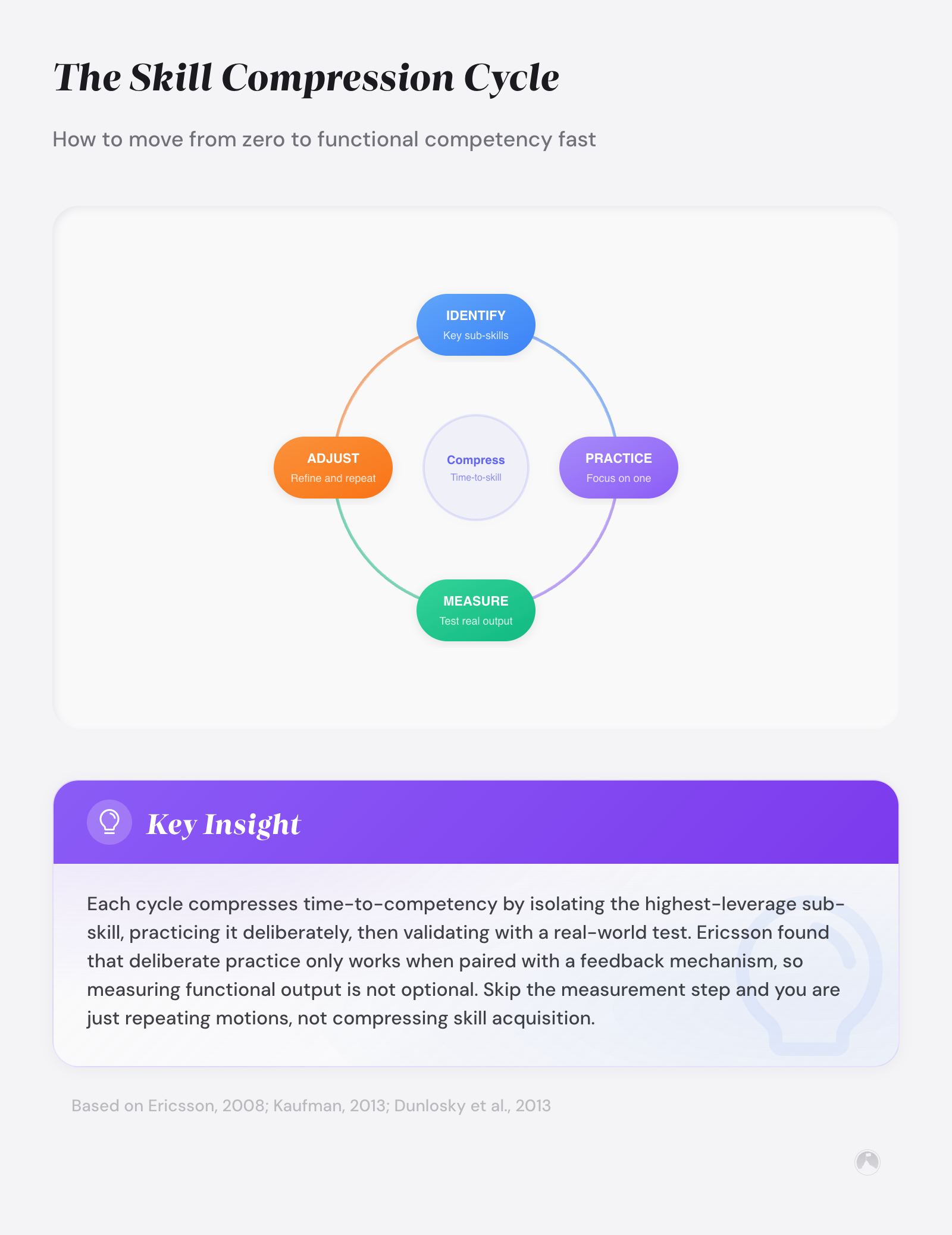
The research on accelerated learning techniques shows a repeated pattern: four phases, cycled multiple times, that compress the path from zero to competent. Each cycle refines your focus further.
Here’s a framework that keeps showing up across the research on rapid skill mastery. Four phases, repeated in a loop, each pass tighter than the last. None of the individual pieces are new – Kaufman’s model covers skill deconstruction [5], Ericsson’s work established deliberate practice as the standard [1], and Dunlosky’s meta-analysis documented the testing effect [4]. We developed a framework called the Skill Compression Cycle by integrating Kaufman’s deconstruction model [5], Ericsson’s deliberate practice standard [1], and Dunlosky’s testing-effect research [4] into a single repeating process.
The four phases are: deconstruct the skill into sub-skills, target the highest-impact subset, practice with structure and feedback, then test in a realistic context. After testing, you deconstruct again at a finer granularity, re-target, compress further.
Here’s what this looks like in practice. Learning public speaking: first cycle deconstructs into structure, vocal delivery, slide design, audience reading, and Q&A handling. You target the two that matter most – structure and vocal delivery. You practice both with feedback, then test by giving a five-minute talk to a colleague.
Second cycle: you deconstruct “delivery” into pacing, eye contact, vocal variety, and filler elimination. You target the weakest area and practice it. Third cycle goes even deeper. Each pass tightens the focus.
The fastest learners do not practice more hours. Fast learners compress the Skill Compression Cycle into shorter iterations.
How do you break down a skill into learnable sub-skills?
This is where accelerated learners gain the clearest edge. They win not by practicing harder, but by practicing the right things first. The 80/20 rule for learning states that roughly 20% of a skill’s components unlock 80% of functional value. Your first job is identifying that 20%.
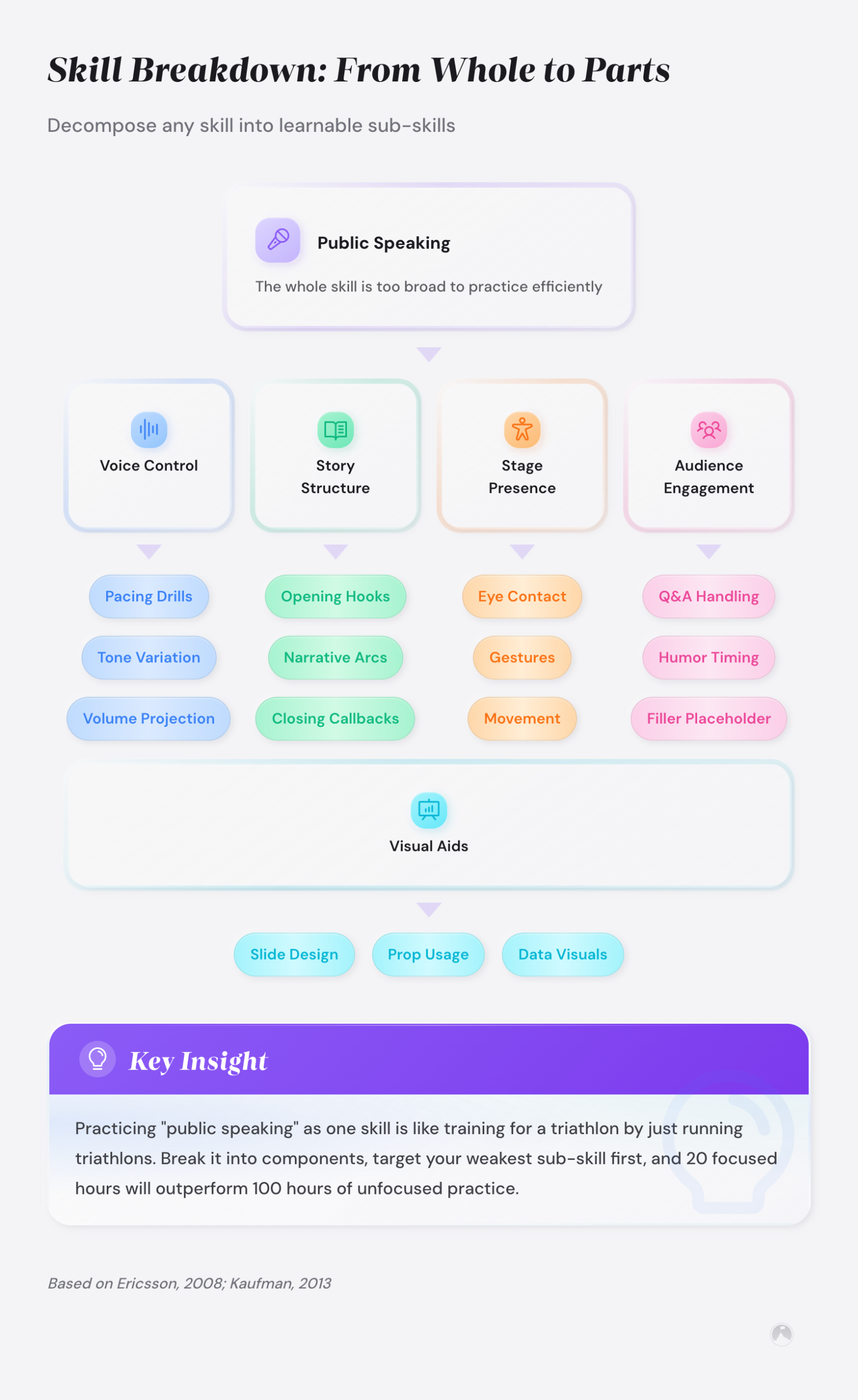
Start by listing every sub-skill you can think of. Don’t filter. For coding, that’s syntax, debugging, algorithms, version control, database queries, API integration, testing, deployment, front-end design, and documentation. Ten sub-skills. Now rank them by how much usable capability each one unlocks independently.
Syntax and debugging unlock basic program writing and fixing. Algorithms unlock efficient problem-solving. Those three components produce more practical ability than the remaining seven combined.
| Skill domain | High-impact sub-skills (the vital 20%) | Lower-priority sub-skills |
|---|---|---|
| Public speaking | Message structure, confident delivery | Slide animation, script memorization |
| Coding | Syntax, debugging, algorithmic thinking | Deployment pipelines, database optimization |
| Guitar | Four open chords, strumming patterns, chord transitions | Music theory, scales, fingerpicking |
| Photography | Composition, exposure triangle, light reading | Post-processing, lens selection, studio lighting |
Functional competency requires depth in a few areas, not surface-level familiarity with many. This is why the 20 hour rule for skill acquisition becomes real: Josh Kaufman’s assertion that you can learn the basics of any skill in 20 hours is true only if those 20 hours target the highest-impact sub-skills [5]. Twenty hours scattered across ten sub-skills produces almost nothing useful.
Building a growth mindset for lifelong learning helps here too. Deconstructing a skill means admitting you don’t yet know what matters most. Your first breakdown will be imperfect. That’s expected. The cycle accounts for it: your second deconstruction after one practice-test cycle will be sharper because you’ve learned the skill’s actual structure.
This approach also connects to skill stacking methods – combining complementary sub-skills from different domains into a unique capability set. But that’s a second-order decision. First, get competent in the core sub-skills of a single domain.
The question isn’t “what should I learn?” It’s “what 20% should I learn first?”
Learning new skills quickly: which techniques have the strongest evidence?
Not all practice hours count equally. A 2019 meta-analysis by Brooke Macnamara and Megha Maitra revisited Ericsson’s original violin studies and found that deliberate practice explained 26% of performance variance in that context [2]. Domain matters: deliberate practice accounted for between less than 1% and 26% of performance variance, depending on the domain [7]. Ericsson later clarified in a 2019 analysis that definitions of deliberate practice vary across studies, which partly explains the range of effect sizes reported by different researchers [3].
“Deliberate practice accounted for 26% of the variance in games, 21% in music, 18% in sports, 4% in education, and less than 1% in professions.” – Macnamara, Hambrick, and Oswald, 2014 [7]
Deliberate practice requires four non-negotiable conditions: a specific session goal, full attention during practice, immediate performance feedback, and focused repetition on weaknesses rather than strengths. Ericsson’s original research showed that expertise emerges from this specific combination, not from accumulated undirected hours [1].
The practical difference is stark. Casual guitar practice: play through songs you already know for 30 minutes. Deliberate guitar practice: isolate the G to C chord transition (your weakest one), set a metronome to 60 BPM, attempt it 20 times, count the clean transitions, increase tempo by 5 BPM when you hit 18 out of 20. Same 30 minutes. Radically different results.
The science connects to neuroplasticity and learning. When you practice at the edge of your ability with immediate feedback, your brain forms neural connections faster than when you repeat what you already know. Comfort is the enemy of skill acquisition speed.
Repetition builds familiarity. Deliberate practice builds ability.
John Dunlosky and colleagues reviewed hundreds of learning studies and ranked each technique for effectiveness [4]. Two techniques stood out as highest-utility across age groups, skill types, and contexts: practice testing (retrieval practice) and distributed practice (also called spaced repetition). Both rated “high utility.” Popular techniques like highlighting and rereading rated “low utility.”
“Practice testing and distributed practice received the highest utility ratings, benefiting learners of different ages, abilities, and levels of prior knowledge across many criterion tasks.” – Dunlosky et al., 2013 [4]
Retrieval practice means forcing yourself to recall information without looking at the source, which strengthens memory far more than passive review [4]. This is why tutorial-following feels productive but isn’t the learning that matters. Following a coding tutorial, you recognize patterns as you see them. When you close the tutorial and try to build something from scratch, you’re retrieving – and retrieving is harder and more effective.
The interleaving practice technique mixes different sub-skills or problem types within a single session (ABCABC pattern) rather than practicing each type in isolated blocks (AAABBB pattern), forcing the brain to practice selecting the right approach under varied conditions. Dunlosky’s team initially rated interleaving as showing moderate promise, and subsequent research has confirmed its benefits across domains [4]. Interleaving feels harder and shows slower visible progress during practice, but it leads to better real-task performance where you need to select the right approach, not repeat a known one.
| Learning technique | Effectiveness rating | Best for | Common mistake |
|---|---|---|---|
| Practice testing (retrieval) | High utility [4] | All skill types | Checking answers too quickly |
| Distributed practice (spacing) | High utility [4] | Memory-heavy skills | Cramming before deadlines |
| Interleaving | Moderate utility [4] | Skills requiring selection | Quitting when progress feels slow |
| Highlighting | Low utility [4] | Very limited | Mistaking familiarity for learning |
| Rereading | Low utility [4] | Very limited | Passive time consumption |
For a deeper comparison of these techniques across different contexts, our guide on learning methods compared explores the trade-offs. For rapid skill mastery in particular, retrieval practice and spacing produce the fastest gains with the least total time invested.
Rereading feels productive but ranks as the least effective learning technique. Retrieval practice feels the hardest but ranks as the most effective learning technique.
How do you fit focused practice sessions into a busy schedule?
Here’s where the distributed practice research gets practical for busy professionals: shorter, frequent sessions beat longer, infrequent ones. Fifteen minutes of focused daily practice produces better retention than a two-hour session once a week [4]. This means you don’t need to find a new dedicated learning block. You need to protect a consistent 15-to-30-minute daily window. These efficient learning frameworks don’t require radical schedule changes – they work within the time you already have.
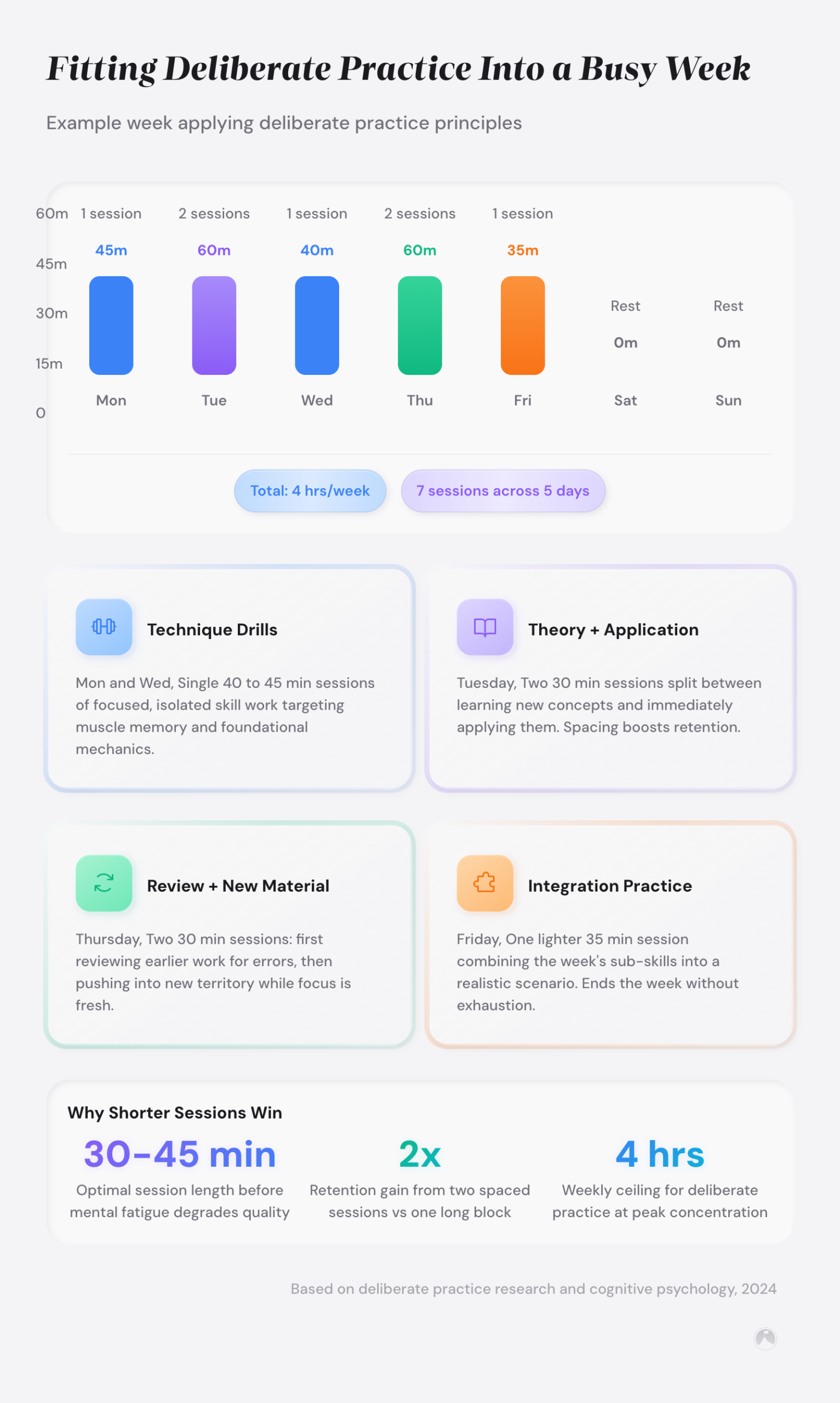
Three scheduling strategies that actually work for time-pressured people:
Anchor stacking attaches your practice session to an existing habit. If you already drink coffee at 7 AM, your practice starts at 7:05. The existing habit triggers the practice, so you don’t rely on willpower or memory. This is why building a personal learning system matters: the system handles the scheduling so your energy goes into practicing.
Micro-practice windows use the 5-to-10-minute gaps that already exist in your calendar. Waiting for a meeting to start – practice flashcards. Commuting by train – listen to a lesson and mentally rehearse it. Five sessions of 8 minutes each equals 40 minutes of daily practice that costs zero new time.
Weekend deep sessions complement daily micro-practice with one 60-to-90-minute integrated session on the weekend. Weekday sessions build isolated sub-skills. Weekend sessions combine them into real performance. The weekday sessions handle spacing; the weekend session handles interleaving.
Distributed practice is a learning strategy that spaces practice sessions across multiple days rather than concentrating them into a single block, leveraging the spacing effect – where forgetting between sessions forces reconstruction that strengthens long-term memory. Distributed practice works through a counterintuitive mechanism: forgetting between sessions forces your brain to reconstruct the memory, which strengthens it more than continuous repetition. It feels like you’re losing progress between sessions. You’re not – you’re building stronger recall pathways.
Consistency beats intensity. Fifteen minutes every day outperforms two hours once a week.
What causes beginner plateaus and how do you break through them?
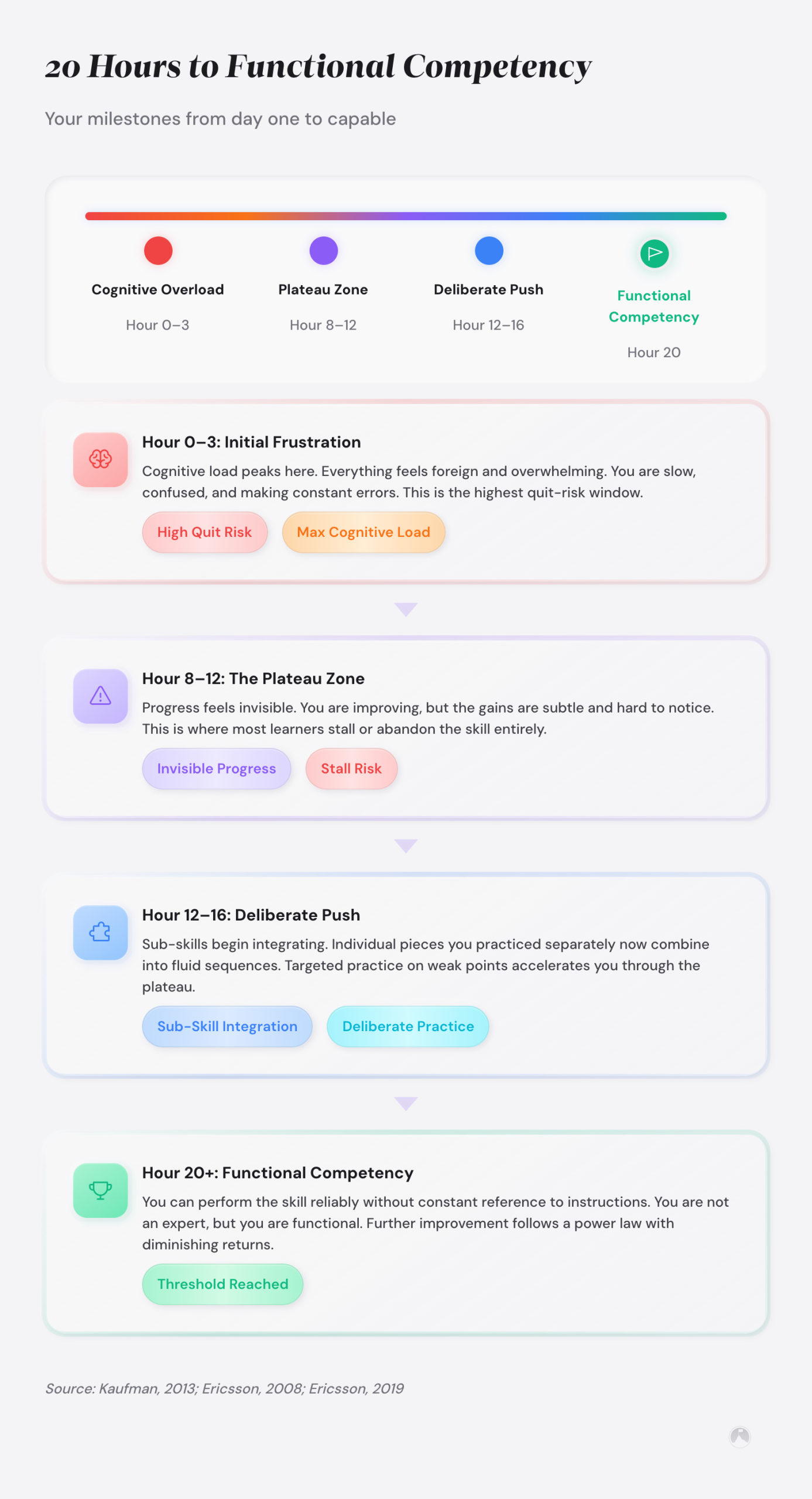
Typically within the first two weeks of regular practice, most learners hit a session where nothing works. The chord transitions that were improving stop. The code that was getting cleaner feels clunky again. The thought arrives: maybe this isn’t for you. But that moment is predictable, normal, and solvable.
Beginner plateaus happen for a specific reason: your brain is consolidating. Initial rapid gains came from learning gross motor patterns or conceptual frameworks. The plateau marks the transition from gross patterns to fine-tuning. Research on motor skill learning shows that performance improvements continue during offline periods – between practice sessions – due to sleep and consolidation processes [6]. Fine-tuning doesn’t produce visible progress as quickly, but it’s happening underneath.
“Performance improvements in motor skill learning occur offline, following a period of sleep, not during practice itself.” – Walker et al., 2003 [6]
Four plateau-breaking strategies supported by research:
First, change the practice method, not the volume. If you’ve been drilling chord transitions at a fixed tempo, try playing a song at full speed and accept the mistakes. The context switch exposes different weaknesses.
Second, seek external feedback. Record yourself and review it, or ask someone more skilled to watch one attempt. Self-assessment during a plateau is unreliable – you can’t see what you can’t see.
Third, reduce difficulty temporarily. Go back to a sub-skill you’ve mastered and practice a harder variation of it. Success on a related task rebuilds momentum.
Fourth, take a deliberate 48-hour break. Sleep consolidation plays a measurable role in motor and cognitive skill development [6]. According to Walker’s research, overnight sleep triggers neural changes that solidify skills learned during practice. Sometimes the best thing for a plateau is stopping practice for two days to let this process work.
Plateaus respond to changes in method, not increases in volume. The bottleneck during a plateau is approach quality, not practice quantity.
| Week | Activities |
|---|---|
| Week 1 | Deconstruct the skill, identify your top 3 sub-skills, practice Sub-skill #1 for 15 min daily |
| Week 2 | Add Sub-skill #2, begin interleaving between them, 20 min daily |
| Week 3 | Add Sub-skill #3, complete your first realistic test, 20 min daily plus weekend deep session |
| Week 4 | Second cycle of the Skill Compression Cycle at a finer level, 20 min daily plus test |
Tools like learning apps help track sessions and maintain spaced repetition schedules automatically, so you focus on practice rather than planning.
When your schedule or brain works differently
The 30-day framework above assumes consistent daily windows and steady focus. If you have ADHD or you’re a parent juggling fragmented time, the framework still works – but the execution looks different.
For ADHD learners: The micro-practice windows strategy is your best entry point. Short bursts (5 to 10 minutes) with clear start and stop conditions prevent the overwhelm of a 30-minute “practice block” that feels like a wall. Set a timer. When it goes off, you stop – even if you’re in flow. That hard stop actually makes it easier to start the next session because you know it won’t swallow your whole evening.
In my experience, interleaving tends to work well for many ADHD learners because the sub-skill switching provides novelty that can help maintain engagement. If you want strategies built around how ADHD affects the learning process, our guide on creative learning ADHD strategies goes deeper.
For parents: Anchor stacking to existing kid-related routines (practice during nap time, or during the 15 minutes after school drop-off) is more reliable than trying to protect a dedicated slot in an unpredictable schedule. Weekend deep sessions may need to shift to early mornings before the house wakes up.
The 80/20 approach matters even more when your time is genuinely scarce – ruthlessly cut the sub-skills that aren’t highest-impact and don’t feel guilty about it.
The framework doesn’t change. The session shape does.
Ramon’s take
Apparently the 10,000-hour rule was mostly about elite performers and we all just ran with it for decades. I haven’t tested the 20-hour version yet, but the bar being lower is already helping me start things I’ve been putting off.
The 80/20 analysis is genuinely transformative when you apply it honestly. Most of us spend too long on the sub-skills that feel productive instead of the ones that move the needle. It feels great to tinker with slide animations, but it doesn’t compare to practicing your opening 30 seconds until you can deliver it without thinking. The framework works, but only if you’re honest about which sub-skills matter and which ones are procrastination wearing a productivity costume.
Conclusion: learning new skills quickly with structure, not shortcuts
Learning new skills quickly comes down to three decisions you make before you start: which sub-skills matter most, what deliberate practice looks like for those sub-skills, and when in your schedule you’ll practice every day. The Skill Compression Cycle gives you a repeatable framework for making those decisions and refining them as you progress. Efficient learning frameworks don’t eliminate the work. They make sure every minute of work produces measurable progress.
The fastest learners aren’t the ones who practice the most hours. They’re the ones who waste the fewest.
Next 10 minutes
- Pick one skill you want to learn and write down every sub-skill you can identify (aim for at least eight).
- Circle the two or three sub-skills that would unlock the most capability if you mastered them first.
- Choose a 15-minute daily time slot by anchoring it to an existing habit.
This week
- Complete your first five daily practice sessions targeting your highest-impact sub-skill.
- Set a specific, measurable goal for each session (for example: “complete 20 chord transitions at 80 BPM with 15+ clean”).
- Schedule a weekend deep session of 60-90 minutes to integrate what you’ve practiced into a realistic task.
There is more to explore
For a broader look at how learning fits into your personal development strategy, explore our guide on creativity and learning strategies. If you’re interested in the brain science behind why these techniques work, our article on neuroplasticity and learning goes deeper into the mechanisms. And if you want to build a complete system around your learning goals, see our guide on building a personal learning system. For creative approaches to breaking through mental blocks during learning, overcoming creative blocks offers practical strategies.
Related articles in this guide
- leveraging-hobbies-for-creativity-boost
- mind-mapping-for-brainstorming
- neuroplasticity-learning-science
Frequently asked questions
Can you learn multiple skills at the same time?
Yes, with conditions. Interleaving two or three related skills during the same practice period can improve retention and transfer. Learning guitar and singing simultaneously, for instance, reinforces both. Attempting five unrelated skills at once, though, fragments your practice time below the threshold for meaningful progress on any single one. Two to three complementary skills is the practical upper limit.
How do you break down complex skills into learnable parts?
List every component sub-skill, then rank them by how much functional capability each one unlocks independently. The top two or three sub-skills on that ranked list become your first practice targets. After one cycle of practice and testing, re-rank the list based on what you’ve learned about the skill’s structure. Each ranking pass becomes more precise than the last.
What is interleaving and why does it accelerate learning?
Interleaving means mixing different sub-skills or problem types within a single practice session (ABCABC) rather than practicing one type in a block (AAABBB). Interleaving feels harder and produces slower visible progress during practice, but it improves real-world performance by training your brain to select the right approach, not repeat a memorized sequence [4].
What should I do when I hit a learning plateau?
Change your practice method rather than increasing practice volume. Record yourself and review the footage for patterns you can’t detect in real time. Temporarily reduce the difficulty and practice a variation of a mastered sub-skill. If the plateau persists for more than three sessions, take a full 48-hour rest period to let sleep consolidation do its work [6].
How do I know if I’m practicing effectively or wasting time?
Effective practice feels uncomfortable. You’re working at the edge of your ability, not repeating what you already know. Track one measurable metric per session (accuracy, speed, completion rate) and check whether that metric improves across sessions. If you’ve practiced for a week with no measurable change, your practice targets or methods need adjustment, not more hours.
References
[1] Ericsson, K.A. “Deliberate Practice and Acquisition of Expert Performance: A General Overview.” Academic Emergency Medicine, 15(11), 988-994, 2008. https://pubmed.ncbi.nlm.nih.gov/18778378/ doi:10.1111/j.1553-2712.2008.00227.x
[2] Macnamara, B.N. and Maitra, M. “The Role of Deliberate Practice in Expert Performance: Revisiting Ericsson, Krampe & Tesch-Romer (1993).” Royal Society Open Science, 6(8), 190327, 2019. https://pmc.ncbi.nlm.nih.gov/articles/PMC6731745/ doi:10.1098/rsos.190327
[3] Ericsson, K.A. “Towards a Science of the Acquisition of Expert Performance in Sports: Clarifying the Differences Between Deliberate Practice and Other Types of Practice.” Journal of Sports Sciences, 38(2), 159-176, 2019. https://www.tandfonline.com/doi/full/10.1080/02640414.2019.1688618
[4] Dunlosky, J., Rawson, K.A., Marsh, E.J., Nathan, M.J., and Willingham, D.T. “Improving Students’ Learning With Effective Learning Techniques: Promising Directions From Cognitive and Educational Psychology.” Psychological Science in the Public Interest, 14(1), 4-58, 2013. https://journals.sagepub.com/doi/abs/10.1177/1529100612453266 doi:10.1177/1529100612453266
[5] Kaufman, J. The First 20 Hours: How to Learn Anything Fast. Penguin Books, 2013. https://first20hours.com/
[6] Walker, M.P., Brakefield, T., Seidman, J., Morgan, A., Hobson, J.A., and Stickgold, R. “Sleep and the Time Course of Motor Skill Learning.” Learning & Memory, 10(4), 275-284, 2003. https://pubmed.ncbi.nlm.nih.gov/12888546/ doi:10.1101/lm.58503
[7] Macnamara, B.N., Hambrick, D.Z., and Oswald, F.L. “Deliberate Practice and Performance in Music, Games, Sports, Education, and Professions: A Meta-Analysis.” Psychological Science, 25(8), 1608-1618, 2014. https://doi.org/10.1177/0956797614535810