 Goals & Progress


Why Your Best Ideas Never Make It Out of Your Head
You sit down to brainstorm, open a blank document, and start typing a list. Ten minutes later, you’ve got seven bullet points that all feel disconnected. The good ideas, the weird ones, the half-formed sparks, got lost somewhere between your brain and the screen. Mind mapping for brainstorming fixes that gap by matching the way your brain actually generates ideas: in webs of association, not straight lines [1].
Tony Buzan, the British author and educational consultant who popularized the mind mapping method in the 1970s, built the technique around a concept he called “radiant thinking,” the brain’s natural tendency to fire outward from a central idea in multiple directions at once [1]. The neuroscience of associative thinking describes how branching patterns mirror the way neural networks form connections. A 2023 meta-analysis of 21 studies published in Asia Pacific Education Review found that mind mapping-based instruction produces stronger cognitive learning outcomes than traditional linear methods [2].
Mind mapping for brainstorming is a visual technique that places one central idea at the middle of a page and branches outward into related subtopics, mirroring the brain’s associative thinking patterns to capture more ideas in less time.
Mind mapping is a non-linear visual brainstorming technique that places a central topic at the center of a diagram and uses radiating branches of keywords, colors, and images to organize related ideas. Unlike linear methods such as lists or outlines, mind mapping preserves the spatial relationships between concepts.
What You Will Learn
- Why mind mapping produces more ideas than linear brainstorming
- Tony Buzan’s original rules and the science behind radiant thinking
- How to build a mind map from scratch in under 15 minutes
- The branch-then-bloom step for turning a messy map into concrete next steps
- Mind map examples across content strategy, career decisions, and exam prep
- When to use paper vs. digital mind mapping tools
- How to run a collaborative mind mapping session with a team
Key Takeaways
- Mind mapping instruction produces stronger cognitive learning outcomes than linear methods across 21 studies [2].
- Tony Buzan’s radiant thinking model mirrors the brain’s associative structure, where each idea triggers multiple connections [1].
- Mind mapping showed a trend toward 10% better long-term recall versus self-selected study techniques in medical students, though the confidence interval was wide [3].
- Pairing the free-form branching phase with a structured review (the branch-then-bloom approach) turns a messy map into prioritized action items.
- Mind mapping reduces cognitive load by offloading working memory onto a visual structure [4].
- Collaborative mind mapping with structured digital tools outperforms whiteboard brainstorming for recall-based group tasks [5].
- Computer-supported scaffolds such as SCAMPER prompts improve idea originality during the individual phase of hybrid brainstorming sessions [6].
Why Does Mind Mapping Beat Linear Brainstorming?
Linear brainstorming, writing a numbered list from top to bottom, forces your thinking into a single lane. You write idea number three and your brain is already filtering whether it “fits” after idea number two. Mind mapping removes that filter. When you branch off a central topic in multiple directions, you give your brain permission to follow tangents without losing track of the main theme.

Researchers Shi, Yang, Dou, and Zeng conducted a meta-analysis of 21 studies involving 1,602 participants and found that mind mapping-based instruction had a statistically positive effect on cognitive learning outcomes compared to traditional instruction [2]. The effect was strongest in science and math subjects, where connecting related concepts matters most.
Shi et al.’s 2023 meta-analysis in Asia Pacific Education Review concluded that mind mapping-based instruction had a statistically positive effect on student cognitive learning outcomes compared with traditional instruction [2].
Farrand, Hussain, and Hennessy found similar results when they tested mind maps against self-selected study techniques with medical students, reporting a trend toward 10% greater factual recall one week after the study session, though with a wide confidence interval [3].
Mind mapping stimulates divergent thinking by removing the sequential constraint that linear methods impose on idea generation. That removal is the core mechanism. A list asks “what comes next?” A mind map asks “what connects here?” Those are different cognitive operations entirely, and the second one is where unexpected combinations surface.
Nesbit and Adesope reviewed 55 studies comparing concept and knowledge maps with other study methods and found a consistent advantage for visual-spatial learning strategies across reading, lecture, and text-processing tasks [4]. Your brain does not have to hold the architecture of your thinking and produce new thoughts at the same time. The mind map externalizes that architecture so your brain can focus on generating new ideas.
Tony Buzan’s Mind Mapping Rules: Where Radiant Thinking Comes From
Tony Buzan developed mind mapping during the late 1960s and 1970s while exploring how the brain organizes information. He noticed that his own note-taking felt disconnected from how his brain processed ideas. Linear notes ran top-to-bottom, but his thinking fired in multiple directions from every concept [1]. That mismatch between brain architecture and note-taking format became the foundation of radiant thinking.
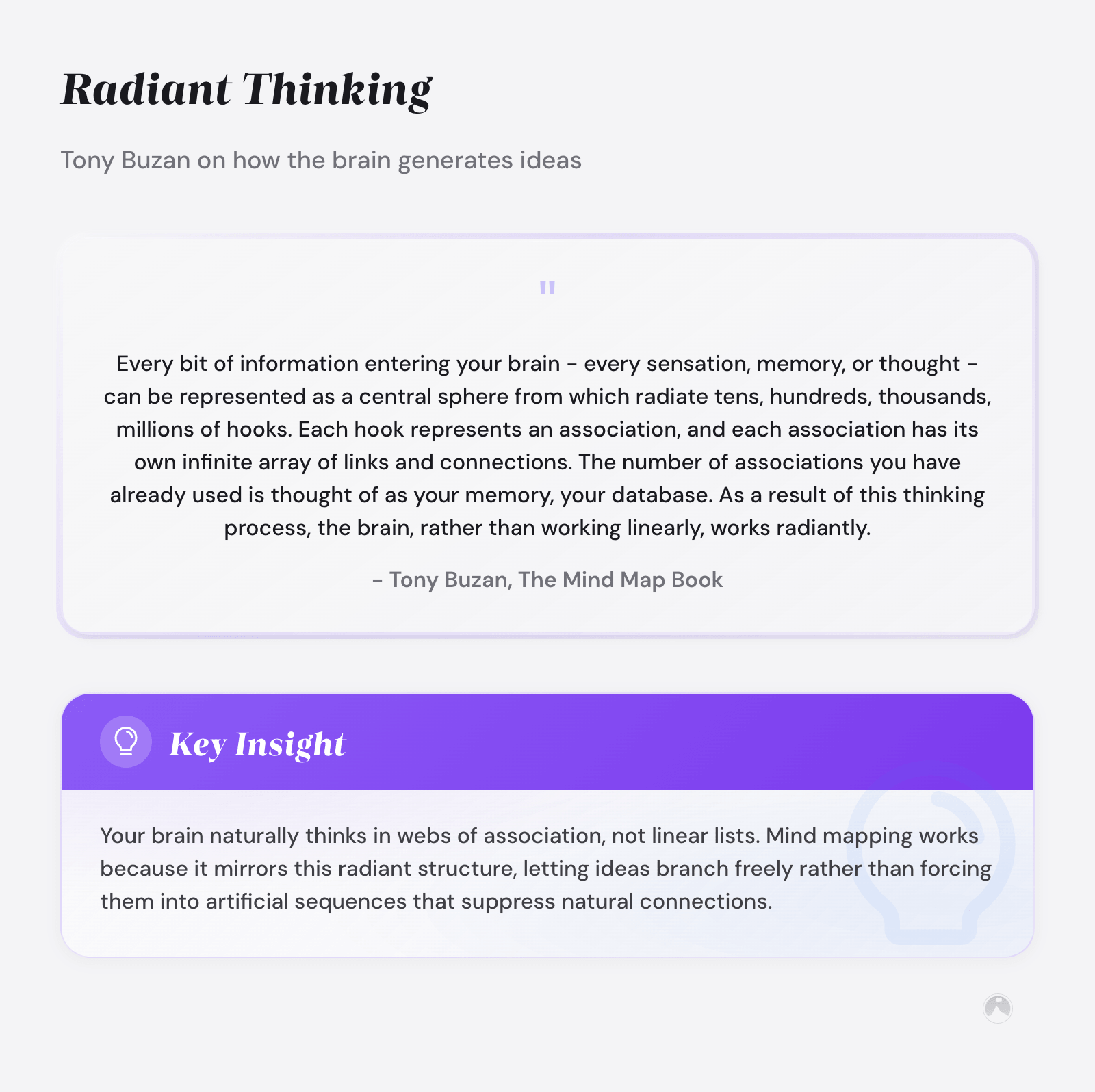
In The Mind Map Book, Buzan and his brother Barry outlined the core principles [1]:
- Central image: Start with a colored image or word at the center of the page, not a title in the corner
- Radiating branches: Main themes extend outward from the center as thick, curved lines
- Single keywords: Each branch carries one keyword, not phrases or sentences
- Color coding: Different branches use different colors to activate visual memory
- Images and symbols: Small drawings on branches strengthen memory encoding
- Curved lines: Organic, curved branches are easier for the brain to track than rigid straight lines
Radiant thinking is Tony Buzan’s term for the brain’s tendency to process information in branching patterns rather than sequential order, with each concept triggering multiple associated ideas simultaneously. The mind map format was designed to match that pattern on paper. Buzan’s insight was not just organizational, it was cognitive: the format of the tool shapes the quality of the thinking [1].
Nesbit and Adesope’s review of 55 studies found that concept maps consistently outperformed reading text, attending lectures, and participating in class discussions across multiple educational settings [4].
How to Build a Mind Map for Brainstorming in 15 Minutes
Here’s the step-by-step process for creating a brainstorming mind map. This works on paper, a whiteboard, or any digital mind mapping app.

- Write your central question (1 min)
- Draw 4-6 main branches with single keywords (2 min)
- Free-associate sub-branches on each branch (8 min)
- Draw cross-connections between related sub-branches (2 min)
- Circle your top 3 ideas for follow-up (2 min)
Step 1: Write Your Central Question (1 minute)
Place one central question or topic in the middle of a blank page. Not a vague category, a specific prompt. “Marketing ideas” is too broad. “How do I grow my newsletter by 20% this quarter?” is a question your brain can actually work with. The more specific the center, the more pointed the branches.
Step 2: Draw 4-6 Main Branches (2 minutes)
From the center, draw thick curved lines outward. Label each branch with a single keyword representing a major category related to your central question. For the email signup example, your main branches might be: “Content,” “Design,” “Incentives,” “Partnerships,” “Testing.”
Don’t overthink the categories. You can rearrange later. The goal right now is speed.
Step 3: Free-Associate on Each Branch (8 minutes)
Set a timer for 8 minutes. Move around the map adding sub-branches (thinner lines with their own keywords) to each main branch. Jump between branches freely. If an idea for “Design” pops up while you are working on “Content,” follow it.
Mind maps preserve spatial context, so returning to an abandoned branch after a tangent takes almost no effort: the visual layout removes the need to scroll or search. Use single words or very short phrases. Full sentences slow you down and activate your inner editor, which is the enemy of brainstorming.
Step 4: Look for Connections (2 minutes)
After the timer ends, scan the entire map. Draw dotted lines between sub-branches on different main branches that connect to each other. These cross-connections are often where the best ideas hide: they are combinations your linear list would never have surfaced.
Step 5: Circle Your Top 3 (2 minutes)
Circle the three most promising ideas or clusters. These become your action items. A brainstorming session that ends without prioritization is just creative entertainment.
Quick Mind Map Checklist
From Messy Map to Action Plan: The Branch-Then-Bloom Step
Most mind mapping guides stop at the creation phase. You end up with a beautiful, colorful diagram and no idea what to do with it. That is where many people abandon the technique entirely, and it is the single biggest reason a brainstorm fails to produce anything you act on.
The fix is to add a structured review step after the free-form mapping, an approach you can think of as branch, then bloom. The branch phase is the divergent step: build the mind map using the 15-minute process above. The bloom phase is the convergent step: you go through each branch deliberately and decide what grows into a project, what gets pruned, and what gets combined with something else. Brainstorming research is consistent on this point, that idea generation and idea selection are separate cognitive modes and work better when you keep them apart rather than judging ideas as you produce them [6].
Here is how the bloom phase works:
| Step | Action | Time |
|---|---|---|
| Tag | Mark each sub-branch as “Build,” “Combine,” or “Prune” | 3 min |
| Cluster | Group all “Build” and “Combine” items into 2-3 project clusters | 3 min |
| Sequence | Put the clusters in order of priority or dependency | 2 min |
| Commit | Write one concrete next action for each cluster | 2 min |
Suppose your central question was “How do I finally finish my side project this year?” After branching, you might tag “set a weekly two-hour block” and “cut the scope in half” as Build, combine “find an accountability partner” and “post weekly progress” into one Combine cluster, and prune “rebuild the whole thing from scratch” as off-strategy. Your two clusters become (1) a protected weekly work ritual and (2) external accountability, each with a concrete next action such as “block Tuesday 7 to 9pm in the calendar tonight.”
Branching then blooming pairs divergent idea generation with convergent prioritization in one sitting, so creative ideas get converted into specific next actions before they fade. The bloom phase takes about 10 minutes and turns a brainstorm artifact into something you can actually execute on. Without it, mind maps become wall decorations.
If you are working on a larger project, this pairs well with building a personal learning system where the mind map becomes one input in a broader knowledge workflow.
Mind Map Examples: What Real Sessions Look Like
Seeing how others apply mind mapping to actual problems makes the method click faster than any abstract description. Here are three concrete mind map examples across different use cases.
Content strategy session: A blogger puts “How do I grow my newsletter by 1,000 subscribers?” in the center. Main branches: Content, Promotion, Monetization, Community, SEO. Under Promotion, sub-branches include social repurposing, guest posts, a referral program, and podcast appearances. After 15 minutes and the bloom phase, two clusters emerge: a content upgrade strategy and a referral program. Next action: draft one lead magnet by the end of the week.
Career decision session: A professional puts “Should I take this new job offer?” in the center. Main branches: Money, Growth, Culture, Risk, Lifestyle. The cross-connections reveal that two “Risk” sub-branches (loss of seniority, longer commute) link directly to two “Lifestyle” sub-branches (family time, health). Those connections surface a constraint that the list format had buried.
Student exam prep session: A student puts the course topic at the center and maps every concept from memory before reviewing notes. This works as a retrieval practice session: branches represent chapters, sub-branches represent key terms. Gaps in the map show exactly what to study next.
Mind map examples work best when the central question is specific and the time limit is strict. Both constraints force the brain to choose rather than catalogue.
Paper vs. Digital Mind Mapping: Which Format Works Better?
Both formats work. But they serve different purposes, and picking the wrong one for your situation adds friction that kills the brainstorming momentum.
| Factor | Paper Mind Map | Digital Mind Map |
|---|---|---|
| Speed of capture | Fastest: no menus or clicks | Moderate: depends on tool familiarity |
| Editing and rearranging | Difficult: you are committed to placement | Easy: drag and drop branches |
| Collaboration | One person at a time (a large whiteboard helps) | Multiple people can add branches simultaneously |
| Sharing and storage | Requires a photo or scan | Built-in sharing and cloud storage |
| Creative freedom | High: draw anything anywhere | Limited by the tool’s interface |
| Best for | Solo brainstorming, early ideation, analog thinkers | Ongoing projects, sharing, remote collaboration |
For the initial brainstorming burst, paper wins. There’s less lag between thought and mark. For anything that needs to be shared, edited, or expanded over time, digital tools like MindMeister, XMind, or even a simple whiteboard app are the better pick. If you’re torn between formats, our guide on balancing digital and analog planning covers the trade-offs in more depth.
A newer category worth knowing: AI-assisted mind mapping tools. Miro AI, Whimsical AI, and Notion AI can generate an initial branch structure from a single prompt, giving you a starting skeleton to edit rather than a blank page to fill. This is useful when you already know the domain well and want to skip the obvious branches and focus on the unexpected ones. That said, the AI-generated map reflects the AI’s associations, not yours, so treat it as a scaffold, not a finished map. For template starting points, Miro’s free mind map template and Canva’s mind map builder both open directly in a browser without an account.
Paper mind maps produce faster initial idea capture, but digital mind maps are better suited for editing and long-term project development. If you are brainstorming solo for a personal project, grab paper. If you need to share, revisit, and expand the map over weeks, go digital. And if the problem is that ideas are not coming at all, that is a different issue: see our guide on overcoming creative blocks.
How Do You Mind Map With Other People?
Brainstorming with a partner, a few friends, or a study group has a well-documented problem: production blocking. When one person talks, everyone else waits, and ideas get lost in the queue. Mind mapping does not fix this on its own, but the right structure does.
Research on collaborative mind mapping tools found that a structured digital mind map interface outperformed a traditional whiteboard for recall-based brainstorming tasks, with participants generating more ideas and organizing them more effectively in the mind map condition [5]. The visual structure gives a group a shared place to organize ideas without one person dominating the conversation.
A study in Computers and Education found that computer-supported scaffolds, specifically SCAMPER-based prompts and cognitive group awareness tools, improved idea originality during the individual phase of hybrid brainstorming sessions [6]. Mind mapping fits this hybrid format naturally because it supports both solo ideation and shared merging. Here is how to run it with two or more people:
- Solo branch phase (5 min): Each person creates their own mini mind map on the central question
- Share and merge (10 min): One person at a time adds their branches to a shared map (digital or paper)
- Cross-pollinate (5 min): Everyone adds new ideas sparked by what others contributed
- Bloom step (10 min): Together, tag each branch, cluster the keepers, and pick the next action
This format respects people who think better alone and people who think better out loud, and it stops the loudest voice from setting the direction for everyone. For more on running creative sessions, see the creativity and learning strategies guide.
Mind Mapping Brainstorming Beyond the Basics: Three Advanced Techniques
Once you’re comfortable with basic mind mapping for brainstorming, these three variations push the technique further.
Constraint Mapping
Add a specific constraint to each main branch before brainstorming. For example, if your central question is “weekend hobby ideas,” one branch might be “under $50 to start,” another might be “can do with my kids,” and a third might be “needs no special equipment.” Constraints do not limit creativity, they channel it. Giving each branch a defined scope forces your brain to work within a specific space, which tends to surface less obvious ideas than an open-ended prompt.
Reverse Mind Mapping
Start with the outcome in the center instead of the question. If you want to “launch a podcast by June,” put that in the middle and branch outward into everything that needs to happen: equipment, guests, format, distribution. This turns the mind map into a backward planning tool. It pairs well with kaizen-style incremental planning where you break big goals into small daily actions.

Speed Mapping
Set a timer for exactly 3 minutes and fill as many branches as possible. No pausing, no evaluating. Quantity over quality: this is pure divergent thinking. Buzan’s original method encouraged exactly this kind of uncritical flow state [1].
After the 3 minutes, step back and review with fresh eyes.
Speed mapping with a strict 3-minute timer forces the brain past its default editing mode and into a state of rapid, uncritical association that often surfaces unexpected ideas.
Ramon’s Take
I’ve been writing about productivity and learning systems at goalsandprogress for several years, and mind mapping is one of the few techniques that stuck. In my opinion, skip the apps for now. Grab paper, write one problem in the middle, and just branch it for 10 minutes. The friction of going analog is annoying but it slows you down enough to actually think.
My best article ideas don’t come from the main branches; they come from the weird cross-connections between branches I didn’t expect to relate. That said, I always pair brainstorming with the bloom phase: a mind map without a follow-through step is just a colorful way to procrastinate.
Mind Mapping Brainstorming Conclusion: Your Next Move
Mind mapping for brainstorming works for the same reason it feels different from making a list: it matches how your brain generates associations. The radiant structure gives every idea a home without forcing it into a sequence. And when you pair that divergent phase with a convergent review, the bloom step, you turn creative exploration into concrete plans.
The best brainstorming tool is the one that gets out of your brain’s way. For most people, that’s not a blank document. It’s a blank page with a circle in the middle.
Next 10 Minutes
- Grab a blank sheet of paper and write one question you have been thinking about in the center
- Draw 4 to 5 main branches with single keywords, spending no more than 2 minutes on this
- Set a timer for 5 minutes and free-associate sub-branches without judging any ideas
This Week
- Run one full branch-then-bloom session on a real project you are working on
- Try a 3-minute speed mapping session on a problem that has been stuck
- If you brainstorm with others, run one hybrid mind mapping session using the solo-then-merge format above
More Mind Mapping and Creative Thinking Resources
Mind mapping is one tool in a broader creative thinking toolkit. For a survey of other ideation methods, including SCAMPER, lateral thinking, assumption reversal, and random word association, see our guide to creative thinking techniques. If your problem is not generating ideas but feeling stuck before you start, overcoming creative blocks in learning covers how to diagnose and clear the four common block types. And when an idea turns into a skill you actually want to build, learning new skills quickly lays out a 30-day practice blueprint.
If you are interested in the science behind how your brain forms new connections, our piece on neuroplasticity and learning science covers the neural mechanisms that make visual learning strategies effective. For a broader view of how different study methods compare, see comparing learning methods.
Related articles in this guide
- Neuroplasticity and learning science: the brain research behind why visual and associative learning strategies like mind mapping work.
- Creative thinking techniques: the wider toolkit of ideation methods, from SCAMPER to lateral thinking, for when you want options beyond mapping.
- Overcoming creative blocks: practical techniques for breaking through mental resistance when brainstorming stalls.
- Best learning apps: a reviewed list of digital tools for studying, note-taking, and knowledge management, including mind mapping apps.
Frequently Asked Questions
What is the difference between mind mapping and regular brainstorming?
Regular brainstorming typically produces ideas in the order they occur to you, which means later ideas are filtered by earlier ones. Mind mapping removes that filter by letting you jump between branches freely, so an idea about one theme can appear next to an idea about another without either one feeling out of sequence. The structural difference changes what your brain is willing to produce, not just how the output looks.
Can mind mapping help with brainstorming if I am not a visual thinker?
Yes, because the benefit of mind mapping comes from the non-linear structure, not from artistic ability. Buzan’s original rules emphasize single keywords and simple branches rather than detailed drawings [1]. Many people who consider themselves verbal thinkers report that mind maps help them see connections they miss in written lists, since the spatial layout activates a different mode of processing than sequential text.
How many branches should a brainstorming mind map have?
Start with 4-6 main branches radiating from the center, with each main branch supporting 3-10 sub-branches depending on topic depth. A mind map with fewer than 3 main branches is probably too narrow, and one with more than 8 main branches may need a second map for a subtopic. The sub-branches are where most of the creative value emerges, so prioritize depth over breadth.
What is the best mind mapping software for brainstorming sessions?
For solo brainstorming, MindMeister, XMind, and Miro all offer strong free tiers with drag-and-drop branch creation. For team brainstorming, Miro and FigJam stand out for real-time collaboration features that support the hybrid brainstorming format. Paper and markers remain the fastest option for initial idea generation when speed matters more than shareability.
Does mind mapping actually improve idea quality or just quantity?
One way to test this: compare your top 3 ideas from a mind map session against your top 3 from a list session on the same topic. Most people find the mind map ideas are more combinatorial, because they merge concepts from different branches in ways that linear lists do not produce. The visual structure also makes weak ideas easier to spot and strong connections easier to develop, which improves quality alongside quantity.
How long should a mind mapping brainstorming session last?
A focused solo session works well in 15-25 minutes: 1-2 minutes for the central question, 8-10 minutes for free-association branching, and 5-10 minutes for review and prioritization. Group sessions typically run 30-40 minutes when using the hybrid format of solo mapping followed by shared merging. Sessions longer than 45 minutes tend to produce diminishing returns as mental fatigue sets in.
Can I use mind mapping to plan a personal project?
Yes. Mind mapping is well suited to the early planning phase of a personal project, where you need to explore goals, tasks, resources, and obstacles at the same time. Start with the project in the center and add branches such as what to do, what you need, who can help, and what might get in the way. That gives you a reusable structure for each planning session, and the bloom step then converts the exploration into a short list of next actions you can actually start on.
What is the difference between a mind map and a concept map?
Mind maps and concept maps are both visual knowledge tools, but they serve different purposes. A mind map radiates outward from a single central idea using free-form branches, and is designed for brainstorming and generating associations quickly. A concept map uses nodes connected by labeled arrows to show relationships between multiple ideas, and is built for showing how concepts relate to each other precisely, which is why it is often used in academic and scientific contexts. In practice: use a mind map when you want to generate and organize ideas fast; use a concept map when you need to map the logical structure of a subject in detail. The research on knowledge maps (Nesbit and Adesope, 2006) covers both formats, but the brainstorming benefits described in this article apply specifically to mind maps.
Can mind mapping be used for note-taking, not just brainstorming?
Yes, and this is one of the most practical uses of the technique. Instead of writing linear lecture notes, place the main topic at the center and add branches as new concepts or examples appear. Sub-branches capture supporting details. The result is a one-page summary that shows how ideas connect rather than just listing them in order. Research on visual note-taking suggests that spatial organization helps with later recall: the Farrand et al. study (2002) found a trend toward 10% better factual recall among medical students who used mind maps versus self-selected methods, though the confidence interval was wide. For note-taking, the trade-off is that mind maps take more space and more setup time than linear notes, so they work best when you already have some familiarity with the material and want to build a connected overview rather than capture everything verbatim.
Glossary of Related Terms
Radiant thinking is Tony Buzan’s term for the brain’s natural pattern of processing information by branching outward from a central concept in multiple directions, rather than following a single sequential path.
Divergent thinking is a cognitive process that generates multiple possible solutions to an open-ended problem by exploring many different directions, as opposed to convergent thinking which narrows options toward a single answer.
Production blocking is a group brainstorming phenomenon where participants cannot share ideas simultaneously, causing ideas to be lost or forgotten during the wait for a turn to speak.
Cognitive load is the total amount of mental effort being used in working memory at any given time, with higher loads reducing the brain’s capacity for generating new ideas or processing complex information.
Convergent thinking is the cognitive process of narrowing multiple ideas or possibilities toward a single best solution, typically used after divergent brainstorming to select and refine the strongest options.
Branch-then-bloom is a two-phase way to run a mind map that pairs a divergent mapping session (the branch phase) with a structured convergent review (the bloom phase) to convert raw ideas into prioritized action items.
Hybrid brainstorming is a structured ideation format that alternates between individual idea generation and group sharing phases, combining the creative independence of solo thinking with the cross-pollination benefits of collaborative discussion.
This article is part of our Creativity and Learning complete guide.
References
[1] Buzan, T. and Buzan, B. “The Mind Map Book: How to Use Radiant Thinking to Maximize Your Brain’s Untapped Potential.” Plume/Penguin, 1993. ISBN: 9780452273221
[2] Shi, Y., Yang, H., Dou, Y., and Zeng, Y. “Effects of mind mapping-based instruction on student cognitive learning outcomes: a meta-analysis.” Asia Pacific Education Review, 24, 303-317, 2023. DOI
[3] Farrand, P., Hussain, F., and Hennessy, E. “The efficacy of the ‘mind map’ study technique.” Medical Education, 36(5), 426-431, 2002. DOI
[4] Nesbit, J.C. and Adesope, O.O. “Learning with concept and knowledge maps: A meta-analysis.” Review of Educational Research, 76(3), 413-448, 2006. DOI
[5] Shih, P.C., Nguyen, D.H., Hirano, S.H., Redmiles, D.F., and Hayes, G.R. “GroupMind: Supporting idea generation through a collaborative mind-mapping tool.” Proceedings of the ACM 2009 International Conference on Supporting Group Work (GROUP ’09), 139-148, 2009. DOI
[6] Farrokhnia, M., Noroozi, O., Baggen, Y., Biemans, H.J.A., and Weinberger, A. “Improving hybrid brainstorming outcomes with computer-supported scaffolds: Prompts and cognitive group awareness.” Computers and Education, 227, 105229, 2024. DOI


