
Two frameworks, one problem nobody compares them for
You’ve read about kaizen. You’ve read about GROW. Both promise personal development, but they operate on different timescales and philosophies. The kaizen vs GROW framework question matters because choosing the wrong one for your situation wastes months of effort on a system that doesn’t match the problem you’re trying to solve.
One is a continuous improvement philosophy rooted in Japanese manufacturing. The other is a structured coaching model born from British executive boardrooms. And yet most comparison articles treat them like interchangeable productivity hacks. They aren’t. The distinction between incremental change versus structured coaching determines whether a framework will feel natural or forced depending on what you’re actually trying to accomplish.
Kaizen is a Japanese continuous improvement philosophy centered on small daily adjustments that compound into significant long-term results. Masaaki Imai formalized the approach in his 1986 book “Kaizen: The Key to Japan’s Competitive Success,” building on the PDCA cycle (Plan, Do, Check, Act) developed by quality experts Walter Shewhart and W. Edwards Deming [1][2].
GROW Framework is a four-stage structured coaching model (Goal, Reality, Options, Will) designed to move from vague aspirations to concrete action plans through targeted questioning at each stage. Sir John Whitmore introduced the model in his 1992 book “Coaching for Performance” [3].
Here’s what other articles skip: these two frameworks come from completely different worlds. Kaizen emerged from Japanese manufacturing, where Imai argued that small daily refinements could outperform dramatic innovation [1]. GROW developed from British executive coaching in the 1980s and 1990s, where Whitmore and colleagues needed a repeatable structure for business conversations [3]. But for personal development, this goal setting frameworks comparison is worth making because most people pick the wrong one for their situation.
What you will learn
- How kaizen and GROW compare on five decision-critical dimensions
- What kaizen’s continuous improvement cycle looks like for personal goals
- How the GROW model works as a self-coaching tool
- When to choose kaizen, when to choose GROW, and when to combine both
Key takeaways
- Kaizen targets daily process refinement through small changes; GROW targets specific goals through structured self-coaching sessions.
- GROW works best when you have a clear destination but need to map the route to get there.
- Kaizen works best when the goal is ongoing improvement without a fixed endpoint.
- Combining GROW quarterly for direction-setting and kaizen daily for execution covers both strategic clarity and consistent action.
- Structured coaching produces measurable gains in self-regulation and performance [4], and research on small wins supports kaizen’s incremental approach [5].
The kaizen vs GROW framework comparison
Before getting into how each framework works, here’s the side-by-side comparison that determines which fits your situation.
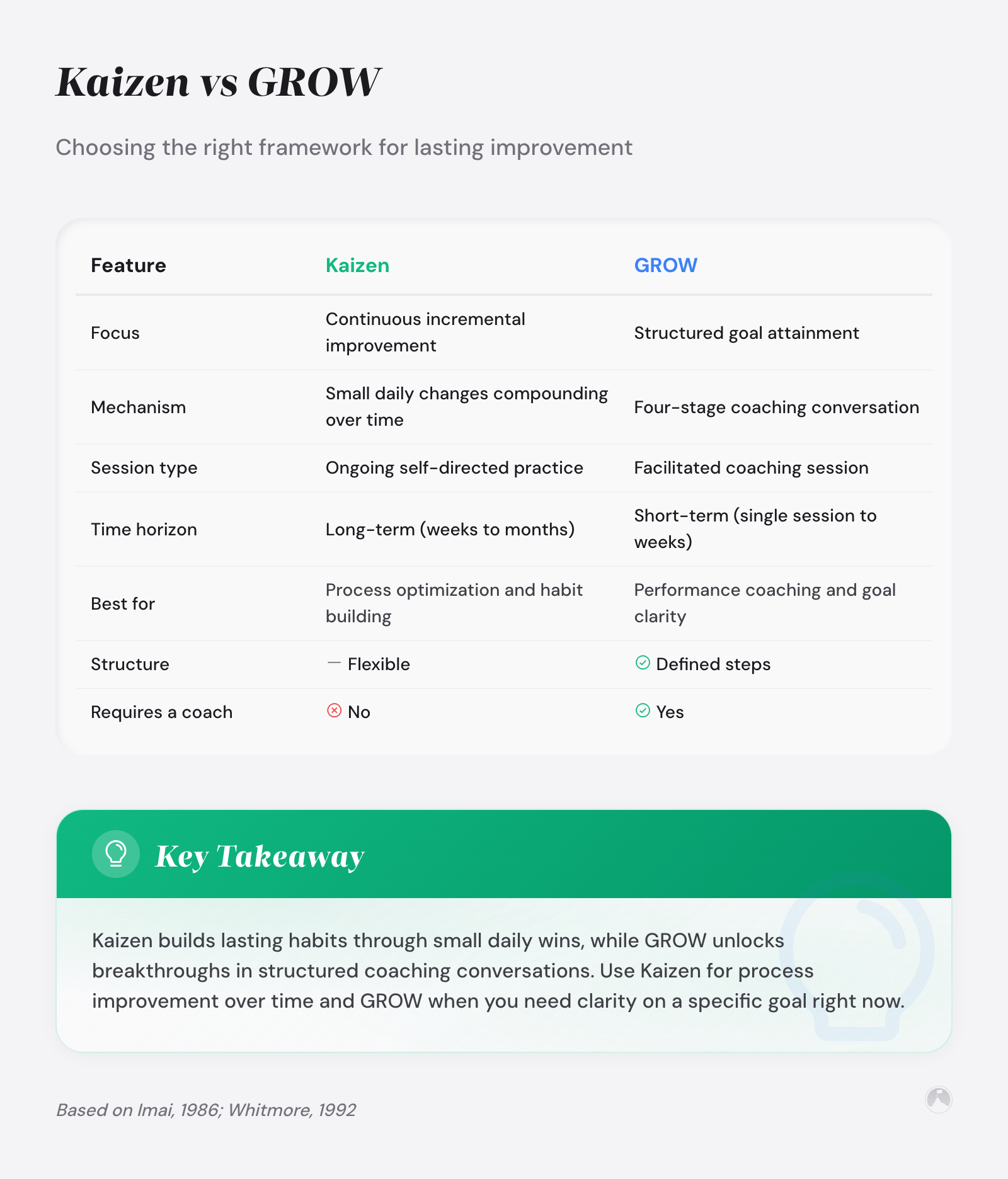
| Dimension | Kaizen | GROW |
|---|---|---|
| Core philosophy | Continuous incremental improvement through daily micro-adjustments | Structured goal achievement through four-stage coaching conversation |
| Best for | Ongoing habit refinement, skill building, process optimization | Specific goals with clear outcomes, career decisions, problem-solving |
| Time investment | 5-15 minutes daily (embedded in routines) | 30-60 minutes per session, monthly or quarterly |
| Flexibility | Low structure – adapts daily based on what works | High structure – four defined stages (Goal, Reality, Options, Will) |
| Success measures | Process consistency and compound gains over time | Goal completion and action plan execution |
Kaizen vs GROW framework is a choice between daily process improvement and structured goal achievement. Kaizen uses small daily adjustments through the PDCA cycle for ongoing development without a fixed endpoint. GROW uses a four-stage coaching conversation (Goal, Reality, Options, Will) to convert specific goals into concrete action plans with deadlines.
Kaizen asks “what one small thing can I improve today?” and GROW asks “what specific outcome do I want and how will I get there?” This distinction isn’t semantic. It determines whether applying kaizen principles for individual growth or running a GROW coaching model application will feel natural or forced given what you’re trying to accomplish.
“Coaching had significant positive effects on performance and skills, individual-level results, self-regulation, and well-being outcomes.” – Theeboom, Beersma, and van Vianen [4]
That finding comes from a meta-analysis of 18 coaching studies that met rigorous inclusion criteria, making it some of the strongest evidence available for structured coaching approaches like GROW [4]. But what about the other side of this comparison?
How does kaizen work for personal development?
Kaizen for personal development translates a manufacturing continuous improvement philosophy into a daily practice. Masaaki Imai introduced the concept in 1986, arguing that small, consistent changes compound into results that dramatic overhauls rarely sustain [1]. The approach operates through the PDCA cycle: Plan a small change, Do it, Check the results, and Act on what you learned. Walter Shewhart originally developed this cycle for quality control in the 1930s, Deming promoted it widely in postwar Japan, and Imai adopted it as the operational mechanism for kaizen [1][2].
In practice, this translates to a daily question: “what worked yesterday, what didn’t, and what’s one small thing I’ll adjust today?” The advantage is low activation energy. You don’t need a coach, a planning session, or a dramatic overhaul. Just five minutes and a willingness to make one tiny adjustment.
Consider someone building a reading habit. A kaizen approach doesn’t start with “read 30 books this year.” It starts with “read for two minutes after my morning coffee.” After a week, extend to five minutes.
After a month, add note-taking. Each adjustment is small enough to feel effortless, but they compound.
The mathematics of compound growth show that a 1% daily improvement yields approximately 37x improvement over a year – a principle popularized by James Clear in “Atomic Habits” [6]. Karl Weick’s research on small wins adds scientific backing: incremental progress builds momentum and self-efficacy more reliably than large-scale change attempts [5].
Kaizen’s greatest strength is removing psychological resistance that kills most personal development before it starts. When the next step is always small, fear of failure shrinks proportionally. But kaizen has a blind spot: it doesn’t tell you where to direct those improvements. You can optimize a daily routine that takes you nowhere meaningful.
How does the GROW framework work for self-coaching?
The GROW framework for self-coaching follows a four-stage sequence that Sir John Whitmore first published in 1992 [3]. It stands for Goal, Reality, Options, and Will (sometimes called Way Forward). Research by Anthony Grant on coaching psychology found that structured coaching approaches are associated with better goal attainment than unstructured problem-solving [7].
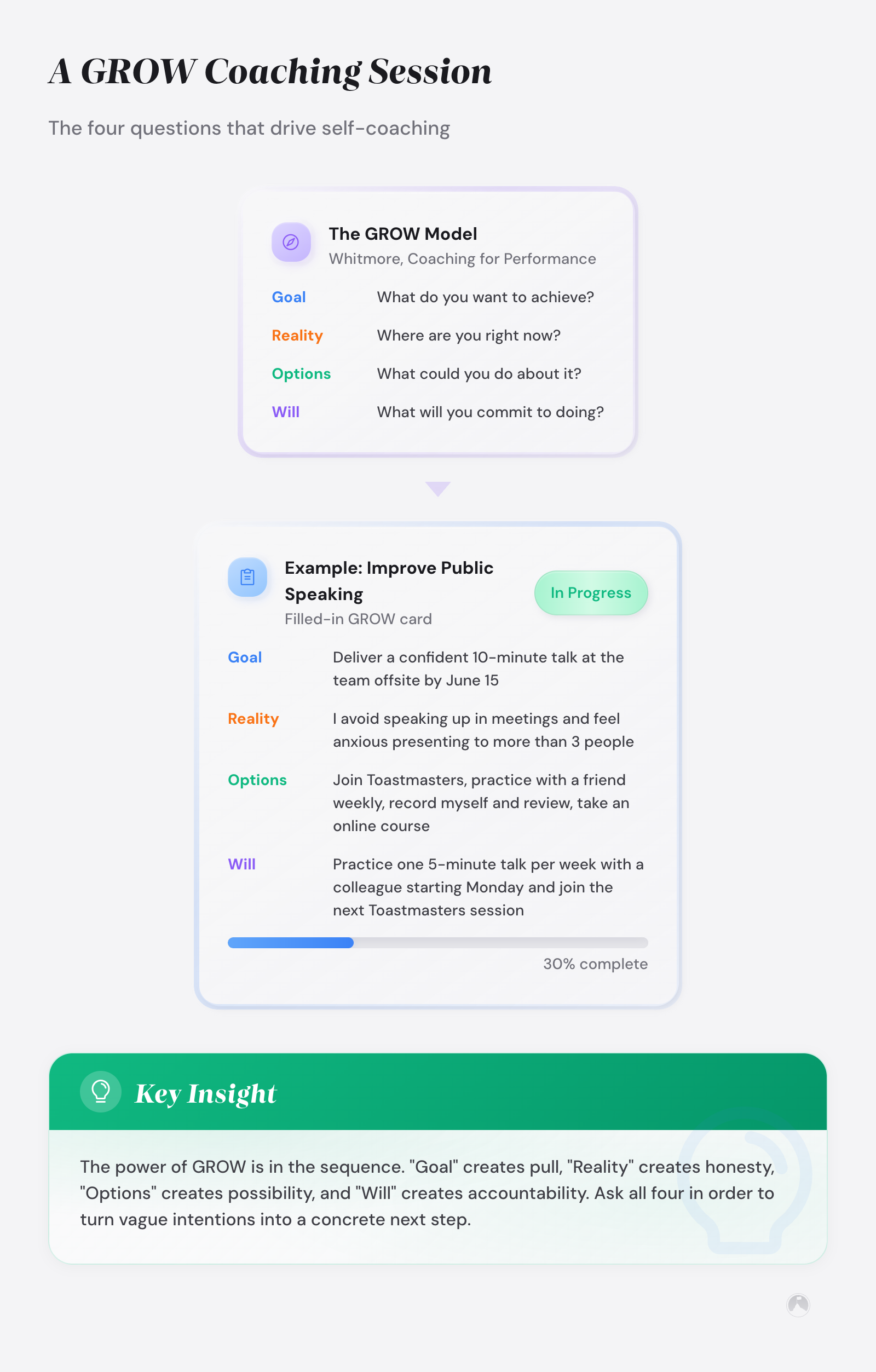
Each stage does distinct work. Goal defines what you want to achieve in specific, measurable terms. Reality forces an honest assessment of where you stand right now. Options generates multiple paths forward through structured brainstorming. And Will commits you to specific actions with deadlines [3].
The value is in the sequence. Most people jump straight from a vague goal to scattered action. GROW inserts two critical steps in between: confronting reality and mapping options. The Options phase broadens the range of solutions people consider, while the Will phase creates ownership over the chosen action plan.
Say you want to transition from marketing to product management. Goal: land a product role within six months. Reality: you have marketing analytics experience but no product certifications or portfolio projects. Options: take a product management course, volunteer for cross-functional projects, build a side product, or network with PMs at your company. Will: enroll in a course this week and schedule two informational interviews by Friday.
GROW turns fuzzy aspirations into concrete action plans by forcing you to close the gap between where you are and where you want to be. But here’s where it falls short for ongoing development: GROW is designed for discrete sessions around specific goals. Once you’ve completed the Will phase and taken action, momentum can decay without a complementary daily practice.
If you want the full step-by-step breakdown, the GROW framework guide walks through each stage in detail.
When should you use kaizen vs GROW?
The right framework depends on the type of growth challenge you’re facing. Use kaizen when your development goal is ongoing and doesn’t have a natural endpoint. Skills like writing, communication, fitness, and emotional regulation are kaizen territory – they benefit from daily 1% refinements more than they benefit from periodic strategic sessions. Weick’s research on small wins supports this: incremental progress on open-ended challenges builds the kind of momentum that sustains long-term behavior change [5].
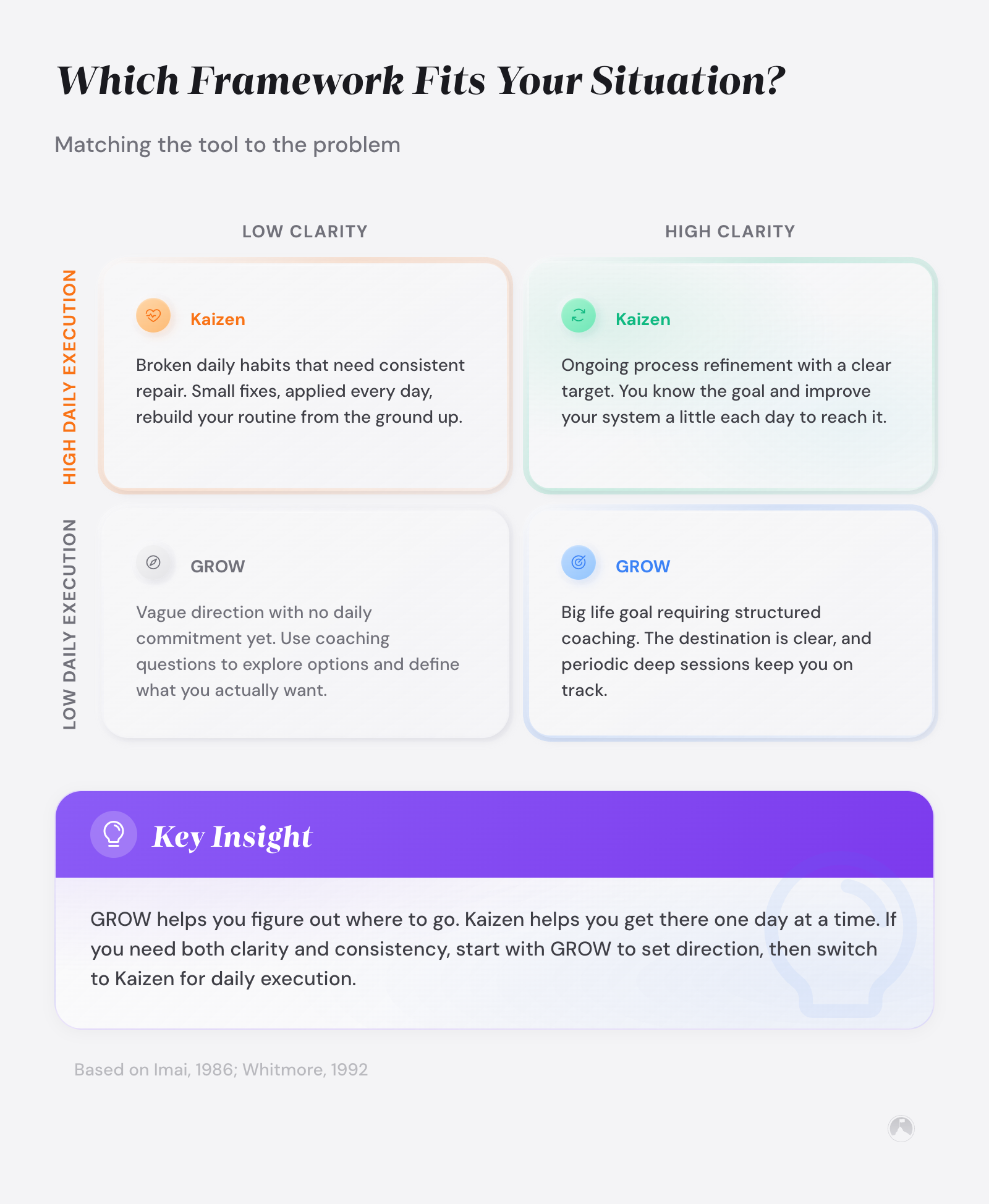
Use GROW when you face a specific decision or goal with a defined outcome. Career transitions, salary negotiations, launching a side project, or completing a certification are GROW problems. You need structured thinking, not daily increments. Grant’s research on coaching psychology suggests that structured goal-setting conversations are associated with better outcomes for bounded, specific objectives [7].
| Your situation | Recommended framework | Why |
|---|---|---|
| Clear goal, need a plan to reach it | GROW | GROW is built for mapping the path from current reality to specific outcome |
| No fixed endpoint, want steady improvement | Kaizen | Kaizen’s incremental cycle keeps you improving without needing a finish line |
| Big goal plus daily execution gap | GROW + Kaizen | GROW sets quarterly direction; kaizen provides daily improvement actions |
| Feeling stuck, unclear what to work on | GROW first, then kaizen | Use GROW to clarify goals, then switch to kaizen for daily momentum |
Most framework failures happen when people apply a process-oriented tool to a goal-oriented problem, or vice versa. Kaizen won’t help you decide whether to change careers. GROW won’t keep you practicing guitar every day. Know which problem you’re solving first.
And if you’re not sure whether your challenge is a direction problem or a consistency problem, the personal development plan guide can help you sort that out.
Can you combine kaizen and GROW?
The strongest personal development systems combine both approaches – and research in goal-setting psychology supports this. Locke and Latham’s foundational work on goal-setting theory demonstrates that combining strategic planning with regular progress monitoring and micro-adjustments produces stronger sustained results than either approach alone [8]. That’s the case for combining improvement methodologies rather than picking just one.
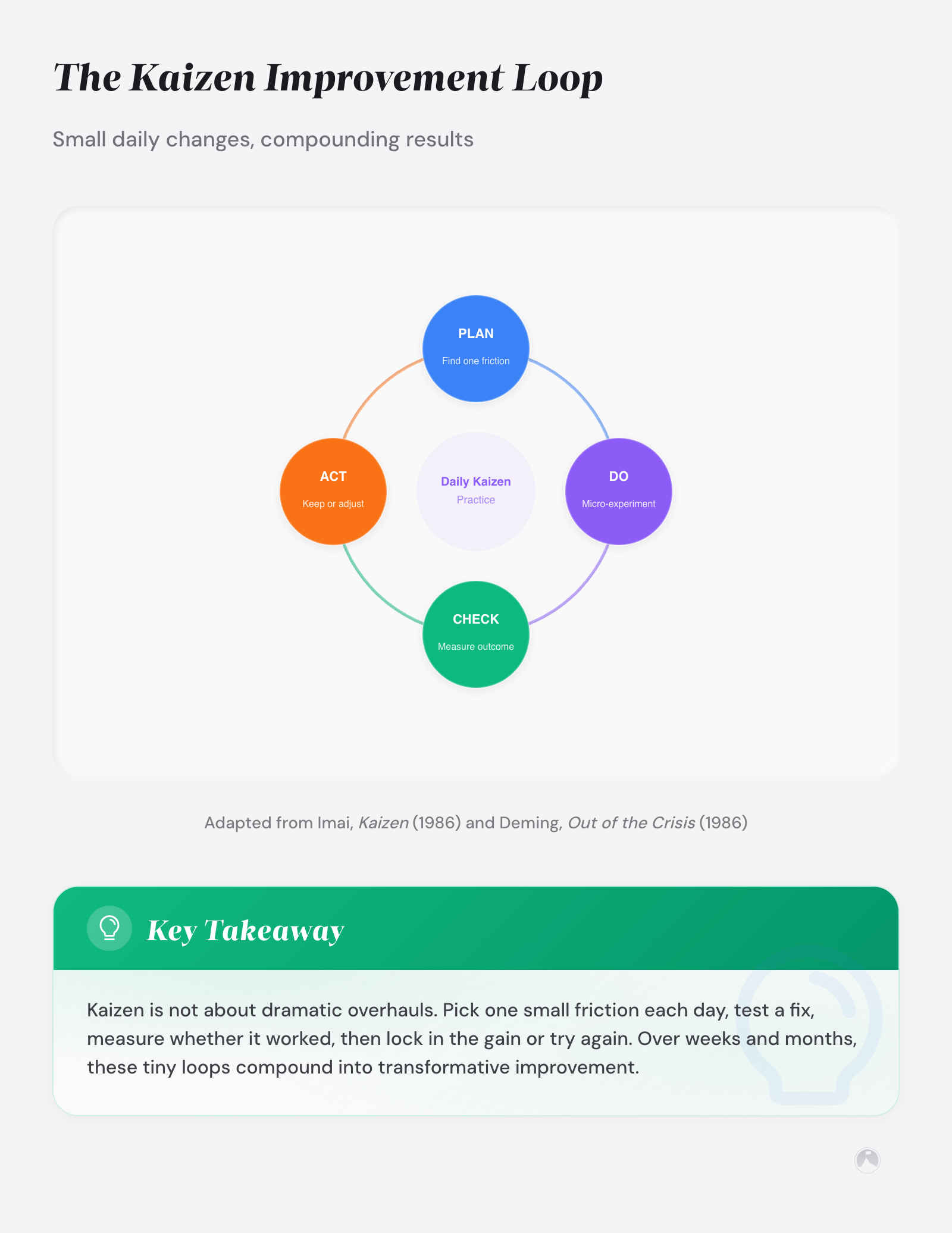
GROW provides the strategic layer: the quarterly check-in where you define goals, assess reality, explore options, and commit to a direction. Kaizen provides the operational layer: the daily practice of making small improvements that move you toward those goals. So the PDCA cycle and GROW integration works because each framework covers the other’s weakness.
Here’s what an integrated approach looks like in practice. Once per quarter, you run a GROW session on your primary development area. You define your specific goal, honestly assess where you stand, brainstorm options for closing the gap, and commit to concrete actions.
Then for the next 90 days, you apply kaizen daily: each morning, identify one small improvement related to your GROW goal. Each evening, check whether that adjustment worked and plan tomorrow’s micro-step.
Consider someone whose GROW goal is transitioning from individual contributor to team lead. Kaizen takes over daily: Monday they prepare more structured agendas, Tuesday they practice asking questions instead of giving answers, Wednesday they delegate one task they’d normally do themselves.
This combined approach sounds elegant on paper. But three specific failure modes can derail it.
First, what we call kaizen drift: when daily improvements stop connecting to the GROW goal. Fix this by reviewing your GROW goal every Monday before choosing your daily kaizen focus. Second, what we call GROW staleness: when quarterly sessions become routine rather than genuine strategic rethinking. Fix this by including a “what has changed?” question that forces you to update your Reality assessment.
Third, scope creep: when daily kaizen improvements expand the goal beyond what GROW originally defined. Keep kaizen adjustments small and goal-aligned. If something bigger surfaces, save it for the next GROW session.
The frameworks that survive real life address both where you’re headed and what you do tomorrow morning. Using GROW without kaizen gives you a plan that gathers dust. Using kaizen without GROW gives you consistent effort that may point nowhere. The combination is where sustained personal development strategies produce results.
ADHD and unpredictable schedules
Both frameworks need adaptation when your schedule isn’t predictable or when executive function challenges make daily consistency harder. For individuals with ADHD, kaizen’s “one tiny thing” daily approach aligns well with how variable executive function and attention allocation work [9]. Clinical research on ADHD shows that frequent, small reinforcement cycles support better sustained behavior change than quarterly goal-setting sessions alone [9]. Consider a weekly review instead of daily adjustments if daily consistency feels unsustainable.
For GROW, break the structured conversation into four separate 15-minute sessions across a week: Monday for Goal, Wednesday for Reality, Friday for Options, and the following Monday for Will. Same structure, spread to match your energy. If you’re looking for more ideas on self-paced versus structured personal development, that comparison may help you calibrate the right pace.
With the framework mechanics and adaptations covered, here’s what using both looks like over time.
Ramon’s take
Somehow I ended up reading about Japanese manufacturing philosophy to figure out if I should use a coaching tool. And yet here I am, genuinely thinking about which one I need this week. That’s either very productive or a sign I need to go outside.
Conclusion
The kaizen vs GROW framework decision comes down to one question: do you need better direction or better daily execution? GROW gives you the compass. Kaizen gives you the steps. For most people working on personal development, you need both – but at different times.
The paradox of personal development frameworks is that the system matters less than consistency of using it. A mediocre framework applied daily beats a perfect framework applied once a quarter. Pick the one that fits your immediate bottleneck and start there.
Next 10 minutes
- Identify your current primary development challenge: is it a direction problem (use GROW) or an execution problem (use kaizen)?
- Write down one thing you want to improve and pick which framework fits.
This week
- If you chose GROW: run one complete self-coaching session on that goal (30-45 minutes, pen and paper).
- If you chose kaizen: practice daily for five days – each morning identify one small improvement, each evening note if it helped.
Related articles in this guide
- multi-domain-personal-development-orchestration
- personal-development-books-that-changed-lives
- personal-development-burnout
Frequently asked questions
When should I use kaizen instead of GROW?
Use kaizen when your development goal is ongoing and doesn’t have a fixed endpoint, such as improving communication skills, building fitness habits, or refining a creative practice. Kaizen’s daily micro-adjustment cycle works best for areas where consistent small changes compound over time rather than requiring a strategic decision or one-time plan.
Can I self-apply the GROW model without a professional coach?
GROW works well for self-coaching when you write your answers down rather than thinking through them mentally. Research on reflective practice suggests that externalizing thought through writing supports clearer self-assessment, particularly during the Reality stage where honest evaluation matters most [10]. Set a timer for 10-15 minutes per stage and treat the questions as journal prompts rather than a formal coaching session.
How often should I practice kaizen for personal growth?
Daily practice produces the best compounding effect, but three to five days per week still works if your schedule is unpredictable. The key factor is consistency of the review habit, not perfection. Research on habit formation by Lally and colleagues found that an average of 66 days is needed for a new behavior to become automatic, though this varies considerably from person to person (range: 18 to 254 days) [11], so commit to at least two months before evaluating results.
What are the main limitations of kaizen and GROW?
Kaizen lacks strategic direction – you can improve daily without progressing toward meaningful goals. GROW lacks daily momentum – strong strategic sessions lose impact without a follow-through mechanism between sessions. Kaizen struggles with complex multi-step goals, and GROW can feel too rigid for goals that evolve rapidly as you learn.
Which is better for career development: kaizen or GROW?
Career goals with specific outcomes (promotions, transitions, certifications) typically respond better to GROW since they require strategic planning and reality assessment. Life goals involving ongoing development (health, relationships, creativity) often fit kaizen better since they benefit from daily incremental attention rather than quarterly goal-setting sessions.
How do I measure progress with kaizen versus GROW?
Kaizen progress shows up in process metrics: streak length, number of adjustments tried, and qualitative journals tracking gradual shifts. GROW progress shows up in outcome metrics: goals completed, action plans executed, and gap-closing between Reality and Goal. Track both types using separate logs.
References
[1] Imai, M. “Kaizen: The Key to Japan’s Competitive Success.” McGraw-Hill, 1986.
[2] Deming, W. E. “Out of the Crisis.” MIT Press, 1986.
[3] Whitmore, J. “Coaching for Performance: The Principles and Practice of Coaching and Leadership.” Nicholas Brealey Publishing, 1st edition 1992; 5th edition 2017. Link
[4] Theeboom, T., Beersma, B., and van Vianen, A.E.M. “Does coaching work? A meta-analysis on the effects of coaching on individual level outcomes in an organizational context.” The Journal of Positive Psychology, 9(1), 1-18, 2014. DOI
[5] Weick, K. E. “Small wins: Redefining the scale of social problems.” American Psychologist, 39(1), 40-49, 1984. DOI
[6] Clear, J. “Atomic Habits: An Easy and Proven Way to Build Good Habits and Break Bad Ones.” Avery, 2018.
[7] Grant, A. M. “The impact of life coaching on goal attainment, metacognition and mental health.” Social Behavior and Personality, 31(3), 253-263, 2003. DOI
[8] Locke, E. A. and Latham, G. P. “Building a practically useful theory of goal setting and task motivation: A 35-year odyssey.” American Psychologist, 57(9), 705-717, 2002. DOI
[9] Barkley, R. A. “Attention-Deficit Hyperactivity Disorder: A Handbook for Diagnosis and Treatment.” 4th edition, Guilford Press, 2015.
[10] Schon, D. A. “The Reflective Practitioner: How Professionals Think in Action.” Basic Books, 1983.
[11] Lally, P., van Jaarsveld, C.H.M., Potts, H.W.W., and Wardle, J. “How Are Habits Formed: Modelling Habit Formation in the Real World.” European Journal of Social Psychology, 40(6), 998-1009, 2010. DOI
Key sources for this comparison: Imai’s “Kaizen” (1986) formalized continuous improvement for organizations. Whitmore’s “Coaching for Performance” (1992) introduced the GROW model. Theeboom et al. (2014) provided meta-analytic evidence for coaching effectiveness, and Locke and Latham (2002) established the theoretical foundation for goal-setting in personal development contexts.