
Most plans fail because they’re designed wrong
Knowing how to create a personal development plan is easy. Following through on one is the hard part. Gail Matthews’ research at Dominican University found that people with written goals are 42% more likely to achieve them than those keeping goals in their head [1]. But many plans still collapse within the first quarter. Here’s the disconnect: Writing a goal is not the same as building a system that keeps you on track when life gets messy.
A personal development plan is a structured document that maps your current skills and values against growth areas you want to develop, sets specific goals with timelines, and includes recurring checkpoints to track progress and adjust course. Unlike a career development roadmap creation focused narrowly on professional advancement, a personal development plan spans health, relationships, learning, creative pursuits, and career growth. The concept formalized in organizational psychology during the 1990s as companies adopted individual development planning, but personal (non-corporate) development plans emerged as a distinct practice in the 2000s.
The difference between plans that work and plans that languish comes down to one thing: they’re built differently. A plan that changes your life is not the longest one or the most elaborate one. It’s the one that survives contact with reality – which means it has to be small enough to maintain and reviewed often enough to stay relevant as your priorities shift. So the question isn’t whether to plan. It’s how to create a personal development plan with the right structure from the start.
What you will learn
- Why most people skip the self-assessment step and why that ruins everything downstream
- How the Priority Filter Method cuts through overwhelm and narrows 10 ideas down to 2-3 that matter
- The behavioral proxy technique for making fuzzy SMART goals personal growth targets measurable and real
- How to translate big goals into the specific weekly actions that actually fit your schedule
- Why quarterly personal development reviews are where most plans either resurrect or die
Key takeaways
- Written goals produce 42% higher achievement rates, but only if the system around them works [1].
- Self assessment for development planning that combines skills inventory, values ranking, and external feedback prevents chasing the wrong priorities.
- The Priority Filter scores development areas on impact, gap severity, and values alignment to cut through overwhelm.
- Behavioral proxies translate unmeasurable goals like “become more confident” into trackable actions like “volunteer for one presentation monthly.”
- Weekly calendar blocks are what separate real personal growth action plan steps from wish lists with formatting.
- Quarterly reviews diagnose why you’re stuck and decide whether to adjust tactics or shift priorities entirely.
- Locke and Latham’s research consistently demonstrates that focused goal-setting outperforms diffuse efforts – fewer, specific goals drive substantially higher completion than long scattered lists [2].
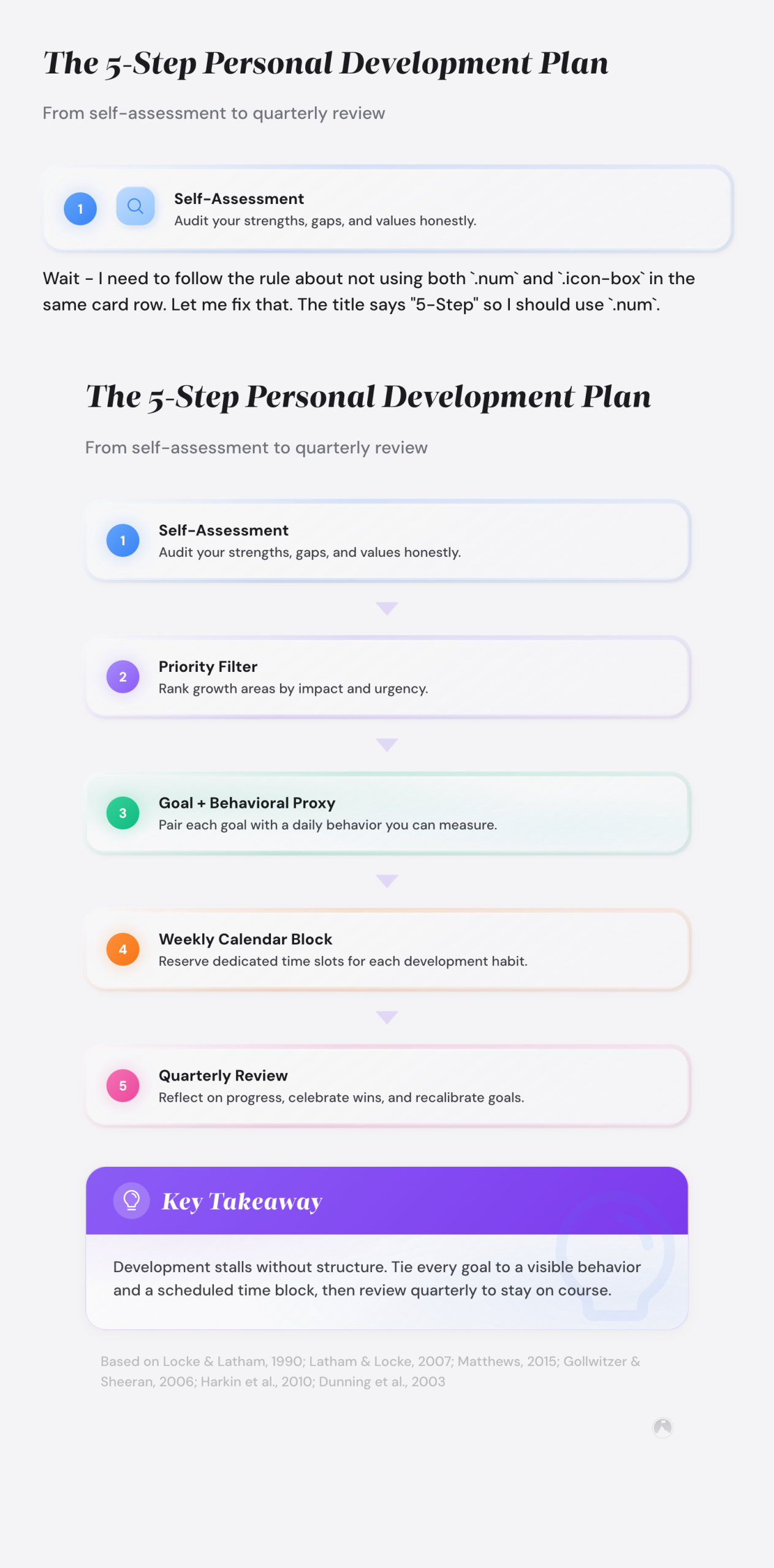
The 5-step process
- Complete a self-assessment covering skills, values, and external feedback.
- Run each development area through the Priority Filter (impact, gap, values fit).
- Write SMART goals with behavioral proxies for your top 2-3 priorities.
- Decompose goals into weekly calendar blocks with specific time slots.
- Conduct quarterly reviews to audit progress and refresh priorities.
Self assessment for development planning: the step everyone rushes
Most people skip straight from “I want to grow” to “Here’s my goal.” That gap creates plans that target symptoms instead of root causes. And without knowing where you stand right now, you’re designing for urgency instead of importance. Research on multi-source feedback by Bracken and colleagues found that combining self-assessment with external input produces developmental plans substantially more effective than self-directed planning alone [3].
A solid self assessment for development planning covers three dimensions. First, a skills inventory where you get specific. Not “communication” – that’s too broad and tells you nothing. Instead, “Explaining technical decisions to non-technical people” or “Running remote meetings where everyone feels heard.” Be task-level specific.
One client listed “communication” as a gap. When pressed for specifics, she identified “giving negative feedback to direct reports without softening it into meaninglessness.” That task-level clarity changed her entire plan.
Second, a values ranking where you order your top five values (autonomy, mastery, connection, security, creativity, health, adventure, service) and check whether your current development efforts actually align with them. Third, external feedback from two or three people you trust about your blind spots – the gaps between how you see yourself and how others experience you. If you’re looking for a structured way to reflect on these areas, crafting a personal mission statement can anchor your values ranking.
Dunning’s research on metacognitive bias explains why external feedback matters so much: self-perception and actual performance diverge most when the skill is vague and feedback is delayed [4]. That’s the exact profile of personal development goals. Combine internal reflection with external input, and you get a clear enough picture to make smart decisions in the next step.
The Priority Filter Method: from overwhelm to focus
After self-assessment, you face the problem that kills most personal development plans: too many gaps, too little time. You’ve identified eight or nine areas where you want to grow. A list that long is a recipe for paralysis.
The Priority Filter Method solves this by testing every potential development area against three scoring criteria. Only areas that score high enough make the plan. Everything else goes on a “revisit next quarter” list.
The Priority Filter Method runs each development area through three criteria: impact (how much this growth affects your overall life satisfaction or career trajectory), gap severity (the distance between where you are and where you need to be), and values fit (how closely this connects to your top five personal values). Score each 1-5. Only areas scoring 12 or higher earn a spot in your plan.
Priority Filter Scorecard
| Development Area | Impact (1-5) | Gap (1-5) | Values Fit (1-5) | Total |
|---|---|---|---|---|
| Example: Public speaking | 4 | 4 | 3 | 11 |
| Example: Strategic thinking | 5 | 3 | 5 | 13 |
| Example: Fitness consistency | 5 | 4 | 5 | 14 |
Threshold: 12+ makes your plan. Below 12 goes on the revisit list.
This filter forces honest trade-offs. Public speaking might feel urgent because you have a presentation coming up, but if the gap is moderate and the area doesn’t connect to your core values, it drops below the line. That doesn’t mean you ignore it forever. It moves to the revisit list, and you reconsider it next quarter when your situation might have changed.
Locke and Latham’s research consistently demonstrates that focused goal-setting outperforms diffuse efforts – fewer, specific goals drive substantially higher completion than long scattered lists [2]. Two or three focused priorities drive more measurable progress in 90 days than ten scattered ones deliver in a year. That’s why the Priority Filter forces a hard stop at 2-3 priorities for setting personal growth milestones.
Harkin and colleagues’ meta-analysis of goal monitoring confirms the importance of checking in regularly – progress tracking promoted goal attainment across more than 100 studies, with larger effects when progress was physically recorded [5]. So the filter is not a one-time exercise. You run it again every quarter with updated data.
SMART goals personal growth: why they don’t work until you use behavioral proxies
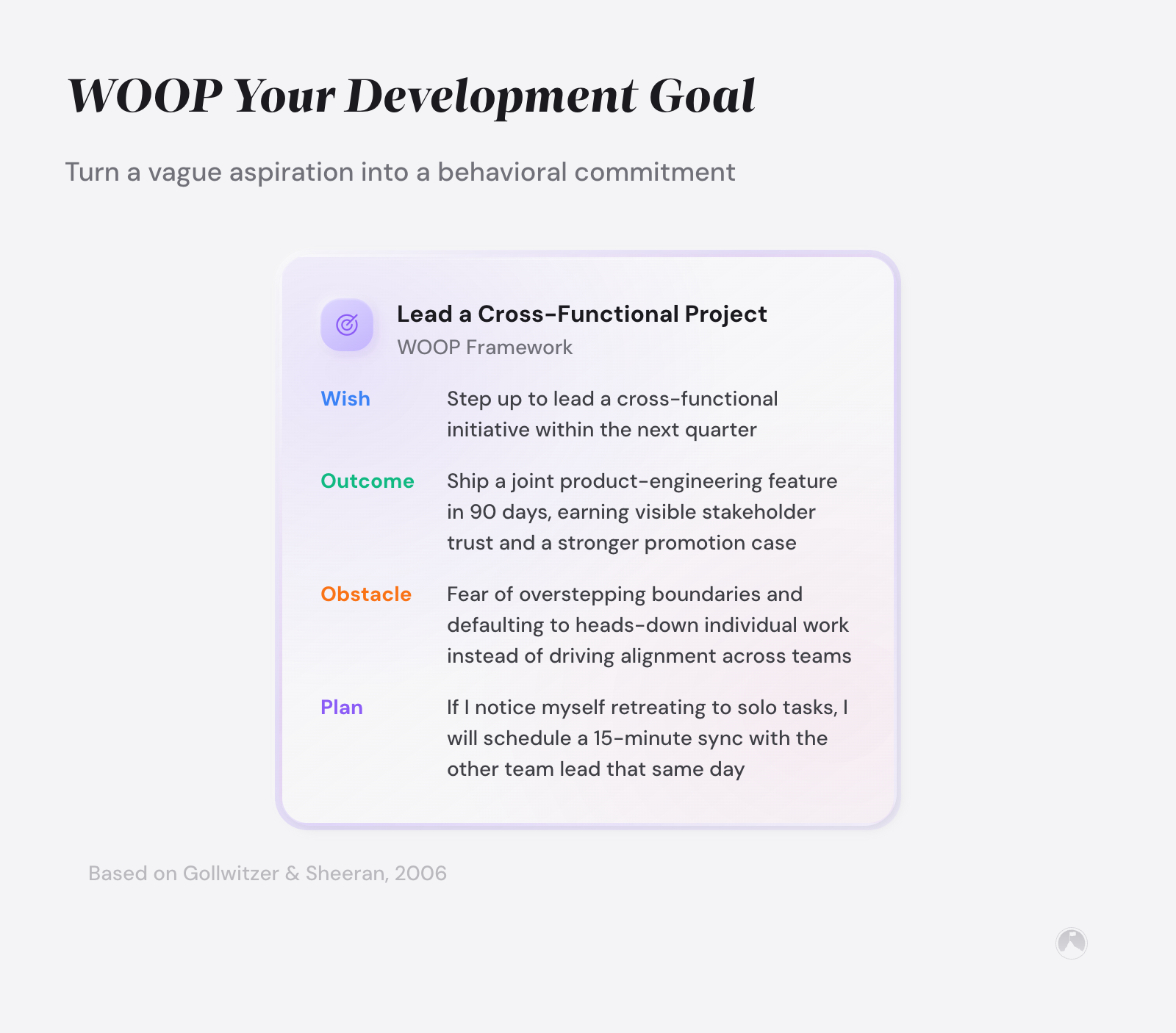
“Increase quarterly revenue by 15%” is naturally measurable. “Become more confident” is not. Professional SMART goals hit a hard wall when you move into personal growth territory. The solution is behavioral proxies – concrete, observable actions that signal progress on otherwise fuzzy goals.
Locke and Latham’s foundational research synthesized more than 400 studies and found a consistent pattern: specific, difficult goals produce higher performance than vague “do your best” goals [6]. That finding is solid for career goals. But for personal growth, the challenge is translating “specific” into something trackable when the goal itself resists measurement.
“The beneficial effect of goal setting on task performance is one of the most robust and replicable findings in psychological literature.” – Locke and Latham [6]
This is where behavioral proxies step in. “Become more confident” becomes “Volunteer for one presentation per month and rate my comfort level 1-10 after each one.” “Improve communication” translates to “Have one difficult conversation weekly I would normally avoid, then journal about the outcome.” The proxy isn’t the goal itself. It’s the evidence that growth is happening. The most reliable progress signals specify behavioral targets with concrete frequency metrics rather than relying on self-reported internal states [7].
Here’s how this works in practice for different individual development plan examples:
| Vague Goal | SMART Version (with Behavioral Proxy) | Timeline |
|---|---|---|
| Be more assertive | State my position first in 3 of 5 weekly team meetings for 8 weeks | 8 weeks |
| Read more | Read 20 pages daily for 30 consecutive days, tracking in a habit app | 30 days |
| Get healthier | Complete 3 strength workouts per week for 12 weeks, logging each session | 12 weeks |
| Learn leadership | Complete one leadership course module per week and apply one principle in a meeting that same week | Ongoing quarterly |
| Network better | Schedule 2 one-on-one coffee conversations per month with professionals outside my team | Ongoing quarterly |
The measurable component must track behavior frequency, not subjective internal states. You can’t reliably measure whether you “feel more confident.” You can reliably measure whether you volunteered for that presentation. The table above works as a starting personal development plan template – adapt the format to your own priorities after running the filter.
Turning goals into weekly calendar blocks
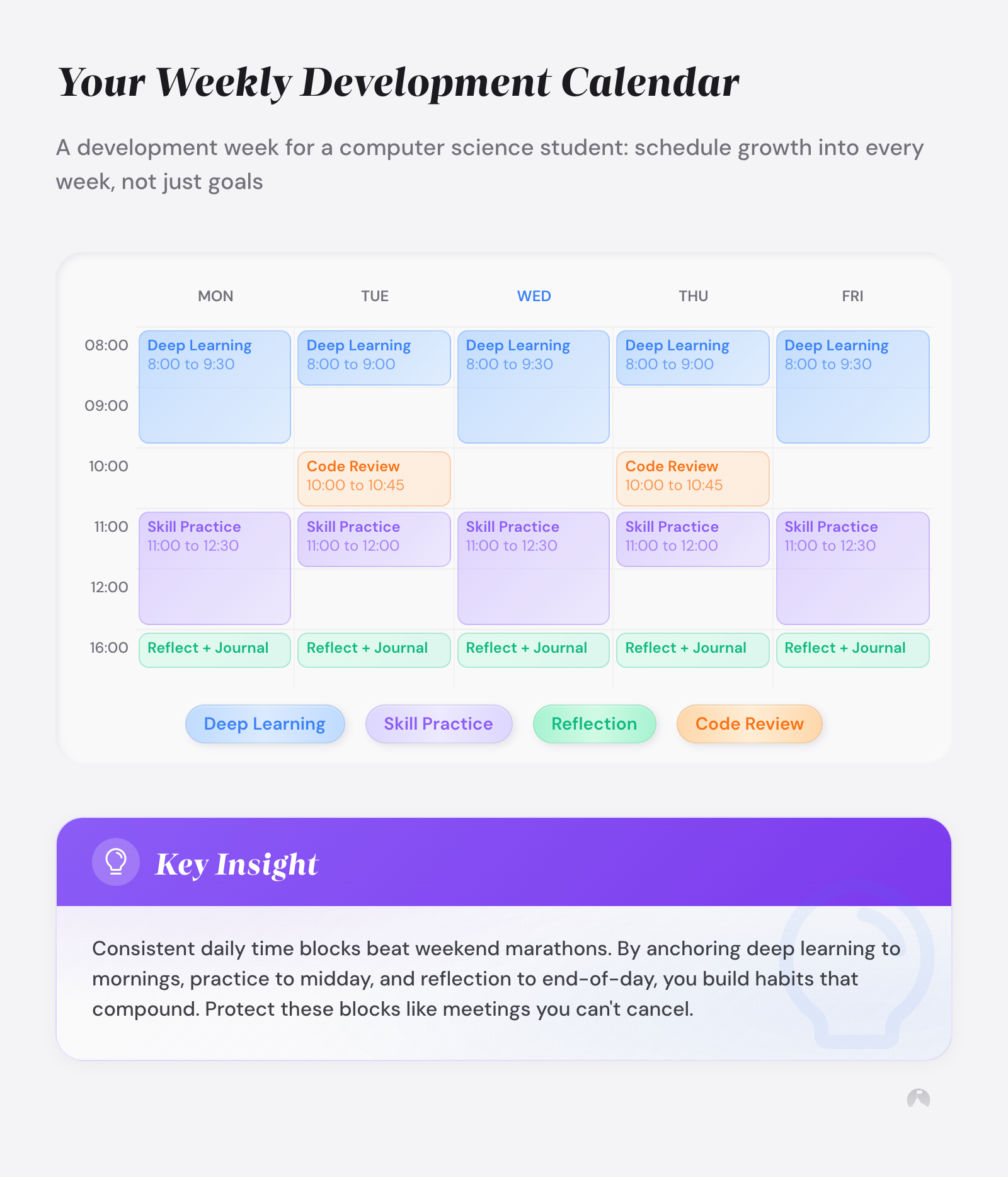
This is where most personal development plans die. The goals are clear, the priorities are filtered, but the plan never makes it onto a calendar. The bridge between “develop strategic thinking” and “what do I do on Tuesday at 2pm” requires decomposition – breaking goals into milestones, milestones into monthly targets, and monthly targets into weekly actions. This is the part of the personal growth action plan steps that most guides skip over.
Start with your 90-day milestone. If your SMART goal is “Complete one leadership course module per week and apply one principle in a meeting that same week,” your 90-day milestone is “12 modules completed, 12 application attempts documented.” The monthly target becomes “4 modules, 4 application journal entries.” The weekly action is then obvious: block 45 minutes for the module on Tuesday, apply one lesson in Wednesday’s meeting, spend 10 minutes journaling about it Thursday.
The difference between short term versus long term development goals matters here – your weekly actions are short term, but they feed a long term trajectory.
The decomposition has to respect your actual life. If you’re a working parent balancing personal growth goals, a two-hour daily study block is fantasy. Thirty-minute blocks three times a week might be real. The test: can you point to the specific calendar slots where this action lives? If not, the action is still too abstract. A step-by-step GROW coaching model can help you break down goals that feel too big to calendar.
The mechanics of this bridge are grounded in what psychologists call “implementation intentions” – specifying exactly when, where, and how you’ll act reduces decision fatigue and increases follow-through. Gollwitzer and Sheeran’s meta-analysis of 94 studies found implementation intentions have a medium-to-large effect (d = .65) on goal attainment [8].
According to Gollwitzer and Sheeran’s meta-analysis, forming implementation intentions – specifying when, where, and how – produced a medium-to-large effect on bridging the gap between intentions and action across 94 studies [8].
That 42% figure from Matthews’ research carries a quiet implication. Writing the goal is step one. Writing the weekly action is what creates the execution bridge. A personal development plan without weekly calendar entries is a wish list with formatting.
Quarterly personal development reviews: where plans resurrect or die
Weekly reviews catch tactical drift – did you do what you planned? Quarterly personal development reviews catch something more important: strategic drift. Are you still working on the right things, or are you grinding on goals that no longer matter?
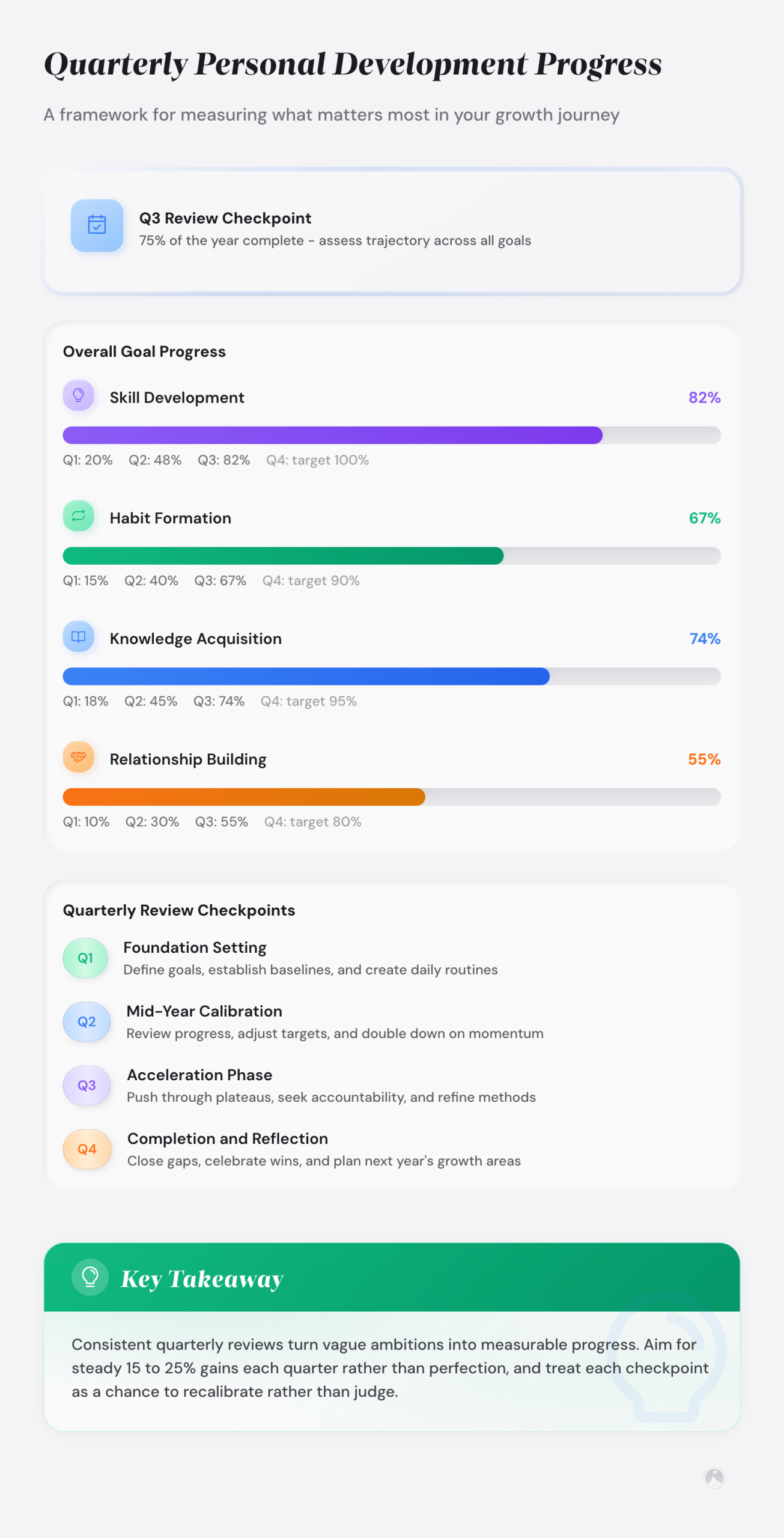
The 90-day timeframe for these reviews isn’t arbitrary. Lally and colleagues tracked habit formation across different behaviors and found that reaching automaticity took an average of 66 days, though individual results ranged widely from 18 to 254 days [9]. That falls precisely in the window where a quarterly review gives you meaningful but not complete data on whether a new behavior is taking root or stalling out.
A quarterly review has three parts. First, a progress audit: for each priority, what percentage of your 90-day milestone did you hit? Anything below 50% needs diagnosis, not abandonment. Second, a relevance check: do your top priorities still score 12+ on the Priority Filter? Life changes fast. A promotion, a new relationship, a health crisis – any of these shifts your filter scores.
Maybe public speaking now scores 14 after a role change. Maybe fitness dropped to 10 once you hit baseline consistency you’re happy with. Third, a priority refresh: run the filter again with updated self-assessment data.
Here’s the decision framework for tracking personal development progress at each review:
| Scenario | Action |
|---|---|
| Goal on track (70%+ milestone completion) | Set next 90-day milestone, increase difficulty slightly |
| Goal behind (30-70% completion) | Diagnose the blocker – was it time, skill gap, or motivation? Adjust the weekly action, not the goal |
| Goal stalled (below 30%) | Re-run the Priority Filter. If still 12+, redesign the approach. If below 12, move it to revisit list |
| New priority emerged | Score it on the filter. If 12+, swap out the lowest-scoring current priority |
Quarterly reviews prevent the two failure modes that kill most plans: grinding on goals that no longer matter, and abandoning goals that hit a temporary obstacle. The review is not extra work bolted onto the plan. It’s the mechanism that keeps the plan alive.
This review cadence connects to the broader approach of personal development strategies – building systems that self-correct rather than systems that rely on willpower alone.
The four mistakes that destroy most plans
Knowing how to create a personal development plan means nothing if you fall into these traps. Here are the failure modes worth guarding against.
Mistake 1: Building the 12-page manifesto. You spend a weekend creating an elaborate document with sections for every life domain, color-coded matrices, inspirational quotes. The plan becomes the project. A single page with your top 2-3 priorities, their SMART goals, and weekly actions is more useful than a beautiful document you never reopen.
Mistake 2: All career, no life. Most individual development plan examples online come from HR departments. They focus on professional competencies. A personal development plan that ignores health, relationships, learning outside your field, or creative outlets is incomplete. The point of “personal” versus “professional” is the personal part. If you need to guard your time for growth that isn’t on any performance review, build that boundary into the plan.
Mistake 3: No review rhythm. You create the plan in January and find it in December. Without weekly micro-reviews (5 minutes: did I do what I planned?) and quarterly macro-reviews (30 minutes: am I working on the right things?), the plan decays silently. Harkin’s meta-analysis found that tracking personal development progress at regular intervals – and physically recording it – is what separates achieved goals from forgotten ones [5].
Mistake 4: Copying a template without filtering. A personal development plan template is a starting point, not a prescription. Templates from corporate contexts assume a manager providing feedback and organizational goals shaping priorities. Self-directed plans need the Priority Filter step – nobody is assigning your development areas. Adapt the template to your reality. If you’re working on setting personal growth goals that stick, the filter is what makes the difference between borrowed goals and owned ones.
Ramon’s take
Something about the self-assessment step still bugs me. I’ve done skills inventories plenty of times but never paired them with external feedback first. Does that actually change what you end up prioritizing, or does everyone arrive at the same answers anyway?
Conclusion
Learning how to create a personal development plan that works is less about the planning tool and more about the system you build around it. Self-assessment gives you an honest starting point. The Priority Filter prevents overwhelm by forcing focus. SMART goals with behavioral proxies make fuzzy growth areas trackable. Weekly actions put the plan on your calendar. And quarterly reviews keep the whole thing alive as your life changes.
The best version of your plan hasn’t been written yet – it’s the third revision, after two quarters of real data about what actually fits your life.
The plan that changes your trajectory is not the most detailed one. It’s the one you still use on day 91.
Next 10 minutes
- List 5-8 development areas that come to mind without filtering or judging
- Score each on the Priority Filter criteria (impact, gap severity, values fit) using 1-5 scales
This week
- Complete a self-assessment covering skills inventory, values ranking, and external feedback from one trusted person
- Write one SMART goal with a behavioral proxy for your top-scoring priority
- Block 30 minutes on your calendar for the first weekly action tied to that goal
There is more to explore
If the Priority Filter revealed that your values are unclear, crafting a personal mission statement can resolve that before your next quarterly review. If your goals resist decomposition into weekly actions, the GROW framework provides a structured way to break them down. And if you’re finding it hard to sustain motivation past the first month, self-determination theory explains why autonomy and competence matter more than discipline.
Related articles in this guide
- how-to-master-the-grow-framework-a-step-by-step-guide-for-real-results
- kaizen-personal-productivity
- kaizen-vs-grow-frameworks
Frequently asked questions
What is the difference between a personal development plan and a career plan?
A career plan focuses on professional advancement within a specific field, targeting promotions, skill certifications, and role transitions. A personal development plan spans all life domains including health, relationships, creativity, and learning alongside career goals. Most individual development plan examples online are career-only, which is why personal plans need the Priority Filter to balance professional and personal growth.
How do I conduct an honest self assessment for my development plan?
Start with three parts: a specific skills inventory where you list capabilities at the task level (not category level), a values ranking where you order your top 5-7 values and check alignment with current efforts, and external feedback from 2-3 trusted people about your blind spots. Dunning’s research shows self-assessment bias is worst when competencies are vague and feedback delayed – exactly the profile of personal development goals [4].
What are realistic timelines for achieving different types of development goals?
Behavioral habit goals like reading daily or exercising consistently typically show measurable progress within 30-60 days. Skill-based goals like public speaking or strategic thinking require 3-6 months of focused practice. Identity-level shifts like becoming a better leader or communicating more assertively often take 6-12 months of sustained effort with quarterly milestone checks. Lally’s research found habit automaticity emerged at an average of 66 days, with wide individual variation (18-254 days) [9].
Should I share my personal development plan with others for accountability?
Sharing with one accountability partner produces better results than sharing broadly or keeping the plan private. Matthews’ research on goal achievement found that reporting progress to a specific person weekly increases completion rates [1]. Avoid sharing on social media, where the positive feedback for announcing goals can substitute for the satisfaction of achieving them. Research by Gollwitzer and colleagues also suggests that when goals feel identity-linked, public declaration can reduce rather than increase follow-through – so choose one specific partner rather than broadcasting widely.
How do I adjust my plan when circumstances or priorities change?
The key is to match the response to the type of change. A job change typically means re-scoring career-related priorities while leaving health and relationship priorities intact. A new child often drops all active priorities to 1-2 for 3-6 months – that’s expected adjustment, not failure. Run the Priority Filter again with your updated self-assessment data and let the scores guide which goals to pause, adjust, or retire rather than making changes based on guilt or pressure.
What tools or templates make creating a personal development plan easier for beginners?
A one-page personal development plan template with four sections works for most beginners: top 2-3 priorities (from the Priority Filter), one SMART goal per priority, weekly actions with calendar blocks, and a quarterly review date. A notes app or single spreadsheet page is sufficient. More complex tools add value only after you have maintained a basic plan for at least one full quarter.
How do I balance short term versus long term development goals in my plan?
The real tension is when a short-term win (finishing a course) conflicts with a long-term direction shift (realizing you want to change fields entirely). A practical decision rule: if your long-term priority scores differently on the filter than it did three months ago, let that score change drive the decision – not the sunk cost of work already done. Short-term actions should always be traceable back to a long-term priority. When they stop connecting, that’s a signal to re-run the filter.
What should I do if I am not making progress on my personal development plan?
Before changing course, diagnose the type of stall. Perfectionism stalling happens when the plan feels too important to start imperfectly – lower the bar until the action feels trivially easy, then scale up. Identity resistance happens when the goal conflicts with how you currently see yourself – this requires reframing the goal as exploration rather than transformation. Environmental friction happens when your surroundings actively work against the behavior – redesign your environment first, adjust the goal second. Harkin’s meta-analysis shows that physically recording progress boosts attainment [5], so adding a visible tracker often resolves the motivation dimension.
References
[1] Matthews, G. (2015). The impact of commitment, accountability, and written goals on goal achievement. Dominican University. Link
[2] Latham, G. P., & Locke, E. A. (2007). New developments in and directions for goal-setting research. Journal of Leadership & Organizational Studies, 14(1), 45-58. DOI
[3] Bracken, D. W., Timmreck, C. W., & Church, A. H. (Eds.). (2001). The handbook of multisource feedback. Jossey-Bass. ISBN: 978-0787952860
[4] Dunning, D., Johnson, K., Ehrlinger, J., & Kruger, J. (2003). Why people fail to recognize their own incompetence. Current Directions in Psychological Science, 12(3), 83-87. DOI
[5] Harkin, B., Webb, T. L., Chang, B. P. I., Prestwich, A., Conner, M., Kellar, I., Benn, Y., & Sheeran, P. (2016). Does monitoring goal progress promote goal attainment? A meta-analysis of the experimental evidence. Psychological Bulletin, 142(2), 198-229. DOI
[6] Locke, E. A., & Latham, G. P. (1990). A theory of goal setting & task performance. Prentice-Hall. Link
[7] Webb, T. L., & Sheeran, P. (2006). Does changing behavioral intentions engender behavior change? A meta-analysis of the experimental evidence. Psychological Bulletin, 132(2), 249-268. DOI
[8] Gollwitzer, P. M., & Sheeran, P. (2006). Implementation intentions and goal achievement: A meta-analysis of effects and processes. Advances in Experimental Social Psychology, 38, 69-119. DOI
[9] Lally, P., van Jaarsveld, C. H. M., Potts, H. W. W., & Wardle, J. (2010). How are habits formed? Modelling habit formation in the real world. European Journal of Social Psychology, 40(6), 998-1009. DOI