
You have read the books, so why don’t your habits stick?
You have read Atomic Habits. You have tried habit stacking. You downloaded a tracking app, set your reminders, and still watched new behaviors dissolve within two weeks. Phillippa Lally’s research at University College London found that habit formation takes a median of 66 days, not the popular 21-day myth, and that missing a single day does not meaningfully affect the automaticity curve [1]. So the problem is not your willpower. The problem is that you built individual habits without a system connecting them. Habit system design shifts the question from “How do I build a habit?” to “How do I build an architecture where habits reinforce each other?” That is the difference between stacking bricks randomly and building a wall with a blueprint. If you have ever wondered how to make habits stick long term, the answer is not more discipline. The answer is better design.Habit system design is a structured approach to behavior change that treats individual habits as interconnected components within a larger behavioral architecture, using triggers, environmental cues, and feedback loops to create routines that reinforce each other rather than competing for willpower.
What you will learn
- Why building habits in isolation almost guarantees they will collapse
- How to design behavioral loops that sustain themselves without willpower
- The 5-step habit system design process you can start this weekend
- How environment engineering reduces friction below the point where motivation matters
- What to do when your habit system breaks down
Key takeaways
- Treat each habit as a load-bearing component that triggers or supports the next behavior in your system.
- The strength of a behavioral loop depends less on how motivated you feel and more on how little friction stands between the trigger and the action.
- BJ Fogg’s research shows that reducing a behavior’s friction matters more than increasing motivation [2].
- Start your system with one keystone behavior — exercise, sleep, or journaling — that creates positive spillover across other habits.
- Variable rewards prevent the brain from adapting to predictable stimuli, sustaining engagement far longer than fixed rewards [3].
- Build a five-minute minimum viable routine that runs on your worst days to prevent full system collapse.
- Systems survive disruption through recovery protocols, not perfection.
Why do isolated habits fail so often?
Most habit advice treats each behavior as a standalone project. You pick a habit, attach a cue, choose a reward, and hope the loop holds. But a single habit floating outside a supporting structure is fragile in the same way a tent pole is fragile without the other poles holding it up. This is why habits keep failing for most people: each behavior has to sustain itself alone. BJ Fogg, the Stanford behavioral scientist behind the Tiny Habits method, argues that behavior happens when three elements converge at the same moment: motivation, ability, and a prompt [2]. When any of those elements drops below threshold, the behavior does not happen. A single habit has to generate all three elements on its own, every single day. That is a lot to ask of one behavior. A habit system solves this by making habits load-bearing for each other. Your morning coffee (an existing habit) becomes the prompt for a two-minute journaling practice. The journaling practice creates a mindset shift that makes your next behavior, a 15-minute walk, feel like a natural extension rather than a separate decision. Each behavior lowers the activation energy for the one that follows. Habit system design works by treating each behavior as a load-bearing component in a larger behavioral architecture, not as an isolated project that must sustain itself.How does behavioral loop design keep habits alive?
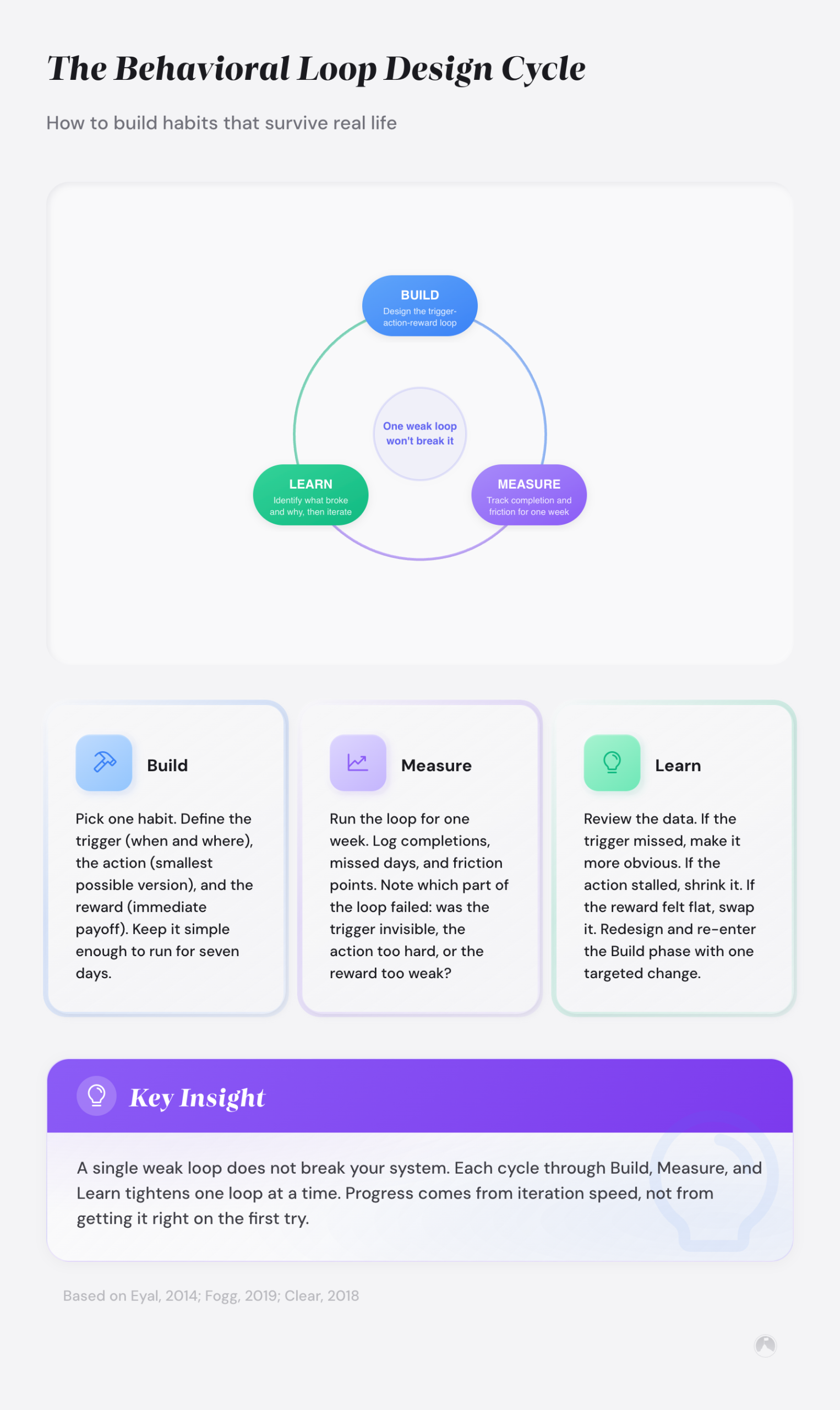
Behavioral loop design is the process of selecting specific triggers, calibrating action difficulty, and engineering rewards that create self-reinforcing cycles of behavior, moving each repetition closer to automaticity.
Habit system design in 5 steps: The behavioral integration map
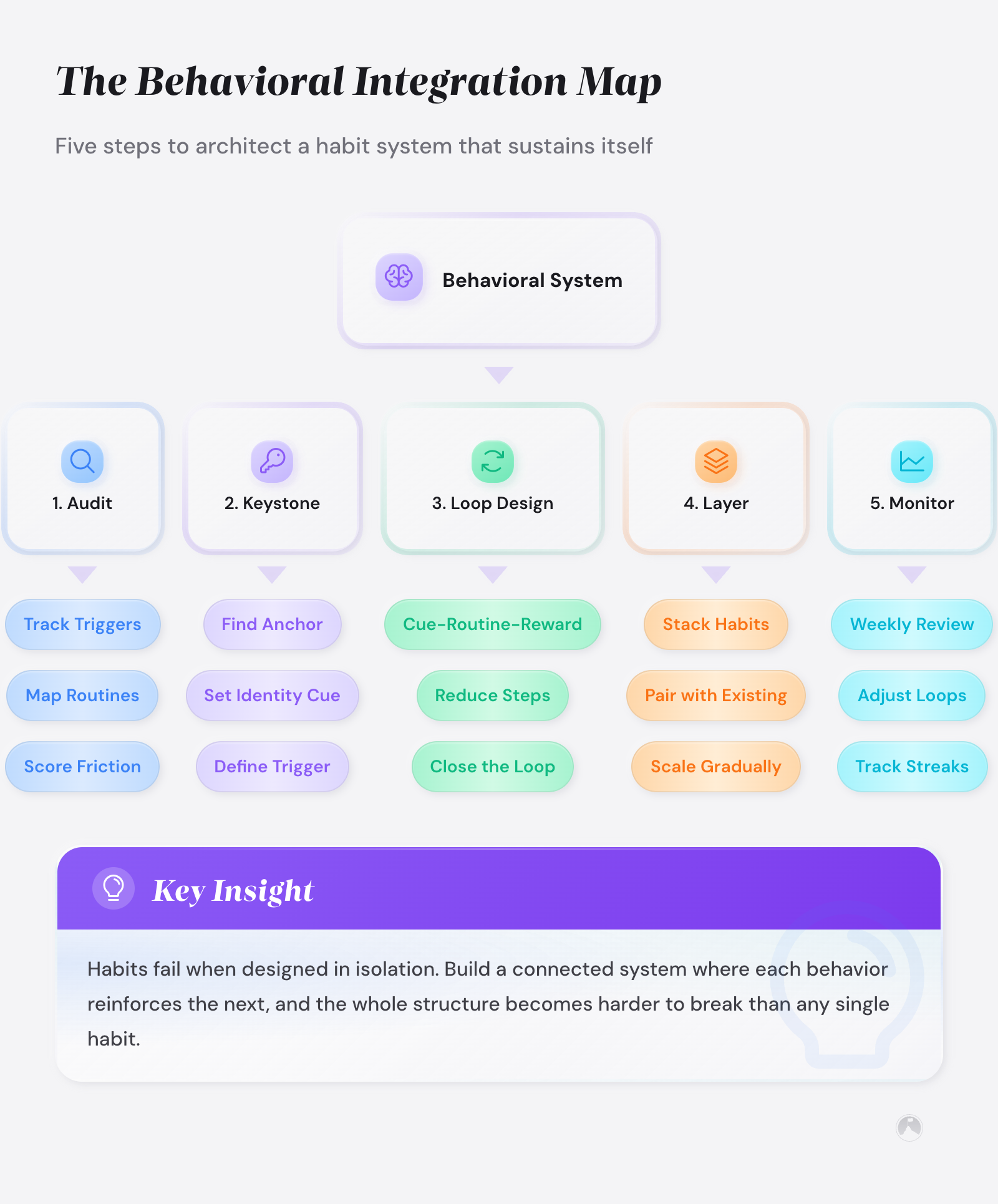
Step 1: Audit your existing behavioral infrastructure
Before adding new habits, understand the system you already run. Spend three days writing down every recurring behavior: when you wake up, when you check your phone, when you eat, when you transition between activities. The goal is not judgment. The goal is a map of your existing triggers and routines. Pay special attention to transition points – the moments between activities. The gap between “finished breakfast” and “started working” is a trigger-rich zone where new habits can slot in with minimal disruption. Here is a quick template you can use for three days. Download the full 7-day behavior audit template at goalsandprogress.com/resources for a version with built-in pattern analysis. Daily behavior audit (sample) | Time window | Current behavior | Natural trigger | Transition gap (Y/N) | |—|—|—|—| | 6:30-7:00 AM | Check phone in bed | Alarm goes off | N | | 7:00-7:15 AM | Make coffee | Getting out of bed | Y – 2 min gap before coffee starts | | 7:15-7:45 AM | Scroll news while eating | Coffee ready | Y – 5 min gap after eating | | 5:30-6:00 PM | Change out of work clothes | Walk in the door | Y – 10 min transition window |Step 2: Select your keystone behavior
Not all habits carry equal weight in a system. A keystone behavior is one that creates a cascade of positive downstream effects. Exercise, for example, is a common keystone: it improves sleep, energy, mood, and cognitive function, all of which make other habits easier to maintain. For a deeper look at identifying and building on these high-impact behaviors, see our keystone habits guide.Keystone behavior is a single habit that generates disproportionate positive spillover effects across multiple life domains, making it the strongest foundation for habit architecture creation.
Step 3: Design your trigger-action-reward loops
With your keystone selected, build the behavioral loop around it. For each habit in your system, define four components explicitly.Trigger-action-reward loop is a self-reinforcing behavioral cycle where a specific cue initiates a calibrated action, an immediate reward closes the cycle, and an investment phase increases the likelihood of the next repetition — distinguishing it from a simple habit loop by including the forward-linking investment that binds one cycle to the next.
Step 4: Layer habits using habit stacking methodology
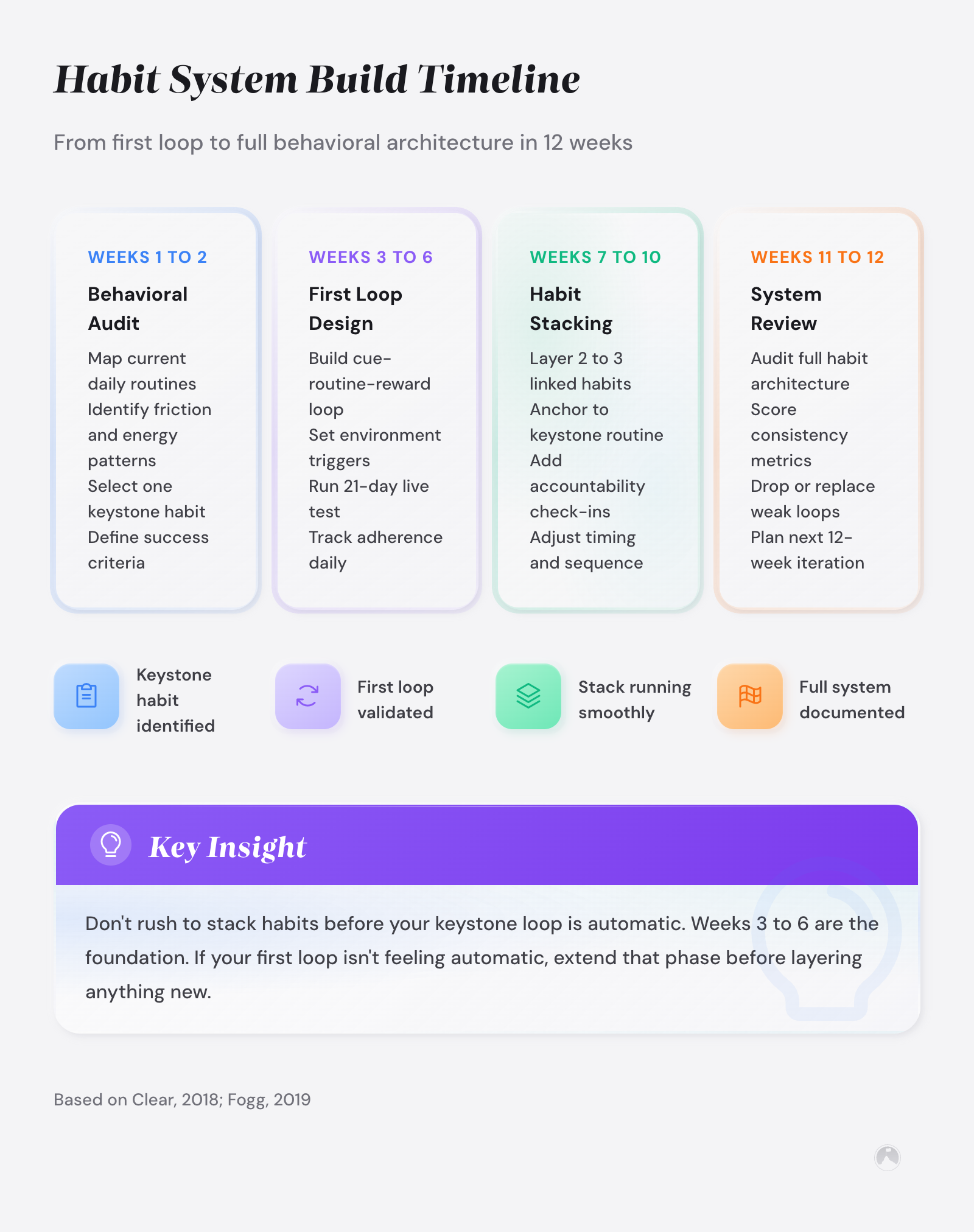
Once your keystone loop is stable (give it two to three weeks), begin layering additional habits using habit stacking for productivity. But the execution requires careful sequencing. Stack based on energy flow, not arbitrary order. Place high-effort habits (exercise, creative work) when your energy peaks and low-effort habits (gratitude logging, hydration tracking) when energy dips. Matching your habit stack to your natural energy rhythm is one form of routine automation design – letting your biology carry part of the load instead of your willpower. For more on aligning your habits to your energy cycles, see our guide on habit pairing and energy management. James Clear’s framework in Atomic Habits emphasizes that you fall to the level of your systems [4]. The stacking sequence is the system. If you are new to this approach, our guide on habit stacking for beginners walks through the basics. A common failure happens when people create chains of five or six new behaviors and expect the entire chain to hold from day one. Build in pairs. Let each pair stabilize before adding the next. Habit stacking works when each new behavior bonds to a stable, established routine underneath, not when six unproven behaviors are glued together on the same morning.Step 5: Engineer your environment to carry the load
Environment engineering for habit formation is the deliberate redesign of physical and digital spaces to reduce friction for desired behaviors and increase friction for unwanted ones, using visual cues, object placement, and context manipulation rather than relying on willpower or memory.
What happens when your habit system breaks down?
Systems break. That is not a design flaw, it is a design constraint. The real test of a habit architecture is not whether it survives perfect conditions. The test is whether it recovers from a chaotic week, a sick kid, or a project deadline that swallows three evenings. Build a minimum viable routine (MVR) as your fallback layer. Your MVR is the stripped-down version of your habit system that takes five minutes or less and preserves the identity signal without requiring full execution.Minimum viable routine is a condensed version of a habit system that preserves behavioral momentum through reduced-scope execution during disrupted days, preventing the complete collapse that triggers abandonment.
Habit system design for ADHD and unpredictable schedules
Adapting habit system design for ADHD requires external triggers and smaller minimum viable routines to compensate for executive function variability. The same design principles apply for people with ADHD or parents of young children, but with two modifications. For ADHD brains, triggers need to be external and impossible to miss: a physical object in your path, an alarm on your phone placed across the room, a visual cue taped to your bathroom mirror. Research by Vaughn and colleagues on ADHD and habit formation shows that executive function deficits – particularly working memory and impulse control – make internal prompts unreliable [7]. Fogg’s “make it easy” principle becomes even more critical here: the smaller the action, the more likely it survives a day of scattered focus [2]. For a complete guide to adapting habit systems for ADHD, see our habit building ADHD guide. Parents face a different constraint: the minimum viable routine is not optional, it is the default. Your MVR runs every day. The full system is the upgrade that happens when conditions allow it. Build your architecture around your children’s predictable rhythms (nap time, school drop-off, bedtime) rather than around clock-based triggers that toddlers routinely destroy. Our guide on habits for working parents covers more strategies for building around unpredictable schedules. The best habit system for unpredictable lives is one where the fallback version still counts as a win.Habit system readiness check
Before diving into the five steps, run this quick diagnostic against your current setup:- Do I have at least one keystone behavior that runs on autopilot?
- Is each habit in my routine triggered by the previous one (not by willpower)?
- Do I have a minimum viable routine for my worst days?
- Have I removed at least 3 friction points from my environment?
- Can my system survive missing one day without collapsing?
Ramon’s take
The teams I have worked with in medical device development that ship on time are not the ones with the best plans – they are the ones with the best recovery protocols. I apply the same thinking to my personal habits. My current setup has three tiers: the full routine (30 minutes, if the stars align), the short version (10 minutes, most days), and the “proof of life” version (drink water, write one thing I am grateful for, move my body for 60 seconds). That last one runs about twice a week, and it matters more than the full routine running perfectly.Conclusion
Habit system design reframes behavior change from a willpower test into an engineering project. Instead of asking “Am I disciplined enough?” you ask “Is my system designed well enough?” The five-step Behavioral Integration Map gives you a blueprint: audit your existing behaviors, select a keystone, design your loops, layer through stacking, and engineer your environment. Continuity beats intensity. The habit system that runs at 60% on your worst day will outperform the one that runs at 100% only when conditions are perfect.Next 10 minutes
- Write down the five most consistent behaviors in your current day (your existing infrastructure)
- Identify the transition points between those behaviors where a new habit could slot in
- Pick one keystone behavior you want to add and define its trigger, minimum action, and reward
This week
- Run a three-day behavior audit using the template above, noting every recurring routine and its natural trigger
- Design one complete trigger-action-reward-investment loop for your keystone habit and test it for seven days
- Define your minimum viable routine: the five-minute version of your system that runs on the hardest days
There is more to explore
For more on building habits that connect and reinforce each other, explore our complete guide to habit formation. If you want to understand how long it really takes to lock in a new behavior, our guide on how long it takes to form a habit breaks down the research. And if your system tends to break, our diagnostic guide on why habits fail covers the most common failure patterns and how to fix them.Related articles in this guide
Frequently asked questions
What are the key elements of a working habit system?
A working habit system requires four interconnected elements: triggers, actions, rewards, and an investment phase. The most common mistake is building all four elements for each habit independently. Instead, audit whether the reward from one habit doubles as the trigger for the next. When your system has these cross-links, missing a single behavior no longer causes a full chain collapse [3].
How can I design variable rewards into my habit system?
Variable rewards work by introducing unpredictability into the positive feedback that follows a behavior. Practical approaches include rotating between different reward types (social recognition one day, a favorite snack the next), using a reward jar with random options, or tracking metrics that fluctuate naturally like workout performance. Lyubomirsky’s research on hedonic adaptation shows that varied and surprising rewards sustain engagement longer because each novel type prevents the brain from settling into adaptation [8].
How long does it take for a designed habit system to become automatic?
A single habit reaches automaticity in a median of 66 days, but a multi-habit system adds complexity. Each new linked behavior introduces its own adaptation curve, and the system as a whole stabilizes only after its weakest link becomes automatic. Watch for the signal that a behavior no longer requires a conscious decision to start — that is the point where one loop is ready to support the next [1].
What role does identity play in habit system design?
Identity-based habit building, a concept from James Clear’s Atomic Habits, anchors behaviors to the type of person you want to become rather than the outcomes you want to achieve [4]. Instead of ‘I want to run a marathon,’ the reframe is ‘I am a runner.’ When habits are tied to identity, skipping them creates cognitive dissonance rather than simple disappointment, which makes the system more psychologically durable over time. Clear argues this identity layer is what separates temporary behavior changes from lasting ones.
How should I sequence multiple new habits within a system?
Sequence habits based on three criteria: energy demand, dependency, and stability. Place habits that require the most cognitive or physical effort during your peak energy window. Build dependent habits in order so the one that supports the next goes first. Let each new habit stabilize for two to three weeks before adding the next layer. Attempting five new habits simultaneously divides your adaptation capacity and typically results in none of them sticking.
Can I build a habit system if my daily schedule is unpredictable?
Shift workers and frequent travelers benefit from anchoring habits to portable events rather than clock times. Instead of ‘at 7 AM I will meditate,’ use ‘after my first meal of the day, I will write one sentence in my journal.’ Pair this with a minimum viable routine that travels with you — no equipment, no specific location, under five minutes. Seasonal schedule changes require a quarterly review of your triggers to confirm they still fire reliably.
Does the BJ Fogg behavior model work for breaking bad habits too?
Fogg’s behavior model applies to stopping unwanted behaviors by inverting the three elements [2]. To break a bad habit, reduce the prompt (remove visual cues), increase friction (make the behavior harder to start), and lower motivation (reframe the reward). For example, placing your phone in a different room at night removes the trigger for late-night scrolling and adds friction to the behavior simultaneously. The same environmental design principles that build good habits can dismantle unwanted ones.